I. INTRODUCTION
Fabrication of optically active glass–ceramic materials is a fairly urgent problem. This is conditioned by feasible multifunctionality of such systems (phosphors, scintillators, optical transformers, active laser elements) and the essentially simple technology of their fabrication compared to single crystal growth technology. For years, the idea of producing optically active and transparent glass–ceramic materials has remained fairly popular, and numerous attempts have been made to realize it using a wide variety of crystalline and amorphous phases.Reference Vaz de Araujo, Weber, Santos, de Silva, de Mello, Alves, de Sa and de Mello Donega1–Reference Zadneprovskiy, Sosnovtsev, Permenov, Meotishvili and Voronova6 In this work, lutetium and yttrium orthoborates were used as a crystalline part of glass–ceramic materials. Such orthoborates are well known as effective phosphors and scintillators.Reference Danilov7–Reference Mansuy, Nedelec and Mahiou9 The most efficient and convenient method of fabricating such orthoborates is the reaction of rare earth oxide powders with boron anhydride B2O3 melt at elevated temperatures.Reference Portnoy and Timofeeva10 This reaction is the basis of the processes realized in melts of boron oxides and alkaline metals, particularly in melts of tetra borax salts.Reference Dzhurinskiy, Belyakov and Tananaev11 This technique is used to obtain polycrystalline powders of individual rare earth orthborates with crystallite sizes from fractions to tens of micrometers as well as glasses with these compositions.Reference Vinogradova, Dmitruk and Petrova12–Reference Dmitruk, Petrova, Popov, Shukshin and Prokhorov14 We present the results of lutetium and yttrium orthoborate synthesis achieved by the reaction of lutetium and yttrium oxides with boron anhydride in the thin layers of the corresponding oxide glass melt. The specific reaction conditions determine the morphological and structural characteristics of the obtained glass–ceramic materials that enable using them as effective scintillators for x-ray, particle, and gamma detectors.
II. EXPERIMENTAL DETAILS
Na2O–18B2O3, K2O–2B2O3, 0.5PbO–B2O3, 0.69PbO–B2O3, 2.17PbO–0.44SiO2–B2O3 glasses were used as glass-forming media. NaNO3, K2B4O7•4H2O, H3BO3, PbO, and SiO2 compounds were used as glass components. Lutetium and yttrium oxides, activated by Ce3+ (about 1 at.%), were obtained in the mode of combustion of the metal nitrite–citric acid complexes (1:2 mol relationship) by heating to 650 °C in an electric furnace. Only high purity agents were used. The glass components together with the lutetium or yttrium oxides and a stoichiometric amount of orthoborate acid required to form these orthoborates from the given amount of the metal oxide were thoroughly ground by milling with water or ethanol in an agathic mortar. Upon evaporation of the solvent, the mixture was transferred into a ceramic crucible and annealed at 500–600 °C for 5–10 min. The thermal treatment resulted in removal of the reaction gases and boron anhydrite melting. At that stage, the product obtained was a vitreous mass, which was further ground with alcohol in an agathic mortar. The fine powder composite obtained upon evaporation of the alcohol was then deposited by sedimentation on 2 × 2 cm substrates made of fused silica or single-crystalline aluminum oxide (sapphire). The composite powder was deposited from the alcohol suspension in cylinder glasses (cups). Before deposition, the suspension volume was treated by ultrasound. The deposition process was accelerated by centrifugation. The amount of the powder deposited on the substrates was determined by weighing to an accuracy of 0.1 mg and was 2–14 mg/cm2. The powder was finally annealed at 600–1000 °C for 0.5–2 h. Further x-ray diffraction (XRD) measurements revealed that the vitreous transparent film formed on the substrate contained a yttrium (lutetium) orthoborate phase. The amount of orthoborate in the glass matrix was specified by the amount of the oxide introduced and varied from 4.9 to 52 wt%.
The phase state of the synthesized samples was studied in a D500 (Siemens, Berlin, Germany) x-ray diffractometer using monochromatic Cu Kα radiation. The morphology and sizes of the crystals were studied in a SUPRA 50VP scanning electron microscope (SEM; Carl Zeiss, Oberkochen, Germany) equipped by energy dispersive spectrometer (EDX) as well as by optical techniques. The x-ray excited luminescence spectra were investigated by a x-ray tube (accelerating voltage ∼30–35 kV, current 15 mA), a monochromator (Monospek 600; Hilger & Watts, UK), and a FEU-106 photomultiplier. The scintillation characteristics of the samples were studied in a unit consisting of a Cs137 radiation source (662 keV), a FEU photomultiplier (Hamamatsu R1306, Hamamatsu, Japan), and a single-board SBS 79 spectrometer (Green Star, Moscow, Russia).
III. RESULTS AND DISCUSSION
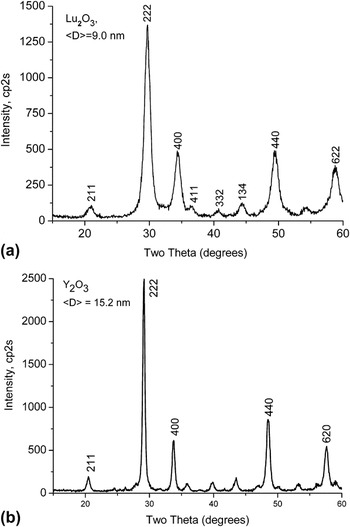
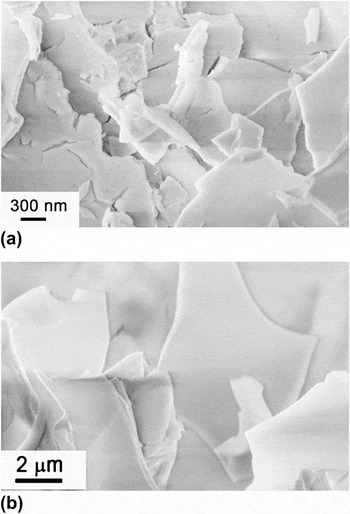
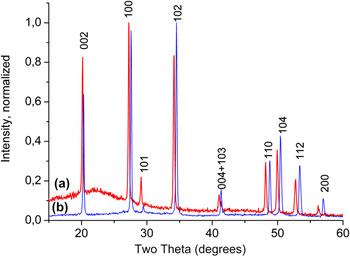
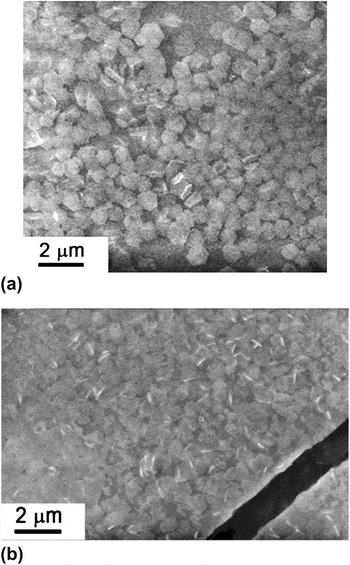
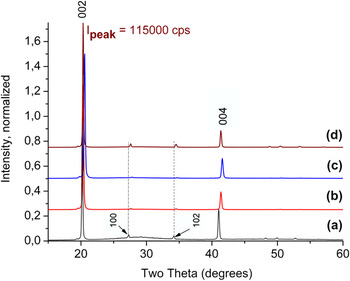
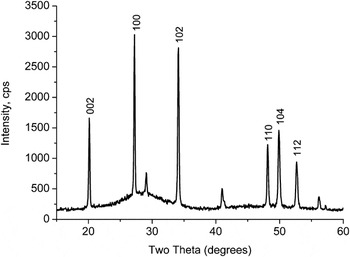
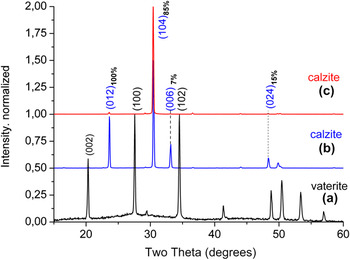
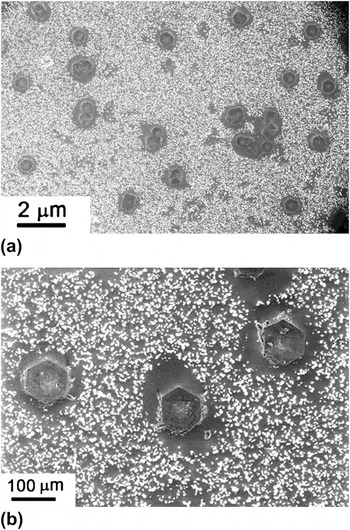
The chosen glass-forming media can be divided into three types: low-density type I (Na2O–8B2O3, K2O–2B2O3), medium-density type II (0.5PbO–B2O3, 0.69PbO–B2O3), and high-density type III (2.17PbO–0.44SiO2–B2O3). The density of types I and II glasses is less than that of the yttrium and lutetium orthoborates, and the density of the three-component glass with a high lead content exceeds that of the orthoborates. These glass groups are also essentially different by their softening points, which are 730–800 °C for type I and type II glasses and 480–500 °C for high-density glass. Besides, the viscosity of liquid glasses decreases significantly with increasing lead fraction. The use of low-melt nonviscous lead-containing glasses whose refraction index is close to that of the synthesized orthoborates enabled a fairly quick (0.5–2.0 h) fabrication of optically transparent samples at relatively low temperatures (600–800 °C). It should be emphasized that in these conditions, no appreciable dissolution of the original oxides and forming borates was observed and, hence, one could expect that the dimensional and morphological features of the original rare earth oxides would affect the similar characteristics of their borates. The x-ray phase analysis and the SEM data showed that the original oxide powders consist of fragments of flat 60–80-nm thick and several micrometer long sheets composed of oxide nanoparticles with 9 nm crystallites (Figs. 1 and 2). Synthesis of yttrium and lutetium orthoborates in type I and II glasses at 800–900 °C produces vaterite phase nanocrystallites with an isotropic orientation distribution, which is independent of the composite layer thickness (2.5–20 μm or 2–14 mg/cm2) and the orthoborate content (4.9–52 wt%). The glass–ceramic films demonstrate strong light scattering resulting in a milk-like appearance. As an example, Fig. 3 shows diffraction patterns of YBO3 with low borate content (15%) in Na2O–18B2O3 glass [spectrum (a)] and a high LuBO3 content (52%) in 0.5PbO–B2O3 glass [spectrum (b)]. In accordance with the database of the International Center for Diffraction Data, the intensity reflection distribution corresponds to the vaterite phase with S.G. P63/mmc (194), see Card 00-074-1929. Different XRD spectra are observed after synthesis of yttrium and lutetium orthoborates in high density 2.17PbO–0.44SiO2–B2O3 glass. The orientation of the formed orthoborate crystals in this case is determined by their weight fraction in the composite. It was found that when the yttrium and/or lutetium orthoborate content did not exceed 15–25 wt%, laminar orthoborate crystallites ∼60–80-nm thick with a developed surface oriented parallel to the substrate surface were formed in the temperature range of 600–900 °C irrespective of the substrate material (Fig. 4). The glass–ceramic films demonstrate high transparency for visible light. The XRD patterns of such LuBO3 and YBO3 structures for different substrates and borate weight contents are shown in Fig. 5. It is well seen that in all the spectra, the main diffracted intensity fraction is observed only in type (001) reflections corresponding to the crystal planes parallel to the substrate plane and defining the texture axis along the [001] direction. In the substrate plane, the scaly crystals show an isotropic orientation. Along with the intensive (002) and (004) texture reflections, the diffraction spectra (Fig. 5) contain also low intensity (100) and (102) reflections of the vaterite phase. Comparison of the intensity distribution of the diffraction spectra presented in Figs. 3 and 5 reveals that the low intensity reflections are related to crystallites with an isotropic orientation of the crystallographic axes in all space directions. However, the share of such crystals is incomparably less than that of the scaly depositions parallel to the substrate plane. On the other hand, the increase of the borate concentration above 15–25 wt% leads to disruption of the [001] texture and also to an isotropic distribution of the crystallites in all directions (Fig. 6). In accordance with the phase diagram of lutetium orthoborate, at high annealing temperatures (950–1000 °C), the equilibrium phase of LuBO3 is a calcite phase.Reference Levin, Robbins and Waring15, Reference Levin, Roth and Martin16 In our case, it is formed in all the glass types in the form of microcrystallites that are partially textured along the [104] direction. Figure 7 shows the diffraction patterns of the LuBO3 crystals obtained from nanosized Lu2O3 in 0.5PbO–B2O3 glass with 35% borate at different annealing temperatures. Spectrum (a) corresponds to nanocrystalline vaterite phase of LuBO3 obtained at 800 °C. The spectrum (b) corresponds to the microcrystalline calcite phase of LuBO3 obtained by further annealing of the same sample at 970 °C. Comparison of the real reflection intensity distribution in the spectrum (b) with the intensity distribution of the isotropic powder sample (shown in Fig. 7 in % close to each reflection) points to a partially textured nature of the calcite packing LuBO3 phase obtained from nanosized Lu2O3 in 0.5PbO–B2O3 glass (7 mg/cm2, 35%), at annealing temperatures 800 and 970 °C, respectively, and the calcite phase (c) obtained in 0.69PbO–B2O3 glass (10 mg/cm2, 30.5%) upon annealing of the prefabricated calcite phase at 800 °C for 1 h.
XRD pattern of (a) Lu2O3 and (b) Y2O3 powders used.

SEM micrograph of (a) Lu2O3 powder and (b) Y2O3 obtained by combustion of lutetium and yttrium nitrite–citric acid complexes.

XRD patterns of vaterite phases obtained in type I and II glasses. (a) 15 wt% YBO3 in Na2O–18B2O3 glass, 6 mkm, 800 °C, 1 h; (b) 50 wt% LuBO3 in 0.5PbO–B2O3 glass, 14 mkm, 800 °C, 1.2 h.

SEM micrograph of textured [001] vaterite nanocrystals. (a) LuBO3 obtained at 800 °C for 0.5 h in 2.17PbO–0.44SiO2–B2O3 glass (13 mkm, 6.3 wt%), on sapphire substrate; (b) YBO3 obtained at 800 °C for 0.5 h in 2.17PbO–0.44SiO2–B2O3 glass (11 mkm, 7.0 wt%), on silica substrate.

XRD patterns of vaterite phases obtained for 1 h at 800 °C in 2.17PbO–0.44SiO2–B2O3 glass with: (a) 8.5 wt% YBO3 (sapphire substrate); (b) and (c) 7 wt% LuBO3 on sapphire and melt quartz substrates, respectively; and (d) 25 wt% LuBO3 on sapphire substrate.

XRD pattern of vaterite YBO3 phase obtained upon annealing for 2 h at 800 °C in 2.17PbO–0.44SiO2–B2O3 glass with orthoborate content 52 wt% (5.3 mg/cm2).

XRD patterns of (a) vaterite and (b) calcite LuBO3 phase obtained from nanosized Lu2O3 in 0.5PbO–B2O3 glass (7 mg/cm2, 35%), at annealing temperatures 800 and 970 °C, respectively, and (c) calcite phase, obtained in 0.69PbO–B2O3 glass (10 mg/cm2, 30.5%) upon annealing of prefabricated calcite phase at 800 °C for 1 h.

The microcrystalline character of the calcite phase is confirmed by a significant decrease of the reflection half width: ∆(2θ) = 0.256° (D ≈ 35 nm) for the vaterite (100) reflection of the sample annealed at 800 °C and ∆(2θ) = 0.083° (D > 100 nm) for the calcite (104) reflection of the sample annealed at 970 °C. The crystallite sizes were estimated by the Scherrer’s formula.Reference Seljakov17 The formation of the orthoborate microcrystallites is explained by the significant solubility of yttrium and lutetium oxides in the glasses at elevated temperaturesReference Dzhurinskiy, Belyakov and Tananaev11 and, as a result, facilitated crystallization processes. Upon prolonged high temperature annealing, orthoborate microcrystals can reach significant sizes due to absorption of smaller particles (Fig. 8).
SEM micrographs of LuBO3 microcrystals grown in 0.5PbO–B2O3 glass (9 mg/cm2, 35.8%) at 970 °C. (a) 0.5 h and (b) 3 h.

It is notable that if glass–ceramic composites are produced from glass components and micropowder of prefabricated calcite orthoborate, then even at annealing temperature of 800 °C, the samples reveal a pronounced microcrystalline calcite modification with a texture axis coinciding with the [104] direction. And, as in the case of scaly deposition of the vaterite YBO3 and LuBO3 phase, the glass matrix involves a small fraction of the polycrystalline (nonoriented) calcite phase (Fig. 7). Therefore, lutetium and yttrium orthoborate synthesis by the reaction of their oxides with boron anhydride in thin layers of lead borate oxide glass melt solutions revealed formation of a well-pronounced texture along the substrate normal and isotropic nano- and microcrystal orthoborates in the substrate plane. Such nanocrystallite structures of vaterite lutetium and yttrium orthoborates are formed at 600–900 °C only in high-density low-viscosity lead borate oxide glass 2.7PbO–0.4SiO2–B2O3 with lutetium and yttrium content not exceeding 15 and 25 wt%. It can be assumed that in types I and II glasses and at a high borate concentration in type III glass, the crystals obtained cannot form oriented structures owing to either their limited mobility or the high glass viscosity, or the high density crystalline packing of the glass matrix. Formation of oriented microcrystalline lutetium and yttrium orthoborate structures in the calcite phase does not depend on whether the orthoborate has been produced from oxide nanoparticles or introduced into the glass as prefabricated orthoborate microcrystals in the calcite phase. In this case, the orthoborate weight content is not decisive.
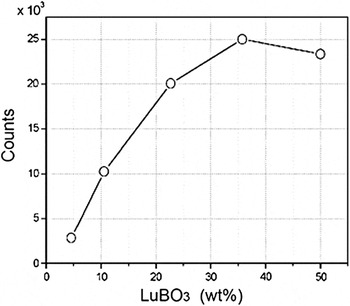
The obtained thin layers of glass–ceramic materials with pseudo-monocrystalline optical properties can be of practical use as luminescent and scintillation detectors for radiation monitoring of x-rays, of β-particles, and γ-emission. We have measured the luminescent and scintillation characteristics of the glass–ceramic samples involving activated Ce3+ lutetium and yttrium orthoborates and compared them with the similar characteristics of the 0.6-mm-thick CsI(Tl) single crystal plate. We have also measured the integral x-ray luminescence light yield and the amount of light pulses per time unit excited in the sample by a Cs137 (662 keV) source as a function of glass composition, the thickness of the glass–ceramic layer, and the phosphor weight content. The efficiency of the scintillator was mainly determined by layer thickness and orthoborate content. Figure 9 shows the number of light pulses per second occurring in a 13–15 mkm glass–ceramic layer as a function of vaterite LuBO3 (1% Ce) weight content in 2.17PbO–0.44SiO2–B2O3 glass. It is seen that with the lutetium orthoborate content exceeding 20–25 wt%, the linear increase of the number of scintillations is over and there appears a tendency to saturation and further decrease with increasing luminophor content. This effect may be due to the texture disturbance in the crystal packing of lutetium orthoborate and its above-mentioned high content in the glass matrix
Number of oscillations as a function of vaterite LuBO3 (1% Ce) weight content in 2.17PbO–0.44SiO2–B2O3 glass with a 13–15 mkm glass–ceramic layer.

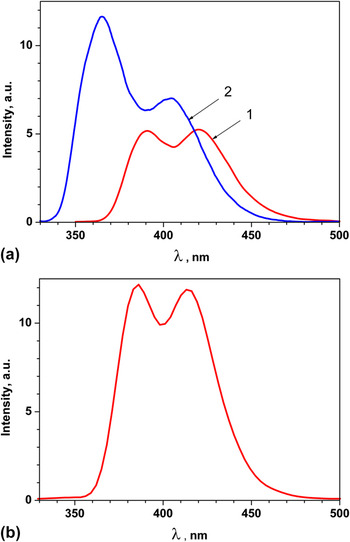
Figure 10 shows the x-ray luminescence spectra of the vaterite and calcite LuBO3(Ce) phases (a) and the vaterite YBO3(Ce) phase (b) in glasses. The vaterite luminescence maxima LuBO3(Ce) are at λmax ∼ 390 and 420 nm, and the calcite maxima are at λmax ∼ 365 and 407 nm. The vaterite luminescence maxima YBO3(Ce) are at λmax ∼ 386 and 414 nm. As it is known,Reference Zadneprovskiy, Sosnovtsev, Permenov, Meotishvili and Voronova6 emission in these bands is initiated by emitting transitions 5d → 2F5/2 and 5d → 2F7/2 in Ce3+. The luminescence of the calcite phase is twice as intensive as that of the vaterite lutetium borate phase. These results agree with our previously published data on x-ray luminescence of powders of both phases of pure LuBO3(Ce) powder synthesized by the sol–gel technique.Reference Klassen, Shmurak, Shmytko, Strukova, Derenzo and Weber18 It points to the absence of the influence of the lead borate oxide medium on the x-ray-initiated electron processes in phosphor crystals.
(a) X-ray luminescence spectra of the (1) vaterite and (2) calcite LuBO3(Ce) (1% Ce) phases in 0.69Pb0–B2O3 glass with a 14–16 mkm glass–ceramic layer and orthoborate content of 30.5 wt%; (b) x-ray luminescence spectra of the vaterite YBO3 (1%Ce) phases in 2.17PbO–0.44SiO2–B2O3 glass with a 9.0 mkm glass–ceramic layer and orthoborate content of 52 wt%.

The integral x-ray luminescence light yield of the 15 mkm thick glass–ceramic sample with a 30.5 wt% content of the LuBO3 (1%Ce) phase was 7% of the light yield of the CsI(Tl) single crystal plate, and the efficiency of the scintillator made up 25% of the CsI(Tl) efficiency. The data obtained suggest the applicability of lead borate oxide glasses as binding material in fabrication of efficient thin layer glass–ceramic phosphors and scintillators based on activated Ce3+ lutetium and yttrium orthoborates.
IV. CONCLUSIONS
A strong orienting effect of thin solution melt layers of some lead borate oxide glasses on lutetium and yttrium orthoborate crystals has been discovered. The effect was found to manifest itself as a well-pronounced texture along the substrate normal and isotropic nano- and microcrystal orthoborates in the substrate plane. Such nanocrystalline structures of vaterite lutetium and yttrium orthoborates are formed at 600–900 °C only in high-density low-viscosity lead borate oxide glass 2.7PbO–0.4SiO2–B2O3 with lutetium and yttrium content not exceeding 15 and 25 wt%. Pronounced calcite lutetium and yttrium orthoborate microcrystalline textures are realized no matter whether the orthoborate has been formed by oxide nanoparticles as a result of annealing or introduced into the glass as as-prepared orthoborate microcrystals in the calcite phase. The produced glass–ceramic films of YBO3 and LuBO3 activated by Ce3+ atoms with a highly oriented texture have good transparency for visible light and demonstrate excellent scintillation and x-ray luminescence characteristics. Therefore, they can be used as efficient x-ray phosphors and scintillators.
ACKNOWLEDGMENTS
The work was supported by the Quantum Physics of Condensed Matter Research Program of the Russian Academy of Sciences (Grant No. 10.32) and RFBR Project No. 12-03-00454-a.