Introduction
Head and neck cancer is the eighth most common cancer in the UK, accounting for 3 per cent of all new cancer cases (2017).1 The coronavirus disease 2019 (Covid-19) pandemic has had a significant effect on the management of cancer patients in the UK, and otolaryngologists and head and neck surgeons around the world have been forced to make changes to their method of practice.Reference Warner, Scholfield, Adams, Richards, Ali and Ahmed2–5 The two-week wait pathway for the referral of head and neck cancer patients by general physicians was also affected by these changes. An attempt was made to rapidly implement a remote triaging system for the assessment of head and neck cancer referrals utilising the Head and Neck Cancer Risk Calculator version 2 (‘HaNC-RCv2’).Reference Tikka, Kavanagh, Lowit, Jiafeng, Burns and Nixon6,7 The use of remote triaging on a large scale has not been used previously and, hence, only limited data are available on the various aspects of such a system.7
Objectives
The study objectives were: (1) to analyse the risk stratification of two-week wait referrals and their outcomes from telephone triage; (2) to evaluate the subsequent outcome of the referrals from an oncological point of view; and (3) to compare our local performance vis-à-vis the interim report of the ENT UK Integrate (The National ENT Trainee Research Network) Head Neck Cancer Telephone Triage Service Evaluation.
Materials and methods
Patient selection
The inclusion criteria were two-week wait referral patients in the consultant author's clinic who were telephone triaged between 6th April 2020 and 22nd June 2020.
Regarding exclusion criteria, patients were excluded from further analyses if they fulfilled any of the following criteria: they had a known previous malignancy including head and neck malignancy; they were unreachable by telephone; had sought treatment elsewhere; the symptoms had resolved by the time of consultation; the symptoms were not relevant for head and neck two-week wait referral; or there was an absence of detailed data in the clinicians’ notes.
Ethical considerations
The study involved the auditing of retrospective data already available on our hospital patient management system. The data were accessed only by clinicians directly involved in the patients’ care. As the data reported by the clinicians in the clinical notes did not deviate from standard practice, no special approval was sought for the study.
Data collection and analysis
Data were collected in an MS Excel® spreadsheet modelled on the Symptom Based Head and Neck Cancer Risk Calculator version 2.Reference Tikka, Kavanagh, Lowit, Jiafeng, Burns and Nixon6,8 Risk stratification based on the score from the online calculator was used to group the patients into low risk (less than 2.2 per cent), moderate risk (2.2–7.09 per cent) and high risk (more than 7.1 per cent), as recommended. The data collected were further analysed using statistical software from the Jamovi Project.9 For analysis that required binary classification, the low- and moderate-risk groups were clubbed together, with the high-risk group remaining as a separate group. Online statistical calculators were also used when required.10
The outcome from an oncological point of view assumed that a patient who had been investigated and/or reviewed, and was subsequently discharged (with or without medical treatment) without cancer detection, was cancer free for the purpose of analyses.
Results
A total of 93 patients referred to the head and neck two-week wait service were remotely triaged by telephone consultation in the period under consideration. None of the virtual consultations where we could connect with the patient were refused by them. The overwhelming majority of patients understood the reasons for the remote consultation. Twenty-nine patients (31.2 per cent) were excluded as per the exclusion criteria, leaving 64 patients (68.8 per cent) in the study. Based on the scoring from the Head and Neck Cancer Risk Calculator version 2, the patients were risk-stratified into low-risk (51.6 per cent, 33 of 64), moderate-risk (14.1 per cent, 9 of 64) and high-risk (34.4 per cent, 22 of 64) groups (Table 1).
Telephone triage outcome as per risk stratification

Data represent numbers and percentages of cases
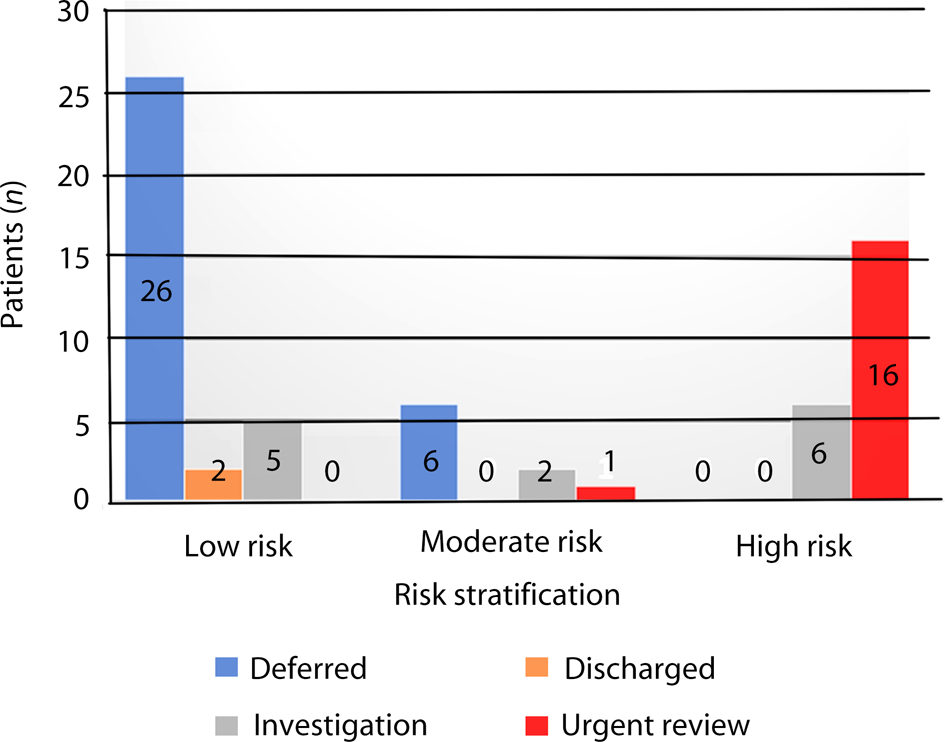
The telephone triage outcomes were classified into deferred appointments, discharges, investigations advised and urgent face-to-face reviews. The majority of low-risk (78.8 per cent, 26 of 33) and moderate-risk (66.7 per cent, 6 of 9) patients were given a deferred appointment, while most of the high-risk patients (72.7 per cent, 16 of 22) were called for urgent review face-to-face. This outcome from telephone triage was statistically significant (chi square test p < 0.001). The number of patients sent for investigations directly from telephone triage was 5 (15.2 per cent) for the low-risk group, 2 (22.2 per cent) for the moderate-risk group and 6 (27.3 per cent) for the high-risk group. Overall, the majority of patients were given deferred appointments (50 per cent, 32 of 64), followed by urgent review (26.6 per cent, 17 of 64) and investigations (20.3 per cent, 13 of 64) (Table 1 and Figure 1).
Telephone triage outcome as per risk stratification.

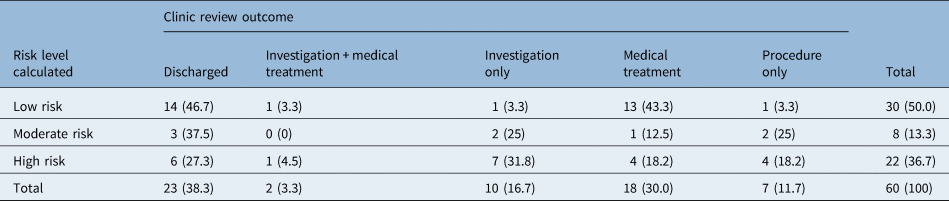
Sixty patients had a clinic (face-to-face) consultation; of the total 64 patients, 2 patients were discharged during telephone triage and 2 others were discharged following investigations arising from the telephone triage. The outcomes were classified as: discharged (38.3 per cent, 23 of 58), investigation plus medical treatment (3.3 per cent, 2 of 58), investigation only (16.7 per cent, 10 of 58), medical treatment only (30.0 per cent, 18 of 58), and procedure only (11.7 per cent, 7 of 58). Most low-risk patients were either discharged (46.7 per cent, 14 of 28) or treated medically (43.3 per cent, 13 of 28), while half of the high-risk patients proceeded to undergo further investigations (31.8 per cent, 7 of 22), or procedures such as excision biopsy (18.2 per cent, 4 of 22). Of the high-risk patients, 27.3 per cent (6 of 22) were discharged without further management, while 18.2 per cent (4 of 22) were discharged with medical treatment (Table 2).
Clinic review outcome as per risk stratification

Data represent numbers and percentages of cases
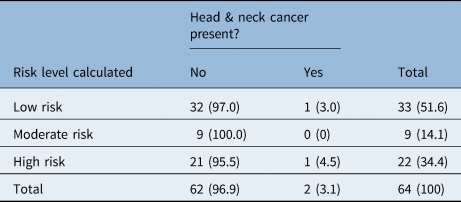
Regarding the final oncological outcome, 96.9 per cent of patients (62 of 64) were considered free from head and neck cancer, while 3.1 per cent (2 of 64) were found to have a malignant head and neck lesion. One of the patients in the former group, who was categorised as moderate risk, was subsequently found to have a lung malignancy, and not a head and neck malignancy for which the calculator was specifically designed. Of the two patients found to have head and neck cancer, one patient had been in the low-risk category while the other was in the high-risk group. However, as the low-risk patient was sent for an investigation based on symptoms, a delay in management was avoided, showing the added importance of using clinical judgement in all cases. For most of the patients across the groups, no malignancy was detected, and they were assumed to be cancer free at the time of consideration (Table 3).
Oncological outcome as per risk level stratification

Data represent numbers and percentages of cases
It has been estimated that, at the end of 2010, there were around 62500 people in the UK with detected head and neck malignancies.1 The prevalence of head and neck malignancy was thus calculated to be 0.1 per cent, with the estimated population in 2010 being about 62.5 million people.11 This rate was used in subsequent calculations that are dependent on prevalence numbers. For calculation of evaluation statistics, the low- and medium-risk groups were clubbed together to enable calculation with binary data.
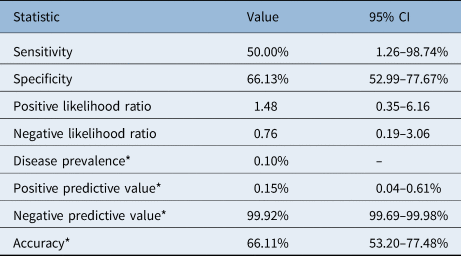
The sensitivity and specificity of using the Head and Neck Cancer Risk Calculator version 2 were calculated as 50.00 per cent and 66.13 per cent respectively. The negative predictive value was 99.92 per cent and the accuracy (i.e. the probability that a patient is correctly classified) was calculated as 66.11 per cent (Table 4). The area under the curve value of the receiver operating characteristic curve was 64.5 per cent.
Calculation of evaluation statistics

*Values are dependent on disease prevalence. CI = confidence interval
Analysis of the accuracy of the remote triaging system was performed at least six months after the original triage (mean interval = 164 ± 23.2 days). No patient deemed to have ‘no cancer’ was subsequently found to have a head and neck malignancy.
• A remote triaging system has been recommended for assessing head and neck cancer referrals utilising the Head and Neck Cancer Risk Calculator version 2
• Limited data are available on the use of this system
• This study was conducted to analyse various aspects of using the Head and Neck Cancer Risk Calculator version 2 in clinical practice
• Although it is reasonable to use the calculator for triaging, it must always be accompanied by a meticulous clinical thought process
Discussion
The Covid-19 pandemic has resulted in otolaryngologists and head and neck surgeons facing unprecedented challenges, with little relevant evidence-based data to base decisions upon. An attempt to rapidly implement a remote triaging system for the assessment of head and neck cancer referrals utilising the Head and Neck Cancer Risk Calculator version 2 was suggested by ENT UK.12 The initial reports of calculator use across the UK were encouraging.13 This study was conducted to analyse the effects of utilising the recommended risk calculator in the two-week wait referral clinics in our institution.
Sixty-four patients were included in the study after considering the inclusion and exclusion criteria. The initial recommendation was to categorise the patients according to two risk groups, low and high, but the low-risk group was subsequently subdivided into low- and moderate-risk groups.12
As expected, most of the referred patients scored as low risk (65.7 per cent, 42 of 64, considering low- and moderate-risk groups), which was similar to the nationally reported rate (70 per cent, 1069 of 1528).13 Following telephone triage, only 26.6 per cent of patients (17 of 64) were called for urgent review, and a further 20.3 per cent of patients (13 of 64) were sent for investigations. Hence, 53.1 per cent of patients (34 of 64) avoided an urgent hospital visit, which is similar to the rate of 57.4 per cent reported nationally.13
Of the patients, 3.1 per cent (2 of 64) were determined to have a head and neck malignancy, which is lower than the reported national figure (6.6 per cent). The pending outcomes in the national report (54.7 per cent, 348 of 646) may be responsible for the discrepancy,13 as these outcomes are more likely to represent the patients deferred for being lower risk, presumably with a lower probability of having head and neck cancer.
The encouraging result from our study was the high negative predictive value for the calculator (99.92 per cent), the use of which has been emphasised in the literature and in recommendations by professional bodies.Reference Tikka, Kavanagh, Lowit, Jiafeng, Burns and Nixon6,7 However, the detection of malignancy in one patient in the low-risk group emphasises the continued need for clinical discretion in all cases. In addition, the detection of a non-head and neck malignancy in another patient shows that we must think about the patient as a whole rather than a sum of different parts. Reassuringly, our finding of 3.1 per cent malignancy is in line with the relatively low rates reported in systematic reviews, which have shown that the pooled cancer detection rate is between 8.8 per cent and 11.1 per cent.Reference Langton, Siau and Bankhead14,Reference Kumar, Drinnan, Mehanna and Paleri15 In the absence of other tested and validated alternatives, the Head and Neck Cancer Risk Calculator version 2 seems to be a satisfactory method for rapid telephone triaging of suspected head and neck malignancy patients, as the vast majority of referrals may be safely triaged to receive a deferred assessment.
The prevalence of malignancy in our study population was 3.1 per cent (2 of 64). This rate is high compared to the reported Cancer Research UK rate of 0.1 per cent.1 This could be explained by the overall impression of an increasing incidence of head and neck cancers.Reference McCarthy, Field, Rajlawat, Field and Marcus16 The Cancer Research UK data were gathered prior to 2011, whereas ours is current. Both patients found to have malignancies had p16 positive oropharyngeal primaries, reiterating the increasing incidence of these tumours.Reference McCarthy, Field, Rajlawat, Field and Marcus16
Significance of this work
This study will help in further waves of the current pandemic and possibly future pandemics too. It is feared that there is an increased chance of zoonotic infections affecting humans given the adverse environmental impact of human activities, such as encroaching on animal habitations and considering exotic animals as culinary delicacies. Use of the calculator, with its high negative predictive value, will help guide primary care to refer patients promptly to the two-week wait service in cases of high scores, but will stagger referrals for patients with low scores.
Utilisation of the calculator will ensure that referrals to secondary care or regional cancer centres are appropriate, and will prevent the two-week wait service from becoming overwhelmed. Specifically, this is because: (1) general practitioners are increasingly carrying out remote consultations, meaning that patients are first ‘seen’ only after being referred to a specialist; (2) it is possible that there will be insufficient specialists in the cancer service in the event of one of the core members having to self-isolate; and (3) there will not be adequately ventilated clinic rooms available to see patients in a timely manner within scheduled clinic hours, resulting in the dependence on ‘out-of-hours’ or weekend waiting list initiatives, with accompanying challenges.17
This triaging system is also in line with the recommendations of ENT UK, and is presently open for further assessment, with invitations for international collaborations.Reference Paleri, Hardman, Tikka, Bradley, Pracy and Kerawala18
In terms of adhering to government guidelines and respecting evolving scientific evidence, and bearing in mind the R nought (R0) figure (which predicts how many people each infected person will infect on average), this system could reduce hospital attendance by triaging out low-risk patients, to protect clinicians and hospitalised patients, while still allowing timely investigations on those deemed to be at higher risk. Additionally, the National Health Service guidance for managing referrals with cancer during the Covid-19 pandemic recommends telephone triage to minimise health service interactions and appointments, and the streaming of patients for investigations where appropriate. A telephone appointment with a specialist clinician is accepted as a first appointment for the purposes of recording cancer waiting times for new referrals.19
Limitations
The sample size was small, with final data available in 64 out of a total of 93 patients from the original triage. Reasons for exclusion included known previous malignancy such as head and neck malignancy, the patient being unreachable on the telephone, symptom resolution at the time of consultation, symptoms not relevant for head and neck two-week wait referral, the patient had sought treatment elsewhere, and the absence of detailed data in the clinician's notes. While some of these causes are inevitable, extra care should be taken to ensure the proper documentation of clinical data and to avoid inappropriate referrals to this pathway, in order to mitigate the avoidable exclusions.
Our study had a sensitivity of 50.00 per cent (95 per cent confidence interval (CI) = 1.26–98.74 per cent) and a specificity of 66.13 per cent (95 per cent CI = 52.99–77.67 per cent), with an area under the curve value of 64.5 per cent. These values are lower in comparison to those obtained by proponents of the calculator (sensitivity of 85 per cent and specificity of 78.3 per cent, and area under the curve value of 88.6 per cent), which may be a result of the comparatively smaller numbers in our study.Reference Tikka, Kavanagh, Lowit, Jiafeng, Burns and Nixon6
Future research
Although it requires a long time, evaluation of the effectiveness of such a rapid telephone triage system needs a larger sample size with multi-centre data, as suggested by Paleri et al.Reference Paleri, Hardman, Tikka, Bradley, Pracy and Kerawala18 The sample could also be extended to include cancer patients on long-term follow up, who may be stratified based on the optimum interval between follow-up consultations. Efforts such as the ENT UK Head and Neck Cancer Telephone Triage (Integrate)7 will certainly go a long way in ensuring further development of such policies.
Conclusion
Usage of the Head and Neck Cancer Risk Calculator version 2 and its subsequent evaluation will remain a continuous process in the days to come, as cumulative data are analysed and probable adjustments made to increase its accuracy further. With the possibility of subsequent waves of Covid-19, and, with initial experience from the calculator being satisfactory, it is reasonable to use the calculator for triaging purposes. However, expertise in clinical decision-making has no substitute and the use of such calculators must always be accompanied by a meticulous clinical thought process to avoid missing obvious diagnoses.
Competing interests
None declared