Introduction
Malnutrition is a state of poor nutrition that includes undernutrition as well as overnutrition. In South Asian countries, generally one in three people is malnourished in one way or another (IFPRI, 2015). Malnutrition results from poor diet quality, health care environments and behaviours, which are shaped by a host of underlying factors such as political instability, low economic development, conflict, inequality and dimensions of globalization.
Over the last 20 years, it has been seen that the double burden of malnutrition, where overweight and obesity exist alongside undernutrition, has increased the incidence of diet-related non-communicable diseases. In 2015–16 the prevalence of overweight and obesity among South Asian women was found to be almost the same as that of underweight (NCD-RisC, Reference NCD-Ris2016), and in India, the percentages of undernutrition and overnutrition were also not so different. The reason for overnutrition in India is that 80–85% of the population use processed foods (package foods, baked foods, noodles etc.), i.e. they are consuming greater amounts of energy-dense foods than micronutrient-rich foods due to rapid urbanization, income growth and constraints on women’s time. High rates of pre- and post-natal mortality, and higher risk of low-birth-weight babies, still-births and miscarriages are some of the consequences of undernutrition among women (Ramachandran, Reference Ramachandran1989; Rotimi et al., Reference Rotimi, Okosun, Johnson, Owoaje, Lawoyin, Asuzu and Kaufman1999). Hence, the study of nutritional status among women is important both to improve the quality of their own lives, and to increase the survival and healthy development of their children (Obaid, Reference Obaid2004).
Another consequence of nutritional deficiency is anaemia, which is caused by a low concentration of haemoglobin in the blood. About one-third of the global population (over 2 million) is anaemic. India has the highest level of anaemia in the world (65–75%) (DeMayer et al., Reference DeMayer and Adiels-Tegman1998). During 2004–05, it was roughly 57.0% (NFHS-3). In India, the predominant cause of anaemia is iron deficiency, but micronutrient deficiency (Shivakumar et al., Reference Sivakumar, Nair, Sreeramulu, Suryanarayana, Ravinder and Shatrugna2006) and Vitamin A deficiency (Mohanram et al., Reference Mohanram, Kulkarni and Reddy1977) are also significant. It may also be caused by other factors such as malaria or hookworm infection, genetic disorders like sickle cell anaemia, thalassaemia, loss of blood during delivery, heavy menstrual blood flow, diarrhoea and HIV/AIDS.
In a holistic study, it is obvious that individual nutritional status is dependent on social, biological, environmental and cultural factors. In the context of food scarcity, women are more vulnerable to nutritional deficiency than men. One of the reasons for this is that women eat last and least throughout their whole lives, which is the age-old tradition in India. Due to this tradition, women in poor or low socioeconomic groups are more affected by nutritional deficiency than men. On the other hand, women in better socioeconomic groups are more likely to become obese than men due to the availability of food, along with their lack of knowledge on balanced diets as a result of low level of education, cultural discrimination and limited mobility (Garn, Reference Garn1986; Sen, Reference Sen1988; Basu, Reference Basu1989; IASC, Reference IASC2005). In this context, it seems appropriate to quote from Deaton and Dreze (Reference Deaton and Dreze2009) that ‘the nutrition situation in India is full of puzzle’.
The major objectives of this study were thus to (i) assess the prevalence of malnutrition and anaemia among Indian women over different states and zones; and (ii) establish the relationship between malnutrition and anaemia with different socio-demographic variables and eating habits.
Methods
Data source
The study was based on cross-sectional unit-level data from the latest National Family Health Survey (NFHS-4) conducted in 2015–16 by the International Institute for Population Sciences (IIPS). The NFHS-4 sample covers 699,683 Indian adult women, living in 30 states and 6 Union Territories. The sample in the present study consisted of 651,642 non-pregnant women aged 15–49 years. The reduction in the sample size was due to removal of outlying observations and the age restriction.
Variables
The dependent variables were ‘nutritional status’, as defined by body mass index (BMI), and ‘anaemia status’. The WHO (1998) classification was used to define nutritional status by BMI (kg/m2): underweight: <18.5; normal weight: 18.5–24.9; overweight: 25.0–29.9; obese: ≥30.0.
For anaemia testing, blood specimens from eligible women aged 15–49 were taken from a finger prick and collected in a microcuvette. Haemoglobin analysis was conducted on-site with a battery-operated portable HemoCueHb 201+ analyser. Respondents were considered to have anaemia if their haemoglobin level was below 12g/dl.
The independent variables were type of place of residence (rural, urban), level of education (illiterate, primary, secondary, higher), religion (Hindu, Christian, Muslim, Other), eating habits (whether eats milk/curds, pulses/beans, leafy vegetables, fruit, animal protein or aerated drinks) and family wealth index. The wealth index was measured based on household assets and facilities. Households were given scores based on the number and kinds of consumer goods they owned, ranging from a television to a bicycle or car, and housing characteristics such as source of drinking water, toilet facilities and flooring materials. These scores were derived using principal component analysis. National wealth quintiles were compiled by assigning the household score to each usual (de jure) household member, ranking each person in the household population by their score, and then dividing the distribution into five equal categories, each with 20% of the population. The calculation of the wealth index was made by IIPS itself and was contained in the data supplied.
Analysis
The data were checked for outliers using an informal technique (Dunn & Clark, Reference Dunn and Clark1974) to identify abnormal BMI and anaemic values based on a scatter diagram, and some subjects were removed from the analysis because their data may have affected the results (Godfrey, Reference Godfrey1992; Stevens, Reference Stevens1996). To establish the relationship of nutritional and anaemic status with different socio-demographic variables and eating habits, univariate and bivariate analyses were performed.
Categorical logistic regression analysis was carried out to see the simultaneous effects of covariates on different dependent variables. The dependent variables were dichotomous. Specifically, while carrying out the logistic regression, underweight women were given the value 1 and all others 0; overweight or obese women were given the value 1 and all others 0; and anaemic women were categorized as 1 and the rest as 0.
The reference categories for the independent variables were ‘rural’ residence, ‘illiterate’ educational status and ‘Hindu’ religion. In the case of eating habits, ‘not consuming’ was the reference category. Lastly ‘the poorest & the poorer’ combined category of wealth index was taken as the reference category. The SPSS version 18.0 was used for all analysis. Significance levels (p-values) were calculated to see the degree of effect of each variable on underweight and overweight or obesity.
Results
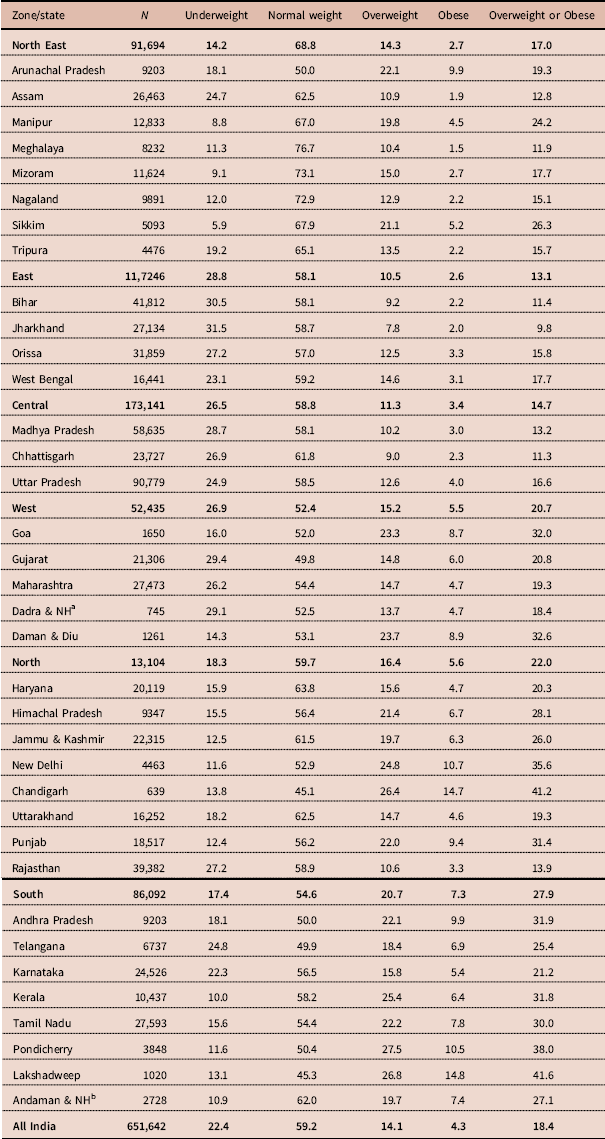
Table 1 shows the distribution of the sample women by nutritional status, as determined by BMI, and by Indian zone and state. A total of 22.4% of Indian women were underweight in 2015–16; 14.1% were overweight, 4.3% were obese and 18.4% were overweight or obese. The lowest percentage of underweight women was found in the North East zone (14.2%) and the highest percentage in the East zone (28.8%). The lowest percentage of overweight or obese women was found in the East zone (13.1%) and the highest percentage in the South zone (27.9 %). Of the 36 Indian states and Union Territories, all the states of the East and Central zones, and most of the states in the West zone, Rajasthan in the North and Telengana in the South had percentages of underweight women above the all-Indian level. However, in the case of overweight and obesity, all states in the West, North and South zones had percentages above the all-India level.
Percentage distribution of 15- to 49-year-old Indian women by nutritional status and by zone and state, NFHS-4, 2015–16

a Dadra & NH: Dadra & Nagar Haveli.
b Andaman & Nicobar Island.
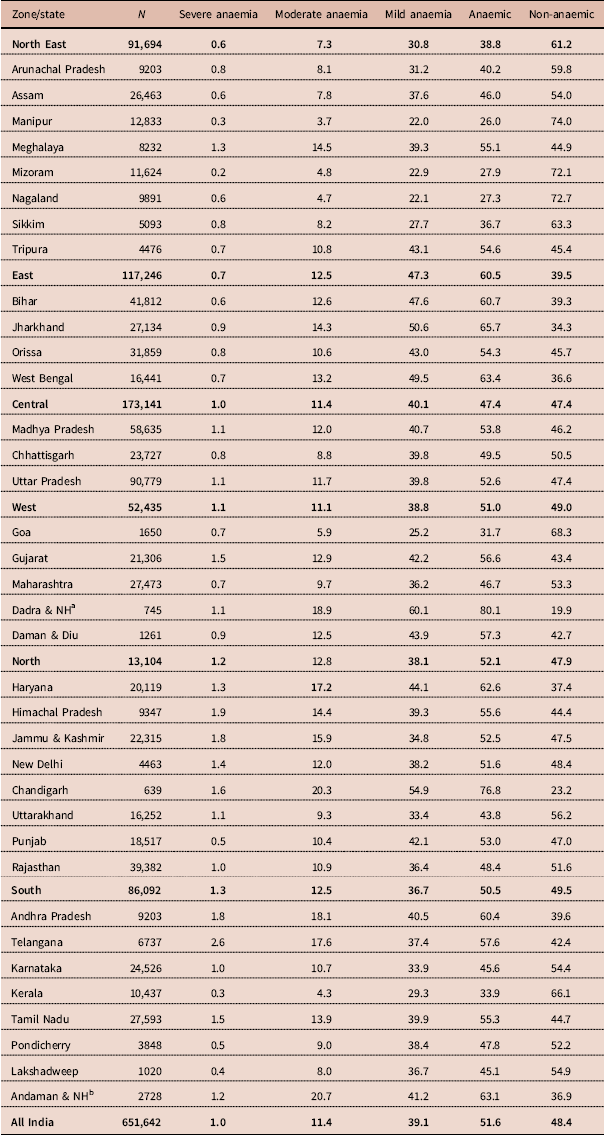
Table 2 shows the distribution of the sample women by level of anaemia, and by Indian zone and state. A total of 51.6% of women were suffering from anaemia during 2015–16. The zone with the lowest percentage of anaemic women (38.8%) was the North East and the highest percentage was found in the East zone (60.5%). The states with percentages of anaemia above the all-India level (51.6%) were Tripura (54.6%), Bihar (60.7%), Jharkhand (65.7%), Orissa (54.3%), West Bengal (63.4%), Madhya Pradesh (53.8%), Uttar Pradesh (52.6%), Gujarat (56.6%), Dadra & Nagar Haveli (80.1%), Daman & Diu (57.3%), Haryana (62.6%), Himachal Pradesh (55.6%), Jammu & Kashmir (52.5%), New Delhi (51.6%), Chandigarh (76.8%), Punjab (53.0%), Andhra Pradesh (60.4%), Telengana (57.6%), Tamil Nadu (55.3%) and Andaman & Nicobar Island (63.1%), so of the total 36 states and Union Territories, seventeen states and three Union Territories were more anaemic than the Indian cut-off point.
Percentage distribution of 15- to 49-year-old Indian women by anaemia status and by zone and state, NFHS-4, 2015–16
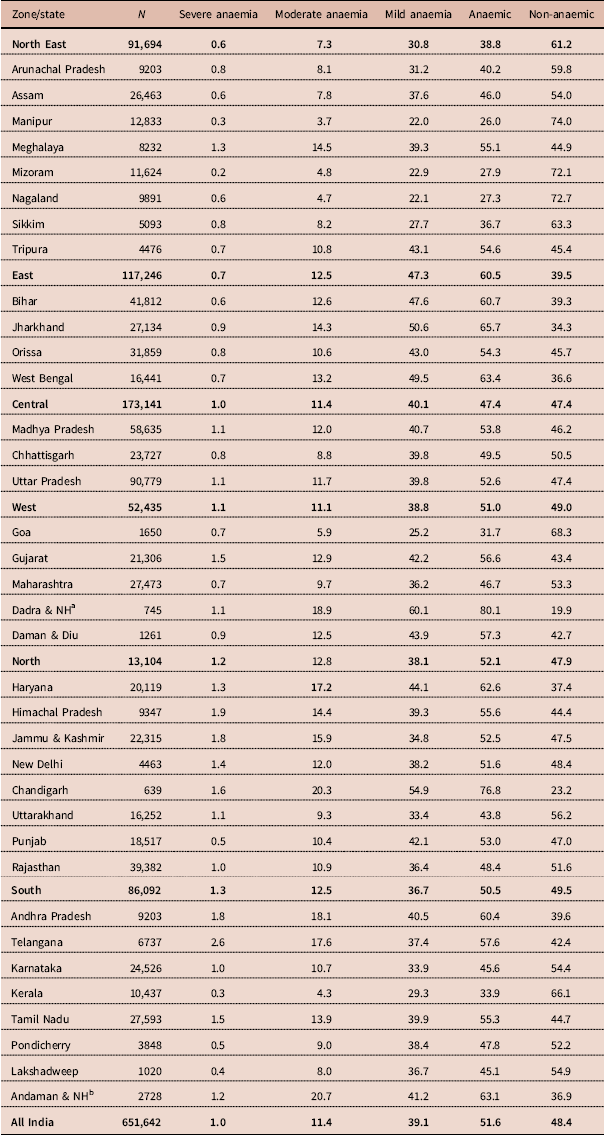
a Dadra & NH: Dadra & Nagar Haveli.
b Andaman & Nicobar Island.
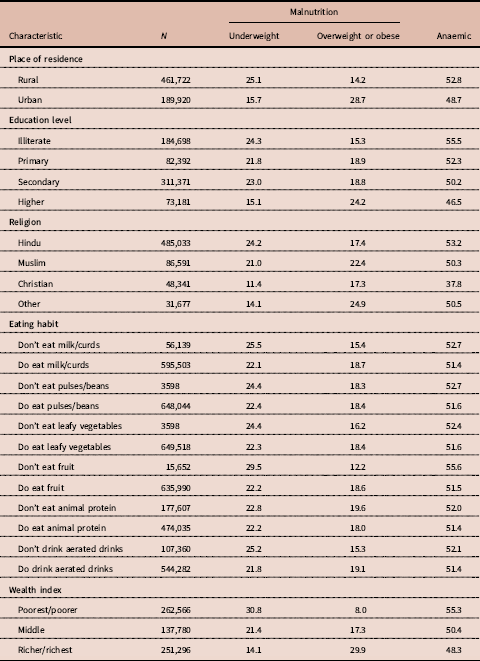
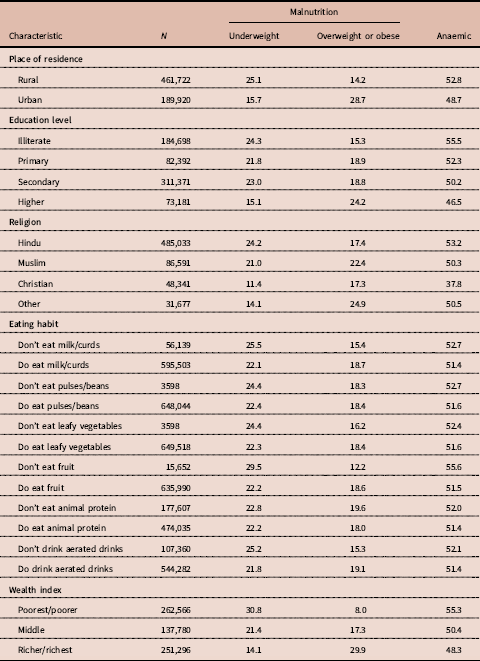
Table 3 shows the incidences of malnutrition (underweight and overweight) and anaemia in women by socio-demographic characteristics and eating habits. Malnutrition levels were lower in urban areas, among the more highly educated and/or richer families, among Christians and among women who consumed milk/curds, pulses/beans, leafy vegetables, fruit, animal protein or aerated drinks regularly. Thus, regularly consuming a range of food items appears to be good for health. Undernutrition was higher among Hindu women compared with other religious groups. Aerated drink seemed to have a very positive effect on reducing undernutrition. The wealth index of the family was inversely related to undernutrition and positively related to overweight or obesity. Likewise, anaemia was positively related to living in a rural area and negatively related to living in an urban area. High level of education was associated with less anaemia. Hindu women seemed to be very much affected by anaemia while Christian women were least affected. Among the different food items, the regular consumption of fruit appears to be the most effective way of reducing anaemia. Wealth index was found to be inversely related to anaemia (Table 3).
Percentages of malnourished and anaemic 15- to 49-year-old Indian women by socio-demographic characteristics and eating habits, NFHS-4, 2015–16
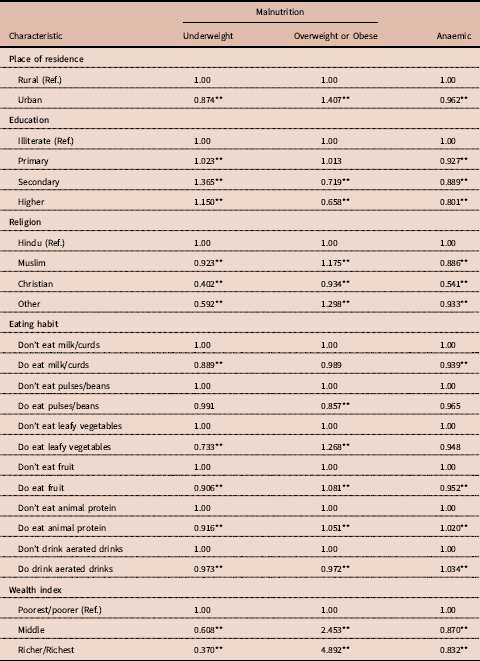
Categorical logistic regressions of undernutrition and anaemia by socio-demographic characteristics and eating habits among 15- to 49-year-old Indian women, NFHS-4, 2015–16
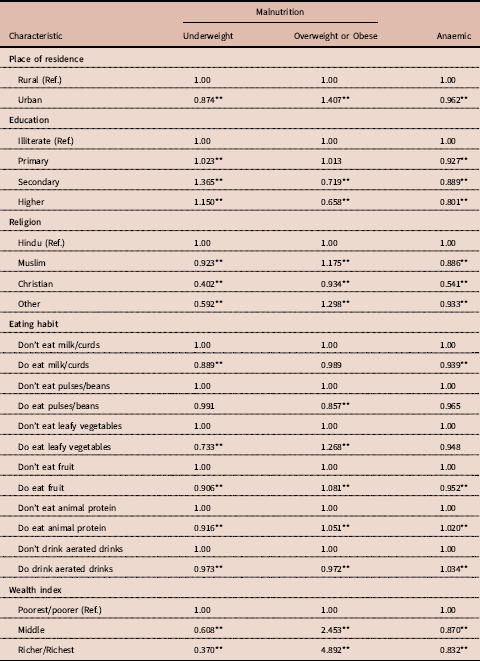
Ref., Reference category.
***p<0.01; **p<0.05; *p<0.1.
Two separate logistic regressions taking the binary variables of undernutrition and anaemia as the dependent variables and type of place of residence, level of education, religion, eating habit and wealth index as categorical independent variables were carried out. Living in an urban area was definitely advantageous, as reflected by the regressions (Table 4). Urban women had a lower possibility of becoming undernourished or anaemic than rural women. It is also very interesting to note that anaemia was inversely related to education level, whereas undernutrition did not show a similar result. The risk of being undernourished or anaemic was much less among Christians and highest among Hindus, and the results were statistically significant at the 1% level. The different food items considered in this analysis had more or less positive effects on nutrition, i.e. the percentage of underweight decreased for women who ate the food item, though the amount of decrease was not very great. The percentage of undernourished women was less among those who drank aerated drinks, but the percentages of overweight and obese were higher among women who drank aerated drinks. This is probably because women of higher economic status drink more aerated drinks. The logistic regression, however, showed that the risk of being undernourished or overweight/obese was lower than expected among this group. Contrary to expectation, the risk of being anaemic was higher among women who drank aerated drinks or ate animal protein. This is probably because of the simultaneous effect of other variables. For instance, studies have reported that the intake of aerated drink has a direct relation with higher intake of energy and carbohydrates and lower intake of protein, vitamins and minerals. So, this may be the reason for the increasing trend in anaemia (Yamada et al., Reference Yamada, Murakami, Sasaki, Takahashi and Okubo2008). As expected, wealth index was negatively related to undernutrition and anaemia, and these results were statistically significant at the 1% level.
Discussion
This study used the latest NFHS-4 data (2015–16) on the health and nutrition status of adult women in India to assess the spatial variation of malnutrition in this group. Spatial variation was studied in three ways: by zone, state and rural–urban residential status. In 2015–16, 22.4% of adult women in India were underweight, whereas in 2004–05 (using NFHS-3 data), 35.6% of women were found to be underweight. So, during the 10-year gap between the two surveys the incidence of underweight women decreased by about 13 percentage points. On the other hand, in 2004–05 (NFHS-3), the percentage of overweight or obese women was 12.6%, and in 2015–16 it was 18.4%. So, the incidence of overweight or obesity women increased by about 6 percentage points in India (IIPS, 2017).
The zone with the lowest percentage of underweight women was the North East zone (14.2%), and that with the highest the East zone (28.8%). The lowest percentage of overweight or obese women was found in the East zone (13.1%) and the highest percentage was seen in the South zone (27.9%). Similarly, in the case of overweight or obesity, it increased only by 2 percentage points from the NFHS-3 study in the East zone and by 5 percentage points in the South zone (Bharati, Reference Bharati2013).
The distribution of underweight prevalence by zone revealed an interesting pattern. The most highly affected zones were mostly in the middle belt of India. The North and South zones were in a comparatively better position. It is also very interesting to note that only the West zone and its allied states, with the exception of Goa, had co-existing high rates of undernutrition and overnutrition.
In India, 51.6% of women were suffering from anaemia during 2015–16. The reduction is only by 4 percentage points over the period between NFHS-3 and NFHS-4 (Bharati, Reference Bharati2013). The lowest percentage of anaemic women (38.8%) was found in the North East zone and the highest (60.5%) in the East zone. To summarize, the health status of women in the North East zone was the best, and it was worst in the East and Central zones of the country. This was true for both undernutrition and anaemia.
In the recent past, India has made considerable progress on the social and economic fronts, as indicated by improvements in per capita income, life expectancy and literacy levels. However, there has been little improvement in nutritional status, including anaemia of women and children (IIPS & Macro International, 2007). When the two national-level datasets, i.e. NFHS-4 and NFHS-3, are compared, it is seen that the differences in the levels of undernourished women between NFHS-3 and NFHS-4 is 13 percentage points. This signifies a significant improvement during the 10 years between the two surveys. The percentages of overweight and obese women have also increased by 4 percentage points over the period. The distribution of undernutrition and overnutrition by state was more or less the same in the two periods. In the case of anaemia, the reduction is only by 5 percentage points. It cannot be overlooked that there is profound regional disparity. Disparities in health status also exist by religion, wealth index and level of education. According to Deaton and Dreze (Reference Deaton and Dreze2009) it is pervasive, i.e. disparity exists in different aspects of life and the most vulnerable group is women.
In conclusion, women in India continue to suffer from the dual burden of under- and overweight, as well as a high rate of anaemia, and this poses a serious challenge, not only for nutritional policymaking aimed at lifting women from their low position in the family, but also for Indian society. The nutritional status of women is affected not only by household income, but also by the quality of the environment, gender discrimination, women’s access to education, their activity levels, exposure to social stimulation and their decision-making power within the household (Heaver, Reference Heaver1989; Radhakrishna, Reference Radhakrishna1992; Dreze, Reference Dreze1993).
Ethical Approval
The study used published NFHS raw data collected by IIPS, Mumbai. Ethical approval for the study was obtained by IIPS before collecting these data.
Conflicts of Interest
The authors have no conflicts of interest to declare.
Funding
No funding from any source was necessary for preparing the paper.