Implications
This is the first study comparing various routes and doses of administration of a phytoestrogen in swine, and it showed that dietary supplementation with 2 g of genistein daily brought about a similar increase in circulating genistein as with two daily i.m. injections of 200 mg of genistein. Physiological status of the sow (weaned v. late gestation) did not affect the genistein response to dietary supplementation with genistein, but the duration of the treatment had an impact. Time relative to feeding is an important effector of isoflavone concentrations and should be considered in future studies. Present results provide essential information for the comparison of results between trials and for the development of future experiments looking at the role of phytoestrogens in sows.
Introduction
Phytoestrogens are naturally occurring plant compounds with estrogenic or anti-estrogenic activities (depending on the concentration of endogenous estrogens present; Sun Hwang et al., Reference Sun Hwang, Seok Kwak, Jae Lim, Hee Lee, Soon Kang, Boo Choe, Gil Hur and Ok Han2006). They have gained much interest in recent years because of their potential health benefits in prevention of mammary cancer (review by Warri et al., Reference Warri, Saarinen, Makela and Hilakivi-Clarke2008) and alleviation of bone loss in post-menopausal women (review by Lister et al., Reference Lister, Skinner and Hunter2007). Phytoestrogens comprise three major classes, namely, isoflavones (including genistein), lignans and coumestans. Genistein was recently shown to have beneficial effects in swine. Indeed, administration of genistein to gilts enhanced mammogenesis (Ford Reference Ford2003; Farmer et al., Reference Farmer, Palin, Gilani, Weiler, Vignola, Choudhary and Capuco2010). Genistein can either be given per os or via injections, but there is no information in swine comparing the effects of the route of administration of genistein on circulating concentrations of isoflavones and hormones. Kuhn et al. (Reference Kuhn, Hennig, Kalbe, Rehfeldt, Ren, Moors and Degen2004) showed significant differences in circulating concentrations of isoflavones when growing pigs were fed two protein sources varying in isoflavone content. Ford et al. (Reference Ford, Clark, Walters, Wheeler and Hurley2006) also reported biological effects varying according to doses ranging from 50 to 400 mg/day via i.m. injections in gilts; however, circulating isoflavone concentrations were not measured in that latter study. Tissue culture studies also demonstrated that genistein affects protein metabolism of porcine myotubes in a dose-related manner (Rehfeldt et al., Reference Rehfeldt, Kalbe, Nürnberg and Mau2009); however, to the best of our knowledge, no dose–response studies showing the relation with isoflavone concentrations in blood were conducted in pigs. Because of its structural similarity to estradiol, many of the actions of genistein are mediated through estrogen receptors (Nilsson et al., Reference Nilsson, Mäkelä, Treuter, Tujague, Thomsen, Andersson, Enmark, Pettersson, Warner and Gustafsson2001), and the IGF-I receptor was also shown to be essential for mediating genistein effects in human breast cancer cells (Chen et al., Reference Chen, Gao and Wong2007). Furthermore, the actions of soy isoflavones on growth and body condition in pigs may be, in part, via the IGF-I system (Li et al., Reference Li, Li, Yang, Yuan, Zhang, Geng, Xiao and Yin2011). It would therefore be of interest to know the effects of genistein on estradiol and IGF-I concentrations. The current study was undertaken to determine the effects of dose and route of administration (per os v. injection) of genistein on circulating concentrations of estradiol, IGF-I and various isoflavones in sows. The effect of physiological status, during treatment (i.e. gestation v. post-weaning), on the response was also studied. Such information is essential for the elaboration of future research projects and for the development of new management strategies that will enhance swine productivity.
Material and methods
Animals and treatments – experiment 1
A total of 65 cross-bred multiparous sows (Yorkshire × Landrace) were equally separated into five treatment groups (n = 13) between days 3 and 5 of the first or second estrous cycle following weaning. The five treatment groups consisted of: (1) controls (CTL), receiving two daily injections of vehicle (2 ml of corn oil), (2) 1 g of genistein fed daily (OR1), (3) 2 g of genistein fed daily (OR2), (4) two daily i.m. injections (at 0800 and 1800 h) of 200 mg of genistein diluted in 2 ml of corn oil (IM400), and (5) two daily i.m. injections (at 0800 and 1800 h) of 400 mg of genistein diluted in 2 ml of corn oil (IM800). Treatments were administered for 10 consecutive days. The genistein given per os (Next Century Inc., Newark, DE, USA) was offered once daily, at 0800 h, before the morning feeding. It was pre-mixed in 15 g of corn flour with water to form a ball. Sows receiving genistein per os had a 10-day adaptation period to receive this 15 g of corn flour without the genistein before the onset of treatment. The genistein used for injections (LC Laboratories, Woburn, MA, USA) was put in corn oil for 30 min at room temperature and mixed by simple rotation a few times during that period. It was then sonicated in an iced water bath for 2 min and vortexed for 20 s. Syringes were prepared twice a week and were kept covered with aluminum foil at 4°C. They were delicately mixed by hand before injecting. Throughout the experiment, all sows were housed in individual stalls (0.6 × 2.1 m) and were fed 2.5 kg/day of a commercial gestation diet (14.2% CP, 13.1 MJ/kg DE, 0.6% lysine) at 0815 h. This diet contained 497 kg of corn, 175 kg of wheat shorts, 100 kg of wheat, 80 kg of soybean meal (48%), 60 kg of canola meal, 43 kg of ground oats and 45 kg of vitamin–mineral pre-mix per 1000 kg of diet. On the basis of the soybean meal content, when extrapolating from a previous trial using similar diets (Farmer et al., Reference Farmer, Palin, Gilani, Weiler, Vignola, Choudhary and Capuco2010), the current diet should provide ∼97, 100 and 10 mg/kg diet of genistein, daidzein and glycitein, respectively. Sows were weighed and their backfat thickness measured ultrasonically at the last rib (Scanmatic SM-1, Medimatic, Hellerup, Denmark) 8 ± 1 days before the onset of treatment, following an overnight fast. Visual appraisal of the redness and swelling of the vulva of each sow was done on days 1, 5 and 10.
Animals and treatments – experiment 2
A total of 10 Yorkshire multiparous sows were equally separated into two treatment groups (n = 5) on day 90 of gestation. They were either controls (CTL), receiving no genistein, or they were fed 2 g of genistein once a day for 10 consecutive days (OR2). The genistein was offered at 0800 h, before the morning feeding, and was pre-mixed in 15 g of corn flour with water to form a ball. Control sows also received 15 g of corn flour mixed with water over the 10-day period. Before the onset of treatment, all sows had a 10-day adaptation to receive the 15 g of corn flour without genistein. Throughout the experiment, all sows were housed in individual stalls (0.6 × 2.1 m) and were fed 2.5 kg/day of a commercial gestation diet (14.2% CP, 13.1 MJ/kg DE, 0.6% lysine) at 0815 h. This diet contained 497 kg of corn, 175 kg of wheat shorts, 100 kg of wheat, 80 kg of soybean meal (48%), 60 kg of canola meal, 43 kg of ground oats and 45 kg of vitamin–mineral pre-mix per 1000 kg of diet. On the basis of soybean meal content, when extrapolating from a previous trial using similar diets (Farmer et al., Reference Farmer, Palin, Gilani, Weiler, Vignola, Choudhary and Capuco2010), the current diet should provide ∼97, 100 and 10 mg/kg diet of genistein, daidzein and glycitein, respectively. Sows were weighed and their backfat thickness was measured ultrasonically at the last rib (Scanmatic SM-1, Medimatic, Hellerup, Denmark) on day 82 ± 1 of gestation, following an overnight fast. All animals were cared for according to a recommended code of practice (Agriculture and Agri-Food Canada, 1993).
Blood sampling
In experiment 1, jugular blood samples were obtained at 0730 h on day 1 (before treatment with genistein) and on days 5 and 10. A blood sample was also obtained at 1730 h on day 10 for CTL, IM400 and IM800 sows. Concentrations of estradiol, IGF-I and isoflavones (genistein, daidzein, glycitein and equol) were measured on all samples. In experiment 2, jugular blood samples were obtained at 0730 h on day 1 (before treatment with genistein) and on days 5 and 10. Concentrations of estradiol and isoflavones (genistein, daidzein, glycitein and equol) were measured in all samples.
All blood samples were collected in EDTA tubes (Becton Dickinson and Cie, Rutherford, NJ, USA). They were put on ice and centrifuged within 20 min, and plasma was immediately recovered. Plasma samples were frozen at −20°C until they were assayed.
Assays
The quantitative analysis of isoflavones in plasma samples was completed with a method using liquid chromatography/mass spectrometry combined with photodiode array detection, as developed in Dr Gilani's laboratory (Sepehr et al., Reference Sepehr, Robertson, Gilani, Cooke and Lau2006). Concentrations of IGF-I were measured with a commercial kit for humans (Alpco 26-G, Salem, NH, USA) with small modifications as detailed previously (Plante et al., Reference Plante, Laforest and Farmer2011). Validation for a plasma pool from lactating sows was demonstrated. Parallelism was 101.2% and average mass recovery was 101.3%. Sensitivity of the assay was 0.10 ng/ml. The intra- and interassay CV were 3.10% and 0.96%, respectively. Estradiol (Diagnostic Systems Laboratories Inc., Webster, TX, USA) was quantified using a commercial RIA kit. The intra- and interassay CV were 7.11% and 6.45%, respectively, for samples in gestation and 2.94% and 4.38%, respectively, for samples post weaning.
Statistical analyses
The MIXED procedure of SAS (SAS 1998) was used for statistical analyses. Two types of analyses were performed. First, a repeated in time ANOVA (including five levels for experiment 1 and 2 levels for experiment 2) with a completely randomized block design was performed on each blood variable. The factors, treatment, day and the treatment × day interaction, were included in the model, and heterogeneous variances for each day were used. Mean separation was done using Tukey's test. When AM and PM samples were obtained on day 10, values for that day were also analyzed separately to know whether the treatment effect was similar in AM and PM. To compare the effect of physiological status (i.e. weaned in experiment 1 v. gestating in experiment 2) on the response to genistein (OR2), the difference between values on days 1 and 5 (delta 5) or days 1 and 10 (delta 10) was compared between sows of both status. ANOVA were therefore performed on these differences for all measured variables in CTL and OR2 sows from experiments 1 and 2. Data in tables are presented as least squares means ± s.e.m.
Results
Experiment 1
Average BWs of sows at the onset of treatment did not differ between treatment groups (P > 0.1) and were 254.1, 251.3, 251.1, 254.0 and 251.9 ± 4.3 kg, for CTL, OR1, OR2, IM400 and IM 800, respectively. Average backfat thicknesses before treatment also did not differ between treatment groups (P > 0.1) and were 19.2, 19.5, 21.0, 19.9 and 19.9 ± 1.1 mm, for CTL, OR1, OR2, IM400 and IM 800, respectively. Visual appraisal of the redness and swelling of the vulva of sows showed no differences between the various treatments.
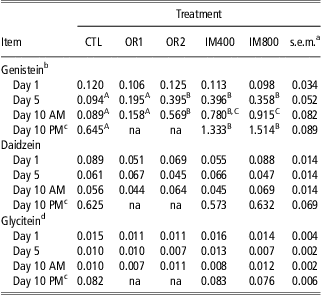
Circulating concentrations of genistein, daidzein and glycitein are shown in Table 1. There was a treatment × day interaction (P < 0.01) on genistein concentrations with no effect of treatment being present on day 1, and values being greater in OR2, IM400 and IM800 sows compared with CTL and OR1 sows on day 5 (P < 0.01). The same was true on day 10 AM, with the exception that genistein concentrations were also greater in IM800 sows compared with OR2 sows (P < 0.01). In the comparison on day 10 PM, IM400 and IM800 sows also had increased concentrations of genistein compared with CTL sows (P < 0.01). There were no effects of treatments on either daidzein or glycitein for any of the days of sampling (P > 0.1); however, there was an AM v. PM effect on day 10 for those three isoflavones, with values always being greater in PM (P < 0.01). Concentrations of equol did not have a normal distribution and this could not be corrected by any transformation, so that medians are more representative than arithmetic means. Values for medians were always 0, except for two values obtained on day 10 PM, whereby medians of 0.03 and 0.145 μmol/l were obtained for CTL and IM800 sows, respectively.
Concentrations of isoflavones (μmol/l) on days 1 (before treatment), 5 and 10 in sows that were controls (CTL) or that received 1 g per os (OR1), 2 g per os (OR2) of genistein daily or two daily i.m. injections of 200 mg (IM400) or 400 mg (IM800) of genistein, for 10 consecutive days starting on days 3 to 5 of the first or second estrous cycle post weaning
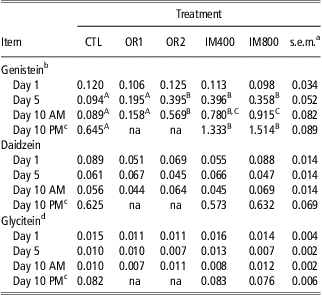
aMaximum value of the standard error of the mean.
bSignificant treatment × day interaction (P < 0.01).
cSignificant AM v. PM effect on Day 10 (P < 0.01) .
dTendency for a day effect (P < 0.1, excluding values on Day 10 PM).
A,BTreatments differ significantly (P < 0.01).
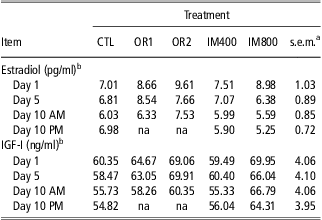
Hormonal concentrations are shown in Table 2. Concentrations of IGF-I were not affected by any of the treatments on any day (P > 0.1, Table 2) but were affected by day of sampling (P < 0.01). Values were lower on day 10 than on days 1 and 5 (P < 0.01). There was a tendency for a treatment × day interaction (P < 0.1) on estradiol concentrations; yet when analyses were performed separately for each day, there were no effects of treatment on any given day (P > 0.1). Values were affected by day of sampling (P < 0.01), decreasing between days 1 and 5, and between days 5 and 10 (P < 0.01). There was no effect of AM v. PM sampling on day 10 (P > 0.1) for either IGF-I or estradiol concentrations.
Concentrations of estradiol and IGF-I on days 1 (before treatment), 5 and 10 in sows that were controls (CTL) or that received 1 g per os (OR1), 2 g per os (OR2) of genistein daily or two daily i.m. injections of 200 mg (IM400) or 400 mg (IM800) of genistein, for 10 consecutive days starting on days 3 to 5 of the first or second estrous cycle post weaning
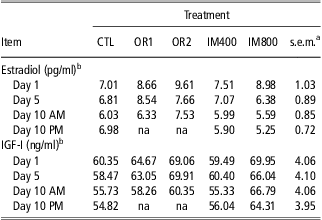
aMaximum value of the standard error of the mean.
bSignificant day effect (P < 0.01, excluding values on Day 10 PM).
Experiment 2
Average BWs of sows at the onset of treatment did not differ between treatment groups (P > 0.1) and were 273.3 and 272.7 ± 5.9 kg for CTL and OR2, respectively. Average backfat thicknesses before treatment also did not differ between treatment groups (P > 0.1) and were 23.3 and 24.1 ± 1.4 mm for CTL and OR2, respectively. Visual appraisal of the redness and swelling of the vulva of sows showed no differences between the various treatments.
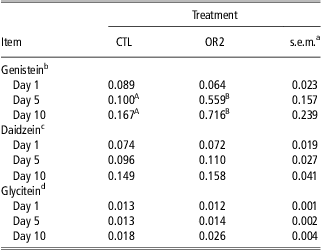
Circulating concentrations of genistein, daidzein and glycitein are shown in Table 3. There was a treatment × day interaction (P < 0.05) on genistein concentrations with no effect of treatment being present on day 1, and values being greater in OR2 than in CTL sows on days 5 and 10 (P ⩽ 0.05). Daidzein and glycitein were not affected by treatment on any of the sampling days (P > 0.1), but were affected by day (P < 0.05) with values being greater on day 10 than on day 1 for daidzein (P < 0.05) and on day 10 compared with days 1 and 5 (P < 0.05) for glycitein. Concentrations of equol did not have a normal distribution and this could not be corrected by any transformation, so that medians are more representative than arithmetic means. Values for medians were 0 for all treatments and doses studied.
Concentrations of isoflavones (μmol/l) on days 1 (before treatment), 5 and 10 in sows that were controls (CTL) or that received 2 g per os (OR2) of genistein daily for 2 subsequent 10-day treatment periods starting on day 90 of gestation and on days 3 to 5 of the first estrous cycle post weaning, respectively
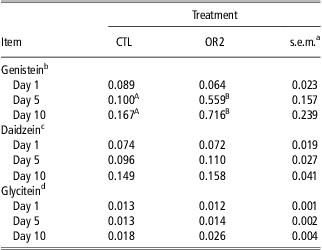
aMaximum value of the standard error of the mean.
bSignificant treatment × day effect (P < 0.05).
cSignificant day effect (P < 0.05).
dSignificant day effect (P < 0.01).
A,BTreatments differ significantly (P ⩽ 0.05).
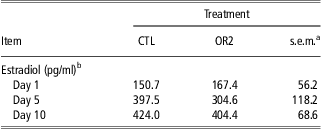
Concentrations of estradiol are shown in Table 4. They were not altered by treatment (P > 0.1) but were greater on days 5 and 10 than on day 1 in all sows (P < 0.01).
Concentrations of estradiol on days 1 (before treatment), 5 and 10 in sows that were controls (CTL) or that received 2 g per os (OR2) of genistein daily for 2 subsequent 10-day treatment periods starting on day 90 of gestation and on days 3 to 5 of the first estrous cycle post weaning, respectively
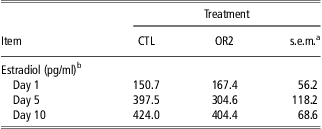
aMaximum value of the standard error of the mean.
bSignificant day effect (P < 0.01).
Experiment 1 v. 2
When comparing the effect of physiological status (i.e. weaned in experiment 1 v. gestating in experiment 2) on the response to the OR2 treatment, the differences in delta 5 (difference between values on days 1 and 5) and in delta 10 (difference between values on days 1 and 10) between sows of both status were studied (data not shown). There were no differences due to physiological status for concentrations of genistein whether on day 5 or 10 (P>0.1), whereas the response was greater in gestating than weaned sows on day 10 for glycitein (P < 0.05) and on both days 5 and 10 for daidzein (P < 0.05). When looking at the effect of physiological status on values for CTL animals only, there were no effects on day 5 for any of the measured isoflavones (P > 0.1); however, values were greater in gestating than weaned sows for genistein (P = 0.01), daidzein (P < 0.01) and glycitein on day 10 (P = 0.05).
Discussion
Providing genistein either per os or via i.m. injections brought about significant increases in circulating concentrations of genistein in female swine within 5 days of the onset of treatment and this response was further increased after 10 days of treatment. To the best of our knowledge, this is the first study comparing various routes of administration of a phytoestrogen in a domestic species. Sepehr et al. (Reference Sepehr, Coke, Robertson and Gilani2007) compared oral v. i.v. administration of isoflavones in rodents to determine bioavailability. However, they used different sources of isoflavones with each of those two routes of administration, thereby making it impossible to look at potential differences solely because of the route of administration. Jefferson et al. (Reference Jefferson, Padilla-Banks and Newbold2007) also compared routes of administration of genistein in rodents; however, the isoflavone given per os was genistin, which is the glycosylated dietary form that needs to be hydrolyzed in the gut to produce genistein, whereas the injected form was genistein. Nevertheless, their findings suggested that ∼80% of the oral dose of genistin is absorbed into the circulation causing a similar biological response as a s.c. injection of genistein. They stipulated that s.c. injections of genistein is a suitable alternative to oral exposure, as both routes and compounds caused biological estrogenic activity. In a recent review, Dinsdale and Ward (Reference Dinsdale and Ward2010) stated that it is not known whether different routes of administration result in similar or dissimilar isoflavone concentrations and that this requires direct comparison within a study. In the current experiment, dietary supplementation with 2 g of genistein daily brought about a similar increase in circulating genistein concentrations than two daily i.m. injections of 200 mg of genistein each. One may speculate that injected genistein could have different pharmacokinetics than when administered orally because it bypasses first-pass metabolism in the gut. Indeed, it appears that genistin is much more bioavailable after oral exposure than genistein, which would suggest that greater amounts of genistein must be supplied per os compared with injections to exert similar biological actions. Nevertheless, it is important to note that the biological effects in rats are because of circulating concentrations of genistein (Cimafranca et al., Reference Cimafranca, Davila, Ekman, Andrews, Neese, Peretz, Woodling, Helferich, Sarkar, Flaws, Schantz, Doerge and Cooke2010) and there are no indications that this should be any different in swine. Jefferson and Williams (Reference Jefferson and Williams2011) stated that the relevant endpoint in studies using exogenous phytoestrogens is the final serum concentration of the isoflavone, not the exact dose administered, because this measurement corrects for differences in absorption and metabolism. It is for this reason that the current study compares routes and dose of administration of genistein in swine in terms of circulating concentrations.
Genistein injected i.m. at doses varying from 50 to 400 mg/day was shown to stimulate the growth of uterine and cervical tissues in a dose-dependent manner in ovariectomized gilts (Ford et al. Reference Ford, Clark, Walters, Wheeler and Hurley2006). No visual signs of vulvar redness or swelling were seen in the current study indicating that changes in the reproductive tract are not necessarily apparent at the level of the vulva, or that phytoestrogens have a greater effect on reproductive tissues in the estrogen-deficient ovariectomized gilts than in intact sows. It is important to mention that even the maximal dose of genistein used by Ford et al. (Reference Ford, Clark, Walters, Wheeler and Hurley2006) elicited a more modest response than administration of a high dose (2 mg/day) of estradiol benzoate.
In the majority of sows from the current study, the phytoestrogen equol was not present in measurable quantities. Equol production results from its conversion from daidzein via bacterial action at the level of the colon (Sepehr et al., Reference Sepehr, Coke, Robertson and Gilani2007). There are species differences in equol production, which are most likely related to differences in gut microflora. Indeed, Gu et al. (Reference Gu, House, Prior, Fang, Ronis, Clarkson, Wilson and Badger2006) reported that rats and monkeys appear to be equol producers, whereas pigs and humans are poor equol producers. This is in agreement with findings from Kuhn et al. (Reference Kuhn, Hennig, Kalbe, Rehfeldt, Ren, Moors and Degen2004) who noted that formation of equol is not a major route of phytoestrogen metabolism in pigs. On the other hand, one previous study showed equol to be produced in growing gilts fed a soy-based diet (Farmer et al., Reference Farmer, Palin, Gilani, Weiler, Vignola, Choudhary and Capuco2010) and this discrepancy was thought to be because of differences in the type of diet between studies. However, present results show that this is not likely to be the case as animals in the current study were also fed a soy-based diet. Nevertheless, current findings corroborate previous studies (Kuhn et al., Reference Kuhn, Hennig, Kalbe, Rehfeldt, Ren, Moors and Degen2004; Gu et al., Reference Gu, House, Prior, Fang, Ronis, Clarkson, Wilson and Badger2006; Farmer et al., Reference Farmer, Palin, Gilani, Weiler, Vignola, Choudhary and Capuco2010) showing that genistein and daidzein are the two major isoflavones present in the circulation of swine.
A surprising finding is the drastic increase in all measured isoflavones (other than equol) occurring on the afternoon of day 10. This was seen both in control and treated animals; hence, the only possible explanation would be the presence of a circadian rhythm in the secretion or the uptake of isoflavones. An increase in uptake is more likely, as soy-based diets are a source of isoflavones and all morning blood samples were obtained before feeding, whereas the afternoon sample (obtained at 1730 h) was after animals had consumed feed. Cimafranca et al. (Reference Cimafranca, Davila, Ekman, Andrews, Neese, Peretz, Woodling, Helferich, Sarkar, Flaws, Schantz, Doerge and Cooke2010) mentioned that human infants have relatively high constant circulating genistein concentrations over a 24-h period because of repeated feeding every 3 to 4 h, whereas mice pups receiving oral genistein had peak values 2 h post treatment and elevated concentrations for the next 8 h. By 16 h after dietary treatment, total serum genistein concentrations had returned to low baseline levels. Gardner et al. (Reference Gardner, Chatterjee and Franke2009) also observed varying circulating isoflavone concentrations over the 24-h period following oral administration in humans, with the highest values being 12 h post treatment. They concluded that spreading the intake of isoflavones over the course of the day will lead to more constant steady-state plasma concentrations. The current finding that, in swine, circulating isoflavone concentrations are affected by time of day and/or time relative to feeding is important for future studies where such measures will be obtained. It is also apparent, that to obtain a maximal biological response to exogenous phytoestrogens, repeated administration would be best. Nevertheless, it is important to mention that the effect of treatment on genistein concentrations in the current study was seen both in the AM and PM samples.
The effect of dietary supplementation or injections with genistein seems specific in terms of isoflavones because concentrations of phytoestrogens other than genistein were not altered by any of the treatments or doses studied. The same was true for circulating concentrations of estradiol and IGF-I, which were not affected. This corroborates previous findings where dietary supplementation of 2.3 g of genistein to growing gilts for 93 days did not bring about any changes in circulating concentrations of the phytoestrogens daidzein, glycitein, or equol, or the hormones estradiol, IGF-I, prolactin or progesterone, when feeding a standard corn–soy diet (Farmer et al., Reference Farmer, Palin, Gilani, Weiler, Vignola, Choudhary and Capuco2010). Kuhn et al. (Reference Kuhn, Hennig, Kalbe, Rehfeldt, Ren, Moors and Degen2004) also saw no increase in IGF-I receptor mRNA expression in the longissimus dorsi of pigs fed various sources of soy products, which affected isoflavone concentrations. On the other hand, Li et al. (Reference Li, Li, Yang, Yuan, Zhang, Geng, Xiao and Yin2011) reported increased circulating IGF-I and increased IGF-I mRNA expression in the longissimus muscle of Chinese mini pigs fed a high level (500 mg/kg of diet) but not a low level (125 mg/ kg of diet) of soy isoflavones. As composition of the soy isoflavone extract fed and of circulating concentrations of isoflavones were not measured in that latter study, comparison between that and the current study is not possible and it is likely that the discrepancy in IGF-I results could be due to a dose or a tissue effect. When either 200 or 400 mg of genistein was injected daily i.m. to finishing pigs for 15 days, circulating IGF-I concentrations were not affected, yet anterior pituitary concentrations of IGF-I were increased with the 400 mg dose (Clapper and Tomlin, Reference Clapper and Tomlin2012). This corroborates current findings in circulating concentrations of IGF-I using a similar dose and route of administration. Interestingly, genistein seems to affect other reproductive hormones as it stimulated the release of oxytocin and prostaglandins in cyclic gilts (Norrby et al., Reference Norrby, Madsen, Saravia, Lundeheim and Madej2011).
Current results show that significant increases in genistein following isoflavone treatment were observed both in post-weaned sows and in late-gestating sows. This response was not affected by the physiological status of the female swine, even if endogenous concentrations of estrogens differed, being much greater in gestating than in weaned sows. Taking into account the estrogen-like effects of phytoestrogens (Sun Hwang et al., Reference Sun Hwang, Seok Kwak, Jae Lim, Hee Lee, Soon Kang, Boo Choe, Gil Hur and Ok Han2006), such information is important for future investigations on the potential beneficial effects of genistein on sow and piglet performances. It is also apparent that both oral administration and i.m. injections of genistein are appropriate routes to elicit biological responses in swine.
Conclusions
The response in circulating concentrations of genistein to dietary supplementation with genistein was similar in weaned and late-pregnant sows, even though endogenous concentrations of estradiol differed greatly. The response to genistein was specific in that estradiol, IGF-I and isoflavones other than genistein were not affected by treatments, but the duration of treatment was an important factor for concentrations of genistein. Comparison of doses and routes of administration showed that dietary supplementation with 2 g of genistein daily brought about a similar increase in circulating genistein as two daily i.m. injections of 200 mg. An important finding is that circulating concentrations of isoflavones were affected by time relative to feeding, which is the first demonstration of such an effect in swine.
Acknowledgments
The authors thank L. Thibault and A. Bernier for their invaluable technical assistance, the staff of the Swine Complex, especially J. Boudreau and E. Bérubé, for care of the animals and S. Méthot for statistical analyses.