Introduction
The main achievement of the International Technical Conference on Animal Genetic Resources for Food and Agriculture, held 3-7 September 2007 in Interlaken, Switzerland, was the adoption of the Global Plan of Action for Animal Genetic Resources. The Global Plan of Action represents a milestone for the livestock sector and a major building block in the development of a coherent international framework for the wise management of agricultural biodiversity as a whole, and contributes to the implementation of the Programme of Work on Agricultural Biodiversity of the Convention on Biological Diversity (FAO, Reference FAO2007a). The Global Plan of Action promotes a pragmatic, systematic and efficient overall approach that harmoniously addresses the development of institutions, human resources, cooperative frameworks, and resource mobilisation for the sustainable use and conservation of animal genetic resources. It consists of three parts: I. the Rationale; II. the Strategic Priorities for Action; and III. Implementation and Financing of the Global Plan of Action. The core of the Global Plan of Action include 23 Strategic Priorities, clustered into four Priority Areas: Area 1: Characterization, inventory and monitoring of trends and associated risks; Area 2: Sustainable use and development; Area 3: Conservation; and Area 4: Policies, institutions and capacity-building. Each Strategic Priority includes individual actions that are needed to achieve the desired outcomes or improvements in current conditions. The Global Plan of Action contains five Strategic Priorities for Action on conservation. Countries have thereby committed themselves to develop national conservation policies, to establish or strengthen in situ and ex situ conservation programmes, to develop and implement regional and global long-term conservation strategies and to develop approaches and technical standards for conservation.
The State of the World's Animal Genetic Resources for Food and Agriculture (FAO, Reference FAO2007b) provided the technical basis for the Global Plan of Action. Analysis of 169 Country Reports revealed that the rapid spread of homogenous large-scale intensive production; inappropriate development policies and management strategies; disease outbreaks and control programmes; and various types of disasters and emergencies were important threats to animal genetic resources (FAO, Reference FAO2007b). All these threats are present in the poultry sector and the speed of change may require immediate conservation action.
The paper first provides an overview over the status of poultry genetic resources and threats to them. Then, conservation technologies and programmes are presented.
Breeding and genetics in the poultry sector
The global poultry sector is divided into two distinct sub-sectors: the large-scale commercial operations, dominated by international, developed-country based and vertically integrated companies, and the small-scale operations that predominate in the least developed countries (Pym et al., Reference PYM, GUERNEBLEICH and HOFFMANN2006). The poultry sector is the fastest developing global livestock sub-sector. Developments in poultry breeding, feeding and housing have enabled an unprecedented increase in production and productivity. Globally, 82 million tonnes poultry meat and 66 million tonnes of eggs were produced in 2006 (FAO). Poultry consumption is projected to grow at 2.5 percent per annum to 2030, exceeding other meats, and at 3.4 percent per annum in developing countries (FAO, Reference FAO2006).
Industrial production systems now account for an estimated 67% of global poultry meat production and 50% of global egg production (FAO, Reference FAO2004), with large differences between countries (Pym et al., Reference PYM, GUERNEBLEICH and HOFFMANN2006). Most of the commercial layer and broiler stocks were created from a limited number of breeds in the last century in Europe and North America. Breeding activities, both for chicken layers and broilers, and for turkeys, are dominated by a few trans-national breeding companies that market their products worldwide.
Small-scale poultry provides up to 90% of total production in some of the least developed countries. Despite the high number of poultry and the variety of poultry breeds kept by smallholders in developing countries, the Country Reports prepared for The State of the World's Animal Genetic Resources indicated that very few countries had capacity in poultry breeding. This is mainly due to the large difference in production between commercial and local poultry, leaving developing countries little incentive to develop their national breeding industry, as they can simply import grandparent/parent stock. Only 18% of countries where chickens are kept reported breeding as a priority, and only 14% had structured breeding activities for poultry. Even fewer countries reported structured breeding activities for turkeys (5 countries), ducks (8 countries) and geese (4 countries). The low importance of local chicken breeding programmes is reflected by a small proportion of breeds with a specific breeding goal (13%) and breeding strategy (11%). Europe and the Caucasus region has a higher proportion of breeds with breeding strategies than the other regions (FAO, Reference FAO2007b).
Two additional recent developments may further threaten poultry genetic diversity, albeit indirectly due to the structural changes they bring along: highly pathogenic avian influenza (HPAI) outbreaks and increasing feed prices. The outbreaks of HPAI since 2003 have raised awareness about the risk of losing genetic diversity, either directly through the disease, or through related culling, movement restrictions or restructuring of the sector. HPAI and other disease outbreaks may have a direct impact on localized populations. The related restructuring of the poultry sector has the potential to marginalize smallholders and add another risk of extinction for local breeds. HPAI-related movement controls and the banning of exhibitions has led to a reduction in the number of breeders and increased inbreeding in some European fancy breeds. However, due to difficulties in data collection, no hard data are available to show that HPAI has directly decreased diversity (Hoffmann, Reference HOFFMANN2007).
If the present increase in feed prices (the major cost of production) continues, the comparative advantage of poultry species in feed-conversion ratio relative to other livestock will increase. This may accelerate the shift between animal species used for food production. Also, commercial poultry, which have much better feed conversion efficiency, may further out-compete local breeds. It is therefore timely to take stock of poultry diversity and conservation measures.
Status of poultry genetic diversity
FAO has recently finalized the report: The State of the World's Animal Genetic Resources, which is the first assessment of domestic animal diversity (FAO, Reference FAO2007b). During this process, the Global Databank in the Domestic Animal Diversity Information System (DAD-IS) was updated and now contains information from 182 countries and 35 species of birds and mammals. Breed-related information on 16 avian species and one fertile interspecies crossing (Muscovy duck crosses) exist, with 3505 country-breed populations and about 2000 breeds. The FAO applies a very wide breed definition, which is more difficult to apply in avian species than mammals, as poultry diversity is often referred to in terms of ecotypes or strains (see below).
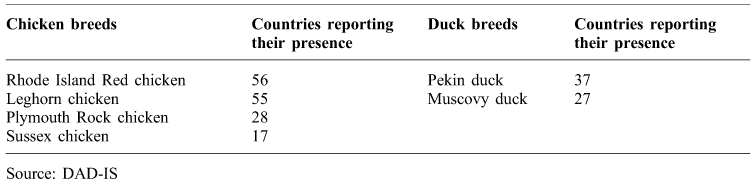
Many reported national breed populations occur in more than one country; these populations have been linked, and are referred to as ‘trans-boundary’ breeds. The number of ‘local’ poultry breeds (reported in only one country) reached 1644. There are records of 85 ‘regional trans-boundary’ breeds (reported by several countries of one region), most of them in Europe and the Caucasus, and 157 ‘international trans-boundary’ breeds (reported by countries of several regions), 101 of which are chicken breeds (16 turkey, 15 goose, 12 duck). European origin accounts for 26, commercial strains for 19, and North American origin for seven out of the 67 most widely reported chicken breeds (FAO, Reference FAO2007b) (Table 1).
Most reported poultry breeds.
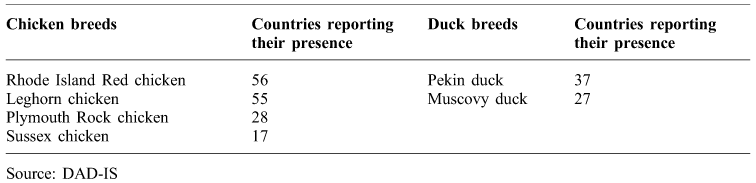
Source: DAD-IS
The species are not evenly distributed across regions, reflecting the origins of domestication and subsequent distribution by humans: while 14 species are present in both Asia and in Europe and the Caucasus, fewer species are reported from the other regions (FAO, Reference FAO2007b). Chicken breeds make up the majority (63%) of the total number of avian breeds in the world, followed by duck (11%), goose (9%) and turkey (5%) breeds. Pigeons and guinea fowl each make up 3%, and all other avian species together make up 6%.
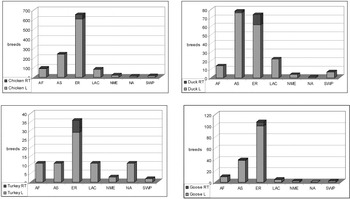
The numbers of local breeds per region are influenced by the number of breeds that had been developed in the region before commercialization of the sector began, the number of breeders that maintain them (e.g. in Europe), and the degree of current commercialization. Asia, being the origin of domestication for chickens and ducks, has many local breeds in both species (Figure 1). The high number of breeds reported by Europe and the Caucasus reflects, firstly, the well developed national reporting systems, but also the long history of breed formation, including through imports from other regions, and the ‘formalization’ of breeds in standards or registries.
Local and regional trans-boundary breeds for the four main poultry species: chicken, turkey, duck, goose, by region (FAO, Reference FAO2007b; DAD-IS).
L local breeds, RT regional trans-boundary breeds. AF = Africa; AS = Asia; ER = Europe & the Caucasus; LAC= Latin America & the Caribbean; NME = Near & Middle East; NA = North America; SWP = Southwest Pacific.

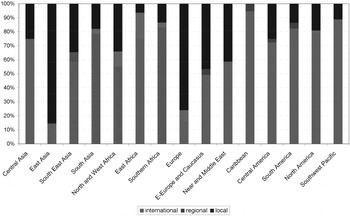
The share of local chicken breeds differs by region (Figure 2). Asia, and Europe and the Caucasus report more than 400 breeds each, Africa, and Latin America and the Caribbean report more than 100 each, and the Near and Middle East, North America and the Southwest Pacific fewer than 40 each.
Origin of chicken breeds, by sub-region (DAD-IS, FAO, Reference FAO2007b).

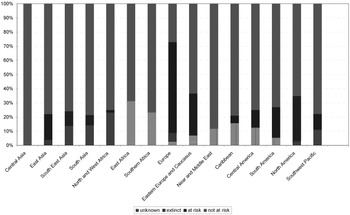
Population data (a prerequisite for breed genetic management and the assessment of the risk status) are missing in most cases, primarily due to the difficulties of monitoring small livestock. The lack of information also reflects the low importance governments attribute to poultry, despite their important role in food security, rural livelihoods and gender equity. As a result, for 36% of reported breeds, the risk status is unknown. Another 35% are reported as not being at risk, whilst 30% of avian breeds are classified as being at risk. Out of 2000 reported avian breeds, 9% (83% of which are chickens) were reported as extinct (FAO, Reference FAO2007b). The majority of the extinct breeds are reported from Europe (Figure 3).
The regions with the greatest proportion of avian breeds classified as ‘at risk’ are North America (79%) and Europe and the Caucasus (49%). These are the regions that have the most highly-specialised livestock industries, in which production is dominated by a small number of breeds/lines. The proportion of breeds at risk is high in chickens and turkeys (36%), geese (31%) and ducks (25%), thereby following their global economic importance.
Risk status of chicken breeds by sub-region (DAD-IS, FAO, Reference FAO2007b).

Conservation of poultry genetic resources
In developing countries, the role of poultry, especially chickens, in small-scale farming and the preference of consumers for meat from local birds will support the continued use of many local breeds, thereby reducing the need for direct conservation interventions. In addition, poultry are kept as a hobby in many developed and some developing countries. This practice offers opportunities for in vivo conservation which allows the continued evolution of the breeds. Research institutes and universities in North America and Europe try to conserve local breeds, mainly chickens, and experimental lines that have no current use (Gibson et al., Reference GIBSON, GAMAGE, HANOTTE, INIGUEZ, MAILLARD, RISCHKOWSKY, SEMAMBO and TOLL2006; FAO, Reference FAO2007b). Due to budget limitations, these poultry flocks are at risk of being culled in many cases.
conservation technology
In situ conservation of poultry genetic resources is not necessarily dependent on high-tech approaches or facilities, but mainly on skills and recording. The technologies are known and software is available to manage small populations. However, some breeds are kept by only a few breeders; e.g. some chicken breeds in Europe are kept by less than 20 breeders and have population sizes well below 200 animals. Many poultry breeders are older people, and there is less interest in such breeding displayed by younger generations. This factor may pose a problem for the maintenance of populations, especially if localised disasters (e.g. outbreaks of HPAI) occur (Carlson et al., 2009).
Ex situ conservation represents an integral component of conservation strategies and should strategically complement in situ conservation (Gibson et al., Reference GIBSON, GAMAGE, HANOTTE, INIGUEZ, MAILLARD, RISCHKOWSKY, SEMAMBO and TOLL2006; FAO, Reference FAO2007b). Although some programmes focus primarily on cryo-conservation of rare breeds (see below), ex situ collections should capture as much genetic diversity at the allele level as possible.
Blesbois (Reference BLESBOIS2007) has recently reviewed the status of cryo-conservation for avian species, which lags far behind that for mammals. The efficiency and efficacy of ex situ conservation depend on advances in reproductive and cryo-conservation technology. Such technologies are usually infrastructure-dependent. Cryo-conservation involves high start-up costs for collection and freezing, but relatively low long-term storage costs, while the expected future use of conserved genetic material is not yet clear. In situ programmes, on the other hand, tend to have low start-up costs, but may require long-term financial support. They have the advantages that the genetic material is immediately available for use and continues to evolve (Woolliams et al., Reference WOOLLIAMS, MATIKA and PATTISON2007). Simianer and Weigend (Reference SIMIANER and WEIGEND2007) found lower costs of chicken ex situ in vitro than ex situ in vivo conservation, but breed re-establishment from in vitro collections was not considered.
Insemination with frozen semen, the usual basis of building cryo-banks, is not widely used in poultry. Fresh semen is commonly used in commercial breeding programmes. Semen-freezing techniques render a fair (60%) post-thaw sperm survival, although differences in the ‘freezability’ of semen between breeds, lines and individual males are considerable. As a consequence, frozen semen of some genetically interesting breeds or individual males may not be suitable as a gene bank resource, or yield poor efficiency, which increases the amount of semen stored (Hiemstra et al., Reference HIEMSTRA, VAN DER LENDE and WOELDERS2006). Hiemstra (Reference HIEMSTRA2007) reported that a new freezing medium improved freezing and insemination results. He estimated that semen from ten cockerels are needed to capture the total diversity of rare breeds, and 600 doses are required to re-establish a breed. Simianer and Weigend (Reference SIMIANER and WEIGEND2007) based their calculations on 100 roosters.
Repeated backcrossing is required to re-establish a breed through frozen semen, but results in a time lag of up to seven generations (Blesbois, Reference BLESBOIS2007; Hiemstra et al., Reference HIEMSTRA, VAN DER LENDE and WOELDERS2006). Also, the original genome of the lost breed can never be fully restored through cryo-conserved semen, due to the loss of mitochondrial DNA. Although cryo-conserved embryos allow the complete re-establishment of a breed, this is not possible for avian species. Cryo-conservation of isolated embryonic cells, primordial germ cells or blastoderm cells may be a future option, but are currently too costly for genetic conservation programmes.
conservation programmes
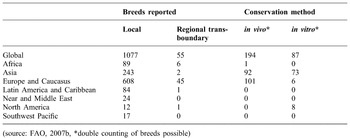
Information on poultry conservation programmes is not easy to find. Table 2 indicates that around 25% of chicken breeds are in some sort of conservation programme, with no information provided about the efficiency of the programme.
Chicken conservation activities.

(source: FAO, Reference FAO2007b, *double counting of breeds possible)
Another analysis of the Country Reports revealed that 26 countries (15% of all countries), including eight developing countries, had poultry conservation programmes (in vivo and in vitro) covering 63% of their local breeds. They also had conservation programmes for national populations of trans-boundary breeds, which covered 11% of those breeds. Many of the fancy/hobby breeds in Europe may fall under this category. By species, 24 countries (68%) had programmes for chickens, seven for ducks (20%), and two each for geese and turkeys (6% each). Equal proportions of countries stored material as semen, tissue or DNA. Half of the programmes were run entirely by governments, the other half co-operated with the private sector, research groups and NGOs.
The Global Databank indicates that 195 poultry breeds (77% chicken, 9% ducks, 9% geese, 3% turkey) are in conservation programmes. For 70% of these breeds, the population figures were collected before the year 2000, and a new population census is required to bring this up to date. Of the available figures, 164 are local populations, and 30 are sub-populations of 27 different trans-boundary breeds.
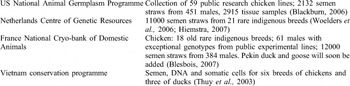
Country-specific programmes, which may not be recorded in the Global Databank, revealed that in France, for example, 154 rare chicken lines are managed in vivo (Blesbois, Reference BLESBOIS2007). In a national programme in Vietnam, eight chicken, four duck and one goose breeds are conserved in situ; including crossbreds of exotic and indigenous chicken and duck breeds targeted for creation of new products to maintain the local breeds (Thuy et al., Reference THUY, VANG and GIAO2003). Many NGOs in developed countries have specifically targeted rare breeds. The list of endangered Dutch breeds and species of domesticated chickens, ducks and geese has been stable since 2002 (Polmann, Reference POLMANN2008).
In vitro conservation of semen is a recent development for chickens (Table 3). Frozen semen from local breeds is stored in a few Asian and European countries. Semen of 20 Dutch rare chicken breeds has been frozen (Hiemstra, Reference HIEMSTRA2007), but the cryo-bank does not contain semen of the trans-boundary breeds kept by Dutch hobby breeders (Polmann, Reference POLMANN2008).
Examples for in vitro collections of poultry genetic material.

making conservation decisions
Poultry are the only species with a well-developed hobby and fancy breed segment in parallel to breeds used for food and agriculture. Therefore, Russell (Reference RUSSELL1998) differentiates poultry breeds into categories that include industrial lines; breeds used in traditional agriculture, historical breeds including old landraces; breeds used for games such as cockfighting; ornamental breeds or those used mainly for exhibitions, and experimental lines. German fancy breed societies, for example, maintain about 200 chicken and dwarf chicken breeds, some with up to 20 different colour or comb variations (Simianer and Weigend, Reference SIMIANER and WEIGEND2007). This variety might represent a potential allele reservoir for future breeding purposes, but it also complicates decision-making for conservation.
Resources for conservation are limited, necessitating the need for criteria to identify breeds to be included in conservation projects. In the past, breeds of specific phenotypes with low population numbers and therefore at risk were included in conservation programmes. In the past decade, a modified ‘Weitzman’ approach to conservation (Weitzman, Reference WEITZMAN1993) has been applied to livestock, taking into account genetic diversity estimated at the molecular level, extinction probabilities and risk status (including through crossbreeding or genetic drift), marginal diversity of one breed in a reference group, capacity of breeding institutions and socio-economic factors (Simianer et al., Reference SIMIANER, REIST-MARTI, GIBSON, HANOTTE and REGE2003; Simianer, Reference SIMIANER2005; Reist-Marti et al., Reference REIST-MARTI, SIMIANER, GIBSON, HANOTTE and REGE2003, Reference REIST-MARTI, ABDULAI and SIMIANER2006; Eding et al., Reference EDING, CROOIJMANS, GROENEN and MEUWISSEN2002; Simianer and Weigend, Reference SIMIANER and WEIGEND2007).
Poultry genetic diversity has recently been investigated at the DNA level (Hillel et al., Reference HILLEL, GROENEN, TIXIER-BOICHARD, KOROL, DAVID, KIRZHNER, BURKE, BARRE-DIRIE, CROOIJMANS, ELO, FELDMAN, FREIDLIN, MÄKI-TANILA, OORTWIJN, THOMSON, VIGNAL, WIMMERS and WEIGEND2003; Cuc et al., Reference CUC, MUCHADEYI, BAULAIN, EDING, WEIGEND and WOLLNY2006; Muchadeyi Reference MUCHADEYI2007; Li et al., Reference LI, YANG, CHEN, CHEN, TANG, TU, YU and MA2006; Li et al., Reference LI, CHEN, YANG, SONG and TANG2007; Granevitze et al., Reference GRANEVITZE, HILLEL, CHEN, CUC, FELDMAN, EDING and WEIGEND2007). Most studies, comparing native chicken breeds from developing countries or fancy breeds in developed countries, reveal that these breeds add to overall diversity and may have a high conservation potential. Within-breed diversity covers the majority of the entire genetic diversity in studies in Germany (Pinent et al., Reference PINENT, SIMIANER and WEIGEND2006), Africa (Muchadeyi, Reference MUCHADEYI2007) and Asia (Cuc et al., Reference CUC, MUCHADEYI, BAULAIN, EDING, WEIGEND and WOLLNY2006), however, between-breed diversity contributes to the conservation potential of breeds. Genetic diversity within populations is higher in developing country populations than in commercial populations and European fancy breeds (Granevitze et al., Reference GRANEVITZE, HILLEL, CHEN, CUC, FELDMAN, EDING and WEIGEND2007; Muchadeyi, Reference MUCHADEYI2007). This can be explained by the history, where more breeds have been developed in Europe with resulting relatively higher between-breed diversity, while less-defined developing country breeds harbour wider diversity. Granevitze et al. (Reference GRANEVITZE, HILLEL, CHEN, CUC, FELDMAN, EDING and WEIGEND2007) also noted that some European local populations with cultural–historical value kept under conservation programmes and fancy breeds were found to show considerable levels of inbreeding.
Geographical isolation contributes to genetic diversity between breeds, but this effect is reduced by geneflow. The mobility of Chinese ducks and geese may have contributed to geneflow between populations (Li et al., Reference LI, YANG, CHEN, CHEN, TANG, TU, YU and MA2006; Reference LI, CHEN, YANG, SONG and TANG2007). Probably due to exchanges, the highly diverse Zimbabwe chicken populations are not genetically sub-structured into eco-types. However, with increasing geographical distance, Zimbabwean populations are distinct from Malawi and Sudanese local chickens and from commercial lines (Muchadeyi, Reference MUCHADEYI2007).
Conclusions
This paper has illustrated the high endangered status of poultry genetic diversity, with 30% of reported poultry breeds at risk, a low level of characterisation and a low number of structured breeding or conservation programmes, particularly in developing countries. Characterisation, inventories and spatial information are needed for improved management of poultry genetic resources to reflect poultry's important role in food security, rural livelihoods and gender equity.
For the most important poultry species, the diversity of phenotypes between breeds is not fully reflected in genetic diversity due to high within-breed diversity (Granevitze et al., Reference GRANEVITZE, HILLEL, CHEN, CUC, FELDMAN, EDING and WEIGEND2007). Many conservation decisions to date have been mostly based on between-breed diversity and risk levels based on population figures, often only at a national level. Within-breed diversity is large in poultry breeds across species, due to past and current exchanges, however, knowledge about genetic diversity is still lacking, even in developed countries (Blackburn, Reference BLACKBURN2006). Diversity and characterisation studies, including the search for functional traits, are therefore prerequisites for rational conservation decisions. International research projects such as AVIANDIV and GLOBALDIV are extremely important in this regard, and the need for meta-analysis across countries and regions cannot be emphasised enough.
The high within-breed diversity, especially in chickens, and the relatively high number of trans-boundary breeds have implications for conservation programmes. The inclusion of breeds from unconnected and distinct geographical locations may increase the between-breed diversity captured even if no detailed molecular characterization information is available. Breeds that have not been genetically managed and those without closely related populations should be preferred for conservation programmes. National conservation programmes that ignore closely related and non-threatened breeds elsewhere may lead to suboptimal allocation of funds and conservation efficiency (Simianer, Reference SIMIANER2005); therefore, conservation strategies should be developed at supra-national level.
Valuable genetic material should be cryo-conserved in a precautionary manner, in view of the fast structural changes in the poultry sector and the risks facing the avian species kept at high densities all over the world, especially in view of epidemics. In vitro conservation of local breeds, wild relatives and populations with known specific traits should be given a high priority at the global level. Because commercial lines contain a share of the genetic diversity, they should also be included in national cryo-banks; the operational protocols would need to be developed.
Acknowledgements
I am grateful for comments received by Steffen Weigend, Badi Besbes and Dafydd Pilling on earlier versions of the paper.