INTRODUCTION
The question of culture and economic success has gained new life (Guiso et al. Reference Guiso, Sapienza and Zingales2006; Tabellini Reference Tabellini2010; Alesina and Guiliano Reference Alesina and Guiliano2015). The sociologist Max Weber suggested that a “Protestant ethic” gave rise to capitalist development (Weber Reference Weber1950). Since then, many argue that values and norms are important determinants of socio-political outcomes (Inkeles and Smith Reference Inkeles and Smith1974; Putnam Reference Putnam1993; Granato et al. Reference Granato, Inglehart and Leblang1996). For many others, however, culture matters a lot less than do formal institutions and structural conditions, such as wealth, industrialization, and mass education (Lipset Reference Lipset1959; Jackman and Miller Reference Jackman and Miller2005; Acemoglu and Robinson Reference Acemoglu and Robinson2012). Even behavior attributed to culture can be explained as optimization under available and feasible alternatives rather than resulting from “sacred values.” Max Weber, who argued that Confucian values are inimical to progress, did not live to see the rise of South Korea and China. Indeed, many argue that the success of Asia is precisely due to its values (Mahbubani Reference Mahbubani1998). Given the considerable alarm over Muslim immigrants and issues of assimilation, this study examines the association between Islam and free-market institutions, contrasting religion with structural factors, such as the level of development and the production of petroleum. This study first examines cultural arguments linking religion to economic institutions and then addresses the question afresh empirically using the latest available data.
My results are easily summarized. If one uses just the share of the religious population, then a larger share of Protestants shows positive effects while Islam is not significantly associated with economic freedom, except that the share of the Sunni population shows stronger positive effects than even the effects of the Protestant share. The share of the population, however, only captures cultural mores partially because what matters is whether there is a dominance of a particular religion, representing at least 50% of a population. When dichotomous measures capturing Muslim and Protestant dominance are used, then Muslim dominance trumps even Protestant dominance in many specifications. The Protestant effect is particularly strong when testing the index's component part measuring “legal security and property rights protection,” but it consistently correlates negatively with “small government” and “freedom to trade,” two critical dimensions of capitalist economies. Muslim dominance, on the other hand, has positive and statistically significant effects on freedom to trade, access to sound money, and lower business regulation, although majority-Muslim countries show weak negative effects on legal security compared with others. In so far as religion captures culture, it is a poorer predictor of capitalist institutions and policies than are structural conditions, such as income level, formal democracy, and the production of petroleum. Oil production could be considered a truly exogenous factor, since a country's religion cannot determine the discovery of oil. The article proceeds by discussing theory linking culture, particularly religion, to economic institutions and outcomes, and then examines the latest empirical research, provides justification for my empirical approach, methods and data, presents results, and concludes briefly.
THEORY
Many argue that the economic fortunes of states are driven by open and inclusive institutions (Acemoglu and Robinson Reference Acemoglu and Robinson2012, North et al. Reference North, Wallis and Weingast2013). Institutions, according to Nobel laureate in economics, Douglass North (Reference North1991: 97), are simply “humanly devised constraints that structure political, economic and social interaction. They consist of informal constraints (sanctions, taboos, customs, traditions, and codes of conduct) and formal rules (constitutions, laws, property rights).” Given that customs, taboos, traditions, and beliefs are informed by religion, religious beliefs and values should be at the core of institutions that affect economic outcomes (Wuthnow Reference Wuthnow, Smelser and Swedberg1994; Guiso et al. Reference Guiso, Sapienza and Zingales2006). For analytical purposes, most observers simply categorize “culture-related” institutions as informal institutions, and constitutions, property rights systems, legal systems, etc., as formal institutions (Lal Reference Lal1999; Jütting et al. Reference Jütting, Drechsler, Bartsch and de Soysa2007; Alesina and Guiliano Reference Alesina and Guiliano2015). To understand how religion might matter for political and economic outcomes, then, it is useful to examine wider culturalist claims about how culture determines economic outcomes.
Max Weber argued famously that capitalism emerged from the “Protestant ethic,” which explained industrial development and the emergence of modern societies, conditions generally absent in other parts of the world (Weber Reference Weber1950). The reformation allowed a break with Catholic mores, such as the ban on usury and the ability to purchase salvation by buying yourself free from sin. The spread of Calvinistic teachings on predestination generated an individualist ethos that glorified the accumulation of wealth and the attainment of salvation only through individual achievement, hard work, thrift, etc. (Wuthnow Reference Wuthnow, Smelser and Swedberg1994). The protestant ethic has been treated as uniquely “Western,” even Anglo-Saxon. While Western observers are comfortable with culture for explaining success, the focus on culture to paint others as less worthy and as having no culture and history, or what Edward Said termed “orientalism,” is also apparent in social scientific discourse with deep moral and practical implication about how we approach others, particularly the poor (Young Reference Young1999; Said Reference Said2001). As Jackman and Miller (Reference Jackman and Miller2005: 17) suggest, assigning post-hoc outcomes to culture is more like the “analyst playing god,” absolving individuals from the responsibility of their choices. As they put it, nothing about German culture explains Adolf Hitler. The Nazi experience must be understood as the confluence of the choices made by key individuals and masses of others informed by incentives and constraints and their optimization between alternatives. Can a country's religion, thus, determine the rational choices made by governing elites about the institutional arrangements that determine political and economic life?
According to culturalists, values held broadly in society, beliefs and norms, often informed by religion, apparently makes all the difference (Huntington Reference Huntington1997; Harrison and Huntington Reference Harrison and Huntington2000). Some cultures have greater achievement motivation than others, underpinned by greater generalized trust (McClelland Reference McClelland1961; Granato et al. Reference Granato, Inglehart and Leblang1996; Alesina and Guiliano Reference Alesina and Guiliano2015). In collectivist cultures, individuals trust only within groups and have low motivation for achievement (Harrison Reference Harrison1985). Social capital, or the degree of generalizable social trust in a society, determines how a society is able to overcome collective action and solve common dilemmas (Putnam Reference Putnam1993). The lack of generalizable trust matters for how governments and markets function, and how endogenous institutions governing markets might come about (Greif and Laitin Reference Greif and Laitin2004).
Religion is apparently the basis of culture because it determines “material” and “cosmological” beliefs of a culture (Lal Reference Lal1999). Thus, religious mores could determine the degree of generalized morality in a society. Generalized morality in turn is determined by individualist rather than collectivist mores (Alesina and Guiliano Reference Alesina and Guiliano2015). The argument is that hierarchical societies promote a very small circle of trust, confined to family and clan. The individualist ethos promotes a wider circle of trust and interactions, where cheating is not considered moral even outside of smaller circles (Alesina and Guiliano Reference Alesina and Guiliano2015). Hierarchical societies derive from religions that people are born into, such as Hinduism (Lal Reference Lal1999). These religions do not actively convert people, which means that hierarchy in society is set at birth. Both Christianity and Islam, however, which are often contrasted, share the same logic mitigating hierarchy because anyone can convert to them. Perhaps institutional factors from later ages, such as Ottoman rule, etc., matter more than do cosmological beliefs? Nevertheless, scholars that focus on the extent of trust, beliefs in hard work, and achievement, etc., are identified with religious mores.
Avner Greif shows how religion affected the development of formal institutions by analyzing the growth of trade among the Italian city states compared with the Maghrebi traders (Greif Reference Greif2006). The Christian Genoese traders, because of their individualistic ethos, demanded better institutions for contract enforcement. The Muslim Maghrebi traders kept things within a kin-based system built on reputation rather than build institutions that facilitated arms-length trade. Thus, one system led to innovations and the expansion of markets while the other stagnated. Similar arguments are made about the development of democracy and liberal values in the Middle East as opposed to the development of democracy and self-governance in the West. It is, however, rather opaque as to how Islam and Judaism, two monotheistic religions, differ from Christianity, with which they share much. Neither is it clear why some Christians ended up adopting very different trajectories to others (Latin America vs North America). Apart from large generalizations about individualist versus hierarchical societies and generalizable trust, what exactly about religions matter is still poorly specified. Arguments about the distinctiveness of Islam, nevertheless, are most clearly annunciated by Samuel Huntington in his “clash of civilizations” thesis. According to him, Islamic values are distinct from the West and hostile to liberal values of freedom and tolerance, and that Muslims are prone to violence (Huntington Reference Huntington1993).
In opposition to cultural explanations, structuralists focus on factors driving mass change, such as modernization due to industrialization, mass education, and changes in formal institutions as primary drivers of outcomes (Lipset Reference Lipset1959). Economic, political, and natural shocks and other contingencies, such as the discovery of oil, could lead rational actors to “device” appropriate institutions, dependent of course on the distribution of power and economic resources (Knight Reference Knight1992; Acemoglu and Robinson Reference Acemoglu and Robinson2012). The recent discussions on culture seem to uncritically accept the importance of concepts such as social capital. Going back to the highly cited works of Edward Banfield and Robert Putnam, they seem to have ignored prescient criticism of these works coming from within sociology and political science. Jackman and Miller (Reference Jackman and Miller2005) show very convincingly that some of the culturalist arguments, perhaps beginning with Weber, use post hoc reasoning to justify their conclusions. In the case of associational life in Italy, for example, Putnam and others show how the merchant guilds formed an associational legacy that continued. As Jackman and Miller (Reference Jackman and Miller2005: 69–70) write:
[Putnam's] reference to guilds immediately raise a red flag…the craft guilds were monopolies controlled by the guild masters that sought to advance the interests of a given trade….one person's collusion can be another's cooperation [Italics in original].
They go on to demonstrate that Putnam's own data do not support his conclusions and that alternative explanations are possible for both the Italian and US cases that Putnam's work have focused on. They argue that culture is endogenous to formal institutions. Formal institutions are constructs of elites, or as Jack Knight (Reference Knight1992: 19) puts it, “the efforts of some to constrain the actions of others with whom they interact.” Rather than being products of culture, formal institutions come about due to the strategic interactions of groups to achieve distributional gains (Knight Reference Knight1992; Acemoglu and Robinson Reference Acemoglu and Robinson2012). Institutions remain stable, thus, when the powerful, or those with resources to alter them, accept the rules. This structural, rational choice perspective simply sees behavior of people as an outcome of choices made within institutional constraints and structural conditions, not patterned by the behavior and actions dictated by generations past (Jackman and Miller Reference Jackman and Miller2005). Of course, there is room for the coevolution of institutions and cultural change as well as rapid change of attitudes (Alesina and Guiliano Reference Alesina and Guiliano2015), which are views that contradict Putnam's arguments about the resilience of culture.
The theoretical ambiguity related to culture and economic outcomes is also reflected in the empirical literature. There is still a great deal of contention about the relevance of religion, particularly Islam, and the progress of liberal values associated with democracy and other political outcomes (Fish Reference Fish2002; Donno and Russett Reference Donno and Russett2004; Ross Reference Ross2008; Norris Reference Norris2011). Apparently, majority-Muslim countries in the Middle East have inherited a form of “sultanism” stemming from the Ottoman experience, where a state and society are the property of an absolute ruler, and where a bureaucracy simply carries out the whims of the ruler (Chehabi and Linz Reference Chehabi and Linz1998). Religious law, thus, becomes standard practice rather than formal law. Given this, Islamic beliefs and values apparently downgrade the role of women in society, and Muslims are likely to have extremely conservative views on family and sexuality (Norris and Inglehart Reference Norris and Inglehart2004; Gouda and Potrafke Reference Gouda and Potrafke2016). These illiberal views apparently harm prospects for democratization and liberal political outcomes (Potrafke Reference Potrafke2012). It is, however, not quite certain how patriarchal societies in South Asia and East Asia, such as India and Japan, manage democracy so well. Others argue that Islamic teachings are intolerant of other religious beliefs and values, especially liberal values of individual rights and the rights of minorities (Little et al. Reference Little, Kelsay and Sachedina1988; Fox Reference Fox2016).
It is often stated that Muslims all over the world prefer to abide by traditional Sharia law compared with laws that are “Western” and therefore alien to the strict teachings of the Quran (Pew Research Center on Religion and Public Life 2013). Sharia laws are thought to be unforgiving and barbaric, for example, due to the widespread use of blood money and harsh corporal punishment (Johnson and Sergie Reference Johnson and Aly Sergie2014). Some argue also that the appeal of these laws, which are hostile to liberal values, hold back social progress in the Muslim world because it has given rise to political Islam (Islamism), which rejects formal laws as un-Islamic (Kuran Reference Kuran2004; An-Naim Reference An-Naim2009). Consequently, the struggle between Islamism and Muslims in general, as well as secularists, has led to the rejection of democracy, even by a modernized Arab elite that views liberalization with deep suspicion out of fear of political Islam (Lust Reference Lust2011). Political Islam is not just confined to the Middle East, however, and its influence grows across the Muslim world. Moreover, many areas outside of the Middle East, such as Indonesia and Malaysia, manage electoral democracy quite well. Some even report that majority-Muslim countries are less likely to repress human rights and religious freedoms compared with other religions, particularly after controlling for structural factors, such as the production of oil (Albertsen and de Soysa Reference Albertsen and de Soysa2017).
Structuralist arguments blame oil wealth, not religion, as the real problem in Muslim-dominant regions, such as the Middle East, North Africa, and Central Asia (Ross Reference Ross2012). Since earlier structuralists claimed that increasing wealth will change culture and modernize societies, such modernization does not seem to have materialized in much of the Middle East because wealth has been attained without industrialization. Oil wealth militates against industrialization and social progress because rulers can “sow” oil wealth through patronage spending that keeps rulers in power and eases pressure for reform and subjecting themselves to political competition (Beblawi Reference Beblawi1987, Chaudhry Reference Chaudhry1994). If women, for example, do not enter the workforce, as was the case in the West, then women's rights and demands do not become part of the political fabric that might lead to greater liberalization across society; that is, change in wages and rights, political participation of women and voting rights, change in family structures, etc. (Ross Reference Ross2008).
Oil production, thus, leads to rentier states that allow autocrats to maintain hierarchical control and remain in office by sowing oil wealth, which simultaneously explains persistent dictatorship, the continued utility of social norms due to the lack of functioning state institutions, and because of regressive economic policies that allow the consolidation of market power in the hands of the ruling class (Chaudhry Reference Chaudhry1997). Indeed, although the exact social mechanisms are not fully understood, the political and economic ones are widely discussed as the so-called “natural resource curse” (van der Ploeg Reference van der Ploeg2011). Thus, due to a curious accident of history and geology, any assessment of Islam's effect on the economy must account for the effects of oil.
While on the face of it, culture should determine behavior and outcomes, large phenomena such as democracy and institutional change are likely determined by a host of factors other than culture—perhaps by circumstances determined exogenously, such as the Cold War, regional rivalries, economic collapse, neighborhood dynamics, etc. Catholicism and Orthodox Christianity, for example, were vilified when largely Catholic and Orthodox countries, whether in Europe or Latin America, were autocratic during the Cold War. Today, very few scholars talk about a Catholic curse. Indeed, research on political repression shows that majority-Catholic countries seem to be bloodier and more problematic than majority-Muslim countries, much of this effect explained by Latin America and Catholic Africa, where structural conditions, such as income inequality and Cold War-related geopolitical factors were highly unfavorable (de Soysa and Nordås Reference de Soysa and Nordås2007).
Moreover, it is from the Christian West, not Islam, that mass ideologies hostile to capitalism, such as socialism and communism sprang. Whether Marxist-Socialism and communism, the liberal democratic welfare state, or even economic nationalism and fascism, which promoted an anti-capitalist vision of an all-encompassing state providing for a nation (national socialism), these mass ideologies that influenced people across the world originated from one culture—the Western Judeo-Christian culture. Indeed, the word “welfare state” appears for the first time in the writing of an Anglican priest, William Temple, in the inter-war years where he contrasted the German “power-state” with the softer welfare-centered state of “capitalist” Great Britain (Grimley Reference Grimley2004).
Empirical Evidence on Religion and the Economy
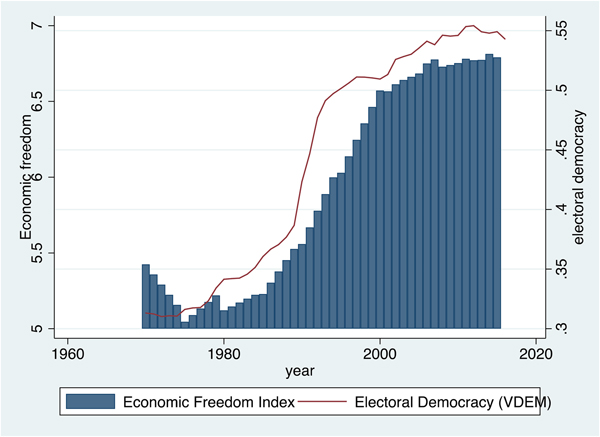
While empirical studies on religions’ influence on the economy, particularly in terms of corruption and economic growth, are plentiful, there is very little focus on religion and economic freedom (Ianaccone Reference Ianaccone1998; Barro and McCleary Reference Barro and McCleary2003; Noland Reference Noland2005; Broms and Rothstein Reference Broms and Rothstein2017). A very recent study examines this issue using cross-sectional data averaged over the period 2001 and 2010 (Hillman and Potrafke Reference Hillman and Potrafke2018). They find that a higher percentage of Muslims have no effect on economic freedom, whereas a larger share of Protestants predict higher economic freedom (Hillman and Potrafke Reference Hillman and Potrafke2018). Surprisingly, they find that religiosity conditions the effect of Protestantism negatively on economic freedom compared with Islam. This carefully constructed, highly insightful study, however, has one serious omission, which is that they fail to control for petroleum production, which could have been a confounding factor explaining Islam's effect on economic institutions and policy. Moreover, the cross-sectional design ignores the rather rapid change in the dependent variable that can be observed in the Index of Economic Freedom since about 1990 onwards (Gwartney et al. Reference Gwartney, Lawson and Hall2011). Figure 1 displays the trend in economic freedom mapped against the trend in electoral democracy (polyarchy) taken from the Varieties of Democracy Project (VDEM 2017).
Trend in the growth of economic freedom and electoral democracy, 1970–2016.

As seen there, economic freedom has progressed rather rapidly from around 1990, and quite unsurprisingly follows the trend in formal democracy very closely.
Moreover, Hillman and Potrafke's (Reference Hillman and Potrafke2018) results are based on a design of the religion variable that does not directly fit with theories on why culture matters for economic institutions. Recall that culturalists assume that religious values and mores are broadly dominant within a culture, which is a feature that is not captured by a measure of the share of the population alone. As an example, consider that Singapore has 3% of its population that are Protestant, clearly due to British colonial influence there. Saudi Arabia, however, has 0% Protestants. If only the share of the population is estimated, Singapore beats Saudi Arabia, but Singapore is clearly not culturally Protestant by objective standards. Likewise, if Muslims settled in large numbers in animist countries (in Africa largely), then the effects of animist beliefs may inform the economic freedom score, even if Muslims are only large minorities and do not represent the broader culture. It is, after all, the cultural dominance of a majority religion one should really care about given theoretical arguments based on the cosmological beliefs of religions and its influence on the political economy of countries. Then, one might also ask why Sunni Islam is not tested against other denominations of Muslims since Shia and other Muslim groups are likely to be large in many majority-Muslim societies, and results on economic outcomes might differ due to the mix of shares (Levendis Reference Levendis2014).
I have little specific criticism of Hillman and Potrafke's (Reference Hillman and Potrafke2018) pioneering study but seek to improve their design and measurement of culture by testing the effect of religion on economic freedom in several alternate ways. First, I use a more widely used measure of the share of the religious population, which is the World Religions Database, which reports the population share of every major religion and sect in quintiles from 1970 until 2010 (Maoz and Henderson Reference Maoz and Henderson2013). Second, given the vast literature on the “oil curse,” I enter a separate term for oil production for assessing the independent effect of Islam from structural factors such as oil wealth. Third, I enter a separate term for Sunni Muslim shares to capture differences between Sunni's and the Shia and other denominations of Muslims when replicating the Hillman and Potrafke study. Fourth, I assess the effects of religious dominance measured in terms of a clear majority by distinguishing dominance as religious share above 50% of the population. Fifth, I test an independent effect of the MENA region to sort out arguments about Ottoman legacies and Arab tribal legacies from the effect of a majority-Muslim society. The history, not to mention colonial legacies, of the Middle East are greatly different from Asia, where roughly 50% of all Muslims live. Sixth, I estimate time-series models that will capture the effect of religion on economic policies that can and have changed rapidly since the end of the Cold War (see Figure 1). Finally, I also test the effects of religion on each of the five component areas that make up the Index of Economic Freedom to ascertain exactly what aspects of economic freedom each of our religions of interest explain.
DATA AND METHOD
I use a time-series, cross-sectional (TSCS) dataset. These data are not balanced because not all countries have data for the entire period under study. The main dependent variable, the Economic Freedom Index (EFI), gradually increases its coverage over time, beginning in the 1970s (with roughly 50 countries covered) up until current times where coverage reaches roughly 150 countries (Gwartney et al. Reference Gwartney, Lawson and Hall2011). The data on the population shares of people identifying with one or another religion end in 2010 (Maoz and Henderson Reference Maoz and Henderson2013). I use the period after the Cold War, or 1990 onwards, to avoid Cold War-related choices made by governments in terms of alliances, which might have affected the political economies of these countries, but importantly also because the cross-sectional variance almost triples since roughly 1990. Thus, most of the tests reported are for the period 1990–2010, but results using the entire period (1970–2010) do not challenge the basic conclusions.
The main dependent variable, economic freedom, is taken from the Fraser Institute. These data try to capture the degree of free-market capitalism defined as the degree to which countries have privately owned economic activity measured along several objective and subjective indicators categorized into five main areas. This index is associated with many positive social outcomes, such as economic growth and human development (Berggren Reference Berggren2003, de Haan et al. Reference de Haan, Lundstrom and Strum2006, Easterly Reference Easterly, Gwartney, Lawson and Easterly2006), political liberty and respect for human rights (de Soysa and Vadlamannati Reference de Soysa and Chaitanya Vadlamannati2011), generalized social trust (Berggren and Jordahl Reference Berggren and Jordahl2006), and social peace (de Soysa and Vadlamannati Reference de Soysa, Chaitanya Vadlamannati, Gwartney, Lawson and Hall2014). These data are available in 5-year intervals over the period 1970–2000, and on a yearly basis thereafter. I linearly interpolate the missing years in between the quintile values. Since the score on EFI changes slowly between the 5-year periods, the interpolated values should not be problematic from the perspective of estimating cross-sectional variation.
The five sub-indices are in turn made up of roughly 35 components of objective indicators. The sub-component indices are averaged to determine each component. The five area indices are then averaged to derive the summary index for each country. The final index is then ranked on a scale of 0 (not free) to 10 (totally free).Footnote 1 The mean value of EFI in our sample is 6.1 with a standard deviation of 1.3, and a maximum value of 9.23 (Singapore) and a minimum value of 1.82 (for Nicaragua).
The main independent variables measuring culture are the share of the population that are Muslim and Christian, but I also enter the share of the Protestant population to test the “Protestant ethic” directly. Thus, the partial effect of the Christian variable captures largely the effect of Catholic and Orthodox Christians when the Protestant share is in the model. Likewise, I also use the share of the population Sunni to capture special Sunni effects relative to other Muslim groups. Unlike Hillman and Potrafke (Reference Hillman and Potrafke2018), who only use the share of the religious populations, I create a religious dominance effect by creating a discrete variable taking the value 1 if one of our religions of interest is above 50% of the population and 0 if not. The second main independent variable is “religiosity,” which is taken from a Gallup Poll that surveys the importance of religion to people around the world. Hillman and Potrafke (Reference Hillman and Potrafke2018) use a measure that relies on the Gallup Poll gathered by Berggren and Bjørnskov (Reference Berggren and Bjørnskov2013). I take the percentage of people that answered “yes” on the question “is religion important in your life” as my religiosity variable.Footnote 2 My data correlate at r = 0.99 with Berggren and Bjørnskov's data.
I assess the spuriousness of religion working through several important confounders. I keep the models simple in order to avoid overfitting the models and make the results easier to interpret by simply using two basic variables in a baseline model (Achen Reference Achen2005). First, I enter per capita income, which is a catch-all variable for the history of development, poverty of institutions, and even religiosity, as increasing development increases secularism. Importantly, development explains the level of economic freedom. Second, I add population size since large countries are likely to have larger shares of the dominant world religions, such as Christians and Muslims, and larger countries are also likely to be less economically free because of increasing returns from economies of scale, which affects such factors as openness to trade (Alesina and Spolaore Reference Alesina and Spolaore1997). Per capita income (constant $2010) and populations size are sourced from the World Development Indicators online database (World Bank 2018).
To this baseline model, I add the religion variables and include the potential confounders in a stepwise manner. Importantly, the first control is the production of petroleum sourced from the Ross–Mahdavi dataset (Ross and Mahdavi Reference Ross and Mahdavi2015). I use petroleum production values per capita ($2014). This variable is logged to reduce skewness. Recall that the only available comparable study on the topic to date does not control for the production of oil (Hillman and Potrafke Reference Hillman and Potrafke2018). Since the effects of oil and Islam should be tested against the regional effect of an area influenced by Ottoman cultural practices, I also include the MENA region. The list of MENA countries is in the Appendix. I leave Israel out of the MENA region because Jewish migrants from Europe who founded the state would not necessarily be influenced by Ottoman legacies. Third, I control for electoral democracy using the Varieties of Democracy Project's (VDEM) measure of electoral democracy, or polyarchy. Polyarchy measures the degree to which people can freely, fairly, and without violence and discrimination choose their elected leaders in a regularized process (VDEM 2017). In a final step, I enter a measure of ongoing civil war, which might relate to both oil production and the MENA region and the history of peace, since political violence and instability are likely to affect economic freedoms and vice versa. I create a dummy variable for Western countries, which takes the value one if one is located in Western Europe, North America (USA and Canada), and Oceania (Australia and New Zealand), and 0 if not (16 countries).
TSCS data typically have complicated correlation patterns across and within units because they are pooled observations across space and time, which may yield biased and inefficient estimates. Thus, I control for autocorrelation in standard ordinary least square (OLS) estimates by accounting for Newey–West standard errors, which are robust to heteroscedasticity and serial correlation (Newey and West Reference Newey and West1987).Footnote 3 I also estimate an independent effect of time by including year dummies because economic freedom trends over time with other controls, such as democracy and income. Since our measure of the share of the religious population is time-invariant, or in some cases change by minute amounts, I cannot include country fixed effects to account for any unmeasured unit-specific fixed effects because of the problem of Nickell bias (Nickell Reference Nickell1981).Footnote 4 In robustness tests, however, I also check our basic models in hybrid fixed effects models, where I assume that the time-invariant religion variables to have a constant effect on economic freedom and assuming that the other controls do not. Then I estimate the within and between effects separately and then add them in a basic OLS regression (Allison Reference Allison2009). This method, especially for linear models, is found to be accurate and consistent. First, however, I replicate Hillman and Potrafke's study using my data and the TSCS setup from 1970 onwards.
RESULTS
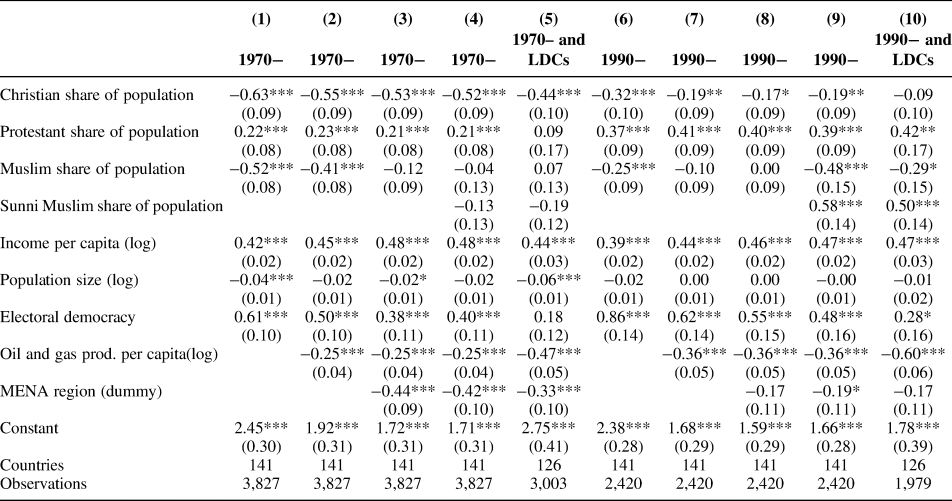
Table 1 replicates the Hillman and Potrafke (Reference Hillman and Potrafke2018) study, where I use the population shares of religious denominations rather than religious dominance (>50% of the population) to measure religious culture. The only difference is that I add the Sunni population share to capture differences between the Sunni's and others. Recall that I use a pooled data setup unlike Hillman and Potrafke, who use cross-sectional analysis with data averaged over the 2001–2010 period. I first test the entire period from 1970 onwards and then the post-Cold War period (>1989), which has a far greater cross-sectional coverage in comparison with the previous years.
The effect of religious population shares on economic freedom from 1970 and from 1990 onwards (until 2010)

Standard errors in parentheses.
***p < 0.01, **p < 0.05, *p < 0.1.
Time fixed effects estimated.
As seen in columns 1–5, when the population shares are tested for the entire period, the Protestant share is positive and statistically significant while neither the Muslim share nor the separate Sunni share matter. These results for the entire period from 1970 mirror the results reported by Hillman and Potrafke (Reference Hillman and Potrafke2018). Notice, however, that in column 5, the Protestant share loses statistical significance when 15 Western countries are dropped from the model. In columns 6–10, however, when we test only the period after 1989 onwards, the share of the population Protestant and the share of the Sunni population are both positive and statistically significant in a full model. These results hold for the full sample and for the sample of only non-Western countries. Thus, while the basic conclusions of Hillman and Potrafke (Reference Hillman and Potrafke2018) are supported, it seems that Sunnis and Protestants have common preferences for greater economic freedom while the rest of the Christians and Muslims do not. The issue of course is whether population shares can really capture a broader representative culture's institutional and policy environments.
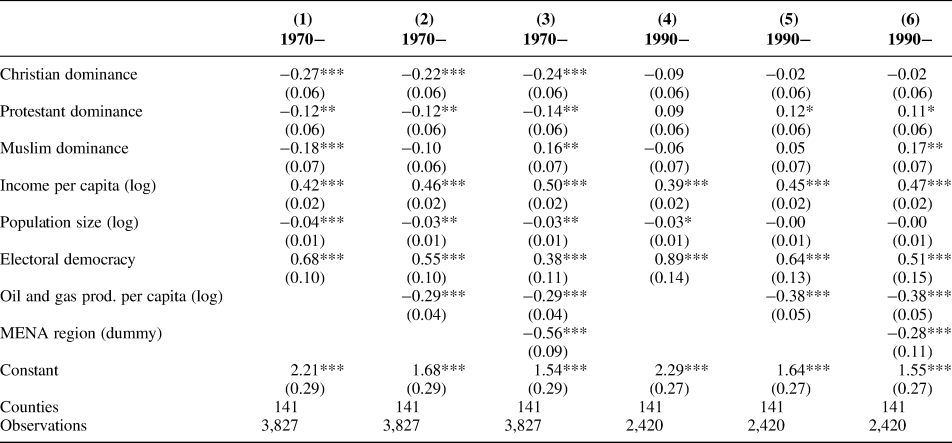
In Table 2, I present results using my preferred religious dominance variables for the full time period and the period after 1989.
The effects of religious dominance on economic freedom from 1970 and 1990 onwards (until 2010)

Standard errors in parentheses.
***p < 0.01, **p < 0.05, *p < 0.1.
Time fixed effects estimated.
As seen in column 1, Christian, Protestant, and Muslim dominance show negative and significant effects on economic freedom, with Protestant dominance showing the least negative effect substantively. However, in column 2, the effect of Muslim dominance washes out when oil production enters the model. Interestingly, when the MENA region enters the model in column 3, the Muslim dominance variable turns positive and is now statistically significant. The two Christian variables remain negative and statistically significant. Notice, however, in columns 4–6, when the post-Cold War period (1989 onwards) is used, both Protestant dominance and Muslim dominance are positive and statistically significant in the full model, with Muslim dominance showing a stronger effect both statistically and substantively.
In both tables, each of the control variables all show reasonable results. Income per capita and democracy increase economic freedom while petroleum production and country size reduce it. Petroleum production shows a highly significant negative effect in every model. Importantly, however, while I can replicate the results of Hillman and Potrafke's (Reference Hillman and Potrafke2018) study using population shares, I also find that the population share of Sunni Muslims have the same positive effect as Protestants. When religious dominance is used, the Muslims show far more robust positive effects on economic freedom even when oil and the MENA region are controlled, and when the longer and shorter time periods are used. Remember also that the positive effects of the Protestant population share wash out when a dummy variable capturing Western countries are used.
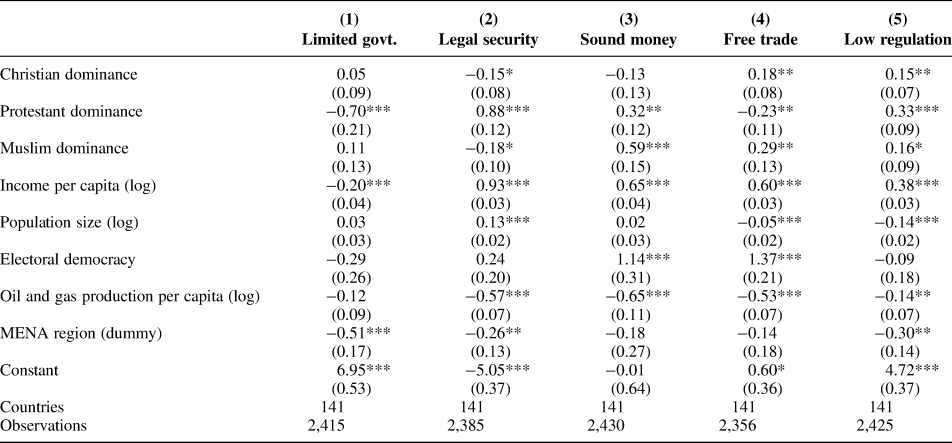
Next, I turn to the tests of religion on the component areas of economic freedom (see Table 3). What aspects of economic freedom as measured by the index are affected by each of our religions and in what ways? I continue with the time period after 1989 because of the better cross-sectional coverage from 1990 onwards.
The effects of religious dominance on the component areas of economic freedom, 1990 onwards (until 2010)

Standard errors in parentheses.
***p < 0.01, **p < 0.05, *p < 0.1.
Time fixed effects estimated.
In Table 3, column 1, when limited government is analyzed, the effect of Protestant dominance is negative and statistically highly significant, while Islam has no significant effect. Protestant dominance predicts larger government, most likely capturing the fact that largely Protestant Western Europe, especially the Scandinavian countries, have large welfare states, large state-owned enterprises, and policies that regulate the economy. While income levels also show a negative effect and democracy does not, it is hard to pin down what exactly might be driving this effect. The MENA region also shares the same taste for bigger government as do the Protestants, so Ottoman legacies of the MENA region are shared on this dimension with Western Europe, while Muslim dominance has no effect on the size of government. This similarity goes against the grain of culturalist explanations that often see grand divides between Protestant Europe and the Middle East.Footnote 5
In column 2, the effect of Protestant dominance is strongly associated with higher respect for property rights and the rule of law, independently of the level of wealth. These results support studies that examine other indicators of governance, such as corruption (Guiso et al. Reference Guiso, Sapienza and Zingales2006; Tabellini Reference Tabellini2010; Broms and Rothstein Reference Broms and Rothstein2017). Both Islamic countries and other Christian countries are weakly negatively associated with legal security and property rights respect, and oil production and the MENA region are also associated with lower legal security and respect for property rights. These results suggest that the Arab world might be cursed with poor institutions due to oil and other MENA legacies, such as the history of Ottoman rule when it comes to legal security. In the MENA region, governments are bigger, but rule of law is weak, whereas in Protestant-dominant countries, big government is accompanied by the rule of law. Perhaps the quality of government should not be judged entirely by size but on the basis of function and performance, as many experts have claimed (Tanzi Reference Tanzi2011). Market enhancing government is likely to ensure better outcomes from economic freedom than market constraining government.
In column 3, the effect of Muslim dominance is positive and significantly related to access to sound money, which reflects good economic management. Notice that the Muslim effect is roughly twice the size of the Protestant effect, substantively. Both income level and democracy increase access to sound money, suggesting that majority-Muslim countries have good financial management, an indicator of more “progressive” economic governance. Interestingly, freedom to trade (internationally) is positive for other Christians and Muslims, but negative and significant in the case of Protestant dominance, a result that challenges views about individualist Protestant ethics and institutions facilitating trade. While democracy and income level both associate with higher freedom to trade, population size and oil production reduce this freedom. Again, Muslim dominance and Protestant dominance are at odds here, but the sign of the relationship favors Muslim dominance given that free trade is a core liberal value. In column 5, the effect of all of the religion variables relate positively and statistically significantly with low business regulation, albeit the Protestant effect is the strongest.
Income level too correlates with low business regulation, independently of the Protestant effect, suggesting that poorer countries tend to regulate their business sectors to higher degrees than do richer states, which contradicts arguments in the globalization debate suggesting that corporations seek lower regulations when they move to the South. All in all, the results in Table 4 suggest that majority-Muslim countries share a great deal of commonality with majority-Protestant and majority “other” Christian countries when it comes to the components of economic freedom, even outdoing the Protestants on some dimensions of capitalist institutions. Protestant-dominant societies predict the rule of law and respect for property rights. Here again, while there is a Protestant advantage, Islam seems no worse than “other” Christians. Notice, however, that petroleum production is negatively related to economic freedom across all the component areas of the index, which is a clear support for an “oil curse” explaining poor economic policies and institutions.
The effects of religious dominance on alternative measurements of inclusive economies (VDEM), 1990 onwards (until 2010)

Standard errors in parentheses.
***p < 0.01, **p < 0.05, *p < 0.1.
Time fixed effects estimated.
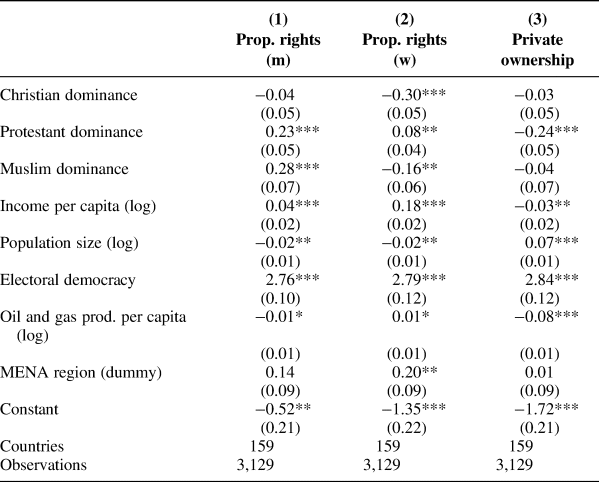
Could these results be an artifact of the sample of countries in the EFI and idiosyncrasies associated with the indicators used by the constructors of this index, such as the gradual increase in the coverage of countries over time? Thus, as an alternative, I use property rights respect for men and women measured separately by the award-winning VDEM data program, which uses expert opinion and sophisticated validating processes in the construction of their data (VDEM 2017). I also use VDEM's measure of “private control over the economy,” which they use as part of their construction of egalitarian democracy to capture the extent to which rulers/states and state agents control economic resources.Footnote 6 The results using the VDEM data are presented in Table 4.
As seen in column 1, both Muslim dominance and Protestant dominance are strongly correlated with private property rights for men, whereas other Christians are not any different to all other religious groupings. Naturally, democracy and income level are both supportive of stronger private property rights for men. In column 2, however, while Protestant dominance shows a weak positive effect on private property rights for women, Muslim dominance has a strongly negative effect, but interestingly, the Muslim effect is half the size of the other Christians when compared with all other religious groupings, including non-religious people.Footnote 7 This result supports others that find that Islamic countries show illiberal attitudes in terms of gender roles in society, independently of oil production and other structural factors (Norris Reference Norris2011; Gouda and Potrafke Reference Gouda and Potrafke2016). Again, the level of income and democracy have the strongest impacts on the private property rights of women, which is hardly surprising. Finally, in column 3, when the degree of private ownership of the economy is tested, Protestant dominance shows a strongly negative effect, results commensurate with those reported above when the individual components of the EFI are used. Big, intrusive government seems to be robustly related to the Protestant ethic, results that are somehow untenable with the position that it is Protestantism that drives rugged individualist behavior underpinning private entrepreneurship—if Protestantism drives the “spirit of capitalism,” it is a form of capitalism that seems to encourage large government and restrict free trade, independently of the effects of the control variables, such as wealth, democracy, and the production of oil. Using entirely different data collected by a different entity, thus, my results confirm the view that Muslim-majority countries show strong associations with the aspects of free-market capitalism jointly shared with Protestant-dominant societies and Muslims do even better than Protestants when it comes to government involvement in the economy and free trade.
CHECKS FOR ROBUSTNESS
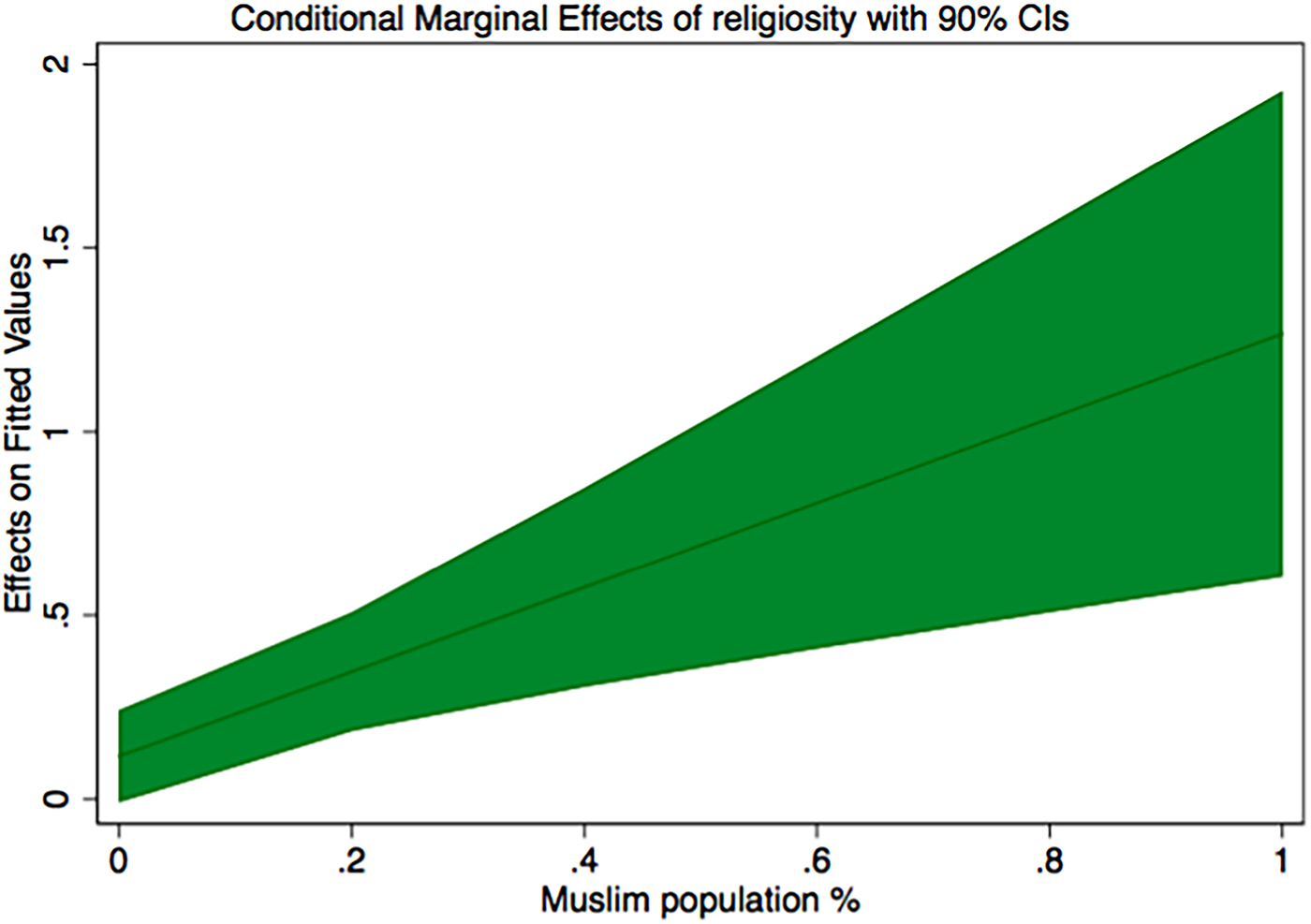
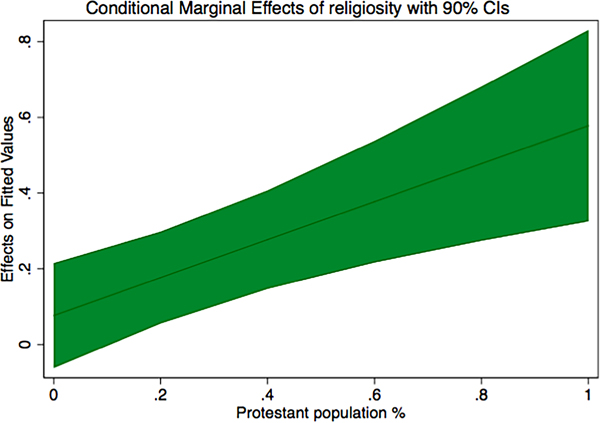
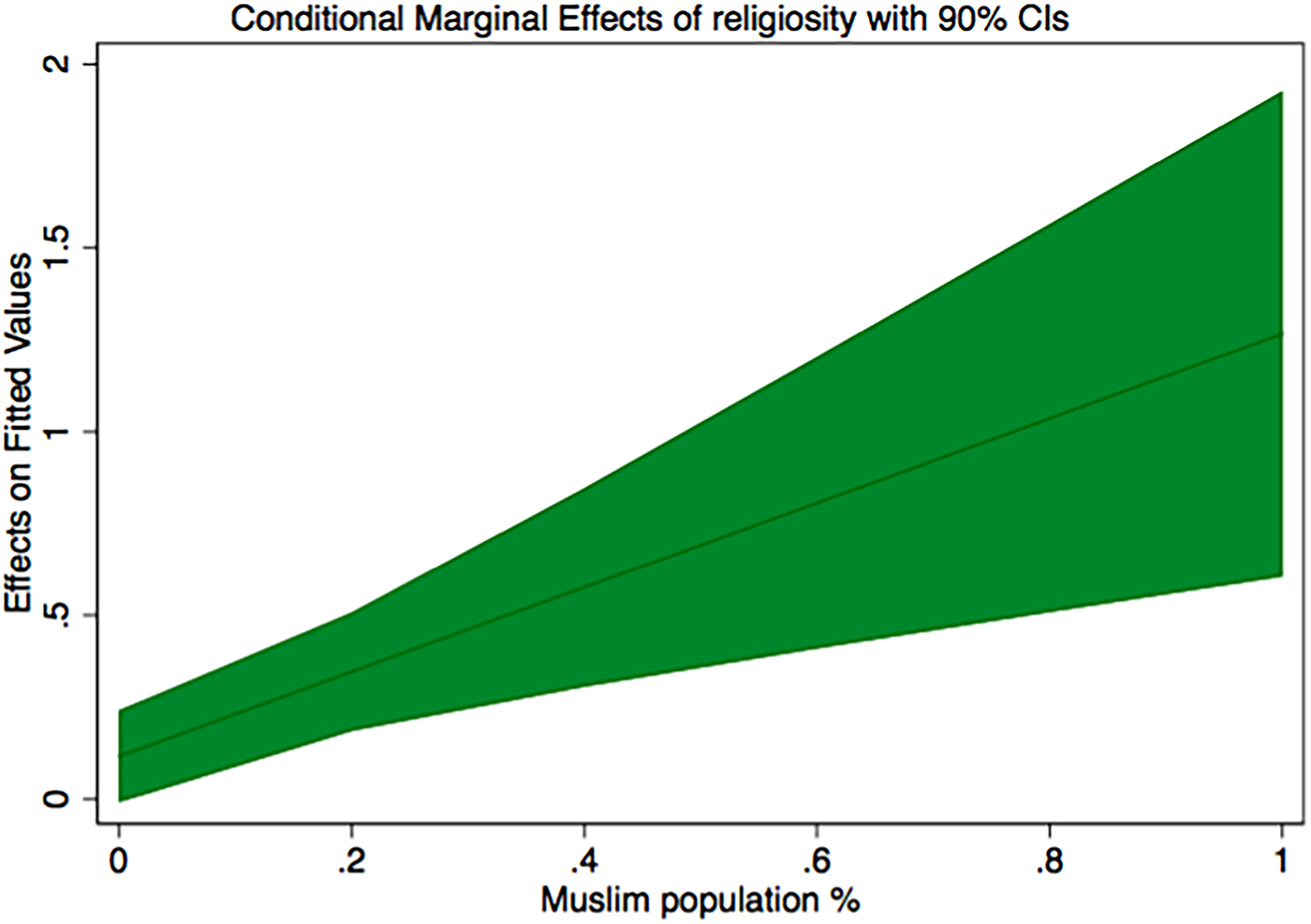
I run several different tests of robustness to ascertain the uncertainties associated with the basic findings presented in Table 2, using the extended sample and the more complete models.Footnote 8 I test the effect of religiosity more thoroughly to assess my results against Hillman and Potrafke (Reference Hillman and Potrafke2018). First, I use my religious dominance variables and religiosity in my basic extended model using just per capita income and the oil producer dummy as controls. Neither religiosity nor any of the religion variables are statistically significant. Income level and oil production are both statistically highly significant and carry all of the load explaining economic freedom. Second, I run the same models with Hillman and Potrafke's preferred population share variables. The result on religiosity is almost always positive and statistically significant when income per capita enters the model, suggesting that religiosity on its own captures largely poverty. Third, like them, I interact the share of the Muslim population and the share of the Protestant population with religiosity, using my extended models for the extended time period. In both cases, the effect of religiosity and the share of the religious populations are positive and statistically significant, results that contradict their conclusions about conditional effects (see margin plots in Appendix Figures A1 and A2).
Next, I estimate my results without Western Europe, North America, and Oceania, the so-called WENAO countries, which are all industrialized democracies with largely Western European heritage. The effect of Muslim dominance relative to others remains positive and highly significant, as is the effect of Protestant dominance, but the effect of other Christians is not significant. It is noteworthy that when the WENAO dummy is included, the effect of Protestant population share washes out, tentatively indicating that the Protestant share largely captures colonial influence rather than Protestant culture. Next, I test a dummy coded variable taking the value 1 if a country was a former Communist bloc state, since these countries have suffered a long period of economic repression. The effect of Muslim dominance becomes statistically more significant and remains positive, while the effect of Protestant dominance loses statistical significance. Next, I enter a term for religious fractionalization in the basic model because of arguments suggesting that fractionalization can reduce the coordination necessary for good economic institutions (Easterly and Levine Reference Easterly and Levine1997; Alesina et al. Reference Alesina, Devleeschauwer, Easterly, Kurlat and Wacziarg2003). Contrary to pessimistic arguments, the effect of religious fractionalization is positive and highly significant on economic freedom, results that are similar to ethnic fractionalization reported in previous research (de Soysa and Vadlamannati Reference de Soysa and Chaitanya Vadlamannati2017). The positive and significant effect of Muslim dominance and Protestant dominance remain unchanged.
Next, I run my basic model for the extended years in a hybrid, or between-within model following the advice of Allison (Reference Allison2009). Essentially, you manually demean the x variables by subtracting the mean values from the individual units, so that the within and the between effects of each of the variables are estimated together with the time-invariant variable in a random-effects regression. Since the effect of the time-invariant variables should be the same at any point in time, its effects for each year are now estimated relative to the between and within effects of all the time-varying variables in the model, in this case per capita income and democracy. Running such a hybrid model does not change the positive and statistically significant effect of Muslim dominance. I also change the threshold of 50–60% and 70% to measure dominance, but the basic results remain unchanged when I use the new thresholds. Next, I disaggregate the Christian measure into Roman Catholic, Orthodox, and other, leaving the Protestant share out as the reference category and run the results on the basic extended model. It seems that Anglicanism has a positive and significant effect while Catholics, Orthodox, and others have negative and statistically highly significant effects. Islam's effect is now statistically not significant, which is not surprising because the other Christians and Catholics are carrying all the negative effects. Moreover, being Anglican and perhaps being a colony might be more important for predicting the success of capitalist institutions than simply being Protestant alone, possibly working through English education (Woodberry Reference Woodberry2012). Finally, I test for multicollinearity by running the Variance Inflation Factor (VIF) scores, which are all below the problematic value of 10, suggesting that my basic model does not suffer from any multicollinearity.
Essentially, my results do not suggest that majority-Muslim countries are problematic for building free-market capitalist institutions. Rather than broad cultural factors, such as religion, however, there is consistent evidence to show that structural conditions, such as income level and petroleum production have stronger, more robust effects on economic freedom and its component areas than culture, which in most results obtained here point in the opposite direction to that which is expected from pessimistic theories about Islam's penchant for “sultanism,” family values, attitudes of trust, and achievement motivation, etc. Petroleum wealth, not religion, seems to be the real “curse” even though some report that even petroleum might be leading to structural changes in the Muslim world that drive demands for political reforms (Gurses Reference Gurses2009). While many of the tests support the Protestant ethic argument, these results are not robust, sometimes even pointing in the opposite direction, where majority-Muslim countries do better than do protestants, particularly when extending the analyses back to 1970 and when income level is controlled. The results on religiosity are the opposite of that expected by culturalists in arguments about secular outlooks and the development of capitalist institutions. Religiosity shows positive effects independently on economic freedom, and religiosity conditions both Muslim and Protestant population shares positively in predictions of economic freedom.
CONCLUSIONS
Recently, there has been renaissance in the study of culture for explaining economic outcomes, particularly in the field of economics (Guiso et al. Reference Guiso, Sapienza and Zingales2006; Tabellini Reference Tabellini2010; Alesina and Guiliano Reference Alesina and Guiliano2015). Much of this revival of interest seems to be based on an uncritical acceptance of notions such as trust and social capital being critical determinants of desirable outcomes, such as good market-based economic governance. Much of the criticism of social capital arguments by structuralists, including direct criticism of the methods, data, and inference of the most prominent social capital arguments, seem to be ignored (Jackman and Miller Reference Jackman and Miller1998). Moreover, the debate this time around, as it has been in the past, seem to be based on post-hoc reasoning about some past historical factors that has shaped culture, which is resistant to change. One could of course find just about anything in history to explain current phenomena. Islam, perhaps again because of its news-worthiness for other reasons, is distinctly identified as antithetical to liberal values. Very few large-N empirical analyses have directly tested how Islam might predict free-market capitalist institutions, despite a heap of literature on Muslim distinctiveness in political and social life. Hillman and Potrafke's (Reference Hillman and Potrafke2018) recent study is the only exception. They do not find any effect of Islam on capitalist institutions, but they find ample evidence for a protestant ethic, and they report a negative effect from religiosity conditionally on lower economic freedom. Despite the ambiguity of their findings on Islam, they are bold enough to conclude that Protestant countries might be affected in the future by increased immigration, particularly from Muslim regions. My results show, contrarily that majority-Muslim countries are likely to be leaders rather than laggards when it comes to free-market institutions and policies.
This study has replicated and extended the analysis of religion's and religiosity's effects on economic freedom and the components areas of the EFI by using data measured over time. Importantly, rather than just examine the population share of a particular religion, I have estimated a theoretically more appropriate measure by examining religious dominance defined as 50% or more of a population. The results show highly mixed effects, with majority-Muslim countries sometimes even outperforming the Protestant countries and other Christian groupings. Curiously, when testing the component areas of the EFI, Protestantism associates negatively with limited government and free trade, two critical aspects of economic freedom. Indeed, the entire Protestant ethic seems to be based on the component area of legal security and property rights. Islam, on the other hand, though showing a small negative effect on legal security and property rights for women especially, seems to support economic freedom on every other component area, interestingly in the area of access to sound money, freedom to trade, and lower business regulation. Moreover, religiosity in my analyses show positive, not negative effects, both independently and conditionally with the population share of both Islam and Protestantism. It seems that the current culturalist project, like that which Max Weber began, might be potentially mistaken when culture and religion become overemphasized for explaining economic life. Future studies might dig deeper into what other factors, including the geopolitics of the MENA region, the Saudi-Iranian geopolitical struggle, the production of petroleum, great power interests, and neighborhood dynamics associated with the Israel–Palestinian questions, might be affecting economic and political outcomes independently of cultural factors in the Arab world.
Appendix
See Figures A1 and A2.
Margins plot of the conditional effects of the share of the Muslim population and religiosity on economic freedom, 1990–2010.
Margins plot of the conditional effects of the share of the Protestant population and religiosity on economic freedom, 1990–2010.