INTRODUCTION
Large tracts of arid and semi-arid lands of African and Middle Eastern countries cannot be cultivated, but can be used by pastoralists to raise livestock, mainly sheep, goats and camels (Degen et al. Reference Degen, Benjamin and Hoorweg2000a). However, unpredictable rainfall and low primary production make the raising of livestock in these areas tenuous. Even in favourable rainfall years, animal performance can be poor due to lack of adequate energy intake in the dry season.
These areas are widely regarded as having been overgrazed and are under threat of desertification (Le Houérou Reference Le Houérou and Le Houérou1980). The flora is characterized by the relative abundance of shrubs and trees, but a scarcity of herbaceous species on which grazing livestock are dependent for their nutritional needs. This situation has arisen because herbaceous species have been severely overgrazed, while shrubs and trees have hardly been affected (Noy-Meir & Seligman Reference Noy-Meir, Seligman and Walker1979).
The foliage of many desert shrubs and trees remain green year-round, even during drought, and often contain high crude protein (CP) content. As a result, it has been suggested that such foliage could be useful as feed for livestock in arid and semi-arid areas (Lefroy et al. Reference Lefroy, Dann, Wildin, Wesley-Smith and McGowan1992). In general, however, limited success has been achieved with the use of shrubs and trees as livestock fodder because of low animal intake (Degen et al. Reference Degen, Becker, Makkar and Borowy1995, Reference Degen, Benjamin, Mishorr, Kam, Becker, Makkar and Schwartz2000b). This has been attributed, among other reasons, to the presence of anti-nutritional factors (Makkar Reference Makkar, Gill, Owen, Pollott and Lawrence1993; Degen et al. Reference Degen, Benjamin, Abdraimov and Sarbasov2002), which include a wide range of phenolics that, apparently, protect trees and shrubs from herbivores (Lindroth Reference Lindroth and Spencer1988; D'Mello Reference D'Mello1992).
There is evidence that both sheep and goats are highly selective when offered a mixed diet (Wahed & Owen Reference Wahed and Owen1986). However, sheep are primarily grazers, whereas goats are intermediate feeders (Ngwa et al. Reference Ngwa, Pone and Mafeni2000) and they differ in their dietary selection (Omphile et al. Reference Omphile, Aganga, Tshireletso and Nkele2004; Celaya et al. Reference Celaya, Oliván, Ferreira, Martinez, Garcia and Osoro2007), feeding behaviour and in their physiological characteristics that are related to feed utilization (Hofmann Reference Hofmann1989). Goats are better able to use feeds containing secondary anti-nutritional agents, such as tannins (McArthur et al. Reference McArthur, Hagerman, Robbins, Palo and Robbins1991, Reference McArthur, Robbins, Hageman and Hanley1993), and they feed on trees and shrubs more readily than do sheep (Sanon et al. Reference Sanon, Kaboré-Zoungrana and Ledin2007). Although there is some overlap in their dietary selection, their intakes can differ substantially and can complement each other. Consequently, to take better advantage of natural pasture and use more of the vegetation as feed, sheep and goats are often raised together in many free-ranging systems (Animut & Goetsch Reference Animut and Goetsch2008).
Today, there are c. 200 000–300 000 sheep and goats in the Negev Desert. The sheep are predominantly Awassi, a fat-tailed, triple-purpose breed that is well-adapted to desert conditions, and the goats are cross-breds, known locally as baladi or Negev, and derived mainly from the Sinai and Mountain breeds. Sheep and goats are generally raised by Bedouin as mixed flocks of 50–200 head, although there are several flocks of over 500 head (Levinson & Yogev Reference Levinson and Yogev2004). Natural pasture can provide the main dietary source for these small ruminants and makes this enterprise viable for many Bedouin. Most flocks free-range away from the Bedouin homestead from about February, following winter rains and the emergence of herbaceous plants, and continue to free-range as long as possible. With the drying out of the herbaceous vegetation, the Bedouin often supplement with a combination of chopped wheat straw, barley grain and wheat chaff. The sheep have to be returned to the homestead by October for compulsory vaccinations (Degen et al. Reference Degen, Benjamin and Hoorweg2000a).
For the current study, a mixed flock of sheep and goats was observed from the emergence of herbaceous vegetation until after it dried out. Based on the foraging habits of sheep and goats, it was predicted that goats would spend more time browsing and that their dietary selection would contain a higher proportion of browse than would sheep. To test these predictions, foraging behaviour and dietary selection of sheep and goats shepherded in the Negev Desert was measured.
MATERIALS AND METHODS
Study site
The study was conducted in the Negev Desert, about 4 km northeast from the city Beer Sheva (31°23′N, 34° 78′E, 207 m asl). The Negev is characterized by a short annual growing season following winter rains, mainly from November to March. Average annual rainfall at the study site is 204 mm. Seasonal plant development and biomass production depend on the amount and distribution of rainfall and on soil nutrient availability. Before rain, herbage ground cover is often grazed out completely. After the onset of significant rains, germination and emergence occur after 5–15 days, depending on air temperature. Vegetation development is slow in December and January due to low temperatures, but increases exponentially with rising air temperatures and can achieve rates of 17 g dry matter (DM)/m2/day in March. The period of plant growth can vary from 5 weeks to 5 months, depending on rainfall distribution (van Keulen et al. Reference van Keulen, Seligman and Benjamin1981). Herbaceous vegetation dries out quickly and decreases markedly in quality by increasing fibre contents and decreasing CP contents (Van Soest Reference Van Soest1982).
Herbaceous vegetation biomass and plant chemical composition
Available herbaceous vegetation biomass was determined once each week from the last week of January (W1) to the last week of March (W9), that is, on nine occasions, following Tadmor et al. (Reference Tadmor, Brieghet, Noy-Meir, Benjamin and Eyal1975). In brief, during each measurement, biomass in a 62 500 mm2 area (within a 250×250 mm2) in 20 random field samples was estimated visually then measured by weighing. In addition, the biomass of another 100 random samples was estimated only visually. Linear regression of visual estimations on measured biomass (n=20) was used to correct the visual estimations (n=100) and the 120 total samples were used to estimate biomass availability. This method allows an increase of sample numbers without harvesting many samples.
Chemical composition of main plant species (whole herbaceous plants, leaves of shrubs and trees) was measured during W5, the mid-point of the study. Samples from six randomly selected plants of each species were pooled, air-dried and then ground to pass through a 1 mm sieve prior to analysis. DM content was determined by drying fresh plant samples at 60°C to constant mass. Higher temperatures are not recommended because phenolics can be inactivated directly and/or can bind with fibre. In addition, drying samples at 50°C and 80–90°C was compared and no difference in DM content was found (Degen et al. Reference Degen, Benjamin, Mishorr, Kam, Becker, Makkar and Schwartz2000b). Samples were analysed for nitrogen (N) concentration by the Kjeldahl method and CP was calculated as 6·25×N (AOAC 1984). In addition, neutral detergent fibres (NDFs) and acid detergent fibres (ADFs) (AOAC 1984; Van Soest et al. Reference Van Soest, Robertson and Lewis1991) and condensed tannins (Landau et al. Reference Landau, Dvash, Decandia, Cabiddu, Shapiro, Molle and Silanikove2004) were also determined.
Sheep and goats, foraging behaviour and forage selection
A mixed flock of 64 Awassi sheep and 47 Negev goats shepherded by two Bedouins was studied. The animals were watered, then free-ranged on natural pasture for 11 h daily, from 07.00 to 18.00 h, after which time they were watered and corralled overnight. Six males of each ruminant species served as focal animals for time activity budget measurements. Foraging behaviour observations of the sheep and goats was made during W2, W3, W4, W5, W6, W8 and W9 of the study. Each of the focal animals was observed for 5 min every hour for 2 days per week. Time spent grazing, browsing, standing, walking and sitting were recorded.
Proportional dietary food composition was determined using n-alkane faecal analysis in comparison with n-alkane profiles of available plants. Faecal grab samples of each of the six focal sheep and six focal goats were taken twice daily, once in the morning and once in the evening, during W4, W5, W6 and W8, and then all samples within each animal within each week were pooled. In addition, three samples from each plant were collected each day and pooled per week. Pooled faecal and vegetation samples were dried at 60°C to constant mass.
Botanical composition of the diet was based on internal markers, C27–C35 n-alkanes (Elwert et al. Reference Elwert, Dove and Rodehutscord2008). N-alkanes were extracted from 1 g DM of each faecal and plant sample and profiles were determined (Brosh et al. Reference Brosh, Henkin, Rothman, Aharoni, Orlov and Arieli2003). Samples were saponified for 17 h in 1·5 m ethanolic KOH at 90°C. N-alkane concentration was determined using a Varian 3300 gas liquid chromatograph with the following operating parameters: hydrogen carrier gas flow, 1 ml/s; split injection, 1:50; capillary column (DBI) 30 m long, 0·25 mm I.D.; injector temperature, 320°C. Oven programme conditions were initially kept at 280°C for 3 min and then raised to 320°C, at 5°C/min, for 3 min. Running time was 14 min. Detection was performed with a flame-ionization detector at 350°C, with n-alkane C34 (tetratriacontane) used as the internal standard. Statistical comparison between faecal n-alkane profile and specific vegetation n-alkane profiles were done using a suitable algorithm (Dove & Moore Reference Dove and Moore1995) and proportional dietary forage composition for sheep and goats were calculated following Brosh et al. (Reference Brosh, Henkin, Rothman, Aharoni, Orlov and Arieli2003). The current study aimed at comparing the proportion of herbaceous plants and browse selected between the sheep and goats. Therefore, herbaceous plants were grouped together and browse plants were grouped together for each ruminant species in each week. Total DM intake was not determined.
In vitro metabolizable energy (IVME) yield of plants
IVME yield of plant samples was estimated using the Hohenheim Gas method (Menke et al. Reference Menke, Raab, Salewski, Steingass, Fritz and Schneider1979; Menke & Steingass Reference Menke and Steingass1988). In this method, the gas production (GP) (CO2 and CH4) due to rumen fermentation of substrate to volatile fatty acids is measured when incubated with rumen liquor and the volume produced is used to estimate metabolizable energy yield (Menke & Steingass Reference Menke and Steingass1988). Rumen liquor and particulate matter were collected before morning feeding via a rumen fistula from two sheep and two goats fed on a roughage diet of mainly poor quality wheat straw and some lucerne hay; the liquor was homogenized, strained and filtered through glass wool. Incubation media were prepared as described by Menke et al. (Reference Menke, Raab, Salewski, Steingass, Fritz and Schneider1979). Samples of 200 mg DM were incubated in triplicate in 100 ml calibrated glass syringes in which 30 ml of the incubation media was added. The glassware was kept at 39°C and flushed with CO2 before use and the mixture was kept stirred under CO2 at 39°C. GP, as determined by piston movement, was measured over 24 h after correcting for GP due to rumen fluid alone. GP (ml/200 mg DM) and CP (g/kg DM) content were used to estimate IVME yield as follows (Menke et al. Reference Menke, Raab, Salewski, Steingass, Fritz and Schneider1979; Menke & Steingass Reference Menke and Steingass1988):

The major advantages of this method over in vivo trials are that only very small plant samples are needed and many measurements can be made simultaneously. In addition, the use of species-specific rumen fluid allows testing differences in food utilization between sheep and goats (Degen et al. Reference Degen, Kam, Pandey, Upreti, El-Meccawi and Osti2010).
Statistical methods
The objective was to compare differences in dietary selection and foraging behaviour between sheep and goats. To do so, matrices of Euclidean distances of the variables for each group were calculated, and a Mantel test (Mantel & Valand Reference Mantel and Valand1970; Sokal & Rohlf Reference Sokal and Rohlf1995) with 9999 iterations was used to calculate the probability of this comparison (GenAlex software package version 6 for Excel) within each period. Mantel test compares two matrices; significance of the test means that the matrices are similar to each other while non-significance means that the matrices differ from each other. This method has been used widely in many areas of biological research and is particularly well-suited for dietary selection studies. It is a non-parametric test that has been suggested as appropriate for comparisons when sample sizes are small (Luo & Fox Reference Luo and Fox1996) and has been proven to be superior to Pearson's correlation statistic (Dutilleul et al. Reference Dutilleul, Stockwell, Frigon and Legendre2000). Analysis of variance (ANOVA) was used to test for among periods and between animal species differences in foraging (Statistica 7.0, StatSoft Ltd, Milton Keynes, UK). Testing significant difference between slopes of regression analyses followed Sokal & Rohlf (Reference Sokal and Rohlf1995) and P<0·05 was chosen as the level required for significance. Values are presented as means±s.d.
RESULTS
Mean body mass of focal sheep and goats at the beginning of free-ranging in February was 41 (±6·7; n=6) and 33 (±5·7; n=6), respectively, and increased gradually to 44 (±4·8; n=6) and 37 (±4·9; n=6) at the end of the season (Table 1), indicating that the animals were in positive energy balance.
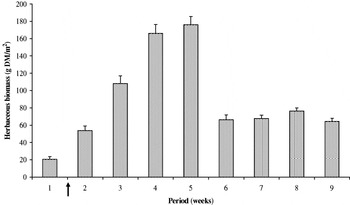
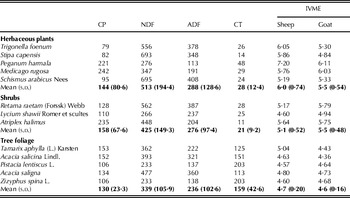
The plant species encountered are given in Table 2. Herbaceous vegetation biomass previous to winter rains in January (W1) was 20 g DM/m2 and increased rapidly, mainly due to emerging annuals, within 5 weeks to 180 g DM/m2 during February (Fig. 1). From the middle of the foraging period to the end of March, herbaceous vegetation decreased and, concomitantly, the vegetation available for sheep and goats changed from mainly herbaceous vegetation at the beginning of the foraging season to a higher proportion of shrubs and trees at the end of the season.
Herbaceous biomass of primary production at different weeks (see text for explanation). The arrow denotes start of grazing season for sheep and goats. Error bars represent s.d.; n=120 per sampling period.

Mean body mass (s.d.) of free-ranging sheep and goats at the beginning of each week (W) when foraging observations were made*

* Animal observations started in W2 and no observations were made in W7.
Fibre contents were higher in herbaceous plants than in shrubs and trees and condensed tannins were higher in trees than in shrubs and herbaceous plants (Table 2). IVME yield was higher in herbaceous plants and shrubs than in trees, but average IVME was similar between sheep and goat rumen fluids for each of the plant groups (Table 2).
Chemical composition (g/kg DM) and IVME yield (kJ/g DM) of the main plants available for sheep and goats

CP, crude protein; NDF, neutral detergent fibre; ADF, acid detergent fibre; CT, condensed tannins.
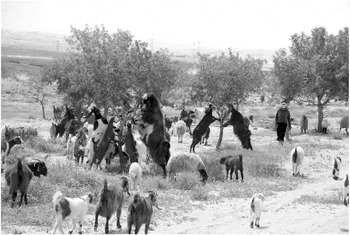
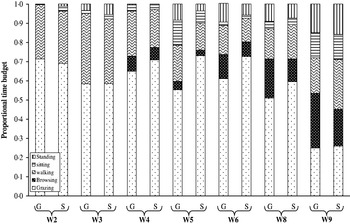
Within periods, sheep and goats spent similar proportions (P=0·575) of their time at pasture for foraging (both grazing and browsing); 0·69 (7·6 h) for sheep and 0·71 (7·9 h) for goats, at the beginning of the season (W2) and 0·45 (5·0 h) for sheep and 0·54 (5·9 h) for goats, at the end of the season (W9). However, there was a significant difference among periods in the time spent browsing (P<0·001). In W2 neither sheep nor goats browsed; browsing commenced during W4 when goats and sheep browsed 0·08 (0·9 h) and 0·07 (0·7 h) of the time allotted for foraging, respectively. Browsing increased to 0·20 (2·2 h) and 0·12 (1·3 h) during W8 and 0·29 (3·1 h) and 0·19 (2·1 h) during W9, for goats and sheep, respectively. At this latter period, grazing was reduced to 0·26 (2·9 h) in sheep and 0·25 (2·8 h) in goats of the time allotted for foraging (Figs 2 and 3). Comparison of time budget matrices using Mantel analyses showed a similar foraging pattern between sheep and goats from W2 (SS x=1·234; SS y=1·089; SP xy=1·158; R xy=0·99, P<0·005) until W8; however, this was not the case at W9 when different patterns (SS x=0·053; SS y=0·051; SP xy=0·011; R xy=0·202; P=0·214) emerged between these two ruminants. In this latter period, grazing time was similar between sheep and goats, but browsing time was higher in goats (Fig. 3).
Goats and sheep foraging in the Negev Desert after the herbaceous vegetation has dried up (end of March, W9 in this study). At this time goats are browsing more than grazing but sheep are still grazing more than browsing. Goats are browsing trees while sheep are grazing the sparse herbaceous plants.

Proportion of time allocated for grazing and browsing, and other activities in foraging sheep (n=6) and goats (n=6) at different weeks (see text for explanation).

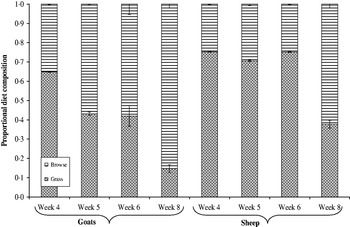
Dietary composition based on faecal n-alkane analyses during W4, W5, W6 and W8 revealed that herbaceous vegetation was composed of a higher proportion of dietary intake in sheep than in goats at all times (Fig. 4). In W8, both small ruminants consumed mainly browse, which contributed 0·85 of the DM intake in goats and 0·62 of the DM intake in sheep. The browse selected was mainly the two shrub species, Atriplex halimus and Lycium shawii.
Diet composition (±s.d.; n=6) based on faecal n-alkane analyses in foraging sheep and goats at different weeks; dark bar denotes herbaceous plants, horizontal lines bar denotes browse.

DISCUSSION
In the current study, a free-ranging mixed flock of sheep and goats was observed and the hypothesis was that goats would spend more time browsing and would consume a higher proportion of browse to herbaceous plants than would sheep. These predictions were only partly supported. In fact, for most of the season, the foraging pattern was similar between sheep and goats and only towards the end, at W9, did patterns differ significantly between these two ruminants. Herbaceous vegetation that emerged after winter rains were preferred by both sheep and goats, and were consumed exclusively for the first 2 weeks (W2 and W3). Differences in foraging pattern and in dietary selection between sheep and goats became apparent only when herbaceous plants dried out and availability decreased substantially.
The time spent foraging throughout this study was similar between sheep and goats in each period, between 5 and 9 h, and within the range reported in other studies of free-ranging, co-grazing sheep and goats (see review by Animut & Goetsch Reference Animut and Goetsch2008). In addition, the approximate amount of time spent foraging when at pasture, 0·50–0·70, for both sheep and goats in the current study was similar to findings for these ruminants foraging in the Sahelian area of Burkina Faso (Sanon et al. Reference Sanon, Kaboré-Zoungrana and Ledin2007). Also, the decline in time of foraging for both sheep and goats from February to March in the current study corresponded well with the decline in feeding in these small ruminants from the rainy to dry season in the Sahelian area (Sanon et al. Reference Sanon, Kaboré-Zoungrana and Ledin2007). However, in contrast to the current findings, goats in other studies did not change feeding time with season. For example, lactating goats in northern Senegal, a semi-arid area, foraged for over 0·80 of pasture time throughout the year (Cissé et al. Reference Cissé, Ly, Nianogo, Sane, Sawadogo, N'Diaye, Awad and Fall2002) and goats in Malawi, a semi-humid area, spent 0·33 and 0·37 of their time feeding in the wet and dry periods, respectively (Becker & Lohrmann Reference Becker and Lohrmann1992).
The current findings on foraging pattern differed from those in the Sahelian area, at least for goats. Goats in the current study generally grazed more than they browsed and, in fact, only grazed with abundant herbaceous vegetation. Only in W9 did they spend more time browsing than grazing, 0·29–0·25 of the foraging time allotted. In contrast, goats in the Sahelian area of Burkina Faso always browsed more time than they grazed, even in the rainy season when they consumed their highest proportion of herbaceous vegetation in their diet (Sanon et al. Reference Sanon, Kaboré-Zoungrana and Ledin2007). Likewise, goats in the Sahelian zone of Cameroon (Ngwa et al. Reference Ngwa, Pone and Mafeni2000) and in semi-humid Malawi (Becker & Lohrmann Reference Becker and Lohrmann1992) always browsed more than they grazed. Some of the differences found among sites in time spent grazing and browsing could be due to the shepherds, as their handling of the animals can affect dietary selection (Seim & Holand Reference Seim and Holand1999).
The foraging behaviour of sheep in the Sahelian zone was similar to that of sheep in the Negev in that at both sites sheep always spent more time grazing than browsing. In the Sahelian zone of Cameroon, sheep always grazed c. 0·67 of foraging time (Ngwa et al. Reference Ngwa, Pone and Mafeni2000) and in Burkina Faso ranged between a maximum of 0·93 in the rainy season and a minimum of 0·53 in the dry season (Sanon et al. Reference Sanon, Kaboré-Zoungrana and Ledin2007). The behaviour of the Negev sheep was also similar to that of sheep in a semi-arid area of South Africa. The sheep consumed only herbaceous vegetation in the wet season and included browse in the dry season only (Omphile et al. Reference Omphile, Aganga, Tshireletso and Nkele2004).
In a study by Papachristou (Reference Papachristou1997) of foraging behaviour of sheep and goats on native pasture in Mediterranean kermes oak shrublands, goats consumed a higher proportion of browse than herbaceous vegetation than did sheep, as was found in the current study. However, unlike in the current study, goats always consumed more browse DM than herbaceous DM, even in the wet seasons, and sheep always consumed more herbaceous DM than browse DM, even in the dry seasons (Papachristou Reference Papachristou1997). In the current study, dietary selection in W4, W5, W6 and W8 was measured. In W4, goats consumed relatively more dry herbaceous vegetation than DM of browse, but the opposite was found in the latter three periods. Yet the goats spent less time browsing than grazing in all these periods. Similarly, sheep in W8 selected proportionately more browse DM than herbaceous DM yet spent less time browsing than grazing. In W8, time spent browsing for goats was about 0·30 of time feeding, but browse intake was 0·85 of total DM intake and for sheep was 0·20 of time spent feeding and browse intake was 0·62 of total DM intake. This was because the herbaceous vegetation was sparse and dry and, consequently, time-consuming to forage. In contrast, browse was still green and abundant and much easier to forage. Thus, for both small ruminants, the intake of herbaceous vegetation was higher than browse in the rainy season but, at one point in the dry season, these intakes were reversed. Furthermore, browse selection increased from the rainy to the dry season in both small ruminants and was always higher in goats than in sheep.
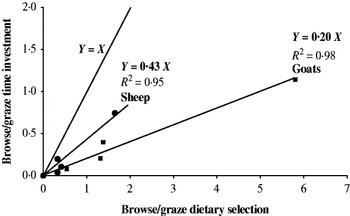
The ratio between the time allotted to browsing and to grazing and the ratio between the proportion of dietary browse to herbaceous plants consumed for the periods W4, W5, W6 and W8 were calculated. These ratios were used to estimate the dietary intake efficiency scope of the sheep and goats using regression analyses (Fig. 5). If grazing and browsing for a certain DM intake are equally time consuming, then the slope of the regression line should equal 1 (i.e. Y=X). The more time it takes to browse than to graze for a certain dietary item, the higher the slope should be. Both small ruminants were found to be more efficient in consuming browse than herbaceous vegetation. Goats, being intermediate feeders, were expected to be more efficient in consuming browse than were sheep, and hence, to have a lower slope. Indeed, the slope for goats was 0·20 and was significantly lower than the 0·43 for sheep (Fig. 5; Sb1–b2=0·0416, t=5·6382, P<0·01). The current approach estimates feeding efficiencies without measuring total DM intake and thus could be useful in comparing pasture utilization among different small ruminant breeds.
Browse to graze ratio of time investment v. dietary intake in foraging sheep and goats (see text for explanation).

We thank Abdullah Abou-Rachbah for technical help, Mussa Abu-Kaf for allowing us to observe his flock and his hospitality and Ali el-Assem for information on sheep and goat husbandry. We also thank an anonymous referee and the editor for helpful suggestions. The current study was supported in part by Israel's Ministry of Science and Technology.