Introduction
Landraces (LRs) have evolved under continuous natural and farmer selection practices in farmers' fields, and are the progenitors of modern crop varieties used by farmers around the world (Harlan, Reference Harlan1972). Today, they represent an important source of novel alleles for crop improvement. In the poorer nations of the world and in areas that are environmentally heterogeneous and isolated from markets, many farmers still rely directly on the genetic diversity they sow for food and fodder as well as the next season's seed.
Semi-dwarf rice varieties now occupy an estimated three-quarters of the area in which the crop was domesticated, although ancestral varieties can still be found in upland areas (Vaughan and Chang, Reference Vaughan and Chang1992; Jackson and Khush cited by Gauchan et al., Reference Gauchan, Smale and Chaudhary2005). More heterogeneous than the modern semi-dwarf varieties that are bred for uniformity in stature and selected on the basis of particular performance criteria, LRs are often adapted to specific local human needs and environmental niches (Simmonds, Reference Simmonds1979). The concern that the replacement of LRs by modern varieties (MVs), which implies a loss of (potentially valuable) genetic variation, has fuelled an extensive effort to sample and store LRs in ex situ genebanks (Frankel, Reference Frankel1970; Harlan, Reference Harlan1972). At the same time, interest in in situ conservation has re-emerged (Maxted et al., Reference Maxted, Ford-Lloyd and Hawkes1997). Among the various in situ conservation options, on-farm management in farmers' fields has recently received considerable attention. Population sizes in farmers' fields are large enough to maintain more rare alleles than can accessions in genebanks (Brown, Reference Brown and Brush2000), but they are vulnerable to human-made and natural disasters, as well as to the routine planting decisions of farmers.
Genetic erosion has been defined as ‘the loss of genetic diversity as a result of social, economic and agricultural changes’ (Food and Agriculture Organization, 1996), or as ‘loss of genetic diversity between and within populations of the same species over time, or reduction of the genetic base of a species’ (Jarvis et al., Reference Jarvis, Myer, Klemick, Guarino, Smale and Brown2000). As genetic diversity exists at various levels (ecosystem, species, gene and gene-complex), genetic erosion needs to be assessed at these levels. The status of varietal diversity at the field plot, household and community levels is regarded as a good indicator of genetic erosion at the social level.
Nepal is a centre of genetic diversity for Asian rice. An estimated 2000 rice LRs are maintained, in association with their wild and weedy relatives (Shrestha and Vaughan, Reference Shrestha and Vaughan1989; Upadhyay and Gupta, Reference Upadhyay, Gupta, Jha, Karmacharya, Baral and Lacoul1998). These LRs have evolved in response to wide variations in local conditions. Rice LRs play an important role in rural food security in Nepal, especially in hill and mountain areas where modern technology is not commonplace. In the plains of the Terai region, LRs are adapted to specific niches, where they out-compete MVs (Gauchan, Reference Gauchan, Stapit, Upadhyaya and Subedi2000). The depletion of genetic diversity in rice has been documented in the Terai and central hills of Nepal (Upadhyay and Sthapit, Reference Upadhyay and Sthapit1998; Vaidya, Reference Vaidya, Pratap and Sthapit1998). Genetic diversity has, however, been maintained in the remote Karnali areas, whereas the level of genetic erosion was the highest in the Kapilvastu and Banke districts of the Terai region (Nepal Agricultural Research Council, 1991). Given this background, we have set out to document the losses of LRs, and to identify the factors that influence the cultivation of Satha, the most dominant LR present in the study area.
Materials and methods
The study is based on a sample survey of 113 rice farmers from the Banke district in the mid-western Terai region. The farmers were selected from three rainfed Village Development Committees (VDCs; Manikapur, Bethani and Bageswori), using stratified random sampling. We assessed the number and types of rice varieties grown (including LRs), farmers' preference for attributes, and associated socio-economic and demographic characteristics of the farm household. The relevant data for the cropping year 2001/02 were collected by using a set of pre-tested questionnaires. Ministry of Agriculture and Cooperatives (MOAC) data covering the area under MVs and LRs have been utilized.
In addition to a descriptive analysis, we applied an empirical model based on a quantitative analysis. This used the logistic regression for the factors influencing the area under the most prominent LR (Satha), and was carried out using the SPSS software package. The logit model is based on the cumulative logistic probability function. It is hypothesized that the probability of cultivating a given LR is determined by various farm- and farmer-specific variables, and the farmers' preference for attributes.
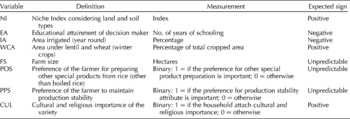
An important farm-specific variable relates to the heterogeneity of the land and soil. The Niche Index (NI) for the ith farmer is defined as one minus the sum of squares of the proportional area under the kth soil type and lth land type as described by Kshirsagar et al. (Reference Kshirsagar, Pandey and Bellon2002). The probability of cultivating LRs in general and Satha in particular increases with NI. The availability of irrigation has a significant effect on the adoption of MVs (Shakya and Flinn, Reference Shakya and Flinn1985). Farmers with irrigated fields are more likely to adopt MVs. Hence, the area under LRs is expected to decrease with the availability of assured irrigation. Finally, the area used for cultivating winter crops such as wheat and lentil affects the probability that Satha will be cultivated, because as the former increases, so does the probability of cultivating Satha as a result of its early maturity.
Farm size is an important socio-economic variable, which influences farmer choice of Satha, although the direction of the effect is, a priori, ambiguous. Bigger farmers are likely to be less risk averse, and hence may lack the incentive to reduce risk by varietal diversification. As the possession of agricultural land is a major source of wealth in rural societies, risk aversion is expected to be negatively correlated with wealth (Arrow, Reference Arrow1970). On the other hand, larger farmers, as a result of their higher social status in rural communities, may be more inclined to grow a number of varieties (including LRs) to ensure the supply of a range of rice products for farm labour, friends, guests and relatives.
The education of the decision-making farmer has encouraged the adoption of modern technology, as more-educated producers tend to adopt new technology more quickly and apply modern inputs more efficiently (Kebede et al., Reference Kebede, Gunjal and Coffin1990; Adesina and Seidi, Reference Adesina and Seidi1995; Abdelmagid and Hassan, Reference Abdelmagid and Hassan1996). Hence, the educational attainment of the household head is held to be negatively associated with the cultivation of LRs.
Given the situation of imperfect markets, different varieties are often grown to meet consumption requirements for niche products such as fried rice and beaten rice. The farmers' preference for such products can affect the decision to cultivate specific varieties and the direction of the effect depends on the importance of these attributes. Similarly, the cultural and religious importance of certain LRs influences the extent of their cultivation. The explanatory variables used for the analysis and their expected direction are presented in Table 1.
Definition of the variables included in the logistic regression of Satha landrace cultivation

Results and discussion
Area under MVs and LRs
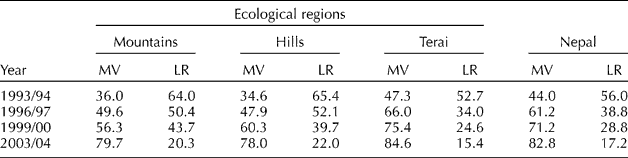
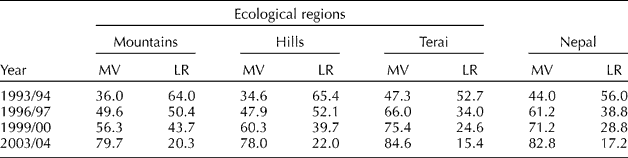
Rice is the main staple food crop of Nepal and is cultivated over about 15 Mha, representing 53% of the total cropping area. It alone contributes more than 40% of the total human calorie intake. The efforts initiated to increase rice productivity via the introduction of high-yielding MVs during the late 1960s have seen their share increased from 17% in the mid-1970s to 40% by the mid-1980s (Nepal Rastra Bank, 1987). An increasing research and extension effort has resulted in a rather different picture in more recent years. LRs occupied about 56% of the total paddy area in 1993/94, declining to about 17% by 2003/04. This decline is highest in the Terai region (from 53% to only about 15%; see Table 2), where irrigation, roads and market infrastructure are well developed.
Description of the production environment and varieties grown
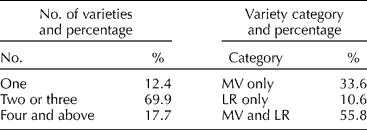
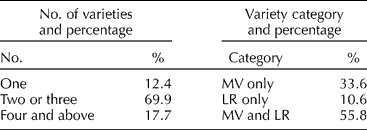
Of the total rice-cropping area, about 20% is occupied by LRs, 24% is irrigated with ground water (deep and shallow tube wells), 11% by canal water and over 60% is rainfed. The cropping intensity is 151%. MV and LR yield an average of, respectively, 3.0 and 1.6 t/ha. On the basis of variety names, the varietal diversity is high (20 MVs and nine LRs). Most of the farmers grew more than one variety, but some use as many as nine. The proportion of farmers growing two to three varieties was about 70% (Table 3). About 56% of households cultivated MVs and LRs simultaneously, about 34% grew only MVs and the remainder grew only LRs. Thus the majority of the farmers still grow LRs (although on a small scale) in combination with MVs.
Percentage of households growing number of varieties of rice and their combination in Banke district, Nepal
MV, modern varieties; LR, landraces.
Description of LRs
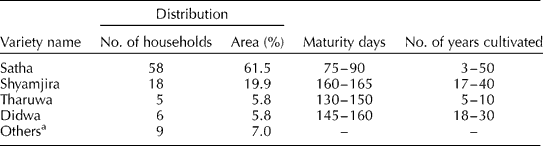
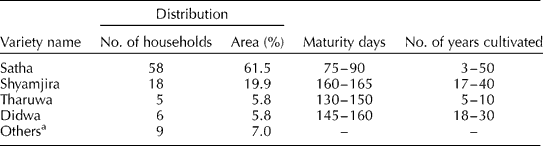
LR names are based on phenotype, not genotype. As a result, the nomenclature is imperfect, different names can be given to genetically closely related populations, while the same name can be given to genetically very distinct ones. However, farmers have recognized, controlled and acted upon these descriptors for many years. Some of the phenotypic differences between various LRs are well recognized. Thus, Satha is a short-statured LR, producing a bold and coarse grain which is brownish white in colour. Its panicle is short and surrounded by the leaves, hence not easily visible from outside. The colour of the milled grain is red. The height of Shyamjira is >1.5 m, producing a black, thin and long grain. The panicle is long and the colour of the milled grain is white. Sugapankhi is a tall-statured LR with bold grains of shape like the wings of a parrot. Both Barma and Kalanamak are medium to tall with fine and small grains. The former produces yellow grains, and the latter black. Of the area used for LR cultivation, Satha accounted for about 62%, representing about 10% of the total rice area. According to the farmers, it is directly seeded, and is suitable for seasons where the monsoon is late. On the other hand, Shyamjira occupied about 20% of the LR area and is mostly cultivated in lowland fields (Table 4). Apart from Satha, all of the LRs are late maturing. The name Satha is based on its early maturing habit. Most LRs have good flavour, some are aromatic, and some have religious and cultural significance; hence, they have been cultivated for many years by the farmers (Table 4).
Percentage area share of popular landraces and related characteristics in Banke district, Nepal
a Including Gadapuraina, Sugapankhi, Anadi, Malati and Chaurasia.
Varietal loss
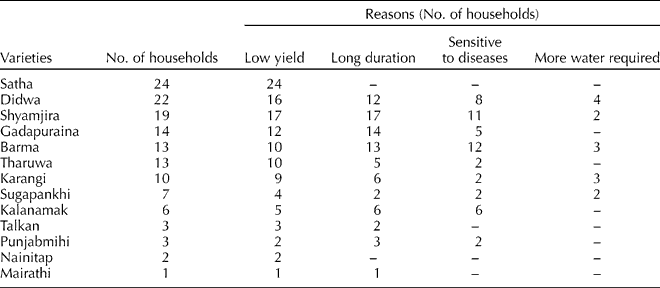
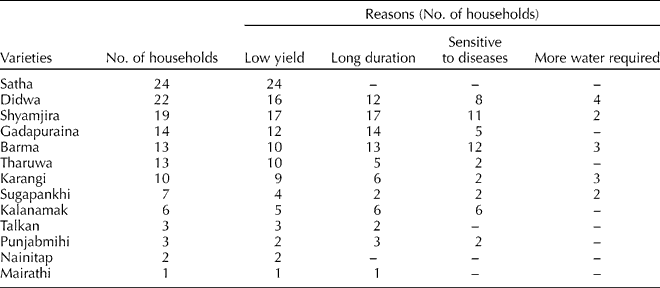
Farmers reported the number of LRs which they had stopped cultivating in the 5 years prior to the survey (Table 5). Using the number of households ceasing to cultivate a variety as a measure of incidence, the highest loss occurred for Satha and Didwa (20% each), followed by Shyamjira (17%), and Gadapuraina and Tharuwa (12% each). Kalanamak, Barma, Karangi, Talkan, Punjabmihi, Nanitap and Mairathi have also fallen out of cultivation in this period. Thus in recent years, there has been a decrease in varietal diversity and a loss of some LRs from the community. The major reason for the rejection of LRs is their low yield. The average yields of Satha and Shyamjira, as reported by the farmers, are, respectively, only 1.5 and 1.7 t/ha, compared to the 3.0 t/ha achieved by the MVs. The late maturity and high disease susceptibility are cited as further reasons for the loss of Shyamjira, Kalanamak, Barma, Gadapuraina, Didwa and Tharuwa. A high water requirement for some LRs is another reason for their discontinued cultivation.
Households ceasing to cultivate landraces between 1997/98 and 2001/02, Banke district, Nepal
Quantitative analysis of Satha cultivation
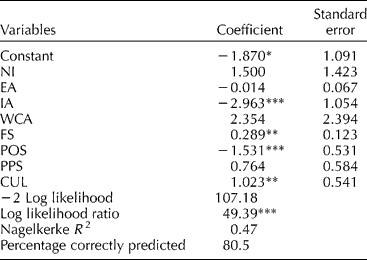
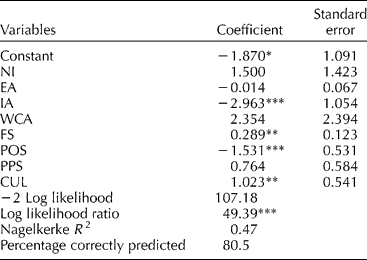
The logistic regression of the factors influencing the probability of cultivating Satha is presented in Table 6. The goodness of the fit of the model is tested by the likelihood ratio test and Nagelkerke R 2. The former is highly significant, implying that the independent factors, when taken together, influenced the farmers' choice to cultivate Satha. The latter statistic indicates that 47% of the variation in the probability of Satha cultivation can be explained by the explanatory variables.
Factors determining Satha cultivation using a logit model
See Table 1 for variable definitions.
*P < 10%; **P < 5%; ***P < 1%.
Among the agro-hydrological factors, the coefficient of the proportion of the area irrigated is negative and significant. This implies that the lower the proportion of year-round irrigated area, the more likely that the households will choose Satha. This finding is consistent with that of Pham et al. (Reference Pham, Quilloy, Huong, Tuyen and Morin1999) who showed that the balance between the cultivation of traditional cultivars and modern cultivars depended on the development of irrigation.
Among the socio-economic factors, farm size is positive and significant, so that the bigger the farm size, the higher the probability of cultivating Satha. The educational attainment of the household head is negative, while the proportion of cropping area under major winter crops (wheat and lentil) is positive. However, both of these are not statistically significant. The consumption attributes farmers prefer have a significant effect on the likelihood that a household cultivates Satha. With an increase in the preference for the preparation of niche products such as chiura and murahi, the probability of cultivating Satha declines, as this variety is perceived to be unsuitable for preparing these special products. The preference for maintaining production stability is positive but not significant. The greater the farmers' cultural and religious attachment, the probability of Satha cultivation is higher. This reflects the situation that many ethnic Hindu communities use Satha in certain religious ceremonies and festivals.
Conclusion and policy implications
The area under LRs has declined substantially following the development and the extension of high-yielding MVs in Nepal. At present, LRs occupy less than 20% of the total area under rice. However, over half of all households continue to grow MVs and LRs simultaneously. Their demand for these types is shaped in part by the production environment, and by the cultural and religious significance of these LRs.
Although the varietal diversity appeared to be high, the number of LRs under cultivation is declining. Changes in the production environment, the farmers' preference for consumption and market integration have acted to increase the area sown to MVs at the expense of both area and diversity of LRs. However, specific LRs, in particular Satha, which can grow in rainfed soils where MVs do not perform well, remain important to poorer farmers. The dominant LR Satha is preferred where irrigation is limiting, but also persists among large-scale farmers who retain a religious and cultural attachment.
Genetic resources and their diversity are important to agriculture for both present and future generations. The concerns of the ordinary farmer are traits of economic, agronomic and cultural importance and not all LRs are of equal value to farming communities. LRs deficient in traits of importance to farmers are less likely to be accepted by the community, and farmers are not likely to be motivated to maintain such germplasm as it offers them little obvious benefit. Market-based incentives are generally less costly than publicly funded conservation programmes. The superior taste and tolerance to abiotic stress such as drought of some LRs and the cultural significance of others may serve as a basis for the development of niche markets. To achieve this, some public investment is needed to develop the necessary marketing and support infrastructure. Genetic erosion of LRs is occurring rapidly in the Terai region of Nepal, so there is a particular need to introduce incentive mechanisms to maintain them. A policy of creating awareness about the importance of LRs and rewarding farmers who maintain unique ones should be adopted. In addition, the seed production and distribution of some important LRs should be promoted via the existing research and extension network, rather than confining this activity to MVs.
Acknowledgements
The authors are grateful to the Alexander von Humboldt Foundation, Germany for supporting this research. We are also grateful to two anonymous reviewers of this journal for providing very helpful comments.