INTRODUCTION
The environmental stimuli experienced by parasites may vary considerably if their life cycle contains both off-host (free-living) and on-host (parasitic) phases, and/or if they are dependent upon one or more hosts, either the same species or different species, to successfully complete the life cycle. It would be advantageous for parasites living in temporarily uncertain or spatially heterogeneous environments to have certain phases of their life cycle synchronized with favourable environmental conditions for survival and/or reproduction. This is often the case for free-living organisms that live in temperate and arctic regions where seasonal differences in environments are the most pronounced (Gwinner, Reference Gwinner1986; Adkisson, Reference Adkisson1996; Denlinger, Reference Denlinger2002; Saunders, Reference Saunders2002; Danks, Reference Danks2005; Paul et al. Reference Paul, Zucker and Schwartz2008).
The different phases in the life cycle of ixodid ticks are characterized by a series of irreversible and interconnected physiological, morphological and behavioural changes. Once an ixodid tick commences development it is committed to proceed through to the next life cycle phase; however, progression through the life cycle may be delayed by a period of dormancy or diapause (Balashov, Reference Balashov1972; Belozerov, Reference Belozerov, Obenchain and Galun1982). According to Belozerov (Reference Belozerov, Obenchain and Galun1982), there are two different forms of diapause in ticks, behavioural diapause (i.e. suppression of host-seeking behaviour of unfed ticks) and morphogenetic diapause (i.e. delayed development of engorged ticks). The advantage of a diapause is that it permits the more vulnerable life cycle stages to avoid harsh environmental conditions, or to emerge at a time when there is an increased chance of contacting a host (Belozerov, Reference Belozerov, Obenchain and Galun1982), thereby increasing survival and maximizing fitness. For some ticks, on-host feeding ceases during periods when their hosts have reduced metabolic rates and/or lowered body temperatures (e.g. during dormancy or hibernation) (Balashov, Reference Balashov1972; Bull and Sharrad, Reference Bull and Sharrad1980). In contrast, ticks often proceed more rapidly and uninterrupted through their life cycle in the laboratory where the environmental conditions, both on- and off-host, are controlled to maximize reproduction and growth (Oliver, Reference Oliver1989).
Bothriocroton hydrosauri and Amblyomma limbatum are 3-host ticks that have largely allopatric distributions in southern Australia except where their ranges contact one another at a parapatric boundary (Bull et al. Reference Bull, Sharrad and Petney1981). The two species do not always exhibit similar behavioural and physiological responses when exposed to the same environmental stimuli, both on-host and off-host (Chilton and Andrews, Reference Chilton and Andrews1988; Chilton, Reference Chilton1994; Chilton and Bull, Reference Chilton and Bull1993 a–c, Reference Chilton and Bull1994). These different responses are often a reflection of the different climatic conditions each species experiences over its distributional range (Smyth, Reference Smyth1973; Bull et al. Reference Bull, Sharrad and Petney1981). B. hydrosauri occurs in cooler wetter regions (Smyth, Reference Smyth1973) and is a more mesic-adapted species, while A. limbatum is found in warmer and drier areas to the north (Smyth, Reference Smyth1973) and is a more xeric-adapted species. However, both species experience similar environmental conditions in areas near their parapatric boundary (Bull et al. Reference Bull, Sharrad and Petney1981).
B. hydrosauri and A. limbatum infest a range of reptiles (Smyth, Reference Smyth1973; Bull et al. Reference Bull, Sharrad and Petney1981). The most common host used by the larvae, nymphs and adults of both tick species in South Australia is the sleepy lizard, Tiliqua rugosa (see Bull et al. Reference Bull, Sharrad and Petney1981). Both ticks show seasonal patterns of activity in the field while attached to hosts (Bull and Sharrad, Reference Bull and Sharrad1980; Bull and Burzacott, Reference Bull and Burzacott1994; Kerr and Bull, Reference Kerr and Bull2006). Mating in both tick species takes place on the host (Andrews, Reference Andrews1982; Chilton and Andrews, Reference Chilton and Andrews1988) and occurs predominantly during the warmer spring and summer months (i.e. September–February), the period during which T. rugosa is most active (Bull and Sharrad, Reference Bull and Sharrad1980; Bull and Burzacott, Reference Bull and Burzacott1994). During the cooler months of autumn and winter (i.e. March–August) when hosts are inactive (Bull and Sharrad, Reference Bull and Sharrad1980), B. hydrosauri females can continue to mate and engorge to repletion, but at a significantly slower rate (Bull and Burzacott, Reference Bull and Burzacott1994). In contrast, there is no mating of A. limbatum females during the cooler months (Bull and Sharrad, Reference Bull and Sharrad1980; Bull and Burzacott, Reference Bull and Burzacott1994) because the reduced body temperature of their ectothermic hosts (Bull and Sharrad, Reference Bull and Sharrad1980; Chilton, Reference Chilton1994) is below the minimum threshold temperature needed to induce mating (Chilton and Andrews, Reference Chilton and Andrews1988). However, in the laboratory, mating and engorgement by A. limbatum and B. hydrosauri females can occur, irrespective of season, if ticks and their hosts are provided with suitable high temperatures (Chilton and Andrews, Reference Chilton and Andrews1988; Chilton, Reference Chilton1994; Chilton and Bull, Reference Chilton and Bull1994).
Mated female ticks of both B. hydrosauri and A. limbatum spend 8–35 days feeding on a host (Chilton and Bull, Reference Chilton and Bull1991), before dropping to the ground to search for a suitable microhabitat in which to lay one large egg batch (1500–3000 eggs; Chilton and Bull, Reference Chilton and Bull1993a, Reference Chilton and Bull1994). The duration of the pre-oviposition period (i.e. the number of days from when an engorged female detaches from its host until it lays the first egg) is significantly shorter for A. limbatum than for B. hydrosauri (see Chilton and Bull, Reference Chilton and Bull1994). Once the eggs have hatched, the unfed larvae must quickly find a host because they can survive desiccation for only a relatively short period of time in warm and dry conditions (Chilton and Bull, Reference Chilton and Bull1993b). As this is a critical point in the life cycle, it would be beneficial if females laid eggs when environmental conditions are suitable for hatching and the resulting larvae have only a short time to wait to find a suitable host in order to proceed to the next life cycle stage.
Chilton (unpublished observations) noted that it was difficult to raise large numbers of B. hydrosauri larvae at certain times of the year, leading to the suggestion that females somehow regulate times when larvae hatch from eggs. Therefore, in the present study, we compared the duration of the pre-oviposition times and reproductive success of females of B. hydrosauri and A. limbatum in relation to the time of the year in which mating and engorgement took place in the laboratory.
MATERIALS AND METHODS
All T. rugosa used in this study were collected during spring and early summer (September–December) in 2 years from a parapatric boundary between B. hydrosauri and A. limbatum near Mount Mary (34°02′S; 139°40′E) in the mid-north of South Australia. Lizards were initially maintained in outdoor enclosures (3×3 m) on the Flinders University campus (Adelaide, South Australia) prior to use in the laboratory. The duration that each individual lizard spent in an enclosure or in the laboratory was not recorded. Adult hosts were used but no record was kept of the sex of individual lizards. In the laboratory, each T. rugosa was kept in a separate cage (340×260×200 cm) within a room with a 12:12 photoperiod, and where the ambient temperatures were 17–24°C at night and 22–32°C during the day. A 120 W heat lamp, positioned approximately 15 cm above each cage, provided a source of heat to lizards during the light phase of the 12:12 photoperiod. Lizards were provided with fresh water each day and fed 3 times a week. The diet of T. rugosa consisted of a combination of fruit and vegetables mixed with canned dog food and a vitamin supplement.
All A. limbatum and B. hydrosauri adults used in this study were laboratory reared from the eggs derived from several mated and engorged females infesting T. rugosa that were collected near Mount Mary. Over a 2-year period, adult ticks were used (2–9 months after they had moulted from the nymphal stage) to attach to lizards. Ticks (3–9 females and 4–9 males) of a single species were placed in a cloth bag with a lizard and kept in the dark at 22°C. The mouth of each host was taped closed with adhesive tape to prevent ticks being consumed. After 24–48 h, hosts were removed from the bags and the number of individuals that attached to each host was recorded. Each infested lizard was placed in a separate cage (as described above). Each tick was individually marked using water-based paints. Mating was observed directly, or inferred by the presence of a spermatophore in the female genital pore, or by the commencement of engorgement by a female. Detached engorged females were collected from metal trays beneath the wire grid floor of the lizard cage, although lizards consumed some female ticks before they could be retrieved. Each fully engorged female that was collected was weighed (to 0·01 mg) and placed into a separate ventilated vial (4×5 cm). All vials were maintained at 21–24°C, 85% R.H. and in a 12:12 photoperiod, conditions suitable to induce oviposition in both tick species (Chilton and Bull, Reference Chilton and Bull1994). Observations were made daily to determine when each female had commenced oviposition. For each tick species, a least squares regression analysis was used to determine the relationship between an index of reproductive output of a female (RFI=number of eggs that hatch into larvae/weight of the engorged female at time of host detachment; Chilton, Reference Chilton1992) and her pre-oviposition period. The reproductive success of engorged female ticks that detached from hosts in the laboratory during September–February (spring/summer) was compared to conspecific females that detached from hosts during March–August (autumn/winter). The data for the two years were combined because the seasonal patterns in pre-oviposition times were consistent. Data were separated according to when females mated and detached; either in spring and summer, when the majority of tick mating occurs on hosts in the field (Bull and Sharrad, Reference Bull and Sharrad1980), or during the rest of the year. Contingency tests were used to compare between the two groups, the proportion of females of each species that laid eggs. For each species, the mean pre-oviposition period of females, the mean engorged weight of females, the mean number of eggs laid and the mean number of eggs that hatched per egg clutch were each compared between the two groups using a one-way analysis of variance. In addition, for each species, the RFI of females of the two groups was compared using a Mann-Whitney U-test.
RESULTS
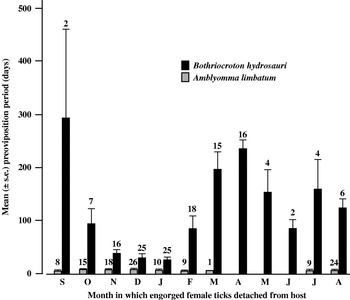
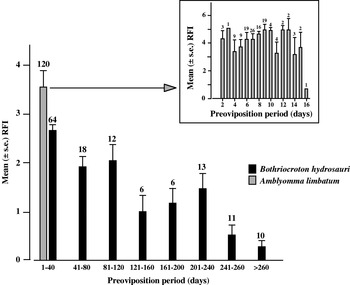
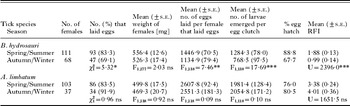
Fig. 1 shows the mean pre-oviposition periods of engorged female ticks that detached from hosts at different times of the year. Mated and engorged B. hydrosauri females that detached from hosts during the autumn/winter months of March to August took significantly longer to lay eggs (189·7±13·8 days; n=47) than conspecifics that detached from hosts in the spring/summer months of September to February (55·2±8·3 days; n=93) (F1,138=77·3, P<0·001) even though they were maintained under identical conditions following host detachment. All B. hydrosauri females that had mated, engorged to repletion and subsequently detached from hosts during autumn/winter, delayed oviposition until the following spring. In contrast, most females mated in spring and early summer showed no delay in oviposition. The single exception was a female that had mated in early September but did not lay eggs until December of the following year (i.e. 461 days). The reproductive success of B. hydrosauri females also differed depending on the season in which they detached from hosts (Table 1). Significantly fewer of the mated B. hydrosauri females that detached from hosts during autumn/winter subsequently laid eggs. Although the mean engorged weight of females that detached during autumn/winter was not significantly different from that of females that detached during spring/summer, those autumn or winter females that oviposited, laid significantly fewer eggs and produced a significantly lower proportion of viable eggs, and thus had a significantly reduced reproductive success (i.e. a lower RFI value). In addition, the longer the pre-oviposition time of B. hydrosauri females, the greater the reduction in their RFI (r 2=0·47; F1,138=124·8, P<0·001) (Fig. 2).
The mean pre-oviposition period (days) of fully engorged Bothriocroton hydrosauri and Amblyomma limbatum females that detached from hosts during different months of the year. The data for 2 consecutive years are combined.

The Reproductive Fitness Index (RFI=number of eggs that hatch into larvae/weight of the engorged female at time of host detachment; Chilton, Reference Chilton1992) of Bothriocroton hydrosauri and Amblyomma limbatum females with different pre-oviposition periods (days).

Reproductive output of Bothriocroton hydrosauri and Amblyomma limbatum females that detached from hosts that were maintained in the laboratory during different seasons

Significance levels:
*** P<0·001, ** P<0·01, * P<0·05, ns=P>0·05.
The mean pre-oviposition period of engorged A. limbatum females (Fig. 1) that detached from hosts in the autumn/winter months (6·4±0·5 days; n=34) was significantly shorter than for conspecifics that detached from hosts during spring/summer months (7·7±0·5 days; n=86) (F1,118=5·57, P<0·05). There was, however, no significant difference between the two groups of A. limbatum females in the mean engorged weight, the proportion that laid eggs, the mean number of eggs laid per female, the proportion of eggs that hatched into larvae, or in their RFI (Table 1). There was also no relationship (r 2<0·001; F1,118=0·5, P>0·05) between the duration of the pre-oviposition period and the RFI of A. limbatum females (Fig. 2), but the single female that commenced oviposition on day 16 had a reduced RFI compared to conspecifics with a shorter pre-oviposition period.
DISCUSSION
In the laboratory, all mated and engorged B. hydrosauri females that detached from hosts during autumn/winter months delayed oviposition until the following spring. There was no delayed oviposition by B. hydrosauri females that had mated and engorged on hosts during spring/summer. The same sinusoidal seasonal pattern in pre-oviposition times of B. hydrosauri females was recorded in 2 consecutive years. The number of days spent by B. hydrosauri females on a host prior to mating, and the number of days spent feeding on a host following mating, do not influence their reproductive output (Chilton et al. Reference Chilton, Andrews and Bull1992). However, the results of the present study show that the reproductive success of B. hydrosauri females decreased significantly as the pre-oviposition time increased.
In contrast, there was no evidence of an ovipositional diapause in A. limbatum because all engorged females that failed to lay eggs by day 16 following host detachment, had died by day 18. Thus, given suitable environmental conditions for reproduction, A. limbatum females will lay their eggs as quickly as possible (Chilton, Reference Chilton1994; Chilton and Bull, Reference Chilton and Bull1994) because this species has a narrower window of time available each year when temperatures are above the minimum threshold for development of juvenile stages and for the mating and engorgement of female ticks (Chilton et al. Reference Chilton, Andrews and Bull1993; Bull and Burzacott, Reference Bull and Burzacott1994). Also, it is known that unlike for B. hydrosauri, any delay in the time taken by A. limbatum females to mate and/or engorge on a host results in the production of significantly fewer progeny (Chilton et al. Reference Chilton, Andrews and Bull1993). Hence, there is no ovipositional diapause in A. limbatum and exogenous factors (temperature) directly control the timing of most on-host and off-host phases of its life cycle.
Ovipositional diapause in ticks has been reported in some species of Amblyomma, Dermacentor, Haemaphysalis, Hyalomma and Ixodes (see Balashov, Reference Balashov1972; Belozerov, Reference Belozerov, Obenchain and Galun1982; Pegram et al. Reference Pegram, Mwase, Zivkovic and Jongejan1988; Oliver, Reference Oliver1989), but not, as far as we are aware, for any species of Bothriocroton. Most studies that have reported biological rhythms in ticks have indicated that environmental cues, such as photoperiod, provide the stimuli associated with the timing of the onset of delayed oviposition or diapause (Belozerov, Reference Belozerov, Obenchain and Galun1982; Pegram et al. Reference Pegram, Mwase, Zivkovic and Jongejan1988; Oliver, Reference Oliver1989). For example, morphogenetic diapause in Amblyomma variegatum is suggested to be a response by unfed females to reduced day length (Pegram et al. Reference Pegram, Mwase, Zivkovic and Jongejan1988). However, what is intriguing in the case of B. hydrosauri, is that photoperiod was not involved in triggering the biological rhythm. All B. hydrosauri females were: (1) derived from the same source (i.e. laboratory-reared adults derived from eggs laid by engorged females infesting T. rugosa captured in the field near Mount Mary, South Australia), (2) attached to hosts that were maintained in laboratory conditions suitable to induce mating, (3) exposed to the same photoperiod, temperature and humidity regimes, before, during and after mating (i.e. both on-host and off-host), and (4) exposed to environmental conditions suitable for oviposition following host detachment. Thus, the biological rhythm in B. hydrosauri cannot be attributed to the entrainment of females to external conditions (photoperiod, temperature or humidity) experienced at some early stage of development (i.e. as unfed females, nymphs or larvae) in the field. Also, there were no differences in photoperiod at different times of the year within the laboratory to provide information to B. hydrosauri females as to the season when they had mated or when they had detached from their hosts. Despite this, B. hydrosauri females that were mated during the autumn or winter months, delayed oviposition until the subsequent spring, whereas there was no such diapause in any female mated in spring or early summer. Photoperiodic information may be of limited importance to B. hydrosauri with respect to the timing of oviposition. It has been shown previously that the mean pre-oviposition times and RFI of engorged B. hydrosauri females placed in continuous darkness, do not differ from females exposed to a 12:12 photoperiod (Chilton and Bull, Reference Chilton and Bull1994). Furthermore, engorged female ticks detaching from hosts seek shelter in leaf litter that accumulates within the refuge sites used by their reptile hosts (Chilton and Bull, Reference Chilton and Bull1993c). The litter layer provides a suitable microclimate for oviposition and egg development. A small proportion (6%) of engorged B. hydrosauri females bury themselves in loose soil to lay their eggs, while most select a position at the interface between the soil and litter layer (Chilton and Bull, Reference Chilton and Bull1993c). In such microhabitats, particularly under the soil surface, B. hydrosauri females would be unable to detect any change in photoperiod. Also, B. hydrosauri lacks the ‘eyes’, photoreceptors that detect changes in photoperiod (Carroll and Pickens, Reference Carroll and Pickens1987; El-Shoura and El-Shoura, Reference El-Shoura and El-Shoura1988; Phillis and Cromroy, Reference Phillis and Cromroy1997), that are present in many species of ixodid ticks, including A. limbatum. All of these factors suggest that the cues that set the biological rhythm in B. hydrosauri are detected by different sensors than the light-sensitive interval timers in other ticks and invertebrates (e.g. Saunders, Reference Saunders2002; Danks, Reference Danks2005; Paul et al. Reference Paul, Zucker and Schwartz2008).
There is a strong association between parasites and their hosts, both in an evolutionary and physiological context. For instance, it is known that consumption of host blood and lymph is crucial for activating the endocrine system of ticks (Rees, Reference Rees2004). Therefore, chemical signals (e.g. hormones, such as melatonin and serotonin) received by B. hydrosauri females from blood imbibed from their reptile hosts may provide cues to entrain the biological rhythm. Melatonin (N-acetyl-5-methoxytrptamine) is a potential candidate because it has been proposed to play a role in photo-periodism in some insects (Saunders, Reference Saunders2002). It has also been established that plasma melatonin in the host, T. rugosa, exhibits a daily fluctuation, with elevated levels during darkness (Firth et al. Reference Firth, Kennaway and Rosenbilds1979). There is also seasonal variation, such that levels of this hormone in T. rugosa are greater in summer/autumn than in spring (Firth et al. Reference Firth, Kennaway and Rosenbilds1979). Such a seasonal change in the host has been proposed to follow an endogenous rhythm, regulated by photoperiod and temperature (Firth et al. Reference Firth, Kennaway and Rosenbilds1979). Ticks may have receptors that can determine the level of melatonin or other chemicals in the blood of the host, and levels above a specific threshold may provide the signal for the onset of delayed oviposition. Paine et al. (Reference Paine, Kemp and Allen1983) demonstrated that the level of serotonin in bloodmeals influenced the feeding rate of Dermacentor andersoni females, suggesting that there are receptors for serotonin in the tick gastrointestinal tract (Lees and Bowman, Reference Lees and Bowman2007). Delayed oviposition in B. hydrosauri may be fully exogenous, representing an evolutionary adaptive response to the physiology of their hosts. The significant variation when diapause ceased and oviposition commenced among B. hydrosauri females may relate to differences in: (1) the rate at which females convert components of the bloodmeal into egg production during the period of reduced metabolism, (2) the physiology (i.e. hormonal levels) among hosts as they were maintained in the laboratory for different periods of time, or (3) the physiological age of ticks when attached to hosts.
A chemical-mediated biological rhythm in B. hydrosauri that is synchronized with seasonal rhythms of their vertebrate hosts would represent a major alternative to the light-sensitive and temperature-compensated interval timers of many invertebrates (Saunders, Reference Saunders2002; Danks, Reference Danks2005; Paul et al. Reference Paul, Zucker and Schwartz2008). However, it would be analogous to that for some insect parasites and parasitoids, where the regulation of a diapause is associated with changes in the physiology of their invertebrate hosts (Saunders, Reference Saunders2002). The seasonal cycles of some phytophagous insects (e.g. root-feeding insects) are also influenced or controlled by chemical changes associated with the photoperiodic response of the plant host (Saunders, Reference Saunders2002). Reproduction in the rabbit flea (Spilopsyllus cuniculi) is under the control of the reproductive cycle, through the sex hormones of the host such that the maturation of the ovaries of female rabbit fleas only takes place while attached to pregnant female rabbits (Mead-Briggs and Rudge, Reference Mead-Briggs and Rudge1960; Rothschild and Ford, Reference Rothschild and Ford1964). On the other hand, some parasitic protozoa and helminths can increase their rate of growth and/or reproduction by manipulating their host's hormonal system by a process called transregulation (Escobedo et al. Reference Escobedo, Roberts, Carrero and Morales-Montor2006).
Although the mechanism underlying the rhythm in B. hydrosauri is unknown, delayed oviposition by females mated on hosts during autumn and winter would represent an adaptation for the production of eggs at a time of favourable environmental conditions for development and coincide with the period of increased host activity (i.e. spring and early summer). This would maximize the opportunity for the hatching larvae to find, as quickly as possible, a host on which to feed. This is important because unfed B. hydrosauri larvae survive desiccation for only a relatively short period of time compared to unfed nymphs in warm and dry conditions (Chilton and Bull, Reference Chilton and Bull1993b). Nonetheless, such a strategy represents a ‘trade-off’ between maximizing the survival chances of the progeny and a reduction in reproductive output. The results showed that a greater proportion of B. hydrosauri females that underwent a diapause failed to produce any eggs. Furthermore, ovipositional diapause in B. hydrosauri females leads to decreased body weight during the pre-oviposition period and is associated with a reduction of resources to contribute to egg production, even when maintained under ‘optimal’ environmental conditions for oviposition. As a consequence, those females that laid eggs produced significantly fewer eggs and suffered a subsequent significant decrease in egg viability.
In conclusion, the pre-oviposition times of B. hydrosauri females (7–461 days) are significantly longer than for A. limbatum females (2–16 days). This interspecific difference may have evolved in response to the different environmental conditions each species experiences throughout most of their ranges. It also has implications for the transmission of the microorganisms these ticks carry (Smallridge and Bull, Reference Smallridge and Bull1999; Stenos et al. Reference Stenos, Graves, Vsevolod and Walker2003). This is particularly important with respect to B. hydrosauri, as this tick has recently been implicated as the vector and reservoir for Rickettsia honei, the causative agent of spotted-fever in southern Australia (Stenos et al. Reference Stenos, Graves, Vsevolod and Walker2003). The results of the present study show that the life cycle of B. hydrosauri is controlled through a diapause (i.e. delayed oviposition) that was absent in the life cycle of A. limbatum. The results also suggest a type of interval timer in B. hydrosauri that triggers delayed oviposition in females mated during late summer, autumn and winter until the following spring, thereby synchronizing oviposition with favourable conditions for egg development and maximizing the chance of the resulting larvae finding a reptile host. The onset of the diapause in B. hydrosauri was not induced by the photoperiod, temperature or relative humidity experienced by ticks prior to host attachment, during mating and feeding on hosts, or following host detachment. We propose that this rhythm is chemically mediated and is directly linked to the body fluids imbibed from their hosts. This would also suggest a long association of this parasite species with its reptilian hosts. Further investigation is required to determine the genetic and physiological mechanisms associated with this biological rhythm, and whether similar mechanisms exist in other species of Bothriocroton or tick species that parasitize hosts with periods of seasonal activity.
This research was funded by grants from the Flinders University Research Budget and the Australian Research Council. We thank Drs T. Marchant and G. Bortolotti for their valuable comments on the manuscript.