As pointed out by Colin S. Gray, all human beings are encultured, strategists included.Footnote 1 Hence, although some argue that culture is somehow insubstantial and relatively slight in comparison with objective material realities, no analysis of the strategy pursued by any country can be undertaken without a serious attempt to understand the role of culture in strategic thinking.Footnote 2 This issue, usually related to the concept of “strategic culture,” is particularly important for countries such as China that pride themselves on their long history and ancient culture. A number of scholars have been writing on this topic since the 1980s, but it is the work done by Alastair Iain Johnston that is most respected.Footnote 3 His book Cultural Realism is usually held as the benchmark of methodological solidity for its clarity and empirical richness.Footnote 4 Johnston defines strategic culture as two sets of interconnected assumptions about the nature of war in human affairs and how to conduct warfare.Footnote 5 From these assumptions, the foreign policy elites of a country derive a number of ranked preferred actions, or “ranked preferences,” which should be consistently reflected in the behavioural patterns of the state over time.
The assumptions about war are represented by a system of symbols (argumentation structures, metaphors, languages, analogies, images, and so on) that can be materially found in an infinite number of objects, or “cultural artefacts,” for instance war movies, military doctrine, popular stories or the design of weapons. As an example of how all these different elements work together, Johnston argues that the ancient Chinese foreign policy elites preferred, and consistently acted, to preserve maximum strategic and tactical flexibility in war because their assumptions were grounded in the concept of absolute flexibility, as symbolized by the expression quanbian 权变 in one of the Seven Military Classics (Wujing qishu 武经七书).
Although I stick to Johnston's definition, I contend that a significant flaw in his work is that the relationship between the foreign policy elites and the cultural artefacts they refer to remains unclear. Many have exaggerated this flaw, transforming Johnston's concept into a straw man to knock down and advance their own widely different arguments. Andrew Scobell and Toshi Yoshihara, with their respective studies on the so-called “cult of defence” and strategic culture-driven military innovation, are two remarkable exceptions.Footnote 6 While a plurality of ideas is always welcome and Johnston's work merits improvement, the proliferation of studies based on completely different definitions of strategic culture has undermined Johnston's potentially fruitful attempt to develop a more coherent research methodology and agenda. Hence, instead of building beside his work, this paper ambitiously aims at building on it. I intend to do so by shedding light on the relationship between the People's Liberation Army (PLA) and Chinese ancient texts on warfare. My argument is that in order to understand why and how strategic culture evolves and affects the behaviour of the state, it is necessary to look at how foreign policy elites select and interpret cultural artefacts and their symbols. The empirical analysis also offers new insight into the PLA's understanding of the nature of war and the ways to fight in particular, and into China's relationship with the use of force in foreign policy in general.
The Elites and the Cultural Artefacts: A Problematic Relationship in Johnston's Work
Johnston's work is excellent, but it is not perfect. At least partially, this is because of his decision to focus more on verifying whether or not Chinese strategic culture has changed over time, rather than explaining how and why it has transformed. On the one hand, he pays too much attention to behavioural patterns, the ultimate indicators that strategic culture is affecting the state's behaviour. On the other hand, he under-theorizes the mechanics of the relationship between foreign policy elites, cultural artefacts, and the symbols from which assumptions of strategic culture originate. This problem is further amplified by his vague description of continuity in strategic culture.
According to Johnston, strategic culture's assumptions “are rooted in the ‘early’ or ‘formative’ military experiences of the state or its predecessor.”Footnote 7 However, while this means that the scholar should look at the earliest available artefacts to identify the strategic culture of a country in its virtually original form, Johnston shares McCauley's position that “the ‘same’ belief can sprout from different roots, at different times.”Footnote 8 In any case, irrespective of which historical moment one examines, research on strategic culture is based on the analysis of the artefacts first and analysis of behaviour second.Footnote 9 Neither of the two steps can be avoided and the order should not be inverted.
Yet, in a contradictory way, rather than delving further into the relationship between the elites and the artefacts in moments of change in strategic culture, Johnston pays more attention to behavioural patterns. Instead of exploring how the “same” assumptions of strategic culture can reappear over time, he neglects the problem of “sameness” in strategic culture. Hence, he ends up arguing that the same behavioural patterns indicate the presence of the same strategic culture at different historical moments. This is evident in a later study where he puts forward the idea that there has been a significant level of continuity in Chinese strategic culture from ancient times to the Mao era and beyond. He does so despite the fact that, as he acknowledges, there is only “rather spotty” evidence that Mao had some solid knowledge of the Seven Military Classics.Footnote 10 Johnston provides even less information about the other artefacts to which Mao referred. Johnston's argument that the parabellum strategic culture was still dominant in China in the 1980s and 1990s is based only on the rather vague observation that Chinese foreign policy was “still dominated by defection and free riding.”Footnote 11
This approach is problematic in three interconnected ways. First, the fact that Johnston focuses on behavioural patterns, rather than on artefacts and symbols, betrays the fact that he hazardously assumes that he and the Chinese foreign policy elites interpret the same cultural artefacts in the same way. This is hardly possible, even simply because of the difficulty in understanding ancient Chinese.Footnote 12 Second, by implicitly bypassing the elites as interpreters of the artefacts, he argues that the same strategic culture persisted for more than two millennia because the behaviour of ancient and Maoist China was consistent with his own understanding of the symbols contained in the artefacts. Carefully selecting episodes in which imperial and Mao's China behaved in an arguably similar way is, in any case, empirically debatable and can hardly support such an argument. Third, because of the resulting lack of solid evidence necessary to demonstrate that the same strategic culture persisted over time, the excessive emphasis on finding commonalities in behavioural patterns renders Johnston's work vulnerable to accusations of determinism.Footnote 13
To conclude, it is evident that while behavioural patterns are crucial to verify the effects of strategic culture, it is first and foremost imperative to identity why the elites refer to certain sources/artefacts. It otherwise becomes extremely easy to transform an elaborate theoretical work into a straw man to knock over and, eventually, dismiss the importance of culture. My attempt to expand Johnston's work starts here.
Exploring the Relationship between the Elites and Cultural Artefacts
As highlighted above, the main criticisms of Johnston's work are concerned with how he deals with the (non-) evolution of strategic culture and not in Johnson's definition of strategic culture, which already places the elites and the artefacts at its centre. Expanding on Johnston's work, my focus in this section will be specifically on how and why strategic culture changes.
I argue that the key to understanding how strategic culture evolves and what kind of behaviour is expected from a state depends on how elites choose the cultural artefacts they refer to and interpret the symbols contained within them. It is implausible that different people at different moments interpret the same symbol in precisely the same way. Their readings will be, at best, similar. It is, therefore, possible to talk about continuity in strategic culture so long as the artefacts referred to by elites from different eras, the way the symbols are interpreted, and the resultant actions all remain consistent over time. When the first two change, so too does strategic culture. While small and short-termed behavioural changes do not necessarily indicate changes in strategic culture, significant and long-lasting ones can indeed be symptomatic of changes in strategic culture. In turn, such changes are reflected in the artefacts and symbols to which the elites refer. It is possible that the elites in two different historical moments hold similar assumptions about war, but applying stricter parameters to identify continuity in strategic culture allows the analyst to avoid over-deterministic arguments.
Within the limits of bounded rationality, changes in strategic culture happen when the context within which war is expected to take place/has taken place is different compared to the past, and/or because the cohort of elites has changed. It is important to look at war as a problem that the elites must find a solution to if they want the state and themselves to survive. Since strategic culture represents their tentative solution to such a problem, failures and expected failure are the main drivers of change. As long as the elites believe that their answer is correct, they will have little reason to change it for two reasons. First, the more a “solution” proves to be successful over time, the less incentive there is to revise it. The literature on innovation in military doctrine is helpful in this regard: defeat and fear of defeat, not success, lead civilians to pressure the armed forces to review military doctrine.Footnote 14 It is plausible that the same logic applies to strategic culture. Second, as argued by the so-called “second generation” scholars of strategic culture,Footnote 15 cultural symbols and practices can be used to legitimize the rule of the elites. Therefore, the elites also have little incentive to change symbols and practices that represent their success. On the contrary, a terrible defeat, such as in the case of Japan during the Second World War, or the emergence of conditions that might lead to this outcome, such as a new disruptive technology, can de-legitimize both the elites and the culture, symbols and practices that dominated until that moment. It is in those moments that the elites look for new clues to formulate a novel answer to the problem of war. Consistently, they will also be likely to change the artefacts to which they refer.
Changes in strategic culture entail the integration of new assumptions derived from foreign cultures about how and why to fight a war and/or the revision of other domestic assumptions that were not considered pertinent until that moment. Indigenous and completely new artefacts, symbols and assumptions are especially likely to be developed when new technologies are invented, thereby creating the need for them to be integrated into the country's way of war. Military innovation is, however, for the few countries that can afford to invest significant resources in it; today, it is much more common to copy and/or revisit already existing ideas.
The addition of foreign cultural elements can happen either through active cherry-picking of what is considered to be most relevant to solve the problem of war, or through socialization.Footnote 16 Domestic elements of strategic culture are usually preferred by elites over foreign ones because their use helps to make changes be more easily accepted by transmitting a sense of continuity with the past.Footnote 17 Moreover, it should not be forgotten that domestic related artefacts are easier to access, even if only because of the language. The assumptions that make up strategic culture are very likely to be explicitly expressed in a country's military doctrine and other documents that are meant to inform readers of how war is expected to be. As new and old ideas are constantly discarded or integrated, so too are the artefacts from which elites draw these ideas.
It is important to emphasize that when old and foreign ideas start being revisited and integrated after the initial formative period of strategic culture, the intended message of the original artefacts’ author should not be our focal point. Rather, the elites’ interpretation of the artefacts is more important because it helps to delineate the strategic culture of a country in a given moment. Thus, the scholar must not only find references to the cultural artefacts but also analyse and comprehend how the elites interpret the symbols contained in them. This is crucial to pinpoint the evolution of strategic culture, identify the reasons behind it, and, ultimately, avoid being exposed to attacks about methodology, as in Johnston's case.
To sum up, in this section I expand upon Johnston's definition of strategic culture and further elaborate on the relationship between the elites and the artefacts, especially in regards to the evolution of strategic culture. I also clarify why and how strategic culture can change. In so doing, I advance a solution to a critical problem that plagues Johnston's work. First, by mapping the logic and mechanics of the evolution of strategic culture, the concept of strategic culture is now more robust. Moreover, it is clear what the scholar has to look for and what cannot be ignored. Second, the stricter parameters to measure continuity prevent the scholar from falling into the trap of determinism and position him/her to offer stronger evidence for his/her argument.
Ancient Thinking in Modern Strategic Culture: The PLA Reads Sunzi
In this section, I test the validity of my argument by taking Chinese strategic culture as the object of study, in a similar vein to Johnston, Scobell, and Yoshihara. In particular, I focus on how and why parts of ancient military thinking have been selected, revised and integrated effectively into Chinese strategic culture today. This means verifying that the PLA has read the texts of ancient thinkers and looking at what assumptions about war and, ultimately, behaviour resulted from this process. To do so, I formulate two hypotheses that have to be proved correct:
-
1. PLA analysts have been studying China's ancient history and the works of ancient Chinese military thinkers consistently over time because they see similarities between the period they are living in and the past in regard to the nature of war. Analysts do so critically by emphasizing both the utility and the limitations of the ancient works.
-
2. The PLA has focused on drawing concrete lessons about the use of force from the ancients, and those lessons are mainly expressed in theorizing and authoritative doctrine. Chinese actions in security-related issues should also be consistent with those lessons and the ranked preferences derived from them.
I decided to focus on the PLA for the following reasons. First, along with the end of the symbiotic relationship with the Party and its growing professionalization, the PLA has, rather naturally, spent much more time and energy thinking about war than have Party officials. Its officers are what Johnston calls the “culture-bearing unit” par excellence, that is, the gatekeepers of strategic culture. Second, the PLA, despite the end of the symbiotic relationship, still wields significant influence over matters of national security and foreign policy.Footnote 18 It has, therefore, the potential to affect top-level decision making about why, and not only how, China uses force. Third, also as a result of this influence, Chinese military doctrine and writings have traditionally paid equal attention to the nature of war in human affairs as to the ways of conducting warfare.Footnote 19
To test my hypotheses, I rely on analysis of the articles in China Military Science (Zhongguo junshi kexue 中国军事科学), the PLA Academy of Military Science's (AMS) publicly available flagship journal, published between 1992 and early 2016. The AMS, together with the PLA National Defence University (NDU) and the PLA National University of Defence Technology (NUDT), is one of the top Chinese military research and teaching institutions. The AMS is particularly important because its researchers are responsible for the elaboration of China's military doctrine.
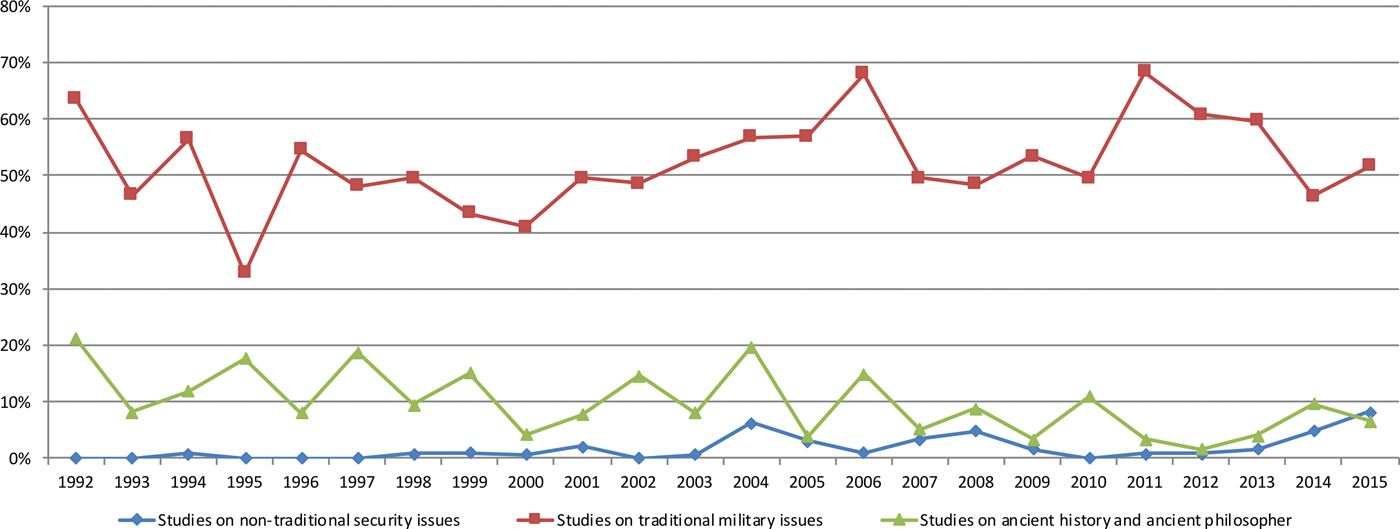
China Military Science mostly deals with issues of strategy, tactics, force structure and military industry (see Figure 1). To verify the second hypothesis, I also look at Chinese military doctrine as described in the Science of Military Strategy (Zhanlüexue 战略学) and other authoritative texts published by the NDU, presented below. In both cases, I search for explicit references to the artefacts and symbols of Chinese ancient military thinking and history in order to understand how the PLA interpreted them and what kind of assumptions it adopted about why and how to fight a war.
Studies on Traditional Military Issues
Besides having the two hypotheses verified, I also expect to see no significant differences with the findings of other important studies on Chinese foreign and security policies. Despite the adoption of different points of view, from neorealism to foreign policy analysis, a number of scholars maintain that China's behaviour is consistent with a realist approach to world affairs.Footnote 20 Furthermore, Scobell's “cult of defence” ultimately supports the same conclusion. Different conclusions in my study would be problematic for two reasons. First, as highlighted above, there cannot be significant inconsistencies between the preferences of strategic culture and behaviour; discovering such differences would likely mean that serious mistakes were committed in the empirical test. Second, the PLA and the other groups that compose the Chinese foreign policy elites should share the same strategic culture. Indeed, both Hu Jintao 胡锦涛 and Xi Jinping 习近平 have suggested that the idea of “being prepared for danger in times of peace” (ju'an siwei 居安思危) (which Johnston takes as a core concept of China's ancient parabellum strategic culture) is an element of the party-state's strategy in various policy areas.Footnote 21 China's behaviour should be consistent with the assumptions of strategic culture even on issues where the PLA is not the only actor involved in the decision-making process.
There is one last and important issue that must be clarified before moving on. Some could argue that the articles analysed in this paper do not represent the comprehensive opinion of “the PLA,” but, at best, only a portion of it. I suggest that because the authors are mid- and high-level officers belonging to a variety of PLA institutions, their articles offer at the very least a good sample of what “the PLA” thinks.
Testing hypothesis No.1
As Figure 1 shows, in the period under consideration, the PLA has continually studied China's ancient history and the works of ancient military thinkers more than it has contemporary issues (articles about non-traditional security, international organizations, and international law are grouped under the label “Studies on non-traditional military issues”).Footnote 22 The AMS is the main institution driving these studies, both directly and indirectly, either through publications authored by its members or through the China Research Society of Sun Tzu's Art of War (hereafter, Society). This institution was founded in 1989 with the support of the Ministry of Civil Affairs and is led by PLA officers who hold, or held, high-level positions. For example, Colonel General Sun Sijing 孙思敬 became the president of the Society in 2013 while working as political commissar at the AMS. In 2014, the Society's vice-president was the AMS vice-president, Lieutenant General He Lei 何雷. The Society has held nine international conferences to date, the first in 1989 and the most recent in 2014, in which both top PLA figures and international guests have participated. Not always, but very often, some of the papers presented are published in China Military Science. Additionally, the Society and its regional branches regularly organize a number of national and regional forums as well as publish books on Sunzi's military thinking. PLA scholars also publish studies on this subject outside the events organized by the Society. Finally, alongside works focusing on Sunzi's teachings, there are also a number of studies whose authors draw from Sunzi by referencing his concepts.
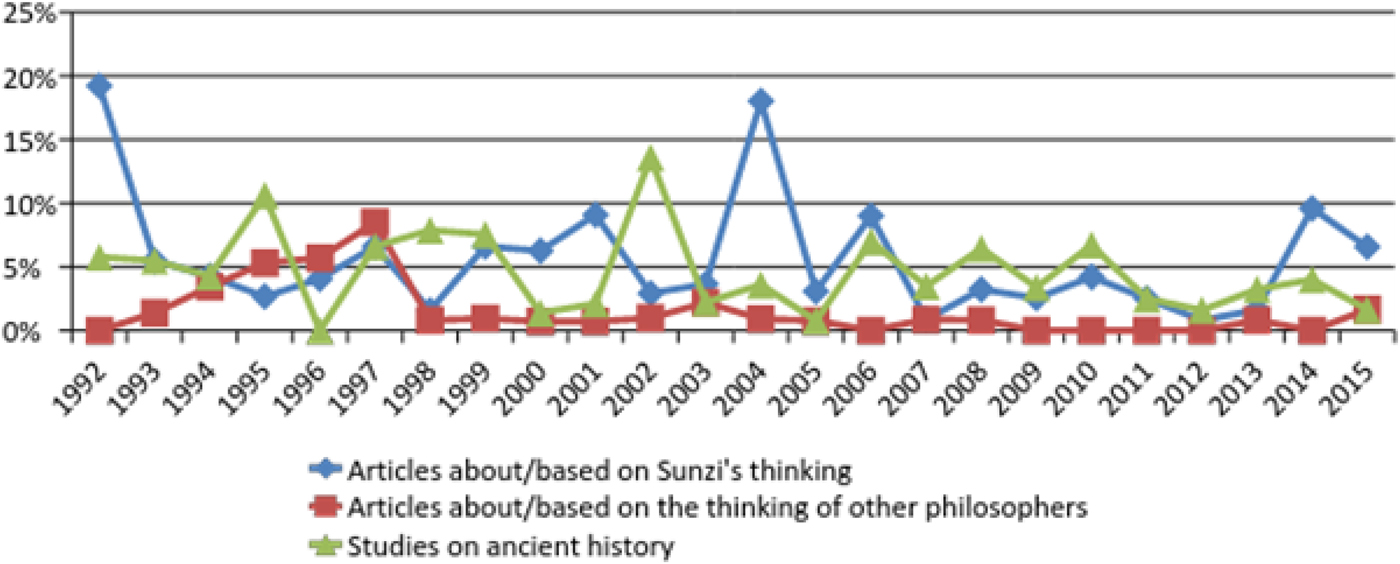
Some high-ranking scholars from the AMS have recently stated that with the arrival of Xi Jinping, studies on traditional strategic culture, and Sunzi in particular, have received renewed attention.Footnote 23 While Sunzi is acclaimed as the standard bearer of a military tradition that has changed little over time,Footnote 24 other ancient masters, from Confucius to Mengzi 孟子, Laozi 老子, Mozi 墨子 and Weiliaozi 尉缭子, are either criticized for attaching too much importance to moral values and for being too defensive, or plainly ignored.Footnote 25 Figure 2 shows that studies on ancient history and Sunzi received more attention than studies on other thinkers.Footnote 26 Sunzi's Art of War (Bingfa 兵法) is the cultural artefact upon which PLA scholars focus their attention. It is important to see how and why this has happened by identifying the symbols to which PLA scholars pay attention.
Studies on History and Traditional Philosophy
To begin with, a group of AMS researchers harshly criticized the fact that in the past, traditional culture had been revered as an icon, and they emphasized the need to “update” culture in order to keep it relevant.Footnote 27 Moreover, there is no interest in “political” interpretations of ancient teachings and symbols. While an entire article criticized the use of the Great Wall as a symbol of national defence because the focus on the defensive capabilities of the past resulted in multiple invasions,Footnote 28 different scholars made clear that even Sunzi's teachings are meant to be used as lessons on how to neutralize security threats to the state. Other interpretations would be misleading.Footnote 29
Chinese military scholars see many similarities between today's international system and the fragmented China of the Spring and Autumn period. Consistently, directly quoting the Art of War, they emphasize the importance of “subduing the enemy without fighting” (bu zhan er churen zhi bing 不战而屈人之兵) and “avoiding moves that are not really conducive to victory” (heyu li er dong, bu heyu li er shang 合于利而动,不合于利而上).Footnote 30 Despite a sharp decrease in interstate wars and the fact that China is enjoying its most peaceful environment of the last few centuries, the world has not become a less dangerous place for the military.Footnote 31 While war has become less violent and more controlled, peacetime has become more violent and competitive.Footnote 32 Waging war is far less necessary to defeat an enemy than in the past. Before any shot is fired, all the economic, diplomatic and military resources of the state are deployed in order to undermine the enemy's strategy.Footnote 33
Indeed, when not seen as threatening, dialogues, forums, international organizations and treaties are framed as ways to “prevent the junction of the enemy's forces” (fajiao 伐交).Footnote 34 As one professor from the Xi'an Institute of Political Science summarizes, international laws and organizations are not useless but are simply too weak to constrain great powers.Footnote 35 He and other scholars thus suggest that it is important to prioritize military modernization first and then later on learn how to make the best use of international laws and organizations to defend China's interests.Footnote 36
Consistently, scholars from the NUDT argue that while it is possible to reach some kind of agreement on how to fight cybercrime, international laws cannot prevent countries from waging cyber wars against each other.Footnote 37 The United Nations Convention on the Law of the Sea (UNCLOS) is seen as something between useless and dangerous. On the one hand, it has application risks: in cases of disagreement, UNCLOS draws in countries that are not directly involved in the dispute, thereby making it more difficult to find a solution.Footnote 38 On the other hand, UNCLOS is insufficient to defend China's interests and therefore must be bolstered with the strengthening of domestic laws. Those laws should be enforced through peaceful and non-peaceful means. Non-peaceful means include patrols and the protection of fishermen and commercial ships from other state and non-state actors conducted by the PLA navy and law enforcement agencies.Footnote 39 As to other international agreements, a number of scholars from the AMS, the PLA General Staff Department, and the Military Economics College also expressed concerns about China joining the World Trade Organization (WTO) because of the eventual negative effects on the defence industry.Footnote 40 These criticisms have persisted, even after China's accession in 2001.Footnote 41
In cases where there is no other option, two high-ranking AMS scholars refer to another important concept from the Seven Military Classics, outlined in the Methods of the Minister of War (Simafa 司马法): “using war to end war” (yi zhan zhi zhan 以战止战). They argue that quick and decisive military offensives are not only necessary but also justified if such manoeuvres prevent the escalation of a dispute into a prolonged and costly war of attrition.Footnote 42 Seizing the initiative and launching an attack in order to contain the conflict temporally and geographically is consistent with Sunzi's teachings.Footnote 43 Interestingly, this concept has also been used in relation to the deployment of armed forces for non-traditional missions such as peacekeeping, as non-military crises are likely to become military threats if not neutralized in a timely manner.Footnote 44
Beyond the assumptions about war at the strategic level, PLA scholars acknowledge the fact that Sunzi provided a set of instructions for the Chinese strategist but not the experience to use the tools available in an age of globalization. For example, Sunzi has been criticized for attaching too much importance to moral virtues and not enough to technology and maritime power.Footnote 45 In a range of issues from international law to economic sanctions and public opinion, PLA scholars have highlighted the importance of learning lessons from other countries. After all, before the George W. Bush administration launched the War on Terror, the Americans were regarded as excellent students of the Art of War.Footnote 46 While PLA scholars look towards the US and other Western countries for examples of when and how to use non-military means,Footnote 47 Russia's wars are closely observed. In particular, Russian military doctrine is highly praised for its emphasis on hybrid and asymmetric warfare supported by a smart programme of military modernization.Footnote 48
To conclude, it is evident that the first hypothesis has been verified. PLA scholars and officers have consistently paid attention to Chinese ancient strategic thought through publications and conferences. They have done so because they see similarities between the current situation and ancient times; this can be seen in how PLA scholars regard the role of diplomacy and war in interstate relations. International laws and diplomacy are useful so long as they serve China's interests. In peacetime, the idea of combining a variety of tools, military and non-military, to defeat an enemy is clearly appreciated and preferred over open war. Yet, although war is the last option, China should strike first if its leaders see no other solution. As expected, the PLA scholars admit that some ancient ideas are good for establishing a general direction but are less helpful for implementation. Hence, they even recommend learning from foreign strategic cultures. This provides a foundation for a critical selection of the elements to be revised and reintegrated in the strategic culture of today.
Testing hypothesis No. 2
How much has the debate on Sunzi influenced contemporary China's military thinking? This question is difficult to quantify. However, the discussions in China Military Science and the references to the Art of War in the 2013 edition of the Science of Military Strategy and other similar texts are quite illuminating.
Following the idea that it is necessary to know oneself and the enemy in order to win a confrontation (zhibi zhiyi, bai zhan bu yi 知彼知已,百战不贻), it is crucial to develop an effective intelligence-gathering system in order to identify an adversary's weak spots and the optimum time to strike.Footnote 49 Winning a war involves not just destroying military targets but also the targets (both civilian and military) whose elimination would effectively undermine the enemy's plan.Footnote 50 And although intelligence and stratagems have always been a pillar of Chinese security strategy,Footnote 51 Sunzi's work has to be adapted to the conditions of the time.Footnote 52
Based on Sunzi's logic, technology is a force multiplier.Footnote 53 For example, psychological warfare through classic sabre-rattling and other uses of the military in peacetime is an effective way to “rob the enemy army of its spirit and the commander-in-chief of his presence of mind” (sanjun ke duoqi, jiangjun ke duoxin 三军可夺气, 将军可夺心). The development of the concept of joint operations echoes the use of “direct methods” (zheng 正) and “indirect methods” (qi 奇) to fight the enemy. Power projection capabilities, such as long-range transport aircraft, can also reduce the costs of fighting far away from the home bases (a problem Sunzi paid much attention to in the second chapter of the Art of War Footnote 54 ) and permit a geographically broader military strategy. Technology, understood as mechanized forces and early-warning systems, also makes the fighting closer to China more effective.Footnote 55
Sunzi is again found to be relevant because of his emphasis on strategic and tactical flexibility (neng yin di bianhua er qushengzhe, wei zhi shen 能因敌变化而取胜者,谓之神).Footnote 56 Operational flexibility also means ignoring the law of war in its jus in bello meaning in order to ensure the largest room for manoeuvre possible.Footnote 57 Such flexibility is necessary to prevent the enemy from dictating the conditions under which the fighting will take place. After all, Iraq fought the kind of war the American enemy preferred and, indeed, was defeated.Footnote 58
Moving from the debate in China Military Science to official doctrine, it is possible to see that the Art of War is identified as the most influential work on strategic and military affairs in the Chinese military tradition.Footnote 59 It is placed on an equal footing with Mao Zedong's sinification of Marxism. Sunzi is given a place of honour in Chinese military doctrine and is mentioned additionally in chapters 3, 5 and 6 of Science of Military Strategy. In chapter 5, “subduing the enemy without fighting” is mentioned as the conceptual foundation upon which the idea of active defence is built. This is because in today's world, wars are expensive and difficult to justify.Footnote 60 In chapter 6, Sunzi's “direct methods” and “indirect methods” are used to introduce asymmetric warfare.Footnote 61 The idea of seizing the initiative to impose one's own will on the enemy (gushan zhanzhe, zhiren er bu zhiyu ren 故善战者,致人而不致于人) from chapter 6 of the Art of War is mentioned at the very beginning of the Science of Military Science’s own chapter 6 as an example of a principle that is still valid and relevant today.Footnote 62
As to the idea that military and non-military means should be combined in order to strike against enemy targets irrespective of whether or not they are military targets, clear references to this are present in chapters 5 and 6 as well as chapter 3.Footnote 63 Moreover, another study, An Introduction to Public Opinion Warfare, Psychological Warfare (Yulunzhan xinlizhan falüzhan gailun 舆论战心理战法律战概论), a text published in 2014 by the NDU,Footnote 64 includes other important references to Sunzi, particularly in respect of the role of international law and foreign public opinion in the context of interstate competition.Footnote 65 It is clear, then, that even after 15 centuries, more than lip service is being paid to Sunzi; his contribution is recognized, respected and taken into consideration by the Chinese military strategists of today.
After being selected and revised, several concepts from China's ancient military thought can be seen shining through the PLA's doctrine as answers to the “new, but old” challenges that Chinese soldiers expect to face. Manifestations of this, for example, can be seen in the reorganization and militarization of the Chinese coast guard and maritime militia,Footnote 66 and in the definition of the internet “by geopolitical lines” and the consideration of cyber warfare as an equivalent of nuclear warfare in the information age.Footnote 67 These actions perfectly coincide with the idea of using non-military means for military purposes in an age where traditional wars are no longer considered legitimate and where there is no world policeman to ensure that everyone plays by the rules.
When it comes to discussing broader diplomatic issues where other components of the Chinese polity are involved, China's behaviour still partially reflects the assumptions about diplomacy and war mentioned above. Since other institutions of the Chinese state, for example the Ministry of Foreign Affairs, are involved, the final result is more consistent with the general logic of Scobell's “cult of defence,” rather than only with the hard-core realist vision typical of the PLA. Indeed, despite the PLA's apparent dislike for the international laws and organizations created or led by the West, China has signed and/or ratified many treaties and joined several international organizations. Doing so is consistent with the image of a defence-minded and harmony-promoting country at the centre of Scobell's “cult of defence.” This is exemplified by China's approach to the Comprehensive Test Ban Treaty (CTBT), signed in 1996. The PLA opposed the decision to sign,Footnote 68 but Chinese diplomats, socialized through interactions with their counterparts from other countries,Footnote 69 won the argument. China, in any case, has yet to ratify the treaty and has objected to the use of “national technical means” (NTM) of verification.Footnote 70 This episode indicates that a compromise was reached between two institutions which, despite having different functions, share the same strategic culture. On the one hand, China eased the pressure of constant international criticism that was tarnishing its image as a peace-loving country; on the other hand, the door to more nuclear tests was, in theory, never closed.
The cases of the UNCLOS and cooperation on non-traditional security issues with other countries are largely similar. China's support for these initiatives is consistent with its vision of itself as a peaceful country. Nonetheless, the way China in practice approaches these issues reflects a more traditional understanding of security; China's international anti-terrorism exercises often resemble invasions and its non-military forces are frequently deployed in China's surrounding waters.Footnote 71
While the above discussion focuses on the main current manifestations of strategic culture, it is also possible to glean future developments. In accordance with the test of the first hypothesis, it seems that the interpretation of non-traditional security from the viewpoint of strategic culture is that there are no obstacles to the deployment of military force against non-traditional threats if such a manoeuvre is deemed necessary. Indeed, some initial effects of this evolution in Chinese strategic culture are already visible in Chinese diplomacy and military operations in the form of greater flexibility to authorize and use force through the United Nations.Footnote 72 In this case, some of the assumptions embedded within Chinese strategic culture that are at the origins of the non-interference policy are being marginalized and substituted with older, but revised, ones. After all, the hasty evacuation from Libya, followed by terrorist attacks against Chinese nationals and diplomatic representatives abroad, hardly demonstrates that a highly conservative approach to the use of the military has been successful. It was after Libya that adjustments began to be made to Chinese strategic culture.
Conclusion
In this study, I develop Johnston's concept of strategic culture by focusing on the relationship between the elites and artefacts. The under-theorization of this issue represented a significant obstacle to understanding how and why strategic culture evolves and influences the behaviour of the elites of a state. Strategic culture evolves through the revision of old symbols and the integration of new domestic and eventually foreign ones in order to solve the problem of war. Failure, fear of failure, and changes within the body of the elite are the main reasons behind its evolution. As this happens, cultural artefacts and the way in which they are interpreted by the foreign policy elites also change.
As to the specific Chinese case, the PLA has actively, persistently and critically studied and revised China's ancient strategic culture. The PLA has had no problem acknowledging the limitations of ancient strategic culture and turning to foreign examples for guidance. Since the PLA is mostly interested in how to use force, Chinese military scholars and officers have looked at foreign military doctrines rather than at other symbols of those strategic cultures. The PLA has always tried to close the technological gap that separates it from other militaries. It is thus natural that it should look at foreign examples in order to learn how to use new technologies against the general background of China's vision of the international system, which has been informed by its own older strategic culture. Once the process of selection, revision and integration was completed, strategic culture left its imprint on Chinese military doctrine and can also be seen in China's actions in both the country's maritime affairs and the cyber domain.
My findings are consistent with the general opinion that Chinese foreign policy is anchored in a realist vision of the world when it comes to security affairs. This is not surprising since Chinese civilian and military leaders’ interpretations of strategic culture originate from mostly shared artefacts and symbols. Moreover, the PLA still enjoys privileged access to the country's top leader and can significantly affect the making and the implementation of security and foreign policies in many direct and indirect ways. The hard-core realist interpretation of strategic culture, popular within the PLA, easily flows through those channels to the top of the Chinese polity. This, together with the fact that Chinese diplomats have less influence than their military counterparts,Footnote 73 can partly help to explain the limited effects of socialization within the multilateral institutions led by the West. Indeed, major departures from this modern version of parabellum strategic culture, such as the presentation of the “new security concept” or of the idea of a “peaceful rise,” happened mostly when influential civilian figures such as Qian Qichen 钱其琛 and Zheng Bijian 郑必坚 were close to those at the top in the leadership chain. Changes within the cohort of elites resulted in those variations in Chinese strategic culture.
What to do with China's cultural realism? As China grows stronger, those who are perceived as threatening its “core interests” ought to be increasingly careful and devise clear and well-calibrated policies. Currently, Chinese strategic culture envisions the use of non-military and military means to neutralize a perceived threat, but with a strong preference for avoiding the use of military force if there are other options available. If the use of military force is seen to be the only option left, Chinese strategic culture encourages quick pre-emptive operations, arguably in the hope of inflicting sufficient damage to the enemy to make it desist from continuing the confrontation. Excessive military pressure at the wrong moment is, therefore, only going to increase the risk of war with China, a result that no one desires.
Engagement, especially with the PLA, is crucial. It should be based on issues that are relatively foreign to Chinese strategic culture and, as argued by Lyle J. Goldstein, on the realist acceptance that China is an increasingly powerful country, one that is no more “evil” or less “virtuous” than any other great power in history.Footnote 74 After all, despite what American elites like to say to themselves, pre-emptive attacks and the non-ratification of international treaties are on the policy menu of other countries, too.Footnote 75 As shown above, there are signs that Chinese strategic culture is evolving as a result of the new security needs emerging with China's global economic presence. Under such conditions, meaningful military cooperation that goes beyond handshaking clearly offers the potential to influence Chinese strategic culture to make it more conducive to cooperation on common security problems.
To conclude, the study of Chinese strategic culture helps us to understand where and when to opt for engagement and containment. The work done in this paper is not just an intellectual exercise but also has concrete policy implications. Based on the concepts put forward here, future studies should focus on cases beyond China as well as on mapping out which elements compose Chinese strategic culture beyond those considered by this paper. The relationship between strategic culture and organizational preferences, such as between civilians and soldiers, is also worthy of further attention. Continuing the study of strategic culture in more depth would further help us to understand the role of culture in international politics in general, and pinpoint the evolution of various important aspects of the relationship between China and the use of force in particular. I wish to conclude by making clear again that “it takes two to tango”; any failure to recognize the opportunities to work together will be costly for all parties, not just China.
Acknowledgement
The author would like to thank Professor Toshi Yoshihara for the encouragement and advice offered throughout the whole process.
Biographical note
Dr Andrea Ghiselli is a contract researcher at the School of International Relations and Public Affairs of Fudan University and a non-resident junior research fellow with the Torino World Affairs Institute (T.wai).