


Introduction
Avian collisions with transmission and distribution powerlines are a global conservation concern affecting a wide variety of species (Bernardino et al. Reference Bernardino, Bevanger, Barrientos, Dwyer, Marques and Martins2018; Dwyer and Harness Reference Dwyer, Harness, Martín-Martín, GarridoLópez, Clavero Sousa and Barrios2022; Loss et al. Reference Loss, Will and Marra2015). Collisions occur on every continent except Antarctica, including Europe where up to one million avian collisions with powerlines occur annually in the Netherlands (Koops Reference Koops1987), and an estimated 30 million occur annually in Germany (Hoerschelmann et al. Reference Hoerschelmann, Haack and Wohlgemuth1988). To our knowledge, national estimates are unavailable for other European countries or for Europe as a whole. However, the temporally and geographically widespread documentation of collisions across Europe, for example in Austria (Raab et al. Reference Raab, Schütz, Spakovszky, Julius and Schulze2012), England (Scott et al. Reference Scott, Roberts and Cadbury1972), Greece (Crivelli et al. Reference Crivelli, Jerrentrup and Mitchev1988), Hungary (Raab et al. Reference Raab, Schütz, Spakovszky, Julius and Schulze2012), Italy (Rubolini et al. Reference Rubolini, Gustin, Bogliani and Garavaglia2005), Norway (Bevanger and Brøseth Reference Bevanger and Brøseth2001), Poland (Tryjanowski et al. Reference Tryjanowski, Sparks, Jerzak, Rosin and Skórka2013), Portugal (Marques et al. Reference Marques, Martins, Silva, Palmeirim and Moreira2020), Spain (Barrientos et al. Reference Barrientos, Ponce, Palacín, Martín, Martín and Alonso2012), and Ukraine (Andriushchenko and Popenko Reference Andriushchenko and Popenko2012), suggest a continental-scale avian collision problem. Birds with high wing loading and high flight speeds appear to be at particular risk of collision (e.g. Janss Reference Janss2000; Rioux et al. Reference Rioux, Savard and Gerick2013; Rubolini et al. Reference Rubolini, Gustin, Bogliani and Garavaglia2005). This conclusion may be partially influenced by detection bias, because birds with high wing loading and high flight speeds also tend to be relatively large, and thus more likely to be noticed as carcasses and less likely to be removed by scavengers than small, cryptically coloured passerines which may more readily be overlooked (Bernardino et al. Reference Bernardino, Martins, Bispo, Marques, Mascarenhas and Silva2022). However, passerine collisions have been noted in various studies (e.g. Barrientos et al. Reference Barrientos, Ponce, Palacín, Martín, Martín and Alonso2012; Guil et al. Reference Guil, Colomer, Moreno-Opo and Margalida2015; Rogers et al. Reference Rogers, Gibson, Pockette, Alexander and Dwyer2014; Sporer et al. Reference Sporer, Dwyer, Gerber, Harness and Pandey2013). Overcoming detection and scavenging biases are likely persistent hindrances to understanding the true scope of the global problem of avian collisions with powerlines.
Powerline configurations also affect avian collision risk. Transmission lines appear particularly dangerous, presumably because they are taller than distribution lines, and because transmission lines frequently include a shield or earth wire above the live conductors. Birds approaching transmission lines appear to see relatively large-diameter conductors, and adjust flight heights upward to avoid them. This causes birds to be flying at about the height of the smaller diameter, harder to see shield wires leading to collisions. Studies using night vision and automated bird strike indicators have documented that it is these shield wires with which birds more often collide (Faanes Reference Faanes1987; Murphy et al. Reference Murphy, Mojica, Dwyer, McPherron, Wright and Harness2016; Pandey et al. Reference Pandey, Harness and Schriner2008).
Collisions are frequently managed through the installation of line markers (also known as bird flight diverters, bird markers), which are devices intended to increase the visibility of powerlines to birds (Baasch et al. Reference Baasch, Hegg, Dwyer, Caven, Taddicken and Worley2022; Bernardino et al. Reference Bernardino, Bevanger, Barrientos, Dwyer, Marques and Martins2018; Dwyer and Harness Reference Dwyer, Harness, Martín-Martín, GarridoLópez, Clavero Sousa and Barrios2022). The effectiveness of line markers varies widely across studies with some reporting no effect and others reporting almost complete effectiveness (see Bernardino et al. Reference Bernardino, Bevanger, Barrientos, Dwyer, Marques and Martins2018). Presumably, differences in effectiveness are driven by a suite of factors including the species of birds involved, the time of day of avian movements, powerline configurations, habitats and environmental conditions, and the specific line markers used (Baasch et al. Reference Baasch, Hegg, Dwyer, Caven, Taddicken and Worley2022; Bernardino et al. Reference Bernardino, Bevanger, Barrientos, Dwyer, Marques and Martins2018; Dwyer and Harness Reference Dwyer, Harness, Martín-Martín, GarridoLópez, Clavero Sousa and Barrios2022; Guil et al. Reference Guil, Fernández-Olalla, Moreno-Opo, Mosqueda, Gómez and Aranda2011).
In this study, we sought to evaluate whether FireFly™ FF line markers (AB Hammarprodukter, Bjursås, Sweden) might be effective in reducing collisions with a 70-kV transmission line crossing the IJzerbroeken (seasonally flooded riverside wetlands) in western Belgium.
Methods
Study area
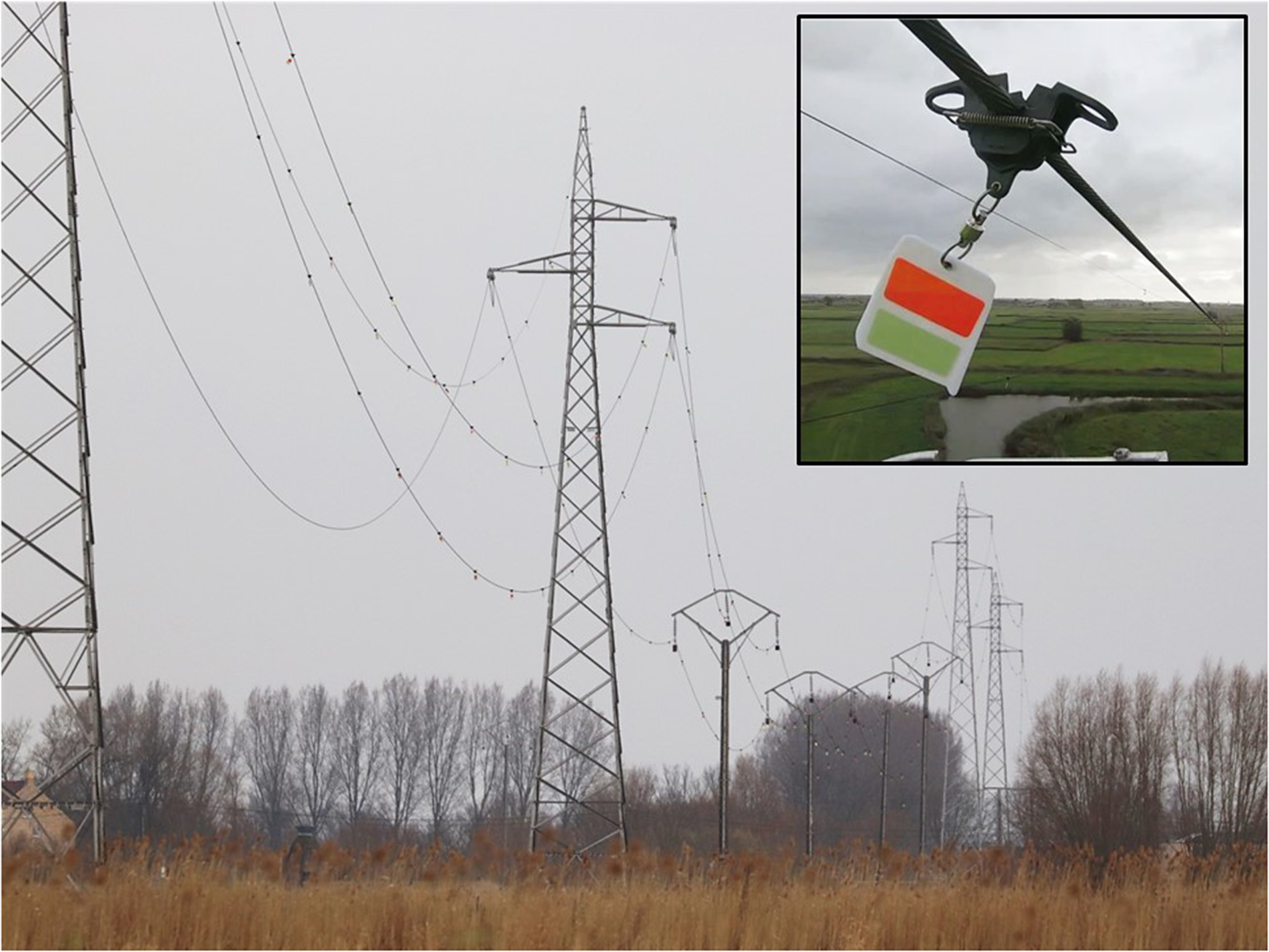
The transmission line we studied was owned and operated by Elia, Belgium’s Transmission System Operator, with over 8,867 km of 30-kV to 400-kV overhead lines and underground cables throughout Belgium. The line ran parallel to the Ieperlee, a semi-channelled watercourse draining wetlands around our study area to the Yser River (Figure 1).We chose this line segment because a nationwide model-based risk assessment identified it as high-risk for avian collisions based on the combination of land cover, avian use, and powerline configuration (Paquet et al. Reference Paquet, Swinnen, Derouaux, Devos and Verbelen2022). The contiguous 10 spans we studied were supported by pylons of two different heights and configurations. The southern five spans were supported on each end by tall lattice pylons (36 m tall) constructed with a vertical configuration with each of three conductor wires at a different height below a single shield wire (four horizontal planes of wires in total; Figure 2). The northern five spans were supported on at least one end by short vault pylons (15 m tall) constructed with a horizontal configuration with two of three conductors at the same height and without a shield wire (two horizontal planes in total). This resulted in five tall spans crossing 2.07 km with shield wires and five short spans crossing 1.03 km without shield wires. Wire heights ranged from a maximum height of 36 m where overhead shield wires connected to tall pylons to as low as 12 m where conductors sagged towards the ground between pylons.
The study included 10 powerline spans in or adjacent to three important avian wintering areas.

The study area included two pylon configurations. A taller configuration with a shield wire supported five spans at the south end, and a shorter configuration without a shield wire supported five spans at the north end. (Photo credit: James F. Dwyer.)
Line marking
We surveyed 10 study spans 11 times in 2001 (5–30 March), 2018 (4 March–7 April), and 2021 (7 March–11 April) for a total of 33 surveys. During the first survey in each year, we removed all carcasses found. We conducted our surveys in March and early April immediately after large flocks of wintering geese departed on spring migration so that our surveys would not disturb the flocks, potentially causing collisions. This timing allowed us to avoid semi-annual winter flooding of the Yser River in the survey area, and to search for carcasses before tall summer vegetation blocked detection.
In October 2019, Elia installed 302 line markers at 30-m spacing on each marked wire, with markers offset by 10 m on each of three marked wires in each span. This created a visual effect of 10-m spacing. Elia installed the FF model of FireFly because the FF was an active (moving) device which spun and fluttered in wind, presumably increasing visibility to birds compared with alternative passive line markers that lacked movement. On the southern five spans (supported by tall pylons), Elia installed line markers on the shield wire and on the upper and lower conductors, i.e. all wires accessible from the west. This left the middle conductor unmarked. On the northern five spans (supported by short pylons), where no shield wire was present, Elia installed line markers on all three conductors.
During each survey, at least two volunteers searched for avian carcasses by walking parallel to each other along the transmission line right-of-way, maintaining 10–15-m spacing between surveyors as they searched for carcasses. We attempted to minimise the influence of variation in the number of searchers by ensuring that each survey included at least one ornithological expert with carcass surveying experience and knowledge of the local avifauna. In 2001, we used paper maps and data sheets to record each carcass found. In 2018 and 2021, we used a smartphone app (ObsMapp/iObs; www.waarnemingen.be) to facilitate the collection of real-time spatially accurate data (2001 data were also entered into this portal when available). The app recorded carcass locations together with user data and photographs of each carcass. We subsequently identified the span involved from the location data and used that data to avoid double-counting during subsequent visits. Each time we found a carcass, we recorded the most precise taxonomic level possible given the condition. We also recorded piles of ≥10 feathers within 1 m² following Barrientos et al. (Reference Barrientos, Martins, Ascensão, D’Amico, Moreira and de Agua2018). This allowed us to include feather piles likely attributable to post-collision scavenging while omitting feathers likely attributable to moulting or preening (Barrientos et al. Reference Barrientos, Martins, Ascensão, D’Amico, Moreira and de Agua2018).
We considered the effects of line marking across the entire studied line segment by comparing numbers of collisions documented before line marking to numbers of collisions documented after. We also considered the effects of line marking on spans with shield wires (connecting tall pylons to tall pylons) and separately on spans without shield wires (connecting short pylons to short pylons and short pylons to tall pylons) to consider the effects of line marking relative to configuration.
Year effect
Our study design prevented us from comparing collisions on marked and unmarked spans within the same year, creating the potential for a confounding year effect. To address that, we scaled the number of collisions we found to metrics of avian abundance at our study site each year. Each winter, the Research Institute for Nature and Forest (INBO) and Natuurpunt coordinate mid-monthly waterbird counts from October to March throughout northern Belgium (Flanders). During these counts, all waterbirds other than gulls (Laridae) are counted in as many wetlands as possible, creating a long-term georeferenced data set. Flanders’ gulls are counted separately with simultaneous counts at as many gull roosts as possible, again creating a long-term georeferenced data set.
To consider a year effect, we calculated quasi-collision rates (hereafter, “collision rates”) for waterbirds and gulls, both abundant in our carcass data set, in our study area in 2001, 2018, and 2021 as the number of collisions counted vs the number of birds counted. These are quasi-rates because not all waterbirds and gulls in the area necessarily crossed the study area, and because those that did cross the study area may have crossed multiple times. For waterbirds, we focused particularly on Common Coots Fulica atra and Eurasian Teals Anas crecca because these species were found during carcass searches in each of our survey years and were abundant in count data. For gulls, we focused on Black-headed Gulls Chroicocephalus ridibundus, Common Gulls Larus canus, and Herring Gulls Larus argentatus because they were present in our collision data and occurred in relatively large numbers (≥100 individuals) in count data. We compared collisions with counts from Merkem IJzerbroeken, Noordschote IJzerbroeken, and the Merkem Reservoir for waterbirds, and Merkem Reservoir for gulls because the line we studied traversed or was adjacent to these areas.
Biases
We considered two types of biases. Carcasses found in our study area due to predation could have increased our estimate of collisions, while carcasses due to collision but not found could have decreased our estimate. To consider predation, we followed Constantini et al. (2016) in excluding carcasses attributable to Peregrine Falcons Falco peregrinus, which were known to hunt birds in our study area. The typical prey remains left behind by a Peregrine Falcon were near a pylon rather than mid-span, and had the breastbone and wings connected by the shoulder girdle with all associated muscle consumed (Costantini et al. Reference Costantini, Gustin, Ferrarini and Dell’Omo2016; Verbelen and Swinnen Reference Verbelen and Swinnen2019; Verbelen et al. Reference Verbelen, Bovens and Swinnen2021). Terrestrial scavengers do not leave carcasses in that condition, and Peregrine Falcons generally do not scavenge carcasses, allowing us to clearly distinguish the carcasses of birds depredated by Peregrine Falcons from the carcasses of birds which had collided with the transmission line and were subsequently scavenged.
We considered scavenger bias arising when carcasses were consumed by scavengers more quickly than the sequential surveys occurred, resulting in carcasses which were never found during a survey. We assessed this in March 2021 by setting up three remote cameras along the survey route and placing an avian carcass up to 5 m in front of each camera. Five days later, we downloaded images from each remote camera, changed batteries, and replaced the carcasses. We repeated this every five days from early March to early April, resulting in 21 carcasses deployed. This allowed us to estimate the percentage of carcasses likely to have been present but scavenged between surveys to better estimate the actual number of birds present. The Wildlife Rescue Centre (Ostend, Belgium) donated carcasses for these trials after rehabilitation efforts failed. Presumably, scavengers also removed carcasses during the 2001 and 2018 studies. As we did not quantify scavenging in those surveys, we do not know if rates were comparable to 2021 scavenging rates; 2018 rates were likely similar, but 2001 rates may have differed substantially. For that reason, we used raw numbers in our analyses, and simply noted that they indicate minimum values.
Results
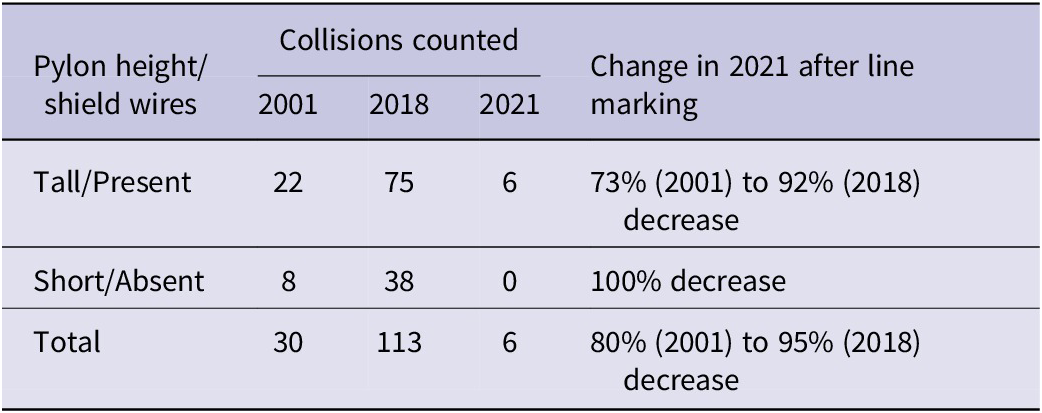
Before line marking, we found 30 carcasses attributable to collision under the study spans in 2001 and 113 in 2018 (Table 1). After line marking, we found six carcasses attributable to collision in 2021. Of the total carcasses found in all three surveys, 57 were waterbirds and 17 were gulls. Collision rates averaged one collision for every 2,519 waterbirds and one collision for every 524 gulls before line marking (Table 2). Collision rates averaged one collision for every 19,292 waterbirds and one collision for at least every 2,596 gulls after line marking. Thus, in 2021, line marking correlated with a collision rate reduction of at least 85% and up to 100%, depending on the pre-treatment year and species group being considered.
Carcasses attributable to powerline collisions found in our study before (2001 and 2018) and after (2021) a 70-kV powerline was marked with FireFly line markers

* These species were prevalent in collision and abundance data.
Waterbird and gull collisions decreased in 2021 after line marking

* Waterbirds considered were Common Coots and Eurasian Teals. Gulls considered were Black-headed Gulls, Common Gulls, and Herring Gulls because these species were prevalent in collision and abundance data.
The spans we studied were of two different configurations: tall spans with shield wires, and short spans without shield wires. Prior to line marking, 97 collisions (68% in 2001 and 2018 combined) occurred on spans supported by tall pylons with shield wires, and 46 collisions (32% in 2001 and 2018 combined) occurred on spans supported by short pylons without shield wires (Table 3). After line marking, six collisions (100% in 2021) occurred on spans supported by tall pylons, and none (0%) occurred on spans supported by short pylons. Thus, in 2021, FireFly line markers correlated with an observed mortality reduction of at least 73% and up to 100%, depending on the configuration.
Most carcasses attributable to collision were found prior to line marking. After line marking, all carcasses attributable to collision were found under powerline spans with shield wires connecting tall pylons
Biases
Peregrine Falcons were likely present in the area in 2001 but were not considered as a cause of mortality for the carcasses collected. Presumably some carcasses in 2001 should have been attributed to Peregrine Falcon predation, but because Peregrine Falcons were relatively rare at that time, the biasing factor is likely low. In 2018 and 2021, 23 and 11 carcasses were attributed to Peregrine Falcon predation, respectively (Figure 3), and were removed from the data set to avoid over-counting carcasses attributable to collisions.
Examples of avian carcasses found in 2021 attributable to Peregrine Falcon predation in which the breastbone and the wings were connected by the shoulder girdle and all muscle had been consumed. (A) Common Pochard Aythya ferina; (B) Common Starling Sturnus vulgaris; (C) Common Coot Fulica atra; (D) Eurasian Teal Anas crecca. (Photo credits: Filip Declerck.)

We deployed 21 carcasses with remote cameras to quantify carcass persistence. Of these, seven (33%) were removed completely by scavengers and presumably consumed within the five-day deployment window (Appendix 1). This suggests that in addition to the six carcasses we found in 2021, an additional 33% (two carcasses) likely occurred in the study area but were not detected because they were scavenged.
Discussion
After installing line markers, avian collisions declined in our study area, even as avian populations increased. Collisions may even have been eliminated on spans without shield wires, although with only six collisions found in 2021, it may be that through collecting more data over multiple years a collision might be identified eventually. Our findings suggest line markers reduced avian collisions with the transmission line we studied, presumably by increasing the visibility of suspended wires to birds. Our findings suggest FireFly FF line markers or other line markers with similar characteristics may also be effective in reducing bird collisions with transmission lines at other sites in Europe, particularly when collisions involve waterbirds and gulls.
Previous research has identified a wide range of effectiveness in using FireFly line markers to reduce avian collisions. Specifically, Yee (Reference Yee2007) identified a 60% reduction in the number of carcasses found under spans marked with FireFly line markers, and Murphy et al. (Reference Murphy, McPherron, Wright and Serbousek2009) identified a 50–66% reduction in collisions. More recently, Silero et al. (Reference Silero, Clara, Azorin, Argaña, Martins and Vieira2011) identified a collision reduction of 87% and found a 40% increase in birds flying above wires marked with FireFly line markers, rather than flying between or below unmarked wires. In meta-analyses considering many types of line markers, Barrientos et al. (Reference Barrientos, Ponce, Palacín, Martín, Martín and Alonso2012) found line markers reduced collisions by an average of 78% (range = 55–94%) across 21 mostly peer-reviewed studies. Bernardino et al. (Reference Bernardino, Martins, Bispo and Moreira2019) also considered many types of line markers and found line markers reduced collisions by an average of only 50% (95% confidence interval estimate: 40–59%) when additional grey literature was included in their analysis. Given that nonsignificant findings are generally published less frequently, the average effectiveness is likely lower. Our findings of collision mitigation were near the top of the range of effects. We suggest this is because all wires except for the middle conductor were marked on spans supported by tall pylons, and all wires were marked on spans supported by short pylons. Usually, only shield wires are marked. The large effect we documented may also have been attributable, at least in part, to the selection of active FireFly FF line markers which incorporated high-contrast, reflective, glow-in-the-dark, and moving elements intended to make them as visible as possible to birds in flight. This hypothesis remains speculative because studies attempting to compare the effectiveness of various line marker types have generally been inconclusive due to a lack of statistical power (Bernardino et al. Reference Bernardino, Martins, Bispo and Moreira2019). Future research should continue to investigate the merits of high-contrast, reflective, glow-in-the-dark, and moving elements in avian collision mitigation.
The spans where collisions continued after line markers were installed were longer and higher than spans where collisions were not observed, included an unmarked conductor, and were composed of multiple horizontal planes. This combination of variables makes it impossible to identify the specific mechanism allowing collisions to persist on the marked spans between tall pylons. Perhaps because spans were longer, birds using pylons as cues to increase flight height (Pallett et al. Reference Pallet, Simmons and Brown2022), did not see the nearest pylons when crossing the right-of-way, leading to ongoing, but reduced, collisions. Perhaps because pylons were taller, birds flew higher, but not high enough, and so collided with the shield wire despite the presence of line markers. Although sandwiched between marked wires, it is possible the unmarked conductor was involved in the collisions. This seems unlikely because prior research has demonstrated that most collisions with transmission lines involve shield wires. For example, in early research Scott et al. (Reference Scott, Roberts and Cadbury1972) found 10 of 10 (100%) observed collisions involved shield wires. Thereafter, Faanes et al. (Reference Faanes1987) found 102 of 109 (94%) collisions involved overhead shield wires, and Murphy et al. (Reference Murphy, McPherron, Wright and Serbousek2009) found 233 of 321 (73%) collisions involved shield wires. More recently, Dwyer et al. (Reference Dwyer, Pandey, McHale and Harness2019) found 47 of 50 collisions (94%) and Baasch et al. (Reference Baasch, Hegg, Dwyer, Caven, Taddicken and Worley2022) found 36 of 64 collisions (56%) involved shield wires. Shield wires are approximately half the diameter of conductors, do not generate corona emissions, and are higher than conductors. This makes overhead shield wires more difficult to see than conductors and places them in the flight paths of birds climbing over conductors (Bernardino et al. Reference Bernardino, Bevanger, Barrientos, Dwyer, Marques and Martins2018). Based on the history of observed collisions, it seems likely birds collided with the shield wire on the marked spans in our study, but future research involving nocturnal observations with night vision optics or automated collision detection systems (as in Sporer et al. Reference Sporer, Dwyer, Gerber, Harness and Pandey2013; Dwyer et al. Reference Dwyer, Pandey, McHale and Harness2019; Baasch et al. Reference Baasch, Hegg, Dwyer, Caven, Taddicken and Worley2022) would be necessary to verify or refute this hypothesis.
Although our findings were positive, two features limited our study. First, we used varying numbers of volunteers to conduct surveys, and second, we only accounted for two types of bias. Intuitively, more volunteers per survey should result in increased detection rates. This would presumably be true if all volunteers were highly qualified and actively engaged throughout their time searching for carcasses. This was likely the case when Demeter et al. (Reference Demeter, Horváth, Nagy, Görögh, Tóth and Bagyura2018) used volunteers to search for avian electrocutions at the bases of power pylons, and Kolnegari et al. (Reference Kolnegari, Hazrati, Tehrani and Dwyer2022) used crowd-sourced reporting to identify avian nesting on power pylons. In practice, sometimes our additional volunteers were neither highly qualified nor actively engaged throughout the day, but were instead accompanying friends or family with those characteristics. We encouraged participation by untrained volunteers because we believe it helped support our long-term conservation goals by encouraging development of a conservation ethic, but their presence did not necessarily increase the detection of carcasses during surveys. Consequently, our analysis does not account for numbers or expertise of volunteers. Future research using volunteers may contribute to avian conservation by quantifying volunteer numbers and expertise.
Future research could also improve the accuracy of overall collision estimates by quantifying crippling bias, detection bias, predator bias (Peregrine Falcons), and scavenging bias during each field season (Dwyer and Mannan Reference Dwyer and Mannan2007; Huso Reference Huso2011; Ponce et al. Reference Ponce, Alonso, Argandoña, García Fernández and Carrasco2010). Quantifying crippling bias was not strictly necessary in this study as we can assume that was relatively consistent across survey years. Detection bias could have changed from year to year, however, and scavenging bias almost certainly changed from 2001 to 2021. For that reason, although our results were generally consistent when comparing 2001 to 2021 and 2018 to 2021, a very conservative interpretation might discard the 2001 data, and only consider the comparisons we report from 2018 to 2021. Our separate-year reporting in the Results section facilitates this approach.
Although our study was imperfect, our findings that avian collisions declined substantially following the installation of line markers is encouraging, our quantification of Peregrine Falcon predation is novel, and our findings of different collision rates on tall spans with shield wires compared with short spans without shield wires is important to future conservation and management. We hope lessons learned in our study can be used to improve future avian collision research in Europe.
Acknowledgements
We thank Elia, the owner of the transmission line included in this study, for funding and site access, and we thank the volunteers for conducting surveys. We thank Geert Spanoghe for assistance in identifying species from feathers, and Peter van Geneijgen for assistance in distinguishing carcasses attributable to Peregrine Falcon depredation from carcasses attributable to powerline collisions. We are also grateful to Koen Devos and Filiep T’Jollyn of the Research Institute for Nature and Forest (INBO) who collected the waterbird and gull data with which we compared collisions. Richard Harness, Olivia Geels, Johan Mortier, Jean-Yves Paquet, and two anonymous reviewers provided feedback on early versions of this manuscript. This study was previously published as a series of internal Natuurpunt reports written in Dutch, and not distributed outside Belgium (Elia 2001; Verbelen and Swinnen Reference Verbelen and Swinnen2018a, Reference Verbelen and Swinnen2018b; Verbelen et al. Reference Verbelen, Bovens and Swinnen2021).
Appendix 1.
(A) A red fox Vulpes vulpes moved but did not consume a Eurasian Sparrowhawk Accipiter nisus carcass. (B) A beech marten Martes foina investigated but did not consume a Eurasian Sparrowhawk carcass. (C) A Grey Heron Ardea cinerea approached but did not contact a European Robin Erithacus rubecula carcass. (D) A stoat Mustela erminea approached but did not contact a Rock Pigeon Columba livia carcass. (E) Two Common Buzzards Buteo buteo plucked and consumed a Common Snipe Gallinago gallinago carcass. (Photo credits: Natuurpunt remote cameras, March and April 2021.)

Of 21 carcasses deployed, 10 were moved or removed by scavengers, and 11 remained in place for the duration of the five-day exposure period



