1 Introduction
In an earlier study (Clark & Hillenbrand Reference Clark and Hillenbrand2003), we examined the acoustics and perception of front vowels preceding /r/ in American English. We noted that the contrasts between the vowels /i/ and /I/ and between /ē/ and [ε] are neutralized preceding tautosyllabic /r/, and we related this loss of contrast to the variability of phoneticians’ descriptions of the vowel nuclei in words such as beer and bear. For one variety of American English (specifically, as spoken in southern Michigan), we established that the initial part of the schwar diphthongs in these words was closer to [i] and [ē], respectively, than to /I/ and [ε]. Our methods included acoustic measurements of vowels produced in rhotic and nonrhotic environments, judgments by listeners, and discriminant analyses.
1.1 The existence of only one central back rhotic diphthong in most American English
In the current study we used similar methods to explore parallel questions about the nature of the diphthong in words such as bore/boar. Although earlier studies (especially Kurath & McDavid Reference Kurath and McDavid1961) showed widespread maintenance of a contrast between two classes of vowel, exemplified by four vs. forty, in parts of the United States, there appears now to be only one such class in much of the country. Word pairs such as four and forty have the same stressed vowel nucleus in the English of southern Michigan, and in many other North American dialects of English. Kreidler (Reference Kreidler1997: 81), after characterizing a DOOR set of words pronounced with the vowel of TOE followed by /r/, and a WAR set, pronounced with the vowel of LAW followed by /r/, notes that ‘A large – and growing – number of North Americans have no contrast between the DOOR set and the WAR set.’ American dialects are similar in this respect to other well-studied varieties of English, such as Received Pronunciation (RP) and Australian English (Kreidler Reference Kreidler1989). In a similar vein, Ladefoged (Reference Ladefoged2001) notes that ‘many people make no difference between “bore” and “boar”. But some speakers do contrast [ɔː] and [óʊ] in these two words, or in other pairs such as “horse” and “hoarse”.’ A parallel comment comes from Giegerich (Reference Giegerich1992), suggesting morning and mourning as possibly distinct in the speech of some Americans. The most current and comprehensive data, derived from telephone surveys, are found in The Atlas of North American English (ANAE; Labov, Ash & Boberg Reference Labov, Ash and Boberg2006), which shows a lack of contrast between words of these two classes across most of the United States, including southern Michigan (see especially Map 8.2, page 52).
The contrast is neutralized, but of course the diphthong has some phonetic value, and most descriptions suggest that the initial part of it tends toward [ɔ]. For example, Kreidler (Reference Kreidler1989: 60) notes that ‘[i]n rhotic dialects which do not have this distinction [between DOOR and WAR words] the articulation may range between [ó] and [ɔ] but is likely to be nearer the latter’. Similarly, Giegerich (Reference Giegerich1992: 64) says that ‘[f]or those who do not have the contrast at all, we assume the lower one of the two phonemes – /ɔ/ – in both’. Giegerich acknowledges that if there is no contrast, it is difficult to say that the vowel is, phonologically speaking, one vs. the other, with the implication that it is the phonetic value that favors /ɔ/ over [o]. Ladefoged (Reference Ladefoged2001: 81f.) suggests that [ɔː] best represents the value of the vowel in bore words (and boar words, given that most American speakers do not distinguish these) but also explicitly suggests that often, ‘in contexts in which there is no opposition between two sounds, the actual sound produced is somewhere between the two’.
1.2 The variable existence of /ɔ/ in nonrhotic environments in American English
To give a broader context to this question of whether DOOR/WAR words have [ɔ] or [ó], it should be noted that many American speakers do not have a vowel of [ɔ] quality in nonrhotic environments; that is, the contrast between LAW words and LOCK words (and between these and SPA words) has been lost, with words in these categories having generally a low back vowel [ɑː] (Ladefoged Reference Ladefoged2001). For such speakers, it is sometimes suggested that [ɔ], while not generally needed as a symbol, is still useful for transcribing DOOR/WAR words. For example, Ladefoged (Reference Ladefoged2001: 30) states, ‘Many Midwestern and Far Western American speakers do not need to use this symbol in [words such as caught, bought, law], as they do not distinguish between the vowels in words such as “cot” and “caught”. They may, however, have different vowels in words such as “moss” and “morse”, so that they, like many other Americans, would use the symbol [ɔ] when there is a following [r] sound.’
However, some areas of the United States do retain a clear distinction between LOCK and LAW words, as shown by Labov et al. (Reference Labov, Ash and Boberg2006; see especially Map 9.2, page 61). Southern Michigan, as part of the Inland North, is one such area where the merger has been resisted, and that is the home region of the speakers whose vowels are reported here and in Clark & Hillenbrand (Reference Clark and Hillenbrand2003; see also Hillenbrand, Getty, Clark & Wheeler Reference Hillenbrand, Getty, Clark and Wheeler1995).
In our experience, beginning phonetic students in this region, who have DOOR = WAR and separate categories for LOCK, LAW, and TOE words, often express surprise at the suggestion in phonetics textbooks that DOOR/WAR words could be transcribed with [ɔ]. To their ears, the initial part of DOOR/WAR words sounds much closer to the vowel of TOE than to that of LAW.
1.3 Other American English back diphthongs sharing vowel space with DOOR/WAR
The question of the phonetic quality of DOOR/WAR words is paralleled in discussions of the diphthong of TOY words, in that its initial part is usually described as [ɔ]. For example, Carr (Reference Carr1999: 30) states, ‘In the RP and [General American] pronunciations of soy, Roy, buoyed, etc., the vowel begins with an [ɔ]-like quality (in the region of cardinal vowel 6) and ends in an [ɪ]-like quality. We will transcribe this as [ɔɪ].’ Similarly, Ladefoged (Reference Ladefoged2001: 31) notes that for many speakers of both British and American English, ‘The vowel in “boy” [bɔɪ] is a combination of [ɔ] as in “bawd” and [ɪ] as in “hid”’, and Kreidler (Reference Kreidler1989: 59) notes that the diphthong of TOY words ‘begins in the low-back area or somewhat higher . . . the beginning may be somewhat higher or lower but variation [across dialects of English around the world] is negligible’. Taking a different view, Shriberg & Kent (Reference Shriberg and Kent2003: 42) suggest more variation among speakers of American English in the initial part of this diphthong, in that ‘[t]he tongue position for the onglide is low-mid-back, like that for /ɔ/, or mid-back, like that for [o]’.
Our beginning phonetics students show a strong tendency toward transcribing the onset of this diphthong with [ó] rather than [ɔ]. They acknowledge the difference in pronunciation between joy and Joey, for example, but nonetheless sense that joy is closer to Joey than to ‘jaw-y’. Thus their sense of the nature of this TOY diphthong, based primarily on audition but perhaps also somewhat on kinematic impressions or knowledge of orthography, parallels their sense of DOOR/WAR.
One other diphthong merits consideration as well, by reason of sharing vowel space with the DOOR/WAR diphthong. This is the STAR diphthong, which like DOOR/WAR ends in the rhotic vowel [ɚ], schwar. (Transcriptions of all these rhotic diphthongs sometimes use [r] or [ɹ] or [ɜ ˞] for the offglide, rather than [ɚ].) Kreidler (Reference Kreidler1989: 61) describes the STAR onset as ‘a long, unrounded low central or low back-central vowel’. For Ladefoged (Reference Ladefoged2001: 81), it is [ɑː], a long low back tense vowel. Shriberg & Kent (Reference Shriberg and Kent2003: 39) do not include STAR words in their discussion of diphthongs but do suggest barn as a key word for the vowel [ɑ], which is described as a low back tense unrounded vowel. Labov et al. (Reference Labov, Ash and Boberg2006) show conclusively that one of the key features of the speech of the Inland North is the relative fronting of the LOCK vowel, compared to its pronunciation in other dialect areas, and that similarly the STAR vowel nucleus is relatively fronted. Consequently a characterization such as one of Kreidler's above, ‘long, unrounded low central’, more accurately describes the phonetic facts for the STAR diphthong in this dialect, rather than ‘low back’.
1.4 Experimental studies of these diphthongs
These diphthongs have elicited a fair amount of attention from dialectologists over the years. Kurath & McDavid (Reference Kurath and McDavid1961) and Labov et al. (Reference Labov, Ash and Boberg2006) both offer comprehensive descriptions, and these works’ geographical coverage is wide, especially the latter's. As an example of a geographically narrower but rich and sociolinguistically informed account, see Laferriere's (Reference Laferriere1979) discussion of these diphthongs as used by speakers of differing ethnicity in Boston. However, as we noted in our previous study, most accounts involve no systematic description of acoustic measurements or formal listening studies that might provide objective information on the phonetic quality of the initial part of the diphthongs in question. In general, these diphthongs appear to have been little studied by speech scientists. A notable exception is Lehiste (Reference Lehiste1964), who examined the acoustic structure of several words of the DOOR/WAR type (war, yore, wharf, lore, pour, and wore) spoken by five Midwestern men as part of a study of /r/ allophones. Lehiste was primarily interested in the /r/ itself, but she also attended to the vowels in the immediate phonetic neighborhood of /r/, and she recognized neutralization of vowel contrast in such words. In brief, these DOOR/WAR words were found to be acoustically distinct from words with [o] and /ɔ/ not followed by /r/ (roe and raw). Based on inferences from formants, the DOOR/WAR words were similar in vowel height to roe but with greater vowel backness. The DOOR/WAR words were both higher and further back than raw. (In one informant's pronunciation F1 and F2 for raw were similar to the values found in the other four informants’ DOOR/WAR words.)
Kameny (Reference Kameny1975) reported vowel nucleus formant measurements of the words door and tar, as pronounced by two men and two women, as part of an attempt to define these and other vowel nuclei in comparison with vowels in non-/r/ environments. Two of her subjects appeared not to distinguish between /ɑ/ and /ɔ/, and for these two the initial part of tar was close in F1 and F2 to the values measured in their LAW/LOCK words (baud and bod). The other two subjects distinguished between /ɑ/ and /ɔ/; for one of them tar was similar in F1 and F2 to the LOCK word (bod), and for the other tar was intermediate between bod and baud. Kameny found her measurements for door to be generally closer to those for bode (a TOE word) than to baud (a LAW word). Unlike most of the writers discussed above, then, she saw DOOR words as involving an allophone of [o] rather than /ɔ/.
The Atlas of North American English (Labov et al. Reference Labov, Ash and Boberg2006) is noteworthy among dialectological works for its extensive use of acoustic measures. Such measurements indicate that the eight southern Michigan women represented in the ANAE data pronounced DOOR/WAR and TOY words with backed and raised nuclei, relative to their pronunciation of TOE words, while their STAR words were pronounced with nuclei somewhat closer to the center of the vowel space, relative to their pronunciation of LOCK and LAW words.
1.5 Summary
To summarize, in the current study we are interested in the quality of the onset of the diphthong in DOOR/WAR words and in two other diphthongs with onsets in the back part of the vowel space, those in TOY and STAR words. Because of the differences of opinion noted above about the nature of the onsets of these diphthongs, we are also interested in the vowels of TOE, LAW, and LOCK words. Building on the earlier work of Lehiste (Reference Lehiste1964) and Kameny (Reference Kameny1975), our earlier study of front vowels before /r/ (Clark & Hillenbrand Reference Clark and Hillenbrand2003), and the recent work of Labov et al. (Reference Labov, Ash and Boberg2006), our purpose is to examine the initial part of the DOOR/WAR, STAR, and TOY diphthongs by conducting observations of three types: acoustic measurements, discriminant analyses, and listening tests.
2 Acoustic measurements
2.1 Speech material
The subjects produced monosyllables containing /ó ɔ ɑ/, with initial /b ɡ h/ and with final /d/ or /z/. This set of nine words consisted of bode, baud, bod, goad, gauze, God, hoed, hawed, and hod. Additionally eight words with diphthongs were recorded: board, gored, hoard, Boyd, goys, barred, guard, and hard. Each word appeared in the middle of a short carrier sentence which invited a repetition of the item of interest, e.g. ‘Say bode again. Bode.’ Eighty-two such sentences were recorded, the 17 of interest here plus another 65 with words having other phonological characteristics, included in order to avoid drawing attention to the diphthongs ending in [ɚ]. The sentences were spoken with tonic accent on the item of interest, followed by a single-word repetition of that item. The order of recording the 82 sentences was randomly scrambled for each talker.
2.1.1 Recording methods
Recordings were made in a sound-treated booth using a dynamic microphone. Signals were preamplified, low-pass filtered at 4.3 kHz, and directly digitized at a 10 kHz sample rate.
2.1.2 Talkers
Originally 14 subjects were recorded. With one exception all were students in their early to mid twenties; one was a faculty member in her mid forties. All had had exposure to the study of phonetics but were naïve to the purpose of the recordings. All were raised in southern Michigan and would be considered residents of the Inland North dialect region, as characterized by Labov et al. (Reference Labov, Ash and Boberg2006). Most of the talkers were from urban areas such as Detroit, Grand Rapids, and Kalamazoo, while the others had small town backgrounds.
For analysis the original group of 14 was reduced to 10 on the basis of the preliminary results of the first listening test. In that test, which is described further in Section 4.1, listeners identified the talkers’ /b/-initial words (bode, baud, bod, board, Boyd, barred). Four talkers’ baud productions were misidentified as bod by half or more of the listeners. Possibly the word baud was insufficiently familiar to those talkers, so that they pronounced it with the /ɑ/ vowel. In any case, since the baud productions were the source of the /ɔ/ excerpts used in the second and third listening tests, it seemed appropriate to remove these four talkers’ data from analysis of all three types: acoustic, discriminant, and listening. (It should be noted that a small number of misidentifications of baud and of other words remained in the data from the first listening test even after these four talkers’ data were removed; see Section 4.1)
The remaining 10 talkers – the faculty member and 9 students – provided imperfect but reasonable data sets. For the acoustic analysis, instead of 170 words (10 talkers × 17 words) there were 167. The discrepancy resulted from one talker's frank mispronunciation of hawed and baud – i.e., not using either /ɔ/ or /ɑ/ – although she produced a valid gauze, and another's mispronunciation of hod (but valid bod and God). The same 167 items were used in the discriminant analysis.
In the second and third listening tests, described further in Section 4.1, while the subjects identified vowel excerpts from all 14 talkers, only their judgments of tokens from the set of 10 were analyzed. The tokens were derived from the 59 /b/-initial words (10 talkers × 6 words, less the missing baud from one talker). The second listening test involved two excerpts from 39 of the /b/-initial words, or 78 tokens. The third listening test involved two excerpts from 29 words, or 58 tokens.
Each of the 10 talkers answered a questionnaire concerning whether certain pairs of words were homophonous in her own speech. Included were some pairs which would be expected to be homophonous for any speaker of English (e.g. way, weigh), some which would be clearly different for any speaker (e.g. least, list), and some which might vary dialectally (e.g. tint, tent; cot, caught). Seven pairs of words focused on the /ɑ ɔ/ distinction. Three pairs (cot, caught; tot, taught; body, bawdy) were reported by all 10 subjects to be different in pronunciation. Two /ɑ ɔ/ pairs (tock, talk; pod, pawed) were judged homophonous by one subject, and one other pair (Don, Dawn) was so judged by another. These two subjects plus one other also judged the last pair (Shah, Shaw) homophonous. For every talker, then, the majority of the /ɑ ɔ/ pairs were not homophonous, and for 7 of the 10, all such pairs in the questionnaire were not homophonous. This set of judgments is considered to establish the existence of the /ɑ ɔ/ contrast in the speech of the 10 talkers.
One of the pairs in the questionnaire was sore, soar. All 10 talkers responded that these words are identical in pronunciation. In a separate self-judgment task, 8 of the talkers reported that the pairs bore, boar, horse, hoarse, and morning, mourning are likewise identical in pronunciation; two reported a tentative sense of difference in one or two of these pairs. These judgments support the lack of contrast between DOOR and WAR words for these subjects.
2.2 Acoustic measurements
For each talker one token of each word was measured. Unless there were problems with recording fidelity, the token measured was the second, the one produced as a one-word utterance. In about 2% of the cases, the second token was considered inferior because of noise, so the token to be measured was excised from the first utterance. For each token, formant contours for F1–F3 were measured from LPC spectra (sampled every 5 ms) and edited by hand over the vowel duration using methods described in Hillenbrand et al. (Reference Hillenbrand, Getty, Clark and Wheeler1995). Measurements were also made of vowel onset, vowel offset, and steady state time. Onset and offset were judged by visual inspection of a gray-scale spectrogram using standard criteria (Peterson & Lehiste Reference Peterson and Lehiste1960). Steady state was determined automatically using a program developed by Hillenbrand, Clark & Nearey (2001), which is described in Clark & Hillenbrand (Reference Clark and Hillenbrand2003) as follows: ‘That program reduces the vowel formant contour to an array of logF2–logF1 values (see Miller Reference Miller1989), calculates the sum of differences between adjacent frames for every sequence of 7 frames (35 ms) during the initial 60% of the vowel, and then designates as steady state the middle of the sequence showing the smallest absolute summed difference.’
2.3 Acoustic measurement results
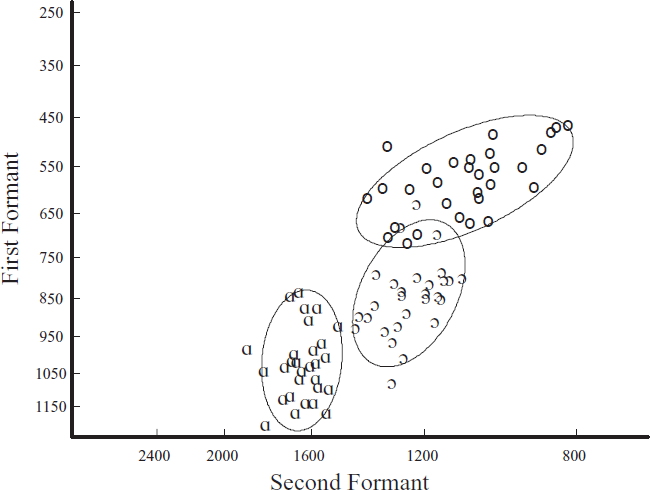
Figure 1 shows a plot of F1 and F2 steady state measurements for the /ɑ ɔ ó/ vowels of the 10 talkers, measured from their productions of the words bod, God, hod, baud, gauze, hawed, bode, goad, and hoed. The formant frequency measurements have been converted to Bark, and the axes are reversed so as to represent the vowel space with more conventional height and backness orientations. This figure, with its minimal overlap among the vowel types, confirms the /ɑ ɔ/ contrast in the speech of these subjects.
F1 and F2 (Bark) measured at automatically determined ‘steady state’ points within the first 60% of vowel duration. Ten women talkers uttering ‘baud’, ‘bod’, ‘bode’, and similar syllables beginning with /ɡ/ and /h/.

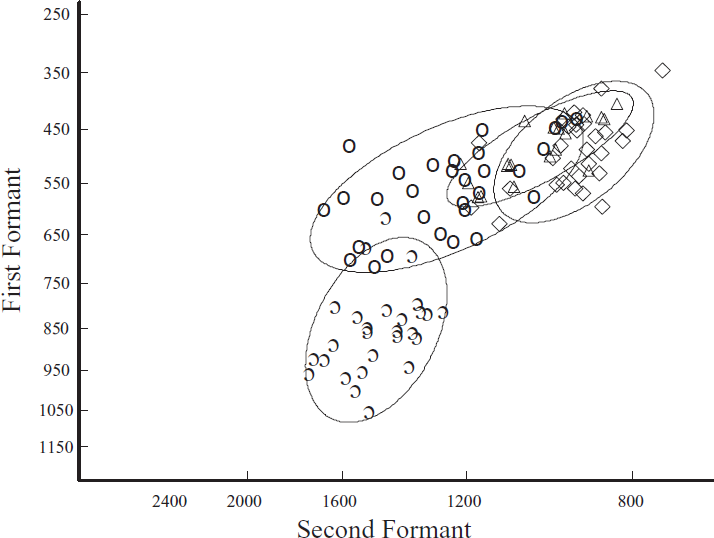
Figure 2 shows a plot of F1 and F2 measurements for the /ɔ ó/ vowels of the 10 talkers, measured from baud, gauze, hawed, bode, goad, and hoed, together with the same measurements for their DOOR/WAR diphthong, measured from board, gored, hoard, and for their TOY diphthong, measured from Boyd, goys. The figure demonstrates close affinity of the initial part of both DOOR/WAR and TOY diphthongs to the [o] words, and no similarity to the /ɔ/ words. There is in fact a tendency for the onsets of the diphthongs to be higher and more back (lower F1 and F2 values) than the [o] vowel, and thus even less like the /ɔ/ in the speech of these subjects.
F1 and F2 (Bark) measured at automatically determined ‘steady state’ points within the first 60% of vowel duration. Ten women talkers uttering ‘baud’, ‘bode’, ‘board’ (diamond), ‘Boyd’ (triangle) and similar syllables beginning with /ɡ/ and /h/.

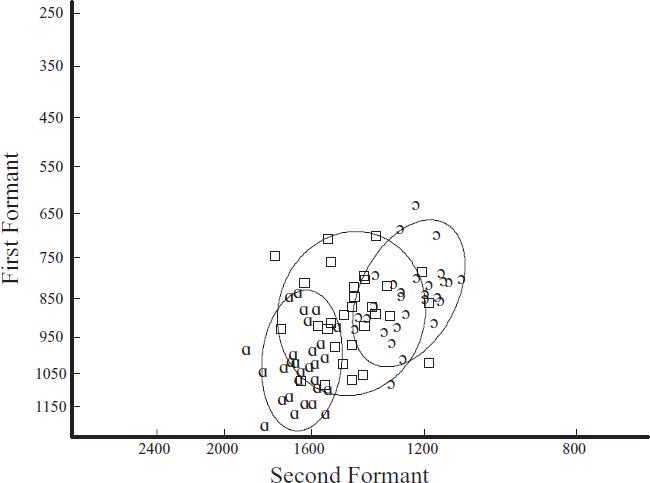
Figure 3 shows the same measurements for the /ɑ ɔ/ vowels and the diphthong in barred, guard, and hard. Unlike the earlier measurements for the TOY and DOOR/WAR diphthongs as compared with [o] and /ɔ/, however, these demonstrate considerable overlap of the STAR diphthong with both /ɑ/ and /ɔ/. The initial part of this diphthong seems intermediate.
F1 and F2 (Bark) measured at automatically determined ‘steady state’ points within the first 60% of vowel duration. Ten women talkers uttering ‘baud’, ‘bod’, ‘barred’ (square), and similar syllables beginning with /ɡ/ and /h/.

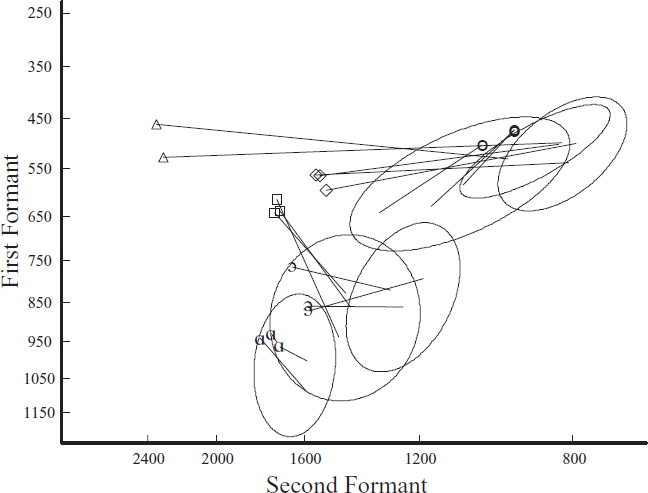
Figure 4 sums up the impressions gained from the previous figures and adds the dimension of change over time in the vowel formants. The ellipses in this figure are the same as in figures 1, 2, and 3; they are computed on the complete set of F1–F2 steady-state data points (typically 30 data points). Each vowel in the figure is represented as well by three spectral change vectors, representing average values for the syllables beginning with /b/, /ɡ/, and /h/. F1 and F2 were measured at two points in each vowel token: at 0.25 and 0.75 of vowel duration. The averages of the measurements at these two points for the /b/-initial words (and similarly for /ɡ/ and /h/) defined the end points of a vector for a given vowel. The symbol is shown at the 0.75 point. As would be expected, the three diphthongs in question show considerable spectral change between the two measurement points. The vectors for the TOY words (only two because there were only /b/ and /ɡ/ words) swing off into high front vowel space, while those for the DOOR/WAR and STAR words end centrally. The other vowels show considerable spectral change as well. The vectors for the LOCK and LAW words move forward in vowel space, and mostly higher, as well. The vectors for the TOE words head toward the high back region – not surprisingly, given that this vowel is often considered a diphthong and represented with a complex symbol /óʊ/ rather than plain [o].
Spectral change vectors showing mean F1 and F2 (Bark) measured at 25% and 75% of vowel duration. The vowel symbol is at the 75% point. Ten women talkers uttering ‘baud’, ‘bod’, ‘bode’, ‘board’ (diamond), ‘Boyd’ (triangle), ‘barred’ (square) and similar syllables beginning with /ɡ/ and /h/. Separate vectors for /b/-initial, /ɡ/-initial, and /h/-initial words.

3 Discriminant analysis
To formalize impressions gained from the F1–F2 plots (namely the greater similarity of the initial part of the DOOR/WAR and TOY diphthongs to [o] than to /ɔ/, and the intermediate nature of the initial part of the STAR diphthong between /ɑ/ and /ɔ/), discriminant analysis was undertaken. A quadratic discriminant classifier was used (Johnson & Winchern Reference Johnson and Winchern1982). For the DOOR/WAR and TOY diphthongs, the classifier was trained on [o] and /ɔ/ in nonrhotic environments (bode, baud, . . ., etc.), with F1, F2, and F3 at steady state as parameters, and then tested on the diphthongs in question (board, gored, hoard; Boyd, goys). Similarly for the STAR diphthong, the classifier was trained on /ɑ/ and /ɔ/ in nonrhotic environments (bod, baud, . . ., etc.) and then tested on the STAR diphthong (barred, guard, hard).
The same pattern of results was observed for the DOOR/WAR and the TOY diphthongs. Of the 30 tokens (3 words by 10 talkers) of board, gored, and hoard, 100% were classified as [o], confirming the similarity of the initial part of the diphthong to this vowel. All 20 tokens of Boyd and goys were similarly classified as [o]. For the STAR diphthong, on the contrary, the 30 tokens of barred, guard, and hard were about equally classified as /ɑ/ and /ɔ/, 16 vs. 14 tokens, respectively. It is worth noting that these discriminant analysis results using F1, F2, and F3 neatly mirror the relationships suggested by the acoustic vowel diagrams, using only F1 and F2, in figures 1–3.
4 Listening tests
In this part of the study we aimed to discover how listeners would classify brief initial excerpts of the recorded vowels and diphthongs. Based on the acoustic measurements and discriminant analyses, we expected that signals extracted from board and Boyd, for example, would be heard more often as [o] than as /ɔ/. On the other hand, we anticipated that signals excerpted from barred would sound ambiguously like /ɑ/ or /ɔ/.
4.1 Listening test methods
As a preliminary to the listening tests involving short-duration vowel excerpts, the first listening test involved the complete words bode, baud, bod, board, barred, and Boyd as produced by the 10 talkers. There were 59 such words rather than 60, as one subject did not know the word baud. These 59 words, along with 24 others produced by the four talkers who were excluded from the original set of 14 (see Section 2.1.2, above), were presented to 18 listeners (all women 19 to 37 years, with an average age of 22) from the same dialect group as the talkers. Three listeners were from suburban Chicago, and all the others were from southern Michigan, mostly from urban and suburban locales. They were all familiar with phonetic transcription of vowels, although they did not need that knowledge for the task. They were informed of the target words and given examples of rhyming words, to ensure certainty about pronunciation. For example, the written instructions gave pawed and sawed as rhymes for baud, and load and rode as rhymes for bode.
The signals were presented via Alvin, a program for controlling behavioral experiments (Hillenbrand & Gayvert Reference Hillenbrand and Gayvert2005). The listeners were to listen to each word (with repetition as desired) and indicate its identity by mouse click. Buttons were labeled with spelled words. The order of presentation of the 83 signals was randomized separately for each listener. Signals were low-pass filtered at 4.3 kHz, amplified and delivered at approximately 75 dBA over a single loudspeaker positioned about one meter from the listener's head. (This same instrumentation was used for the second and third listening tests, below.)
On the whole the words were well recognized. There were only 39 misidentifications in 1,062 judgments (18 listeners × 59 words). Boyd, board, barred, bod, and bode were correctly identified at least 96.7% of the time. Baud was less reliably judged, at 84.6%. Of the six incorrect responses for bod, all were baud, and almost all of the 25 incorrect responses for baud were bod, indicating less reliable discrimination of these two vowels. Most of the incorrect responses for baud were registered for signals from just three talkers. (These were not excluded from the original 14 in the process described in Section 2.1.2 because their baud tokens were correctly identified by over half the listeners.) Acoustic measurements showed a tendency toward somewhat higher F1 and F2 at steady state in the baud signals that were frequently misjudged as bod than in those that were correctly identified. But this distinction was not robust; one baud signal that was correctly identified by 17 of 18 listeners was quite similar in F1 and F2 to two that were misidentified by up to a third of the listeners, while one baud signal that was misidentified as bod by a third of the listeners was very similar, by these acoustic measures, to some that were correctly identified by all 18 listeners.
The listeners, as well, were not equally successful at identifying the baud and bod words. Sixteen of the 18 listeners correctly identified over 75% of the baud signals, with five of these achieving 100%, while the other two fell just above 50% correct judgment of the baud signals. It is possible that a response bias was operating in favor of bod, a common slang term, to the disadvantage of baud, a much less common technical word. In any case, on the whole the results of this first listening test establish the identifiability of the words intended by the talkers, so that segments excerpted from the vowels can be considered representative of the six vowel categories.
The second listening test was prepared with vowel segments of two different durations excised from the original recordings of the /b/-initial words with [o], /ɔ/, and the DOOR/WAR and TOY diphthongs. There were 78 signals instead of the expected 80 (2 segment durations × 10 talkers × 4 words – baud, bode, board, Boyd) because of the missing baud token from one subject. All excised segments were taken from the initial part of the vowels, starting with vowel onset, as determined from the waveform. Thirty-nine of the excerpts extended for 60 ms from vowel onset, and the other 39 extended for 120 ms. These durations were short enough to exclude most of the spectral changes seen in latter portions of the vowel tokens, yet long enough for the signals to be recognizable as vowels. All test signals were ramped on and off by a 20 ms lifted and inverted half cosine function.
The 78 signals, along with 32 others excerpted from vowels produced by the excluded four talkers, were presented to 23 listeners (one man and 22 women) from the same dialect group as the talkers. The listeners were all young adults (19–25 years of age). One was from suburban Chicago, and the others were from southern Michigan, more or less balanced between the eastern and western parts of the state. Most came from urban or suburban backgrounds. The listeners were all familiar with phonetic transcription of vowels. They were informed that most of the vowels they were to judge would seem to belong to the categories [o] or /ɔ/, but that an occasional vowel might seem unidentifiable.
As in the first listening task, these signals were presented via Alvin (Hillenbrand & Gayvert Reference Hillenbrand and Gayvert2005). The listeners were to listen to each vowel excerpt (with repetition as desired) and indicate by mouse click whether it sounded like an example of the vowel of jaw or the vowel of Joe. Load, rode, and sawed were suggested as other key words for the two vowels in question. The listeners were told that there was no expectation that equal numbers of the vowels would occur, and that occasionally a signal might seem unidentifiable and could be so labeled. The order of presentation of the 110 signals was randomized separately for each listener.
The third listening test, administered to the same 23 listeners, was prepared with 58 vowel segments excised from the original recordings of the /b/-initial words with /ɑ/, /ɔ/, and the STAR diphthong (10 talkers × 3 words – baud, bod, barred – × 2 durations, less the missing baud signals from one subject), along with 24 signals from vowels produced by the excluded talkers. Its presentation was organized in the same fashion as the second listening test. Half the listeners did the second test followed by the third, and the others did these tests in reverse order.
4.2 Listening test results
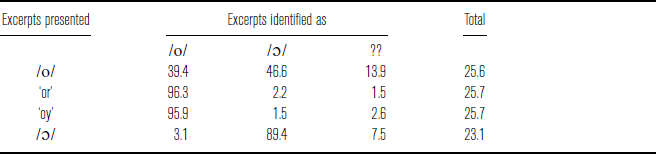
Table 1 shows the results of the second listening test, involving identification of 60 and 120 ms excerpts from the initial parts of the vowels of bode, board, Boyd, and baud. In the table these excerpts are labeled [o], ‘or’, ‘oy’, and /ɔ/, respectively. The excerpts from board and Boyd are labeled with spellings ‘or’ and ‘oy’ rather than with phonetic symbols since the phonetic characteristics of these diphthongs are at issue. The column headed ?? shows the percentage of signals that were considered unidentifiable. Very few of the ‘or’ and ‘oy’ signals were unidentifiable, and indeed the significant finding for these signals is their almost unanimous identification as examples of the vowel [o]. This result is consistent with the acoustic measurements showing that F1 and F2 at steady state for ‘or’ and ‘oy’ are much closer to those for [o] than for /ɔ/ (see figure 2 above) and with the discriminant analysis results, using F1, F2, and F3, showing that ‘or’ and ‘oy’ are classified as examples of [o].
Listeners’ identification of 60 ms and 120 ms initial excerpts from vowels of bode, board, Boyd, and baud (labeled [o], ‘or’, ‘oy’, and /ɔ/, respectively). Values (percentages) for [o], /ɔ/ and ?? (unidentifiable) in each row sum to 100. Percentages in the Total column likewise sum to 100, showing roughly equal numbers of excerpts in the four categories.

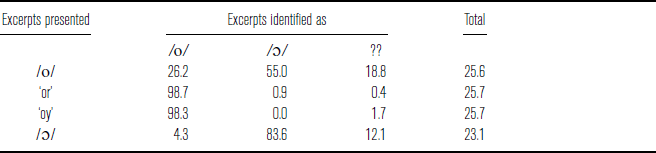
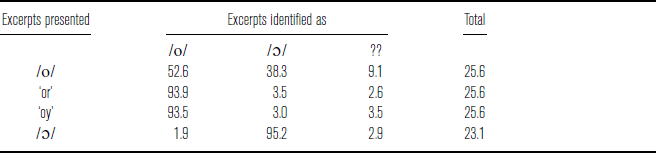
Comparison of the identification results for the 60 ms and 120 ms signals, shown in tables 2 and 3, changes the picture only slightly. The data for the 120 ms signals show much lower uncertainty for [o] and /ɔ/ than the 60 ms signals, and correspondingly greater correct identification. Correct identification of [o] doubles, from 26.2% for the 60 ms signals to 52.6% for the 120 ms signals. (See the ‘Discussion’ section for consideration of problems in identifying the nominally non-diphthongal vowels [o] and /ɔ/.) Identification of the ‘or’ and ‘oy’ signals as [o] declines somewhat from the 60 ms condition, from over 98% for both ‘or’ and ‘oy’ to just under 94%. It is possible that some of the 120 ms ‘or’ and ‘oy’ signals included just enough spectral change (in the direction of high front or central regions of the vowel space) to decrease their perceptual similarity to [o], thus leading to slightly greater labeling as /ɔ/ or as unidentifiable.
Listeners’ identification of 60 ms initial excerpts from vowels of bode, board, Boyd, and baud (labeled [o], ‘or’, ‘oy’, and /ɔ/, respectively). Values (percentages) for [o], /ɔ/ and ?? (unidentifiable) in each row sum to 100. Percentages in the Total column likewise sum to 100, showing roughly equal numbers of excerpts in the four categories.

Listeners’ identification of 120 ms initial excerpts from vowels of bode, board, Boyd, and baud (labeled [o], ‘or’, ‘oy’, and /ɔ/, respectively). Values (percentages) for [o], /ɔ/ and ?? (unidentifiable) in each row sum to 100. Percentages in the Total column likewise sum to 100, showing roughly equal numbers of excerpts in the four categories.

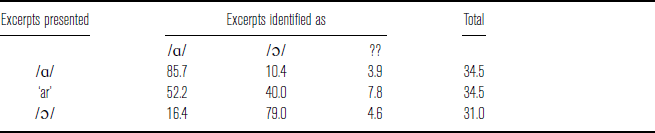
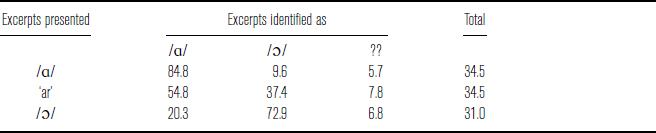
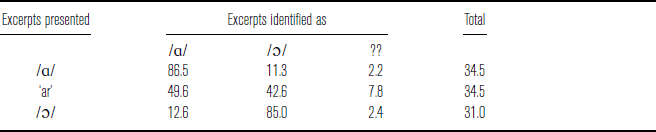
Table 4 shows the results of the third listening test, involving identification of 60 and 120 ms excerpts from the initial parts of the vowels of bod, barred, and baud. In the table these excerpts are labeled /ɑ/, ‘ar’, and /ɔ/, respectively. The column headed ?? shows the percentage of signals that were considered unidentifiable.
Listeners’ identification of 60 ms and 120 ms initial excerpts from vowels of bod, barred, and baud (labeled /ɑ/, ‘ar’, and /ɔ/, respectively). Values (percentages) for /ɑ/, /ɔ/ and ?? (unidentifiable) in each row sum to 100. Percentages in the Total column likewise sum to 100, showing roughly equal numbers of excerpts in the three categories.

This table shows that few of the ‘ar’ signals were unidentifiable, and that these signals were roughly equally identified as /ɑ/ and /ɔ/, although there is a 12% advantage for /ɑ/. This result is consistent with the acoustic measurements showing that F1 and F2 at steady state for ‘ar’ are intermediate to those for /ɑ/ and /ɔ/, with considerable overlap with these two vowel categories (see figure 3 above). It is consistent as well with the discriminant analysis findings based on F1, F2, and F3.
Tables 5 and 6, separating out the 60 and 120 ms signals, do not change this picture much, although there is a somewhat stronger bias toward /ɑ/ for the 60 ms signals (roughly 17 percentage points) and a correspondingly weaker bias toward /ɑ/ for the 120 ms signals (7 percentage points).
Listeners’ identification of 60 ms initial excerpts from vowels of bod, barred, and baud (labeled /ɑ/, ‘ar’, and /ɔ/, respectively). Values (percentages) for /ɑ/, /ɔ/ and ?? (unidentifiable) in each row sum to 100. Percentages in the Total column likewise sum to 100, showing roughly equal numbers of excerpts in the three categories.

Listeners’ identification of 120 ms initial excerpts from vowels of bod, barred, and baud (labeled /ɑ/, ‘ar’, and /ɔ/, respectively). Values (percentages) for /ɑ/, /ɔ/ and ?? (unidentifiable) in each row sum to 100. Percentages in the Total column likewise sum to 100, showing roughly equal numbers of excerpts in the three categories.

5 Discussion
5.1 The nature of the DOOR/WAR, TOY, and STAR diphthongs
A major finding of this study is the strong similarity of the initial part of the diphthong in DOOR/WAR words to the vowel of TOE, and the corresponding dissimilarity to the vowel of LAW. This characterization of the diphthong is supported by all three kinds of evidence examined here: acoustic measures of formant structure, discriminant analysis, and perceptual judgment of vowel excerpts. For American speech of the type studied here, then, phonetic representation of the DOOR/WAR diphthong more reasonably uses [ó] than [ɔ]. The same conclusion is reached concerning the initial part of the diphthong in TOY words. It too largely resembles TOE and is quite far from LAW with respect to formant measurements, discriminant classification, and judgments of listeners, and correspondingly a phonetic representation using [ó] matches the facts better than one using [ɔ].
A different situation is seen for the vowel of STAR, here investigated in the words barred, guard, and hard. Acoustically, the F1–F2 points for these vowel tokens show considerable overlap with those for bod, God, hod and baud, gauze, and hawed. Similarly, the discriminant analysis using F1, F2, and F3 yields intermediate results, with roughly half the tokens classified as either comparison vowel. The findings of the third listening test also point to an approximately intermediate position for the initial part of the diphthong between LOCK and LAW, although there was a slight preference to judge the vowel excerpts as /ɑ/. This situation would seem to suggest that the initial part of the diphthong could reasonably be represented by either [ɑ] or [ɔ], although there is little precedent in the phonetics literature for the latter choice, and as well no surprise on the part of our beginning phonetics students at the use of the former. Perhaps the fact that STAR words are spelled with ‘a’ lends a kind of unspoken orthographic support for the use of [ɑ] in phonetic transcription of these words.
As noted in the Introduction, Lehiste (Reference Lehiste1964) measured F1 and F2 for several words similar in phonological structure to some examined in this study: roe, corresponding to the present bode, goad, and hoed; also raw, corresponding to baud, gauze, and hawed, and war, wore, wharf, yore, lore, and pour, corresponding to board, gored, and hoard. Lehiste's (Reference Lehiste1964: 87) F1–F2 plot shows no overlap between roe and the words with post-vocalic /r/. Although all the F1 measurements were similar, the F2 measurements were lower for the post-vocalic /r/ words than for roe. There was also, except for one subject, no overlap between raw and the post-vocalic /r/ words. The latter showed both F1 and F2 measurements lower than did raw.
There is thus some discrepancy between Lehiste's results and those of the present investigation, where the measurements for board, gored, and hoard overlapped somewhat with those for bode, goad, and hoed. The difference in results could be related to generational or regional differences (see Clark & Hillenbrand Reference Clark and Hillenbrand2003 for description of Lehiste's subject pool), or possibly to a difference in the size of the data sets. Lehiste's five male subjects, combined, produced just five tokens of [o] and five of /ɔ/, considerably fewer than were produced by the present 10 subjects uttering three tokens each for each vowel category. With more data, Lehiste might have found a pattern of overlap similar to the present findings.
Kameny (Reference Kameny1975), as noted above, also had few subjects and just one word exemplifying any given vowel in pre-/r/ context. Two of the four subjects resembled those in the present study in having distinct LOCK and LAW categories. One subject's F1 and F2 values for tar were very close to those for bod, while the other subject showed tar values halfway between those of bod and baud. In the present study the ten subjects showed mostly intermediate values for their three STAR words, some a little closer to /ɑ/ and others a little closer to /ɔ/. Kameny's results for door are generally similar to those in the present study, showing a tendency to have slightly lower F1 and F2 than the vowel in bode.
Labov et al. 's (Reference Labov, Ash and Boberg2006) findings are consistent for the most part with those of the current study. The Michigan women represented in the ANAE data showed average acoustic measures (F1 and F2 only) for DOOR/WAR and TOY diphthongs that are very similar to the current study's measures of these vowels, such that if the ANAE data points were overlaid on figure 2, they would lie almost entirely within the ellipses drawn for the current study's measures of these vowels. Similarly the F1 and F2 data points for the ANAE Michigan women's STAR diphthong, if overlaid on figure 3, would mostly lie within the ellipse drawn for the current study. However, ANAE and the current study differ somewhat in how the data points for STAR plot in relation to those for LOCK and LAW. In the current study, as shown in figure 3, there is rough overlap of the STAR (i.e., barred/guard/hard) measures with those for LOCK (bod/God/hod) and LAW (baud/gauze/hawed); some of the STAR data points lie toward the central part of the vowel space, but not most. In contrast, a similar plot of the ANAE data would show the STAR data points as a group falling slightly more centrally than the corresponding points for LOCK and LAW words. The ANAE data imply a slight, consistent centralization of the nucleus of STAR words.
5.2 Identification of the comparison vowels
As seen in tables 1 and 4, which combine results for the 60 ms and 120 ms signals in the listening tests, the three comparison vowels against which the excerpts of ‘or’, ‘oy’, and ‘ar’ were being compared were not evenly recognized. The /ɔ/ signals, used in both the second and third listening tests, were correctly identified the great majority of the time (89.4% and 79.0%, respectively), as were the /ɑ/ signals used in the third listening test, at 85.7% correct. In contrast, the [o] signals used in the second listening test were often judged unidentifiable (13.9%) or misidentified as /ɔ/ (46.6%, vs. 39.4% correct identification). These results for [o] in the second listening test, involving short duration vowel excerpts, contrast sharply with the results from the first listening test, involving the whole word bode, which was correctly identified 97.2% of the time. For /ɔ/ and /ɑ/, the results for the short excerpts, given above, are similar to the results for the whole words in the first listening test, 84.6% and 96.7%, respectively.
Since the vowel excerpts used in the present study differ in two significant ways from the full vowels – short duration and reduced spectral change – understanding the differences among these results may be furthered by considering the results of two earlier studies conducted in this laboratory. Hillenbrand & Nearey (Reference Hillenbrand and Nearey1999) studied the importance of spectral change for vowel identification. Listeners identified naturally spoken /hVd/ words and two synthetic versions of the same tokens. One synthetic version reproduced the original formant contours and the other had flat formant contours set at the steady state values. Hillenbrand & Nearey found that the [o] vowel was among several whose identification by listeners was severely affected in the flat formant condition. The /hód/ tokens with flat formant contours were less successfully identified than the synthetic /hód/ tokens reproducing the original formant contours (and much less successfully than the naturally produced /hód/ words). The most frequent error for the flat-formant synthetic [o] vowels was misidentification as /ɔ/. By contrast the /ɔ/ flat-formant tokens were well identified by the listeners, even though the naturally produced /ɔ/ words showed about the same degree of vocalic spectral change as did the [o] words. Among the few errors that occurred for flat-formant /ɔ/, the most frequent was misidentification as /ɑ/, not [o]. The /ɑ/ flat-formant tokens were also well identified, though at a lower rate than the /ɔ/ tokens (85.2% vs. 96.0% correct identification) and the most frequent error was misidentification as /ɔ/.
Thus the Hillenbrand & Nearey (Reference Hillenbrand and Nearey1999) results are consistent with the present findings of (1) identification vulnerability for [o] and robustness for /ɔ/ and /ɑ/ under conditions where spectral change is minimized, (2) the tendency for frequently misidentified [o] to be heard as /ɔ/, and (3) the tendency for infrequently misidentified /ɔ/ and /ɑ/ to be confused with each other. The response topography was different in the present study, of course, since listeners did not have the full range of vowels to select as identification responses. (The listeners in Hillenbrand & Nearey (Reference Hillenbrand and Nearey1999) had 12 vowel categories to select from.) Direct comparison is further complicated by the fact that the Hillenbrand & Nearey's signals were synthetic, vs. the naturally produced signals in the current study, as well as by the fact that their signals were of normal duration and included synthetic pre- and post-vocalic consonants. Nonetheless, the present results for [o] are striking. It may be that the [o] vowel's typical shift of F1 and F2 values toward the high back region of the vowel space is necessary for robust identification of this vowel.
The importance of spectral change is reinforced by inspection of separate confusion matrices for the 60 ms and 120 ms vowel excerpts in the second listening test, shown in tables 2 and 3 above. Both [o] and /ɔ/ are notably better identified in the 120 ms condition, but the difference is especially striking for [o]: 52.6% correct identification of the 120 ms signals vs. only 26.2% correct for the 60 ms signals.
The effect of duration on vowel identification was investigated by Hillenbrand, Clark & Houde (Reference Hillenbrand, Clark and Houde2000), who examined listeners’ identification of /hVd/ syllables synthesized by two different synthesis methods. These signals reproduced patterns of spectral change seen in naturally produced syllables but at various vowel durations, of which the shortest was 144 ms, just a bit longer than the 120 ms vowel excerpts used in the present study. Across all 12 vowels, and for the synthesis method that more faithfully reproduced the spectral features of the naturally produced syllables, the 144 ms signals were identified less well than syllables synthesized at the original syllable durations (91.4% vs. 96.0% correct identification – see table 1 in Hillenbrand et al. Reference Hillenbrand, Clark and Houde2000). Individual vowels were not equally affected by shortening, however. In particular, identification of [o] was not disadvantaged; the 144 ms /hód/ signals were identified about as well as the original duration /hód/ signals (98.3% vs. 100%). This suggests that in the current study, it was primarily the loss of spectral change that rendered the brief [o] excerpts so difficult to identify, rather than their short duration. Hillenbrand et al. (Reference Hillenbrand, Clark and Houde2000) observed similar robustness for /ɑ/, though at lower overall levels, 83.7% correct identification at original durations and 80.5% at 144 ms. On the other hand, /ɔ/ identification suffered from shortening – from 88.3% to 50.9% correct identification. Fully 43.0% of the /ɔ/ signals that were correctly identified at original durations were misidentified when shortened to 144 ms; about one third of the erroneous responses were /ɑ/, and the others were almost all /ɑ/ (not a response option in the current study). This vulnerability to shortening suggests that in the present study, the 60 and 120 ms /ɔ/ excerpts might have occasioned more identification error than was actually found, if /ɑ/ had been available as an identification response.
5.3 Status of the /ɑ/–/ɔ/ distinction
Although all the talkers and listeners in this study resided in a part of the country where the /ɑ/–/ɔ/ distinction is considered robust (viz. the Inland North; see maps in Labov et al. Reference Labov, Ash and Boberg2006), it is worth noting that these two vowels occasioned more confusion than the other vowels and diphthongs of interest. Recall that four of the original 14 talkers were removed from the data set because their baud tokens tended to be misidentified as bod (see Section 2.1.2), and the first listening test, in which the six /b/-initial words were identified, showed more confusion of these two words than of the others (see Section 4.1). To some extent it is reasonable to ascribe such confusion to a fundamental greater similarity of these two vowels (see figure 4 above), or perhaps to the subjects’ unfamiliarity with the word baud. On the other hand, the results also raise the question whether the /ɑ/–/ɔ/ distinction may be weakening in southern Michigan, or at least is not universally maintained by speakers in this region. Ongoing survey work of the type underlying The Atlas of North American English might help resolve this question.
Alternatively, the work of Conrey, Potts & Niedzielski (Reference Conrey, Potts and Niedzielski2005) suggests a different possible interpretation of the bod/baud confusion in the listening test. Conrey et al. showed that subjects who maintained a distinction between /I/ and /ɛ/ before nasals had some difficulty judging the words pin and pen in a perceptual task, though less difficulty than experienced by subjects who showed a merger between pre-nasal /I/ and /ɛ/ in their own speech. It appeared that general exposure to ambient merged pronunciations compromised the judgments even of listeners who maintained the distinction. By analogy, our subjects in the first listening test, as maintainers of the /ɑ/–/ɔ/ distinction (cot/caught, bod/baud), might have been expected to have some difficulty judging bod vs. baud in the listening test. Our results do seem to mirror what Conrey et al. found. This cannot be the whole story, however. Consider our best listeners and the talkers whose words were most successfully labeled. Five of the 18 listeners, judging the speech of 10 talkers, successfully labeled every bod and baud token or made at most one labeling error (i.e., 95–100% correct labeling). Five of our 10 talkers had every bod and baud token, or all but one, correctly labeled by the 18 listeners. The five best listeners listening to the five best talkers labeled bod and baud with 100% accuracy. Evidently, if exposure to merged /ɑ/ and /ɔ/ in other dialects compromises perceptual distinction of these vowels by speakers who do not merge them, the effect is far from uniform.
6 Conclusion
All three methods of investigation used in this study – acoustic measurement, discriminant analysis, and listening studies – showed that, in American speech of the type examined here, the initial part of the DOOR/WAR and TOY diphthongs more closely resembles [o] than /ɔ/, while the initial part of the STAR diphthong was shown to be intermediate between /ɑ/ and /ɔ/. It is likely that similar methods could be useful for investigating other cases in which vowel contrasts are neutralized in certain phonetic environments.
Acknowledgements
Supported by the National Institutes of Health under grant DC-01661 to Western Michigan University. Careful review by the JIPA editor and two anonymous referees is gratefully acknowledged.