


%20--%3e%3c!DOCTYPE%20svg%20PUBLIC%20'-//W3C//DTD%20SVG%201.0//EN'%20'http://www.w3.org/TR/2001/REC-SVG-20010904/DTD/svg10.dtd'%3e%3csvg%20version='1.0'%20id='Layer_1'%20xmlns='http://www.w3.org/2000/svg'%20xmlns:xlink='http://www.w3.org/1999/xlink'%20x='0px'%20y='0px'%20width='64px'%20height='64px'%20viewBox='5.5%20-3.5%2064%2064'%20enable-background='new%205.5%20-3.5%2064%2064'%20xml:space='preserve'%3e%3cg%3e%3ccircle%20fill='%23FFFFFF'%20fill-opacity='0'%20cx='37.785'%20cy='28.501'%20r='28.836'/%3e%3cpath%20fill='%23595959'%20d='M37.441-3.5c8.951,0,16.572,3.125,22.857,9.372c3.008,3.009,5.295,6.448,6.857,10.314%20c1.561,3.867,2.344,7.971,2.344,12.314c0,4.381-0.773,8.486-2.314,12.313c-1.543,3.828-3.82,7.21-6.828,10.143%20c-3.123,3.085-6.666,5.448-10.629,7.086c-3.961,1.638-8.057,2.457-12.285,2.457s-8.276-0.808-12.143-2.429%20c-3.866-1.618-7.333-3.961-10.4-7.027c-3.067-3.066-5.4-6.524-7-10.372S5.5,32.767,5.5,28.5c0-4.229,0.809-8.295,2.428-12.2%20c1.619-3.905,3.972-7.4,7.057-10.486C21.08-0.394,28.565-3.5,37.441-3.5z%20M37.557,2.272c-7.314,0-13.467,2.553-18.458,7.657%20c-2.515,2.553-4.448,5.419-5.8,8.6c-1.354,3.181-2.029,6.505-2.029,9.972c0,3.429,0.675,6.734,2.029,9.913%20c1.353,3.183,3.285,6.021,5.8,8.516c2.514,2.496,5.351,4.399,8.515,5.715c3.161,1.314,6.476,1.971,9.943,1.971%20c3.428,0,6.75-0.665,9.973-1.999c3.219-1.335,6.121-3.257,8.713-5.771c4.99-4.876,7.484-10.99,7.484-18.344%20c0-3.543-0.648-6.895-1.943-10.057c-1.293-3.162-3.18-5.98-5.654-8.458C50.984,4.844,44.795,2.272,37.557,2.272z%20M37.156,23.187%20l-4.287,2.229c-0.458-0.951-1.019-1.619-1.685-2c-0.667-0.38-1.286-0.571-1.858-0.571c-2.856,0-4.286,1.885-4.286,5.657%20c0,1.714,0.362,3.084,1.085,4.113c0.724,1.029,1.791,1.544,3.201,1.544c1.867,0,3.181-0.915,3.944-2.743l3.942,2%20c-0.838,1.563-2,2.791-3.486,3.686c-1.484,0.896-3.123,1.343-4.914,1.343c-2.857,0-5.163-0.875-6.915-2.629%20c-1.752-1.752-2.628-4.19-2.628-7.313c0-3.048,0.886-5.466,2.657-7.257c1.771-1.79,4.009-2.686,6.715-2.686%20C32.604,18.558,35.441,20.101,37.156,23.187z%20M55.613,23.187l-4.229,2.229c-0.457-0.951-1.02-1.619-1.686-2%20c-0.668-0.38-1.307-0.571-1.914-0.571c-2.857,0-4.287,1.885-4.287,5.657c0,1.714,0.363,3.084,1.086,4.113%20c0.723,1.029,1.789,1.544,3.201,1.544c1.865,0,3.18-0.915,3.941-2.743l4,2c-0.875,1.563-2.057,2.791-3.541,3.686%20c-1.486,0.896-3.105,1.343-4.857,1.343c-2.896,0-5.209-0.875-6.941-2.629c-1.736-1.752-2.602-4.19-2.602-7.313%20c0-3.048,0.885-5.466,2.658-7.257c1.77-1.79,4.008-2.686,6.713-2.686C51.117,18.558,53.938,20.101,55.613,23.187z'/%3e%3c/g%3e%3c/svg%3e)
%20--%3e%3c!DOCTYPE%20svg%20PUBLIC%20'-//W3C//DTD%20SVG%201.0//EN'%20'http://www.w3.org/TR/2001/REC-SVG-20010904/DTD/svg10.dtd'%3e%3csvg%20version='1.0'%20id='Layer_1'%20xmlns='http://www.w3.org/2000/svg'%20xmlns:xlink='http://www.w3.org/1999/xlink'%20x='0px'%20y='0px'%20width='64px'%20height='64px'%20viewBox='5.5%20-3.5%2064%2064'%20enable-background='new%205.5%20-3.5%2064%2064'%20xml:space='preserve'%3e%3cg%3e%3ccircle%20fill='%23FFFFFF'%20fill-opacity='0'%20cx='37.637'%20cy='28.806'%20r='28.276'/%3e%3cg%3e%3cpath%20fill='%23595959'%20d='M37.443-3.5c8.988,0,16.57,3.085,22.742,9.257C66.393,11.967,69.5,19.548,69.5,28.5c0,8.991-3.049,16.476-9.145,22.456%20C53.879,57.319,46.242,60.5,37.443,60.5c-8.649,0-16.153-3.144-22.514-9.43C8.644,44.784,5.5,37.262,5.5,28.5%20c0-8.761,3.144-16.342,9.429-22.742C21.101-0.415,28.604-3.5,37.443-3.5z%20M37.557,2.272c-7.276,0-13.428,2.553-18.457,7.657%20c-5.22,5.334-7.829,11.525-7.829,18.572c0,7.086,2.59,13.22,7.77,18.398c5.181,5.182,11.352,7.771,18.514,7.771%20c7.123,0,13.334-2.607,18.629-7.828c5.029-4.838,7.543-10.952,7.543-18.343c0-7.276-2.553-13.465-7.656-18.571%20C50.967,4.824,44.795,2.272,37.557,2.272z%20M46.129,20.557v13.085h-3.656v15.542h-9.944V33.643h-3.656V20.557%20c0-0.572,0.2-1.057,0.599-1.457c0.401-0.399,0.887-0.6,1.457-0.6h13.144c0.533,0,1.01,0.2,1.428,0.6%20C45.918,19.5,46.129,19.986,46.129,20.557z%20M33.042,12.329c0-3.008,1.485-4.514,4.458-4.514s4.457,1.504,4.457,4.514%20c0,2.971-1.486,4.457-4.457,4.457S33.042,15.3,33.042,12.329z'/%3e%3c/g%3e%3c/g%3e%3c/svg%3e)
%20--%3e%3c!DOCTYPE%20svg%20PUBLIC%20'-//W3C//DTD%20SVG%201.0//EN'%20'http://www.w3.org/TR/2001/REC-SVG-20010904/DTD/svg10.dtd'%3e%3csvg%20version='1.0'%20id='Layer_1'%20xmlns='http://www.w3.org/2000/svg'%20xmlns:xlink='http://www.w3.org/1999/xlink'%20x='0px'%20y='0px'%20width='64px'%20height='64px'%20viewBox='5.5%20-3.5%2064%2064'%20enable-background='new%205.5%20-3.5%2064%2064'%20xml:space='preserve'%3e%3cg%3e%3ccircle%20fill='%23FFFFFF'%20fill-opacity='0'%20cx='36.924'%20cy='28.403'%20r='28.895'/%3e%3cpath%20fill='%23595959'%20d='M37.442-3.5c8.99,0,16.571,3.085,22.743,9.256C66.393,11.928,69.5,19.509,69.5,28.5c0,8.992-3.048,16.476-9.145,22.458%20C53.88,57.32,46.241,60.5,37.442,60.5c-8.686,0-16.19-3.162-22.513-9.485C8.644,44.728,5.5,37.225,5.5,28.5%20c0-8.762,3.144-16.343,9.429-22.743C21.1-0.414,28.604-3.5,37.442-3.5z%20M12.7,19.872c-0.952,2.628-1.429,5.505-1.429,8.629%20c0,7.086,2.59,13.22,7.77,18.4c5.219,5.144,11.391,7.715,18.514,7.715c7.201,0,13.409-2.608,18.63-7.829%20c1.867-1.79,3.332-3.657,4.398-5.602l-12.056-5.371c-0.421,2.02-1.439,3.667-3.057,4.942c-1.622,1.276-3.535,2.011-5.744,2.2%20v4.915h-3.714v-4.915c-3.543-0.036-6.782-1.312-9.714-3.827l4.4-4.457c2.094,1.942,4.476,2.913,7.143,2.913%20c1.104,0,2.048-0.246,2.83-0.743c0.78-0.494,1.172-1.312,1.172-2.457c0-0.801-0.287-1.448-0.858-1.943l-3.085-1.315l-3.771-1.715%20l-5.086-2.229L12.7,19.872z%20M37.557,2.214c-7.276,0-13.428,2.571-18.457,7.714c-1.258,1.258-2.439,2.686-3.543,4.287L27.786,19.7%20c0.533-1.676,1.542-3.019,3.029-4.028c1.484-1.009,3.218-1.571,5.2-1.686V9.071h3.715v4.915c2.934,0.153,5.6,1.143,8,2.971%20l-4.172,4.286c-1.793-1.257-3.619-1.885-5.486-1.885c-0.991,0-1.876,0.191-2.656,0.571c-0.781,0.381-1.172,1.029-1.172,1.943%20c0,0.267,0.095,0.533,0.285,0.8l4.057,1.83l2.8,1.257l5.144,2.285l16.397,7.314c0.535-2.248,0.801-4.533,0.801-6.857%20c0-7.353-2.552-13.543-7.656-18.573C51.005,4.785,44.831,2.214,37.557,2.214z'/%3e%3c/g%3e%3c/svg%3e)
%20--%3e%3c!DOCTYPE%20svg%20PUBLIC%20'-//W3C//DTD%20SVG%201.0//EN'%20'http://www.w3.org/TR/2001/REC-SVG-20010904/DTD/svg10.dtd'%3e%3csvg%20version='1.0'%20id='Layer_1'%20xmlns='http://www.w3.org/2000/svg'%20xmlns:xlink='http://www.w3.org/1999/xlink'%20x='0px'%20y='0px'%20width='64px'%20height='64px'%20viewBox='5.5%20-3.5%2064%2064'%20enable-background='new%205.5%20-3.5%2064%2064'%20xml:space='preserve'%3e%3cg%3e%3ccircle%20fill='%23FFFFFF'%20fill-opacity='0'%20cx='36.944'%20cy='28.631'%20r='29.105'/%3e%3cg%3e%3cpath%20fill='%23595959'%20d='M37.443-3.5c8.951,0,16.531,3.105,22.742,9.315C66.393,11.987,69.5,19.548,69.5,28.5c0,8.954-3.049,16.457-9.145,22.514%20C53.918,57.338,46.279,60.5,37.443,60.5c-8.649,0-16.153-3.143-22.514-9.429C8.644,44.786,5.5,37.264,5.5,28.501%20c0-8.723,3.144-16.285,9.429-22.685C21.138-0.395,28.643-3.5,37.443-3.5z%20M37.557,2.272c-7.276,0-13.428,2.572-18.457,7.715%20c-5.22,5.296-7.829,11.467-7.829,18.513c0,7.125,2.59,13.257,7.77,18.4c5.181,5.182,11.352,7.771,18.514,7.771%20c7.123,0,13.334-2.609,18.629-7.828c5.029-4.876,7.543-10.99,7.543-18.343c0-7.313-2.553-13.485-7.656-18.513%20C51.004,4.842,44.832,2.272,37.557,2.272z%20M23.271,23.985c0.609-3.924,2.189-6.962,4.742-9.114%20c2.552-2.152,5.656-3.228,9.314-3.228c5.027,0,9.029,1.62,12,4.856c2.971,3.238,4.457,7.391,4.457,12.457%20c0,4.915-1.543,9-4.627,12.256c-3.088,3.256-7.086,4.886-12.002,4.886c-3.619,0-6.743-1.085-9.371-3.257%20c-2.629-2.172-4.209-5.257-4.743-9.257H31.1c0.19,3.886,2.533,5.829,7.029,5.829c2.246,0,4.057-0.972,5.428-2.914%20c1.373-1.942,2.059-4.534,2.059-7.771c0-3.391-0.629-5.971-1.885-7.743c-1.258-1.771-3.066-2.657-5.43-2.657%20c-4.268,0-6.667,1.885-7.2,5.656h2.343l-6.342,6.343l-6.343-6.343L23.271,23.985L23.271,23.985z'/%3e%3c/g%3e%3c/g%3e%3c/svg%3e)
Introduction
Carbapenem-resistant gram-negative bacilli (CR-GNB) are a critical threat in healthcare settings, associated with mortality rates of 26%–44% and limited therapeutic options. Reference Hamerlinck, Aerssens and Boelens1,Reference Regev-Yochay, Margalit and Smollan2 Hospital drainage systems have been increasingly recognized as environmental reservoirs capable of harboring and transmitting these organisms. Reference Kizny Gordon, Mathers, Cheong, Gottlieb, Kotay, Walker, Peto, Crook and Stoesser3–Reference Kotay, Parikh and Barry5 Once established within drain biofilms, CR-GNB can persist under nutrient-depleted conditions and rapidly disseminate through the drainage network, generating contaminated aerosols and posing infection risk to patients. Reference Kotay, Chai and Guilford4,Reference Kotay, Parikh and Barry5
Evidence-based strategies for drain decontamination remain scarce. Liquid disinfectants applied to drains show modest and transient effects, largely attributed to insufficient contact time and inadequate biofilm penetration. Reference Inkster6 Our team previously identified an outbreak of metallo-β-lactamase-producing Pseudomonas aeruginosa linked to a nursing station drain. Reference Santonato, Martinelli and Quevedo7 This finding prompted a systematic evaluation of sodium hypochlorite for controlling CR-GNB across all nursing station drains in our institution.
Methods
Study design
Quasi-experimental before-and-after study, Hospital Universitario Austral (HUA), Pilar, Argentina, June 2023–August 2025. HUA is a private university hospital with 229 beds, general wards, adult/pediatric/neonatal ICUs, hematopoietic stem cell transplant units, and emergency services.
Study units and interventions
All nursing station handwash basin drains in active inpatient areas were included (outpatient areas excluded). Two interventions were performed: (1) monthly pour of 500 ml sodium hypochlorite (55,000 ppm), with the drain blocked for 30 minutes; and (2) six-monthly syphon replacement, comprising removal of the syphon, mechanical cleaning of pipes and grilles with a brush and chlorine, and installation of a new syphon. Both interventions were applied to all study drains at each scheduled time point.
Sample collection and processing
The June 2023 survey served as baseline. Drains were swabbed quarterly using a rigid-tipped, premoistened sterile rayon swab (APTACA®), inserted through the strain and 8 cm down the drain. Swabs were rotated 360° to maximize surface contact; the rigid shaft ensured navigation of the trap geometry without kinking. The swab tip was placed in BHI (Brain Heart Infusion) broth for laboratory transport. Not all 17 drains were sampled at every time point: three drains were inaccessible at the second assessment (19 July 2023) due to infrastructure works; all three had been negative at baseline, so their absence did not affect the contamination rate.
Microbiological processing and outcome variables
Samples were incubated aerobically at 35°C; tubes with growth at 24 h were plated onto CHROMagar™ mSuperCARBA™. Colonies were identified by MALDI-TOF; susceptibility was tested by disc diffusion (imipenem, meropenem, boronic acid, EDTA—Kirby-Bauer method). Carbapenemase production was confirmed by Blue-Carba colorimetric assay. The primary outcome was drain contamination status (CR-GNB positive/negative). Secondary outcomes were genus/species, carbapenemase production, and carbapenemase class (KPC, MBL, OXA).
Drain contamination was expressed as n/N (%). Microsoft Excel was used for data recording and analysis.
Ethical considerations
As study units were drains and no direct patient interventions were performed, informed consent was not required.
Results
Seventeen drains were included at baseline (June 2023); 71% (12/17) were CR-GNB positive. Fourteen strains were isolated, of which 11 (79%) were carbapenemase-producing, predominantly Citrobacter spp. (n = 5), Klebsiella spp. (n = 3), Pseudomonas spp. (n = 2) and Enterobacter spp. (n = 1).
Six days after the first combined intervention (syphon replacement + chlorine pour), 14 drains were sampled (three were inaccessible due to infrastructure works; all had been negative at baseline). Contamination dropped to 29% (4/14).
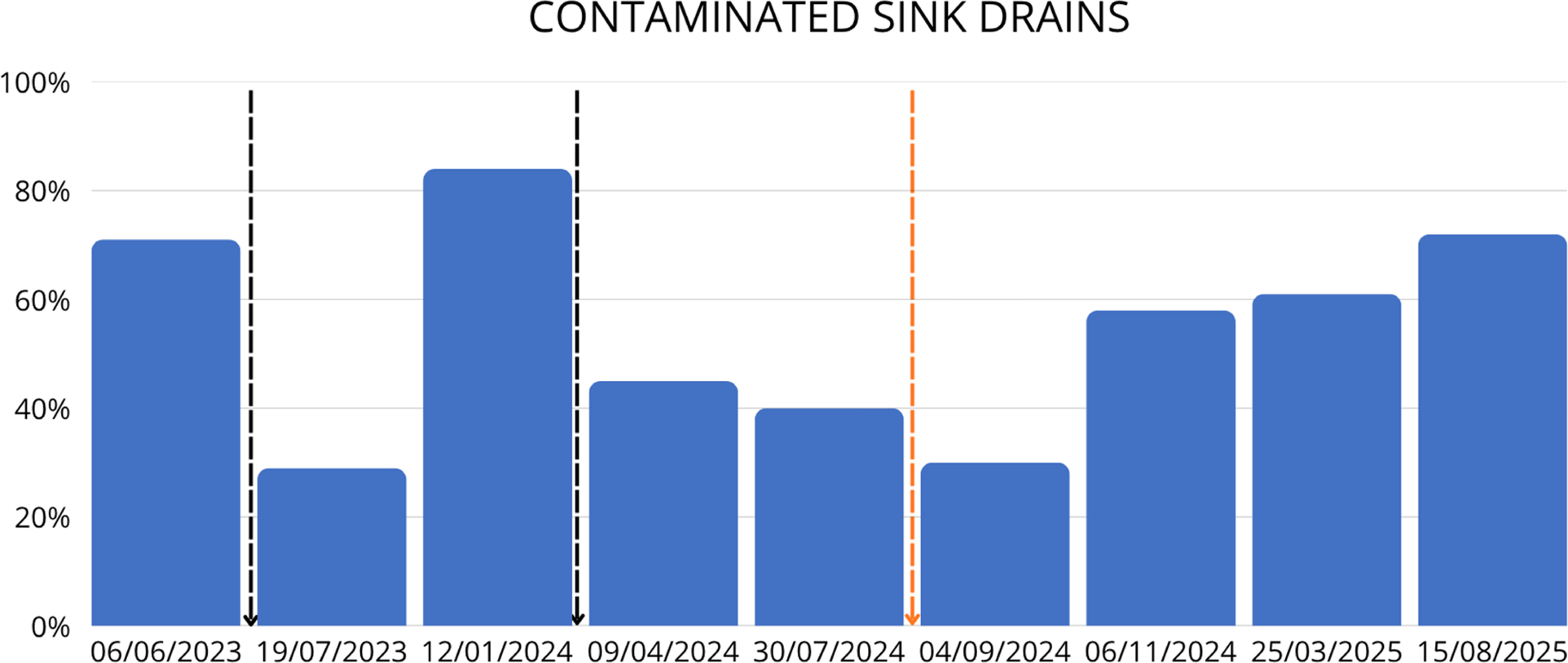
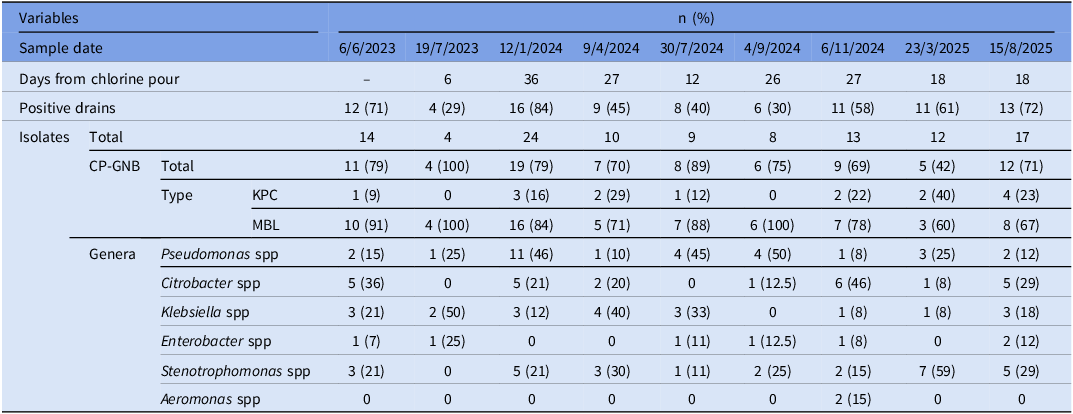
Monthly chlorine pours were then continued. Eight further assessments were conducted over 26 months, at a mean of 24 days (range 12–36 d) after each chlorine pour. The proportion of positive drains at each time point is shown in Figure 1 and described in detail in Table 1.
Relative frequency of contaminated drains during the follow-up period. Dotted lines indicate interventions on syphons. Black—syphon and moving parts replacement, associated with mechanical cleaning. Orange—mechanical cleaning only.

Drain contamination, isolate counts, carbapenemase type, and genera at each assessment

Table 1. Long description
A table comparing drain contamination, isolate counts, carbapenemase type, and genera at each assessment. The table has 11 rows and 10 columns. The columns are labeled with sample dates and days from chlorine pour. The rows are labeled with variables such as positive drains, total isolates, CP-GNB total, types of carbapenemase (KPC, MBL), and genera (Pseudomonas spp, Citrobacter spp, Klebsiella spp, Enterobacter spp, Stenotrophomonas spp, Aeromonas spp). The table provides the count and percentage of each variable at different sample dates. Row 1: Sample date, 6/6/2023, 19/7/2023, 12/1/2024, 9/4/2024, 30/7/2024, 4/9/2024, 6/11/2024, 23/3/2025, 15/8/2025. Row 2: Days from chlorine pour, blank, 6, 36, 27, 12, 26, 27, 18, 18. Row 3: Positive drains, 12 (71 percent), 4 (29 percent), 16 (84 percent), 9 (45 percent), 8 (40 percent), 6 (30 percent), 11 (58 percent), 11 (61 percent), 13 (72 percent). Row 4: Total isolates, 14, 4, 24, 10, 9, 8, 13, 12, 17. Row 5: CP-GNB total, 11 (79 percent), 4 (100 percent), 19 (79 percent), 7 (70 percent), 8 (89 percent), 6 (75 percent), 9 (69 percent), 5 (42 percent), 12 (71 percent). Row 6: Type KPC, 1 (9 percent), 0, 3 (16 percent), 2 (29 percent), 1 (12 percent), 0, 2 (22 percent), 2 (40 percent), 4 (23 percent). Row 7: Type MBL, 10 (91 percent), 4 (100 percent), 16 (84 percent), 5 (71 percent), 7 (88 percent), 6 (100 percent), 7 (78 percent), 3 (60 percent), 8 (67 percent). Row 8: Genera Pseudomonas spp, 2 (15 percent), 1 (25 percent), 11 (46 percent), 1 (10 percent), 4 (45 percent), 4 (50 percent), 1 (8 percent), 3 (25 percent), 2 (12 percent). Row 9: Genera Citrobacter spp, 5 (36 percent), 0, 5 (21 percent), 2 (20 percent), 0, 1 (12.5 percent), 6 (46 percent), 1 (8 percent), 5 (29 percent). Row 10: Genera Klebsiella spp, 3 (21 percent), 2 (50 percent), 3 (12 percent), 4 (40 percent), 3 (33 percent), 0, 1 (8 percent), 1 (8 percent), 3 (18 percent). Row 11: Genera Enterobacter spp, 1 (7 percent), 1 (25 percent), 0, 0, 1 (11 percent), 1 (12.5 percent), 1 (8 percent), 0, 2 (12 percent). Row 12: Genera Stenotrophomonas spp, 3 (21 percent), 0, 5 (21 percent), 3 (30 percent), 1 (11 percent), 2 (25 percent), 2 (15 percent), 7 (59 percent), 5 (29 percent). Row 13: Genera Aeromonas spp, 0, 0, 0, 0, 0, 0, 2 (15 percent), 0, 0.
Across all follow-up assessments, contamination rates fluctuated and were consistently lower following assessments in which syphon intervention was performed alongside the chlorine pour (Figure 1). The most frequently isolated genera over the entire study period were Pseudomonas spp. (27%, 29/110), Stenotrophomonas spp. (25%, 28/110), Citrobacter spp. (22%, 24/110) and Klebsiella spp. (18%, 20/110). Carbapenemase class distribution is shown in Table 1, with predominance of class B (MBL) throughout.
Discussion
In this longitudinal quasi-experimental study, 71% of nursing station handwash basin drains were contaminated with CR-GNB at baseline. Monthly sodium hypochlorite pours produced variable, transient reductions in contamination, without achieving sustained eradication.
The first postintervention assessment—performed only 6 days after the combined syphon replacement and chlorine pour—showed the greatest reduction (71% to 29%). This early time point represents the only assessment with a true preintervention baseline for comparison; subsequent time points reflect the state of drains at a mean of 24 days after chlorine application, without an immediately preceding baseline measure. This is an acknowledged limitation: the data allow characterization of contamination dynamics over time but do not permit formal evaluation of the effect of each individual chlorine pour. What can be observed is that contamination rates were consistently lower following assessments where syphon intervention accompanied the chlorine pour, suggesting a synergistic effect. Regrowth from sectors distal to the syphon appears rapid, consistent with Kotay et al., who showed proximal E. coli regrowth within seven days and persistence of resistant organisms in biofilm under nutrient depletion. Reference Kotay, Chai and Guilford4,Reference Kotay, Parikh and Barry5
Pseudomonas aeruginosa and Klebsiella pneumoniae are the most frequently identified CR-GNB in drainage systems in the published literature, Reference De Geyter, Vanstokstraeten and Crombe8,Reference Volling, Ahangari and Bartoszko9 consistent with our findings. Of particular relevance, MBL-producing P. aeruginosa is the predominant cause of healthcare-associated infections at our institution, underscoring the clinical significance of its persistence in the drainage network.
Wet reservoirs facilitate horizontal gene transfer and aerosol generation, with documented risk of surface and hand contamination. Reference Inkster6 Eradication of CR-GNB from established drain biofilms is generally not achievable with chemical disinfection alone; control is the realistic objective.
Sodium hypochlorite is the most widely used drain disinfectant, though optimal concentration and frequency remain debated. Reference Inkster6 The modest effect of liquid disinfectants is attributed to rapid flow-through, limiting contact time and biofilm penetration—a pattern corroborated by our findings. Foam-based formulations (hydrogen peroxide + peracetic acid) have shown more sustained effects in recent studies, Reference Anantharajah, Goormaghtigh and Nguvuyla Mantu10 though these are not yet available in Argentina.
Limitations include the variable inter-assessment intervals and inability to perform frequent postpour sampling to precisely define the recolonization window; however, our data suggest it is shorter than three weeks. A change in hospital surface disinfectant (from NaDCC to accelerated hydrogen peroxide 1/64) in November 2024 did not appear to affect drain contamination. Active surveillance of general ward patients was not performed, precluding assessment of the clinical impact of drain colonization.
In conclusion, monthly sodium hypochlorite pours in nursing station drains produced variable, transient reductions in CR-GNB contamination without achieving sustained eradication. A synergistic effect with mechanical syphon interventions was observed. Future protocols should evaluate higher-frequency application and foam-based disinfectants, integrated within multimodal infection prevention strategies.
Acknowledgements
The authors thank the General Services and Maintenance staff for their contribution to the implementation of the interventions.
Financial support
None reported.
Competing interests
Santonato D, Martinelli I, Sadorin R, Quevedo A, Peuchot V, Fabbro L, Novau A, Santos ML, Cuello MA, and Cornistein W report no conflicts of interest relevant to this article.
Artificial intelligence tools
Claude (Sonnet 4.6; Anthropic, San Francisco, CA; accessed via claude.ai, May–July 2026) was used to check English translation of the original Spanish manuscript, as well as assisting with reformatting of the manuscript to meet journal submission requirements. All AI-generated content was reviewed, verified, and approved by the authors, who take full responsibility for the accuracy and integrity of the published work.

 Open access

