Introduction
A primary role of clinical neuropsychological assessment includes the evaluation of cognitive functioning. Extensive analysis of diverse cognitive ability batteries shows that the Carrol-Horn-Cattel (CHC) model of cognition is the most comprehensive theoretical approach to diagnostic screening in clinical and non-clinical populations (Flanagan and Harrison, Reference Flanagan and Harrison2005; McGrew, Reference McGrew, Flanagan and Harrison2005; 2009). Use of the CHC model is becoming commonplace in psychological test construction and interpretation because it is the best-supported theory within the clinical ability assessment tradition (McGrew, Reference McGrew, Flanagan and Harrison2005; 2009; Lichtenberger and Kauffman, Reference Lichtenberger and Kaufman2009).
Debate continues about the details of the model and the trade-off between comprehensive assessment and cost-effective screening assessment (Bowden et al., Reference Bowden, Lange, Weiss and Saklofske2008a; Gottfredson and Saklofske, Reference Gottfredson and Saklofske2009). Core abilities in the CHC model include working memory, long-term retrieval, thinking or problem-solving abilities, acquired knowledge and processing speed (McGrew, Reference McGrew2009). These core abilities closely correspond to the six-factor model of the Wechsler Intelligence and Memory Scales, the most widely used diagnostic ability battery for adults internationally, with the addition that long-term retrieval is divided into material-specific memory abilities (Flanagan and Harrison, Reference Flanagan and Harrison2005; Bowden et al., Reference Bowden, Lange, Weiss and Saklofske2008a, Reference Bowden, Weiss, Holdnack, Bardenhagen and Cook2008b).
In the CHC model, long-term retrieval is the ability to store information over extended periods of time, and fluently recall the information later (McGrew, Reference McGrew2009). Deficits of anterograde memory, a clinical synonym for long-term retrieval, are often found in people with a wide range of neurological conditions (Lishman, Reference Lishman1998). Although it is well established that long-term retrieval performance (e.g. recall or recognition of recently acquired information) deteriorates across the adult life span, there is converging evidence that semantic “memory” performance or crystallized intelligence in the CHC model (e.g. recall or recognition of overlearned general knowledge) shows relatively little aging-related variation (see Salthouse, Reference Salthouse1991). The cognitive literature suggests that tests assessing retrieval of semantic or general knowledge show less age-related deterioration. In standardized batteries, like the Wechsler Scales (Wechsler, Reference Wechsler1997a), crystallized intelligence is evaluated with tests of general knowledge (e.g. Vocabulary, Comprehension). In most brief mental status tests, assessment of long-term retrieval and crystallized intelligence is confounded and effective normative comparisons are impractical if the clinician follows the standard instructions and interprets performance in terms of available norms (see Holsinger et al., Reference Holsinger, Deveau, Boustani and Williams2007).
An accurate assessment of long-term retrieval or anterograde memory function is desirable for early detection and targeted interventions in cognitive decline. Most psychological tests, which articulate these constructs, are developed and standardized within the context of Western culture, especially in North America and Western Europe (Nell, Reference Nell2000). In Australia, a neuropsychological assessment is usually performed in English. Yet, Australia has a strong history of migration, especially since the Second World War. In 2006 approximately 24% of Australian residents were born overseas, with one-third of people aged over 60 speaking a language other than English at home (Australian Bureau of Statistics, 2007). As a consequence, the evaluation of cognitive abilities in people from non-English speaking backgrounds is often performed through an interpreter with ad hoc translation of the cognitive assessment items.
Although an established practice, use of interpreters presents additional problems (Artiola i Fortuny and Mullaney, Reference Artiola i Fortuny and Mullaney1998; Artiola i Fortuny et al., Reference Artiola i Fortuny, Heaton and Hermosillo1998; Artiola i Fortuny and Ricker, Reference Artiola i Fortuny and Ricker2004; Attix and Welsh-Bohmer, Reference Attix and Welsh-Bohmer2006). First, use of an interpreter assumes that tests items are equivalent across populations when literally translated. This practice neglects cultural idiosyncrasies and differences in item difficulties (e.g. word frequency or relevance). Secondly, use of an interpreter with ad hoc translation reduces access to ipsative or normative control statistics, which are fundamental to valid assessment (American Psychological Association, 1999; Australian Psychological Society, 2007). Thirdly, interpreters may detract from accurate assessment due to lack of objectivity, for example, when relying on a family member.
Various approaches have been proposed to remove the language component from cognitive assessment when assessing people with English as a second language and provide a culture-fair testing approach (Rosselli and Ardila, Reference Rosselli and Ardila2003). However, these approaches, for example using non-verbal tests for cognitive assessment, may not eliminate cultural bias and may not provide comprehensive information (Rosselli and Ardila, Reference Rosselli and Ardila2003).
Walker and colleagues (Reference Walker, Batchelor and Shores2009; Reference Walker, Batchelor, Shores and Jones2010) reviewed the effects of cultural background and education on the Wechsler Scales, finding the expected tendency for poorer performance in individuals with English as a second language, and in individuals from more diverse cultural backgrounds, when compared to people from English-speaking backgrounds. Australian studies support these results (LoGiudice et al., Reference LoGiudice, Hassett, Cook, Flicker and Ames2001; Carstairs et al., Reference Carstairs, Myors, Shores and Fogarty2006). As a consequence some authors recommend the development of language-specific normed tests in order to avoid risks of diagnostic false-positives (Plitas et al., Reference Plitas, Tucker, Kritikos, Walters and Bardenhagen2009; Plitas and Pliakiotis, Reference Plitas and Plakiotis2010). However, development of language-specific normed tests is expensive and rarely achieved.
The Italian-Australian community is the third largest ethnic group in Australia, numbering about 200,000 persons who were born in Italy. The greatest concentration (41.5%) lives in Victoria (Australian Bureau of Statistics, 2007). As reported in the 2006 Census, approximately 162,000 (81.4%) of Italian-born Australian residents speak Italian at home. Among these people, the ability to speak English is described as “not well” or “not applicable” by 21% and 18% of the sample, respectively (Australian Bureau of Statistics, 2007). The rate of immigration from Italy has dropped significantly since the 1970s, and thus the Italian-born population is aging with 63% being 60 years or older at the time of the 2006 Census. These data are notable in view of the increasing number of Australians expected to have dementia in the future (Alzheimer's Australia, 2003). Ethnic minorities with English as a second language will constitute a significant proportion of those in need of dementia diagnosis and care. Since the Italian-born population in Melbourne will include people at risk of dementia in the foreseeable future, this study sought to evaluate the validity of normed psychological tests in both English and Italian.
Specifically, the aims of the present study were (1) to explore normative comparisons of cognitive performance in English and Italian in order to evaluate discrepancies in diagnostic inferences, (2) to examine the study variables for fit with respect to the CHC model of cognitive ability, and (3) to investigate whether memory and broader cognitive assessment in Italian, or English competence, predict memory performance in English. In line with previous research, it was hypothesized that our sample would perform better on tests of long-term retrieval when using their native language than when using English, and that English competence would predict memory performance when assessed in English, in addition to cognitive status when assessed in Italian.
Methods
Setting and participants
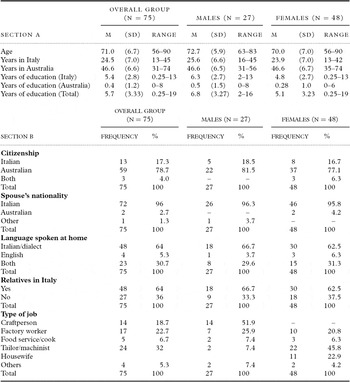
Seventy-five Italian-born healthy volunteers – 48 women and 27 men – participated in the study. Demographic characteristics of the sample are shown in Table 1. The study was approved by the University of Melbourne HREC and the recruitment was made possible with the generous assistance of staff at CO.AS.IT (Comitato Assistenza Italiani – Italian Association of Assistance), a non-profit community organization for Italians and Australians of Italian descent. The sample of volunteers was recruited from eight Italian Senior Citizens Clubs in the Melbourne area. The inclusion criteria for participation were: (1) being born in Italy, and (2) being an Australian resident.
Demographic variables collected during the general interview (descriptives in Section A), and frequencies and percentages of the study sample characteristics (Section B).

Procedure
The neuropsychological assessments were conducted on an individual basis at a time convenient to the participant during their respective Citizens Club hours. Each Club provided a quiet, private room for the interview and testing, which lasted approximately one hour for each participant. The interview and assessment consisted of three sections: (a) a general interview for collecting demographic data; (b) the administration of two long-term retrieval tests, one in English and one in Italian; (c) additional neuropsychological assessment in Italian; and (d) an English language competence assessment. English and Italian memory assessments were presented in counterbalanced order.
Measures
General interview
A general interview to collect demographics was performed using the participant's preferred language. All participants chose to be interviewed in Italian. The results are shown in Table 1.
English Memory Assessment
Word List, Wechsler Memory Scale – Third Edition (WMS-III). Long-term retrieval in English was evaluated using the WMS-III Word List subtest (Wechsler, Reference Wechsler1997b). In this test the participant is asked to recall a list of 12 common concrete nouns repeated over several trials in immediate succession. Word list learning is considered as one of the more sensitive clinical memory tests with a better signal to noise ratio in the form provided with the WMS-III (Wechsler, Reference Wechsler1997b). The total score from the learning trials was used as the measure of long-term retrieval in English for normative comparison, and the sum of immediate and delayed recall (sum of Word Lists I and II) was used in the regression analysis.
Italian Memory Assessment
Milan Overall Dementia Assessment (MODA). The MODA is an Italian cognitive screening for dementia (Brazzelli et al., Reference Brazzelli, Capitani, Della Sala, Spinnler and Zuffi1994) developed as an Italian alternative to the Mini-Mental State Examination (MMSE; Folstein et al., Reference Folstein, Folstein and McHugh1975). Compared to the MMSE, the MODA is a more detailed test of cognitive performance, aimed at evaluating the neuropsychological features of Alzheimer's disease (AD) (Cossa et al., Reference Cossa, Della Sala, Musicco, Spinnler and Ubezio1999; Spinnler, Reference Spinnler, Denes and Pizzamiglio1999). The MODA is used either in parallel or as an alternative to the MMSE (Cossa et al., Reference Cossa, Della Sala, Musicco, Spinnler and Ubezio1997; Cazzaniga et al., Reference Cazzaniga, Francescani, Saetti and Spinnler2003; Bianchi and Dai Prà, Reference Bianchi and Dai2008; Parnetti et al., Reference Parnetti2008; Ambron et al., Reference Ambron, Allaria, McIntosh and Della Sala2009). The MODA consists of three sections: a caregiver support scale, a test of orientation and a neuropsychological section. All the tests included in the neuropsychological section of the MODA are drawn from an Italian series of neuropsychological tests used in clinical practice (Spinnler and Tognoni, Reference Spinnler and Tognoni1987). The total score for the whole test ranges from 0 to 100 (age-adjusted scores cut-offs: > 89.0 = “not impaired”, 85.5 to 89.0 = “borderline” and < 85.5 = “impaired”). Like most screening test summary scores, the MODA total combines scores from several cognitive abilities. The MODA normative data provided in the test manual (Brazzelli et al., Reference Brazzelli, Capitani, Della Sala, Spinnler and Zuffi1994) are based on an age- and education- stratified sample of 217 people from the general community aged between 20 and 97 years (M = 60.8, SD = 18.5), with a mean education of 9.1 years (SD = 4.9, range = 1–17). The test manual reports a retest reliability of 0.83 based on the MODA total score. Effects of age, gender and education on the MODA total score were investigated and only age and education were found to be significant. Adjusted scores are provided in the test manual.
For the purpose of the current research, we administered the MODA neuropsychological section only, which, according to the test manual, assesses the following domains: attention (reversal learning, digit cancellation), verbal intelligence (logical reasoning), verbal memory (prose memory), language (token test, categorical fluency), visuo-spatial cognition (finger agnosia, constructional apraxia/figure copy), and visual perception (figure completion; Brazzelli et al., Reference Brazzelli, Capitani, Della Sala, Spinnler and Zuffi1994). The MODA Prose Memory subtest was chosen as our study measure of long-term retrieval and consists of a story paragraph that has to be recalled immediately after presentation. Although the MODA Prose Memory score range is 0–8 according to the manual, we also used a revised method of scoring (range 0–22), adopting a “per unit” scoring system (i.e. similar to WMS-III Logical Memory subtest: Wechsler, Reference Wechsler1997b; see Appendix). The test manual does not provide separate norms for each subtest but for the overall neuropsychological test section only. Therefore, the MODA neuropsychological total score was used for normative comparisons, and the more discrete, Prose Memory revised scoring (out of 22) was used for latent-structure and regression analysis.
English Competence Assessment
According to Carroll's (Reference Carroll1993) seminal work on the structure of cognitive abilities, language can be regarded as a unitary ability, with an increasing differentiation of skills and competencies seen in the individuals’ native or second language. Some of these language traits are included under the CHC's broad ability of Acquired Knowledge (Gc). For example, Lexical Knowledge (VL) is the extent of a person's vocabulary (i.e. semantic meanings of words), while Language Development (LD) is the general development and application of words, sentences, and paragraphs (not requiring reading) used to communicate a thought or feeling (see Institute for Applied Psychometrics, 2003, for comprehensive definitions). An individual's Foreign Language Proficiency (KL) is also classified under Gc and according to Carroll's analysis (Reference Carroll1993) it is similar to LD, for knowledge of an additional foreign language. Carroll's operational definitions and the CHC model provide a theoretical justification for choosing the following tests as a measure of English competence.
Boston Naming Test – Second Edition (BNT). The BNT (Kaplan et al., Reference Kaplan, Goodglass and Weintraub2001) is a well-known confrontation-naming test. Naming ability is essential for successful communication and several cognitive skills, such as semantic, lexical and phonological processing (Gollan et al., Reference Gollan, Fennema-Notestine, Montoya and Jernigan2007). Worrall and colleagues (Reference Worrall, Yiu, Hickson and Barnett1995) developed the BNT normative data for the Australian elder population, suggesting that the Australian adaptation reduced cultural bias. The Australian norms did not include ethnic minorities. However, the BNT has been widely used in bilingual samples (Moreno and Kutas, Reference Moreno and Kutas2005; Gollan et al., Reference Gollan, Fennema-Notestine, Montoya and Jernigan2007). Growing evidence shows that bilinguals have more difficulty retrieving words than monolinguals and name fewer pictures correctly on standardized naming tests such as the BNT (Roberts et al., Reference Roberts, Garcia, Desrochers and Hernandez2002).
Schonell Graded Word Reading Test. The Schonell Reading Test (Schonell and Schonell, Reference Schonell and Schonell1960) is composed of 100 words (both regular and irregular) in order of increasing difficulty, with a score range from 0 to 100. The Schonell Reading Test is used commonly as a screening test for reading ability and was used here as a second English competence test.
Vocabulary subtest, Wechsler Adult Intelligence Scale – Third Edition (WAIS-III). The Vocabulary subtest (Wechsler, Reference Wechsler1997a) is a measure of word knowledge where the examinee is requested to give verbal definitions for different words of increasing difficulty.
All the above tests were administered according to the standard instructions.
Statistical analysis
Analyses were carried out using Statistical Package for the Social Sciences (SPSS, Version 18) and included: (a) a descriptive analysis of demographic data, (b) two-tailed t-tests and measures of effect size to compare mean performance on the English and Italian long-term retrieval measures, and (c) stepwise multiple regression analyses which were generated to test the influence of English language proficiency on long-term retrieval performance. A maximum likelihood confirmatory factor analysis (CFA) was conducted on the MODA neuropsychological subtests together with the memory and English competence variables to explore the latent-ability structure in line with the CHC model. This CFA was analyzed using Mplus 5.1 (Muthén and Muthén, Reference Muthén and Muthén2008).
Results
Sample characteristics
A total of 75 participants took part in the study. These comprised 27 males and 48 females with a mean age of 70.9 years (SD 6.7 years; range 56–90 years). Details regarding age, place of birth, citizenship, level of education, past occupation, nationality of the spouse or partner, preferred language at home, number of years lived in Italy and Australia are shown in Table 1.
English competence and long-term retrieval
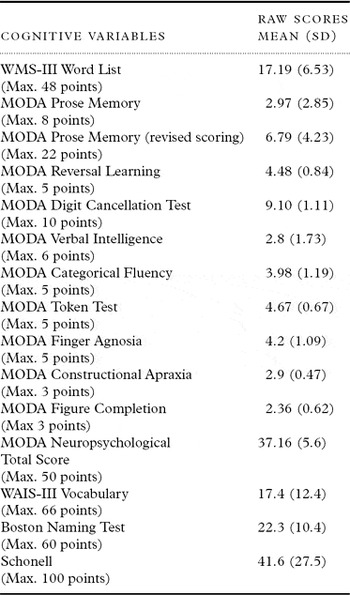
The raw score means and standard deviations (SD) for the cognitive variables used in the study are shown in Table 2. Because the English and Italian tests have a different number of items and different means, comparison of raw score means is uninformative. Instead, z-scores were calculated based on the published, age-corrected norms from the English language memory test and the overall battery score in Italian. The mean z-scores (Z), standard deviations (SD) and confidence intervals (CI) for the WMS-III Word List and the MODA Neuropsychological Total Score were respectively Z = −1.55 (SD = 0.96; 95% CI: −1.77, −1.32) and Z = −1.40 (SD = 1.28; 95% CI: −1.70, −1.11). A matched-samples t-test comparing the z-scores on the WMS-III Word List to the MODA Neuropsychological Total Score produced a statistically non-significant result and small effect (t(73) = 1.006, p = 0.318, Cohen's d = 0.11). As a consequence, we retained the hypothesis of no difference between the available normative scores on the long-term retrieval test assessed in English and the overall neuropsychological battery score in Italian.
Raw score means and standard deviations for the cognitive variables in the study sample (N = 75).

In terms of normative comparisons for cognitive performance assessed in Italian, based on the MODA Neuropsychological Total Score, 27% of the sample obtained a score less than or equal to −2 SD. When memory performance was assessed in English, on the WMS-III Immediate list score, 44% of the sample was at −2 SD or below. Normative comparisons with the MODA memory scores are precluded because there are no separate norms for the MODA subtests. All the participants in the study performed less than or equal to the 10th percentile on the BNT, while 37% of the sample scored at −2 SD or below on the WAIS-III Vocabulary test. Based on the Schonell scores, the participants’ English reading ability was equivalent to a reading age of 9.16 years (SD 2.7).
To test the hypothesis that the CHC model provided the best description of the neuropsychological measures, including the English and Italian language memory tests, and the English proficiency tests, a CFA was conducted contrasting three models. In this and subsequent analyses, the revised MODA prose recall score (out of 22) was used as the Italian-language memory test score. The first factor model examined was a one-factor model representing all tests. The second was a two-factor model contrasting (1) verbal ability and verbal memory (Gc and Glr in the CHC model; McGrew, Reference McGrew2009), versus (2) visuo-spatial thinking abilities (Gv and Gf combined, i.e. similar to the conceptual definition of what is often termed executive functioning).
The third model contrasted (1) verbal (Gc), (2) visuo-spatial (Gv and Gf combined) and (3) long-term retrieval abilities (Glr). In the three-factor model, verbal ability was represented by the WAIS-III Vocabulary, Schonell Reading Test, Boston Naming Test and the MODA tests of Verbal Intelligence, Categorical Fluency and Token Test. The visuo-spatial thinking abilities factor was represented by the MODA tests of Finger Agnosia, Apraxia (figure copy), Reversal Learning (i.e. a visuo-motor sequence similar to the go/ no-go paradigm), and Cancellation. The long-term retrieval factor was represented by the WMS-III list learning total scores at immediate and delayed recall, the MODA Prose Memory (modified scoring) and a joint loading with the Cancellation test. Variable groupings were decided based upon the CHC Broad (stratum II) and Narrow (stratum I) operational definitions (see Institute for Applied Psychometrics, 2003 for a review).
Briefly, the results showed that both the one and two factor models did not fit the data (χ2, p < 0.05), whereas the three factor model provided a fit to the data (χ2[df = 73] = 65.7, p = 0.72; TLI = 1, CFI = 1, RMSEA < 0.001; full details of the CFA are available on request from the authors). In line with the CHC model, this analysis supported the theoretical distinction between long-term retrieval versus verbal and visuo-spatial abilities, where the first two abilities were assessed by tests in Italian and English.
To test the influence of long-term retrieval ability in Italian, and of English competence on the long-term retrieval test in English, regression analyses were used. Initially, two separate regression analyses were conducted and the dependent variable in both cases was the long-term retrieval measure in English (sum of immediate and delayed WMS-III Word list raw scores used to improve the signal to noise ratio). In the first model the influence of demographic variables was examined, including age in years, gender (dummy coded), language spoken at home (Italian/dialect, English, or both: dummy coded), number of years of education completed in Italy, number of years of education completed in Australia, total number of years of education, and number of years lived in Australia. Only age was a significant predictor of the long-term retrieval score in English (adjusted R2 = 0.194, F(1,73) = 18.79, p < 0.001).
In the second regression analysis, the independent variables were age, the scores on the MODA Prose Memory, the MODA neuropsychological composite (excluding the Prose Memory score), and a composite English proficiency score derived from the sum of the BNT, Schonell Reading Test, and WAIS-III Vocabulary. In this analysis the hypothesis tested was that memory and general cognitive status tested in Italian, together with English language competence would predict memory ability tested in English. When age, and the scores on the MODA Prose Memory, and MODA neuropsychological composite were entered into the regression, all three variables were significant predictors of memory in English, and the inclusion of the English competence score did not provide significant improvement to the regression equation (p > 0.05). Nonlinear (quadratic) terms for all of the significant linear predictors were also examined for inclusion, and none was significant. Nor were interactions between the linear terms significant.
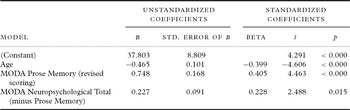
A final regression model was formulated to include age, the MODA Prose Memory and the MODA neuropsychological composite. Overall this model explained 45.2% of variance in the WMS-III word lists (see Table 3 for a model summary). The single best predictor for the WMS-III Word Lists in this final model was the MODA Prose Memory score explaining 22.9% of the variance. Age explained 20.5% of variance and general cognitive status assessed in Italian added a modest 4% of variance.
Final model regression coefficients. The dependent variable was the Word List (WMS III) Immediate and Delayed Composite.

Discussion
Previous studies of cognitive assessment in English for people from non-English speaking backgrounds suggest that there is increased risk of diagnostic errors due to linguistic and cultural differences, when the assessment is conducted without appropriate language-specific test norms (Artiola i Fortuny and Ricker, Reference Artiola i Fortuny and Ricker2004; Pedraza and Mungas, Reference Pedraza and Mungas2008). Within the Australian context some recent studies on ethnic minorities supported this view, emphasizing the importance of subgroup differences and suggesting cautious interpretation in relation to diagnosis of cognitive impairment (Carstairs et al., Reference Carstairs, Myors, Shores and Fogarty2006; Plitas et al., Reference Plitas, Tucker, Kritikos, Walters and Bardenhagen2009).
In contrast, the results of the present study suggest that memory performance of Italian-born older Australians may be assessed in English without disadvantage due to English competence. When the influence of memory and general cognitive status assessed in Italian was controlled, English language competence did not contribute to the prediction of memory assessed in English. The statistically significant predictors of long-term retrieval assessed in English included age and aspects of cognitive function assessed in Italian. When cognitive performance was assessed using their first or second language, participants performed relatively poorly in terms of the available norms. This result was a little surprising in view of the fact that all participants were resident in the community. However, as noted below, many of the participants displayed little understanding of the nature of degenerative dementias, and the overall pattern of results may further highlight the relatively high incidence of unmet health and health-education needs in this type of immigrant community. All participants who expressed concerns about aging and health were encouraged to access appropriate professional services; however, the specific number who sought this information was not recorded.
So far as we are aware this is the only study conducted in Australia using measures of cognitive assessment normed in both English and the participants’ native language, respectively. Plitas and colleagues (Reference Plitas, Tucker, Kritikos, Walters and Bardenhagen2009) for example, compared only Greek language cognitive screening outcomes between groups of Greek-Australians and Greek nationals, while Cairstairs and colleagues (2006) analyzed the impact of language background on the cognitive performance of three subgroups of subjects with different English proficiency levels, relying solely on English-based cognitive tests. The MODA norms are based on a sample of Italians living in Italy and application to an elderly immigrant community living in Australia is also qualified by historical-cultural factors (e.g. educational opportunities and exposure to more contemporary Italian culture). However, the opportunity to use a normed Italian scale has clear advantages when compared to the common pragmatic strategy, to “simply translate existing English-language instruments and apply English-language norms to the translated instruments, seemingly unaware of the methodological nightmare that this constitutes” (Artiola i Fortuny and Ricker, Reference Artiola i Fortuny and Ricker2004, p. 69).
Three main conclusions can be derived from our study. First, the absolute level of memory performance in English and overall dementia screening score in Italian, in terms of z-scores was similar, suggesting no significant discrepancy of assessment outcome when our sample of Italian-born Australians was assessed using either English or Italian. The observed effect, in terms of Cohen's d (Cohen, Reference Cohen1988) is small (d = 0.11) and not likely to be of any clinical significance. Secondly, despite the administration of memory tests in two different languages, namely English and Italian, the memory test scores in our study sample fell along one cognitive ability dimension, the well-established latent variable of long-term retrieval, while the measures of English proficiency (i.e. BNT, WAIS-III Vocabulary and Schonell) fell along an acquired knowledge dimension. On a minor note, the factor assignment of Fluency tasks is slightly ambiguous in the CHC model, since this type of task has overlearned (Gc), fluid (Gf) and speed components. However, inspection of modification indices revealed no evidence to indicate re-assignment of indicator scores to factors. More importantly, the factor analysis was based on a small sample, but the resulting three-factor model conformed to the dimensions of the CHC model reported from many different populations with similar tests batteries (Tulsky and Price, Reference Tulsky and Price2003; McGrew, Reference McGrew2009; Tuokko et al., Reference Tuokko, Chou, Bowden, Simard, Ska and Crossley2009). Therefore, it appears unlikely that an incorrect model was accepted due to lack of statistical power. Thirdly, and contrary to what was originally hypothesized, the strongest predictors of memory in English was memory and broader cognitive status assessed in Italian, rather than English competence. As expected, age was also a significant predictor of long-term retrieval performance.
The overall conclusion to this study is that, in the absence of the native language assessment for older Italian-born Australians, we may be able to place some confidence in the English assessment of clinical memory performance, memory of the type most commonly affected in degenerative dementias. This conclusion is contrary to common clinical cautions regarding the risk of false-positive diagnosis in non-English speakers. This caution needs to be balanced against the risks of false-negative diagnosis, a risk that may arise if poor cognitive performance in a non-English speaker is attributed to language factors alone. Instead, the current results suggest that if an older native Italian speaker scores poorly on a memory assessment performed in English it may be due to cognitive impairment rather than English language issues and should lead to further investigation.
It is also interesting to note that participants in our sample had very limited opportunities to acquire an adequate level of English. They also had limited opportunities to develop other cognitive skills enhanced through formal education, for example, analytic thinking and reasoning abilities, and familiarity with academic assessment and testing situations. Typically, migration from Italy to Australia after the Second World War was more common from rural areas, particularly within the southern regions, where rates of unemployment and illiteracy where higher. Such was the extent of emigration that some participants commented that their rural village no longer existed.
Also, the types of occupations endorsed by our sample seemed to have limited their potential ability to develop occupational or English-speaking community involvement in Australia. Women, for example, were mainly involved in jobs requiring no specific language expertise. Some of them spent their lives as housewives with limited chances to integrate within the Australian community due to language barriers. As a consequence, during their initial interview, the majority of the study participants communicated using a mix of Italian and dialect, presenting also some English words during conversation but with evident lack of educational and culture-related learning opportunities more readily available in contemporary Italy to younger native Italian speakers. Many of our participants reported that, although the Australian government offered free English courses at the time of their arrival, they preferred not to participate because of fear of “losing their traditions”. Interestingly, this scenario is very similar to the one presented by Plitas and colleagues (Reference Plitas, Tucker, Kritikos, Walters and Bardenhagen2009) in their community sample of Greek-Australians and may be a common pattern in immigrant communities (Artiola i Fortuny and Ricker, Reference Artiola i Fortuny and Ricker2004).
In contrast, the opportunity to undergo a memory assessment in Italian with no need for an interpreter was welcomed by many of the participants in this study, and may have enhanced establishment of rapport during the interview session. However, some of the research participants displayed mild anxiety regarding the purpose of the investigation, and appeared unfamiliar with the risks and characteristics of dementia, suggesting a need for more effective education regarding dementia in this community sector.
In conclusion, it is important to note that the reported results apply only to the memory abilities studied. In addition, although our study was underpowered for the CFA analysis, results are precisely in line with the predicted model of cognition for the type of test battery employed. Future studies should examine the impact of second-language competence in terms of other cognitive domains relevant to dementia characterization in larger samples and in samples from other cultural backgrounds. Prominent amongst these abilities are language acquisition and use, and so-called executive function reflecting, respectively, aspects of crystallized and fluid cognitive abilities and working memory, as defined in the CHC model.
Conflict of interest
None.
Description of authors' roles
Sara Fratti designed the study, collected and analyzed the data, and wrote the paper. Stephen C. Bowden assisted with design of the study, analyzed the data and assisted in writing the paper. Olimpia Pino assisted in writing the paper.
Acknowledgments
We gratefully acknowledge the excellent support and collaboration of staff at CO.AS.IT (Melbourne), as well as the Italian Seniors Citizen Clubs members in Melbourne who so kindly agreed to take part in the study. Without their effort this study would have not been possible. We would also like to thank the Department of Psychology at the University of Parma (Italy) for their support.
Appendix
MODA Prose Memory revised score procedure
According to the manual (Brazzelli et al., Reference Brazzelli, Capitani, Della Sala, Spinnler and Zuffi1994), the Prose Memory score has a hierarchical thematic scoring, ranging from zero to a maximum of eight points. In order to reach a minimum score, subjects must recall a specific minimum number of items. If the examinee recalls only items of the short story that are not included within the thematic scoring, then the examinee will score zero.
In this study a revised scoring was used in which the thematic procedure is replaced by a “per item” scoring system, similar to the one presented in the WMS-III Logical Memory subtest (Wechsler, Reference Wechsler1997b). This means that all the details of the short story are included in the scoring system. The examinee is credited one point for each item recalled, to a maximum of 22 points.
The revised scoring system has a better range and distribution of scores (details of the scoring system are available on request from the authors).