1. Introduction
The Paleocene fossil record of birds is very sparse and this is particularly true for non-aquatic species. In Europe, only a few localities have yielded identifiable remains of Paleocene terrestrial birds, that is, Walbeck in Germany, Cernay-lès-Reims, Mont-de-Berru, Louvois and Rivecourt in France, as well as Mesvin in Belgium.
From the Thanetian sites of Mesvin (Dollo, Reference Dollo1883; Buffetaut & Angst, Reference Buffetaut and Angst2014) and Louvois (Buffetaut & Angst, Reference Buffetaut and Angst2014; Mourer-Chauviré & Bourdon, Reference Mourer-Chauviré and Bourdon2016) only remains of the large, flightless Gastornithidae are known. The avian material from the uppermost Paleocene of Rivecourt also includes a gastornithid, which has not yet been described in detail (Smith et al. Reference Smith, Quesnel, De Ploëg, De Franceschi, Métais, De Bast, Solé, Folie, Boura, Claude, Dupuis, Gagnaison, Iakovleva, Martin, Maubert, Prieur, Roche, Storme, Thomas, Tong, Yans and Buffetaut2014).
The sites of Cernay-lès-Reims and Mont-de-Berru, which are geographically and stratigraphically very close to each other, are of Thanetian age, dating back to about 58 Ma (Biochrom’97, Reference Aguilar, Legendre and Michaux1997). The avifauna of these two sites includes remains of the Gastornithidae and the flightless, palaeognathous Remiornithidae, as well as the gruiform Messelornithidae and the strigiform taxon Berruornis (Martin, Reference Martin1992; Mourer-Chauviré, Reference Mourer-Chauviré1994, Reference Mourer-Chauviré1995, Reference Mourer-Chauviré1996; Buffetaut, Reference Buffetaut1997; Angst & Buffetaut, Reference Angst and Buffetaut2013).
The exact age of Walbeck is not well constrained, but it appears to pre-date Cernay-lès-Reims and Mont-de-Berru and is likely to belong to the upper Selandian stage, about 59–60 Ma (de Bast, Steurbaut & Smith, Reference de Bast, Steurbaut and Smith2013). In addition to several poorly represented taxa of uncertain affinities, the Walbeck avifauna includes remains of gastornithids, the messelornithid-like Walbeckornis and the strigiform Berruornis (Mayr, Reference Mayr2002, Reference Mayr2007). In Cernay-lès-Reims, Mont-de-Berru, Louvois, Mesvin and Walbeck, terrestrial avian taxa dominate and so far no remains of small arboreal birds have been found.
Menat (Puy-de-Dôme, France) is another long-known Paleocene site, whose avifauna so far, however, has received very little attention, even though the first bird remains from Menat were reported a century ago. The Menat basin, in the department of Puy-de-Dôme, is located in the northern part of the French Massif Central (see location map in Matsumoto et al. Reference Matsumoto, Buffetaut, Escuillié, Hervet and Evans2013). This small sedimentary basin is surrounded by metamorphic rocks and has been known since the early nineteenth century (Lecoq, Reference Lecoq1829). The sediments are now interpreted as having been deposited in a maar lake occupying a deep depression resulting from explosive volcanism (Vincent et al. Reference Vincent, Aubert, Boivin, Cantagrel and Lenat1977). The shale-like sediments of the basin, which are in fact largely composed of sponge spicules, diatoms and algal remains, were exploited to produce a siliceous abrasive (‘Menat Tripoli’), and in the course of the quarrying operations many exquisitely preserved fossils were discovered.
The age of the Menat beds has long remained controversial. Earlier suggestions of an Oligocene age (Launay, Reference Launay1908, Reference Launay1923) were still accepted, on the basis of the insect fauna, by Balazuc & Descarpentries (Reference Balazuc and Descarpentries1964). Piton (Reference Piton1940) supported a Lutetian age, based on the plants and insects. Russell (Reference Russell1967) identified one of the few mammal specimens from Menat as belonging to a primitive form of the genus Plesiadapis, indicating a middle or late Paleocene age, an age assignment supported by Kedves (Reference Kedves1967) on the basis of palynomorphs. While the Paleocene age of the Menat beds is no longer in doubt, their exact position within that epoch is still disputed. Basalts associated with the Menat maar have yielded ages clustering around 56 Ma, suggesting a Thanetian age, in agreement with palynological evidence (Kedves & Russell, Reference Kedves and Russell1982). By contrast, more recent studies, based on the evolutionary grade of the Menat Plesiadapis and magnetostratigraphy (Wappler et al. Reference Wappler, Currano, Wilf, Rust and Labandeira2009; Wedmann, Wappler & Engel, Reference Wedmann, Wappler and Engel2009) considered an older, Selandian (c. 60–61 Ma) age as likely.
The most abundant fossils from Menat are plant, fish and insect remains (e.g. Piton, Reference Piton1940; Nel, Reference Nel2008; Nabozhenko & Kirejtshuk, Reference Nabozhenko and Kirejtshuk2014, Reference Nabozhenko and Kirejtshuk2017; Hartung et al. Reference Hartung, Garrouste, Pouillon and Nel2016; Garrouste et al. Reference Garrouste, Wedmann, Pouillon and Nel2017; Legalov, Kirejtshuk & Nel, Reference Legalov, Kirejtshuk and Nel2017). However, the site has also yielded several tetrapods including crocodilians, turtles, choristoderes, mammals and birds (Piton, Reference Piton1940; Guth, Reference Guth1962; Russell, Reference Russell1967; Matsumoto et al. Reference Matsumoto, Buffetaut, Escuillié, Hervet and Evans2013). Avian remains from Menat were first reported by Launay (Reference Launay1908, Reference Launay1923), who figured and briefly described two articulated skeletons, one of which is redescribed below, while the whereabouts of the second one are unknown. Piton (Reference Piton1940) mentioned and illustrated a third specimen, now kept at the University of Lyon, which he considered as a possible long-legged wading bird (this specimen, which actually lacks the feet and cannot be unambiguously identified, will not be discussed in the present paper). None of these authors provided a meaningful and more detailed description of the fossils. The birds from Menat were revisited in an unpublished Master's thesis (M. S. Jensen, unpub. M.Sc. thesis, Geological Museum and Geological Institute, Copenhagen, 2008), in which some new specimens were also described; as detailed in the following, however, some of the taxonomic identifications in this study are not supported by the morphologies of the fossils.
Here we review some of the previously found bird fossils from Menat and report a hitherto undescribed specimen that was found in the course of one of the recent excavations. All of these specimens are very poorly preserved and allow the recognition of few osteological details. Their determination would have been doomed to failure even a few years ago, but comparison with the now much improved and extensive early Eocene fossil record (Mayr, Reference Mayr2009, Reference Mayr2017a,Reference Mayrb) allows at least a tentative identification of some specimens. Most of the fossils described in the present study were already found in the first half of the twentieth century. The fossiliferous strata were poorly exposed in the subsequent decades, but in recent years, collecting activities have been resumed, in the course of which new avian material has been discovered, among which is an unusually preserved specimen that is described for the first time below.
2. Material and methods
Institutional abbreviations. BSP – Bayerische Staatssammlung für Paläontologie und Historische Geologie, München, Germany; FSL – Geological collection, Université Claude-Bernard, Lyon, France; IVPP – Institute of Vertebrate Palaeontology and Palaeoanthropology, Beijing, China; MGUH – Geological Museum, University of Copenhagen, Denmark; MHNM – Muséum d'Histoire Naturelle de Marseille, France; MNHN – Muséum National d'Histoire Naturelle, Paris, France; MNT – Musée de Menat, Puy-de-Dôme, France; SMF – Senckenberg Research Institute Frankfurt, Germany; SMNK – Staatliches Museum für Naturkunde, Karlsruhe, Germany. Measurements are in millimetres.
3. Systematic palaeontology
AVES Linnaeus, Reference Linnaeus1758
TELLURAVES sensu Yuri et al. (Reference Yuri, Kimball, Harshman, Bowie, Braun, Chojnowski, Han, Hackett, Huddleston, Moore, Reddy, Sheldon, Steadman, Witt and Braun2013)
cf. Halcyornithidae Harrison & Walker, Reference Harrison and Walker1972 and Messelasturidae Mayr, Reference Mayr2005
Gen. et sp. indet.
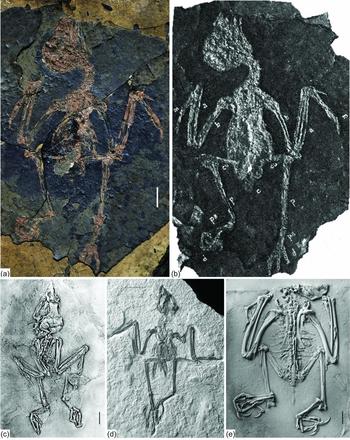
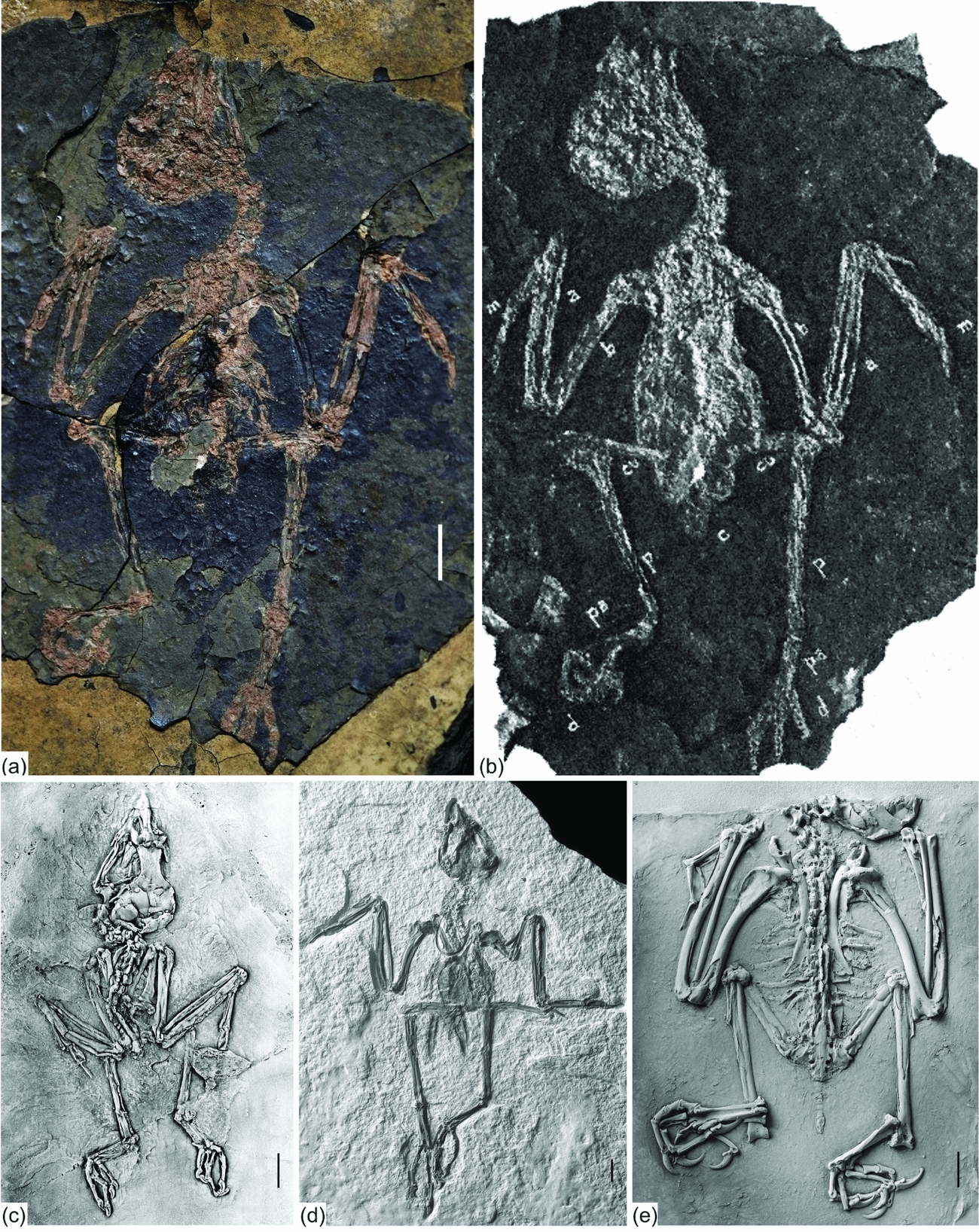
Referred specimen. MNHN-MEN 69 (Fig. 1a, b); nearly complete skeleton on two slabs (the small counter slab, which contains one half of the skull, the cervical vertebrae and the cranialmost portion of the trunk, is not shown).
(a) Skeleton of a bird from the Paleocene of Menat (MNHN-MEN 69), which resembles that of the early Eocene Halcyornithidae and Messelasturidae; note that the slab is broken along the crack that intersects the cranial portion of the trunk, and the two halves, which are more widely separated in the actual fossil, were digitally reassembled. (b) The specimen as figured by Launay (Reference Launay1908). (c) Skeleton of Pseudasturides macrocephalus (Halcyornithidae) from the lower Eocene of Messel, Germany (SMNK.PAL.2373a; specimen coated with ammonium chloride). (d) Skeleton of Tynskya eocaena (Messelasturidae) from the lower Eocene Green River Formation, USA (BSP 1997 I 6). (e) Skeleton of Messelastur gratulator (Messelasturidae) from the lower Eocene of Messel (SMF-ME 11348; specimen coated with ammonium chloride). Scale bars equal 10 mm.
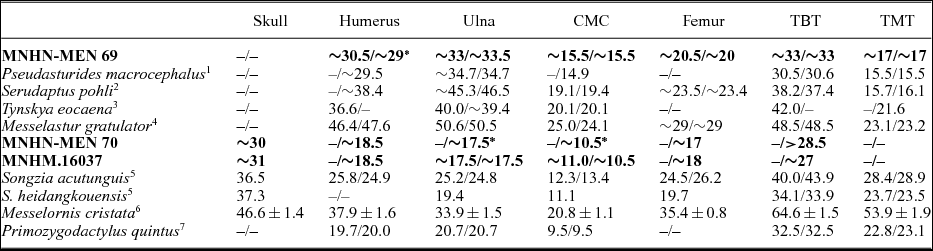
Measurements. See Table 1.
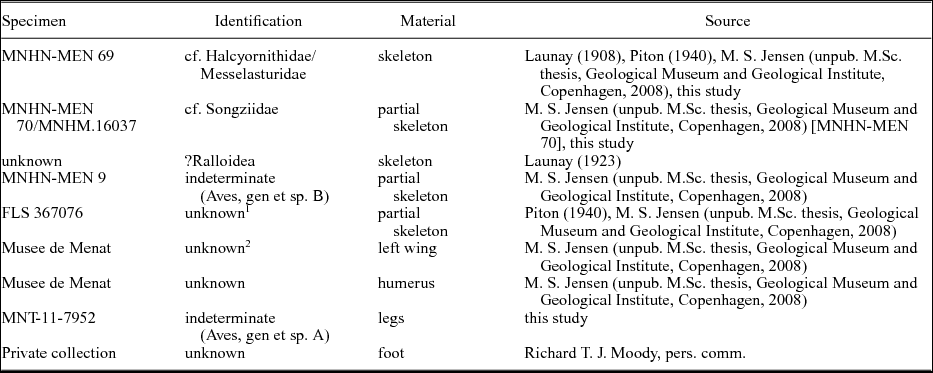
Measurements (left/right, in mm) of two fossil birds from the Paleocene of Menat, MNHN-MEN 69 (cf. Halcyornithidae/ Messelasturidae) and MNHN-MEN 70/MNHM.16037 (cf. Songziidae), in comparison to the early Eocene species Pseudasturides macrocephalus and Serudaptus pohli (Halcyornithidae), Tynskya eocaena and Messelastur gratulator (Messelasturidae), Songzia acutunguis and S. heidangkouensis (Songziidae), Messelornis cristata (Messelornithidae) and Primozygodactylus quintus (Zygodactylidae)

Asterisked values represent estimated measurements based on a tentatively reconstructed bone length. Abbreviations: CMC – carpometacarpus; TBT – tibiotarsus; TMT – tarsometatarsus.
1 holotype, from Mayr (Reference Mayr1998); 2holotype, from Mayr (Reference Mayr2000a); 3holotype, from Mayr (Reference Mayr2000b); 4holotype, from Mayr (Reference Mayr2011); 5from Wang et al. (Reference Wang, Mayr, Zhang and Zhou2012); 6from Hesse (Reference Hesse1990); 7holotype, from Mayr (Reference Mayr2017c).
Description and comparison. The fossil is exposed in dorsal view. Most bones are split along their longitudinal axes and details of the articular surfaces are not visible. The main slab was broken after Launay's (Reference Launay1908) description, so that the cranial and caudal portions of the skeleton are now separated by a crack.
The skull is comparatively large in comparison to the body. The beak appears to have been dorsoventrally tall, but only its caudal section is preserved. The presence of long processus supraorbitales, which are a characteristic feature of Halcyornithidae and strigiform birds (see below), cannot be assessed.
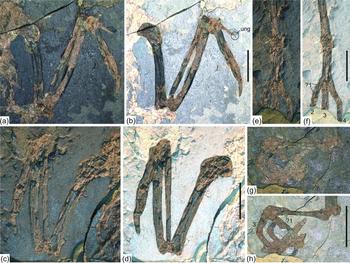
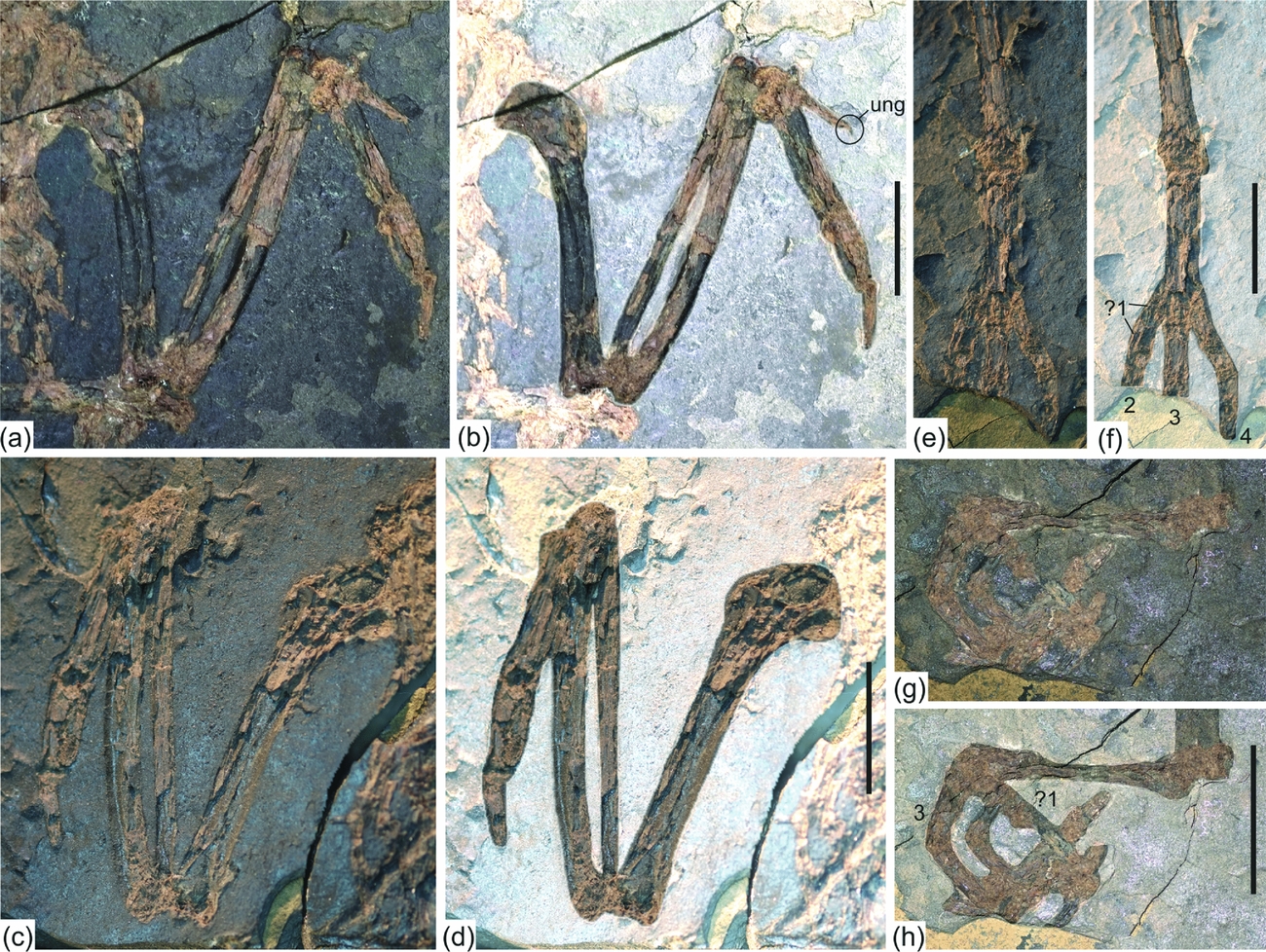
The bones of the pectoral girdle are too poorly preserved for the recognition of osteological features. The humerus, however, has a characteristic shape, being fairly long and slender, with a small proximal end and a short crista deltopectoralis (Fig. 2a–d). Except for the outline of the weakly prominent processus flexorius, details of the distal end of the bone are not visible. The ulna exceeds the humerus in length. The carpometacarpus is craniocaudally slender, with a narrow spatium intermetacarpale. The phalanx digiti alulae bears an ungual phalanx (Fig. 2b).
Osteological details of MNHN-MEN 69 (cf. Halcyornithidae and Messelasturidae). (a, b) Right wing in craniodorsal view. (c, d) Left wing in craniodorsal view. (e, f) Right foot in plantar view. (g, h) Left foot in medial view. In (b, d, f, h) the bones are digitally highlighted; in (a‒d) the slabs are broken along the cracks and the two parts, which are more widely separated in the actual fossil, were digitally reassembled. The toes are numbered in (f) and (h). Abbreviation: ung – ungual phalanx. Scale bars equal 10 mm.
The legs are characterized by a comparatively short tibiotarsus and a short and fairly stout tarsometatarsus. Osteological details of both bones are, however, hardly discernible. The left tarsometatarsus is exposed in medial view and has a dorsoplantarly narrow shaft, with the hypotarsus being only weakly prominent in plantar direction. The right tarsometatarsus is seen in plantar view. The bone is moderately stout and the shaft has an equal width along most of its length; osteological details of the trochleae are not preserved.
The right foot is visible in plantar view and the toes are preserved in a relaxed position (Fig. 2g, h); judging from its curvature, the fourth toe shows the lateroplantar rather than the plantar surface, which may indicate that it is preserved in a semizygodactyl position. The left foot is seen in medial view and, except for the clearly discernible third toe, the identity of the toes is uncertain (Fig. 2e, f); our identification of a long first toe is tentative. The shape of the ungual phalanges cannot be determined. The fact that the toes are strongly curved and exhibit a clasping position indicates the former presence of strong pedal tendons, which contracted postmortem.
Remarks. MNHN-MEN 69 was first described by Launay (Reference Launay1908, p. 395), who identified the fossil as ‘un oiseau de la taille d'une grive et probablement un passereau’ [‘a thrush-sized bird and probably a passerine’]. However, Launay (Reference Launay1908) did not detail his reasons for this classification and provided no description of the specimen. Piton (Reference Piton1940, p. 282) considered the fossil to be undeterminable, whereas M. S. Jensen (unpub. M.Sc. thesis, Geological Museum and Geological Institute, Copenhagen, 2008), mainly based on limb proportions, compared it with Galliformes and the early Eocene coraciiform Primobucconidae.
Passerine affinities clearly are not supported by the skeletal morphology of MNHN-MEN 69, which has a proportionally more robust tarsometatarsus and much stronger feet than any passeriform bird. Closer relationships to Galliformes likewise conflict with the overall morphology of the fossil, in which the ulna exceeds the humerus in length, the tarsometatarsus is stouter and the toes are much stronger. Affinities to the Primobucconidae can be rejected, because MNHN-MEN 69 has a proportionally much longer tibiotarsus and a stouter tarsometatarsus than coraciiform birds.
Because of the poor preservation of the skeleton, a definitive assignment to an avian higher-level taxon is not possible. The morphology of the feet suggests a strong grasping foot, and overall the skeleton corresponds best with that of the Eocene Halcyornithidae (Fig. 1c) and Messelasturidae (Fig. 1d, e). These birds are considered to be representatives of Psittacopasseres, the clade including psittaciform and passeriform birds (Mayr, Reference Mayr2009, Reference Mayr2015, Reference Mayr2017a). In addition to similar length proportions of the limb bones, MNHN-MEN 69 bears a resemblance to halcyornithids and messelasturids in the shape of the humerus, which is a long and slender bone with narrow proximal and distal ends, and in the proportions of the elongate and narrow carpometacarpus and the fairly short and stout tarsometatarsus. The earliest definitive records of halcyornithids and messelasturids stem from the lower Eocene of the British London Clay and from roughly contemporaneous strata of the North American Nanjemoy and Green River formations (Mayr, Reference Mayr2016, Reference Mayr2017a). With an age of about 51–52 Ma, these fossils are at least 4–5 million years younger than MNHN-MEN 69.
Compared with extant birds, MNHN-MEN 69 resembles Strigiformes in overall skeletal proportions, especially concerning the shape of the slender humerus and the morphology of the feet. Owls have a fossil record that dates back into the Paleocene, but the tarsometatarsus of MNHN-MEN 69 differs from that of the two described Paleocene taxa in its proportions: whereas the bone is much stouter in Berruornis from Cernay-lès-Reims (Mourer-Chauviré, Reference Mourer-Chauviré1994) and Walbeck (Mayr, Reference Mayr2007), the tarsometatarsus of the geologically older (Tiffanian) Ogygoptynx from Colorado, USA (Rich & Bohaska, Reference Rich and Bohaska1981) is proportionally much longer.
The only Paleocene bird that may show closer affinities to MNHN-MEN 69 is the recently described Tsidiiyazhi abini from the mid Paleocene (62 Ma) Nacimiento Formation in New Mexico, USA (Ksepka, Stidham & Williamson, Reference Ksepka, Stidham and Williamson2017). This bird is known from a fragmentary partial skeleton, which corresponds in size to MNHN-MEN 69, and the tarsometatarsus ‒ the only bone that is complete in the T. abini holotype ‒ has similar proportions to the tarsometatarsus of the Menat fossil. Owing to the poor preservation of MNHN-MEN 69 and the fragmentary representation of the T. abini holotype, a definitive assessment of possible close affinities is not possible, but we note that such affinities cannot be excluded based on the available data. T. abini was assigned to Coliiformes in the original description, but this classification is best regarded as tentative and the species also shows some resemblance to the Messelasturidae, with which it was not compared. MNHN-MEN 69, the bird from Menat, is clearly distinguished from Coliiformes in the craniocaudally narrow carpometacarpus and the fact that the ulna distinctly exceeds the humerus in length.
?GRUIFORMES sensu Yuri et al. (Reference Yuri, Kimball, Harshman, Bowie, Braun, Chojnowski, Han, Hackett, Huddleston, Moore, Reddy, Sheldon, Steadman, Witt and Braun2013)
?RALLOIDEA (Vigors, Reference Vigors1825)
cf. Songziidae Hou, Reference Hou1990
Gen. et sp. indet.
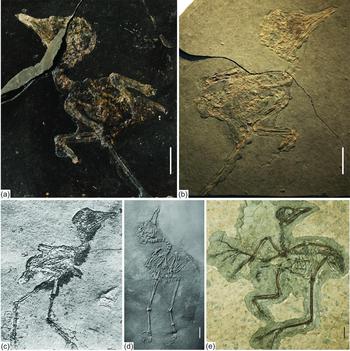
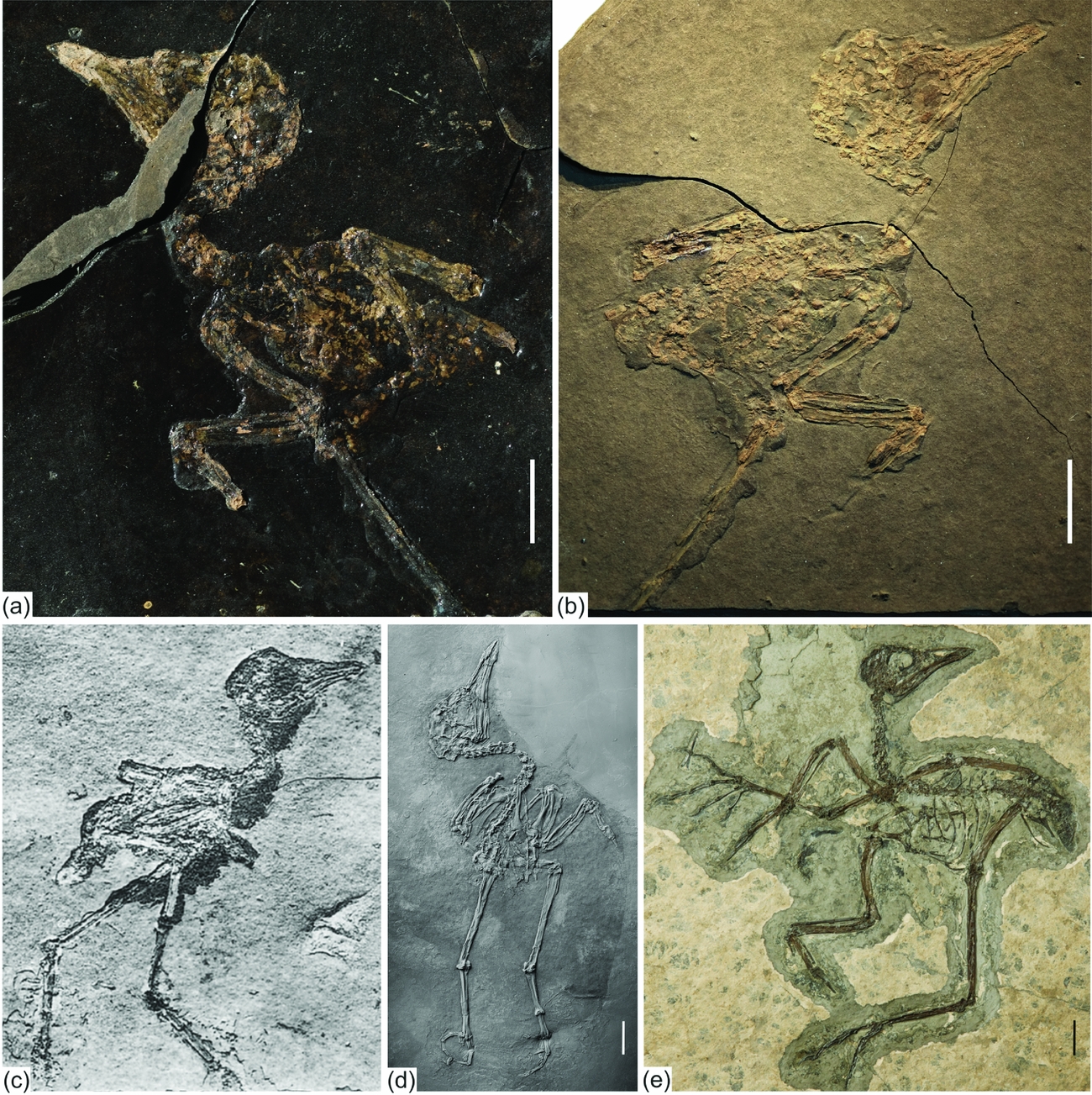
Referred specimen. MNHN-MEN 70 and MNHM.16037 (Fig. 3a, b); partial skeleton on two slabs lacking the left leg and the right foot.
(a, b) Slab and counter slab of a bird from the Paleocene of Menat, which resembles the early Eocene Songziidae (a: MNHM.16037; b: MNHN-MEN 70). (c) A similar skeleton from Menat of unknown whereabouts, which was figured by Launay (Reference Launay1923, fig. 8). (d) Holotype of Primozygodactylus quintus (Zygodactylidae) from the lower Eocene of Messel, Germany (SMF-ME 11091A; specimen coated with ammonium chloride). (e) Holotype of Songzia acutunguis (Songziidae) from the lower Eocene Yangxi Formation in China (IVPP 18188). Scale bars equal 10 mm.
Measurements. See Table 1.
Description and comparison. This fossil consists of two slabs in different repositories, which are here for the first time recognized as being from the same individual. Specimen MNHN-MEN 70 is visible in dorsal view, whereas MNHM.16037 exposes the ventral side. The skull is too poorly preserved for the recognition of osteological details. The beak measures less than the total length of the skull and is dorsoventrally low; in its proportions it appears to have been similar to the beak of Columbiformes or the charadriiform Charadriidae. The shape of the nostrils is not clearly discernible in either of the specimens.
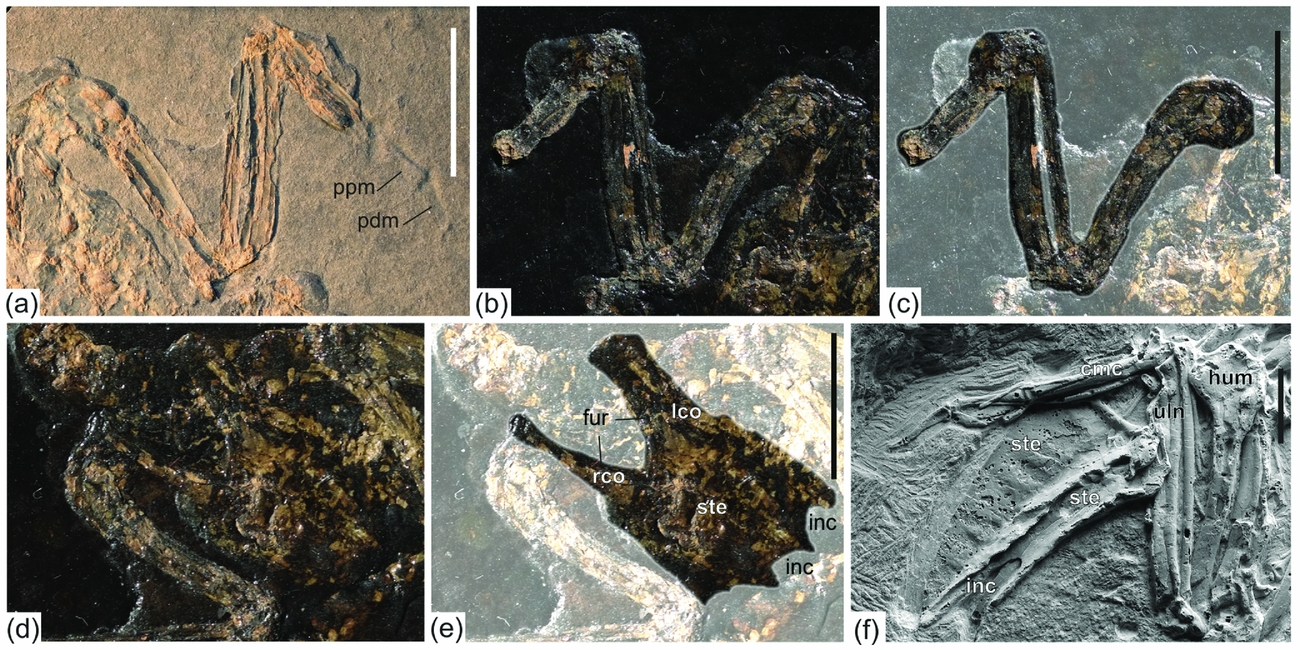
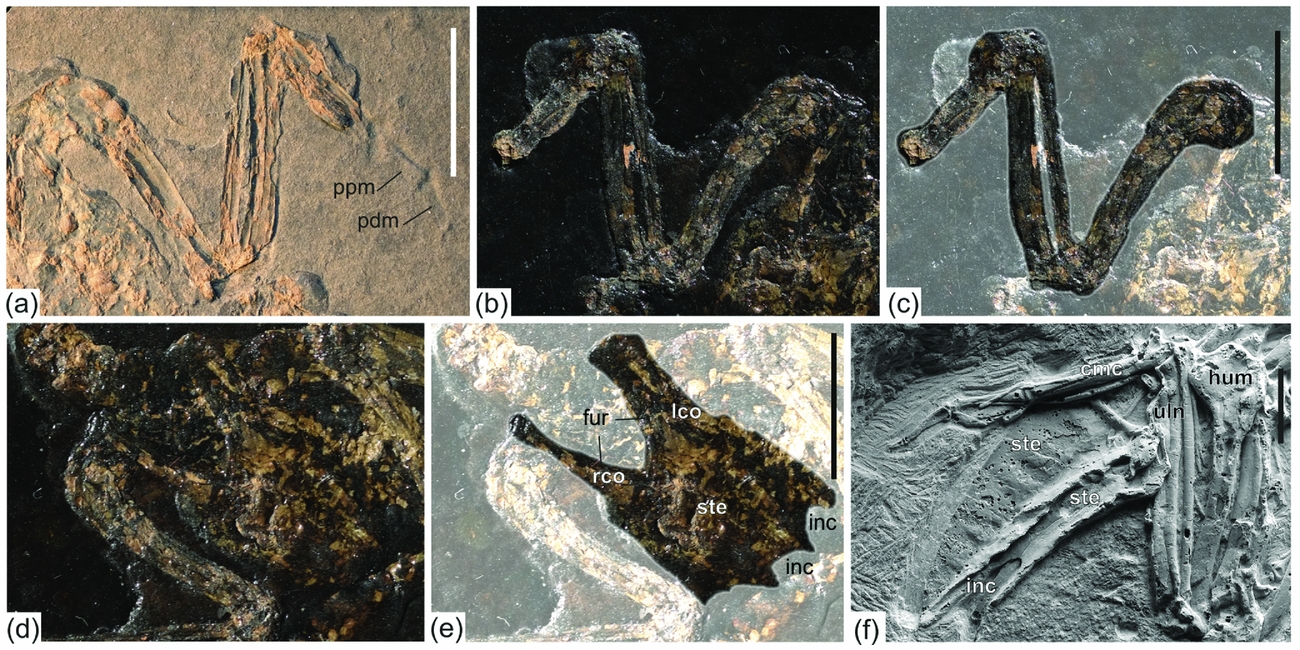
The furcula (MNHM.16037) is broadly U-shaped and bears a short apophysis furculae. The coracoid (MNHM.16037) has a slender shaft. The craniocaudal length of the sternum (MNHM.16037) is distinctly shorter than the humerus length and the bone exhibits two pairs of caudal incisions (Fig. 4e). The humerus is relatively short, with a wide proximal end and a ventrally protruding distal end (Fig. 4a–d). An important feature seen in the specimen concerns the fact that the ulna is slightly shorter than the humerus. The carpometacarpus, which is complete, albeit very poorly preserved in MNHM.16037, is comparatively long and craniocaudally narrow. The distal wing phalanges are missing in both specimens, but an impression in the slab MNHN-MEN 70 traces the proportions and lengths of the bones and shows that the hand section was as long as the ulna (Fig. 4a).
Osteological details of MNHN-MEN 70/MNHM.16037 (cf. Songziidae). (a) Right wing in craniodorsal (MNHN-MEN 70) and (b, c) caudoventral (MNHM.16037) view. (d, e) Pectoral girdle and sternum. (f) Sternum and left wing of Pellornis mikkelseni (Messelornithidae) from the lower Eocene Fur Formation in Denmark (MGUH 29278; specimen coated with ammonium chloride). In (c) and (e) the bones are digitally highlighted. Abbreviations: cmc – carpometacarpus; fur – furcula; hum – humerus, inc – incision in caudal margin of sternum; lco – left coracoid; pdm – phalanx distalis digiti majoris; ppm – phalanx proximalis digiti majoris; rco – right coracoid; ste – sternum; uln – ulna. Scale bars equal 10 mm.
The tibiotarsus is very long, with only moderately prominent cristae cnemiales. Judging from the length of the tibiotarsus, the legs appear to have been very long. Unlike in gruiform birds, there are no ossified tendons along the tibiotarsus. Of the tarsometatarsus, only the most proximal portion is preserved in MNHM.16037, but the small fragment does not show any morphological details.
Remarks. MNHN-MEN 70 was included in the thesis of M. S. Jensen (unpub. M.Sc. thesis, Geological Museum and Geological Institute, Copenhagen, 2008), who did not study the counterpart MNHM.16037. Mainly because of the short ulna, Jensen considered the fossil to be from a representative of Coliiformes. Coliiform affinities are, however, not supported by the overall proportions of the skeletons, in which the legs are much longer than in mousebirds, with the tibiotarsus being sub-equal to the humerus in length (e.g. Mayr & Peters, Reference Mayr and Peters1998).
The long legs of MNHN-MEN 70/MNHM.16037 suggest a predominantly terrestrial bird, although there exists one group of Palaeogene arboreal birds with equally long legs, that is, the Zygodactylidae (Fig. 3d). These birds are stem group representatives of Passeriformes and are abundant in some early Eocene localities (Mayr, Reference Mayr2009, Reference Mayr2017a,Reference Mayrc). Unlike in the fossil from Menat, however, the ulna of zygodactylids exceeds both the humerus and the femur in length – even though the length difference between the humerus and ulna is only slight – and the carpometacarpus is proportionally shorter, measuring less than half of the length of the ulna (Table 1; Reference MayrMayr, 2017c, table 1); furthermore unlike in MNHN-MEN 70/MNHM.16037, the skull of zygodactylids is longer than the tibiotarsus.
The short ulna of MNHN-MEN 70/MNHM.16037, which does not exceed the humerus in length, is a plesiomorphic feature and conflicts with affinities of the fossil to the land bird clade, whose representatives usually have an ulna that exceeds the humerus in length (e.g. Mayr & Clarke, Reference Mayr and Clarke2003). Compared with neornithine avian taxa with an equally short ulna, the overall morphology of the skeleton conforms best with an assignment to Ralloidea, the clade including extant Rallidae and Heliornithidae.
Rallidae and Heliornithidae have no early Palaeogene fossil record and the most abundantly represented ralloid birds in the lower Palaeogene of Europe are the Messelornithidae, which were also reported from Cernay-lès-Reims (Mourer-Chauviré, Reference Mourer-Chauviré1995; Mayr, Reference Mayr2009, Reference Mayr2017a). MNHN-MEN 70/MNHM.16037 is, however, much smaller than the early Eocene Messelornis cristata, which is one of the smallest species of Messelornithidae (Hesse, Reference Hesse1990, Reference Hesse1992; Mourer-Chauviré, Reference Mourer-Chauviré1995; Bertelli, Chiappe & Mayr, Reference Bertelli, Chiappe and Mayr2012). Unlike in the Messelornithidae (Fig. 4f), the sternum of MNHN-MEN 70/MNHM.16037 is shorter than the humerus and there are no ossified tendons along the limb bones. With a humerus length of 36.8–40.3 mm (Mayr, Reference Mayr2007), Walbeckornis creber from Walbeck, whose exact phylogenetic affinities are uncertain, is likewise distinctly larger than MNHN-MEN 70/MNHM.16037.
With regard to its small size, overall limb proportions and short sternum, MNHN-MEN 70/MNHM.16037 agrees best with the Songziidae from the lowermost Eocene (55 Ma; Ni et al. Reference Ni, Gebo, Dagosto, Meng, Tafforeau, Flynn and Beard2013) of the Chinese Yangxi Formation. The type genus Songzia includes two species, S. heidangkouensis and S. acutunguis (Wang et al. Reference Wang, Mayr, Zhang and Zhou2012), which correspond well with MNHN-MEN 70/MNHM.16037 in the length proportions of the major limb bones (Table 1; Fig. 3). Detailed comparisons are, however, prevented by the poor preservation of the fossil from Menat, and it is particularly unfortunate that the feet are not preserved in MNHN-MEN 70/MNHM.16037, because Songzia is characterized by unusually long toes. A songziid-like bird of uncertain affinities was also reported from the lower Eocene of Messel in Germany (Reference MayrMayr, 2017d).
MNHN-MEN 70/MNHM.16037 resembles a complete skeleton from Menat that was figured by Launay (Reference Launay1923, fig. 8), but now appears to have been lost and cannot be traced in a museum collection (Fig. 3c). Launay (Reference Launay1923) did not publish measurements of individual bones, but his indication of a height of 10 cm for the fossil corresponds well with the size of MNHN-MEN 70/MNHM.16037. Unlike in MNHN-MEN 70/MNHM.16037, however, the skull of Launay's (Reference Launay1923) fossil is shorter than the tibiotarsus and the hand section of the wing appears to be shorter than the ulna. Although we therefore do not consider the specimen to be conspecific with MNHN-MEN 70/MNHM.16037, we regard close affinities as possible. Concerning the identification of the fossil, Launay (Reference Launay1923, p. 33) referred to Charles Depéret, who considered it to be a galliform bird close to the taxon Palaeortyx, and to Claude Gaillard, who likened it to the Rallidae. M. S. Jensen (unpub. M.Sc. thesis, Geological Museum and Geological Institute, Copenhagen, 2008) compared the skeleton figured by Launay (Reference Launay1923) with the palaeognathous Lithornithidae and with Galliformes. We consider a tentative assignment to Ralloidea to be best supported by the features that can be assessed in Launay's (Reference Launay1923) figure, with the tarsometatarsus of the fossil being more elongated than in Palaeogene Galliformes, in which the bone is shorter than the humerus (Mourer-Chauviré, Reference Mourer-Chauviré1992; Mayr & Weidig, Reference Mayr and Weidig2004). The toes are poorly preserved in Launay's specimen and difficult to evaluate on the published photograph, but they appear not to have been greatly elongated as in Songzia.
Aves, gen. et sp. indet. A
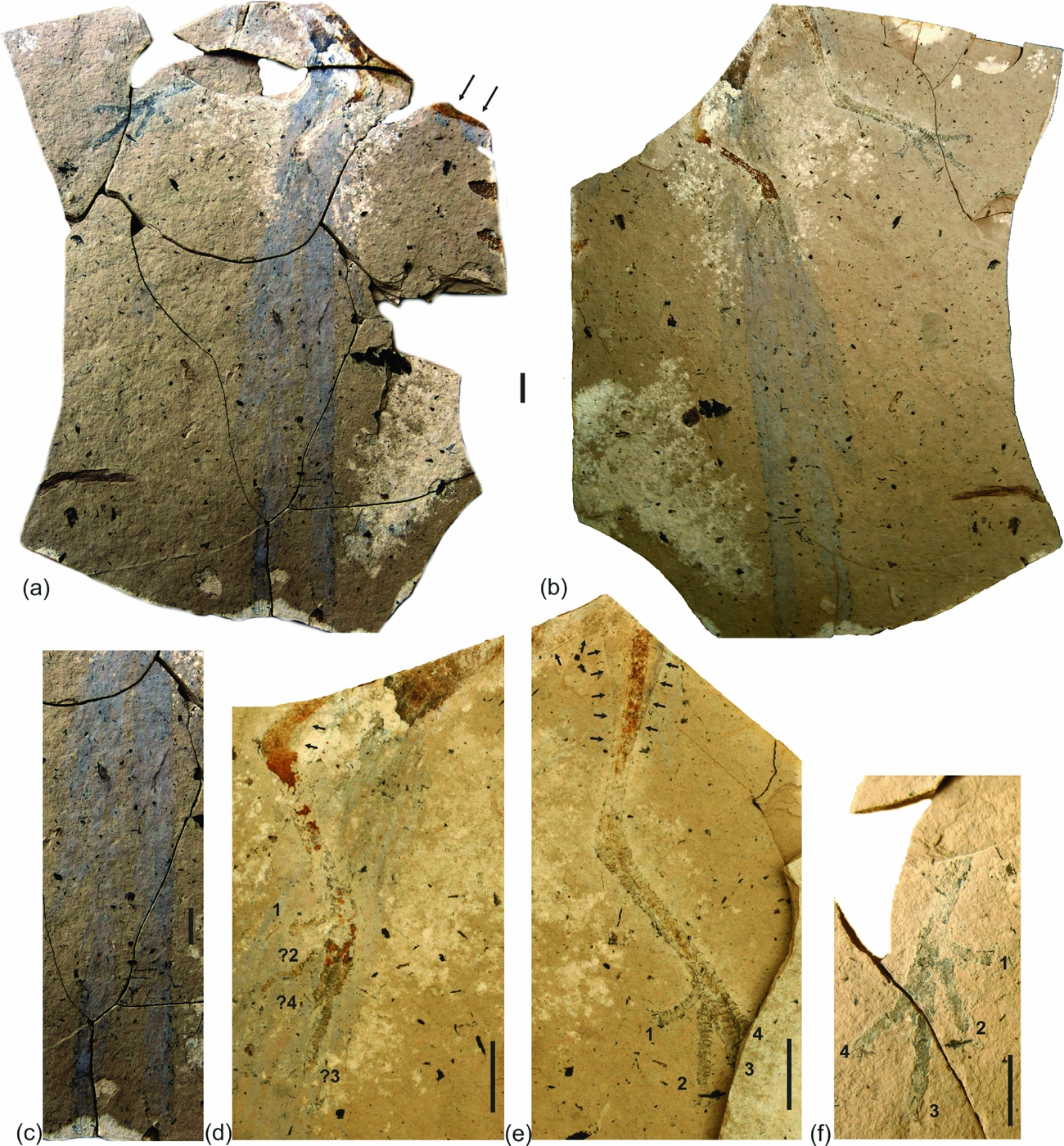
Referred specimen. MNT-11-7952 (Fig. 5); two slabs containing both legs and the tail feathers.
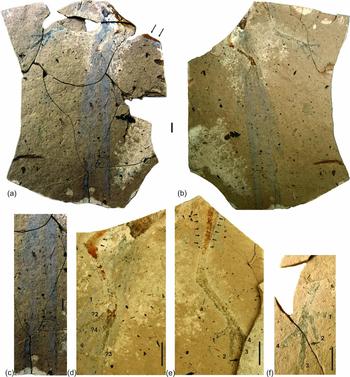
Exceptional soft tissue preservation of an undetermined bird from Menat (MNT-11-7952). (a, b) The two slabs containing the fossil. (c) Detail of the long tail feathers, which exhibit an unusual bluish hue. (d) Right and (e, f) left legs. The long arrows in (a) point to a small patch with preserved feather remains showing a bluish hue; the short arrows in (d) and (e) indicate soft tissue preservation of the shank. The toes are numbered in (d–f). Scale bars equal 10 mm
Measurements (left/right, in mm). Tibiotarsus, ‒/~36–39; tarsometatarsus, ~25–26/~25–26.
Remarks. This specimen was found during a recent excavation campaign and has not been described previously. The skeleton is clearly distinguished from the two above-described species in its larger size, but the bones are only preserved as very faint, brownish shadows and do not allow the recognition of osteological details.
In sharp contrast to the poor condition of the bones, however, the specimen features exceptional soft tissue preservation. Not only is the entire podotheca of both feet preserved, but even the soft tissue of the left shank is visible as a faint outline (Fig. 5d, e). The podotheca exhibits a pattern found in many only distantly related extant birds (Boetticher, Reference Boetticher1929), being scutellate ‒ with large transverse scales ‒ on the dorsal surface of the toes, but reticulate on the tarsometatarsus.
Likewise highly unusual is the preservation of the feather remains of MNT-11-7952. In most fossil birds, feathers are traced by dark residues of the melanosomes, the cell organelles containing the pigment melanin (e.g. Vinther et al. Reference Vinther, Briggs, Prum and Saranathan2008). In MNT-11-7952, however, the tail feathers are represented by light bluish-grey remains – a preservation mode unknown from any other fossil bird. The central pair of tail feathers is greatly elongated and measures c. 200 mm. The outer tail feathers are less well visible, but clearly they were shorter and the tail as a whole, therefore, had a staggered shape. In addition to the tail feathers, there is a further small patch with preserved feather remains showing a bluish hue on one of the slabs (Fig. 5).
Although the poor preservation of the bones prevents a taxonomic identification of the fossil, the shape of the unusually long tail suggests affinities with Coliiformes, which were a common element in early Eocene avifaunas (Mayr, Reference Mayr2009, Reference Mayr2017a,Reference Mayrb). Equally long tail feathers are also known from the early Eocene Zygodactylidae (Reference MayrMayr, 2017c), which are, however, characterized by zygodactyl feet, for which there exists no evidence in MNT-11-7952.
Aves, gen. et sp. indet. B
Referred specimen. MNHN-MEN 9 (Fig. 6); skull, cervical vertebrae, sternum and right wing on a slab.
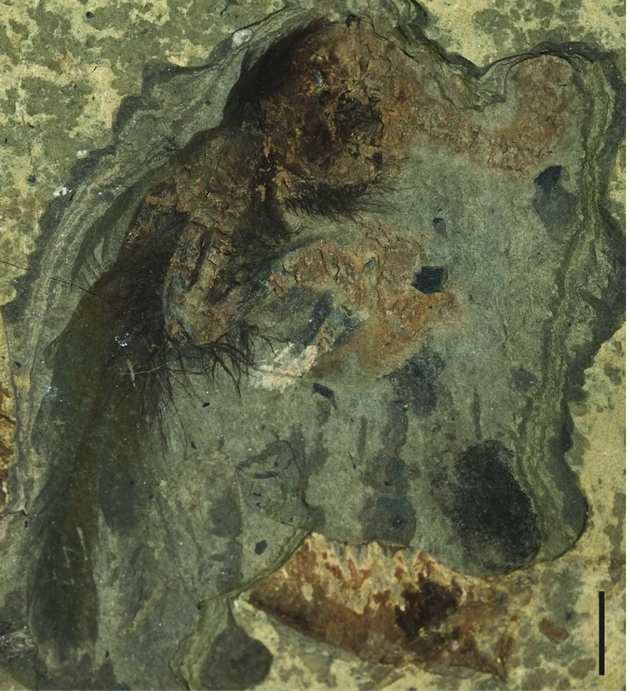
Unidentifiable bird from Menat (MNHN-MEN 9) with well-preserved feather remains. Scale bar equals 10 mm.
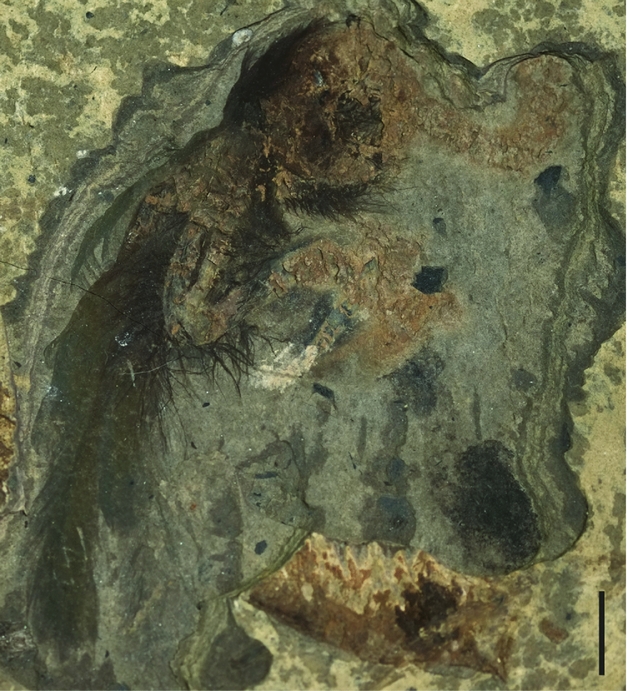
Measurements (in mm). Humerus, ~21.5; ulna, ~27.5; longest primary feather ~55.
Remarks. This fossil was described by M. S. Jensen (unpub. M.Sc. thesis, Geological Museum and Geological Institute, Copenhagen, 2008), but is too poorly preserved for even a tentative identification. The main reason for its inclusion in the present study is the fact that it is one of the few avian specimens from Menat known to us in which feathers are well preserved.
4. Discussion
4.a. Taxonomic diversity of the birds from Menat
Altogether, we know of nine skeletal remains of birds from Menat. Seven of these are in public repositories, one specimen is in a private collection and the whereabouts of another are unknown (Table 2). Virtually all of these fossils are poorly preserved, but most can be clearly differentiated from each other and some are at least tentatively identifiable.
Overview of the bird remains from the Paleocene of Menat that are known to the authors
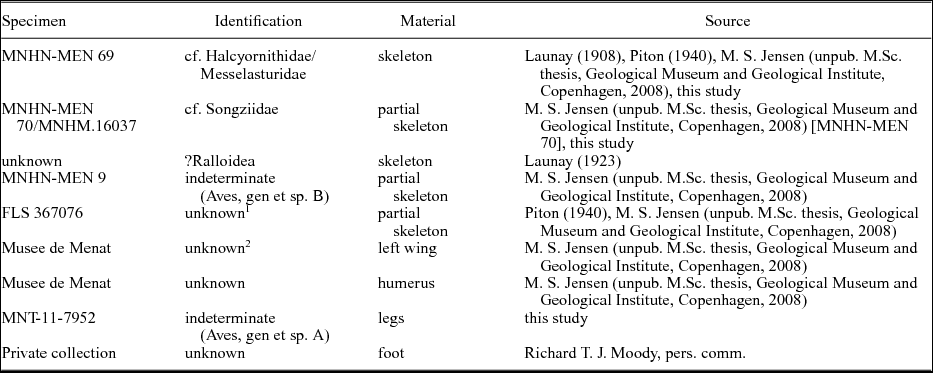
1 Piton (Reference Piton1940) identified the specimen as a possible long-legged wading bird (‘échassier migrateur’), whereas M. S. Jensen (unpub. M.Sc. thesis, Geological Museum and Geological Institute, Copenhagen, 2008) considered affinities to Walbeckornis. 2M. S. Jensen (unpub. M.Sc. thesis, Geological Museum and Geological Institute, Copenhagen, 2008) considered affinities to the palaeognathous Lithornithidae.
As detailed in the introduction, the Paleocene avifaunas of Cernay-lès-Reims, Mont-de-Berru and Walbeck share a few avian taxa, with Gastornithidae and the strigiform Berruornis having been reported from both Mont-de-Berru and Walbeck (the exact affinities between Walbeckornis creber from Walbeck and Messelornis russeli from Cernay-lès-Reims are in need of further scrutiny; Mayr, Reference Mayr2009). In contrast, those birds from Menat that are at least tentatively identifiable show affinities to early Eocene taxa, and no close taxonomic overlap appears to exist between the known birds from Menat and those from Cernay-lès-Reims, Mont-de-Berru and Walbeck (one Menat fossil, i.e. specimen FLS 367076, was compared with Walbeckornis by M. S. Jensen (unpub. M.Sc. thesis, Geological Museum and Geological Institute, Copenhagen, 2008) but its poor preservation renders an identification tentative at best). We hypothesize that this taxonomic disparity between the Menat avifauna and those of Cernay-lès-Reims, Mont-de-Berru and Walbeck reflects the different palaeoenvironments or depositional conditions of the localities.
Likewise, there exists no unambiguous taxonomic overlap between the Menat avifauna and those of Paleocene localities outside Europe (see Mayr, Reference Mayr2009 for a review), although, as noted above, the halcyornithid- or messelasturid-like specimen MNHN-MEN 69 cannot be clearly differentiated from the recently described taxon Tsidiiyazhi from the mid Paleocene of North America. We note that very few Paleocene representatives of Telluraves, the clade including most arboreal land birds, have been described so far (Mayr, Reference Mayr2009, Reference Mayr2017a). If affinities to the psittacopasserine Halcyornithidae and Messelasturidae can be proven, MNHN-MEN 69 would be the first non-strigiform representative of Telluraves from the Paleocene of Europe. MNHN-MEN 70/MNHM.16037, by contrast, would be of biogeographical significance, if a closer relationship to the Chinese Songziidae can be shown.
Because our identification of these specimens is only tentative, we refrain from far-reaching conclusions concerning their evolutionary significance. We note, however, that despite the fact that the fossiliferous strata of Menat were deposited only 5–8 million years after the K/Pg extinction event, the avifauna includes taxa that appear to be phylogenetically widely separated, which adds to the mounting evidence (e.g. Prum et al. Reference Prum, Berv, Dornburg, Field, Townsend, Lemmon and Lemmon2015; Reference MayrMayr, 2017a) that the initial divergences within neoavian birds already occurred within the latest Cretaceous period.
4.b. Unusual soft tissue preservation
Menat is not only of interest because of the taxonomic composition of its fossil assemblage, but also because of the exceptional preservation of some of the specimens. The primatomorph mammal Plesiadapis (‘Menatotherium’) insignis (Piton, Reference Piton1940; Russell, Reference Russell1967; Gingerich, Reference Gingerich1976), for example, is one of the most complete specimens of Plesiadapiformes and the only one with preserved integument.
Outstanding among the avian fossils is the soft tissue preservation of MNT-11-7952 (Fig. 5), which sets this specimen apart from all other avian remains from Menat known to us. Patches of foot scales have been reported from one fossil from the lower Eocene German fossil locality of Messel (Peters, Reference Peters, Schaal and Ziegler1988, fig. 208), but we are not aware of any other Palaeogene fossil bird in which the podotheca is as completely preserved as in MNT-11-7952 (see, however, Falk et al. Reference Falk, Kaye, Zhou and Burnham2016 concerning Confuciusornis fossils from the Early Cretaceous Jehol Biota). Even more unusual is the visible outline of the soft tissue of the shank, which is likely to represent remains of the skin, and the bluish hue shown by the tail feathers of the fossil.
The poor condition of the bones suggests a high degree of decalcification and, hence, deposition of the carcass in an acidic milieu. With regard to the combination of exquisite integument preservation and strongly dissolved bones, the fossil corresponds with some human corpses from North European peat bogs, whose demineralized bones and tanned skin are due to the combined action of a low pH and the antibacterial effects of a polysaccharide produced by sphagnum moss (Painter, Reference Painter1991; Turner-Walker & Peacock, Reference Turner-Walker and Peacock2008). Recent evidence from the study of molecular biomarkers in the sediments (Thibault et al. Reference Thibault, Jacob, Quesnel, LeMilbeau and Bossard2014) suggests that physico-chemical conditions in the Menat lake were highly variable and may have at times approximated those of a peat bog, although not a sphagnum bog (Jérémy Jacob, pers. comm.). Although vegetable antimicrobial or tanning agents may therefore have played a role in the soft tissue preservation of MNT-11-7952, it is equally possible that this was due to phosphatization, which is well known from other instances of exceptional soft tissue preservation and occurs in depositional environments with large quantities of phosphate and a low pH (e.g. Briggs et al. Reference Briggs, Kear, Martill and Wilby1993; McNamara et al. Reference McNamara, Orr, Kearns, Alcalá, Anadón and Penalver Molla2009).
Unlike the two specimens MNHN-MEN 69 (cf. Halcyornithidae and Messelornithidae) and MNHN-MEN 70/MNHM.16037 (cf. Songziidae), which are preserved in a blackish matrix and do not show soft tissue preservation, the sediment of the slab containing MNT-11-7952 is a cream-coloured spongo-diatomite (see Piton, Reference Piton1940). Possibly these differences are indicative of different palaeoenvironmental conditions that could account for the unusual preservation of the fossil, but the exact taphonomic circumstances that led to the unusual soft tissue preservation of MNT-11-7952 still remain to be determined.
Future physico-chemical analyses are also needed to assess the cause of the bluish hue shown by the feather remains. The obvious conclusion that it is due to modified keratin residues is not supported by the fact that the podotheca does not show this unusual coloration; as a protein, keratin furthermore has a low fossilization potential (e.g. Saitta et al. Reference Saitta, Rogers, Brooker, Abbott, Kumar, O'Reilly, Donohoe, Dutta, Summons and Vinther2017). We consider it most likely that the blue colouration of the fossil plumage is due to physical characteristics of the feather residues that are absent in other soft tissue remains preserved in the fossil, and possibly it is caused by light scattering (e.g. Prum et al. Reference Prum, Torres, Williamson and Dyck1998) from fossil feather microstructures such as melanosomes, the melanin-containing cell organelles (Vinther et al. Reference Vinther, Briggs, Prum and Saranathan2008). A light scattering effect of fossilized feather microstructures is, however, unknown from the numerous other cases of fossil feather preservation known to us. Detailed analyses are therefore, required to exclude alternative explanations, such as formation of the iron phosphate vivianite, which was reported from, e.g., the skin and bones of subfossil Pleistocene mammals from the North American mammoth steppe (Guthrie, Reference Guthrie2013), but is unknown from any fossil so far found in Menat.
Acknowledgements
We thank Christophe Borrely (MNHM) and Ronan Allain (MNHN) for access to fossils in the collections under their custody, and Stéphane Jouve (Université Pierre et Marie Curie, Paris VI) for drawing our attention to the specimen in MNHM. Thanks also to Florence Quesnel (BRGM, Orléans) and Jérémy Jacob (Institut des Sciences de la Terre d'Orléans) for their helpful comments about the palaeoenvironment of the Menat maar. Comments from two anonymous reviewers improved the manuscript.