[C]olonial mimicry is the desire for a reformed, recognizable Other, as a subject of difference that is almost the same, but not quite. Which is to say, that the discourse of mimicry is constructed around an ambivalence; in order to be effective, mimicry must continually produce its slippage, its excess, its difference.
Homi BhabhaFootnote 1The hybridization of cultures resulting from colonial contacts is frequently associated with notions of cultural illegitimacy and contamination, a sign of how victims of a colonial conquest fail to completely imitate, or ‘mimic’, in Homi Bhabha's terms, the cultural character of their supposedly ‘superior’ conqueror.Footnote 2 However, this kind of ‘failed’ mimicry also provides the means for decolonizing the contemporary stage of Taiwan. The radical, subversive potential of ‘colonial mimicry’ that may be realized through exploiting the ‘slippage, its excess, its difference’ is explored in this article in relation to the Golden Bough Performance Society (金枝演社 – GBPS).Footnote 3 Formed in 1993, the GBPS aims to decolonize and localize the Taiwanese stage. The company's practice is rooted in and routed through a rearticulation and reconstruction of the cultural hybridity that characterizes the performance traditions of koa-a-hi (歌仔戲) and o-phe-la-hi (胡撇仔戲).Footnote 4 I argue that this rearticulation opens up a transformative and transgressive space, one in which critiques of colonialism are foremost. The Lady Knight-Errant of Taiwan – Peh-sio-lan (台灣女俠白小蘭 – PSL for short) arguably is one of the company's most memorable, important productions and in this article serves as a case study for an analysis of the GBPS's political interventions into and reinventions of koa-a-hi and o-phe-la-hi.
The metamorphosis of cultural hybridity: the Golden Bough Performance Society
During the 1980s, at least twenty-two social movements in Taiwan emerged to challenge the ruling Kuo-min Tang (KMT), the Chinese Nationalist Party, leading to the rapid democratization and localization of Taiwan.Footnote 5 In the theatre, in the wake of the first wave of Taiwan's Little Theatre movement in the mid-1980s, which challenged and critiqued the KMT's political ideology, artists from a second wave in the late 1980s and early 1990s were committed to further localizing the contemporary stage. Founded in 1993 by artistic and executive directors Ong Eng-ju (王榮裕) and Yu Huei-fen (游蕙芬), the Golden Bough Performance Society is one of the foremost companies dedicated to making theatre that addresses Taiwan's experience of colonization and contemporary postcolonial conditions. Both Ong and Yu are former members of the U-Theatre Company, a Grotowski-influenced group from an earlier phase of the second wave.Footnote 6 Founding their own company, Ong, who is from a family of koa-a-hi performers, and Yu, a trained anthropologist, fused Grotowski's emphasis on physical training and Eugenio Barba's anthropological approach to theatre. Core to GBPS actors’ creative work is stringent physical training and in-depth fieldwork. Taken in combination, these are practised with a view to creating a local aesthetics inspired by the performance tradition of koa-a-hi and its comedic offshoot, o-phe-la-hi.
The company's philosophy is centrally informed by the idea that ‘what grows from the native soil is the most beautiful’.Footnote 7 Throughout Taiwan's histories of colonization, local cultures and traditions repeatedly were deemed inferior to the culture of the colonizer, which colonized subjects were forced to adopt and to interiorize. Over time, Taiwanese culture has been infected by a number of foreign influences, resulting in a highly hybridized expression of local culture. The island's experience of colonialism is what drives the aesthetics of the GBPS's work and the company rehearses and performs a cultural hybridity to give expression to Taiwan's collective experience of oppression. Privileging the local, the company insists that their theatre needs to be representative of and responsive to Taiwan's geographical, social and cultural mise en scène.Footnote 8 Further, the GBPS also adheres to the view that ‘high culture’ and popular culture are symbiotic rather than unequal and value-laden opposites. As a strategy to reconcile what, in the colonial past, were deemed incompatible cultural spheres and to resist the colonized histories of popular culture and vernacular languages, the company seeks to blur the boundary between ‘high’ and popular forms, in the interests of a theatre that is entertaining, accessible and at the same time intellectually rigorous and socially aware.
Born of cultural hybridity: Golden Bough's romantic comedy series
Since its inauguration, the GBPS has produced a series of contemporary romantic comedies based on the performance tradition of o-phe-la-hi, a form of comedy derived from koa-a-hi. Originating in the early twentieth century in folkloric traditions and sustained by popular patronage, koa-a-hi, often mistranslated as ‘Taiwanese Opera’, is an entertainment form which showcases its performers’ virtuosity in song, speech, acting and combat. Recognizing the popularity of koa-a-hi, different colonial regimes exploited the form as a vehicle for propaganda in the interests of the dominant, ruling order.Footnote 9 As an offshoot of koa-a-hi, o-phe-la-hi emerged during the Japanese occupation (1895–1945) as a mix of performance strategies that aimed to evade colonial censorship.Footnote 10 These strategies gradually evolved into a form of romantic comedy. Typically, in a day-long performance programme, koa-a-hi is presented during the daytime, providing moral instruction through Chinese classics and local historical events, while o-phe-la-hi is performed in the evening, offering comic relief and romantic escapism.
O-phe-la-hi literarily means ‘opera drama’. The word o-phe-la is derived from the Japanese word for opera, and is also a pun on a Taiwanese word for ‘hotchpotch’ or ‘whatever patched together’. Eschewing historical ‘facts’ and timelines, o-phe-la-hi makes use of any and all kinds of popular culture, thrown together to maximize audience appeal. Popular music, cross-cultural adaptation, anachronism, slapstick, improvisation and audience participation have become its most prominent features.
Although enjoyed by many, o-phe-la-hi is often frowned upon as an illegitimate form of koa-a-hi.Footnote 11 To subvert such stigmatization, the GBPS has sought to create contemporary plays in the vein of the romantic comedy tradition of o-phe-la-hi. Some notable works from the GBPS's romantic comedy series include The Lady Knight-Errant of Taiwan – Peh-sio-lan (1996), She Is So Lovely (可愛冤仇人, 2001) and Yumei and Tianlai (玉美與天來, 2004). Taking centre stage in the company's romantic comedies is a pair of starry-eyed lovers in search of a brighter future. As they strive towards a happy-ever-after ending, the pair must embark on a journey fraught with tribulation as well as side-splitting hilarity. These light-hearted journeys not only test the pair's romantic interests, but also provide the audience with feelings of comic release as they make critical fun of Taiwan's colonial past and contemporary sociopolitical events.
Various social and political realities are portrayed in these plays through humour and wit. For instance, She Is So Lovely dramatizes the social hardships suffered by the working classes, taking as its point of comic departure a famous news story about a suicide attempt. Briefly, a barmaid, suffering unrequited love, is about to jump off a building but is accidentally saved by a rice dumpling vendor, who happens to be cycling past. Rather than dying, the woman ‘falls’ for her rescuer. The strength of the couple's feelings for each other is then put to the test through a series of difficult challenges. Yumei and Tianlai, a Taiwanese version of Romeo and Juliet, touches upon the ingrained ethnic strife and nervous tension between the Hok-lo, who consist of sixty-five percent of Taiwan's local population, and the Mainlanders, who arrived with the KMT government after 1945.Footnote 12 Yumei, a girl from a Mainlander family, and Tianlai, a boy from a Taiwanese Hok-lo-speaking family, fall in love. Despite familial and ethnic hatred, they are determined on a future together.
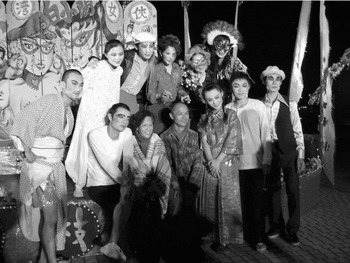
First performed in 1996, The Lady Knight-Errant of Taiwan – Peh-sio-lan is arguably one of the most significant of the GBPS's romantic comedies on account of its wit, humour and sociopolitical critique. The play has remained in the company's repertoire for over a decade. Set sometime between the end of the Japanese occupation and the beginning of the KMT era, PSL is a nostalgic and humorous portrait of Taiwanese life told and seen from the perspective of socially marginalized, lower-class characters. The play revolves around the scandal of a governor's stolen underwear, a crime that brings together three groups of itinerates: the invincible lady knight-errant, underworld gangsters and the nomadic performers of a koa-a-hi troupe.
Accompanied by her flirtatious and incessantly chatty sidekick, the lady knight-errant, a fictional female version of Taiwan's historical thief–knight Liau Thiam-teng (廖添丁), embarks on a quest to retrieve the governor's underwear, a quest that involves her in several feats of (comic) chivalry.Footnote 13 En route she meets a romantically inclined beautiful actress and an actor from the Golden Bough koa-a-hi troupe. Their romance is threatened by the head of a powerful gang to whom the financially embarrassed matron of the troupe has promised the actress in marriage. If the matron reneges on the marriage arrangement, she puts the company at risk.Footnote 14 Coincidentally, the gang is also acting on behalf of the governor in the corruption case. Ultimately, good triumphs over evil. After many dramatic and clamorous sword-clashing confrontations between Peh-sio-lan and the gang, the lady knight-errant teaches the gang a lesson by castrating the leader. The beautiful actress is finally reunited with her sweetheart, and is reconciled with her repentant and chastened matron. The play ends on a celebratory note as a victorious Peh-sio-lan takes up her sword to embark on yet another adventure. Hence the doubly marginalized and oppressed female colonial subject emerges as the invincible super-warrior-woman, as national heroine and saviour.
The lady knight-errant's adventure in performance
Since its 1996 premiere, the lady knight-errant's legend has toured throughout different parts of Taiwan. Over the course of the ninety-minute performance, characters speak, sing and dance to popular Taiwanese, Japanese and Mandarin songs from different historical eras, and comment on contemporary newsworthy topics. Rather than fully developed individuals, the characters are types, defined by distinct behavioural traits. For instance, representing an extension of the colonizer's oppressive power, the head of the gang is always clad in a kimono and shod in noisy wooden clogs, swaggering in the manner of an oriental chauvinist. The ostentation of his incompetent lackey is conveyed by his shuffling gait and bouts of extended, boisterous laughter at inappropriate moments.
PSL mischievously zigzags through time. It is rife with anachronisms and temporal non sequiturs so that anything might be imagined, conceived or made possible. In keeping with the tradition of o-phe-la-hi, the sourcing of the show through popular culture is eclectic. ‘The more the merrier’ is what, if anything, guides the assemblage of popular styles and materials, be it entirely random or random by design.
In this fantastic tale, characters dressed from different historical periods appear together on stage. Costumes range from flashy and glittering koa-a-hi outfits, to variety-show attires, kimonos and everyday fashion from the 1960s and 1970s. PSL also metatheatrically references Taiwan's recent past by quoting many popular performance genres, such as ‘electronic flower cars’, Zhu Geliang's restaurant shows, koa-a-hi and karaoke.Footnote 15
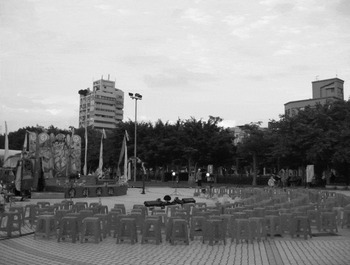
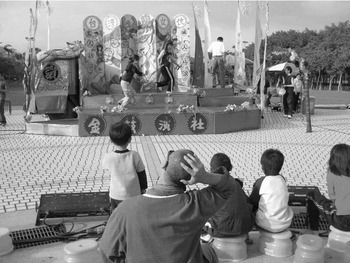
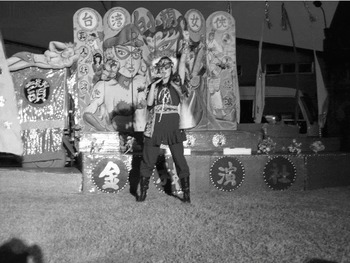
Presented on a truck, PSL's playing space consists of three levels: the truck, a wooden stage assembled from various cubes adjacent to the truck, and the ground on which the audience sit or stand. The truck is ornately decorated with twinkling Christmas lights, mini light bulbs, sparkling paper strips and bright plastic flowers of red, yellow, orange and pink. Glamour is semiotically encoded in gigantic and stylishly sexy cartoon portraits of Peh-sio-lan and her sidekick, painted in fluorescent colours on a foldable backdrop (Fig. 1).
Before the performance of The Lady Knight-Errant of Taiwan – Peh-sio-lan in Chungli, Taiwan, 2006 (courtesy of the Golden Bough Performance Society).

PSL is a paradigm of Taiwan's exuberant, hybridized, flexible and highly inclusive grassroots culture. Homi Bhabha describes the cultural hybridity embedded in the act of mimicry as ‘a process of cultural repetition of the colonizer's culture with multiple slippages’.Footnote 16 Yet PSL subversively rearticulates these multiple slippages, celebrating and transforming the stigma of the colonized into a glamorous spectacle. Cultural hybridity, while an imprint and manifestation of colonial suppression, is theatrically transformed into a site of hope and deliverance.
Re-semanticizing bodies through physical training
In the GBPS's rearticulation of cultural hybridity, the company does not invent its style through superficial borrowing, or mixing of forms and theatrical elements. Instead, it proposes a fundamental remaking of actors’ bodies by bringing the bodies back to the matrix of local culture. On a cultural level, this process, described by Christopher Balme as the re-semanticizing or the rewriting/rescripting of bodies,Footnote 17 becomes an embodied ‘epistemological interrogation into the very notion of colonial knowledge’.Footnote 18 This bodily reinscription is achieved through long-term deep cultural immersion and the embodied learning of previously suppressed forms of folk performance.
The array of folk and grassroots performance genres adopted by the GBPS for use in training is heavily influenced by Daoist beliefs. With the exception of exercises from Grotowski's training and taiji daoyin (太極導引), a system of physical training extrapolated from taiji, these genres have existed in and survived successive regimes of colonial oppression and censorship. Their survival is a result of popular and religious support rather than governmental patronage. They include the Dance of the Eight Heavenly Celestial Beings (八家將), stilt-walking (踩高蹺), the Tumbling Drum Dance (車鼓) and the annual Ma-cho pilgrimage (媽祖進香).Footnote 19
That said, it is the popular theatre forms of koa-a-hi and o-phe-la-hi that exert the most influence on the GBPS's training methods. Through immersion and embodiment, actors acquire a local physical vocabulary, which enables them to retain and reinterpret the often suppressed and forgotten grassroots memories. At the same time, the company's adoption of this training methodology is an attempt to physically counter the externalization of colonial ideology. Throughout Taiwan's colonial experience, the bodies of the local have always been disciplined and shaped by rules and regulations, which represented and enforced the political and cultural ideals of the governing authority. In physically re-embodying folk forms that have survived colonial censorship and stigmatization, the actors are conceptually able to recomprehend their local mise en scène and to question processes of colonialization.
Rehearsing the lady knight-errant's adventure
Described by Ong as a ‘living fossil’, PSL offers a nostalgic treatment of Ong's childhood memories of life in a koa-a-hi troupe during the 1960s and 1970s. To maintain the period ‘look’ of the ‘fossil’ onstage, the company adopts particular rehearsal methods and techniques. To capture the sight, sound and flavour of working-class characters from the period, the GBPS's first generation of actors prepared their characters through field research, which was carried out in teahouses and marketplaces, and with other koa-a-hi troupes. A total physical and emotional embodiment from the outside in was the actors’ main means of realizing their characters onstage. They then created scenes through collective improvisation. Various versions of the same scene were improvised by the actors and presented to the director. The director then chose a version as the basis for further development and rehearsal.Footnote 20
As the blocking of the show stabilized over time, it was possible for new actors to imitate earlier performances. This enabled actors to expedite their roles, as well as to open up new avenues of comic and critical interpretation. Updating the comedy serves to keep the play alive. Each time new performers bring their personalities and interpretations to the play, the comedy is renewed, along with the play's potential as a site of transgression and resistance. During one PSL rehearsal in April 2006, for instance, in his directorial note for Huang Caiyi, who played Peh-sio-lan, Ong stressed that she was to handle her sword with a touch of chivalric elegance and refinement. He explained that when PSL was first performed in 1996, he specifically wanted a quality of deliberate vulgarity in the acting to really shock and defy audiences of Spoken Drama and the Little Theatre. A decade later, in a changing political and cultural climate, comic vulgarity no longer served as a subversive strategy.
The change in the portrayal of the comedy's heroine marks the shift towards a more sophisticated interpretation and nuanced understanding of folk and popular culture. Although Peh-sio-lan is still a mysterious lady knight-errant, who remains vivid in the popular imagination, she is much more than a petty underwear-stealer. She has become a charismatic national heroine with a refined sense of taste and humour. She handles her sword with the élan of a samurai. With a mere kick of the leg and a swish of the sword she can single-handedly overcome a mob of gangsters without being short of breath or disarranging her hair. She has become an icon of the ‘perfect’ woman, possessing feminine charms as well as the strength and skills of a male knight.
Constantly updating the comedy, the GBPS demonstrates how Taiwan's hybridized and objectified folk culture is no longer, in Bhabha's words, ‘an epistemological object’, but instead is ‘an enactive, enunciatory site [which] opens up possibilities for other times of cultural meaning (retroactive, prefigurative) and other narrative spaces (fantasmic, metaphorical)’.Footnote 21 Furthermore, through the embodiment and performance of cultural (re)interpretation, the actor's body becomes a living and moving signifier, which retains as well as creates memories, histories and perspectives marginalized by the official record or version of history.
Scripting in and through cultural hybridity
Inscribed in the text of PSL are traces of a highly hybridized language. Replete with puns, double entendres, metaphors, local idiomatic expressions and sexual innuendos, Ong originally conceived and scripted the show in Hok-lo. Although Hok-lo is the native language of sixty-five percent of Taiwan's population, the language is in decline due to long-term political stigmatization and suppression. Throughout the island's history of colonization, the Hok-lo language has never been instituted as a national language. Therefore it has no one standardized writing system. Out of personal language habit and for emotive reasons, Ong wrote the play in his native language during a time when using the ancestral language was deemed derogatory and uneducated. Central to the performance is the sophistication and wit of the ‘hideous’ and ‘coarse’ language of the grassroots underworld ( ).Footnote 22
Much of PSL's humour, wit and scathing political commentary is socially and linguistically specific. The stage language itself is a taunting gesture aimed specifically at Taiwan's colonial ruling orders. For instance, when the play begins, a group of menacing policemen invade the stage searching for Peh-sio-lan. She has allegedly committed the unpardonable crime of stealing the governor's beloved underwear. The audience is sternly interrogated as to whether they have seen such a garment, while a replica pair of the missing underpants is put on public display. The ‘seriousness’ of Peh-sio-lan's alleged crime, and the governor's actual wrongdoings, are comically revealed. In a witty pun, juxtaposing the scatological with the political, Peh-sio-lan's sidekick comments, ‘Underwear leads to outerwear, so does national treasury to party treasury. Such a rip-off [內褲通外褲, 國庫通黨庫e 錢喔]’.Footnote 23 The significance of the satirical pun is further explained when Peh-sio-lan chivalrously raises her sword and remarks, ‘No wonder they say, may the Republic of China live for ten thousand years/dollars, ten thousand, ten thousand years/dollars [中華民國萬歲/稅, 萬萬歲/稅]’.Footnote 24 The former remark was a criticism levelled at the then ruling party's (KMT) use of the national treasury as its own party treasury, while the latter was a slogan of patriotism that an assembly had to chant in unison during public meetings under the KMT regime. The coincidental pun of the slogan's last word, ‘years’ with ‘dollars’, suggests that heavy taxes are in fact a source of governmental wealth.Footnote 25
The Wandering Knight-Errant of Taiwan – Peh-sio-lan in rehearsal with Ong, Chungli, Taiwan, 2006 (courtesy of the Golden Bough Performance Society).

Reflecting the spirit and performance style of the o-phe-la-hi tradition is the hotchpotch recording system used in scripting PSL. True to the Hok-lo idiomatic expression ‘a bamboo pole stuck to a kitchen knife’ (竹篙道菜刀), meaning an assemblage of anything practical and functional, the four writing systems acquired by the director and actors through Taiwan's education system are all used intermittently in scripting. These include zhu-in (注音), which is the most widely taught Mandarin phonetic system in Taiwan, Chinese written characters, several different Romanization systems and English. In this regard, PSL's script is a palimpsest that documents the layering of cultures and languages resulting from various colonial systems. It also demonstrates how these systems are blended and localized for the purpose of recording a repeatedly colonized language.
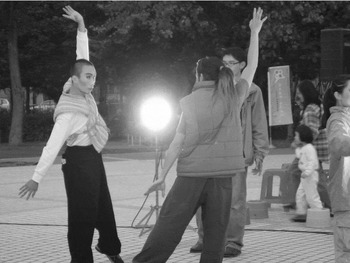
The Wandering Knight-Errant of Taiwan – Peh-sio-lan warm-up before the performance, Chungli, Taiwan, 2006 (courtesy of the Golden Bough Performance Society).

Possibilities and challenges: hybridity as a methodology for cultural production
Hybridity, as a concrete manifestation of Taiwan's colonial experience, has evolved from a cultural phenomenon resulting from colonial contacts to a consciously articulated aesthetics. Such aesthetics in turn open up new possibilities for theatrical innovation. PSL exemplifies how the GBPS has reinvented cultural hybridity from the ‘vulgar’ and the ‘distasteful’ into an aesthetic of glamour and flamboyance. Furthermore, it has significantly informed the creative process and working methods of the company. In the postcolonial context of Taiwan, cultural hybridity as a theatre methodology has been a useful tool in salvaging a culture and a language on the decline. Any tools available, be they cultural or linguistic, are synthesized and applied in a local context for decolonizing purposes. Nevertheless, an unsystematic throwing together of various cultural and linguistic elements that becomes a systematic theatre practice poses several challenges in terms of physical training, rehearsal and play-scripting.
Senior actors in the company agree that stringent physical training is what is required to sustain the aesthetics of the GBPS's style of work. At the same time, training methods need to be sensitive to changes in performance style. Staple training systems such as Grotowski-based exercises and taiji daoyin were inherited from the U-Theatre. These systems and their underlying philosophies first inspired the company's aesthetic principles and underpinned their concern to deconstruct and to subvert mainstream theatre. However, these training systems may no longer be compatible with, indeed may even contradict, the company's current theatre practice and production style – namely flashy, popular theatre imbued with outward-projecting energy and emotions. (The ultimate goal of taiji daoyin is to achieve emptiness, but such is never the goal of the company's productions.) Certainly some company members feel that there is a gap between training methods and performance style, and look to other forms of training.
Huang Caiyi in the role of the lady knight in The Wandering Knight-Errant of Taiwan – Peh-sio-lan, Taichung, Taiwan, 2006 (courtesy of the Golden Bough Performance Society).

Capturing the essence of a highly hybridized language – its pronunciation, accents and flavour – is essential to successfully portraying the characters in the play. This represents a particular challenge for later generations of actors who were raised at a time when Hok-lo was erased, denied and stigmatized by various government institutions. As a solution, Ong seeks to raise the actors’ language competency through the creation of daily language contexts for Hok-lo acquisition and practice, rather than through formal language instruction. Immersing actors in existing language contexts, and creating micro-language contexts within the daily functioning of the company, have been the two main methods used. The actors are also encouraged to find Hok-lo-speaking partners in the company. Hok-lo language games are incorporated as part of warm-up preparations before rehearsals. In addition, actors are encouraged to search for the language of their characters in marketplaces, temple festivals and koa-a-hi troupes where Hok-lo is predominantly spoken.Footnote 26 The company's approach to language training addresses the most fundamental cause of language disappearance: the disappearance of contexts for language use in the larger social and cultural environment.
The cast of The Lady Knight-Errant of Taiwan – Peh-sio-lan, Chungli, Taiwan, 2006 (courtesy of the Golden Bough Performance Society).

However, as language in rehearsal gradually becomes a systematic cultural practice, phonetic recording or scripting of scenes in a combination of zhu-in, Chinese written characters and various forms of Romanization proves inadequate and sometimes counterproductive, in respect of capturing Hok-lo. The complexity of Hok-lo's nasal sounds, glottal stops and tonal differences cannot always be adequately realized by these combined linguistic systems. Furthermore, the mixing up and application of the various phonetic systems is only a reflection of what actors think they hear, rather than what they are meant to hear. Since younger actors are more fluent in and attuned to Mandarin, a four-tone language, failure to register the more nuanced tonal differences of Hok-lo, an eight-tone language, is common. Because each actor's self-invented phonetic system is unique, it is difficult to cross-check the accuracy of phonetic spellings. Ultimately, given that the script, the language on the page, can be less than helpful to the actors, because of the limitations of recording Hok-lo, actors are much more reliant on working orally with the director to learn, perfect and deliver their lines.
In the final analysis, these various kinds of language-based and body-based training methods, despite their attendant and respective difficulties, are the means by which the GBPS arrives at a style of theatre that embraces and celebrates cultural hybridity. Through its productions, the company subversively reinterprets the cultural stigmas and legacies of Taiwan's colonial rulers and generates a new Taiwanese aesthetic. The gaudy flashiness of a highly hybridized Hok-lo grassroots culture, formerly ridiculed as tasteless and vulgar, is now transformed into a consciously articulated aesthetic – the more the merrier, the flashier the more beautiful.