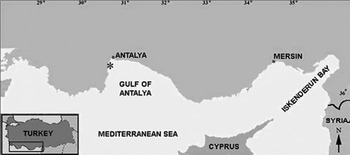
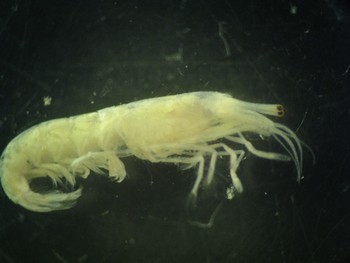
A single Ogyridid shrimp, Ogyrides mjoebergi (Balss, 1921) was collected from the Gulf of Antalya on the Levantine coasts of Turkey (36°47′35″N 30°34′31″E), during SCUBA diving on the sandy bottoms at a depth of 5 m (Figure 1). In the study area, the salinity measured 38.7‰, temperature (26.5°C) and dissolved oxygen 4.91 mg/l. The specimen photographed is preserved in 4% formaldehyde and deposited at the Museum of the Faculty of Fisheries, Ege University, Turkey (Collection number: ESFM-MAL/2005-10) (Figure 2).
Map of the study area.

Lateral view of Ogyrides mjoebergi (Balss, 1921) (♂, TL = 6.1 mm) captured from Gulf of Antalya (Levantine coasts of Turkey) (photograph by T. Özcan).

Ogyrides mjoebergi has a rather wide distribution throughout the Indo-West Pacific Ocean, Red Sea and Australia (Banner & Banner, Reference Banner and Banner1982). The species has entered the Mediterranean Sea via the Suez Canal and was first recorded at the Israeli coast, Mediterranean Sea (Holthuis & Gottlieb, Reference Holthuis and Gottlieb1958). Five specimens of O. mjoebergi were collected between 8 and 21 September 2005 off Iskenderun and Mersin (Özcan et al., Reference Özcan, Katağan and Ateş2008). Ogyrides mjoebergi generally inhabits sandy or muddy-sand bottoms of depths ranging from 0 to 37 m (Özcan et al., Reference Özcan, Katağan and Ateş2008; CIESM, 2009). This record, together with the previously published records from Iskenderun and Mersin, mark the known distribution of O. mjoebergi along the Mediterranean coast of Turkey. This is the western boundary record of O. mjoebergi along the Turkish coast, and nearly 320 km west of the previous record.
ACKNOWLEDGEMENTS
The authors thank colleagues at the Department of Hydrobiology, Ege University for their help in collecting and sorting the benthic material. The study was supported by the Scientific and Technological Research Council of Turkey (TUBITAK) 104Y065 coded project.