INTRODUCTION
Studies of boundaries in archaeology attempt to outline limits or divisions between groups within a landscape (Lightfoot and Martinez Reference Lightfoot and Martinez1995; Stark Reference Stark1998). To understand divisions between people and places for the ancient Maya, often scholars present territorial models that rely on site hierarchies, which are defined by a capital with monumental architecture governed by a paramount king and an elite court who held variable control over smaller neighboring settlements (Golden et al. Reference Golden, Scherer, René Munõz and Vásquez2008, Reference Golden, Scherer, René Munõz and Hruby2011; Golden and Scherer Reference Golden and Scherer2013; Marken and Fitzsimmons Reference Marken and Fitzsimmons2015). Such models are most frequently applied to the Preclassic or Classic-period Maya, where the presence of monumental architecture is interpreted as a statement of cosmological order and political authority (Ashmore and Sabloff Reference Ashmore and Sabloff2002; Doyle Reference Doyle2012; Joyce Reference Joyce2004). In this study, we cross-examine these models in the context of Terminal Classic and Postclassic settlement in the eastern Maya lowlands. We examine how post-monumental architecture, such as northern Yucatec-style circular and colonnaded open halls, in many instances replaced larger monumental buildings as places of elite authority in ancient Maya political centers (but see Bey and May Ciau [Reference Bey, May Ciau and Braswell2014:350]). The Terminal Classic and Postclassic often are characterized as periods of increased conflict and disruption of Classic Maya dynastic succession, resulting in political fragmentation and displacement with greater movement of groups across the land (Demarest et al. Reference Demarest, Rice and Rice2004; Iannone et al. Reference Iannone, Houk and Schwake2016; Rice Reference Rice2004, Reference Rice, Rice and Rice2018). We offer a relational approach to theorizing boundaries for the Maya, which highlights the tension between a divided and an integrated landscape and takes into account the agency of materiality and the role various kinds of objects and architecture played in negotiating relationships between groups at key points of convergence during these periods of political fragmentation.
The influx of northern-style circular and colonnaded open halls point to greater movement of people and increased interaction between nobles in the southern and northern Maya lowlands during the Terminal Classic and Postclassic periods (ca. a.d. 830–1525). These architectural types appear in the Terminal Classic (ca. a.d. 830–930) and both building types continue into Postclassic times at sites like Mayapan in northern Yucatan (Bey et al. Reference Bey, Hanson and Ringle1997; Harrison-Buck Reference Harrison-Buck2012:68; Milbrath and Peraza Lopes Reference Milbrath and Peraza Lopes2009). Circular architecture has been primarily identified in Terminal Classic contexts in the eastern Maya lowlands while colonnaded open halls are present in the Terminal Classic but become more common in the Postclassic (Harrison-Buck Reference Harrison-Buck2012; Harrison-Buck and McAnany Reference Harrison-Buck and McAnany2013; Pugh et al. Reference Pugh, Rice, Chan Nieto and Rice2016:12; Rice Reference Rice, Sabloff, Andrews and .1986, Reference Rice, Wilk and Ashmore1988). While circular architecture has been primarily interpreted as ritual in function, open colonnaded halls may have served a range of functions, which included a combination of residential, administrative, and religious purposes (Bey et al. Reference Bey, Hanson and Ringle1997; Bey and May Ciau Reference Bey, May Ciau and Braswell2014; Cheek Reference Cheek2003; Driver Reference Driver2002; Fash et al. Reference Fash, Fash, Lane, Larios, Schele, Stomper and Stuart1992; Peraza Lopes and Masson Reference Peraza Lopes, Masson, Masson and Lopes2014:107–110; Proskouriakoff Reference Proskouriakoff, Pollock, Roys, Proskouriakoff and Smith1962a; Pugh et al. Reference Pugh, Rice, Chan Nieto and Rice2016; Rice et al. Reference Rice, Boileau, Cecil, DeFrance, Freiwald, Meissner, Pugh, Rice and Yacubic2018).
This study builds on previous archaeological work (Duff and Harrison-Buck Reference Duff, Harrison-Buck and Harrison-Buck2015; Harrison-Buck Reference Harrison-Buck and Harrison-Buck2013; Harrison-Buck et al. Reference Harrison-Buck, Runggaldier and Gantos2018; Pugh et al. Reference Pugh, Rice, Chan Nieto and Rice2016; Taube Reference Taube1988), which suggests that genital bloodletting and other penitential acts involving groups of men were among the many activities taking place in both circular and colonnaded open halls from Terminal Classic to Postclassic times. Scholars suggest that colonnaded open halls located in the site centers were likely the houses of the principal lineage and functioned as both elite residences and administrative council buildings where public ceremonies and official gatherings took place (Bey et al, Reference Bey, Hanson and Ringle1997; Cheek Reference Cheek2003; Fash et al. Reference Fash, Fash, Lane, Larios, Schele, Stomper and Stuart1992; Peraza Lopes and Masson Reference Peraza Lopes, Masson, Masson and Lopes2014:107–110; Pugh et al. Reference Pugh, Rice, Chan Nieto and Rice2016). These scholars and others interpret these buildings as council houses or popol nah, and suggest they may be equivalent to the Nim Ja or “Big Houses” associated with the principal patrilineage (nimja) documented in ethnohistoric accounts for the Postclassic highland Maya (Carmack Reference Carmack1981; Carmack and Wallace Reference Carmack, Wallace, Wallace and Carmack1977; Fox Reference Fox1987; Wallace Reference Wallace, Wallace and Carmack1977). According to the ethnohistoric accounts, such council houses varied in size depending on the rank of the lineage and were places used for administering community and judicial affairs, which included things such as wars, banquets, and marriages (Carmack Reference Carmack1981:192; Coe Reference Coe1965:105).
In this article, we focus on an area of the eastern Maya lowlands along the Guatemala–Belize border where we find sites, such as Nixtun-Ch'ich’, Yaxha, Ucanal, Chau Hiix, Jabonche, Caye Coco, Nohmul, Lamanai, and others that show evidence of northern-style colonnaded buildings and circular shrines, carved monuments, and other forms of more portable material culture, such as molded-carved ceramics, phallic effigies, and turtle altars. Some of the architecture and traits discussed, like molded-carved ceramics, date exclusively to the Terminal Classic while others (like phallic effigies and turtle altars) date primarily to the Postclassic. Based on the spread of these “Mexicanized” non-Classic traits, Thompson (Reference Thompson1970) suggested his now famous “Putun-Itza” hypothesis, which argued (based on his reading of the ethnohistoric accounts) that Chontal-speaking Putun Maya groups from the Gulf lowlands invaded Chichen Itza in a.d. 918. While most scholars now find Thompson's chronology for Chichen Itza untenable, they generally accept his suggestion that an outward movement of Chontal-speaking “Mexicanized” Maya merchants from the Gulf Coast established Chichen Itza and introduced a series of “non-Classic” traits in the southern Maya lowlands and other parts of Mesoamerica beginning in the late eighth to early ninth century a.d. (Kristan-Graham and Kowalski Reference Kristan-Graham, Kowalski, Kowalski and Kristan-Graham2007:35; see also Chase Reference Chase, Robertson and Fields1985; Chase and Chase Reference Chase and Chase1982; Fox Reference Fox1987; Kowalski Reference Kowalski, Diehl and Berlo1989; Kowalski et al. Reference Kowalski, R., M., H., Robertson, Macri and McHargue1994; McCafferty Reference McCafferty, Kowalski and Kristan-Graham2007; Rice Reference Rice2004, Reference Rice, Rice and Rice2018; Sabloff and Willey Reference Sabloff and Willey1967; Tourtellot et al. Reference Tourtellot, Sabloff, Carmean, Chase and Chase1992). Building on these prior studies, we refer to these traits as an expression of the “Chontal-Itza” and argue that their presence in the eastern Maya lowlands signals the in-migration of groups, perhaps stemming from both the Gulf lowlands and northern Yucatan from Terminal Classic to Postclassic times (Harrison-Buck Reference Harrison-Buck, Iannone, Houk and Schwake2016; Harrison-Buck and McAnany Reference Harrison-Buck and McAnany2013; Harrison-Buck et al. Reference Harrison-Buck, Moriarty, McAnany and Card2013). Here, we consider these Mexicanized elements in the context of new alliances and conflicts that arose during the Terminal Classic and subsequent Postclassic. We suggest that the appearance of these traits in the eastern lowlands indicates growing concerns with establishing connections to a Chontal-Itza ancestry as a form of elite legitimation following the decline of the Classic Maya dynasties. These close connections may have been fostered through physical migrations, including trading diasporas (Harrison-Buck et al. Reference Harrison-Buck, Moriarty, McAnany and Card2013). Ringle and others (Reference Ringle, Negrón and Bey1998) suggest that the spread of these northern traits and building styles, such as circular architecture, that began in the Terminal Classic and continued through Postclassic times involved the spread of a religious cult dedicated to the Mexican feathered serpent deity, Quetzalcoatl. According to their reconstruction of this interaction sphere (Ringle et al. Reference Ringle, Negrón and Bey1998:Figure 1), these traits center on the Gulf and along the coast of Yucatan (roughly paralleling Thompson's Putun coastal trading route), but also involved other areas of the Maya lowlands to which we would add the eastern lowlands of Belize and Guatemala. In addition, Ringle and colleagues (Reference Ringle, Negrón and Bey1998:185) suggest this interaction sphere extended to the Mixtec region in the Valley of Oaxaca during Terminal Classic and Postclassic times and present the Mixtec codices to demonstrate how the spread of these traits involved “religious proselytism, pilgrimage, militarism, placemaking, and political alliance.” Notably, what is clear from their Mixtec example is that this “religious cult” that they argue spread with “messianic vigor” was directly linked with noble marriages and the foundation of new dynasties (Pohl Reference Pohl, Smith and Berdan2003; Ringle et al. Reference Ringle, Negrón and Bey1998:186–187).
Similarly, we argue below that the spread of these traits in the Terminal Classic and Postclassic signaled conflict and intermarriage and the formation of new dynasties in the eastern Maya lowlands, with greater emphasis placed on the consolidation of alliances through shared governance. We also argue, however, this was not some entirely new form of governance or “heterodoxic” break from Classic-period traditions, as some have suggested (McAnany Reference McAnany2012). Marriages had always been tightly controlled among noble lineages and principals of shared governance appear to root in earlier times (Fash et al. Reference Fash, Fash, Lane, Larios, Schele, Stomper and Stuart1992; Marcus Reference Marcus1976, Reference Marcus, Chase and Chase1992; Martin Reference Martin2017; Rice and Rice Reference Rice and Rice2018; Sabloff Reference Sabloff2018, Reference Sabloff2020). While masculinity, feathered serpent imagery, and displays of warfare appear to be emphasized during Terminal Classic and Postclassic times, we argue there is a concurrent emphasis on marriage and the maternal line that continues to be central to elite legitimation. We show the connection between marriage and the council house or popol nah (“mat house”), which was a deeply rooted institution in northern Yucatan earlier in the Classic period (Bey and May Chiu Reference Bey, May Ciau and Braswell2014:352) and may have originated in the Gulf lowlands as an early form of political authority (Carrasco and Englehardt Reference Carrasco and Englehardt2015).
Boundary Things (Objects and Architecture): A Relational Model of Migration and Intermarriage
Most definitions of boundaries in archaeology stress the division between people and places, delineated in some way by material culture. Yet, this approach to materiality is inherently one-sided in that it does not contend with how divisions can also be potentially mediated through materiality and can facilitate border crossing. Mills (Reference Mills2018:1052) examines materiality that she defines as “boundary objects,” which provides a useful concept for understanding how material culture (objects and architecture) for the ancient Maya did not just demarcate boundaries or divisions between groups, but were “things that [crossed] social boundaries.” Although Mills’ (Reference Mills2018) case study examines the diffusion of pottery across the American Southwest, her model for migration and intermarriage offers a useful comparative framework in this study for understanding how material culture can move across social boundaries and connect disparate groups as a result of post-marital migration of women within patrilocal societies.
It is generally assumed that the Maya practiced patrilocality, where a bride moved to a groom's residence following marriage (Gillespie and Joyce Reference Gillespie, Joyce, Claassen and Joyce1997:199; Haviland Reference Haviland, Andrews, Berlin, Kelly, Haviland, Carmack, de Borhegyi, Morley and Folan1968, Reference Haviland, Wilk and Ashmore1988; Villas Roja Reference Villas Roja1947:582). In most cases, marriage partners among the pre-Hispanic Maya were probably between members of communities that were in close proximity with one another and involved alliances between patrlineages (ch'ib’als), which were strictly exogamous at the time of Spanish Contact (Coe Reference Coe1965:107–108). Following Mills (Reference Mills2018:1053), we refer to this form of intermarriage as “local exogamy,” which contrasts with intermarriage that involves migration and boundary crossing “outside of the local group's more regular marriage patterns.” Records from Spanish Contact period and pre-Hispanic Maya epigraphy suggests that, in many cases, Maya kings (ahau) were polygamous, marrying not only local women but also “foreign” noble females who moved post-marriage to live in their husband's city (Sabloff Reference Sabloff2020:Table 2). For instance, the Classic-period epigraphic and iconographic evidence suggest that royal women from Calakmul were actively involved in marriages with dynasties at La Corona and El Peru-Waka (among other places) that required noble brides to move, shown being physically transported in palanquins by porters over long distances to their post-marital residences (Freidel and Guenter Reference Freidel and Guenter2003; Martin Reference Martin2008).
At the time of contact, records for the Quiche Maya of Utatlan suggest marriage partners were strategically matched, and often there was significant “disagreement over marriage arrangements, for a lineage placed rigid restrictions on where wives could be obtained, as well as heavy obligations for aiding in bride-price payments” (Carmack Reference Carmack1981:157). According to colonial accounts, the groom's family paid a bride-price of quetzal feathers, cotton mantles, and jade beads and other precious stones—considered female-gendered goods, which were provided as a replacement for a woman's (re)productive work (Gillespie and Joyce Reference Gillespie, Joyce, Claassen and Joyce1997:200–201; Harrison-Buck Reference Harrison-Buck2021; Tedlock Reference Tedlock2003). Elsewhere, the senior author makes the argument that the gifts and marriage partners were not objectified in these reciprocal exchanges, but rather, gendered and personified (human and nonhuman) beings (Harrison-Buck Reference Harrison-Buck2021). In return, the bride's family provided a dowry of cacao beans and furnished the meal at the wedding banquet (Bassie-Sweet Reference Bassie-Sweet2008:237; Dreiss and Greenhill Reference Dreiss and Greenhill2008:64; Harrison-Buck Reference Harrison-Buck, Matthews and Guderjan2017:114–116; McNeil Reference McNeil and McNeil2006:362–263). According to colonial accounts, such exchanges of cacao and other precious gifts continued to be supplied to lineage heads long after the marriage as part of an extended obligation among wife-exchanging groups (Gillespie and Joyce Reference Gillespie, Joyce, Claassen and Joyce1997:200–201). Bridewealth and other gifts and tribute were said to be presented at council house buildings, according to ethnohistoric accounts (Carmack Reference Carmack1981:11; Kowalski Reference Kowalski and Christie2003:219; Ringle and Bey Reference Ringle, Bey, Inomata and Houston2001:275–276).
Such reciprocal exchanges of objects—or what Mills (Reference Mills2018) might refer to as “boundary objects”—highlight the active role objects played in the building of alliances and how marriage as an interpersonal exchange was bound up with economic and political relations in mutually constituted ways (Harrison-Buck Reference Harrison-Buck2021). Such exchanges shed light on the agency of materiality, its networks of circulation, and the entanglement of objects, people, and places in marriage negotiations, which facilitated boundary crossing or “bridging” among noble families at key points of convergence. For this study, we use the term “boundary things” to include objects that were exchanged as well as the architectural assemblages in which such exchanges occurred. This approach offers a means of understanding how people, places, and things serve as bridges for crossing boundaries and were critical for facilitating the development and maintenance of lasting allied social networks and material exchange relations in the Maya world. In this relational model, noble females served a key role as “brokers” among “foreign” groups and contributed to the spread of northern-style objects and architecture in Terminal Classic and Postclassic times. Following Mills (Reference Mills2018:1051), we suggest northern material signatures “did not define boundaries but facilitated boundary crossing or bridging” among noble families during periods of heightened political fragmentation and elite migration across the Maya lowlands.
Below, we present archaeological investigations of northern-style circular and colonnaded buildings, including data gathered from our own excavations carried out in both Belize and Guatemala. We begin by presenting an overview of these architectural buildings and discuss the associated archaeological finds, including bloodletting implements, turtle effigies, and other sculptural elements found primarily in Postclassic contexts. We also present an analysis of Terminal Classic epigraphy and iconography, including scenes depicted on molded-carved ceramics, shell pectorals, and stone monuments found in the eastern Maya lowlands. We examine the processes and practices of migration and movement across boundaries to consolidate alliances through material exchanges and intermarriage. We conclude with a discussion of the material agency of boundary things (objects and architecture) and how young men and women may have been implicated in their transition to adulthood at these places of convergence during fractious times in the Terminal Classic and Postclassic periods.
Colonnaded Open Halls
Colonnaded open halls are referred to as “long houses” because they are long and narrow buildings with a width to length ratio of less than 1:4 (Arnauld Reference Arnauld, Ciudad, Iglesias and Martínez Martínez2001:363). Open hall buildings characterized as “council houses” typically comprise a single room with three or more doors or columns made of wood or stone supporting a masonry or perishable roof (Bey and May Ciau Reference Bey, May Ciau and Braswell2014:336). Small altars are frequently found on the central axis of the rear of the building, and often low masonry L-shaped or C-shaped benches line the sides and back walls (Bey and May Ciau Reference Bey, May Ciau and Braswell2014; Bey et al. Reference Bey, Hanson and Ringle1997; Rice Reference Rice, Sabloff, Andrews and .1986; Rice and Puleston Reference Rice, Puleston and Ashmore1981; Tourtellot Reference Tourtellot1988). Buildings with these benches are so common in the Postclassic that they are often simply referred to as “C-shaped” structures (Rice Reference Rice, Rice and Rice2018). As Bey and May Ciau (Reference Bey, May Ciau and Braswell2014:352) observe, however, we should be cautious about assuming all structures with C-shaped benches functioned as council houses; some may have just been residences and had nothing to do with serving the wider community. It would seem, however, that elongated open halls positioned in public plaza spaces and that were sizeable enough to accommodate large numbers of community members likely served as council houses (Bey et al. Reference Bey, Hanson and Ringle1997). These open halls “were meant to be available and visible to the larger community” (Bey and May Ciau Reference Bey, May Ciau and Braswell2014:351).
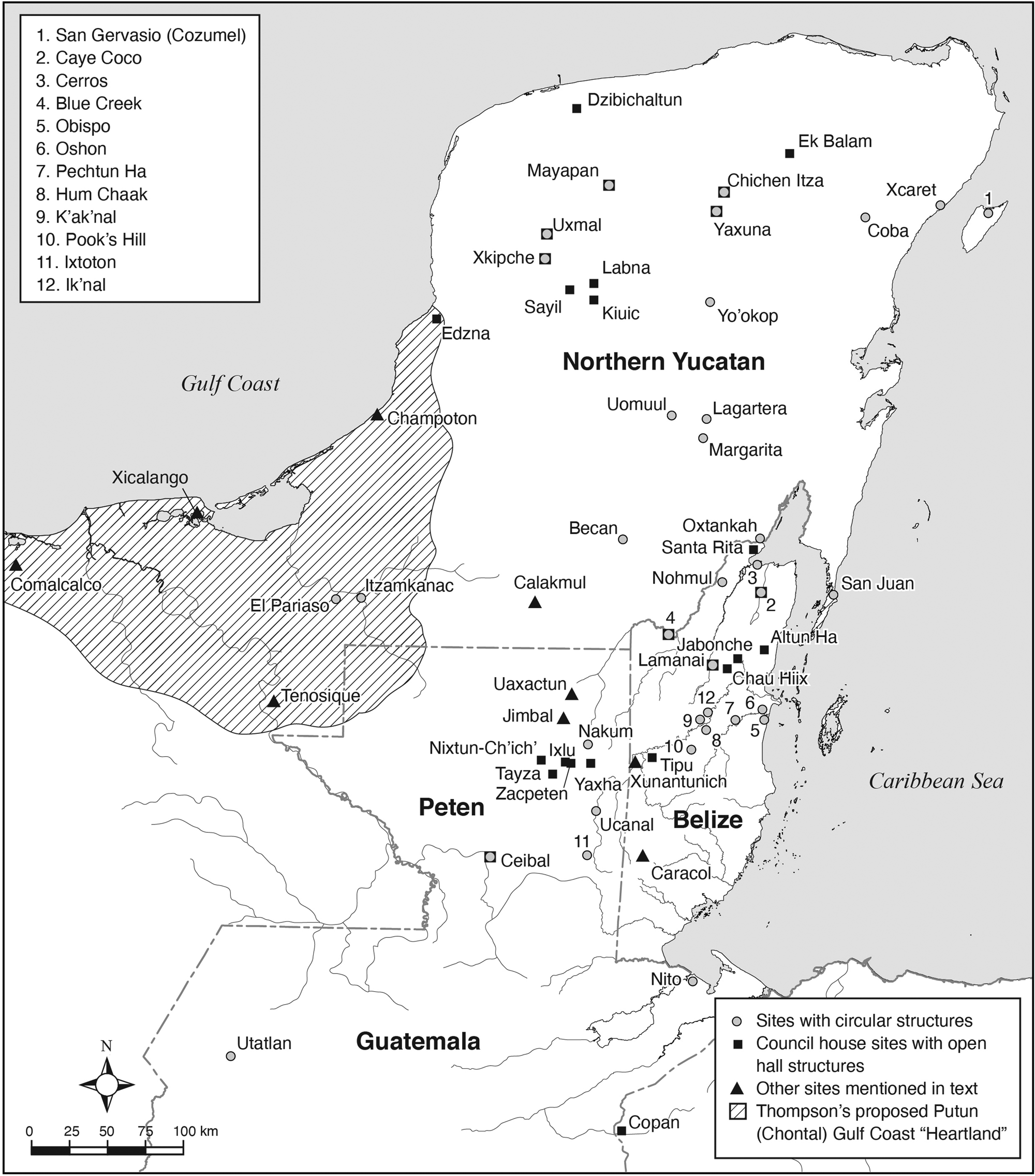
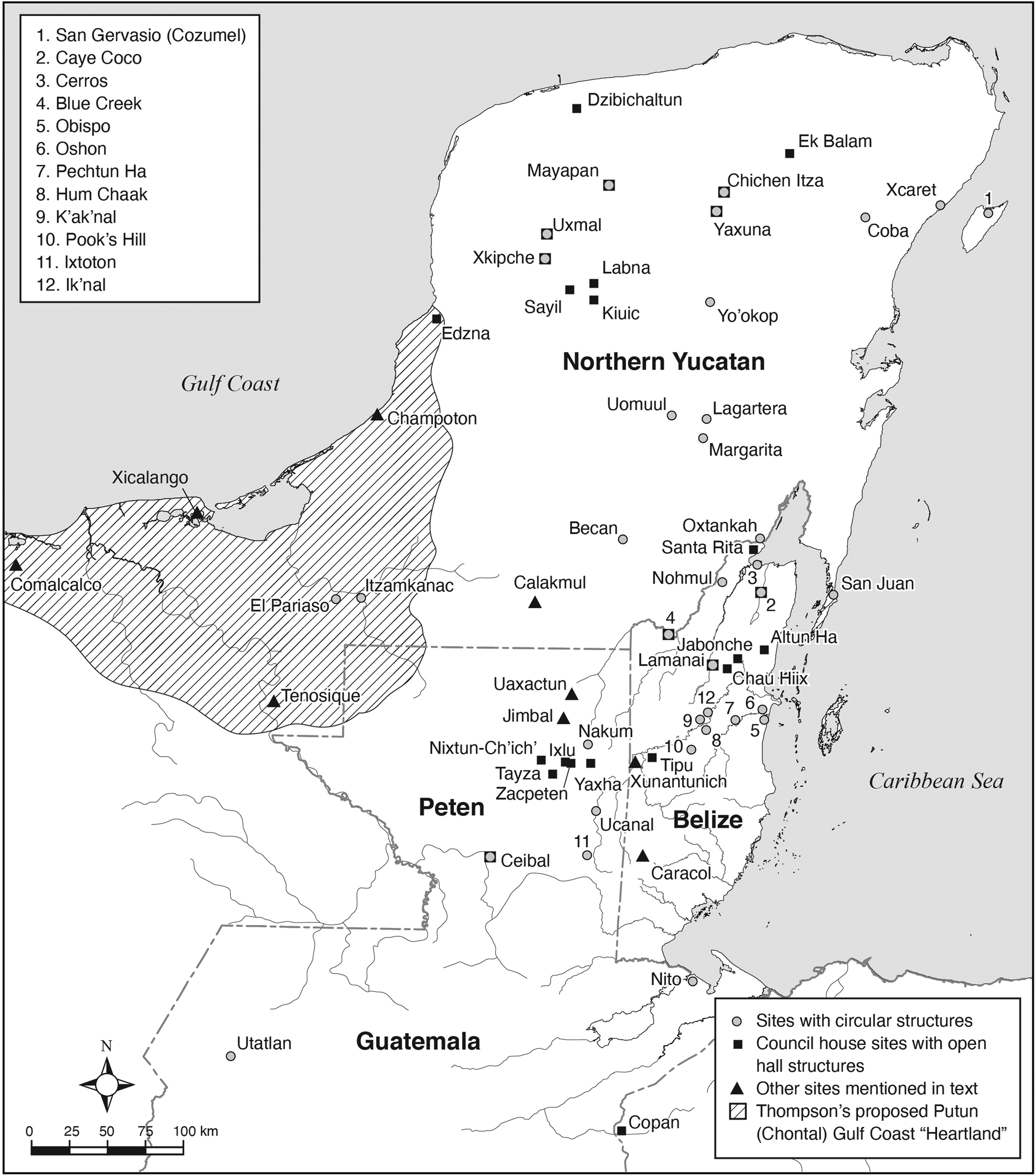
From Classic to Postclassic times, colonnaded open halls are among the most prominent architectural types found in northern Yucatan at the Itza centers of Chichen Itza and Mayapan (Proskouriakoff Reference Proskouriakoff, Pollock, Roys, Proskouriakoff and Smith1962a; Smith Reference Smith1971). Open colonnaded halls are also one of the most prominent architectural types at Postclassic Itza-related sites in the Peten Lakes, including the sites of Nixtun-Ch'ich’, Tayza, Yaxha, and Ixlu, among others (Pugh and Shiratori Reference Pugh, Yuko, Rice and Rice2018; Pugh et al. Reference Pugh, Rice, Chan Nieto and Rice2016; Rice and Rice Reference Rice and Rice2018:39–40). Most long, open halls with stone or wooden columns date to the Classic to Postclassic transition (Bey et al. Reference Bey, Hanson and Ringle1997; Rice and Rice Reference Rice and Rice2018). Open colonnaded halls have also been found in Belize, including Postclassic examples at Caye Coco, Lamanai, and Tipu, as well as Terminal Classic examples at Chau Hiix and Jabonche (Figure 1; Andres Reference Andres2009; Harrison-Buck Reference Harrison-Buck and Harrison-Buck2015; Masson Reference Masson1999; Pendergast Reference Pendergast1981). Long, open colonnaded buildings often are interpreted as public meeting houses that functioned as seats of authority for a council form of government. Some suggest the presence of these buildings across the Maya lowlands signal a shift to “joint rulership” or shared governance in Terminal Classic and Postclassic times (for further discussion see Kowalski [Reference Kowalski, Kowalski and Kristan-Graham2007]).
Map of sites mentioned in text. Map by Marieka Brouwer Burg.
“Conference Scenes” on Monuments, Molded-Carved Ceramics, and Incised Shell
Scholars also cite evidence of shared governance in the so-called “conference scenes” depicted in molded-carved ceramics, monuments, and other media dating to the Terminal Classic. In the case of molded-carved ceramics, a predominant theme centers around a bloodletting ceremony following a warfare event that involved captive-taking (Helmke and Ting Reference Helmke, Ting and Powis2017:78). Many of these scenes appear to represent interior spaces and are divided into segmented panels with narrow partitions. We suggest that the narrow partitions may represent columns and indicate that these scenes may take place in the rooms of colonnaded open halls, perhaps analogous to the physical form of Classic-period palace architecture depicted on painted Late Classic polychrome vases (Reents-Budet Reference Reents-Budet, Inomata and Houston2001). Observations by Helmke and Ting (Reference Helmke, Ting and Powis2017) lend support to this architectural interpretation. Helmke and Ting (Reference Helmke, Ting and Powis2017:78) note that of the five horizontal bands found on molded-carved ceramics, the three moldings framing the top of the segmented panels “are identical to the atadura columns on Puuc architecture” (Kubler Reference Kubler1990:234). Notably, three-member moldings and engaged colonnettes are among the “foreign” architectural traits cited by Tourtellot and colleagues (Reference Tourtellot, Sabloff, Carmean, Chase and Chase1992:92) that are found at southern lowland sites like Ceibal during the Terminal Classic period, which stem from northern Yucatan and are found at Puuc sites, as well as Chichen Itza.
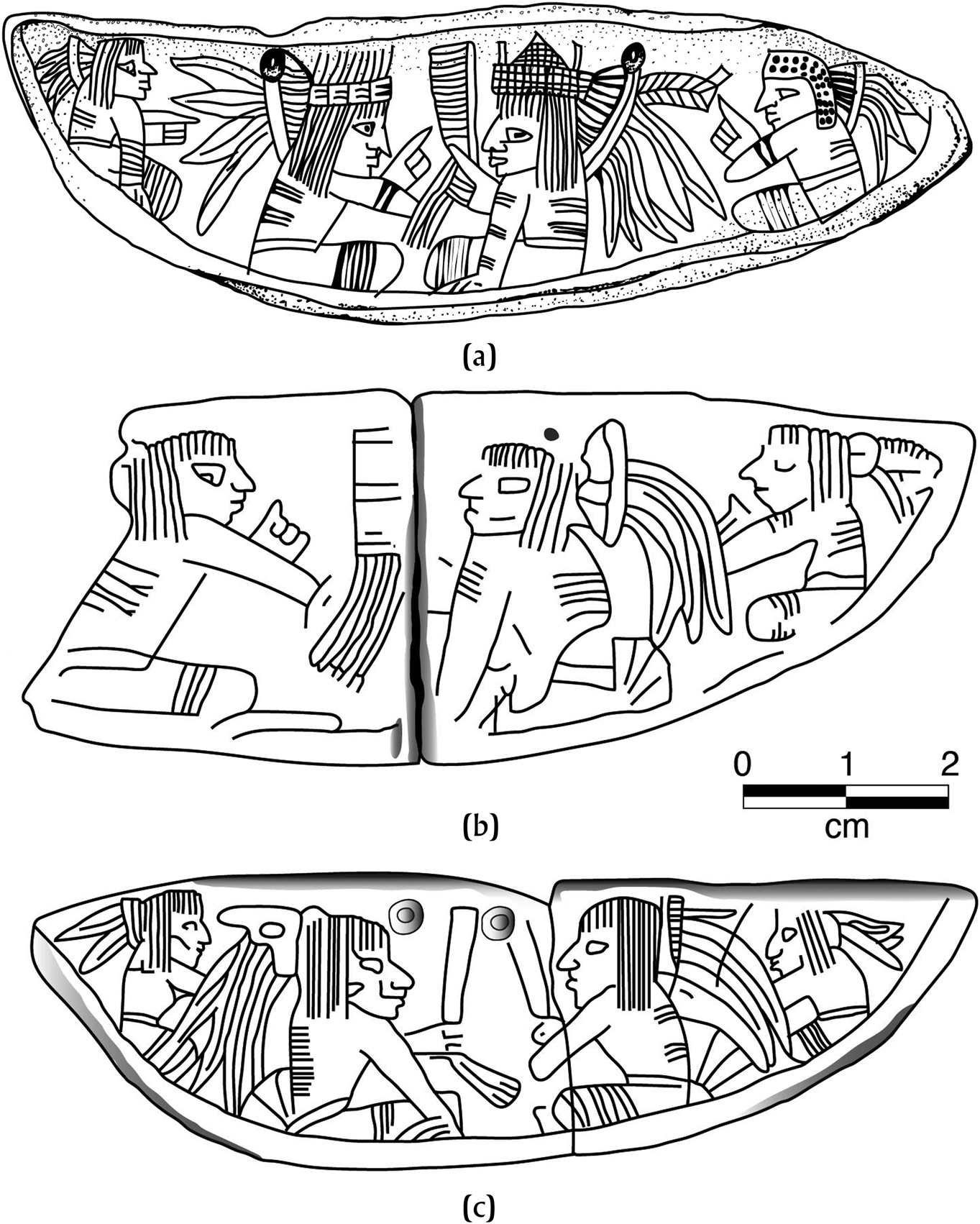
The individuals in the Terminal Classic “conference scenes” are often shown in pairs and gesture toward one another as if in the midst of a conversation or negotiation. Frequently the figures are seated either on thrones or on woven mats. In some cases, one pair of figures seems to be floating above the others and could represent deceased ancestors. Similar conference scenes depicted on incised shell pectorals also dating to the Terminal Classic, however, suggest that the sets are perhaps senior-junior pairings (Figure 2). Some have argued that the pairing is further evidence of a shift in political order to dual rulership, although the pairing could also reference ancestral replacement. The distribution of the “conference scenes” depicted on molded-carved ceramics and other media such as shell pectorals (Figure 2) have been predominantly recovered from Terminal Classic contexts that suggest nonroyal, secondary, elite members of Maya society (Helmke and Ting Reference Helmke, Ting and Powis2017:86).
Terminal Classic shell pectorals. (a) From SL-13 Group, San Lorenzo, Belize. Redrawn by Katherine Titus after Yaeger (Reference Yaeger2000:1239, Figure VII.6). (b) From Structure T-30 at Tayza, Guatemala. Drawing by Katherine Titus after Pugh et al. (Reference Pugh, Sánchez and Shiratori2012:Figure 10). (c) East Plaza Group A, Uaxactun, Guatemala. Drawing by Katherine Titus after Kidder (Reference Kidder1947:Figure 51a).

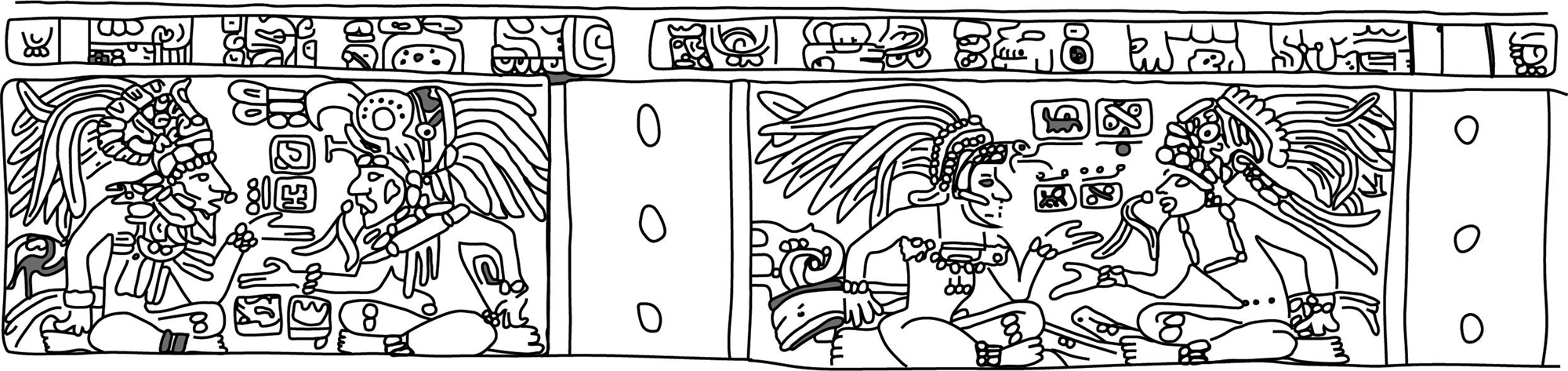
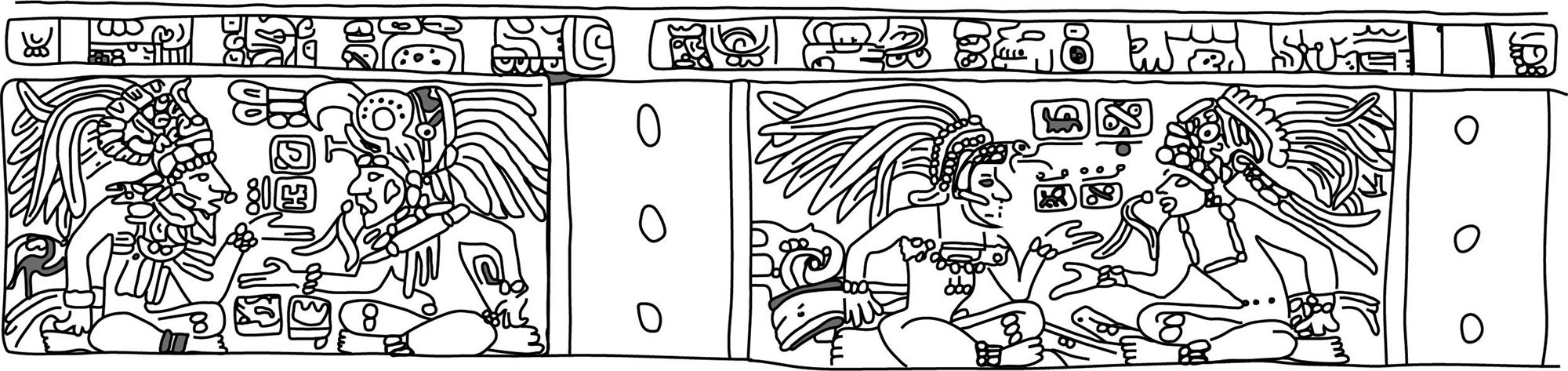
Monuments from the Terminal Classic also show “conference scenes” with pairs of figures at sites like Caracol (Altars 10, 12, and 13 and Stela 17), Ixlu (Stela 2), and Ceibal (Stelae 3 and 17). The iconographic evidence has led many to argue that these monuments express new strategies of shared governance beginning in Terminal Classic times (Demarest Reference Demarest, Demarest, Rice and Rice2004:122–123; Rice Reference Rice2004; Rice and Rice Reference Rice and Rice2018). These and other similar scenes with paired individuals have been interpreted as evidence of submission, friendship, and alliance, in part based on the different hand and arm gestures (Chase Reference Chase, Robertson and Fields1985; Chase et al. Reference Chase, Grube and Chase1991). This interpretation of hand and arm gestures referencing alliance aligns with an observation made by Jansen and Jiménez (Reference Jansen and Jiménez2010). They note that in Mixtec Postclassic codices, when two people are shown sitting together with their arms raised and a hand extended with two fingers pointing, it is a signal for an alliance, specifically an offering of marriage (Jansen and Jiménez Reference Jansen and Jiménez2010:228). In other Postclassic Mixtec codical scenes, “a finger pointed upward may be read in a general way as the verb yonaha, ‘to signal,’ which has the connotations of ‘to know’ and ‘to give counsel’” (Jansen and Jiménez Reference Jansen and Jiménez2010:228). Although it remains speculation, this range of hand gestures may be expressed in some of the so-called conference scenes on monuments and mold-carved vessels, such as in one nearly complete Pabellon vessel from Uaxactun (Figure 3). Hand gestures with fingers pointed upward appear with the paired groups on some of the incised shell pectorals, such as the examples from San Lorenzo, a site near Xunantunich in Belize, as well as two others from Tayza and Uaxactun just across the border in Guatemala (Figure 2). It is conceivable that some of the negotiations depicted in the Terminal Classic “conference scenes” on incised shell, molded-carved ceramics, and monuments took place in colonnaded buildings and involved lineage heads (and their junior kinsmen) negotiating community affairs, which may have included noble marriages.
Pabellon Molded-Carved vessel from Uaxactun. Redrawn by Katherine Titus after a drawing by Maline Diane Werness, courtesy of the Foundation for the Advancement of Mesoamerican Studies, Inc. (FAMSI).
Colonnaded Open Halls as Council Houses, Men's Houses, and Places of Marriage
Colonnaded open halls are frequently interpreted as “council houses” or “men's houses” where male noble lords would periodically gather (Bey and May Ciau Reference Bey, May Ciau and Braswell2014:336; Proskouriakoff Reference Proskouriakoff, Pollock, Roys, Proskouriakoff and Smith1962a:89–90; Pugh et al. Reference Pugh, Rice, Chan Nieto and Rice2016:12). Although we cannot be sure that women were prohibited from entering the council house, all the figures depicted in the “conference scenes” are male. As previously noted, the appearance of colonnaded open halls in the southern Maya lowlands during the Terminal Classic and Postclassic periods has been interpreted as marking a shift in the political order, signaling more power sharing in elite governance (Chase Reference Chase, Robertson and Fields1985; Chase et al. Reference Chase, Grube and Chase1991; Demarest Reference Demarest, Demarest, Rice and Rice2004:122–123; Rice and Rice Reference Rice and Rice2018:37–39). Yet, there is evidence of council house structures in the Classic period, which suggests an earlier date for this form of shared governance. For instance, Bey and May Ciau (Reference Bey, May Ciau and Braswell2014:337) report that council houses dating to the early Late Classic period (ca. a.d. 550–750) are found at sites in northern Yucatan. In the southern Maya lowlands, coeval Classic-period examples have also been recorded, including Structure 1 at Blue Creek and Structure B-5 at Altun Ha—both located in Northern Belize (Driver Reference Driver2002; Pendergast Reference Pendergast1982). There is also the well-known Late Classic example of Structure 10L-22a from Copan in Honduras, which Fash and colleagues (Reference Fash, Fash, Lane, Larios, Schele, Stomper and Stuart1992) identified as a popol nah or council house based on the series of mat designs decorating the façade. Scholars have cautioned that a mat symbol alone does not necessarily designate a building as a council house (Stone and Zender Reference Stone and Zender2011). In the case of Structure 10L-22a, however, there are also representations of men sitting on glyphs interpreted as place names, which lend additional support to the designation of a council house or “men's house” where local lineage heads gathered (Cheek Reference Cheek2003:131). In addition, Cheek (Reference Cheek2003) has suggested that Structure 10L-223, a significantly larger, elongated building in the Great Plaza at Copan may represent a second Classic-period council house at this site.
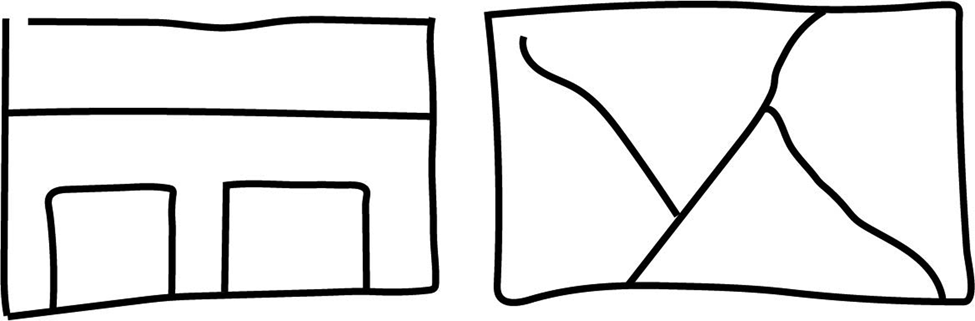
The literal translation of popol nah is “mat house,” in which pop is a woven “mat” and nah is “house” (Rice and Rice Reference Rice and Rice2018:39; Schele and Matthews Reference Schele and Matthews1998:44). The concept of the mat as a seat of authority roots in earlier Preclassic times. The mat is found in the diphrastic kenning “the throne-and-mat” couplet, which Carrasco and Englehardt (Reference Carrasco and Englehardt2015) identified on the Olmec Cascajal block, making it one of the earliest couplets found in ancient Mesoamerican writing (Figure 4). This same couplet is later found in Classic and Postclassic Mayan writing, including examples in the epigraphic texts at Palenque and in the Dresden Codex which references not only the office of rulership but also noble marriage. This dual concept is explicit among the Postclassic Mixtec where marriage and both paternal and maternal descent are emphasized in the linguistic term yuvui tayu (“mat and throne”) as the seating place of both noble men and women (Jansen and Jiménez Reference Jansen and Jiménez2010:16). In marriage scenes in the Mixtec codical books, women normally sit on the mat (yuvui) and the men sit on the throne (tayu).
Throne-and-mat couplet from the Olmec Cascajal Block. Redrawn by Katherine Titus after Carrasco and Englehart (Reference Carrasco and Englehardt2015).
Relying on ethnohistoric accounts, Carmack (Reference Carmack1981:192) has suggested that open colonnaded halls for the Postclassic Quiche Maya were council houses used for betrothal, bride wealth, marriage rites, and spousal exchange (Pugh Reference Pugh2003:410; Rice Reference Rice, Wilk and Ashmore1988:240–241). At the time of contact, Landa (Reference de Landa and Tozzer1941:124) noted that open colonnaded halls also served as sleeping quarters for unmarried men, for those preparing to marry, or for married men whose wives were pregnant. Following Landa's account, Proskouriakoff (Reference Proskouriakoff, Pollock, Roys, Proskouriakoff and Smith1962a:89–90) concluded that the Postclassic open colonnaded halls at Mayapan “were used as lodging for men in training for religious or military service.”
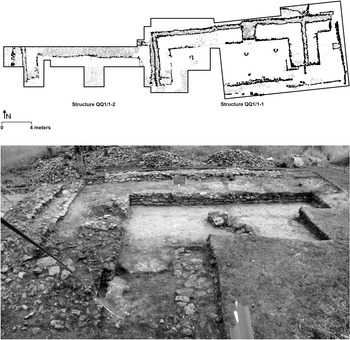
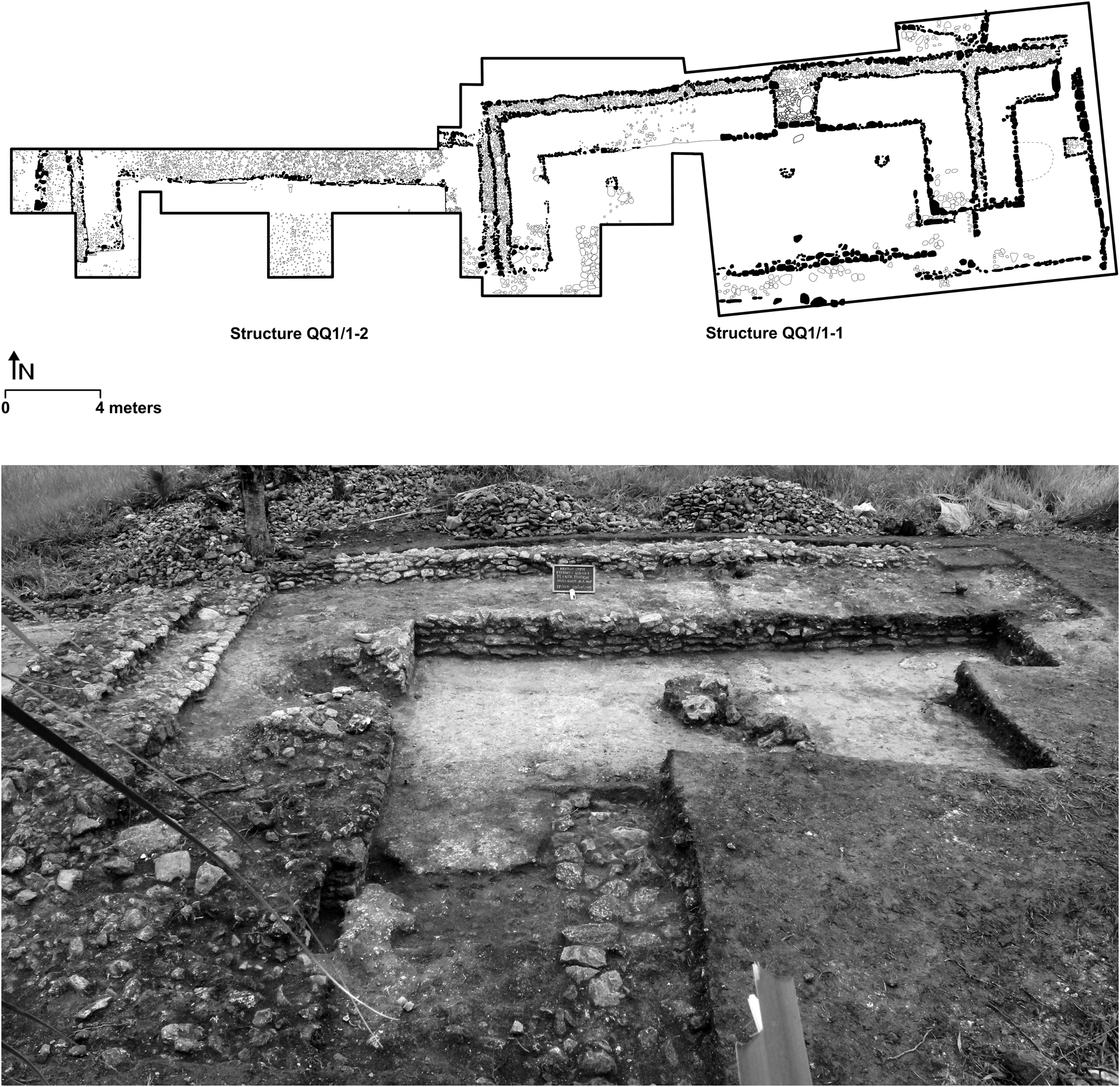
Archaeological investigations lend support to the suggestion that open colonnaded halls served as “men's houses” or “noble schools” where young males prior to marriage were trained in military and religious activities, including learning how to carry out autosacrifice in the form of genital bloodletting tied to calendrical period endings (see section Turtles and Phalli in Circular and Colonnaded Buildings). Excavations carried out by the second author at the Peten site of Nixtun-Ch'ich’ exposed two adjacent open colonnaded halls (Structures QQ1/1-1 and QQ1/1-2) that are similar in layout to those recorded at Mayapan (Figure 5; Pugh et al. Reference Pugh, Rice, Chan Nieto and Rice2016:5). Excavations revealed “architectural sculpture that includes raptorial birds, possible coyotes, serpents, small phalli, and turtles” (Cecil and Pugh Reference Cecil and Pugh2018:59). Pugh also excavated four of these buildings at the site of Zacpeten, also located in the Lake Peten region. Pugh and colleagues observed that at least half of the excavated open halls “contained small stone phalli, which were not encountered in any other structure type” (Pugh et al. Reference Pugh, Rice, Chan Nieto and Rice2016:8). These phalli stones may have been originally tenoned and mounted on the interior walls of these buildings, similar to those found at the House of the Phalli at Chichen Itza where realistic phalli sculptures were mounted on the walls of several of its rooms (Amrhein and Looper Reference Amrhein and Looper2015:132).
(a) Excavated areas of Structure QQ 1/1, Nixtun-Ch'ich’, Peten, Guatemala. Drawing by Pugh, modified from Pugh et al. (Reference Pugh, Rice, Chan Nieto and Rice2016:Figure 3). (b) Western half of Structure QQ 1/1–1, Nixtun-Ch'ich’, Peten, Guatemala. Photograph by Evelyn Chan Nieto.
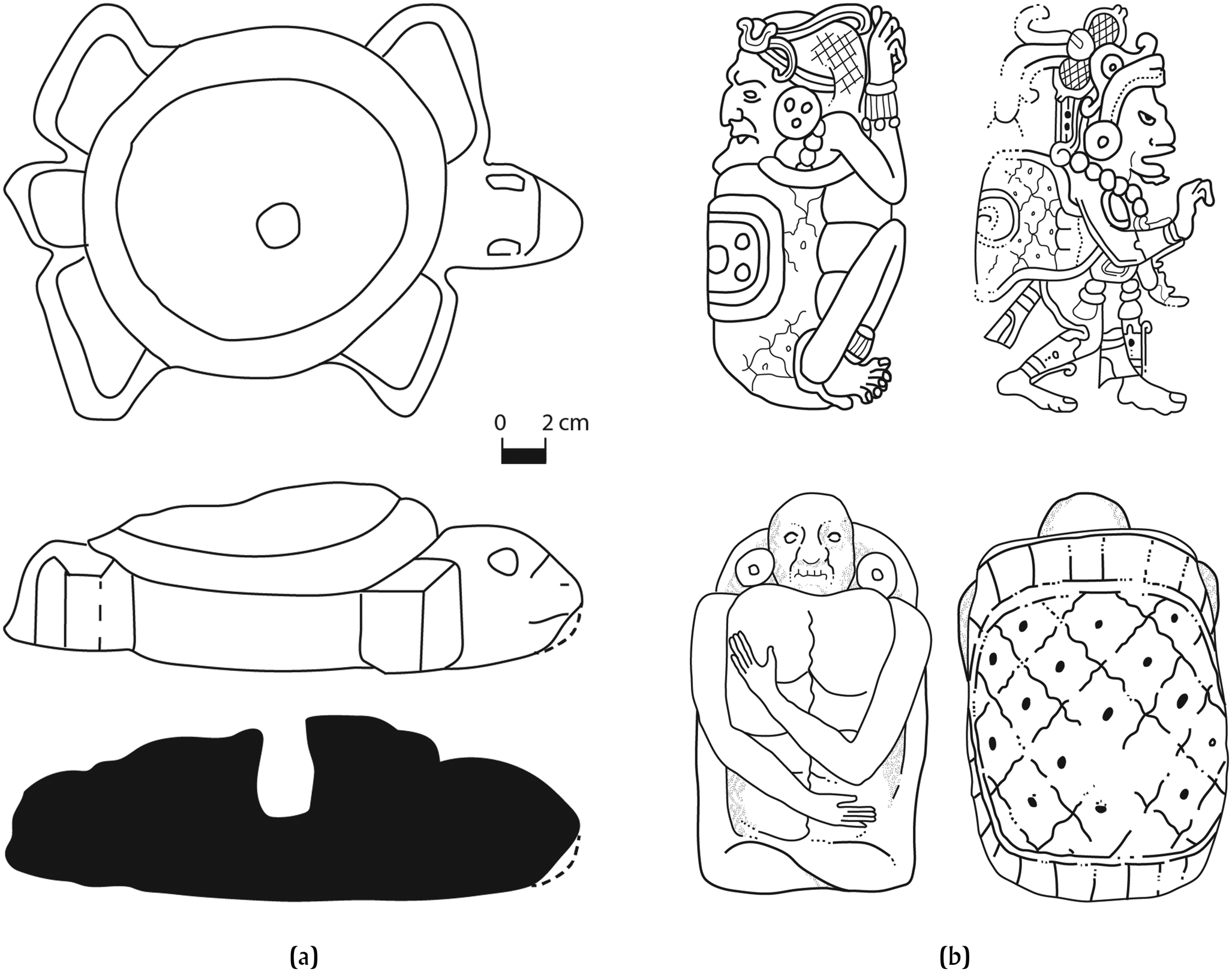
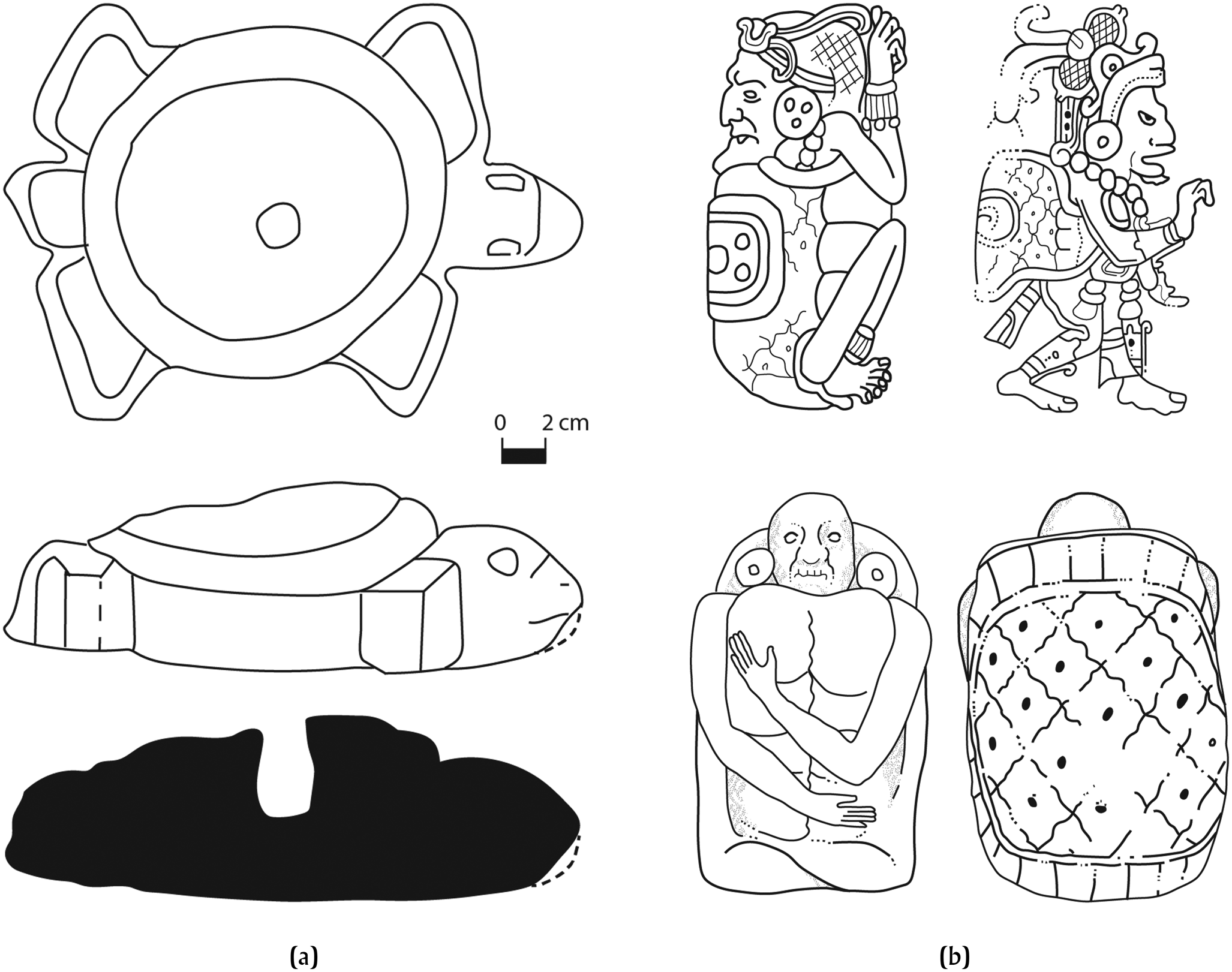
In addition, stone turtle altars with receptacles on their backs were found associated with the interior shrines of the two adjacent open colonnaded halls at Nixtun-Ch'ich’ (Pugh et al. Reference Pugh, Rice, Chan Nieto and Rice2016:8). Other similar turtle effigy sculptures have been found in northern Yucatan at Chichen Itza and Mayapan, where they are frequently found associated with bloodletting implements, namely obsidian blades (Taube Reference Taube1988). At Mayapan, the majority of the turtle altars were found associated with altars in rear interior shrine rooms of colonnaded elite residential buildings (Proskouriakoff Reference Proskouriakoff, Pollock, Roys, Proskouriakoff and Smith1962b; Taube Reference Taube1988:186), resembling the context of the finds from Nixtun-Ch'ich’. In Belize, several examples of turtle effigies with receptacles on their backs have been reported from similar contexts at Late Postclassic sites. For instance, at the island site of Caye Coco in Northern Belize, one similar sized turtle sculpture (29.8 cm long) with a cavity on the back was found in a cache deposit and inside the cavity were several items, including an obsidian blade (Masson Reference Masson1999:290, Figure 3b). The turtle offering was cached within a rear altar of Structure 5, a building identified as an elite residence with a layout that resembles other Postclassic elite residential structures from Mayapan. Other similar examples of turtle effigies with receptacles on their backs have been reported from the Late Postclassic site of Santa Rita Corozol in Northern Belize (Figure 6a; Chase and Chase Reference Chase and Chase1988:27–29). One example found cached in front of Structure 213 at Santa Rita Corozal includes a ceramic-style turtle figurine with a receptacle on the back (Chase and Chase Reference Chase and Chase2008:Figure 2a).
(a) Altar turtle from Santa Rita Corozal, Belize. Drawing by Katherine Titus after Chase and Chase (Reference Chase and Chase1988:Figure 9). (b) Classic and Postclassic God N turtle forms. Drawings by Katherine Titus after Zender (Reference Zender2005:Figure 8).
Circular Shrine Buildings
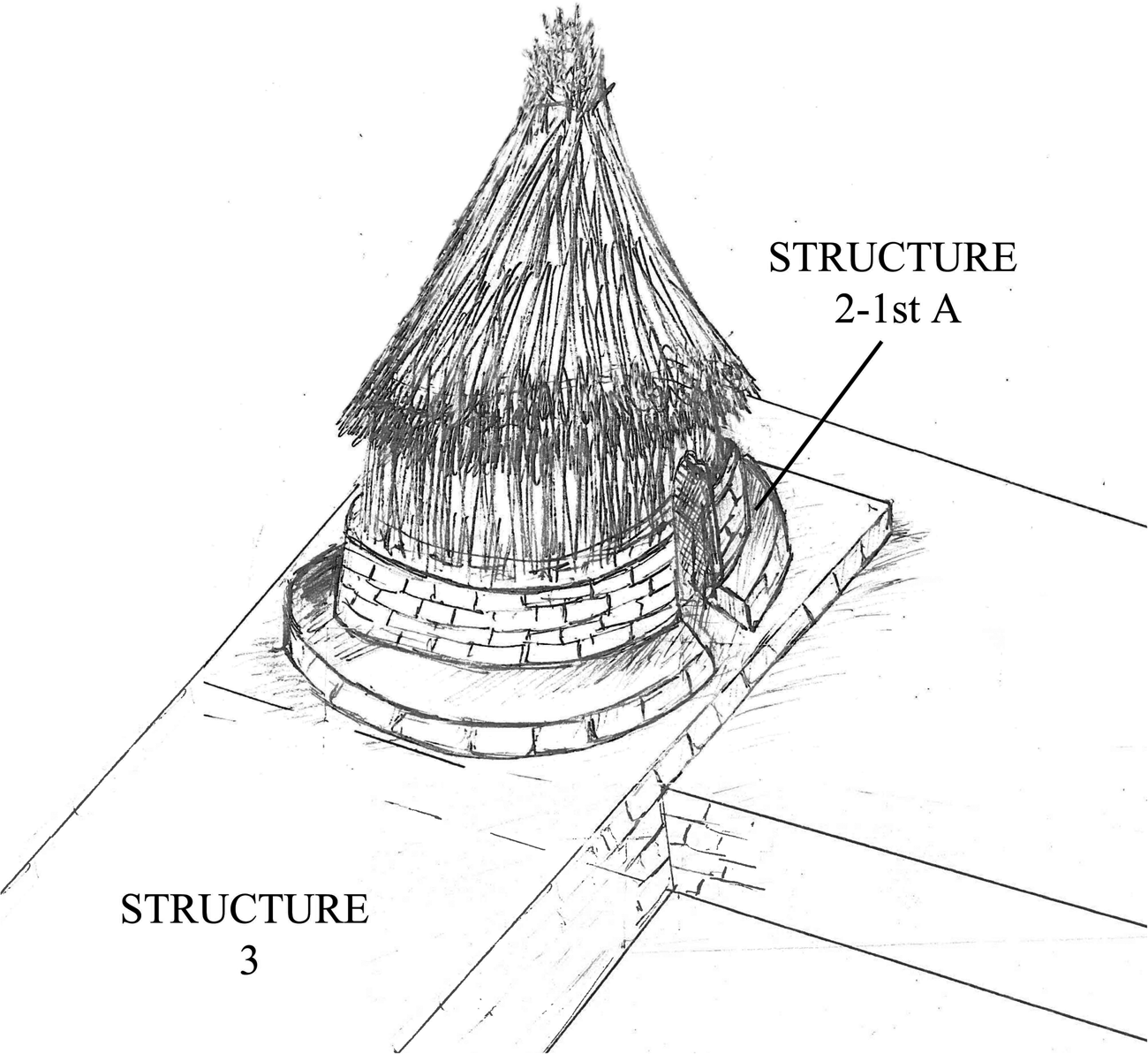
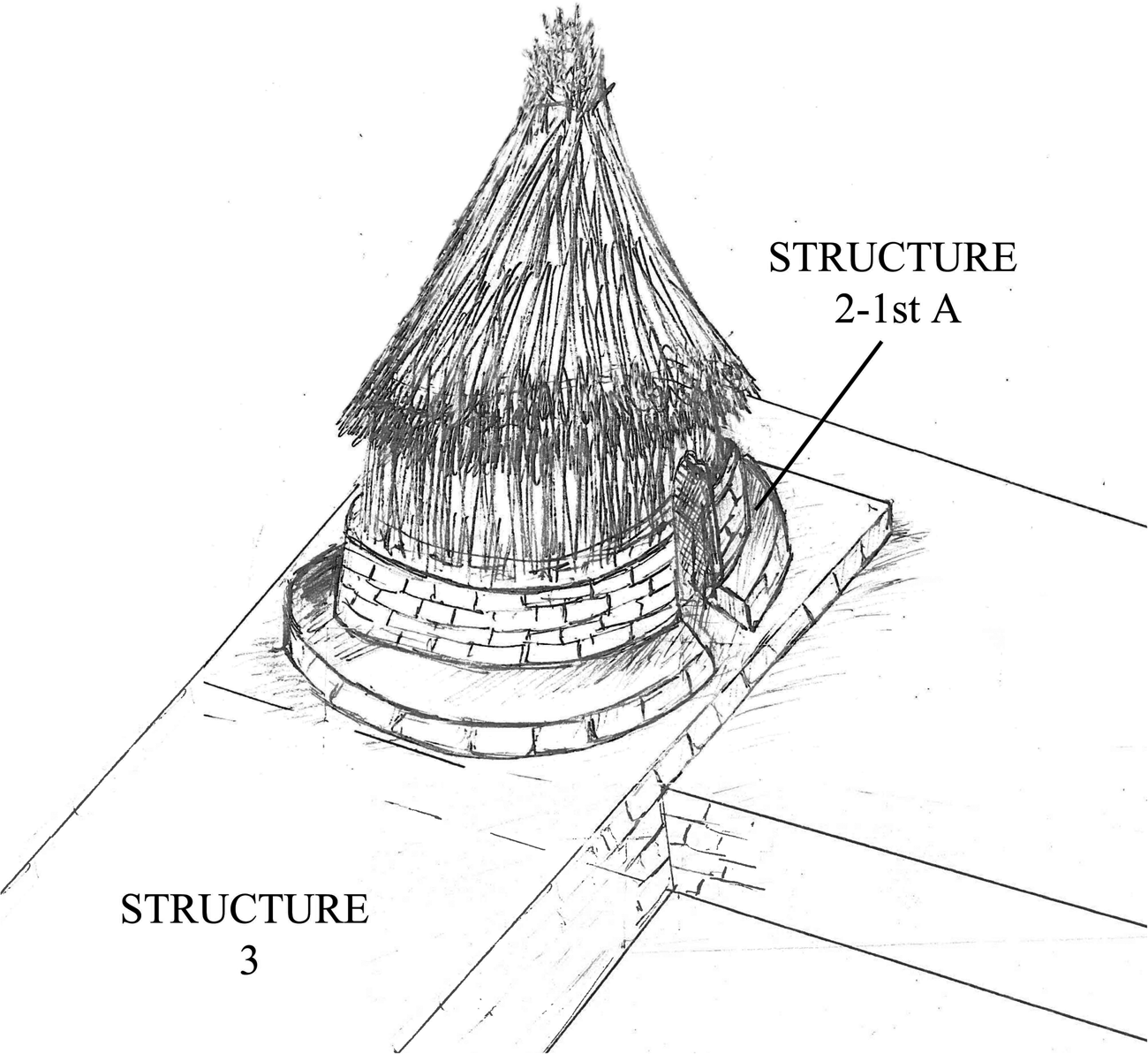
Similar ceramic and carved stone turtle effigies with receptacles on their backs have also been found associated with Postclassic circular shrine buildings at Mayapan and at Chichen Itza. Investigations of the round Caracol Building revealed one example in the doorway of the final phase of the building, which contained associated cached artifacts including an obsidian blade (Ruppert Reference Ruppert1935:219, Figure 278d). More recent investigations at Chichen Itza in the Initial Series Group have revealed another circular shrine (Structure 5C17) in addition to the Caracol, this one made in the form of a turtle that dates to the Terminal Classic period (Schmidt Reference Schmidt, Kowalski and Kristan-Graham2007). Examples of circular shrines that date to the Terminal Classic have been found in other parts of the Maya lowlands, including Guatemala at Nakum, Ucanal, and Ceibal (Halperin and Garrido Reference Halperin and Garrido2020; Hermes and Źrałka Reference Hermes and Źrałka2012; Smith Reference Smith1982; Źrałka and Hermes Reference Źrałka and Hermes2012) and in Belize at sites such as Nohmul, Blue Creek, Pook's Hill, Caye Coco, and the site of San Juan on Ambergris Caye (Chase and Chase Reference Chase and Chase1982; Guderjan Reference Guderjan1995; Guderjan et al. Reference Guderjan, Preston, Luzzadder-Beach and Bozarth2009; Helmke Reference Helmke2006; Rosenswig and Masson Reference Rosenswig and Masson2002). At Caye Coco, an earlier phase of Structure 1 contained evidence of a Terminal Classic circular platform, which was subsequently covered over by a Postclassic colonnaded open hall, interpreted as a public meeting hall or council house (Rosenswig and Masson Reference Rosenswig and Masson2002:Figure 4). In addition to these examples, the senior author has investigated numerous examples of circular structures in the Sibun and Belize Valleys that date to the Terminal Classic and Early Postclassic periods (Figure 7; Harrison-Buck Reference Harrison-Buck2012; Harrison-Buck and McAnany Reference Harrison-Buck and McAnany2013). Although no turtle effigies with receptacles have been found in these contexts, the structures from the Sibun and Belize Valley sites all exhibit exceptionally high quantities of turtle carapace, which in many cases cluster around the central doorways and centerlines within the interiors of these buildings in their final phase, which appear to date to the beginning of the Early Postclassic based on associated ceramics (Duff and Harrison-Buck Reference Duff, Harrison-Buck and Harrison-Buck2015:42; Harrison-Buck Reference Harrison-Buck and Harrison-Buck2013:119). Notably, a high density of potential bloodletting implements were recovered in and around the circular shrines directly associated with the turtle shell. Perforators that were recovered range from stingray spines to obsidian blades, but obsidian was by far the more common implement that was found in these contexts.
Circular shrine at Ik'nal, Belize Valley. Drawing by Harrison-Buck.
Turtles and Phalli in Circular and Colonnaded Buildings
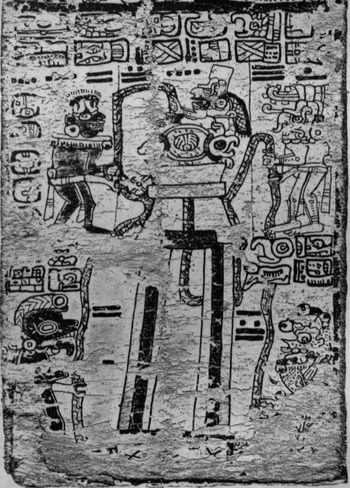
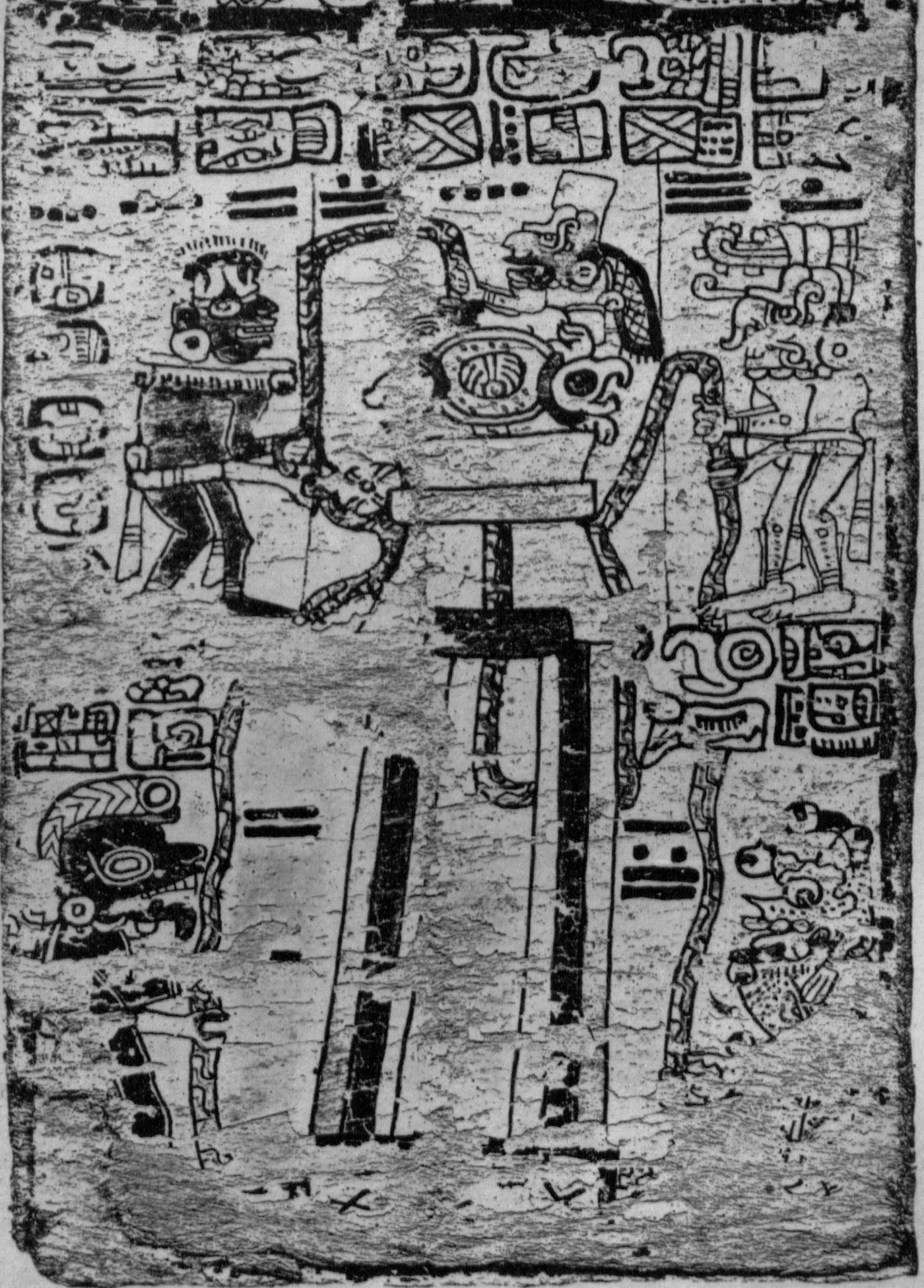
Taube (Reference Taube1988:189–193) has argued that turtle altars with receptacles and turtle carapaces themselves may have served as a locus of penis bloodletting from Classic to Postclassic times. If so, this would suggest that both circular shrines and colonnaded buildings were locations where genital bloodletting took place in the past. Elsewhere, the senior author has discussed the interconnections between turtles, phalli, and self-sacrifice, specifically with penis bloodletting carried out as part of the annual springtime New Year's ceremonies celebrating the onset of the rainy season (Harrison-Buck et al. Reference Harrison-Buck, Runggaldier and Gantos2018). A scene depicted on page 19b of the New Year's pages in the Madrid Codex shows how turtle altars were used in acts of genital bloodletting conducted during annual New Year's ceremonies during the Postclassic (Figure 8). The scene depicts four year-bearers, or batabs, bloodletting from their penis with a rope connecting all four being threaded through the carapace of a turtle altar by a central figure (Vail and Hernandez Reference Vail and Hernandez2013). An earlier example from outside the Maya area may be shown in the scene carved on a table altar found in Building 4 at El Tajin in the Gulf Coast of Mexico (Koontz Reference Koontz2010:Figure 7.4). Similar to the Madrid Codex, four entwined cords come together and are threaded through a hole in an altar table and inserted into the back of a turtle effigy that sits, in this case, beneath the altar. Pugh and colleagues (Reference Pugh, Rice, Chan Nieto and Rice2016:5) note that in the case of the Peten, open halls that functioned as council houses often contained low rectangular masonry “tables.” It is possible these tables when associated with turtle altars functioned in a similar fashion during bloodletting ceremonies as the altar tables described above.
Page 19b of the Madrid Codex showing a New Year's ceremony involving bloodletting (after de Rosny [Reference de Rosny1883]). Courtesy of the Florida Institute for Hieroglyphic Research, St. Petersburg.
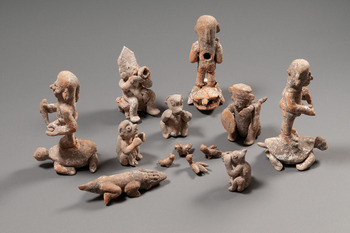
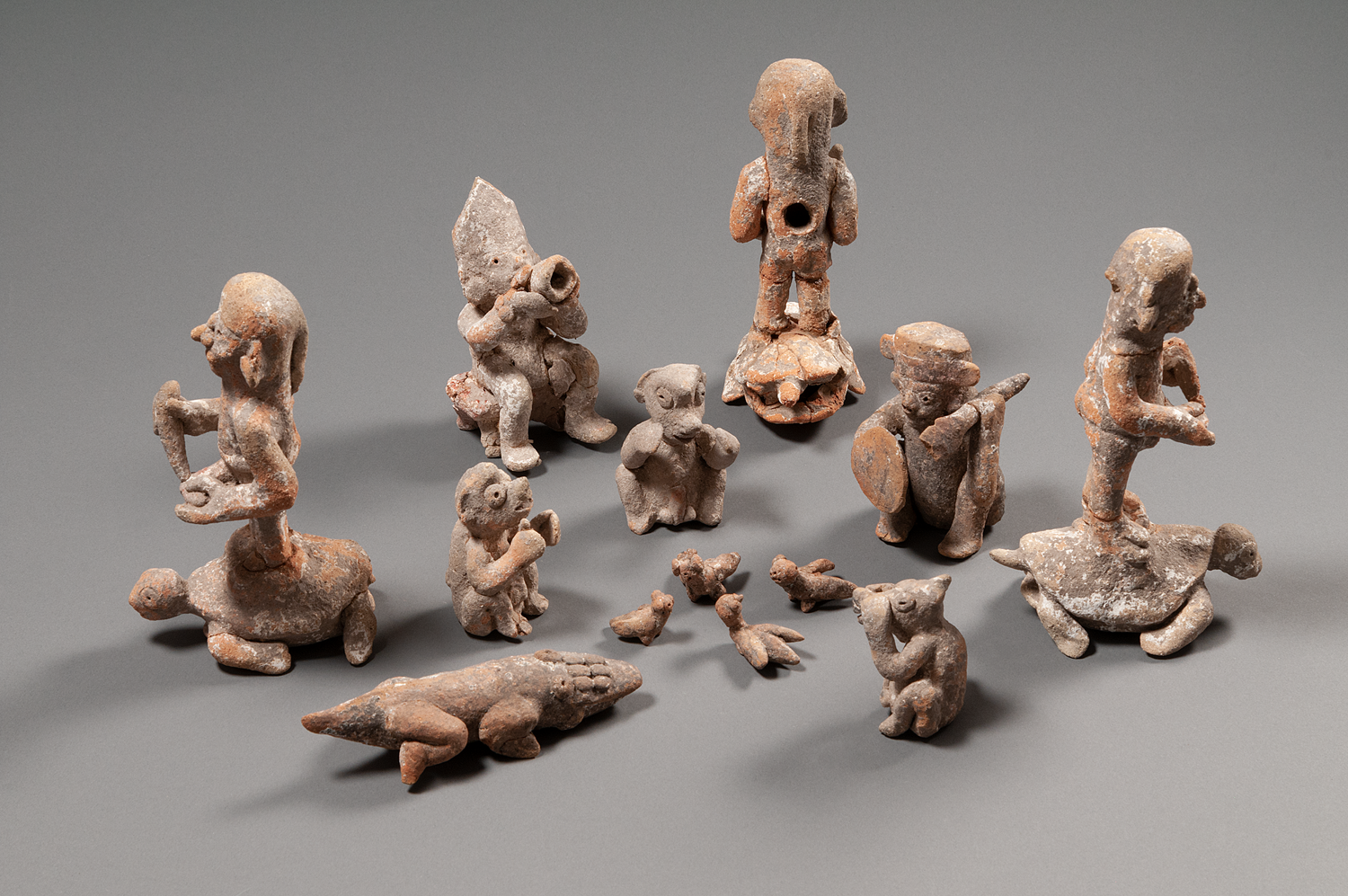
In Classic and Postclassic contexts, the b'atab' year-bearer for the New Year is frequently associated with turtles and the act of genital bloodletting. Notably, the b'atab' yearbear (in his guise as God N) often takes the form of a turtle and embodies the four-part earth and its world directions, and references time and the calendar (Figure 6b; Taube Reference Taube1988). At the site of Santa Rita Corozal in Northern Belize, Late Postclassic cache deposits contain figurines of four b'atab' year-bearer figures (perhaps reminiscent of the pairings of four figures from the conference scenes mentioned earlier). In this case, the four figures stand on the backs of turtles, letting blood from their genitals, and mark the year ending (Figure 9; Chase Reference Chase1982, Reference Chase, Robertson and Fields1985; Chase and Chase Reference Chase and Chase1988, Reference Chase and Chase2008).
Cache deposit at Santa Rita Corozal, Belize, showing three of the four b'atab’ year-bearers standing on a turtle letting blood from the genitals and other figurines, including a seated figure blowing a conch trumpet. Photograph by Jorge Pérez de Lara.
From Classic to Colonial times, the four batabs played a fundamental role in the structure of Maya time and cosmology and also in the structure of regional political power and authority (Pugh Reference Pugh2001). Their role as a four-fold leadership structure was described by the Itza of the Peten Lakes to the Spanish at the time of contact. According to the colonial accounts, this form of leadership was said to “[comprise] four senior-junior pairs, an ajaw b'atab' (“lord governor”) with a b'atab' (“governor”), respectively” (Rice and Rice Reference Rice and Rice2018:33). According to ethnohistorian Jones (Reference Jones1998), these four senior-junior pairs were governed by a principal ruler, ajaw kan ek', who coruled this council with his cousin (his father's brother's son) ajk'in kan ek', who was considered the high priest. Jones (Reference Jones1998:94) concludes that the two members of the same ch'ib’al or patrlineage “ruled jointly as a single persona: one primarily in the realm of political affairs and the other in the…realm of the supernatural.” They presided over a large council that met in an open colonnaded hall that was both a council house and residence of ajaw kan ek’ in his Itza capital of Tayza on the island of Flores in Peten (Rice and Rice Reference Rice and Rice2018:39). The council included the four senior-junior pairs and 13 individuals called ach kat (Rice and Rice Reference Rice and Rice2018:30). Jones (Reference Jones1998:87–88) suggests that the office of ach kat, which translates to “penis [ach, aat] of the vessel,” may be related to the Nahautl title achcauhtli (singular achcacautin) in central Mexico, who are described by Torquemada as “captains of the guard” and by Clavigero as “an officer, to whom they (the youth) were entrusted.” Young males beginning at the age of 15 were placed in charge of the achcacautin until they married and were trained by this military captain in war (Bandelier Reference Bandelier1877:101).
It is possible a similar form of military and religious training for young unmarried men may have taken place in the Maya lowlands by Terminal Classic times in the context of circular and colonnaded open hall buildings. During the Postclassic, letting blood onto the stone turtle appears to be connected to the onset of the rains wetting the dry, cracked earth (Taube Reference Taube1988). Notably, among contemporary Atiteco Maya, traditionalists consider springtime rains that moisten the dry earth as an explicit sexual act (Stanzione Reference Stanzione2003:57). From Preclassic times onward, rain is rendered as a phallus and clefts in the earth connote the female sex (Astor-Aguilera Reference Astor-Aguilera2010:104; Tate Reference Tate2012). Genital bloodletting was not just a ritual that “symbolized” the onset of the rains; it was a procreative act that was necessary to carry out each spring to moisten the dry earth and geminate young seed (Harrison-Buck et al. Reference Harrison-Buck, Runggaldier and Gantos2018:342; Schele and Miller Reference Schele and Miller1986). These were extremely painful acts and, according to Landa, “he who did this [genital bloodletting] the most was considered as the bravest; and their sons from the earliest age began to practice it” (de Landa Reference de Landa and Tozzer1941 [1566]:114; Amrhein and Looper Reference Amrhein and Looper2015:137). This account suggests that these ritual acts were paired senior-junior activities that were passed down from father-to-son among ch'ib’als, or patrlineages. It is possible that both “real” and “artificial” turtles and phalli found in the context of circular shrine buildings and the rear shrine altars or masonry table altars in colonnaded halls are the remains of group bloodletting activities that took place during the Terminal Classic and Postclassic times. As young men prepared themselves for marriage and adulthood, these spaces may have facilitated ceremonial bloodletting with members of their ch'ib’al as part of their personal training in which they learned early on how their own sexuality and successful procreation was directly linked with the fertility and annual regeneration of the female earth.
Women, Intermarriage, and Movement across Boundaries
Scholars working in both the northern and southern Maya lowlands observe that during the Terminal Classic and Postclassic periods, maleness, masculinity, and father-son relationships appear more emphasized in the visual and epigraphic record, with a notable absence of elite women in portraiture in comparison to the Late Classic (Amrhein and Looper Reference Amrhein and Looper2015; Ardren Reference Traci and Harrison-Buck2012; Carter Reference Carter2014). The lack of overt female representation has prompted some to suggest that the female role was subverted at this time and there was “a decline in the diplomatic importance of royal marriages, itself connected to the downfall of…hegemonic powers” among the Classic Maya dynasties of the southern Maya lowlands (Carter Reference Carter2014:208). Yet, in the northern Maya lowlands epigraphic studies show a marked emphasis on the royal matriline during the ninth century at sites such as Sayil, Edzna, Ek'Balam, Uxmal, and Chichen Itza, among others (Amrhein and Looper Reference Amrhein and Looper2015; Krochock Reference Krochock and Ardren2002; Reese-Taylor et al. Reference Reese-Taylor, Peter Mathews, Fritzler, Orr and Koontz2009:64; Wren et al. Reference Wren, Spencer, Hochstetler, Koontz, Reese-Taylor and Headrick2001). Some suggest that stressing the maternal line signals a shift in the political rhetoric that begins in northern Yucatan during the Terminal Classic period, but there are earlier examples of this in the southern lowlands during the Late Classic period (Houston Reference Houston2012:159). For instance, scholars such as Marcus (Reference Marcus1987, Reference Marcus, Chase and Chase1992) and Reese-Taylor and colleagues (Reference Reese-Taylor, Peter Mathews, Fritzler, Orr and Koontz2009:64–65) have observed that, beginning in the seventh century, the Kaan queens are featured on more monuments at Calakmul, like Stela 28, and seem to gain significant political and military authority and overall greater prominence in the royal court, also referenced by the royal kaloomte’ title. This emphasis on the maternal line seems to co-occur with the relocation of the Kaan capital, from Dzibanche to Calakmul, and the resetting of the king list to zero as observed by Martin (Reference Martin2005). It may be that during periods of displacement and disjunction in royal successions there is greater concern with marriage negotiations and the maternal line is stressed more by the lineage that has migrated to a new area.
During the Terminal Classic and Postclassic periods, there was greater movement and displacement resulting in massive disruption of dynastic succession at many lowland Maya centers. Carter (Reference Carter2014:227) links “travel and interaction among polities, including between the northern and southern Lowlands” during the ninth century with nobles who integrate northern-affiliated names and titles, such as kan ek’, into their name phrases. As noted above, this was the title of the Itza ruler of Tayza in the Peten Lakes who noted to the Spanish that he was a direct descendant of the Itza of Chichen Itza in northern Yucatan (Jones Reference Jones1998:11). The kan ek’ title also appears in the epigraphy during the Terminal Classic period in reference to an important ruler who travels to other polities to supervise period endings, accessions, and other primary ritual events. For instance, at Uaxactun Stela 13 records the 10.0.0.0.0 bak'tun ending of a.d. 830 that was honored by the king of Uaxactun along with a visiting lord Olom Jaatz’ who is referred to as kan ek’ and who also bears the title ochik'in kaloomte’ or “western overlord” (Carter Reference Carter2014:201–202).
The role of the kan ek’ title bears some resemblance to a halach uinic, a Postclassic title defined in the Motul dictionary as “a certain superior judge…governor, provincial, or comisario [the traveling inspector of religious order]” (Roys Reference Roys1972:60). The title of halach uinic was reserved for the head of the governing lineage of a specific region (e.g., the Xiu family of Mani or the Cocom family of Sotuta) who Roys (Reference Roys1972:60) describes as being a kind of “territorial ruler” who governed their own capital and also oversaw other “local town heads, or b'atabs, many of whom were related to him.” It is possible that those bearing the kan ek’ title in the Classic and Terminal Classic periods held a similar role to the halach uinic, traveling to other polities to visit junior members of their own ch'ib’al and to oversee their military and ritual affairs, perhaps even partaking in the group bloodletting ceremonies like those depicted in the Madrid Codex, described in the previous section.
In addition to the title's northern-affiliation, “the prestige value of the kan ek’ title may derive from participation by kan ek’ people in long-distance travel and exchange, perhaps mediated through kinship ties” (Carter Reference Carter2014:204–205). In the case of Olom Jaatz’, this kan ek’ lord was the father of the ruler of Jimbal, who referred to himself as the k'uhul Mut ajaw, which implies that both he and his father claimed descent from the royal Tikal lineage (Carter Reference Carter2014:202). Both Olom Jaatz’ and his son are central political figures at Terminal Classic centers in the southern Maya lowlands. They are mentioned in texts on Stelae 10 and 11 at Ceibal (a.d. 830), Stelae 7 and 13 (a.d. 810 and a.d. 830) at Uaxactun, and on Stelae 1 and 2 (a.d. 879 and 889) at Jimbal, among others (see Carter [Reference Carter2014:Figure 4.15] for further discussion). The epigraphic record suggests that kan ek’ Olom Jaatz’ was actively involved in long-distance travel, visiting polities along the Guatemala–Belize border, and may have used his kin ties to mediate his relationships with these various centers.
In addition to his claimed royal descent, we further suggest that this kan ek’ noble also derived his prestige from his marriage to a “foreign” noble female, likely of Chontal-Itza ancestry. The wife of Olom Jaatz’ and mother of the Jimbal lord is named 8 Alligator, which is written with a Mexicanized, square day sign (Carter Reference Carter2014:202). This suggests that while Olom Jaatz’ is of local noble descent, likely from the eastern Maya lowlands, he was married to a noble female who was perhaps from Chichen Itza or from the Chontal-Itza Gulf Coast homeland, referred to as Zuyua (for further discussion, see López Austin and López Lujan [Reference López Austin, López Lujan, Carrasco, Jones and Session2000]). Notably, it was only after intermarriage with a Mexicanized noble that the highland Quiche Maya gained aristocratic standing and were able to bear the feathered serpent (Nacxit) political title, according to ethnohistoric accounts (Fox Reference Fox1987:65). For Olom Jaatz’, his marriage to a Mexicanized foreign woman (and the birth of their son and heir to the throne of Jimbal) served to further legitimize his central political authority as the ochik'in kaloomte’ or “western overlord” in the eastern Maya lowlands during the ninth century. This may be an example from the Terminal Classic where the maternal line is stressed more by the lineage that is on the move during a period of displacement and disjunction in royal succession.
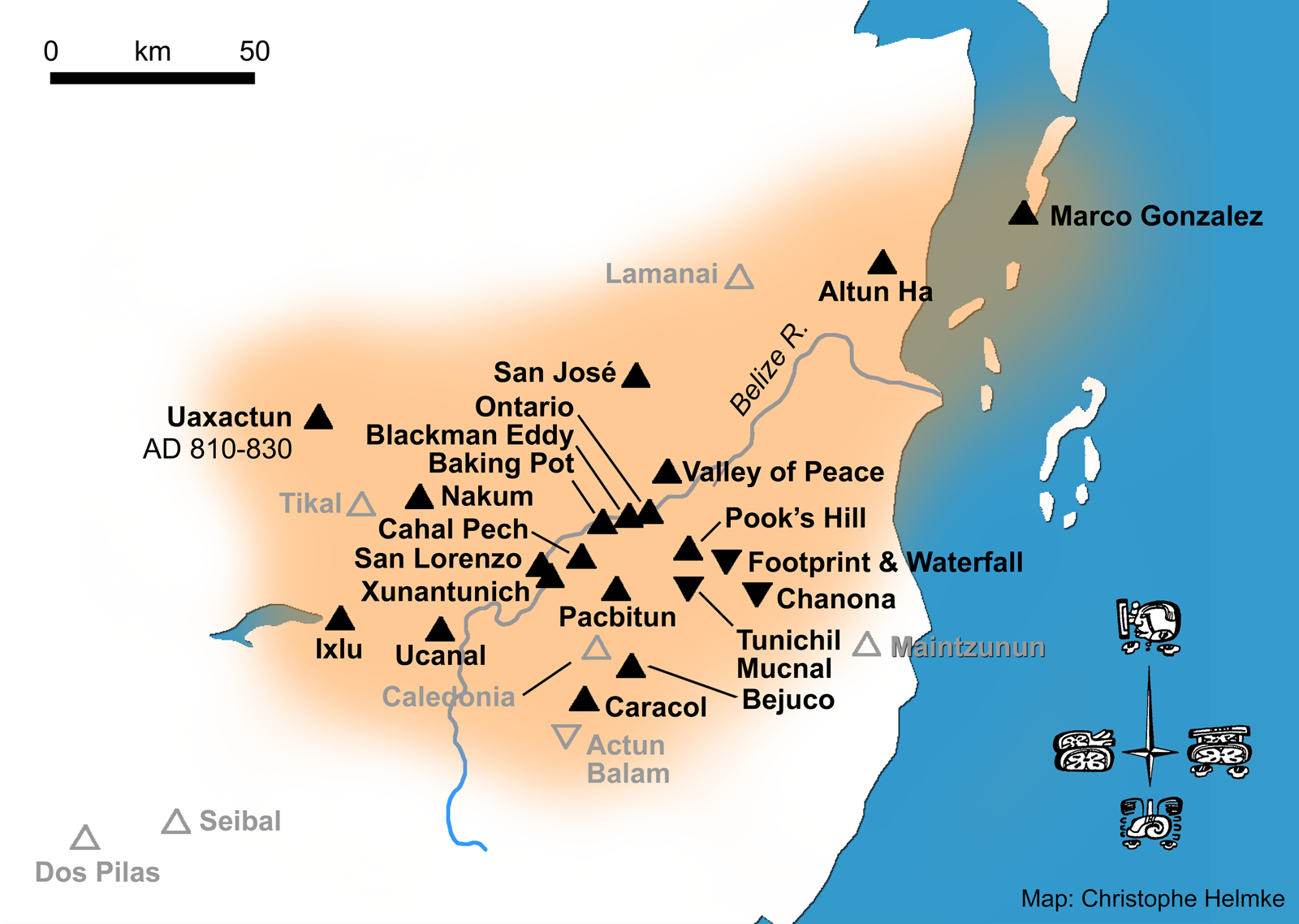
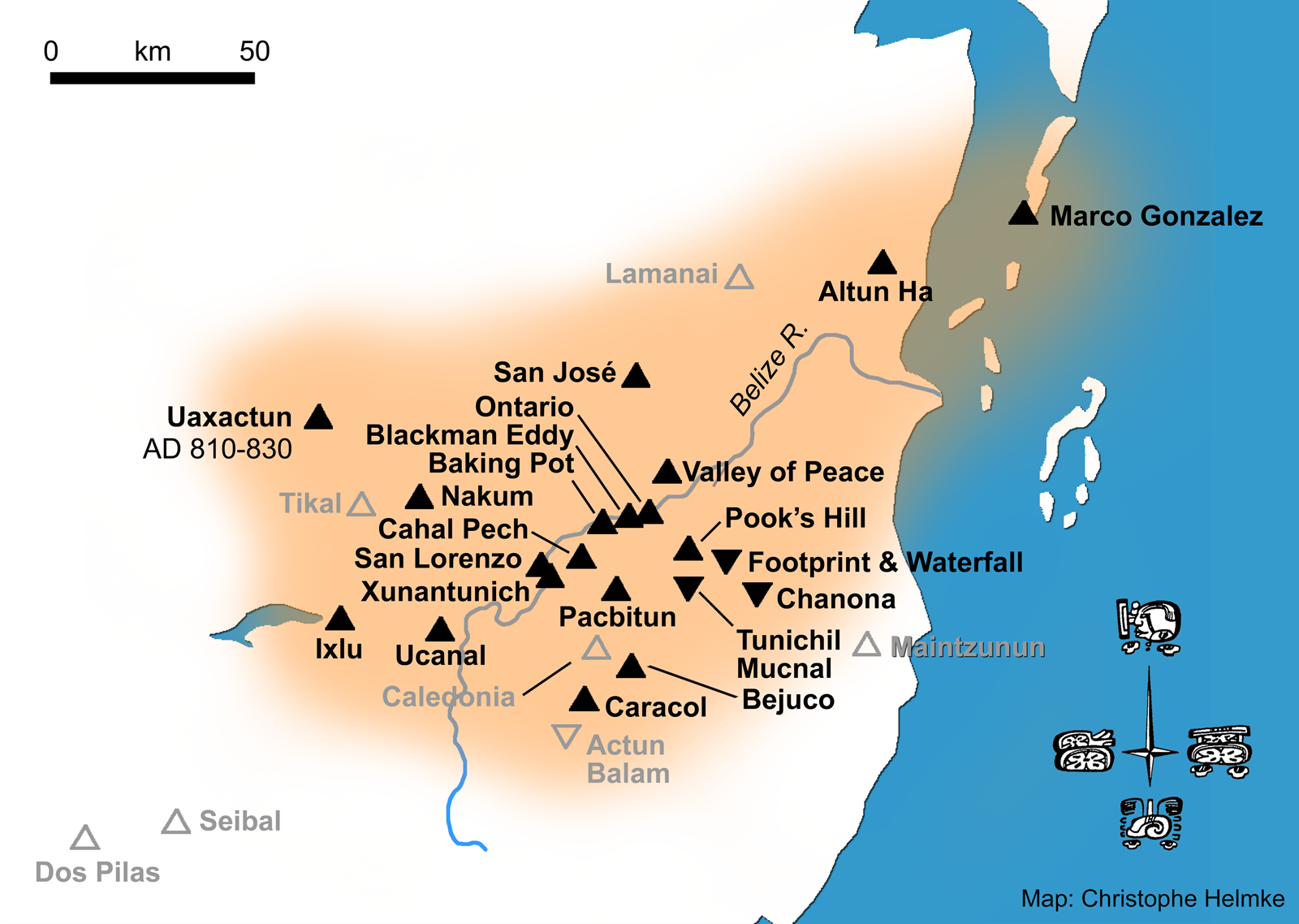
Not only is Olom Jaatz’ mentioned in monuments, he is also featured on numerous mold-made Ahk'utu’ ceramics, distributed in an area of the eastern Maya lowlands that straddles the Belize–Guatemala border (Figure 10). Helmke and Reents-Budet (Reference Helmke and Reents-Budet2008) suggest the glyph band that encircles the Ahk'utu’ drinking cups reference a “Lady Olom,” but others have suggested that the vessel's protagonist Olom is male, not female and the dedicatory inscriptions on these vessels describe them as “the young man's thing for giving” (yahk'utu’ keleem; Carter Reference Carter2014:203; Simon Martin, personal communication 2019). One interpretation that is explored here is that the Ahk'utu’ drinking cups represent male-gendered gifts that served as “boundary objects” (sensu Mills Reference Mills2018). We suggest that these drinking vessels were gifted by kan ek’ Olom Jaatz’ during his visits to distant polities in order to mediate relationships and judicial affairs, which may have included marriage negotiations. Today, a marriage spokesman among the K'ichee’ is called a k'amalb’e, or “road guide,” and serves as a negotiator for the groom among traditional Maya societies (Tedlock Reference Tedlock2002:167–168). In the past, however, a lineage head or b'atab' played this role and was referred to in Yucatek as aj atanzah or “matchmaker” (McNeil Reference McNeil and McNeil2006:362–363; Sharer Reference Sharer2009:171). As the lineage head, kan ek’ Olom Jaatz’ may have served the role of spokesman and marriage negotiator for his chi'ibal. If so, the distribution of the Ahk'utu’ drinking cups may signal his long-distance travel and exchange in an effort to bridge or cross boundaries and form alliances with other noble lineages at sites across central Guatemala and Belize. As previously noted, acceptance of such proposals would have set into motion a series of social obligations and material exchanges within the context of council houses that would have solidified key political alliances during a period of dynastic instability in the southern Maya lowlands. Such exchanges entangled people, places, and objects in the “boundary crossings” of noble families who sought to foment their allied relations through kin ties and marriage partnerships.
Map of distribution of Ahk'utu’ ceramics. Map by Christophe Helmke, after Helmke and Reents-Budet (Reference Helmke and Reents-Budet2008:Figure 6).
A Relational Approach to Boundary Studies: Gathering Things in the Four-Fold
In archaeological studies of boundaries, we often look to materiality as an expression of a singular identity and as a static thing, rather than as a social relation involving multiple groups. Archaeological and anthropological studies of boundaries (and related studies of borders and territories, which boundaries encompass), often implicitly or explicitly stress division and segregation between people, rather than their integration. Yet, as Halperin, Freiwald, and Iannone (Reference Halperin, Freiwald and Iannone2020) note in their introduction to this Special Section, the material signatures of past human practices and interactions “are relational, dynamic, mutually-constituting, and entangled.” In recent years, Maya archaeologists have started to incorporate such relational perspectives in their theorizing of material agency (for a current review see Harrison-Buck [Reference Harrison-Buck, Hutson and Ardren2020]). In these studies, agency “denotes the power of objects to shape human behavior and influence change” (Zedeño Reference Zedeño and Watts2013:121; see also Brown and Walker Reference Brown and Walker2008:297; Pauketat Reference Pauketat2013:27). This work is part of a recent “materialist turn” in archaeology in which studies of materiality consider an object's agency, mobilities, and itineraries as a relational subject (see Joyce and Gillespie [Reference Joyce and Gillespie2015] for further discussion).
A relational approach offers an exciting avenue of exploration in boundary studies, taking into account the agency of materiality and the role various kinds of objects and other nonhuman social actors played in negotiating relationships within and between boundaries. From this perspective, phenomena like objects, buildings, and other forms of materiality are viewed not in isolation but as part of relational collectivities, emphasizing “the interconnectedness or entanglement of people, things, ideas, bodies, relations, and landscapes, with agency itself distributed among them” (Bauer Reference Bauer2019:342). We consider this entanglement in the context of “boundary things” where materiality and immaterial things, such as social roles and obligations are mutually constituted and operate as a relational totality (Hatala Reference Hatala2013:17)—or what Heidegger (Reference Heidegger and Hofstadter1971) has termed “the four-fold” of earth, sky, divinities, and mortals. This concept of the four-fold, which is central to Heidegger's thinking of relationality (Mitchell Reference Mitchell2015:3–4), is useful in this study for understanding how a quadripartite form of Maya cosmological order expressed in the four batabs can also operate simultaneously as a political structure and form of shared governance. From Classic to Colonial times, the four batabs played a fundamental role in the structure of Maya cosmology and also in the structure of regional political power and authority. Citing Jones (Reference Jones1998:Tables 3.7 and 3.8), Rice and Rice (Reference Rice and Rice2018:33) suggest that these “pairs” embodied a quadripartite configuration associated with the four world directions, but concluded, “it is unclear whether they were empirically real or only symbolic.”
This paradox of being real or not real persons or places becomes less problematic from a relational perspective when people, places, and things have the capacity to operate similarly as relational subjects. In this example, batabs can be a set of four paired junior and senior male leaders, perhaps members of the same ch'ib’al who collectively supported their principal ruler and served to integrate otherwise physically separate communities in a landscape. At the same time, these relational subjects can also embody the four-part coessence of the turtle-earth as a rain-making deity, collectively supporting and convening with the heavens for wind and rain each spring. In this way, people, places, material, and immaterial things—the metaphysical—operate simultaneously and become unified and interconnected “gathering things in the four-fold.” While Heidegger stresses unity in his four-fold model, in the Maya four-fold the batabs (both human and more-than-human) are “the between”—a point of convergence, both connecting and dividing (earth and sky) and in this way, exemplify the ongoing tension between integration and division in the gathering of boundary things.
CONCLUSIONS
From this study we conclude that “Mexicanized” non-Classic traits introduced in the eastern Maya lowlands during the Terminal Classic and Postclassic periods signal multiple movements and migrations of noble groups, perhaps from various places, including the Gulf lowlands, Chichen Itza, Mayapan, and other places in northern Yucatan. Yet, these traits also reflect ongoing efforts to maintain continuity in certain traditions that are rooted in earlier times, including the establishment of elite authority through a combination of descent and marriage relations. Beginning in the Terminal Classic, the influx of northern-style circular buildings and open halls emphasize shared governance among a council of men. The introduction of Mexicanized names and dates on molded-carved ceramics points to new allied formations that involved intermarriage with “foreigners” as a means of elite legitimation, which seems to have involved the increased movement and long-distance travel of both men and women across the lowlands.
During the Terminal Classic and Postclassic, council houses appear to have played an increasingly central role in the eastern Maya lowlands. These buildings are especially common in the Postclassic, along with the presence of portable turtle altars that point to genital bloodletting as a group activity among related male kin—senior and junior batabs. Such activities may have served to consolidate allied relations, which were particularly critical during times of war. In the Terminal Classic, male bloodletting ceremonies are directly linked with warfare events involving captive-taking, as shown on the scenes in the molded-carved ceramics (Helmke and Ting Reference Helmke, Ting and Powis2017). Male bloodletting from the genitals is also linked to the renewal of earthly and human fertility and, as such, may have been aimed at preparing young men (junior batabs) in their transition to adulthood, which included marriage and sexual relations (Harrison-Buck et al. Reference Harrison-Buck, Runggaldier and Gantos2018). Stone (Reference Stone and Miller1988:75) suggests that this means of self-sacrifice for young males was among the most potent forms of fertility, conjoining blood and semen. Such expressions of masculinity, coupled with increased displays of warfare, are prominent themes in the Terminal Classic and Postclassic periods. Yet, we suggest that marriage and the maternal line, particularly for lineages on the move, continued to be central to elite legitimation during these fractious periods in Maya history.
In this study, we interpret northern-style architecture and objects as “boundary things” that were implicated and entangled in boundary crossing negotiations among “local” and “foreign” groups. We consider both objects and buildings as “boundary things” and apply a relational model to understand how people, things, and places in the landscape serve as agents in bridging boundaries. Even buildings, despite being fixed places in the landscape, “live through new encounters, contexts, and modifications and are not the same structure they were when first built” (Bauer Reference Bauer2019:343, our emphasis). As conduits, boundary things mark “the between” (sensu Mitchell Reference Mitchell2015), both separating and connecting visitors (fathers and sons, senior and junior council members, husbands and wives, and locals and foreigners), each with a vastly different experience depending on where they came from (Gosselain Reference Gosselain, Roddick and Stahl2016) and their age and position in the “life process” (Ingold Reference Ingold2010). In addition to these transitions in the life cycle, our study considers the agency of materiality during periods of migration and political upheaval. From a relational perspective, the active role objects and architecture played in negotiating relationships between groups is examined at key points of convergence during Terminal Classic and Postclassic times, highlighting the tension between a divided and an integrated landscape in boundary studies.
RESUMEN
En este estudio, se ofrece un enfoque en relación a teorizar las fronteras Mayas, adaptando el concepto de “objetos fronterizos” de Mills (Reference Mills2018) como un medio para comprender cómo las personas y los objetos cruzaron los puentes fronterizos o fronteras. Esto fue fundamental para desarrollar y mantener las relaciones con los aliados. Se trazó una red de sitios en ambos lados de la frontera entre Guatemala y Belice que datan del clásico terminal y el posclásico (a.C. 830–1525 d.C.), generalmente se caracterizan por ser períodos de mayor conflicto, movimiento y migración de personas, además trastornos en la sucesión dinástica con énfasis en la gobernanza compartida. Se examinó la introducción de rasgos del estilo norte en el este de las tierras bajas Mayas durante los períodos clásico terminal y posclásico, incluyendo los edificios circulares y con columnas que servían como casas del consejo, asimismo de artículos portátiles distintivos como cerámica moldeada-tallada, efigies fálicas y de tortugas, además de otras formas materiales que hacen referencia a la guerra y al sangrado genital.
Se examinó la evidencia arqueológica de las estructuras del santuario circular y salones del consejo del clásico terminal y posclásico, lo cual sugiere que la acción relacionada con el sangrado genital se llevó a cabo como actividad grupal entre parientes masculinos: líderes Senior y Junior conocidos como batabs. Tales actividades pueden haber servido para consolidar las relaciones entre aliados, que fueron particularmente importantes durante este período de tiempo. Se analizaron escenas en cerámica moldeada-tallada del clásico terminal, como también otros medios que involucran actividades grupales y ceremonias de derramamiento de sangre directamente relacionadas con la guerra y la toma de cautivos. Estas escenas incluyen evidencia de nombres y fechas no-Mayas que indican la formación de nuevas alianzas involucrando matrimonios mixtos, ósea con “extranjeros” mexicanizados como un medio de legitimación de la élite, lo que sugiere un mayor movimiento y viajes de larga distancia de hombres y mujeres a través de las tierras bajas. Se sugiere que durante el clásico terminal y el posclásico, tales “cruces fronterizos” fueron facilitados por las casas del consejo, que jugaron un papel cada vez más importante en el Este de las tierras bajas Mayas. Ejemplo fue la introducción de rasgos “extranjeros” lo que señala múltiples movimientos y migraciones de grupos nobles, tal vez desde varios lugares, incluyendo las tierras bajas del Golfo, Chichén Itzá, Mayapan y otros lugares en el norte de Yucatán.
Sin embargo, se argumenta que estos rasgos también reflejan los esfuerzos continuos para mantener la secuencia en ciertas tradiciones arraigadas en épocas anteriores; lo cual incluye el establecimiento de la autoridad de élite a través de una combinación de descendencia, guerra y relaciones matrimoniales. En este estudio, se interpretó la arquitectura y los objetos del estilo Norte como “elementos fronterizos” que estaban implicados y mezclados en las negociaciones del cruce de fronteras entre grupos “locales” y “extranjeros.” Desde una perspectiva relacional, el papel activo que desempeñan los objetos y la arquitectura en la negociación y relaciones entre los grupos, se examina en los puntos clave de convergencia durante los periodos del clásico terminal y posclásico, destacando la tensión entre un paisaje dividido e integrado en los estudios de fronteras.
ACKNOWLEDGMENTS
The authors wish to thank the staff members, students, and local field assistants who contributed to research reported herein, which includes the Belize River East Archaeology (BREA) project, directed by Harrison-Buck, and the Itza Archaeology Project, directed by Pugh. Funding for the BREA project was provided by the Alphawood Foundation with additional support from the University of New Hampshire. Funding for the Itza Archaeology Project was supported by the National Science Foundation (BCS-1037927 and BCS-9222373). We thank the governments of Belize and Guatemala for permission to carry out our investigations. Several anonymous reviewers provided valuable and constructive feedback, which served to strengthen and improve this paper. We wish to thank Christina Halperin and Carolyn Freiwald for inviting us to be part of this Special Issue and who generously took the time to provide their comments on earlier drafts of this article. We also extend our gratitude to Evelyn Chan Nieto who kindly edited the translation of the resumen. Any errors or omissions, of course, are solely our own.