In Belgium, pharmaceutical products for which reimbursement is requested are categorized into three classes according to their therapeutic value. Class 1 drugs are drugs with an added therapeutic value compared with existing alternatives, class 2 drugs are those with comparable therapeutic value, and class 3 drugs are mainly generics.
Since 2002, pharmaceutical companies submitting a reimbursement request for a claimed class 1 product must provide an economic evaluation. This may also be required for the revision file, 1.5 to 3 years after the initial reimbursement decision.
Reimbursement requests are evaluated by the Drug Reimbursement Committee (DRC), a division of the National Institute for Health and Disability (NIHDI), based on 5 criteria (1): (i) therapeutic value, taking into account the efficacy, effectiveness, side effects, applicability and user-friendliness of the product; (ii) market price; (iii) clinical effectiveness and likely impact of the product, taking into account therapeutic and social needs; (iv) budgetary impact for the National Health Insurance; (v) cost-effectiveness of the product.
Based on this evaluation, the DRC formulates an advice for the Minister of Health & Social Affairs about the final class of the product (class 1, 2, or 3), the appropriateness of reimbursement, the reimbursement rate and the conditions for reimbursement. The legal basis for the assessment of reimbursement requests for implants and invasive medical devices exists but is not implemented yet (2). So far, there is no requirement to perform an economic evaluation of new devices for which reimbursement is requested.
Since the mandatory request for submitting an economic evaluation for class 1 drugs in 2002, it appeared that there was a large variability in methodological quality and reporting formats of the submitted files, which lead to time-consuming evaluation processes.
In 2008, the Belgian Health Care Knowledge Centre (KCE), an independent semi-governmental public organization, published a first set of guidelines for the economic evaluations of pharmaceuticals in Belgium (Reference Cleemput, Van Wilder and Vrijens3). These guidelines have now been used by assessors and researchers for more than 4 years. This practical experience has highlighted the need for clarifications and further development of the guidelines. The scope of the guidelines was also extended to encompass all medical interventions (i.e., besides drugs also medical devices, screening programs, etc). In addition, a new section on budget-impact analysis (BIA) was included. The new guidelines for economic evaluations have been recently published in a KCE report (Reference Cleemput, Neyt, de Sande and Thiry4) and a summary is presented in this article.
The Belgian guidelines should be used for all reimbursement claims for a class 1 drug for which submission of an economic evaluation is mandatory. The guidelines should further be used for the economic evaluations of drugs from other classes, medical devices, or other interventions. Indeed, even if economic evaluations are not officially required for obtaining the reimbursement of such healthcare interventions, they are nonetheless useful to stimulate the efficient use of limited healthcare resources.
OBJECTIVE
The objective of this article is to present the updated guidelines for economic evaluations of healthcare interventions in Belgium.
METHODS
The first set of guidelines was developed based on a review of existing guidelines from other countries and on a test of the guidelines’ feasibility during a 12-month proof period (Reference Cleemput, Van Wilder and Vrijens3). The update of those guidelines was performed by three Belgian health economists following informal feedback from users (i.e., assessors of the reimbursement requests, independent researchers and pharmaceutical companies) of the former guidelines and personal experience. Recently published international guidelines were consulted (5–7). The updated guidelines were discussed with a multidisciplinary team consisting of other health economists, assessors of reimbursement request files (i.e., experts of the DRC and the Technical Council for Implants), representatives of Belgian databases (Agence Intermutualiste/InterMutualistisch Agentschap, Cellule Technique/Technische Cel), representatives of the drugs industry (Pharma.be and a pharmaceutical company) and medical devices industry (UNAMEC and a medical device company). The final document was reviewed by three external validators who validated the methodological quality, objectivity, and independence of the guidelines. The validators were selected at the start of the project, based on their scientific expertise in the field. None of them was involved in the development of the guidelines or in previous discussions.
The previous set of twelve guidelines was critically reviewed. Major amendments relate to guidelines on the choice of the comparator (it should now be identified on the efficiency frontier), the calculation of costs (numerous sources for identifying costs were added, together with new costing procedures to account for the specificities of the Belgian healthcare financing system) and the valuation of outcomes (preference for using the generic EQ-5D with Belgian index values in cost-utility analyses is now made explicit). The content of the other guidelines was not fundamentally modified.
Guidelines for Economic Evaluations
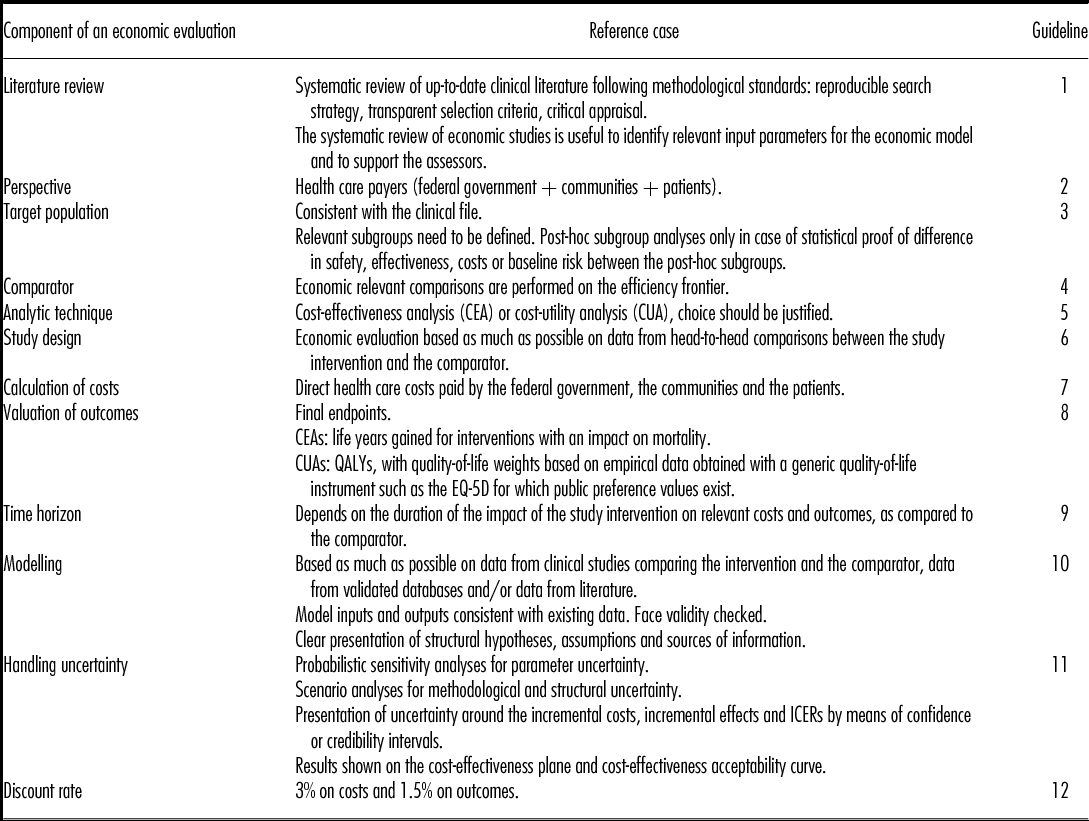
For most methodological aspects, different approaches exist. The guidelines present the choices for each component of an economic evaluation. All these methodological choices together make up the reference case (Table 1) that is the minimal requirement for the Belgian economic evaluations. Additional analyses are allowed, but should be distinguished from the reference case. Variations to the reference case should be justified and well-argued. It is then up to the assessor to decide how much weight it attaches to the additional analyses.
Reference Case Methods for Economic Evaluations

CEA, cost-effectiveness analysis; CUA, cost-utility analysis; QALY, quality-adjusted life-year; ICER, incremental cost-effectiveness ratio.
Guideline 1: Literature Review
The value of an economic evaluation crucially depends on the value of the evidence it is based upon. Each economic evaluation should be accompanied by a description of the disease and the interventions studied and a systematic review of the existing relevant clinical literature. The review should reveal up-to-date evidence for clinical effectiveness of the intervention relative to its appropriate comparator(s). Besides published literature, an overview of ongoing studies should be provided. A review of economic studies is mainly useful to identify relevant input parameters for the context-specific economic model.
The medical and economic literature search strategies should be clearly presented and be reproducible. This includes presentation of the databases searched, date of search, search strings, selection procedure with in- and exclusion criteria, etc. The best available up-to-date evidence can be found following the methodology of systematic literature reviews, as detailed in the guidelines of the Centre for Reviews and Dissemination (8;9). To retrieve primary clinical studies, databases searched should at least include Medline, Embase, The Cochrane Controlled Trials Register, The Cochrane Database of Systematic reviews, and the NHS CRD Database of Abstracts and Reviews of Effectiveness (DARE). Besides Medline and Embase, the economic search strategy should also search the public NHS CRD Economic Evaluation (EED) and Health Technology Assessment (HTA) databases.
The evidence should be critically appraised (e.g., the Rothwell publication for the external validity of randomized controlled trials [RCTs]) (Reference Rothwell10), its quality assessed and data presented in summary tables. A clear and concise synthesis, substantiated with references, should be provided.
Guideline 2: Perspective of the Evaluation
Consistent with the previous guidelines, the reference case should be based on the aggregated costs of all healthcare payers, that is, the patients, the federal government and the three Belgian communities. It is also useful to report the healthcare payers costs in a disaggregated form, that is, as the costs borne by the different categories of payers.
Analyses from a broader perspective are allowed but should be clearly distinguished from the reference case. This can be the case, for instance, if other considerations such as substantial reductions in the absence from work are a major factor for the value of a therapy.
Guideline 3: Target Population
The patient population to which the economic evaluation applies should be consistent with the target population defined in the clinical part of the reimbursement file. The population identified for routine use of an intervention is not necessarily identical to the population included in clinical trials. It may be larger (e.g., in case of strict selection criteria in clinical studies) or smaller (e.g., if a treatment is only cost-effective in a sub-group of the trial population).
If the intervention's effectiveness and/or costs differ between subgroups, as may already have been analyzed in the clinical study, separate subgroup analyses should be performed and a scientific justification provided.
If subgroups were not analyzed in the clinical study, subgroup analyses might still be useful for the economic evaluation. Such post-hoc subgroup analyses are only allowed if the safety, effectiveness or costs between subgroups are proven to be different based on appropriate statistical analyses or if the baseline risk for events differs between subgroups. When the baseline risk differs between the subgroups, the relative effectiveness should still be assumed equal across subgroups (Reference Neyt, Cleemput, Thiry and De Laet11). The relative effectiveness to be used in this case is the one found in the complete sample of the clinical trial(s).
Guideline 4: Comparators
The intervention should be compared with alternative interventions with proven efficacy (in RCTs) and clinically recommended for the target indication. The choice of the comparator(s) should always be justified. To stimulate the efficient use of resources, the inclusion of an “off-label” used product as a comparator in the reference case is only allowed if there is evidence about its clinical safety and efficacy. The evidence should be described in the literature review.
The previous guidelines stated that comparisons should be done with the most relevant alternative treatment most likely to be replaced by the new intervention. To avoid the fallacious improvement of the incremental cost-effectiveness ratio (ICER) of an intervention by comparing it to a non–cost-effective intervention, the current guidelines recommend that comparisons should be performed on the efficiency frontier (Reference Neyt and Van Brabandt12). This involves the identification of all relevant treatments for the targeted indication and population, the removal of dominated or extendedly dominated interventions from the list of relevant comparators, and the calculation of the ICERs of all interventions compared with the next best alternative (Reference Briggs, Sculpher and Claxton13;Reference Goeree, O’Brien and Hunt14).
If the comparator commonly used in clinical trials is no longer relevant, for example, due to changes in prescription behavior over time, indirect comparisons may be required. Indirect comparisons are only allowed if no single trial of appropriate quality has been performed. Appropriate statistical techniques must be used (Reference Bucher, Guyatt, Griffith and Walter15–Reference Song, Altman, Glenny and Deeks17). The choice for an indirect rather than a direct head-to-head comparison should be explained, together with the limitations of the indirect comparison.
Guideline 5: Analytic Technique
The report should specify whether a cost-effectiveness or cost-utility analysis is used. Justification for choosing a particular analytic technique should be provided.
Cost-effectiveness analysis (CEA) should be used if improving life expectancy is the main objective of the treatment and the most important outcome for the patient. Outcomes of CEAs should be expressed in euro per life-year gained.
Cost-utility analysis (CUA) should be used if the treatment has an impact on health-related quality of life that is significant to the patient or if there are multiple patient-relevant clinical outcomes expressed in different units that cannot be translated into one common unit in a valid way (e.g., side effects and survival). Outcomes of CUAs should be expressed in euro per quality-adjusted life-year gained. If a cost-utility ratio is presented as the result of a reference case, the corresponding cost per life-year gained should also be presented.
Cost-minimization analyses are used if the effects of two treatments are identical. Hence, cost-minimization analyses can only be justified by proof of equal outcome. Cost-benefit analyses are not accepted as a reference case for economic submissions.
Guideline 6: Study Design
Economic evaluations can be performed alongside an RCT (“piggyback” evaluation) or an observational study, or be based on a model. Each design has its peculiarities and specific caveats. Analysts should be explicit about the limitations of their design and explain the methods used to deal with these limitations.
RCTs have the strongest design to demonstrate differences in clinical efficacy, which can be causally linked to the treatment. Weaknesses of RCTs for the purpose of economic evaluations are, amongst others, potentially inappropriate comparator, inadequate sample size, limited time horizon, protocol-driven costs or outcomes, inappropriate outcome measures and patient selection. Observational studies avoid some of the weaknesses of RCTs but may nevertheless be insufficient to demonstrate long-term (cost-) effectiveness of a product, for example, if there is no comparator group. Whenever possible, economic evaluations should be based on data from RCTs comparing the study intervention and a relevant (active) comparator.
Even if RCTs or observational studies exist, some modeling is likely to be needed (e.g., to extend the time horizon to longer time spans). In that case, the number of assumptions not based on clinical evidence should be reduced to a minimum and be fully justified. A separate guideline is devoted to modeling (guideline 10).
Guideline 7: Calculation of Costs
The identification, measurement and valuation of costs should be consistent with the Belgian healthcare payers’ perspective. Healthcare costs borne by the different governments (federal and local) and the patients should be reported both separately and aggregated.
Identification
The reference case should only include direct healthcare costs, that is, costs directly related to the treatment of the disease over the patients’ lifetime. Direct costs outside the healthcare sector (e.g., travel costs), productivity costs and healthcare costs associated with unrelated diseases should not be included in the reference case, but may be reported separately. In this case, the impact of the intervention on these elements should be demonstrated.
Measurement
Volumes of resources used should be measured by means of observations or derived from literature. Observations offer the best guarantee that the estimates are specific for Belgium. Observations can be obtained from clinical trials, prospective observational studies, databases and patient charts. Expert panels are preferably only used as a complementary source of information. Official governmental databases (Reference Van De Sande, De Wachter and Swartenbroekx18) should be used whenever possible provided that they comply with legal requirements about privacy. The weaknesses of these databases should be discussed, together with their potential impact on the cost estimates. If derived from literature or studies from other countries, resource use estimates should be validated for Belgium.
Valuation
In principle, costs are valued at opportunity costs. In practice, opportunity costs will be approximated by market prices or tariffs used for the reimbursement of procedures (e.g., the Belgian per diem hospitalization price). For reasons of uniformity between analyses, it is suggested to use these proxies in the reference case, knowing that they do not necessarily reflect real opportunity costs. Alternative cost estimates, for example, based on micro-costing approaches, can be presented in alternative scenarios, supported with a clear justification.
The values should reflect Belgian prices/costs for each resource item. Valuation of resource use by means of simple currency conversion of values found in studies from other countries is not acceptable. All costs should be expressed in values for the current (or most recent) year. If this is not possible and costs from past years are used, these costs should be inflated using the appropriate Health Index figures, if relevant. Index figures can be obtained from the Web site of the Belgian Ministry of Economic Affairs (19).
Several Belgian references and sources for the measurement and valuation of resources (drugs, healthcare services, devices.–.–.) have been added and can be found in the original report (Reference Cleemput, Neyt, de Sande and Thiry4). Furthermore, a new methodology was developed to standardize the valuation of some resources that are crucial when estimating Belgian hospitalization costs (i.e., the average per diem hospitalization prices and the hospital lump-sums for drugs, medical imaging, and clinical biology) (Reference Cleemput, Neyt, de Sande and Thiry4).
Guideline 8: Estimation and Valuation of Outcomes
Outcomes in economic evaluations should be expressed in terms of final endpoints instead of intermediary outcomes. All outcomes should be incorporated, including those associated with positive and negative effects of the treatment (e.g., adverse side effects).
Outcomes should be expressed in terms of life-years gained. Age- and gender-specific life tables for Belgium should be used (20). The estimated effectiveness should be based on all-cause mortality in the reference case. Estimates based on disease-specific mortality can be presented in complementary analyses.
If quality-adjusted life-years (QALYs) are calculated, quality-of-life assessment should be done in two steps. The first step is to obtain the description of the health states by patients on a generic descriptive system such as the EQ-5D. The use of proxies to describe the health states is only accepted if patients cannot describe their health state themselves (e.g., mentally ill patients, very young children, etc). The reason for using proxies should always be justified. Scenarios with disease-specific measures and scenarios including effects on caregivers’ health-related quality of life can be presented as complementary analyses but are not accepted as reference case. The second step consists of assigning a value between 0 (= dead) to 1 (= perfect health) to the health states descriptions. Values should come from (a representative sample of) the general public. If the EQ-5D is used, the Belgian (Flemish) tariff values should be applied (Reference Cleemput21). Mapping valuations from other health-related quality-of-life instruments (e.g., disease-specific instruments or another generic instrument) to EQ-5D public preference values should be avoided.
To avoid possibilities for manipulation of the quality-of-life values, it is now recommended in the Belgian guidelines to use the EQ-5D specifically, and the same set of utility values for the health states (so-called “EQ-5D tariff”) across all economic evaluations. Moreover, it is recommended to calculate QALYs based on original Belgian empirical data. If this is not possible, for example, because the original clinical study was performed in another country, two options exist: (i) Either primary data on the health state descriptions should be obtained and “translated” into utility values based on the Belgian tariffs; (ii) Or, in case of secondary data analysis, health-related quality-of-life and utility data used in the economic analysis should originate from the same country.
Adjustment for baseline (age- and gender-specific) health-related quality of life is required in estimating the incremental utility of an intervention. When quality-of-life data from another country are used, baseline health-related quality-of-life data should also be from that country. For treatments leading to complete remission to normal health, reference data on quality of life from the general population should ideally be used. However, in Belgium such data are not available yet. Reference data from another country should be used for now. A separate study is devoted to quality of life (Reference Cleemput, Neyt, de Sande and Thiry4).
Guideline 9: Time Horizon
The time horizon of the economic evaluation should be in concordance with the period over which the main differences in costs and health consequences between the intervention under consideration and its comparator are expected. Health consequences include intended as well as unintended consequences (e.g., side effects).
Guideline 10: Modeling
Models may be used for different reasons: bringing together all best available data, extension of time horizons, extrapolation of intermediate to final outcomes, simulation of effectiveness as compared to efficacy, comparing the intervention with its relevant comparator(s), consideration of externalities associated with a treatment, etc. The decision to model should be justified. Guidelines for good general modeling practices (Reference Weinstein, O’Brien and Hornberger22;Reference Caro, Briggs and Siebert23) and for infectious disease modeling (24) ought to be followed whenever a model is built.
Different types of models and modeling softwares can be used as long as the model remains transparent to allow critical appraisal. The main principle is that a model should be as simple as possible. Models should be based as much as possible on data from clinical studies, data from validated databases and/or data from literature. If modeling is performed, the structural hypotheses, assumptions and sources of information should be justified. All studies that served as a basis for the modelling input parameters’ valuation should be described in detail (methodology used, assumptions, results).
The results of the model should be intuitively correct (face validity) and logically consistent with real-life observations (calibration). The model description should be transparent enough to allow the comparison with other models (cross-validation).
Primary data and original sources of information as well as the original computer model should be kept at the disposal of the assessors.
Guideline 11: Handling Uncertainty
Irrespective of the study design, the uncertainty surrounding the cost-effectiveness/cost-utility estimates should be analyzed. Parameter, structural and methodological uncertainty (Reference Gray, Clarke, Wolstenholme and Wordsworth25) should be specifically addressed in sensitivity analyses.
Parameter uncertainty is the uncertainty around input parameters. This uncertainty is handled by means of probabilistic and one- or multiple-way sensitivity analyses. Structural and methodological uncertainty comes from the analytical methods chosen to perform the evaluation (e.g., discount rate or extrapolation methods). This uncertainty is handled by presenting results from a methodological reference case and other scenarios handled through one-way sensitivity analyses.
In case of modeling, probabilistic sensitivity analyses should be performed on all uncertain parameters (e.g., Monte Carlo simulations where all uncertain parameters are allowed to vary according to a predefined distribution). Distributions used for the uncertain parameters should be justified. Uncertainty around the incremental costs, incremental effects and ICERs should be provided by means of confidence or credibility intervals. A cost-effectiveness plane and cost-effectiveness acceptability curve should be presented. The most important contributors to the uncertainty of the estimated ICER should be shown, for example, by means of a Tornado diagram. In addition to probabilistic sensitivity analyses, univariable sensitivity analysis could be performed on modeling parameters that are decisive for the ICER, such as the price of a product.
Guideline 12: Discount Rate
ICERs should be presented in current values. This means that future costs and benefits should be discounted to reflect the lower value given to future costs and benefits.
The discount rate for costs in Belgium was previously set at 3 percent. This rate is maintained to allow the comparison with previous economic evaluations. Likewise, the discount rate for outcomes remains 1.5 percent in the reference case.
Alternative scenarios should be presented in the sensitivity analysis, e.g., 0 percent, 3 percent or 5 percent discount rate for both costs and outcomes.
CONCLUSIONS
The current guidelines are developed as a tool to improve the methodological quality, transparency and uniformity of economic evaluations in Belgium. This will increase their consistency and provide support to both researchers and assessors of economic evaluations. They will further encourage researchers setting up trials to anticipate the needed input parameters for economic evaluations.
The ultimate decision to reimburse or not reimburse a medical intervention will depend on the quality of the submission file and on the therapeutic value of the intervention. The decision will also depend on other aspects that may not be considered explicitly in the submission but may nonetheless be important from a health policy perspective, for example, equity implications, patient characteristics and organizational issues. As such, the economic evaluation will be but one input in the decision-making process (Reference le Polain, Franken, Koopmanschap and Cleemput26). Other information or additional analyses that may provide relevant information to the policy maker may be presented but should be clearly separated from the original economic evaluation. Quality and consistency in health economic submissions might improve the extent to which such evaluations can reliably and consistently be used in the reimbursement decision-making process.
Just as for the development of any guidelines, normative choices had to be made which reflect preferences for dealing with some methodological/practical issues. Other countries may have made different choices. This precludes (to some extent) the transferability and generalizability of the economic evaluations performed according to Belgian standards.
The guidelines encompass today's “state of the art” methodologies for economic evaluations in Belgium. As this field of expertise is continuously evolving, these guidelines will have to be updated to address emerging practical issues and to ensure that most appropriate designs and methods are used in Belgian economic evaluations.
CONTACT INFORMATION
Nancy Thiry, MSc (Nancy.Thiry@kce.fgov.be), Mattias Neyt, PhD; Stefaan Van De Sande, MD; Irina Cleemput, PhD, Belgian Health Care Knowledge Centre (KCE), Doorbuilding, Boulevard du Jardin Botanique, 55, B – 1000 Brussels, Belgium.
CONFLICTS OF INTEREST
The authors have no conflicts of interest and have nothing to disclose.