INTRODUCTION
Bats (Chiroptera) perform key ecosystem services and are one of the most speciose, diverse and widespread of mammalian orders. They have been implicated in recent outbreaks of high-profile viral zoonoses, including rabies, Ebola, Nipah, Hendra and SARS-related coronaviruses (Calisher et al. Reference Calisher, Childs, Field, Holmes and Schountz2006) and the recent devastating effects of White-nose syndrome in the USA highlights that bats themselves are not exempt from emerging pathogens (Blehert et al. Reference Blehert, Hicks, Behr, Meteyer, Berlowski-Zier, Buckles, Coleman, Darling, Gargas, Niver, Okoniewski, Rudd and Stone2009).
Although generally not considered to be pathogenic, gastrointestinal helminths are known to influence host immune status (Maizels and Yazdanbakhsh, Reference Maizels and Yazdanbakhsh2003) and hence may have a role in the overall health status of an individual animal and may influence the outcome of co-infection with other parasites. The bat immune system is not well understood (Calisher et al. Reference Calisher, Childs, Field, Holmes and Schountz2006). Moreover, studies that focus upon bat helminth communities are relatively rare compared to those of other wild mammals. Indeed, the majority of data on helminths of chiropteran populations comprise checklists of species, new species descriptions and new host, or locality records (Webster and Casey, Reference Webster and Casey1973; Marshall and Miller, Reference Marshall and Miller1979; Esteban et al. Reference Esteban, Oltra Ferrero and Mas-coma1990; Lotz and Font, Reference Lotz and Font1991; Botella et al. Reference Botella, Sanchez and Esteban1993; Ricci, Reference Ricci1995; Shimalov et al. Reference Shimalov, Demyanchik and Demyanchik2002; Nahhas et al. Reference Nahhas, Yang and Uch2005). Such studies indicate that bats are infected with a rich diversity of helminths, including trematode, cestode and nematode species; however, there remains a paucity of data on parasite community composition and the factors that may influence community structure.
Further investigations of bat helminths are likely to generate insight not only into bat-parasite interactions but also contribute to a wider understanding of host-parasite associations. To date, investigations of bat-associated helminths have illustrated a dominance of trematodes within the bat gastrointestinal tract (Lotz and Font, Reference Lotz and Font1991; Ricci, Reference Ricci1995; Shimalov et al. Reference Shimalov, Demyanchik and Demyanchik2002). As most studies have focused upon insectivorous bat species, this observation is most likely due to the diet and foraging habits of the hosts. The life cycle of bat-associated trematodes most likely involves intermediate hosts; a mollusc and an insect secondary intermediate host. Encystment of the metacercariae has been demonstrated to occur within aquatic insect larvae (Macy, Reference Macy1960), which may then be ingested, upon emergence of the adult insect, by a foraging bat.
The most abundant UK bat species are the common pipistrelle (Pipistrellus pipistrellus) and the soprano pipistrelle (P. pygmaeus) (Harris et al. Reference Harris, Morris, Wray and Yeldon1995). The relative success of this genus compared to other bat genera in the UK is most likely a result of their ability to exploit housing estates that have replaced farm and woodland areas. As a consequence of their ability to roost in modern buildings, pipistrelle bats have more contact with human populations and their domestic animals than other species of bat in the UK. This contact enabled these enigmatic, nocturnal mammals, to be the subject of examination in the present study.
To our knowledge, published records of chiropteran helminths in the UK appear to be absent. As such, the primary aim of the current study was to identify gastrointestinal helminth parasites present within pipistrelle bats of Greater Manchester and Lancashire, and hence establish some baseline data on helminth parasites of chiropterans in the UK. In order to accomplish this, both morphological and molecular analyses were utilized; the latter allowing a revised assessment of the phylogeny of bat-associated lecithodendriids.
MATERIALS AND METHODS
Collection and processing of bat specimens
To comply with legislation, the Natural England Wildlife Management and Licensing Service were informed of the research intentions of the study and a licence under the Habitats Directive to possess and transport dead specimens and/or derivatives of bats for scientific purposes was obtained. Acquisition and processing of all bat specimens complied with current legislation and guidelines (Wildlife and Countryside Act, 1981; The Conservation (Natural Habitats, &c.) Regulations, 2007, amended). All specimens had either died of natural causes, or had been euthanized due to moribund injuries. Euthanasia, by severance of the spinal cord, was only carried out after a decision had been made by a qualified member of The South Lancashire Bat Group.
Between September 2005 and September 2008, a total of 99 pipistrelle bats were collected from locations across Greater Manchester and Lancashire; the details of specimen location (OS grid reference) and approximate date of death were recorded (Lord, 2010; Ph.D. thesis). Each bat was placed into age categories of ‘pup’, ‘juvenile’ or ‘adult’, based on fur texture and wing epiphyseal fusion (Anthony, Reference Anthony and Kunz1988) and then weighed with a precision balance and frozen at −20°C prior to parasite analyses (Lord, 2010; Ph.D. thesis).
The bats were identified to genus level using classical morphological features (Stebbings et al. Reference Stebbings, Yalden and Herman2007) and species was confirmed by PCR amplification of the NADH dehydrogenase subunit 1 gene (Mayer and von Helversen, Reference Mayer and von Helversen2001), restriction digestion of the PCR product with HindIII (New England Biolabs, Ipswich, MA, USA) and analysis by agarose gel electrophoresis.
Collection and identification of helminths
The gastrointestinal tract was dissected from each bat and immersed in phosphate-buffered saline in a Petri dish. The stomach and intestine were opened and examined for the presence of helminths using a stereo-microscope. Individual helminth specimens were examined by light microscopy at x100 and x400 magnification. Measurements taken included the length and width at the widest point of the body, and the size and position of the oral sucker, pharynx, acetabulum, testes, ovary and vitellaria. Morphological descriptions compiled from observations were cross-referenced with the available literature on species known to be present in bats (Olsen, Reference Olsen1937; Dawes, Reference Dawes1956; Zdzitowiecki, Reference Zdzitowiecki1969; Botella et al. Reference Botella, Sanchez and Esteban1993; Tkach et al. Reference Tkach, Pawlowski and Sharpilo2000b). Helminths were imaged using a Leica DM500 light microscope with Leica DFC 295 digital camera attachment and either preserved in 10% (v/v) neutral-buffered formalin, or placed in 70% (v/v) ethanol and stored at −20°C. Representative specimens were archived in vials with the Parasitic Worms Group, The Natural History Museum, London.
Genomic DNA was extracted and purified from individual ethanol-fixed trematodes using standard phenol:chloroform and ethanol precipitation techniques (Sambrook and Russell, Reference Sambrook and Russell2000). The purified genomic DNA was resuspended in Tris-EDTA (pH 7·4) buffer and stored at −20°C prior to molecular analysis. A 5′ region of the 28S rRNA gene was PCR amplified from individual digenean DNA samples using a universal oligonucleotide, LO, and digenean specific oligonucleotide, dig12 (Tkach et al. Reference Tkach, Pawlowski and Mariaux2000a). PCR products were purified using the StrataPrep PCR purification kit (Agilent Technologies, Santa Clara, CA, USA). Sequence data were obtained (Source BioScience LifeSciences, Nottingham, UK) from purified PCR products derived from 2 helminth specimens of each morphological type and any ambiguities were resolved by at least 2 independent sequencing reactions. All trematode DNA sequence data were submitted to the GenBank™ database.
Statistical analyses
For prevalence, 95% confidence limits were calculated using Sterne's exact method (Reiczigel, Reference Reiczigel2003) and abundance was summarized by the arithmetic mean +/− s.e.m. Frequency distributions of helminth abundance were compared to the negative binomial distribution (Bliss and Fisher, Reference Bliss and Fisher1953) and described using the Index of Discrepancy (Poulin, Reference Poulin1993). Frequency distributions between host sex and age classes were compared using the Brunner-Munzel test of stochastic equality (Reiczigel et al. Reference Reiczigel, Zakarias and Rozsa2005).
Helminth infracommunity structures of a subset of 51 P. pipistrellus bats (41 adults and 10 juveniles) were analysed using GraphPad Prism and Quantitative Parasitology 3, according to published guidance (Rozsa et al. Reference Rozsa, Reiczigel and Majoros2000). The categories of ‘common’ (prevalence greater than 10%) and ‘rare’ (prevalence less than 10%) helminth species were utilized (Bush et al. Reference Bush, Aho and Kennedy1990). The Kruskal-Wallis test was used to compare the abundance of each helminth species. The likelihood of a bat being co-infected with specific combinations of helminth species was assessed using the Spearman's rank correlation coefficient. Further statistical analyses of potential helminth species interactions were precluded due to limited sample size.
Analyses of helminth prevalence and abundance were made with respect to host sex, host age (2 levels; adult and juvenile) and year (3 levels; 2006, 2007 and 2008) using statistical models in R (R Development Core Team, 2011). Month of collection could not be included as an explanatory variable due to limited sample size. Analysis of prevalence (represented in binary form; 0=uninfected, 1=infected) was undertaken using a multifactorial generalised linear model (GLM) with quasi-binomial error and a logit-link function (Crawley, Reference Crawley2005). Abundance was analysed using multifactorial GLMs with quasi-Poisson error and a log-link function (Crawley, Reference Crawley2005) and also using negative binomial error with log-link function (Venables and Ripley, Reference Venables and Ripley2002). Three samples acquired during the bat hibernation period were omitted from all modelling analyses so that only active season infections were analysed. A single sample obtained in 2005 was also omitted. In each case, the minimum adequate model was obtained by step-wise progression from the maximal model, through a series of deletions of non-significant factors/interactions, to arrive at the most parsimonious model. Three-way interactions and the age:year interaction could not be analysed in models that included the factor level 2008 (model A), due to limited sample size and the absence of juvenile specimens in this year. Therefore the potential effects of three-way interactions and the age:year interaction, upon prevalence and abundance, were investigated by repeating the analysis utilizing only 2006 and 2007 as factor levels (model B).
Phylogenetic analysis
Phylogenetic analysis of bat-associated members of the family Lecithodendriidae was carried out, based upon a 733 bp region of the 28S rRNA gene and incorporating sequence data derived from trematodes characterized in this study. A branch and bound search, under maximum parsimony optimality criterion in PAUP* (Swofford, Reference Swofford2004), was applied to sequences aligned using ClustalW (Thompson et al. Reference Thompson, Higgins and Gibson1994), with 1000 bootstrap replications to establish nodal support. The Plagiorchis vespertilionis 28S rRNA sequence (Tkach et al. Reference Tkach, Pawlowski and Mariaux2000a) was utilized as the outgroup. Gaps in the alignment were treated as missing and the positions remained unweighted. A 50% bootstrap majority-rule consensus tree was produced and viewed using TreeView (Page, Reference Page1996).
RESULTS
The host population and gastrointestinal helminth infection
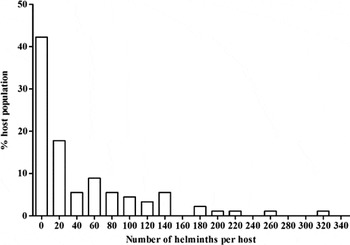
Following morphological inspection and molecular analysis of the pipistrelle NADH dehydrogenase subunit 1 gene (data not shown), the host population was confirmed as comprising 93 P. pipistrellus and 6 P. pygmaeus bats. The characteristics of this sample set are summarized in Table 1. Mean body weights were within accepted ranges for pipistrelle bats; however, due to the sampling methodology, it was not possible for the majority of specimens to comment with certainty about health status and the cause of death. Helminths were isolated from the gastrointestinal tract of 76% of the adult and juvenile bat specimens; no pups were infected. Based upon morphology, all helminths were classified as trematodes; nematodes and cestodes were absent in all the examined hosts. Total helminth infection levels ranged from 0 to 328, with a mean abundance of 48·2 (+/−7·0 s.e.m). The frequency distribution of the number of helminths per bat did not statistically fit a negative binomial distribution (χ 2=30·1, d.f.=14, P=0·05) (Fig. 1) and the Index of Discrepancy was 0·648.
Frequency distribution of the total number of helminths per host isolated from 90 adult and juvenile pipistrelle specimens.

Summary of the pipistrelle population sampled from the Greater Manchester and Lancashire region

Identification of helminth species
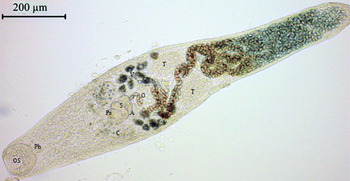
To facilitate an analysis of bat helminth infracommunity composition, helminth species data were determined from a subset of 51 P. pipistrellus. The following trematodes (voucher codes in parentheses): Lecithodendrium linstowi (NHMUK 2011.5.25.15-16), L. spathulatum, Prosthodendrium sp. (NHMUK 2011.5.25.17-18), Plagiorchis koreanus (NHMUK 2011.5.25.14) and Pycnoporus heteroporus, were identified using a combination of morphological and molecular analyses of individual helminths isolated from the gastrointestinal tracts of the host specimens. L. linstowi was always localized to the duodenum and upper sections of the jejunum, whereas the other identified trematodes were isolated from the ileum. Although not assigned to species level, all specimens identified as belonging to the genus Prosthodendrium had the vitelline follicles localized between the acetabulum and testes and never anterior to the acetabulum (Fig. 2). Two of the 6 P. pygmaeus specimens examined also contained gastrointestinal helminths that were identified as L. linstowi and L. spathulatum and these were localized within the gastrointestinal tract as described above for the common pipistrelle.
Micrograph image of a representative specimen of Prosthodendrium sp. isolated from the gastrointestinal tract of a common pipistrelle bat. OS, oral sucker; Ph, pharynx; A, acetabulum; Ps, pseudobursa; S, seminal vesicle; CP, cirrus pouch; C, caeca; T, testes; O, ovary; V, vitellaria; U, uterus.

Analysis of helminth assemblages
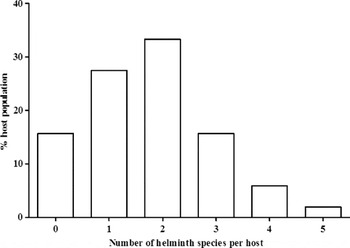
One P. pipistrellus specimen was infected with all the identified species of trematode; however, the largest proportion of hosts (33%) was infected with combinations of 2 of the species (Fig. 3), the most common pair being L. linstowi and L. spathulatum (Rs=0·32, P=0·02). Other positive associations were observed between L. linstowi and P. heteroporus (Rs=0·30, P=0·03), L. linstowi and Prosthodendrium sp. (Rs= 0·29, P=0·03) and L. spathulatum and P. koreanus (Rs=0·29, P=0·03). Statistical analyses were not undertaken for subsets of samples, including a comparison of assemblages between common and soprano pipistrelles, due to the relatively small sample size.
Histogram showing the number of helminth species per host within the subset of 51 Pipistrellus pipistrellus specimens for which gastrointestinal helminths were identified: Lecithodendrum linstowi, L. spathulatum, Prosthodendrium sp., Plagiorchis koreanus and Pycnoporus heteroporus.

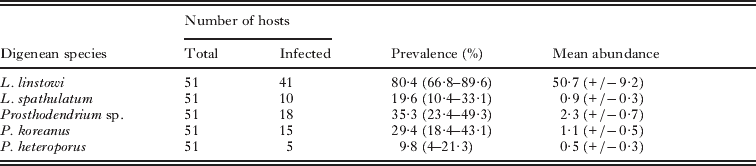
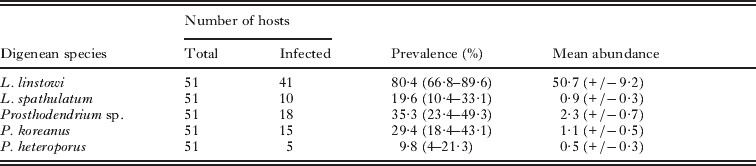
With the exception of P. heteroporus, the other trematodes were classified as being ‘common’ within the pipistrelle population. L. linstowi was significantly more abundant than the other species identified (P<0·0001) (Table 2). Fitting a negative binomial distribution (χ 2=24, d.f.=17, P=0·05), the frequency distribution of numbers of L. linstowi per host recorded the Index of Discrepancy value of 0·61, which implies significantly less aggregation (P<0·001) than the distributions observed for the 4 other species of trematode identified (Index of Discrepancy values in parenthesis): L. spathulatum (0·867), Prosthodendrium sp. (0·811), P. koreanus (0·856) and P. heteroporus (0·930).
Prevalence and abundance data for the trematodes identified within the collection of Pipistrellus pipistrellus specimens
Helminth infection with respect to host and environmental factors
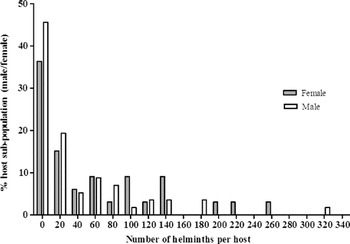
Statistical modelling using GLMs confirmed that potential interactions between any of the explanatory variables; host age, sex and year of collection, did not significantly (P⩽ 0·05) affect total helminth prevalence or abundance. Helminth prevalence was not significantly different between male (76·8%) and female pipistrelle bats (76·5%); however, the distribution of helminths did differ significantly between the sexes (P=0·05), with males exhibiting a more aggregated distribution (Index of Discrepancy= 0·667) than female specimens (Index of Discrepancy=0·586) (Fig. 4). According to the Poisson GLM, there was also a significantly lower mean helminth abundance in males (33·9 +/−6·5) compared to females (62·5 +/−12·7); the significance of removing sex from each GLM being F 1,85=6·35, P=0·0138 for model A and F 1,72=4·254, P=0·0429 for model B. Age was not a significant factor in GLMs for prevalence or abundance and the distribution of helminths amongst adults was not significantly different from that observed in juvenile hosts (data not shown).
Frequency distribution of the total number of helminths per host isolated from 43 adult male and 31 adult female bats.

There was a significant increase in helminth prevalence throughout the sample acquisition period 2006–2008 (Table 3) according to binomial GLM models; the significance of removing year from the models being F 2,85=6·7, P=0·002 for model A and F 1,72=4·5, P=0·0384 for model B. Mean helminth abundance also increased significantly between 2006 and 2008 (Table 3) according to Poisson model A; the significance of removing year from the model being F 1,72=3·164, P=0·0475. However, mean helminth abundance did not increase significantly between 2006 and 2007 according to model B. The Index of Discrepancy decreased between 2006 and 2008 (0·709, 0·613 and 0·432 respectively), indicating that the distribution of helminths became less aggregated over the study period, in accordance with the increase in abundance.
Summary of helminth infections in the juvenile and adult pipistrelle population with respect to the year of specimen collection

* 9 pups were excluded from this analysis.
Negative binomial GLMs were in agreement with Poisson GLMs, verifying the significant effect of sex and also year of sample acquisition, upon helminth abundance (data not shown).
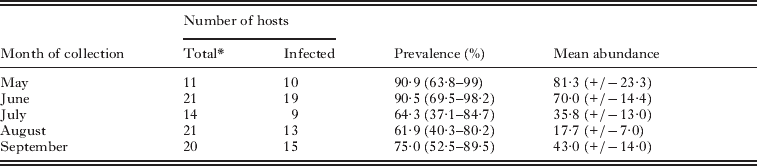
Throughout the period of study there appeared to be a trend in total helminth prevalence and abundance with respect to the season of acquisition of the bat specimens. Helminth prevalence and abundance were higher in bats acquired during the early summer months (May/June) than those acquired in mid-late summer (July/August), and increased again in individuals acquired in September (Table 4). This apparent trend could not be investigated further utilizing GLMs due to limited sample size.
Summary of helminth infections in the juvenile and adult pipistrelle population with respect to the month of specimen collection
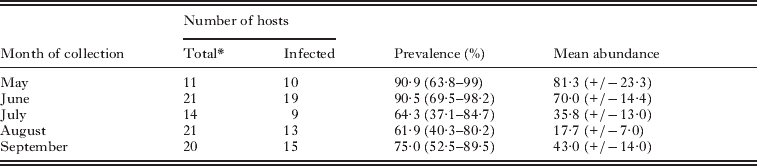
* 12 bats were excluded from this analysis; 9 pups and 3 adults that were acquired during the non-active season.
Phylogenetic analysis
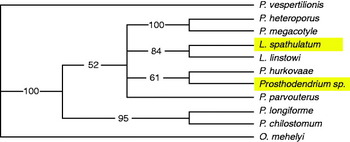
Inspection of GenBank™ confirmed that the 28S rRNA gene sequences derived from specimens identified morphologically as L. linstowi, P. heteroporus and P. koreanus were identical to the published 28S rRNA gene sequences for these organisms (Tkach et al. Reference Tkach, Littlewood, Olson, Kinsella and Swiderski2003). In contrast, the 28S rRNA gene sequence of the L. spathulatum and the Prosthodendrium sp. specimens was novel (Accession numbers JF784193 and JF784196 respectively) and hence these were aligned with published 28S rRNA gene sequences derived from other bat-associated lecithodendriids (Tkach et al. Reference Tkach, Pawlowski and Mariaux2000a, Reference Tkach, Littlewood, Olson, Kinsella and Swiderski2003) and a boostrap majority rule consensus tree constructed (Fig. 5). The novel L. spathulatum sequence clustered with that of L. linstowi whereas the novel Prosthodendrium sp. sequence formed a clade, albeit less convincingly, with sequence derived from P. hurkovaae. This latter clade was separated from the well-supported clade formed by the P. longiforme and P. chilostomum sequences. P. parvouterus did not cluster with any of the Prosthodendrium sequences. The analysis also convincingly grouped P. heteroporus and P. megacotyle into a clade. Ophiosacculus mehelyi occupied the basal position of the dendogram.
Bootstrap 50% majority rule consensus tree depicting phylogenetic relationships within the Lecithodendriidae family members isolated from bats. The dendogram was constructed with a 733 bp region of the 28S rRNA gene using a branch and bound search with maximum parsimony optimality criterion (1000 bootstrap replications) (PAUP*). Figures before the nodes represent the % bootstrap support. Highlighted sequences are from the current study (Accession numbers: JF784193 and JF784196 respectively). GenBank™ Accession numbers for previously published sequences are: P. vespertilionis, AF151931 (used as the outgroup); P. heteroporus, AF151918; P. megacotyle, AF151917; L. linstowi, AF151919; P. hurkovaae, AF151922; P. parvouterus, AY220617; P. longiforme, AF151921; P. chilostomum, AF151920 and Ophiosacculus mehelyi, AF480167.

DISCUSSION
To our knowledge, this study is the first to utilize a combination of morphological and molecular techniques to analyse the gastrointestinal helminth fauna of UK bats. Our data show that pipistrelle bats in the UK have a high prevalence of infection with digenean trematodes. Although cestodes and nematodes have been reported present in other bats (Shimalov et al. Reference Shimalov, Demyanchik and Demyanchik2002; McAllister et al. Reference McAllister, Bursey and Burns2005; Junker et al. Reference Junker, Bain and Boomker2008), none were identified from the pipistrelle hosts examined in this study. The predominance of trematode infection is perhaps unusual when compared with other vertebrate hosts. However, it is not unknown in populations of bats (Webster and Casey, Reference Webster and Casey1973; Marshall and Miller, Reference Marshall and Miller1979; Esteban et al. Reference Esteban, Oltra Ferrero and Mas-coma1990; Lotz and Font, Reference Lotz and Font1991; Botella et al. Reference Botella, Sanchez and Esteban1993; Ricci, Reference Ricci1995; Shimalov et al. Reference Shimalov, Demyanchik and Demyanchik2002; Nahhas et al. Reference Nahhas, Yang and Uch2005), which most likely reflects the foraging and dietary habits (predominantly insectivorous) of the species.
Lecithodendrium linstowi has been recorded from a wide range of bat species, including pipistrelle bats from elsewhere in Europe (Gibson et al. Reference Gibson, Bray and Harris2005). Indeed, consistent with this study and previous work (Esteban et al. Reference Esteban, Amengual and Cobo2001), L. linstowi appears to be one of the most prevalent and abundant helminth species associated with bats. This observation may, in part, be due to low definitive and/or intermediate host specificity and the availability of both molluscan and insect intermediate hosts. Given that Neorickettsia riticii, the bacterium responsible for Potomac horse fever, is known to associate with lecithodendriids (Pusterla et al. Reference Pusterla, Johnson, Chae and Madigan2003), a more detailed analysis of the relationships between the host, the parasite and this bacterium is warranted.
Pycnoporus heteroporus, Prosthodendrium sp. and Plagiorchis koreanus have all previously been recorded from pipistrelle bats of Europe; however, there is no documented association between L. spathulatum and either the common, or the soprano pipistrelle (Gibson et al. Reference Gibson, Bray and Harris2005). As such, this study presents new host and locality records for L. spathulatum. Moreover, to our knowledge, this study is the first to definitively identify any endoparasite infection of P. pygmaeus; despite its comparatively common occurrence, the soprano pipistrelle was only recognized as a species relatively recently (Barratt et al. Reference Barratt, Deaville, Burland, Bruford, Jones, Racey and Wayne1997).
The effect of host factors such as sex, or age, on the composition and structure of helminth assemblages in small mammals is relatively unknown and with respect to digenean trematode infection, there are no reports implicating any strong influences due to host age, or reproductive status (Feliu et al. Reference Feliu, Torres, Miquel, Segovia, Fons, Morand, Krasnov and Poulin2006). However, external factors undoubtedly influence the complexity of the dynamics of parasite assemblages and hence interpretation of any host effect is often difficult (Cattadori et al. Reference Cattadori, Haukisalmi, Henttonen, Hudson, Morand, Krasnov and Poulin2006). Helminth prevalence did not differ between the male and female pipistrelle bats, which is consistent with other bat (Esteban et al. Reference Esteban, Amengual and Cobo2001) and also rodent (Feliu et al. Reference Feliu, Torres, Miquel, Segovia, Fons, Morand, Krasnov and Poulin2006) studies. However, the significantly more aggregated distribution of helminths within the male host, and also the significantly lower mean helminth abundance within males, do suggest that subtle differences in infection between the sexes may be occurring. It has been documented that helminth infections in male hosts are usually more severe (Poulin, Reference Poulin1996; Wedekind and Jacobsen, Reference Wedekind and Jacobsen1998) and that this may be due to the influence of host sex hormones (Haukisalmi et al. Reference Haukisalmi, Henttonen and Tenora1988). The female sex hormones, particularly oestrogen, are implicated in increasing resistance towards many helminth infections, whereas the male sex hormones may have a beneficial effect upon helminth development. The results of the current study appear to conflict with this trend; however, there are some examples of higher prevalence and/or intensity of helminths in female hosts, including Trichostryonglyus retortaeformis in rabbits, Schistosoma mansoni and Taenia crassiceps in mice and Hymenolepis nana in rats (Klein, Reference Klein2004). Additional sampling of bat helminths is necessary to further investigate the sex-linked observations reported in the current study.
Seasonal variations in bat helminth prevalence and intensity have been previously reported (Nickel and Hansen, Reference Nickel and Hansen1967; Blankespoor and Ulmer, Reference Blankespoor and Ulmer1970; Coggins et al. Reference Coggins, Tedesco and Rupprecht1982). The apparent seasonal trend observed in this study is consistent with previous data reported on little brown bats (Myotis lucifugus) in North America (Coggins et al. Reference Coggins, Tedesco and Rupprecht1982). Other studies of insectivorous bats in North America have reported low helminth prevalence and intensity in spring, increasing throughout summer to a peak in autumn (Nickel and Hansen, Reference Nickel and Hansen1967; Blankespoor and Ulmer, Reference Blankespoor and Ulmer1970). Interestingly, pipistrelle and little brown bats have similar hibernation periods and these are considerably longer than the bats studied by Nickel and Hansen (Reference Nickel and Hansen1967) and Blankespoor and Ulmer (1972). The observed pattern may be an indirect effect of variation in climatic conditions between the seasons, or in host reproductive/hormonal status that differ between the studies (Nickel and Hansen, Reference Nickel and Hansen1967; Blankespoor and Ulmer, Reference Blankespoor and Ulmer1970; Coggins et al. Reference Coggins, Tedesco and Rupprecht1982). High autumn helminth intensities, as observed in all the reported bat studies, would suggest that the greatest recruitment of trematodes occurs during the late summer period. Indeed, Coggins et al. (Reference Coggins, Tedesco and Rupprecht1982) noted that the largest numbers of immature trematodes were observed in bats during this time-period. This is consistent with late summer correlating with high numbers of intermediate hosts and also a peak bat population density, enabling enhanced levels of parasite transmission to the population.
The high helminth abundance observed in spring in this study and others indicates that the parasites are likely retained during hibernation (Coggins et al. Reference Coggins, Tedesco and Rupprecht1982). Relatively little is understood about the bat immune system (Butler et al. Reference Butler, Wertz, Zhao, Zhang, Bao, Bratsch, Kunz, Whitaker and Schountz2011); however, it is possible that bat hibernation may be associated with a decreased immune response against parasites, as has been documented in ground squirrels (Prendergast et al. Reference Prendergast, Freeman, Zucker and Nelson2002). Moreover, malnutrition is known to promote the establishment of helminth infections in a range of animals (Koski and Scott, Reference Koski and Scott2001). As such, the longer hibernation period associated with pipistrelle bats and also little brown bats (Coggins et al. Reference Coggins, Tedesco and Rupprecht1982), may predispose individuals to a greater nutritional deficit and hence immune system attenuation, allowing higher helminth abundance to be retained through to the spring, compared with bats that experience shorter hibernation periods (Nickel and Hansen, Reference Nickel and Hansen1967; Blankespoor and Ulmer, Reference Blankespoor and Ulmer1970).
The observation that helminth prevalence and abundance increased significantly between 2006 and 2008, is most likely a result of a number of interacting factors. The prevalence of P. muris in the wood mouse Apodemus sylvaticus varied significantly over a 13-year period and it was noted that higher prevalence occurred during years of high spring/summer rainfall (Rogan et al. Reference Rogan, Craig, Hide, Heath, Pickles and Storey2007). During this study, total annual rainfall in the North-West region of England was similar in 2006 and 2007, and increased between 2007 and 2008 (Met Office, 2011), which may have contributed to the significant increase in helminth prevalence and abundance in the bats sampled in 2008. However, potential confounding factors, such as variations in host population density may also have contributed to the observed trend.
The positive associations observed for L. linstowi and L. spathulatum, Prosthodendrium sp. and P. heteroporus are most likely due to these trematodes sharing common intermediate hosts. Indeed, previous work has emphasized that positive associations between bat gastrointestinal helminths are more common than negative associations and that this is facilitated by many of the parasites having close evolutionary relationships and hence similar intermediate hosts (Lotz and Font, Reference Lotz and Font1985, Reference Lotz and Font1991, Reference Lotz and Font1994); as exemplified by the lecithodendriids in the current study. The lack of positive association between L. linstowi and P. koreanus may be a consequence of a requirement for different intermediate hosts compared to the other trematode species due to alternative ancestry. However, the positive association observed between P. koreanus and L. spathulatum disputes this argument and hence warrants further investigation.
The phylogenetic analysis of the Lecithodendriidae conducted in the current study is generally in agreement with previous studies; however, incorporation of the novel L. spathulatum and Prosthodendrium sp. sequences disrupts the contentious L. linstowi-P. hurkovaae clade (Tkach et al. Reference Tkach, Littlewood, Olson, Kinsella and Swiderski2003), forming separate Lecithodendrium and Prosthodendrium clades. In both the current and previous phylogenies, neither P. parvouterus or P. hurkovaae cluster with the morphologically typical representatives of the genus Prosthodendrium; P. longiforme and P. chilostomum (Tkach et al. Reference Tkach, Littlewood, Olson, Kinsella and Swiderski2003). Interestingly, the specimens identified in the current study as Prosthodendrium sp. cluster with P. hurkovaae. As such, the molecular analysis reported in this study is consistent with morphological descriptions since the vitelline follicles of Prosthodendrium sp. specimens were localized between the acetabulum and testes; as reported for P. hurkovaae, and in contrast to descriptions of the position of the vitelline follicles in P. longiforme and P. chilostomum (Tkach et al. Reference Tkach, Littlewood, Olson, Kinsella and Swiderski2003). Bootstrap support for the clade formed by Prosthodendrium sp. and P. hurkovaae, however, still questions the systematic position of P. hurkovaae. As such, further molecular analyses of Prosthodendrium specimens is required to confirm, or dispute, current species designations and produce a more reliable classification, as exemplified for the genus Plagiorchis (Tkach et al. Reference Tkach, Pawlowski and Sharpilo2000b).
Studies on helminth intestinal communities, and the factors regulating each hierarchical level, are undoubtedly complex. This is accentuated when analysing communities consisting of digenean trematodes since environmental and immunological factors affecting host exposure and susceptibility must be accounted for not only in the vertebrate definitive host, but also in the molluscan and secondary intermediate host. It is only relatively recently that studies have focused on these aspects of parasitology in wild mammals and rodent analyses predominate (Chowdhury and Aquirre, Reference Chowdhury and Aquirre2001; Behnke, Reference Behnke2008). As such, the data reported in this study should contribute to our knowledge of bat-parasite associations and the growing field of wildlife parasitology.
ACKNOWLEDGEMENTS
We wish to thank The University of Salford and Emeritus Professor David Storey for funding and support, The Parasitic Worms Group at The Natural History Museum, London, for access to archived material, Dr Vasyl Tkach (University of North Dakota) for useful discussion and Drs Brian Faragher and Matthew Spencer (University of Liverpool) for advice on statistical modelling.