


Electoral institutions are embedded in broader social and political contexts, and electoral rules and party systems evolve in interaction rather than through a simple mechanical relationship. But many studies of electoral system change focus on specific major electoral reforms and their effects, without historical analysis and overlooking minor and technical reforms. Here we rely on a single case study with data from almost 200 years to explore the association between major, minor, and technical changes in electoral rules and the evolution in the ENP in the legislature.
From the nineteenth century, as in many other countries, Chile transited from majoritarian electoral rules to proportional representation rules that consolidated an early multiparty system. This complex and nuanced transition included numerous electoral reforms. We identify 18 electoral reforms adopted between 1833 and 2025 that modified the number of seats, the district magnitude (DM), and other electoral rules. Using the ENP in Congress, we show a bidirectional association between electoral rules for legislative elections and the party system.
In what follows, we review the literature on the two-way interaction between electoral rules and the party system. With a diachronic analysis of the electoral rules and the ENP in the bicameral Congress since the nineteenth century, we show that the multiparty system in Chile precedes the adoption of proportional representation. Changes to electoral rules promoted by Congress have mostly increased the ENP, but on occasions, they have been associated with a reduction in the ENP. We also identify reforms that have decreased the number of seats and districts, promoted or restricted party competition, and allows or banned inter-party lists, suggesting a nonlinear path in electoral rules. Although electoral rules matter, the association between them and the party system is far more complex, and often institutional changes only reflect social and political changes that have occurred before.
A Two-Way Street between Electoral Rules and the Party System
There is a mechanical effect of electoral rules on the party system, as different rules produce different distortions on how votes are transformed into seats, and psychological, as candidates, parties, and voters react strategically to changes in rules (Duverger Reference Duverger1954; Cox Reference Cox1997). Although social cleavages might define the party system (Lipset and Rokkan Reference Lipset and Rokkan1967), electoral rules establish an upper bound limit (DM + 1) in the number of electoral political parties in any given district (Cox Reference Cox1997). A higher DM increases party system fragmentation (Singer and Gershman Reference Singer and Gershman2018). Changes in electoral rules tend to have a stronger effect when the DM increases than when it decreases (Lago and Martínez i Coma 2023). As the number of political forces increase and the party system becomes more fragmented, the electoral rules eventually become more permissive to accommodate the new parties (Colomer Reference Colomer2005; Benoit Reference Benoit2007).
Laakso and Taagepera (Reference Laakso and Taagepera1979) introduced the ENP to capture changes in the number of parties that comprise a party system and the vote and seat share for each party. Taagepera and Grofman (Reference Taagepera and Grofman1985) converge institutionalist and sociological views by claiming that the ENP adds an additional unit to the issue dimensions or social cleavages, similar to Cox’s institutionalist M+1 rule (Cox Reference Cox1997). As for the determinants of the ENP, Taagepera and Shugart (Reference Taagepera and Soberg Shugart1989) argued that electoral system features—especially DM, electoral formula, thresholds, and assembly size—shape fragmentation through mechanical and psychological effects (Taagepera and Shugart Reference Taagepera and Soberg Shugart1989).
Studies highlight the adoption of more inclusive electoral systems with the expansion of suffrage in the late nineteenth and early twentieth centuries (Przeworski and Sprague Reference Przeworski and Sprague1986; Renwick Reference Renwick2010). The adoption of proportional representation responded to the threat posed to the dominant party by emerging urban working class and socialist parties (Boix Reference Boix1999; Ahmed Reference Ahmed2013). While political parties might support electoral reform to maximize seat gains (Benoit Reference Benoit2004; Renwick Reference Renwick2010; Shugart Reference Shugart and Blais2008), ruling elites support reform either because they think it will benefit them or because they feel threatened under existing rules (Ahmed Reference Ahmed2013). In Latin America, the ruling elites promoted more proportionality when they fear being absolute losers as suffrage rights expand (Wills-Otero Reference Wills-Otero2009).
Methodology
The unit of analysis is every electoral reform adopted in Chile since 1833 until 2025. Jacobs and Leyenaar classify electoral reforms according to their depth and breadth. Major reforms change the formula, ballot structure, or DM in ways that alter the core logic of the system. Minor reforms adjust parameters, such as tweaking thresholds, slight changes in districts, increasing DM modestly, or adjusting seat allocation rules (Jacobs and Leyenaar Reference Jacobs and Leyenaar2011). Technical reforms focus on administrative issues without affecting incentives. Following that classification, we include seemingly minor and technical electoral reforms that modified the DM, the size of districts, the formation of multiparty coalitions and the rules that convert votes into seats.
Although studies about Chile address the evolution in electoral rules and the party system (Valenzuela Reference Valenzuela1995; Scully Reference Scully1992; Collier and Sater Reference Collier and Sater2004) and discuss specific reforms (Valenzuela Reference Valenzuela1985; Gamboa and Morales Reference Gamboa and Morales2015; Gamboa Valenzuela Reference Gamboa Valenzuela2011; Fuentes Reference Fuentes2015; Valenzuela Reference Valenzuela1998), our comprehensive analysis links changes to electoral rules with changes in the party system. Our two key variables are the content of the electoral reform and the ENP in the legislature. We expect more comprehensive reforms to have a stronger association with the ENP than minor reforms.
We calculated the ENP using the formula proposed by Laakso and Taagepera (Reference Laakso and Taagepera1979) for every legislative term starting in 1864 for Chamber of Deputies and in 1876 for the Senate using the number of seats that each party had in the respective chamber. The dates coincide with the formation of the first party system in the middle of the nineteenth century and the electoral reform that introduced provincial districts for senatorial elections, respectively. We relied on the Library of Congress and Urzúa Valenzuela (Reference Urzúa Valenzuela1992) to determine the composition and party affiliation of legislators for each term. Also, we calculated the average DM for both chambers in every election since 1834 using data from Anguita (Reference Anguita1912), Valencia Avaria (Reference Valencia Avaria1986), and Urzúa Valenzuela (Reference Urzúa Valenzuela1992). We use the number of seats elected per province or district in each election. For elections before 1890, we calculated the DM using the number of seats of official legislators (propietarios), not alternates (suplentes). To our knowledge, neither the ENP nor the average DM have been previously published for the years before 1932. As far as we know, this is the first study that explores the evolution of the ENP and DM for the entire period when a party system has existed in Chile.
Electoral Reforms in the Nineteenth Century
After a period of political and constitutional instability (1823–30), the first permanent constitution and stable electoral rules were imposed under conservative rule in 1833. The 1833 Constitution granted the president extraordinary attributions, including influence over the electoral process. Conservative presidents governed using emergency powers, including the state of exception, martial law, exiling political opponents, and censoring dissidents (Loveman Reference Loveman2001, 101; Urzúa Valenzuela Reference Urzúa Valenzuela1992, 48–56).
The electoral law of November 20, 1833, established a 56-member Chamber of Deputies elected in mostly single-member districts in 38 departments (Valencia Avaria Reference Valencia Avaria1986, 130–35). This arrangement, together with the government’s electoral intervention, gave pro-government forces an incontrovertible advantage. The 20-member Senate was elected for nine-year terms on a single slate of candidates nominated by the president and partially renewed by thirds every three years (Donoso Reference Donoso1946, 475), with staggered elections for 7, 7, and 6 seats, respectively, until 1876. Senatorial elections were indirect. Votes were tallied at the provincial level, but seats were assigned at the national level adding all the provincial votes.
Studies often refer to the electoral system between 1833 and 1874 as complete list (Valenzuela Reference Valenzuela1995; Urzúa Valenzuela Reference Urzúa Valenzuela1992; Obando Camino Reference Obando Camino2017). Even in single-member districts, the list was made up of an official legislator (propietario) and an alternate (suplente), which permitted block voting. In most districts, the propietario and suplente received the same number of votes. For example, in Curicó in 1849, Juan Gandarillas and Rafael Vial (proprietario) and Ramón Briceño (suplente) were elected with 1,058 votes each (Urzúa Valenzuela Reference Urzúa Valenzuela1992, 145). But in some larger districts, such as Santiago, the votes were slightly misaligned. The seven deputies for Santiago elected in 1849 obtained votes between 6,124 and 6,006 votes each (Urzúa Valenzuela Reference Urzúa Valenzuela1992, 143). Since there was no single ballot, each list or party had to print its own ballots. Generally, each ballot had all the names of the candidates that comprised the list—both propietarios and suplentes. The Ministry of the Interior produced an official list of candidates (Valenzuela Reference Valenzuela1995, 20), but the process was not strictly top-down. There were negotiations where the government could veto some names, but local leaders also had influence to place their own candidates (Valenzuela Reference Valenzuela and Posada-Carbó1996, 237). In some elections, some liberal candidates were included in the official list, such as José Victorino Lastarria in 1849, a vocal opponent of the government (Heise González Reference Heise González1982, 298). The government mobilized its resources to deliver votes for the government-backed candidates, although some opposition candidates managed to win in some districts.
Two laws, in 1854 and 1866, expanded districts and seats in the Chamber of Deputies, but the electoral system remained intact. Although the government retained control over elections, it could prevent the breakup of the ruling party over a doctrinal dispute about the separation of Church and the State. In the 1850s, different factions and organized political groups led to the rise of a party system (Scully Reference Scully1992; Valenzuela Reference Valenzuela1995), with the Liberal and Radical parties representing secular views, and the Conservative Party representing ecclesiastical interests. The rising National Party promoted strong executive power. There was a multiparty system long before the enactment of the 1874 electoral reform that introduced a form of proportional representation. The fragmentation of the party system allowed for the emergence of the first government coalition, the liberal-conservative fusion. Growing political pluralism led to a constitutional reform in 1867, ratified in 1871, that established a one-term limit for presidents (Arellano-González and Martínez Reference Arellano-González and Martínez2020).
After 1871, Liberal Party presidents exerted control over Congress. With representation in both chambers, the Conservative Party and other opposition groups pushed for inclusive electoral reforms (Urzúa Valenzuela Reference Urzúa Valenzuela1992; Heise González Reference Heise González1982; Collier and Sater Reference Collier and Sater2004, 130). As the central government controlled the national registry of voters and the electoral process, elections were not competitive in most districts (Valenzuela Reference Valenzuela1995, 13). Before 1874, no opposition candidate had won a seat in the Senate (Loveman and Lira Reference Loveman and Lira1999, 78).
The 1874 law introduced the cumulative voting system in the Chamber of Deputies to grant representation to excluded minorities (Valenzuela Reference Valenzuela1985, 103–4). Opposed by the government (Donoso Reference Donoso1946, 422–24; Madrid Reference Madrid2025, 136), that major reform expanded the size of the electorate, replaced property ownership with a literacy requirement for enfranchisement, and limited the government’s influence over electoral results (Valenzuela Reference Valenzuela1998, Reference Valenzuela1995; Joignant Reference Joignant2001). Although the opposition wanted cumulative voting for all elections, a compromise restricted cumulative voting only to the Chamber of Deputies (Collier and Sater Reference Collier and Sater2004, 130). Formally known as cumulative multiple non-transferable vote (MNTV), the new rule gave electors as many votes as seats in each district. Electors could assign all votes to one candidate or distribute them among different candidates—thus allowing for the cultivation of the personal vote (Ponce de León Atria and Fonck Larraín Reference Ponce de León Atria and Larraín2017). Those with the highest individual majorities won a seat, but seats were assigned without using proportional representation rules (Valenzuela Reference Valenzuela1998, 280).
The national Senate district was replaced by provincial districts where voters, rather than electors, cast ballots (Correa Sutil Reference Correa Sutil2015, 424). Senatorial terms were reduced to six years, and the number of seats increased to 48, with one Senate seat established in proportion to every three deputies (Donoso Reference Donoso1946, 477). The complete list-system rule was kept for the provincial districts in the Senate (Valenzuela Reference Valenzuela1985, 105).
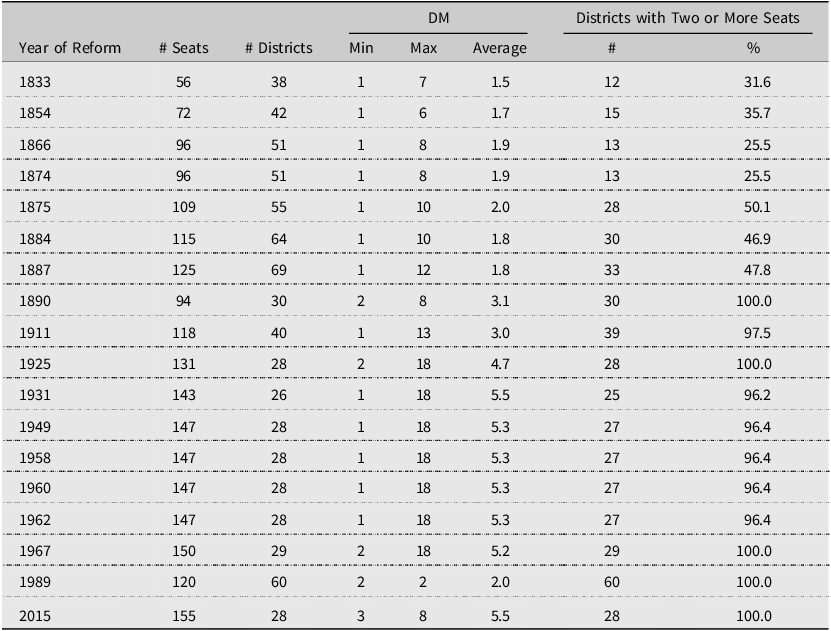
A complementary reform in 1875 expanded the size of the lower chamber from 96 to 108 seats (Obando Camino Reference Obando Camino2017). As Table 1 shows, districts that elected two or more seats increased from 13 of the 51 districts in 1866 to 28 of the 55 districts in 1875. The size of Congress continued to expand in 1884 and 1887, with new districts in the northern provinces annexed after the War of the Pacific (1879–83). By 1887, there were 69 departments and 123 seats in the Chamber of Deputies (Obando Camino Reference Obando Camino2017). Starting in 1890, all districts elected at least two members. That change effectively constrained the president’s ability to shape that chamber’s composition. Legislators also became increasingly more independent. In 1888, the government won 109 seats in the Chamber of Deputies, but a year later, many of those legislators had deserted President José Manuel Balmaceda who only had the support of 40 legislators, while the opposition had 80 (Heise González Reference Heise González1982, 90).
Seats and DM in Lower Chamber after Electoral Reforms, 1833–2025

Table 1. Long description
The table presents data on the number of seats, districts, and districts with two or more seats in the lower chamber after electoral reforms from 1833 to 2025. It includes columns for the year of reform, number of seats, number of districts, minimum and maximum districts per member (DM), average DM, and the number and percentage of districts with two or more seats. The table has 18 rows and 8 columns. Row 1: Year of Reform, 1833; # Seats, 56; # Districts, 38; DM Min, 1; DM Max, 7; DM Average, 1.5; Districts with Two or More Seats #, 12; Districts with Two or More Seats %, 31.6. Row 2: Year of Reform, 1854; # Seats, 72; # Districts, 42; DM Min, 1; DM Max, 6; DM Average, 1.7; Districts with Two or More Seats #, 15; Districts with Two or More Seats %, 35.7. Row 3: Year of Reform, 1866; # Seats, 96; # Districts, 51; DM Min, 1; DM Max, 8; DM Average, 1.9; Districts with Two or More Seats #, 13; Districts with Two or More Seats %, 25.5. Row 4: Year of Reform, 1874; # Seats, 96; # Districts, 51; DM Min, 1; DM Max, 8; DM Average, 1.9; Districts with Two or More Seats #, 13; Districts with Two or More Seats %, 25.5. Row 5: Year of Reform, 1875; # Seats, 109; # Districts, 55; DM Min, 1; DM Max, 10; DM Average, 2.0; Districts with Two or More Seats #, 28; Districts with Two or More Seats %, 50.1. Row 6: Year of Reform, 1884; # Seats, 115; # Districts, 64; DM Min, 1; DM Max, 10; DM Average, 1.8; Districts with Two or More Seats #, 30; Districts with Two or More Seats %, 46.9. Row 7: Year of Reform, 1887; # Seats, 125; # Districts, 69; DM Min, 1; DM Max, 12; DM Average, 1.8; Districts with Two or More Seats #, 33; Districts with Two or More Seats %, 47.8. Row 8: Year of Reform, 1890; # Seats, 94; # Districts, 30; DM Min, 2; DM Max, 8; DM Average, 3.1; Districts with Two or More Seats #, 30; Districts with Two or More Seats %, 100.0. Row 9: Year of Reform, 1911; # Seats, 118; # Districts, 40; DM Min, 1; DM Max, 13; DM Average, 3.0; Districts with Two or More Seats #, 39; Districts with Two or More Seats %, 97.5. Row 10: Year of Reform, 1925; # Seats, 131; # Districts, 28; DM Min, 2; DM Max, 18; DM Average, 4.7; Districts with Two or More Seats #, 28; Districts with Two or More Seats %, 100.0. Row 11: Year of Reform, 1931; # Seats, 143; # Districts, 26; DM Min, 1; DM Max, 18; DM Average, 5.5; Districts with Two or More Seats #, 25; Districts with Two or More Seats %, 96.2. Row 12: Year of Reform, 1949; # Seats, 147; # Districts, 28; DM Min, 1; DM Max, 18; DM Average, 5.3; Districts with Two or More Seats #, 27; Districts with Two or More Seats %, 96.4. Row 13: Year of Reform, 1958; # Seats, 147; # Districts, 28; DM Min, 1; DM Max, 18; DM Average, 5.3; Districts with Two or More Seats #, 27; Districts with Two or More Seats %, 96.4. Row 14: Year of Reform, 1960; # Seats, 147; # Districts, 28; DM Min, 1; DM Max, 18; DM Average, 5.3; Districts with Two or More Seats #, 27; Districts with Two or More Seats %, 96.4. Row 15: Year of Reform, 1962; # Seats, 147; # Districts, 28; DM Min, 1; DM Max, 18; DM Average, 5.3; Districts with Two or More Seats #, 27; Districts with Two or More Seats %, 96.4. Row 16: Year of Reform, 1967; # Seats, 150; # Districts, 29; DM Min, 2; DM Max, 18; DM Average, 5.2; Districts with Two or More Seats #, 29; Districts with Two or More Seats %, 100.0. Row 17: Year of Reform, 1989; # Seats, 120; # Districts, 60; DM Min, 2; DM Max, 2; DM Average, 2.0; Districts with Two or More Seats #, 60; Districts with Two or More Seats %, 100.0. Row 18: Year of Reform, 2015; # Seats, 155; # Districts, 28; DM Min, 3; DM Max, 8; DM Average, 5.5; Districts with Two or More Seats #, 28; Districts with Two or More Seats %, 100.0.
Source: Authors with Valencia Avaria (Reference Valencia Avaria1986), Anguita (Reference Anguita1912) and Servicio Electoral.
Adopted on August 20, 1890, another opposition-promoted reform made electoral registration permanent, and introduced the secret ballot and cumulative voting for all elections, including the Senate (Valenzuela Reference Valenzuela1998, Reference Valenzuela and Posada-Carbó1996). The Senate went from 44 to 32 seats. As Table 1 shows, the new rules decreased the number of districts in the Chamber of Deputies from 69 to 30 and increased the number of deputies per electoral unit (the average DM went from 1.8 to 3.1). But the overall number of seats declined from 125 in 1887 to 94 in 1890, by merging several single-member districts into fewer districts with two or more members each.
The literature suggests that legislators will not adopt reforms that reduce their chances of keeping their seats, such as decreasing the number of seats. In previous decades, the number of seats in the Chamber had increased constantly, from 96 seats in 1866 to 125 in 1887. The Chamber no longer had single-member districts after 1890. Incumbent legislators might have preferred to run in larger multimember districts than in single-member districts where the president could use his powers to back a different candidate. Thus, legislators seem to have been amenable to a change that reduced the number of overall seats in exchange for having districts with larger magnitudes.
The 1890 reform occurred under a fierce confrontation between the legislative and executive branches and preceded, by a few months, a civil war between both powers. The forces loyal to President Balmaceda were defeated. The ley de comuna autónoma, enacted immediately after the end of the civil war, transferred control of elections to the municipalities, ending the government’s direct intervention in the electoral processes. With the victory in the civil war and the adoption of that new law, the electoral process became independent of the executive, and the legislature acquired a predominant role in the political system, in what is known, in Chilean historiography, as the Parliamentary Republic.
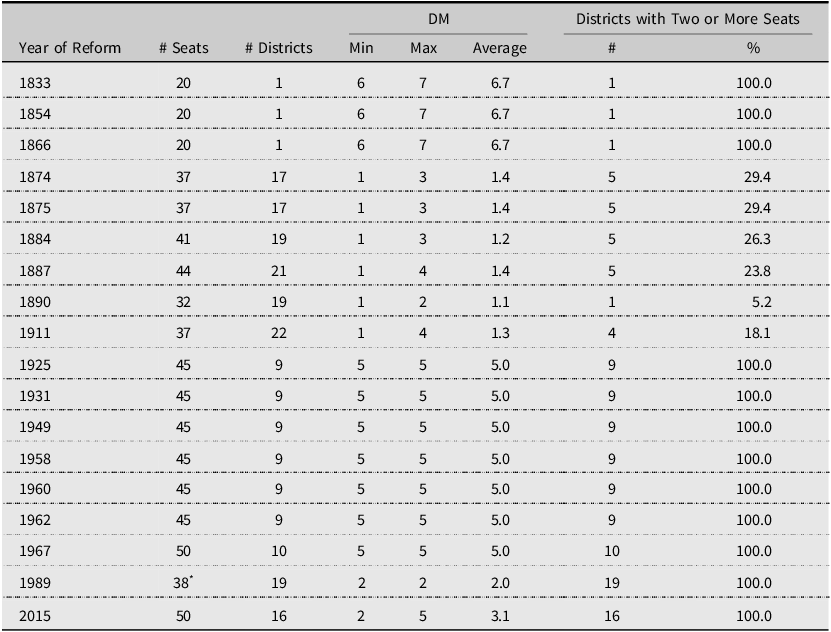
Table 2 illustrates the evolution in the number of seats and DM in the Senate. The adoption of cumulative voting in 1890 applied only to the Santiago senatorial district between 1891 and 1906. That year, three other provinces (Valparaíso, Talca, and Concepción) received an additional seat and cumulative voting applied to those districts starting in 1906. But most senatorial districts remained single-seat units.
Seats and DM in the Senate after Every Electoral Reform, 1833–2025

Table 2. Long description
The table presents data on the number of seats, districts, and district magnitudes in the Senate from 1833 to 2025. It includes columns for the year of reform, number of seats, number of districts, minimum and maximum district magnitudes, average district magnitude, and the number and percentage of districts with two or more seats. The table has 16 rows and 8 columns. Each row corresponds to a specific year of reform, detailing the changes in the Senate’s structure over time. Notable trends include the introduction of cumulative voting in 1890 and the addition of seats and districts in subsequent years.
* Plus nine non-elected senators elected for 8-year terms according to 1980 Constitution.
Source: Authors with Valencia Avaria (Reference Valencia Avaria1986), Anguita (Reference Anguita1912) and Servicio Electoral.
Electoral Reforms in the Twentieth Century
Only one electoral reform occurred between 1891 to 1925. Enacted in 1911, Law #2,453 increased Chamber of Deputies seats and districts from 94 to 118, and 30 to 40, respectively. Although the primary reason was an increase in the population, the reform also gave more representation to political minorities (Heise González Reference Heise González1982, 138–39).
The growing political weight of middle class and working class demands for labor and political rights deepened the legitimacy crisis of the Parliamentary Republic. The election of Arturo Alessandri in 1920 brought in a government inclined to support bottom-up demands. But Alessandri also faced legislative gridlock with a tone-deaf Congress. After a military coup in 1924 forced him into a short exile, Alessandri returned to lead the drafting of a new constitution in 1925. That constitution lengthened the presidential term from five to six years, kept the ban on immediate reelection, and granted the president strong legislative and administrative powers. Legislative terms remained on a four-year cycle, on odd years, retaining the non-concurrent nature of presidential and legislative elections.
The 1925 constitution established nine five-seat senatorial districts, elected under open-list proportional representation (OLPR). Outlined in Decree Laws #542 and #543, the rules established 28 multimember districts for the Chamber of Deputies using OLPR rules with a DM varying between 2 and 18 seats (Gamboa and Morales Reference Gamboa and Morales2015; Navia Reference Navia2005). The new rules consolidated a multiparty system and helped correct the strategic coordination problems parties faced under the old rules by creating districts with more seats. The introduction of OLPR and the D’Hondt seat allocation formula eliminated the intra-party conflict caused by cumulative voting (Gamboa and Morales Reference Gamboa and Morales2015).
The 1925 constitution stipulated, as did the 1833 Constitution, that the number of seats in the Chamber of Deputies would increase with the population after every census. In 1931, the Carlos Ibáñez dictatorship, by decree (DFL 232 of 1931) set the number of districts at 26 and the number of seats at 143. The Chamber continued to expand until 1941, when it reached 147 members. After that year, Congress stopped increasing the size of the Chamber after every census.
From 1932 onwards, the defining social cleavage was social class tensions (Scully Reference Scully1992; Valenzuela Reference Valenzuela1995). As the Communist and Socialist parties joined the Radical, Liberal, and Conservative parties, as well as other minor parties, multiparty national coalitions were common. Article 15 of the 1949 electoral law (#9,334) allowed parties to form multiparty lists by department for the Chamber of Deputies or by province for the Senate without needing to form national level coalitions (Gamboa Valenzuela Reference Gamboa Valenzuela2011). Thus, different subnational party lists emerged in each district, making the party system even more fragmented. The pre-1973 ENP reached all-time high in 1953 (Bunker Reference Bunker2018, 223).
The electoral law of 1958 (#12,891) pushed by the multiparty coalition Bloque of Saneamiento Democrático and by the executive, banned subnational lists but allowed the formation of national lists, adopted the Australian ballot (a single ballot), which decisively reduced the possibility of electoral fraud, and overturned the banning of the Communist Party in place since 1948. Complementary reforms in 1960 and 1962 banned pre-electoral coalitions in all legislative elections (Gamboa Valenzuela Reference Gamboa Valenzuela2011).
In the 1960s, the centrist programmatic Christian Democratic Party (PDC) replaced the pragmatic Radical Party as the pivotal force, reconfiguring the party system into three-thirds: left, center, and right (Scully Reference Scully1992; Valenzuela Reference Valenzuela1978). In 1969, a new five-member senatorial district was created in the far south, and three seats were added to the lower house. Thus, between 1969 and 1973, there was a 50-seat Senate and a 150-seat Chamber of Deputies. In the legislative election of March 1973, the Tribunal Calificador de Elecciones allowed parties to form federations of parties, which in practice meant the reintroduction of national lists. In 1973, the federated party of the Popular Unity (left-wing government parties) competed against the Confederation of Democracy (PDC and right-wing parties). Growing political polarization under the government of socialist Salvador Allende (1970–73) eventually led to the breakdown of democracy in September of 1973.
Democracy was restored in 1990. Under the rules established in the 1980 Constitution written under military rule, the president had strong proactive legislative powers and the legislature was mostly reactive (Siavelis Reference Siavelis2000). Authoritarian constitutional enclaves—including nine non-elected members in the 47-seat Senate and supermajority requirements for constitutional reforms and landmark legislation—provided counter-majoritarian mechanisms that helped maintain the status quo (Heiss and Navia Reference Heiss and Navia2007).
The 1989 legislative elections were held under a new OLPR system with two seats in each electoral unit, often called the binomial system. The Senate had 38 elected members representing 19 districts, and the 120-member Chamber of Deputies had 60 two-member districts. As multiparty electoral coalitions could form at the national level, the party system was reconfigured around two stable coalitions, the center-left Concertación and the right-wing Alianza, but parties retained their individual identity (Siavelis Reference Siavelis1997; Valenzuela and Scully Reference Valenzuela and Scully1997). The binomial system worked as an insurance against defeat for the two large coalitions, as the minority coalition was guaranteed one seat if it obtained at least one-third of the votes in each district (Navia Reference Navia2005).
In 2005, a comprehensive constitutional reform eliminated non-elected senators, reduced the presidential term from six to four years, made presidential and legislative elections concurrent, reduced some presidential lawmaking prerogatives and increased those of Congress (Mimica et al. Reference Mimica, Navia and Osorio2023). In 2015, an electoral reform increased seats in the Senate and the Chamber of Deputies from 38 to 50 and 120 to 155, respectively. Senators are elected in 16 districts ranging from two to five seats, while deputies are elected in 28 districts ranging from three to eight seats (Gamboa and Morales Reference Gamboa and Morales2016). A long-postponed objective of the center-left ruling coalition, the 2015 reform contributed to party system fragmentation. The two traditional coalitions weakened, and new parties emerged. In 2021, the two dominant coalitions failed to make it to the runoff in the presidential election, and new parties won seats in the concurrent legislative election.
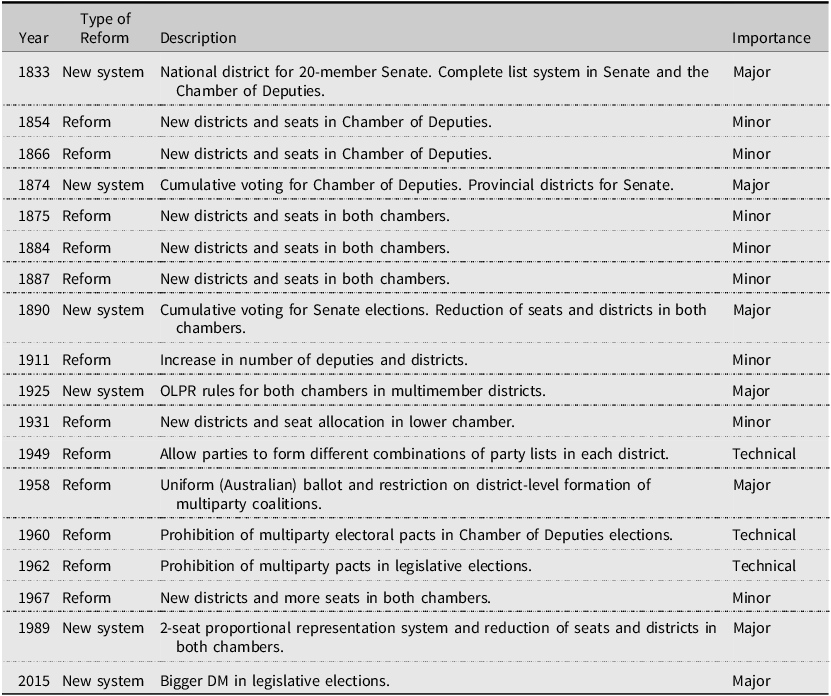
Table 3 summarizes the 18 electoral reforms adopted between 1833 and 2015. We exclude reforms that had no impact on how votes are transformed into seats, such as the establishment of women’s suffrage in all elections (1949), compulsory or voluntary vote (such as those in 1962 and 2012), or term limits for legislators (2020). We classify seven reforms as major, eight as minor, and three as technical. Three major reforms—the electoral laws of 1833, 1925, and 1989—were proposed almost unilaterally by the executive. Congress was more predominant in major reforms in 1874 and 1890, which are fundamentally seen as a victory of the legislature over the executive. Minor reforms primarily added new districts and seats without changing the rules. Although studies on electoral reforms normally underline how changes championed by the legislature often lead to an increase in the number of seats, among the 18 reforms, one reduced the number of seats (1890) and two reduced the number of districts in both chambers (1890 and 1925).
Electoral Reforms in Chile by Importance Level, 1833–2025

Table 3. Long description
A table detailing electoral reforms in Chile from 1833 to 2015. The table has four columns: Year, Type of Reform, Description, and Importance. It lists 18 reforms, each with a specific year, type, description, and importance level. The importance levels are Major, Minor, and Technical. The table includes reforms such as the introduction of a new system, new districts and seats, cumulative voting, and OLPR rules. Notable reforms include major changes in 1833, 1874, 1890, 1925, 1958, 1989, and 2015, minor reforms in 1854, 1866, 1875, 1884, 1887, 1911, 1931, 1967, and technical reforms in 1949, 1960, and 1962.
Source: Authors with data from Arellano-González and Martínez (Reference Arellano-González and Martínez2020), Gamboa Valenzuela (Reference Gamboa Valenzuela2011), Gamboa and Morales (Reference Gamboa and Morales2016), Heise González (Reference Heise González1982) and the sources from the Library of the National Congress.
Electoral Reforms and the Effective Number of Parties
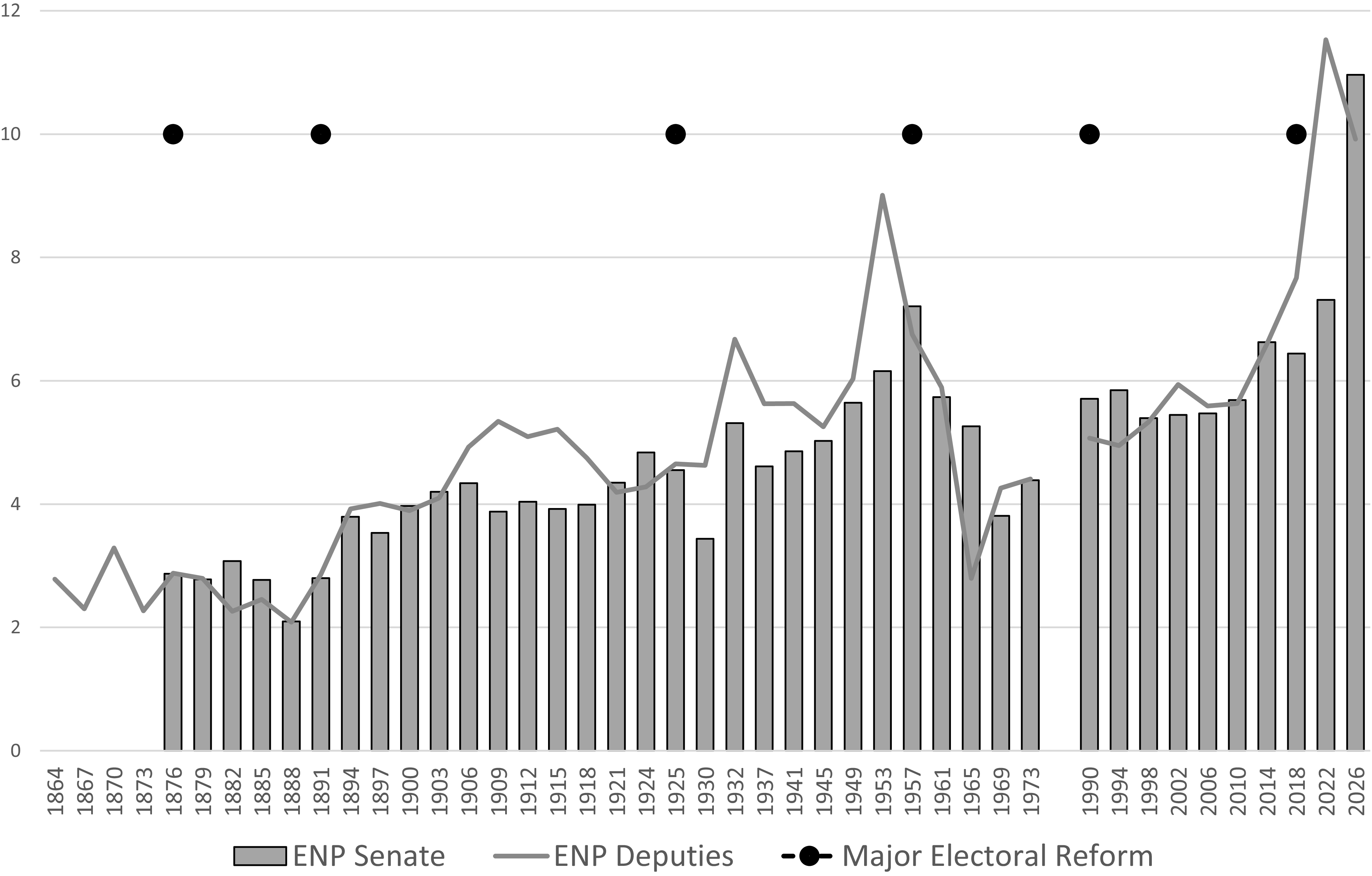
Our central claim is that major and minor changes in electoral rules influence the ENP. Figure 1 shows substantial variance of the ENP over time, with a higher variance in the Chamber of Deputies than in the Senate. The ENP rose more rapidly in the Chamber of Deputies in periods of party system fragmentation. This is consistent with the larger variation in DM in the lower chamber than in the Senate. In addition, staggered elections in the Senate are associated with a delayed impact on fragmentation.
Effective Number of Parties (ENP) in the Chilean Congress, 1864–2022.
Source: Authors based on information from Urzúa Valenzuela ( Reference Urzúa Valenzuela1992), Anguita (Reference Anguita1912), Valencia Avaria (Reference Valencia Avaria1986), Heise González (Reference Heise González1982) and the Library of the National Congress.

The variance in ENP shows an upward trend over the years in both chambers—consistent with expectations—but there have also been periods of decline in the ENP. The six major electoral reforms marked in Figure 1 are associated with changes in the ENP, but not always with an increase in the ENP. Although the system has become more proportional over time, there have been periods when the number of political parties with representation in the Chilean Congress has declined. Those moments can be associated with electoral reforms that sought to reduce the number of political parties.
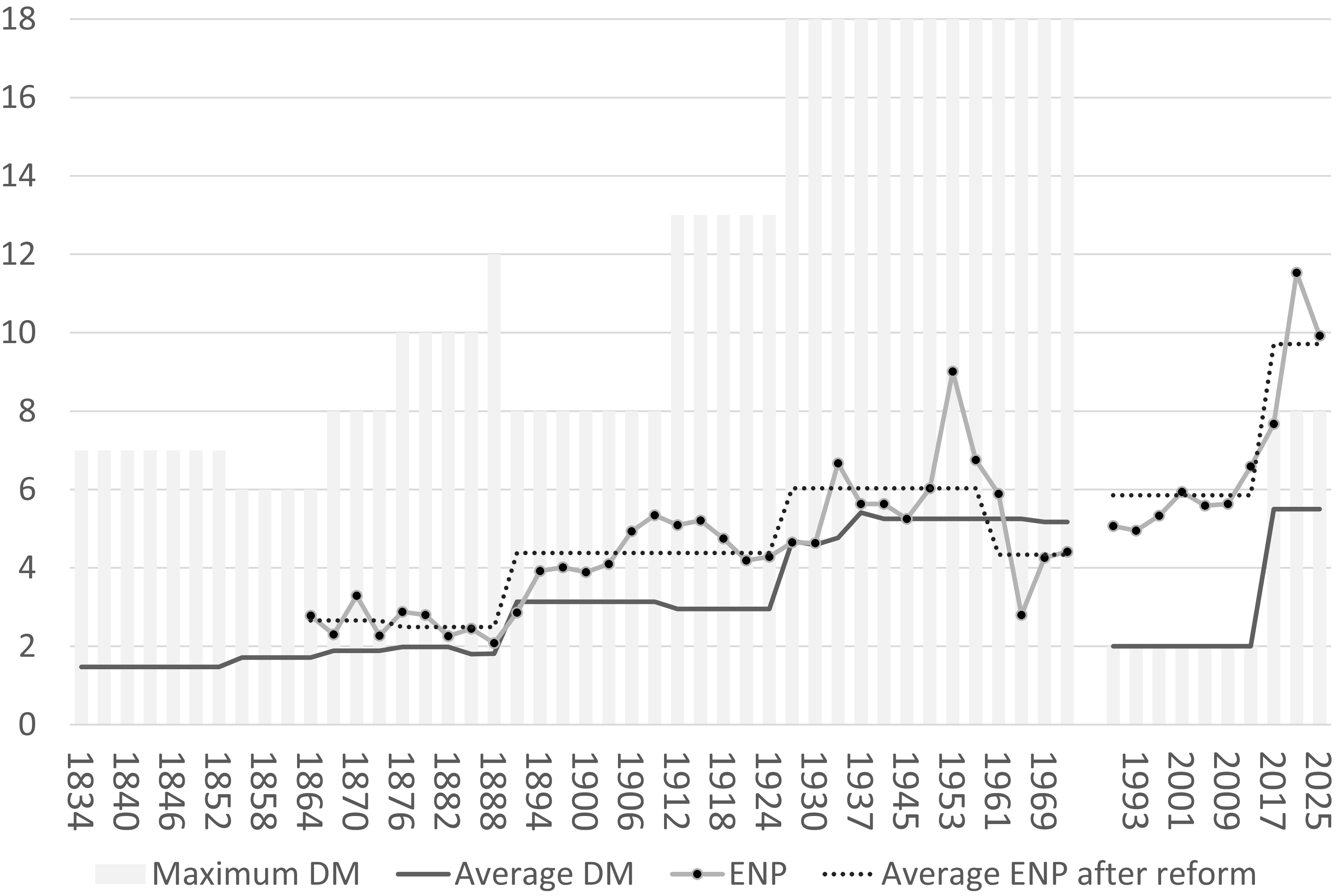
Figure 2 shows the evolution in the ENP and the average and maximum DM in the Chamber of Deputies. As discussed above, the reforms of 1854, 1866, 1875, 1884 and 1887 increased the number of districts and seats. But this increase in the number of seats did not produce a higher average DM, and therefore not a higher ENP. The adoption of cumulative voting for the Chamber of Deputies in 1874 only had a partial effect in consolidating multipartyism. Most deputies continued to be elected in single-member districts, and the government continued to intervene in elections until 1890.
DM and ENP in Chamber of Deputies of Chile, 1833–2025.
Average DM is the average district magnitude for all districts in that election that year. The average ENP after reform is the average effective number of parties at the national level in all the elections between major electoral reforms. Source: Authors based on information from Urzúa Valenzuela ( Reference Urzúa Valenzuela1992), Anguita (Reference Anguita1912), Heise González (Reference Heise González1982), Valencia Avaria (Reference Valencia Avaria1986) and the Library of the National Congress.

In 1890, parallel to the reform that established cumulative voting for the Senate, a new law merged several Chamber of Deputies districts. After decades of pushing for more districts and seats, Congress surprisingly passed a reform to reduce the number of seats and districts and introduced more proportionality. As there were fewer districts, the average DM went from 1.8 to 3.1. Eventually, the ENP reached 5.21 in 1915, the maximum value during the Parliamentary Republic. During this period, the average ENP was 4.38, much higher than the period prior to 1890, which illustrates the importance of the electoral reform of that year.
The ENP throughout the Parliamentary Republic had values above average DM. Although the map for the Chamber of Deputies assigned some districts a higher number of seats than the ENP, the average DM was under pressure as more parties became competitive in some provinces. The evidence is consistent with the claim that there was a multiparty system before electoral rules were modified to further facilitate proportional representation. The adoption of proportional representation in the 1925 constitution simply reflected the preceding multiparty system.
Until 1925, the increase in DM and ENP were positively associated. From 1925 onwards, fluctuations in the ENP were associated more directly with provisions that regulated the formation of electoral pacts and with the rise of new disruptive forces in the party system. Certain reforms, such as the one in 1958, took place after the ENP had declined, whereas others, including those in 1949 and 2015, occurred after an increase in the ENP. The 1958–62 reforms resulted from a compromise among traditional parties to reduce competition. Those reforms gave larger parties more seats and, eventually, caused the disappearance of smaller parties. In turn, in 2015, parties actively sought to increase competition and allow smaller parties to win seats.
Under the 1925 constitution, both ENP and average DM continued to rise. The ENP reached a peak after the enactment of 1949 electoral law, which allowed parties to form district-level pacts. This marked increase coincided with the rise of smaller parties under Carlos Ibáñez’s presidency (1952–58). However, traditional parties took advantage of the 1957 election (when the ENP slightly fell) to adopt more restricted electoral rules between 1958 to 1962. For this reason, and because of the strong rise of the PDC in the 1965 election, the ENP reached an unusually low value of 2.80.
Similarly, the binomial system adopted before the transition to democracy sought to reduce the number of parties that existed before 1973 (Navia Reference Navia2005). But changes in electoral rules included in the 1989 constitutional reforms allowed for the formation of pre-electoral multiparty coalitions, which facilitated the return of the multiparty system (Heiss and Navia Reference Heiss and Navia2007). Responding to the restrictive incentives of the electoral rules, two stable coalitions formed, so the binomial system did not dramatically alter the number of parties (Valenzuela and Scully Reference Valenzuela and Scully1997; Navia Reference Navia2005).
Between 1989 and 2013, the average DM was 2, and the average ENP increased gradually from 5.1 in 1989 to 6.59 in 2013. The rise in the ENP preceded the 2015 electoral reform (Gamboa and Morales Reference Gamboa and Morales2016). In 2017, with more proportional electoral rules, the average DM rose to 5.5 in the Chamber of Deputies, and the ENP also rose accordingly, reaching 7.67 in 2017 and 11.53 in 2021, the highest on record.
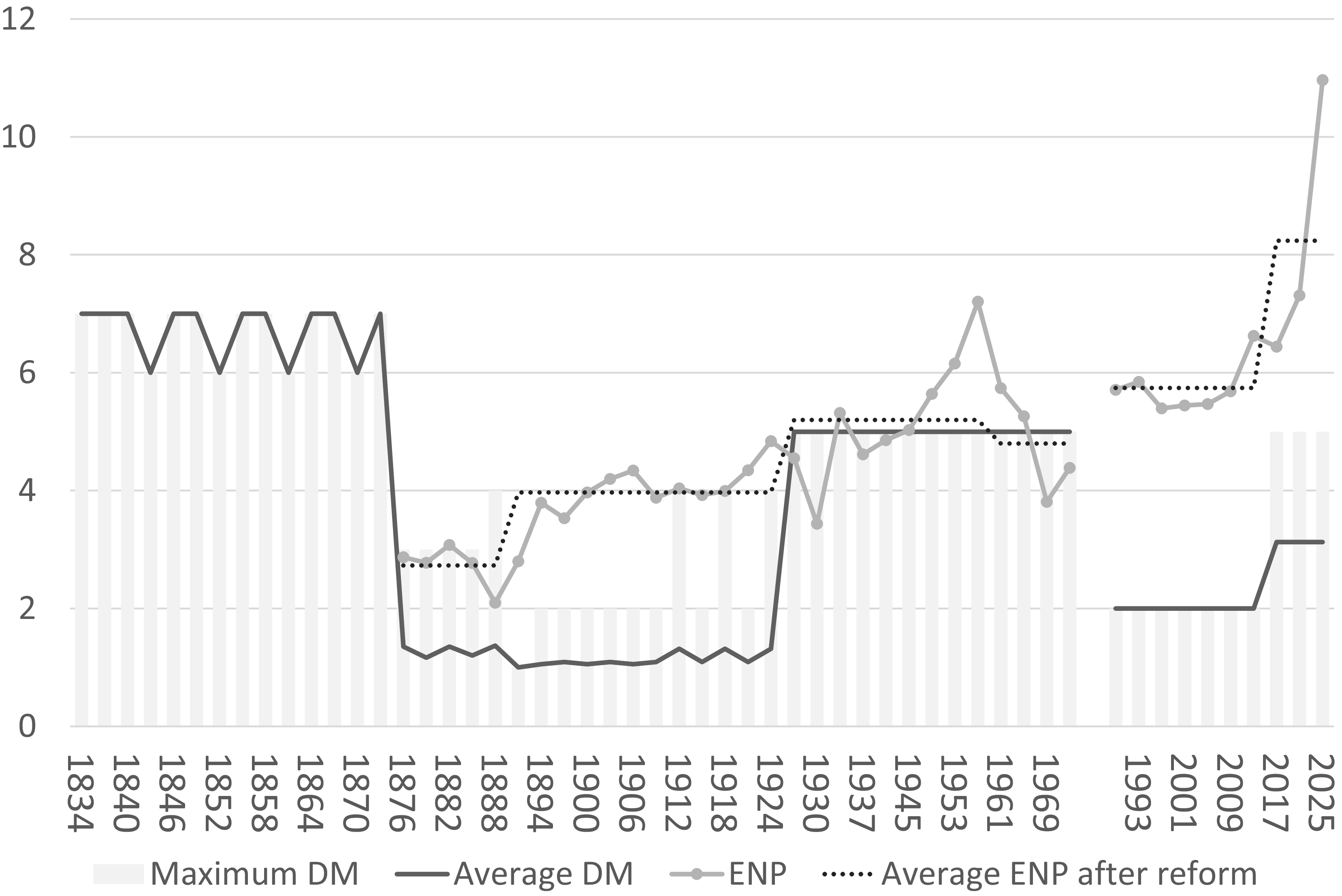
Figure 3 reveals the evolution in ENP and the average and maximum DM in the Senate. We calculated the ENP starting in 1876, when the system changed from a national district in the 20-member Senate to provincial districts, as we discuss above. Between 1876 to 1925, the average DM ranged from 1.0 to 1.4. After 1925, half of the Senate was up for election every four years. As a result, ENP changes in the Senate have been less pronounced than in the Chamber of Deputies.
DM and ENP in Senate of Chile, 1833–2025.
Source: Authors based on information from Urzúa Valenzuela ( Reference Urzúa Valenzuela1992), Anguita (Reference Anguita1912), Heise González (Reference Heise González1982), Valencia Avaria (Reference Valencia Avaria1986) and the Library of the National Congress.

From 1876 onwards, the Senate was elected in mostly single-member districts. As a result, the average DM was always below 2. Nevertheless, the ENP was systematically above 2, as the old Liberal/Conservative divide was replaced by a multiparty system that also included the Radical, National, and Liberal Democratic parties. The restrictive electoral rules for Senate elections during the Parliamentary Republic did not prevent new parties from winning seats. In this period, the average ENP was around 4, even though the average DM remained intact. The cumulative vote introduced in the Senate, in addition to the lack of electoral interference by the executive from 1890 onwards, facilitated the presence of more parties in the upper house.
Starting with the 1925 constitution, the creation of provincial five-seat senatorial districts formally introduced proportional representation in all districts and the average ENP also approached 5. Although the party system became more fragmented, because of staggered elections, the ENP in the Senate was slightly more stable than in the Chamber of Deputies. Still, the ENP rose in both chambers after the 1949 reform. The average ENP declined again in the 1960s, after the reforms of 1958–62.
Since 1989, the Senate had a fixed DM of 2, but the average higher ENP reflected the multiparty nature of the two dominant coalitions. In the Senate, the ENP increased from 5.7 in 1989 to 7.31 in 2021, less than in the Chamber of Deputies. The upward slope anticipated the increase in the average DM that occurred after the 2015 electoral reform. Since 2017, the average DM in the Senate has been 3.12, lower than the 5.5 value for the Chamber of Deputies. But the increase in the ENP in both chambers preceded the electoral rule change of 2015. The ENP in the Senate reach an all-time high after the 2025 legislative election.
Summing up, the 1890 electoral reform was very important in freeing the party system from presidential control. After that reform, the average ENP in both chambers increased, and the multiparty system consolidated. The 1890 reform also reduced the number of seats in Congress. Normally, the number of seats in the legislature increases with the country’s population (Taagepera Reference Taagepera1986). The unusual reductions in the number of seats in national legislatures have been associated with economic crisis (Jacobs and Otjes Reference Jacobs and Otjes2015) or an austerity agenda (Marland Reference Marland2019). Chile challenges that conventional wisdom. In 1890, under a period of growing competition in the political arena and when the economy was booming due to the saltpeter boom after the victory in the War of the Pacific, the number of seats in Congress declined. Also, under military rule (1973–90), the number of legislative seats also declined. That reduction can be associated with the anti-political party discourse promoted by the dictatorship.
DM is not the only important factor that influences the ENP. Electoral reforms that allow different combinations of multiparty pacts at the provincial level can trigger an increase in the ENP. Figures 2 and 3 also point to the importance of the technical electoral reform of 1949 which allowed for the formation of district-level electoral pacts.
As a multiparty system has been the norm in Chile and preceded the introduction of proportional representation, posterior changes to electoral rules have been adopted by compromise between parties, rather than, as the literature suggests, a reaction to a threat from emerging political parties. This explains back and forth dynamics, such as changes in the number of seats before and after the 1890 reform, or the introduction and posterior prohibition of provincial pacts in the 1949 and 1958 reforms. Sometimes, parties choose electoral reforms to promote competition, but other times, parties seek to restrict competition.
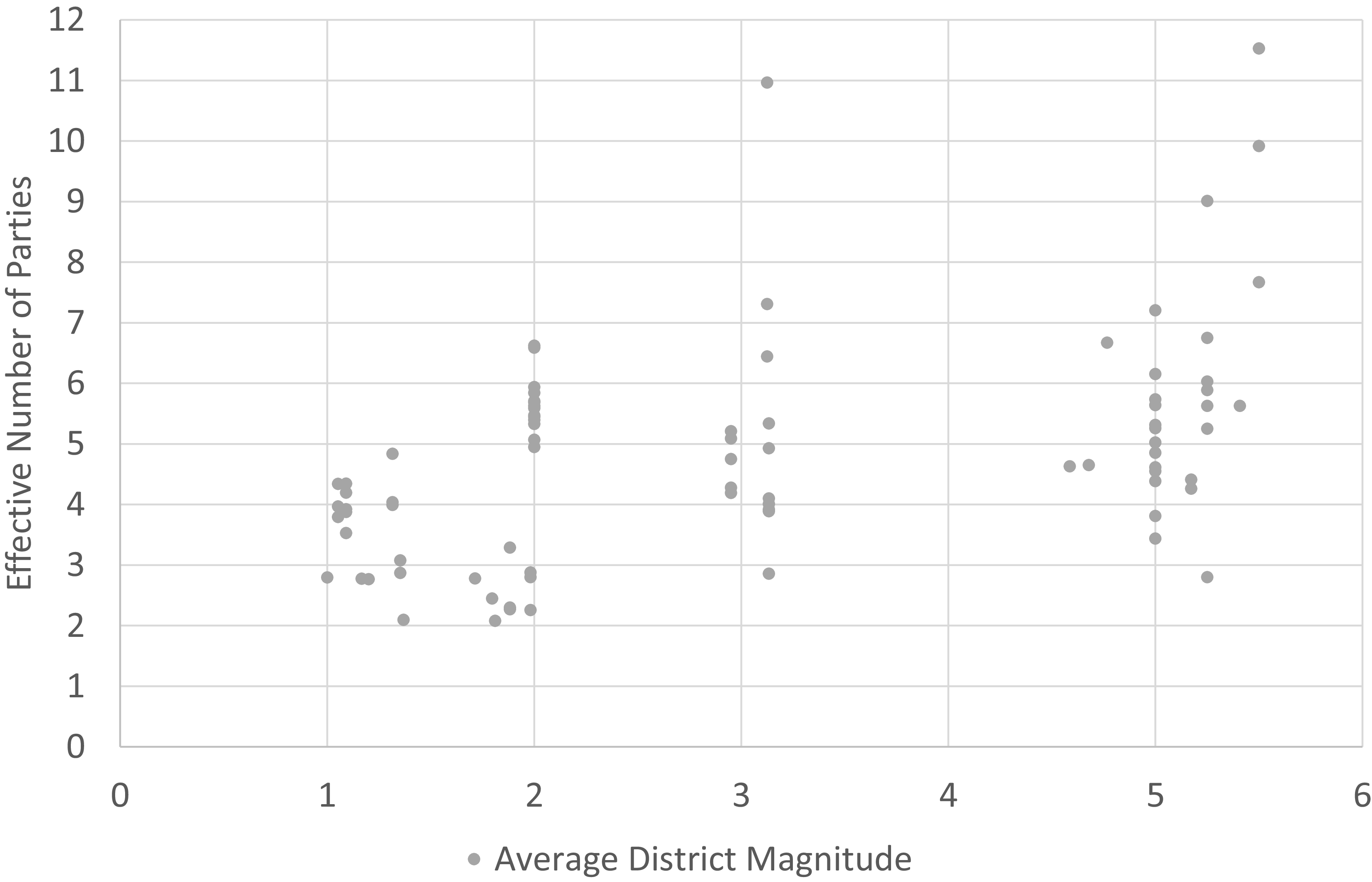
Figure 4 shows a scatter plot with the average DM on the X-axis and the average ENP on the Y-axis at the national level in each election starting in 1864 in the Chamber of Deputies and 1876 in the Senate. The DM and the ENP are positively correlated, pointing to the well-documented mechanical effect of a more permissive DM on the number of legislative parties. Figure 4 also suggests that the party system was systematically competitive with at least two parties and most often three or more competitive parties. There is also significant variance in the ENP with higher values on average DM. That is consistent with Cox’s upper bound limit argument about the effect of the DM on the party system (Cox Reference Cox1997). The explanations for the composition of the party system respond to dynamics other than just electoral rules, especially when the DM is higher.
Scatterplot of average DM and ENP in both chambers of the Chilean Congress, 1864–2025.
Source: Authors based on information from Urzúa Valenzuela ( Reference Urzúa Valenzuela1992), Anguita (Reference Anguita1912), Heise González (Reference Heise González1982) and the Library of the National Congress.

Conclusion
We contribute to the literature on the association between electoral systems and party systems with a diachronic study on the association between electoral reforms and the average DM and the ENP. We explore the case of Chile, a country where multipartyism has been the norm and different electoral rules have been adopted since the nineteenth century.
Although we find evidence consistent with the widely held expectation that DM and the ENP are positively associated, we also report nuances in that association. Contrary to the classic Duverger’s Law, some electoral reforms that increase competition and create districts with a higher magnitude occur after, not before, an increase in the ENP. Conversely, reforms that restrict competition sometimes occur after a decline in the ENP. Our findings are consistent with Colomer’s (Reference Colomer2005) claim about Duverger’s upside-down laws, which suggests that changes in electoral rules are caused by party system dynamics and not the other way around. The case of Chile points to an endogeneity and bidirectionality in the association between electoral rules and the party system.
We also find that electoral rules do not always evolve in a linear way, as we demonstrate by studying reforms that reduced the number of districts and seats, promoted or restricted competition, or approved or banned subnational party lists. We show that the influence of changes in electoral rules on the DM may not be immediate on the ENP. Although the electoral system functions as a straitjacket (Cox Reference Cox1997), removing the constraints will not immediately trigger a change of behavior among parties. When the rules facilitate the entrance of new parties, there might be an inertia factor that delays the influence on the party system. For example, the adoption of more permissive electoral rules in 1925 did not immediately increase the ENP but eventually facilitated the emergence of political parties reflecting a new social cleavage. Electoral rules matter, but the association between electoral rules and the party system is not mechanical nor unidirectional. Electoral institutions influence the party system, but the party system reacts to incentives and influences changes in electoral rules.
Data availability statement
The data used for the article was collected from multiple sources by the authors. We will be happy to share our database with anyone wishing to review it or to replicate our findings.
Acknowledgments
We acknowledge funding from the National Fund for Scientific and Technological Development (grant # 1231627) and by the Millennium Nucleus Center for the Study of Politics, Public Opinion and Media in Chile (grant number NCS2024_007).
Competing interests
The authors declare no conflict of interest.

 Open access

