Introduction
There is overwhelming evidence that trauma precipitates a range of mental health problems, including post-traumatic stress disorder (PTSD) (Norris et al. Reference Norris, Friedman and Watson2002). One of the key moderators of mental health response to a traumatic experience is social support both during and following the traumatic event. Numerous studies have found that separation of children from parents following a disaster is associated with childhood PTSD and depressive symptoms (McFarlane, Reference McFarlane1987; Lau et al. Reference Lau, Yu, Zhang, Mak, Choi, Lui, Zhang and Chan2010; Usami et al. Reference Usami, Iwadare, Kodaira, Watanabe, Aoki, Katsumi, Matsuda, Makino, Iijima, Harada, Tanaka, Sasaki, Tanaka, Ushijima and Saito2012). This pattern is consistent with attachment theories that posit that humans are programmed from an early age to seek refuge in trusted others at times of threat (Mikulincer et al. Reference Mikulincer, Shaver and Pereg2005). This tendency to seek attachment figures purportedly develops as a result of early-life experiences when the child learns that fundamental emotional and physical needs are provided by caring others (Ainsworth, Reference Ainsworth and Ricciuti1973). On the basis of these prior experiences, it is proposed that people develop attachment-based coping responses to threat throughout life, such that people develop internal working models that shape how people subsequently expect others to behave and provide support (Bowlby, Reference Bowlby1988; Mikulincer et al. Reference Mikulincer, Shaver and Pereg2005). Consistent with this proposition, under conditions of threat individuals have faster reaction times in recognizing the names of their secure attachment figures (Mikulincer et al. Reference Mikulincer, Gillath and Shaver2002).
Fundamental to attachment theory is the recognition that attachment styles can be determined by early-life experiences to the extent that absent or inconsistent attachments may result in insecure attachment styles in adulthood (Bowlby, Reference Bowlby1988). Although longitudinal studies do indicate that attachment styles displayed in childhood tend to persist into adulthood (Waters et al. Reference Waters, Merrick, Treboux, Crowell and Albersheim2000a ; Simard et al. Reference Simard, Moss and Pascuzzo2011), larger studies suggest this association can be modest (Raby et al. Reference Raby, Cicchetti, Carlson Egeland and Collins2013; Groh et al. Reference Groh, Roisman, Booth-LaForce, Fraley, Owen, Cox and Burchinal2014). For example, one sample of 857 individuals studied from early childhood to young adulthood found the stability was only 0.15 (Groh et al. Reference Groh, Roisman, Booth-LaForce, Fraley, Owen, Cox and Burchinal2014). Reflecting this pattern is meta-analytic evidence that where stability is observed when assessments are proximal to each other, there is no association when assessments are conducted more than 15 years after the childhood assessment (Pinquart et al. Reference Pinquart, Feussner and Ahnert2013).
Insecure attachment may take the form of anxious attachments that are characterized by the concern of abandonment and that attachment figures will not be readily available at times of need. Alternatively, those with avoidant attachment tendencies tend to distance themselves from others during threat as a means of coping because they have previously learnt that attachment figures are not available when needed. Supporting this proposal is evidence that during threat, avoidantly attached individuals inhibit proximity-seeking behaviour (Mikulincer et al. Reference Mikulincer, Gillath and Shaver2002), and are less likely to activate attachment representations (Mikulincer et al. Reference Mikulincer, Birnbaum, Woddis and Nachmias2000). It is proposed that these insecure attachment systems represent a vulnerability for psychopathology because the individual lacks this mode of coping with stressors. Supporting this proposal is evidence that early experiences of disordered attachments are a risk factor for later disordered attachments and psychopathology. Much of this evidence comes from studies of institutionalized children who have experienced long-term disruptions to secure attachment figures (Tizard & Hodges, Reference Tizard and Hodges1978; Wolff & Fesseha, Reference Wolff and Fesseha1999; Gunnar et al. Reference Gunnar and van Dulmen2007; Zeanah et al. Reference Zeanah, Egger, Smyke, Nelson, Fox, Marshall and Guthrie2009; Hawk & McCall, Reference Hawk and McCall2010). Other longitudinal studies have indicated that other experiences involving parental separation, including death and divorce, can affect the child's developing attachment system (Waters et al. Reference Waters, Merrick, Treboux, Crowell and Albersheim2000a ; Coffino, Reference Coffino2009).
At present there is no evidence pertaining to the long-term effects of very brief absence of an attachment figure during specific childhood trauma on enduring attachment style and psychopathology. According to attachment theory, a child should rely on attachment figures at times of threat, and if this support is not forthcoming then it may contribute to ongoing difficulties in attachment security. To test this prediction, we studied the long-term attachment patterns of children who were initially exposed to a massive natural disaster and who were with or without their parents at the time of the disaster; we then assessed their anxious and avoidant attachment styles 28 years later to determine if adult attachment tendencies was associated with prior parental availability during childhood trauma. We also assessed their PTSD at the follow-up assessment. We hypothesized that children who did not have parents available during the threat would subsequently have more insecure attachment styles than whose parents were with them, and that these would be linked to more severe PTSD.
Method
Participants
The initial sample of children exposed to the disaster were 806 children of mean age 8.44 (s.d. = 2.30) years attending primary schools in the regions affected by the Ash Wednesday fires on 16 February 1983. To provide an age-appropriate control group, 725 school children of mean age 7.39 (s.d. = 2.17) years from a neighbouring region were also surveyed. These schools were matched on sociodemographic factors to the bushfire-affected schools but were unaffected by the fires (for full details, see McFarlane & Van Hooff, Reference McFarlane and Van Hooff2009). Sociodemographic status between the bushfire and control regions remained stable over the follow-up period, as determined by information from the Australian Bureau of Statistics (2001). To contact all children and parents, a register of all primary school children for 1983–1985 was established using data from original questionnaires and archived school records, and current contact information was obtained from government departments and telephone directories.
The sample acquired 28 years later who completed the self-report measures included 500 adults of mean age 36.5 (s.d. = 2.2) years. Participants at 28 years did not differ from the initial sample in terms of age at the time of fires (t 338 = 0.55, p = 0.58), exposure to the fires (t 338 = 0.4, p = 0.67) or separation from parents (χ2 1483 = 0.31, p = 0.86). Participants who were retained at follow-up and completed the self-report measures were more likely to be female (55.4%) than male (44.6%) (χ2 1483 = 15.61, p = 0.001), be in the control (51.2%) than bushfire cohort (48.8%) (χ2 1483 = 4.05, p = 0.04), and have experienced greater combined property and personal loss during the fires (2.02, s.d. = 2.81) than those who were not retained (1.01, s.d. = 2.08) (t 1483 = 3.21, p = 0.001).
Measures
Bushfire exposure
Exposure to the trauma of the bushfires was assessed at baseline using a series of questions: (i) extent of property loss, (ii) geographical region in proximity to fires, and (iii) extent of personal loss.
Parental separation
To index whether the child was with their parent at the time they were personally exposed to the fires, parents were asked at the baseline assessment ‘was either or both parents with your child when the fire passed?’
Attachment style
Attachment style was assessed at follow-up using a 12-item version of the Experiences in Close Relationships scale (ECR; Olsson et al. Reference Olsson, Sorebo and Dahl2010). This scale comprises two subscales that index anxious attachment and avoidant attachment style, with each item scored on a seven-point Likert scale. Although the initial scale is anchored in relation to ‘my (romantic) partner’, for the purpose of this study the wording was rephrased with ‘the person who I consider is close to me’.
PTSD
PTSD at follow-up was assessed using the PTSD checklist (PCL) (Weathers et al. Reference Weathers, Litz, Herman, Huska and Keane1993). This scale is linked to the Diagnostic and Statistical Manual of Mental Disorders, 4th edition (DSM-IV) criteria for PTSD. Items are rated according to how much they bother the participant on a five-point scale (0 = ‘not at all’, 4 = ‘extremely’), yielding a total score of 0–80. The measure has demonstrated strong test–retest reliability (0.96) and high levels of internal consistency (0.97) (Blanchard et al. Reference Blanchard, Jones-Alexander, Buckley and Forneris1996). PTSD was indexed relative to the worst traumatic event that participants reported.
Procedure
The study was approved by the University of Adelaide Human Research Ethics Committee and the Australian Institute of Health and Welfare Research Committee. For the baseline assessment, initial contact was made by letter via the child's school, and consenting parents then completed a self-report survey. A similar format was followed for the follow-up assessment except at this time participants were contacted directly and completed their own responses.
Data analysis
To determine the potential impact of bushfire exposure on subsequent adult attachment style, we initially conducted a planned comparison between the bushfire and control communities on attachment style. We then investigated separation from parents during the fire via a path analysis in those who were initially exposed to the fires to determine the association of early experiences on subsequent attachment style and PTSD. In the first stage of analysis we sought to define the best model that could explain the direct relationship between exposure to separation from parents during the disaster and adult attachment style. To achieve this, we identified three latent variables and one observed variable that were of interest. The observed variable was the parental report of being separated from the child (obtained at baseline). Exposure to bushfires and the subscales of the ECR were constructed as latent variables. ‘Exposure to bushfires’ was calculated using measures of: (i) extent of property loss, (ii) geographical proximity to fires, and (iii) death/injury to family/friends. Attachment style subscales (mean anxious and avoidant attachment) were calculated using the ECR. A confirmatory factor analysis was initially conducted to investigate the structure of the ECR in the current dataset. Model fit for both the CFA and path analysis models was evaluated using the χ2 statistic (with a non-significant χ2 indicating good model fit), comparative fit index (CFI) (Bentler, Reference Bentler1990) and Tucker–Lewis index (TLI) approaching 1, root mean square error of approximation (RMSEA) < 0.06 and standardized root mean square residual (SRMR) < 0.08 (Hu & Bentler, Reference Hu and Bentler1999). These analyses indicated that the anxious and avoidant subscales loaded as separate scales, with the exception that one item (‘I am very comfortable being close’, which is reverse scored, did not load onto either scale and was omitted). While the final model yielded a significant χ2 statistic (χ40 2 = 107.09, p < 0.001), it evidenced good model fit on other indices that are not influenced by sample size (CFI = 0.98, TLI = 0.97, RMSEA = 0.06, SRMR = 0.04). See online Supplementary Table S1 for factor loadings.
Path analysis with Mplus version 7.01 (Muthén & Muthén, Reference Muthén and Muthén1998–2011) was employed to examine the strength of the relationships between the variables of interest. Mplus uses a full information maximum likelihood estimator to account for missing data. Specifically we examined the potential mediating roles of being with a parent during the fire and attachment style (avoidant and anxious attachment, measured on a continuous scale) on the relationship between exposure to the bushfires and PTSD symptom cluster severity (re-experiencing, avoidance, numbing and arousal). These four factors were included rather than overall symptom severity because of strong evidence that they accurately reflect the PTSD construct (King et al. Reference King, King, Foy, Keane and Fairbank1999). The model paths were determined on the basis that any relationship between brief exposure to the disaster at a young age and subsequent attachment style would occur because of the impact of potential parental separation. Further, it was expected that any association between bushfire exposure and PTSD 28 years later would not be direct but would be mediated by the role of attachment style resulting from parental separation.
Results
Participant characteristics
Participants who were retained at follow-up did not differ from those who were lost to follow-up in terms of age (mean = 7.85, s.d. = 2.22 v. mean = 7.98, s.d. = 2.33 years; F 1529 = 1.82, p = 0.18, η = 0.001) or total personal loss (mean = 0.23, s.d. = 0.73 v. mean = 0.16, s.d. = 0.67; t 1529 = −1.96, p = 0.11, η = 0.003). Relative to those who were lost to follow-up, participants who were retained at follow-up reported greater property loss (mean = 0.43, s.d. = 1.11 v. mean = 0.24, s.d. = 0.82; t 1529 = −3.41, p = 0.001, η = 0.04), greater total loss (mean = 0.23, s.d. = 0.73 v. mean = 0.16, s.d. = 0.67; t 1529 = −3.13, p = 0.002, η = 0.03), and were more likely to be female (55.0% v. 44.3%; χ1531 2 = 15.87, p = 001).
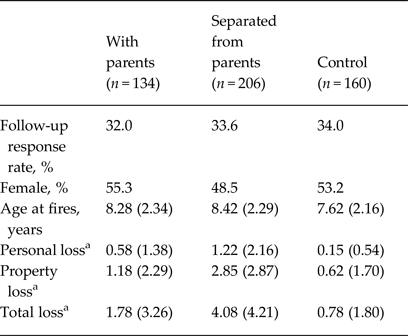
Table 1 presents the participant characteristics of participants (a) not exposed to the fires, (b) separated from parents during the fires, and (c) not separated from parents during the fires. Whereas separation from participants was not associated with differences in child's age, sex, personal loss, or total loss, children who were separated from parents during the fires had greater property loss than those who were not separated from parents (F 338 = 10.96, p < 0.001, η = 0.09). Relative to participants exposed to the fires, control participants were younger (F 498 = 13.24, p < 0.001, η = 0.03) and suffered less total loss than those affected by the fires (F 498 = 29.97, p < 0.001, η = 0.03).
Fire-affected participant characteristics according to separation from parents during fires

Data are given as mean (standard deviation) unless otherwise indicated.
a Personal loss, property loss and total loss are weighted scores based on composite responses pertaining to damage sustained in the Ash Wednesday fires.
The sample at 28 years had experienced a range of traumatic events, including serious motor vehicle accidents (120; 24%), natural disaster (280; 56%), witnessing serious harm to another (118; 24%), sexual assault (61; 12%), non-sexual assault (76; 15%), domestic violence (97; 19%), witnessing suicide (27; 5%), childhood abuse (35; 7%), other traumatic events (88; 18%), while 80 (16%) participants reported no trauma history. In terms of PTSD criteria, 6.4% met full DSM-IV criteria and 12.3% displayed at least subsyndromal PTSD (defined as satisfying at least two of the three symptom clusters).
Effect of bushfire experience on subsequent attachment style
To determine if children exposed to the bushfire had different attachment styles from control children, planned comparisons were conducted between the two groups. Children exposed to the bushfires (mean = 16.32, s.d. = 7.94) had higher scores on the Avoidant Attachment scale than those in the control (mean = 14.80, s.d. = 7.30) communities (F 498 = 6.45, p = 0.01, η = 0.06). In contrast, there was no difference between children in the bushfire (mean = 13.76, s.d. = 7.45) and control (mean = 12.69, s.d. = 7.09) communities on the Anxious Attachment scale (F 498 = 1.25, p = 0.02, η = 0.001).
In terms of being separated from parents during the fires, children who were separated from their parents at the time of the fires had higher scores on the Avoidant Attachment scale (mean = 18.24, s.d. = 7.94) than those who were with their parents (mean = 14.80, s.d. = 7.30) (F 109 = 2.54, p < 0.01, η = 0.03). There was no difference between children who were separated from their parents (mean = 13.49, s.d. = 6.78) and those who were with their parents (mean = 13.81, s.d. = 7.09) on the Anxious Attachment scale (t 109 = 0.15, p = 0.88).
Path analysis
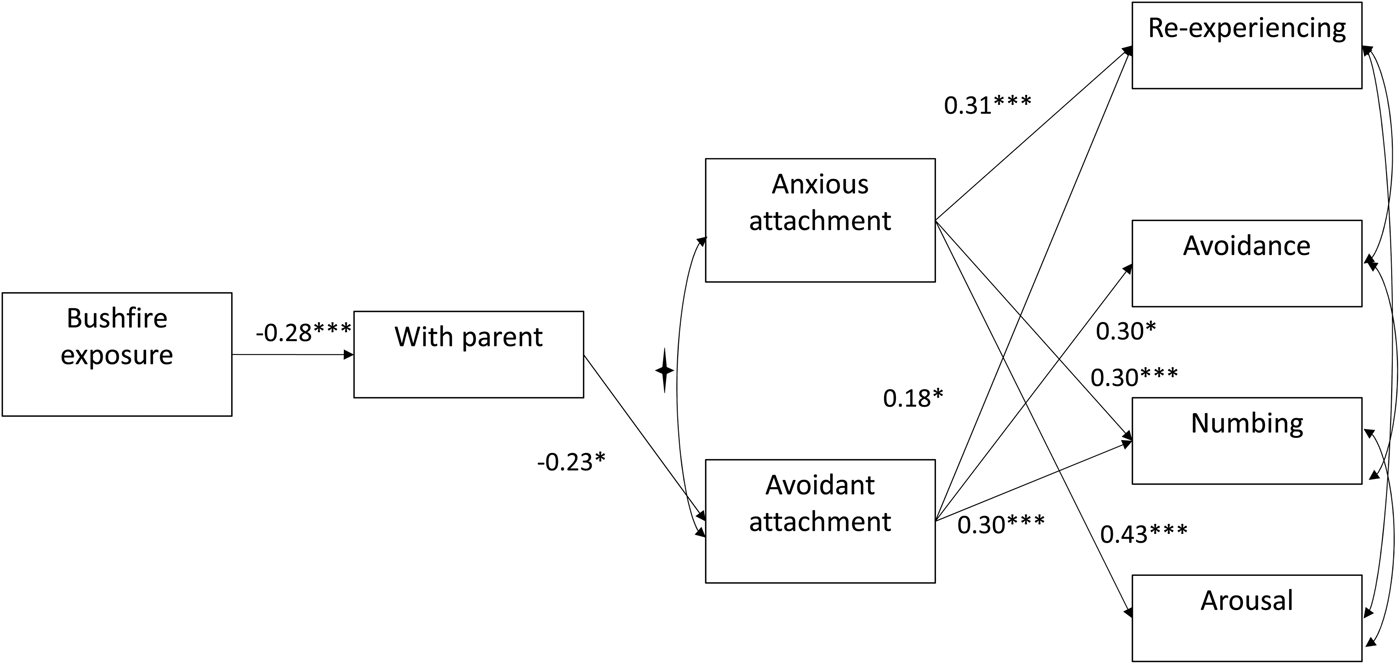
The model evidenced good fit: χ1 2 = 11.67, p = 0.31, RMSEA = 0.02, CFI = 1.00, TLI = 0.99, SRMR = 0.03 (see Fig. 1). There was a significant negative association between bushfire exposure and being with a parent at the time of the fire (B = −0.04, s.e. = 0.01, β = 0.28, p < 0.001). Being with a parent at the time of the fire was negatively related to avoidant attachment (B = −3.69, s.e. = 1.48, β = −0.23, p = 0.013), but not to anxious attachment. Avoidant attachment was associated with re-experiencing symptoms (B = 0.03, s.e. = 0.01, β = 0.18, p = 0.045), avoidance symptoms (B = 0.03, s.e. = 0.01, β = 0.30, p = 0.001) and numbing symptoms (B = 0.03, s.e. = 0.01, β = 0.30, p < 0.001). Anxious attachment was significantly associated with re-experiencing symptoms (B = 0.03, s.e. = 0.01, β = 0.31, p = 0.001), numbing symptoms (B = 0.03, s.e. = 0.01, β = 0.30, p < 0.001) and arousal symptoms (B = 0.04, s.e. = 0.01, β = 0.43, p < 0.001).
Path analysis of childhood trauma exposure, parental separation, and adult attachment style and post-traumatic stress disorder. † Residual items allowed to covary. For correlation coefficients of factors, see Table 2.

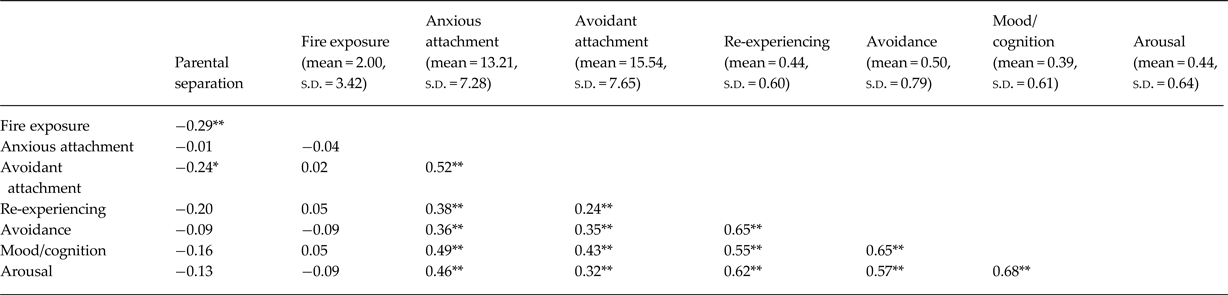
Correlation coefficients of factors in path analysis

Standard deviation.
* p < 0.01, ** p < 0.001.
Discussion
Young children who are separated from their parents during a discrete highly traumatic event display significantly greater avoidant attachment tendencies 28 years later. Although this finding is conceptually comparable with previous findings that have reported associations between prolonged fractured attachment experiences during childhood and adolescence and later attachment style (Tizard & Hodges, Reference Tizard and Hodges1978; Wolff & Fesseha, Reference Wolff and Fesseha1999; Waters et al. Reference Waters, Merrick, Treboux, Crowell and Albersheim2000 Reference Waters, Weinfield and Hamilton b ; Coffino, Reference Coffino2009), this finding stands out because it suggests that brief absence of an attachment figure during an intensely traumatic single event may have very long-lasting effects on one's attachment style. Most attachment research has alluded to attachment style being largely shaped by long-term interactions with parents and other caregivers during childhood (Cassidy & Shaver, Reference Cassidy and Shaver1999; Mikulincer & Shaver, Reference Mikulincer and Shaver2007a ). The current finding extends this conclusion by suggesting that a single pivotal event that threatens this sense of attachment security may destabilize the child's security attachment, persisting to adulthood.
Attachment theory posits that the fundamental function of the attachment system is to protect one from threats, especially during childhood when one is presumably more vulnerable (Bowlby, Reference Bowlby1982). Through consistent and reliable attachment experiences, one purportedly develops a secure attachment system that allows one to navigate subsequent stressors during adulthood. It is possible that the extreme and immediate threat posed by the bushfire during young childhood triggered the need to seek their primary attachment figures, in this case being their parents. The absence of parents during this event (due largely to the fires occurring during school hours) may have undermined the children's sense of attachment security, thereby resulting in a pattern of avoidant attachment tendencies. Avoidant attachment style tends to develop when one learns that attachment figures are not available and so one tends to withdraw from attachment figures because of their perceived lack of availability at times of need (Mikulincer et al. Reference Mikulincer, Shaver and Pereg2005).
The current finding further extends current understanding by identifying avoidant attachment as an important mediator of early brief separation from parents during childhood and PTSD in adulthood. Attachment theories emphasize the regulatory function of being able to activate attachment systems at times of stress, thereby promoting better mental health (Mikulincer & Shaver, Reference Mikulincer and Shaver2007 Reference Mikulincer and Shaver b ). It is also proposed that having an insecure attachment system hinders one from achieving psychological benefits from attachments, and being thus susceptible to emotional difficulties. Consistent with this proposal is evidence that people with an avoidant attachment style display greater stress responses to conflict (Powers et al. Reference Powers, Pietromonaco, Gunlicks and Sayer2006; Ditzen et al. Reference Ditzen, Schmidt, Strauss, Nater, Ehlert and Heinrichs2008). There is also experimental evidence that avoidant attachment style reduces the capacity to benefit from attachment figures in response to a stressor. In the context of trauma, it has also been found that prisoners of war (who may have suffered fractured attachment experiences resulting from interpersonal trauma) do not benefit from attachment proximity (Mikulincer et al. Reference Mikulincer, Solomon and Shaver2014). It is possible that the lingering effect of this avoidant attachment style resulted in these individuals experiencing more PTSD symptoms as adults because they have not been able to draw on attachment figures to regulate the stress response.
Children exposed to the fires reported more avoidant attachment 28 years later than children from the control schools. It is possible that exposure to such a life-threatening event undermined children's attachment systems because many of the children who were in the fire-affected regions were either at school or en route to school at the time of the fires, in which case their tendency to seek refuge with parents could have been thwarted. In contrast, those in the control condition, who were also as likely to be at school at this time, were less prone to develop an avoidant attachment style. This pattern suggests that exposure to early trauma may increase the risk for disrupted attachment systems.
We recognize that numerous factors may have moderated the observed relationship between childhood separation during the fires and adulthood attachment style. It is possible that parents' or caregivers' parenting styles may have been impacted by the fires, or by the fact that the parents were temporarily separated from their children, and this could affect parenting behaviour, which subsequently influences the child's mental health. Longitudinal studies demonstrate that maternal behaviour during childhood has an impact on subsequent attachment security (Beijersbergen et al. Reference Beijersbergen, Juffer, Bakermans-Kranenburg and van IJzendoorn2012), and also predicts child post-traumatic response after disaster (McFarlane, Reference McFarlane1987). Further, parents' exposure to stressful events can drain psychological resources that can otherwise be devoted to parenting (Moss et al. Reference Moss, Cyr, Bureau, Tarabulsy and Dubois-Comtois2005; Levendosky et al. Reference Levendosky, Bogat, Huth-Bocks, Rosenblum and von Eye2011), which can make an impact on the child's sense of security (Fish, Reference Fish2004). Accordingly, future work needs to understand how disaster, and the role of separation during disaster, has an impact on parental behaviour and its influence on the subsequent attachment security and mental health of children. It should also be recognized that the stability of attachment security from childhood to adulthood is not strong (Pinquart et al. Reference Pinquart, Feussner and Ahnert2013), and many factors that were not assessed in the current study may have influenced the attachment styles assessed during adulthood. In this context it is worth noting that the associations between childhood separation and adult attachment were not large, which accords with evidence that there is not a linear relationship between childhood experiences and adult attachment security (Aikins et al. Reference Aikins, Howes and Hamilton2009). We also note evidence of gene/environment influences on adult attachment styles (Fraley et al. Reference Fraley, Roisman, Booth-LaForce, Owen and Holland2013), that there are genetic moderators of the relationship between childhood and adult attachment security (Raby et al. Reference Raby, Cicchetti, Carlson Egeland and Collins2013; see also Raby et al. Reference Raby, Roisman and Booth-LaForce2015). Future disaster research could usefully assess genetic candidates in relation to the impact of parental separation and later PTSD.
We note some methodological limitations. The current data do not allow us to determine if (a) the single experience of being separated from parents directly led to subsequent avoidant attachment tendencies, (b) the experience of separation led to attachment patterns in childhood that triggered subsequent behaviours that compounded attachment periods, and (c) whether the parents' reactions to being separated from their children had an impact on the children's attachment styles. Second, we note that the sample used in the final analysis was substantially smaller than the entire sample who were initially recruited into the study; this is perhaps unsurprising considering the 28-year period between baseline and follow-up assessments. This is particularly an issue considering that participants who were retained at follow-up were more likely to be female and reported greater losses in the fires than those who dropped out. These factors may be associated with the relationship between experiences of the fire and subsequent attachment patterns. Third, attachment style was assessed via self-report rather than observational or interview format, which could provide a more thorough assessment.
These findings have important theoretical and applied implications. From a theoretical perspective, these data validate attachment theory predictions that separation from important caregivers during a threatening event in childhood can have long-lasting effects on one's attachment style and psychopathology. From an applied perspective, these patterns highlight the importance of striving to maintain healthy connections with attachment figures during and after traumatic experiences. Specifically, efforts should be made to ensure that children are connected with supportive others at the time of threat. Although this principle is often cited as an essential component in trauma response (Hobfoll et al. Reference Hobfoll, Watson, Bell, Bryant, Brymer, Friedman, Friedman, Gersons, de Jong, Layne, Maguen, Neria, Norwood, Pynoos, Reissman, Ruzek, Shalev, Solomon, Steinberg and Ursano2007), the current data provide compelling evidence of the potential long-term consequences of not having attachments available at times of threat.
Supplementary material
The supplementary material for this article can be found at https://doi.org/10.1017/S0033291717000472
Acknowledgements
This project was funded by a National Health and Medical Research Council Programme grant (1073041). The study sponsor had no role in the study design, data collection, analysis, or interpretation or writing of the report.
Declaration of Interest
None.