“Liberal,” in 21st century America is an unpopular term. It has been unpopular for decades. Liberal candidates diligently avoid the label. And their opponents assiduously tag them with it. To be called a liberal, everyone understands, is to be called out as one.
Liberal identification among the public has also declined. It was once—roughly before the 1960s—the case that about 44 percent of those who had an identification with either the liberal or conservative label chose liberal.Footnote 1 Now the typical number is about one-third or a point or two more. That is the loss of around ten million (among presidential voters) or 20 million (among all citizens) people.
Liberal identification is of course tied to liberal policy views and to Democratic identification and voting. So one would think that the American public would be abandoning liberal policy preferences and producing heavy majorities for the Republican Party. But that is not the case. Liberal policy preferences—measured by public policy mood (Stimson Reference Stimson1991)—are somewhat cyclical, but now little different than the norm for the last six decades. And it is the Republicans who are having troubles at the polls, having lost the popular vote in six out of the last seven presidential elections (while doing much better in lower ballot contests and midterm elections). Thus the puzzle: the number of people who claim a liberal identification is in serious decline while the number advocating liberal policies or voting Democratic is not.
We endeavor to understand why. If liberalism itself—the set of public policies and proposals for policies—were equally unpopular, the story would be easy. But ordinary Americans are consistent and insistent supporters of liberalism as policy. Social Security, Medicare, unemployment insurance, regulation of the workplace, progressive income taxes, minimum wages, and a litany of other welfare state programs, which have made life better for ordinary working people all enjoy massive support. Mostly they go unchallenged because conservative opponents understand that they are off limits. Since the symbol is unpopular while its substance is revered, it is obvious that the two have become divorced, that “liberal” as symbol has come to mean something different from its policy achievements.
To make sense of the divorce, we believe it is necessary to understand how particular symbols rise or fall as associations with ideological labels in the public mind. This process begins at the individual level, specifically individual-level ideological identification development—how images, experiences, and symbols get tied to terms like “liberal” and “conservative”—shaping the meaning that individuals bring to them. This conception illuminates the long-lasting impact that historical events can have on ideological identification.
IDEOLOGICAL IDENTIFICATION FORMATION: WHAT MATTERS?
At the macro level, Ellis and Stimson (Reference Ellis and Stimson2012) highlight the serious disjunction between ideology as operation (policy preferences) and ideology as symbol (self-identification). Liberals outnumber conservatives by the operational criterion where the reverse is the case for the symbolic. Given that tens of millions of Americans hold left of center policy views and consider themselves “conservatives,” it is obvious that much of self-identification is responsive to forces well outside our usual conception of politics as policy choice.
At the micro level, compelling extant literature demonstrates that predispositions or personalities play a critical role in explaining ideological identifications (e.g., Jost, Kruglanski and Sulloway Reference Jost, Kruglanski and Sulloway2003; Jost Reference Jost2006; Jost, Nosek and Gosling Reference Jost, Nosek and Gosling2006; Haidt and Joseph Reference Haidt and Graham2007; Carney et al. Reference Carney, Jost, Gosling and Potter2008; Haidt, Graham and Joseph Reference Haidt, Graham and Joseph2009).
Importantly, while many “characteristic adaptations” (McCrae and Costa Reference McCrae and Costa1996), such as one’s ideological team, are relatively stable over a lifetime, we also know that events, experiences, and changing contexts may cause attitudes to shift (Gerber et al. Reference Gerber, Huber, Doherty, Dowling and Ha2010). Indeed, inherent in each dispositional or personality focused study of ideological identification is the acknowledgment of one other critical component: the environment, the context in which individuals form and maintain attachments.
The evaluative process for symbols, issues, and groups, such as those attached to the ideological teams “liberals” and “conservatives” is premised on the importance of context: citizens can only evaluate the stimuli to which they are exposed (Conover and Feldman Reference Conover and Feldman1981). What Conover and Feldman found was that ideological identifications are products of evaluations that citizens make of the symbols, issues, and groups that are linked to the ideological labels. And these social identities, such as ideological identifications, carry significant psychological importance (Tajfel Reference Tajfel1974), and thus, individuals strive to maintain positively charged identifications.
Relatedly, we believe, Huddy (Reference Huddy2001) suggests that rhetoric—the words and actions of political leaders—can manipulate political identities, even those sorts of identities that are considered quite stable over time (e.g., partisan identity). Evaluating what she considers critical factors that give group memberships meaning to individuals, Huddy (Reference Huddy2001, 144) places considerable importance on group “prototypes,” or the types of members that exemplify group membership and give the group meaning. For example, if shaven head braless disruptive women protestors represent the contemporary feminist, it would not be surprising to find that white working-class males in the South distance themselves from a feminist group membership. But, if National Rifle Association-supporting, Nascar-loving, white southern males characterize the modern conservative, it would be less surprising to find that those same working-class males in the South are eager to identify as conservative. And, as Huddy notes, “the news media are an especially good place to begin the search for the characteristics of prototypes that exemplify social and political groups, given the narrow range of people who appear in the news” (Reference Huddy2001, 144).
Taken together, we find ample reason for revising our conception of how individuals come to form their attachments to ideological teams. We pursue that goal in the next section.
A THEORY OF LOOSE PERCEPTIONS
We ask “How is ideological identification formed?” and implicitly “what does ideology mean?” Part of the answer is long known and not very interesting. Some people identify themselves as liberals or conservatives because they are—in policy terms—liberals or conservatives. But we know that policy reasoning does not extend very far into the mass electorate whereas about two-thirds of Americans identify with one of the two ideological camps. That opens the intriguing possibility that other things also matter and these other things are not reasoned judgments about preferred policy. Call them the environment of politics, by which we mean the stream of events and images to which individuals are exposed while the formation of a political identity is not yet hardened.
What is this stream of events and images? It is unformed messages like conservatives care about God, country, and flag. Liberals like government and care about minorities and poor people. Conservatives value the practical over the intellectual. Liberals go to concerts and museums. Conservatives go to church on Sunday. Liberals live and work in metro areas where career opportunities draw them. Conservatives stay close to their roots, often in rural and small town America. These things, and many others like them, are widely believed, even if not literally true as generalizations.
These perceptions flow from the calculated rhetoric of political actors filtered by the mass media. But also they come from observation of fellow citizens, friends, neighbors, and strangers seen through the media. Between elite and mass sources there are important differences in skill and motivation. Elites are expert in the art of persuasion and motivated by electoral careers at stake. Ordinary citizens have a much lesser stake in politics and therefore may act in ways that offend as well as persuade. If one were to ask what Donald Trump stands for, for example, the question might be answered from Trump’s speeches and tweets, from media interpretation of Trump’s words, or from the behavior of visible Trump supporters, such as those attending rallies.
Intellectuals can take all these scattered semi-facts and build an ideological structure around them. But we postulate that most Americans do not build such a structure. Politics and ideology are too unimportant to make it worth the trouble. We postulate that citizens attend to the side show of politics, form loose perceptions of who is who and what is what, and that these loose perceptions themselves (not rationalized versions of them) are causal. A person, for example, who goes to church on Sunday and perceives that going to church is a conservative attribute, becomes likely to think of him or herself as conservative.
Many of these loose perceptions are enduring. But politics is a moving picture. Some facts do change with the flow of events and images over time. Thus, we expect the loose perceptions to reflect the politics of the day, to change, albeit gradually, as different events and conditions contest for the spotlight of national attention. We turn now to micro models of the theory of loose perceptions.
Micro Models
We have a macro-level phenomenon, ideological identification over time. It is natural to inquire what micro-level process could yield the resulting macro series. But in over 50 years of trying we have been unable to shoehorn observed identification into any single micro process. The problem that mitigates against a single model is variation in types of ideological conceptualization. A model that could succeed for some types fails to be relevant to others.
We begin with a fact long ago established: that the way Americans conceptualize ideology and its terminology is starkly varied, running the gamut from thoughtful and sophisticated at one end to total absence of content at the other (Campbell et al. Reference Campbell, Converse, Miller and Stokes1960; Converse Reference Converse1964). While growing education levels and clearer ideological cues in politics have undoubtedly shifted the proportions of the various “levels of conceptualization,” all of the types identified in the voters of the 1950s remain in the 21st century electorate. It is clear that different types of conceptualization require different models of identification formation.
We have a singular phenomenon at the measurement level, response to questions like “Do you usually think of yourself as liberal, conservative, moderate, or what?” But we believe that the different levels require different models of stimuli processing, plural. We posit three common stimuli: ideas, events, and people. Because of variations of individual cognitive styles we expect that all three are required for a comprehensive account of identification formation. Jointly the three make up the environment which influences political belief and identification.
Ideas
Ideology, for some, is about connecting ideas. Certain abstract principles are connected to certain policy stances, in turn connected to identifications. A person, for example, who believes that markets are superior decision-makers to governments comes to favor government-minimizing policies and comes to think of him or herself as a conservative. What this requires is the cognitive capabilities to be able to connect ideas and the motivation to work at it in order to achieve consistency. In mass electorates there are probably many who are capable of making the requisite connections, but relatively few who care enough to go to the trouble.
Events
Connecting political ideas or sorting through policy proposals takes a level of commitment to politics that many citizens lack. Politics is distant from their lives and a once every four years act of involvement does not require that they first do their homework. But events intrude. The financial panic of 2008, the terrorism of September 11, the Great Depression, the wars in Iraq and Afghanistan, these are events that touch virtually all. It does not matter if public affairs are distant for most citizens. Events of this character intrude. Sometimes events will carry an interpretation in ideological terms and lead people to identify. The most commonly known example is how the Great Depression and the coming of Franklin Delano Roosevelt (FDR) and the New Deal probably pushed millions of grateful Americans into the ranks of liberals. One need not have known abstract principles or policy proposals. What mattered was that millions of Americans in acute distress saw that FDR was determined to do whatever it took to get them back to their previously productive lives. More generally we experience politics. Even if largely tuned out, the major events of a year or a decade are likely to push us one way or the other. And some of those experiences will have an ideological coloration.
People
Some people, finally, will identify as liberal or conservative because identity is a means to orient oneself to the world. People observe that some people seem to be like themselves—the stereotypical Trump voters, white residents of rural America living in the small communities where they were born and baptized—and others different—multi-cultural urban professionals—and come to associate self to the approved in-group, and no less to draw the line between self and out-group. The process requires neither ideas nor policy attitudes, just a willingness to say “I am like these people” and “I am different from these others.”
We highlight three pure processes here. But probably many individuals will arrive at an identification by more than one path. There is no reason that the processes should be exclusive. We turn now to an empirical evaluation of these symbolic associations in the political world, focusing specifically on two environmental forces: media coverage and elite rhetoric. In the third section we lay out a research design. We then proceed to three kinds of evidence. In the fourth section we explore the words associated with “liberal” and “conservative” over time. Then in the fifth section we explore a group conception by examining the changing correlations between affect toward “liberals” and affect toward other groups for whom feeling thermometers exist in the American National Election Study (ANES) series. In the sixth section we consider the changing policy correlates of identification. In the final section we conclude.
RESEARCH DESIGN
We wish to understand the balance of ideology in the electorate and why that balance changes over time. That is a tall order. But, we are guided by our theory, specifically measuring the environmental forces of the media and elite rhetoric—those forces we believe are connected to ideological change.
For our first assessment of ideological change we shall observe what terms are found over time in treatments of ideology in the news. Potentially such terms are frames for understanding the meaning of left and right. But we see the cognitive process as simple, associating particular topics with ideology or not, a matter of yes or no. And accordingly our method is simple, counting the words that are found most often in stories that mention ideology. This is the focus of the section to follow.
We can imagine a scenario in which the words of the fourth section have no impact. Much of the news is noise, coverage of topics that come and go that does not engage the public. For an electorate that is mostly tuned out of politics, association of differing topics with reference to ideology may leave no ripples on the calm water of public belief. But it may, in which case we would expect to see the groups that are covered in the news have a changing relationship to ideological understanding. If race is repeatedly the subject of the news, for example, we might expect to see the image of blacks become associated with liberalism. Thus, a second sort of evidence of ideological change is changing association between ideology and affective orientations toward groups in politics. For measures of that affect we shall exploit mainly the ANES “feeling thermometer” data for the same groups associated with our news analysis. To tap ideology we use the feeling thermometer for “liberals.”
In our final set of analyses, we go one step further and correlate ideological self-identification with policy preferences. This set of analyses allows us to determine the extent to which the symbols and images linked to ideology for public consumption actually “sink in” and get consumed by the public, affecting how individuals form their ideological attachments. For data on policy preferences we have 61 time series of policy-specific mood (available from the Policy Agendas Project). We are interested in the question of which of these is most associated with the identification as liberal or conservative and how that changes over time.
We turn now to news coverage of ideology.
WORDS ASSOCIATED WITH IDEOLOGY IN MEDIA CONTENT
We hypothesize that the development of ideological identifications depends in part on the experiences of politics. We are interested in particular in the types of topics that newsreaders and listeners would encounter in the almost 80-year period for which we have measures of ideological identification. The issue is what were Americans exposed to?
To answer that question our strategy is to find news content that refers to “liberal” or “conservative” and observe what other words appear in those stories. The point is to observe what topics arise in conjunction with ideology and, therefore potentially give it meaning in the context of ordinary events and experiences.
We are interested in a subset of words that might be used, those that are known to be politically relevant. For that we choose names of groups that citizens might respond to. To connect to other work and other measures we exploit the American National Election Studies “feeling thermometer” battery. We develop a political symbols dictionary that contains the names of all groups that the ANES has ever used as feeling thermometer referents. This has the advantage that the ANES measures of response to political groups can be observed along with media mentions of those same groups. We can ask what were Americans exposed to in the daily press and also (in the next section) how did they respond to the groups linked to liberal and conservative symbols.
The content data
We choose the front page of The New York Times from 1936 to 2012 as our sample of media content.Footnote 2 Our selection criterion is that the article must mention the words “liberal” or “conservative” (or their linguistic variations). That produces a sample of 16,103 articles for analysis.
We then count the number of references to each of the groups in the political symbols dictionary.Footnote 3 The counts are then recomputed as proportions for the analysis below.
Why liberal and conservative together? It would be useful to investigate how these two poles are defined separately, what goes with “liberal” and what goes with “conservative.” That was our original plan. But it is in the nature of journalism that stories about “left” almost invariably refer to “right” and vice versa. So simple word associations are almost the same in the “wrong” direction as in the “right” one.
Labor unions, for example, are often associated with “conservative.” A story that says that liberals are more supportive of labor than conservatives will associate the topic labor with both poles of ideology equally. In figures to come we will display stories including mention of “liberal” and stories including mention of “conservative” together. But, since most stories that mention either the ideological terms mention both of them, we will make nothing of the small differences.
The Traditional New Deal Connotation
We begin with the old issue domain which emerged from the controversies over FDR’s “New Deal.”
Labor unions
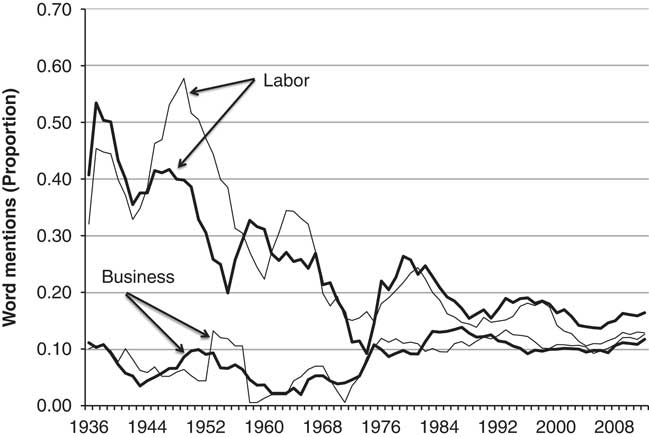
The story of labor unions and ideology is a simple pattern: decline. Reaching a peak in the late 1940s in the struggle between left and right over Taft–Hartley (see Figure 1),Footnote 4 the national dialogue over labor unions and associated issues of workers’ rights becomes steadily less associated with the language of ideology each passing decade. In the 1940s and 1950s almost no explanation of the meaning of ideology could avoid the labor-management divide. By the 21st century it would be an afterthought. As we debate whether left versus right is more about the size and scope of government or the competing social agenda, the once prominent divide over workplace rights and power could easily be forgotten. The same pattern, but even more dramatic, will be seen when we look at the policy correlates of ideological identification.
Proportion of all news stories that refer to “liberal” or “conservative” and mention unions or big business (five-year moving average)

Big business
While business is the opposite of labor in political rhetoric, its role in news treatment of ideology is less important. Reliably associated with the Republican Party for generations, “business” never looms large as a topic associated with ideology. So the main pattern to see in Figure 1 is that “big business” is never strongly associated with “liberal” and “conservative.” Less then 14 percent of our ideology coverage refers to “business,” at its height. That falls off to essentially nothing in the decade of the 1950s and 1960s, a time when party disputes over business were sidelined.
People on welfare
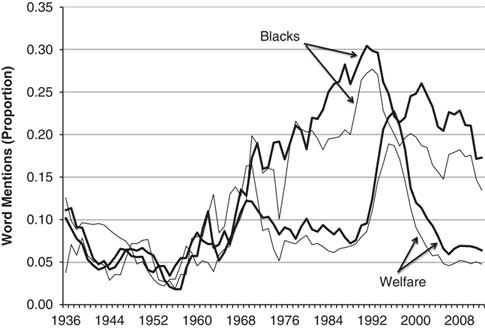
Long a conservative favorite for defining its opponents—liberals are people who believe government should pay people who do not want to work—welfare surprises somewhat by not being powerfully associated with ideological language for most of the seven decade period. One obvious exception is in 1995–1996, when Bill Clinton did battle with a Republican House of Representatives over the shape of welfare reform (see Figure 2). Another, more subtle, increase in welfare salience occurs roughly in the years of LBJ’s Great Society, the one large-scale attempt to alleviate poverty in the United States. Both of these instances show that the real experience of politics—the action inside the beltway—leaves an impact on the definitions of ideological language.
Proportion of all news stories that refer to “liberal” or “conservative” and mention people on welfare or blacks (five-year moving average)

FDR and the Democrats of the 1930s, 1940s, and 1950s had the rhetorical edge in American politics. Based upon a perceived cleavage between the “common man” and the interests of the rich and business—at a time when most Americans saw themselves on the side of the “common man”—such a formula was the basis for an almost permanent majority.
Democrats had succeeded in keeping race off the national political agenda for those three decades. A governing coalition of a racist South and an anti-racist Urban North could not survive if race were to become a salient issue. And thus even though the New Deal was highly favorable to the interests of black America, blacks were not seen as its clients. The rhetorical “common man” was a white worker. It is useful, for contrast to what would follow, to remember that the “common man” was not poor. Except during the high unemployment times of the Great Depression, common workers were doing better in America than they ever had before—or ever would since.
The 1960s and After
That would change with the coming of the Civil Rights Movement and the “Great Society” as Democratic response. The Civil Rights Movement forced Black America to the center of national consciousness. And the response to civil rights, Lyndon Johnson’s Great Society programs discovered “poverty” as a new focus of government policy. A “War on Poverty” made the underclass, disproportionately black and disproportionately urban, the central focus of American political debate (Kellstedt Reference Kellstedt2003). And the urban poor were a radical disjunction with the idea of the common man. If the “common man” of an earlier era was a white worker, the client of LBJ’s programs was not white and not working. The “common man (or person)” was an identity most Americans could comfortably adopt. The urban poor were a quite small minority of Americans. Helping out the common man in distress was seen as simple economic justice. Helping out the urban poor was something else, “welfare” paid to non-working single mothers.
Here we take up the new issues of the 1960s, principally race and poverty. This is the transition between the politics of “the common man” and the politics of the underclass.
Blacks
The growing racial coloration of American ideologies is readily seen in Figure 2, where the proportion of ideological stories mentioning “blacks” grows steadily from near 0 before the 1960s to the 0.15–0.25 range in later decades. This shows that the public has good reason to fuse race and ideology because it has been exposed to interpretation of ideology in terms of race for some 50 years now.
What is remarkable about the connection of race to ideological language in media reports is that the connection grew in prominence in the decades after racial issues were at the center of American politics. It is not surprising that race should have intruded into the discussion of ideology in the 1960s because race intruded into American life in general in the 1960s. But after the election of Richard Nixon in 1968 and the end of the string of “long hot summers” of racial riots in the late 1960s, race receded, in Pat Moynihan’s terms into “benign neglect.” But Figure 2 shows a growing association of black with liberal and conservative after the 1960s, when issues such as the Vietnam War and the Watergate Scandal pushed racial matters off the front pages.
Poor people
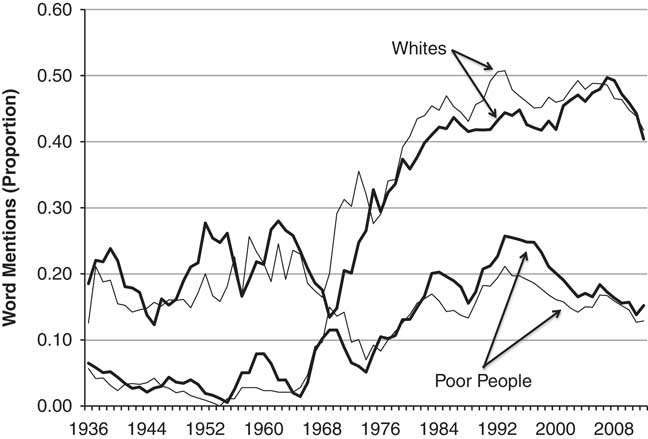
With the Great Society came the emergence of the underclass, “poor people,” as the new clients of liberalism. The pattern is apparent in Figure 3 where the word “poor” is almost non-existent in media treatments of ideology before LBJ is elevated to the Presidency and then surges thereafter. While the linguistic difference between the “common” man of earlier times and the “poor” of the late 1960s may seem small, politically it is huge. “Common” was a self-identification most Americans could adapt. “Poor” referred to the urban underclass, the media image of which, as Gilens (Reference Gilens2009) tells us, was also black. Indeed the correlation here between “black” (Figure 2) and “poor” (Figure 3) is about 0.70, further evidence that poverty has a black face.
Proportion of all news stories that refer to “liberal” or “conservative” and mention poor people or white people (five-year moving average)

Another message of Figure 3 is that the connection of liberalism to poverty was lasting. After Lyndon Johnson left office and after much of the Great Society disappeared, the association of poor with liberal continued to grow. The War on poverty proved to be a minor skirmish. Its effect on ideology, however, was lasting.
White people
White people, such an overwhelming majority at the outset, become politically relevant as a counterpoint to blacks, in spite of numeric dominance. It seems a little strange that a group so dominant should become associated with ideological terms. As best as we can make sense of it, white becomes relevant meaning “not black.” The 2016 election of Donald Trump suggests, however, that we may have observed the growing relevance of white identity politics in our (earlier) data.
In the next section we ask whether the changing news flow mattered. For evidence we look at correlations between affect toward “liberals” and affect toward the same groups we have just examined.
THE IMAGE CONTENT OF IDEOLOGICAL AFFECT
We now know that citizens attending to the news of the day would have been confronted with changing associations of the terms liberal and conservative as the agenda of American politics, as seen through the news, changed. But exposure to information is just a precursor to influence. To see repeated connection, for example, between liberal and conservative on one hand and the fate of black Americans on the other is not quite enough to link the idea of race to images of left and right.
In this section, we pursue the question of whether the ideas and images of the news became linked to perceptions of connections between people as defined by ideology and people as defined by other characteristics. In particular, we employ the ANES feeling thermometers, which were designed to be measures of pure affect. We track in particular the correlation between the feeling thermometer for “liberals” with each of a variety of other groups.Footnote 5 We are interested in the degree to which survey respondents respond similarly or differently to liberals and other groups over time.Footnote 6
When the feeling thermometer for “liberals” was first administered in 1964, slightly more than 50 percent rated the group at 50 (Coggins Reference Coggins2013). Since the instructions in that study told respondents to rate a group at 50 if they had no feelings about it or did not know of it, we surmise that “liberals” was a term without meaning for about half the electorate.Footnote 7
This warmth or coldness toward groups of people is a long remove from ideology seen as an intellectual understanding of fundamental principles and policy specifics. Without any understanding whatsoever of the meaning of ideological terms one can react affectively to people defined by adjectives. To read, for example, “the liberal support for Barack Obama” is to learn the name associated with people who support Obama. Then one can feel warm or cold toward those people without necessarily having any understanding of the precepts of liberalism.Footnote 8 Importantly this conception extends the scope of ideological influence well beyond those who have a working understanding of ideology. Some such conception is necessary if we are to square the evidence of aggregate ideological influence with our knowledge that most citizens have but limited understanding of ideological debates (Converse Reference Converse1964).
If the interpretation of the crucial events of the late 1960s is true, it should be the case that there is evidence in the changing connotation of “liberal.” There are stark limits to what we can observe because for this “end of ideology” period in American political life neither liberalism nor the things that are associated with a liberal identity are well or often measured. The best we can do is the National Election Study feeling thermometer for “liberals.” That begins in 1964. But most of the possible associations suggested so far do not have measures in the ANES series until 1970 or after. So we can observe the growth of new associations over about a decade and a half beginning in 1964. But most cannot be observed both before and after, as would be crucial evidence, but only after.
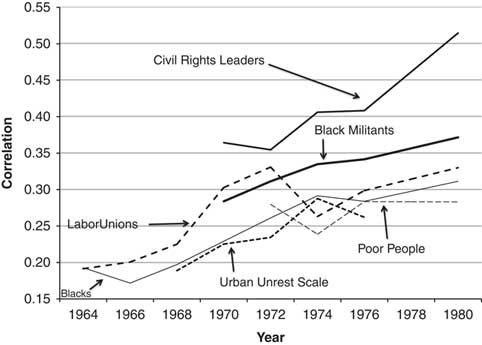
We portray several series of correlations in Figure 4. The figure covers the period between 1964, the first appearance of the feeling thermometers, and 1980, roughly the end of interesting changes. Beginning at the left we see a picture of fairly impoverished group associations with liberalism at the outset, which then grow over the 1960s and 1970s. Only two, blacks and labor unions, are measured in the crucial early and mid-1960s. Both increase more or less steadily over time. We take that to indicate ideological learning, an electorate that better understands who liberals are at the end of the period than at the beginning.
Correlations of the “liberals” feeling thermometer with other feeling thermometers and preference indicators, 1964–1980 Source: The American National Election Studies (www.electionstudies.org) Time Series Cumulative Data File (data set). Stanford University and the University of Michigan (producers and distributors), 2017.

The dominant pattern, however, is that race—and particularly racial activism—emerges as the dominant group association with liberalism. This is curious, because the two groups, civil rights leaders and Black militants were quite temporary visitors to the national stage. Civil rights leaders were dominant in the news from roughly 1962—the first sit-ins—to 1968, punctuated by the assassination of Martin Luther King. “Black militants,” a term with little meaning in the current era, refers to the black power movement, the Black Panther Party, and the race riots of the late 1960s. The militants emerged in the news in the mid-1960s as a challenge to civil rights leaders and were not heard of again after about 1970. As measured by correlations with response to “liberals,” nonetheless, these two groups seem to dominate what it means to be liberal. This is seen in measures that begin in 1970, after they have largely already vacated the national stage. Taken literally it would seem that the dead Martin Luther King defines what it means to be liberal a decade and more after his assassination.
It is notable that the strongest correlations emerge for black leadership, civil rights leaders and militants, rather than “blacks” as a simple racial group. The black leadership was explicitly political, making demands upon American society, in contrast to the racial group. As sources of great controversy, it appears that the leaders are singled out for strong reactions, perhaps a politically correct rejection of leadership demands. This is in contrast to rejection of black citizens, where a “cold” thermometer score would be indicative of racial prejudice.
To round out the picture we also add “poor people” to the figure along with an urban unrest scale—a wholly different sort of measure from the thermometers, but useful to gauge response to the black riots of the late 1960s.
In summary, what we see from Figure 4 is the racialization of liberalism. The evidence is consistent with a story in which the terms “liberal” and a group, “liberals,” come to be seen through a strongly racial lens. The patterns of the growing racial images are consistent with the issue evolution story (Carmines and Stimson Reference Carmines and Stimson1989), with movement coming not at the critical moment of the early 1960s, but rather after.
We have seen movements in ideological identification for those who see ideology as topics in the news and for those who see it as group associations. Yet another subset of the electorate intellectualizes ideology as a bundle of related policy controversies. The question for analysis is “which policies?”.
THE POLICY CONTENT OF IDEOLOGICAL IDENTIFICATION
The previous sections have developed evidence of the impact of experience on ideological perceptions. We have seen which words are used in news stories related to ideology in fourth section. And we have seen which people are associated with the group “liberals” in the fifth section. Here we turn to the more traditional view of ideology as a bundle of policy preferences. We ask do the policy preferences associated with the choice to identify oneself as a liberal or conservative change over the span of time in our analysis?
To capture policy preferences we have 61 time series of policy-specific mood, available from the Policy Agendas website (http://www.comparativeagendas.net).Footnote 9 These are a mix of generic policy domains (e.g., health, education, transportation, and the like), and more specific policy issues (e.g., healthcare reform, elementary and secondary education, and so forth).Footnote 10
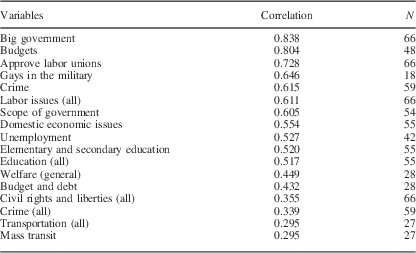
We begin with the obvious first question, which policy controversies are most associated with the decision to identify as a liberal or conservative. For analysis of this issue we have the 61 policy-specific mood estimates and ideological self-identification, 1937–2011, from Ellis and Stimson (Reference Ellis and Stimson2012). We see the beginning of an answer in simple product moment correlations between the identification and preference series in Table 1.Footnote 11
Pairwise Correlations of Liberal–Conservative Self-identification With Policy-Specific Moods

Note: All variables with 15 or more cases and correlations >0.25, 1946–2011.
We have too many ideology-preference correlations for brief presentation and many of them are manifestly uninteresting because the correlations are small, the number of cases is small, or both. So we choose to present correlations for all series present for 15 or more years and with correlations greater than 0.25 (see Table 1).
What we learn from Table 1 is, in part, the message of Converse (Reference Converse1964). Converse found that most respondents who managed to provide a definition for the terms “liberal” and “conservative” turned to the narrow idea that liberals spend more and conservatives spend less. This captures the reality of the larger, more intellectual, debate about the scope of government, but only in fairly crude and primitive terms. But we see the same in Table 1, which shows that respondent attitudes toward big government and spending are the strongest correlates of the self-identification as liberal or conservative.
In addition to narrowness of concept, what distinguishes the debates about budgets and spending from the our scope of government indicator is that budget battles—and the survey items which tap them—are about spending in the abstract. Self-identified conservatives are pretty uniformly opposed to “spending,” the concept. But our scope of government indicator is mainly composed of attitudes toward spending toward concrete social goals and programs. And there we find that conservatives are only slightly less supportive of spending for popular goals (education, environment, Social Security, Medicare, Medicaid, and so forth) than are liberals (Ellis and Stimson Reference Ellis and Stimson2012). So attitudes toward actual spending do not as reliably correlate with self-identification.
The second point we take from Table 1 is that there is little support for a cultural issues perspective on ideology. To be sure there is some cultural content in the table. Gays in the military is the fourth best predictor of self-identification for the brief 18-year period for which we have measures. And our crime indicator takes in gun control attitudes. But the United States of Table 1 is definitely not Kansas (Frank Reference Frank2004). It is instead a structure of association with ideology mainly derived from the issues of the New Deal and Great Society.
Perhaps this absence of cultural issues influence is a question of period. These correlations capture what self-identification means over more than six decades, whereas the social and cultural issue set is relatively modern. That is clearly a limitation of this correlational analysis. Insofar as the association of preferences and self-identifications is dynamic, changing in important ways over the span of the analysis, this method will not catch it. We develop one which will, the moving windows approach.Footnote 12
The Changing Correlates of Identification as Liberal or Conservative
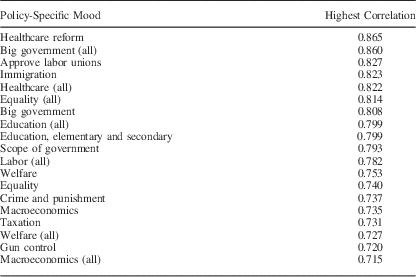
To observe change over time we employ a different criterion in Table 2. Using 21 year moving windows we rank issue contribution to explaining self-identification not by the overall correlation, as before, but here by the highest correlation observed in any particular window. This method eliminates the bias against newer issue domains in Table 1. And this indeed allows some newer issue domains to emerge. See particularly healthcare reform, immigration, and equality (a composite of attitudes toward blacks, women, and gays).Footnote 13
Correlations of Policy-Specific Moods and Liberal–Conservative Self-Identification Ranked by Maximum Moving Window Correlation, 21-Year Window Size

Clearly the newer issues have contributed to the changing connotation of identification, but they do not dominate it. Attitudes toward such standbys as big government are strong predictors of left-right identifications at all times. And newer issues are not only cultural issues. Healthcare and education are both scope of government controversies, but both date from initial efforts in the 1960s.
We can learn a bit from Table 2 by what is not in the table. Most prominent in that role is abortion, an issue domain that is rarely correlated with ideological self-identification, reaching a maximum at any time of 0.36. The abortion controversy is undoubtedly a vital part of American politics. What it is not, we learn, is a strong correlate of self-identification. And that is not merely newness. The controversy has made hot politics since the Roe decision of 1973. For over 40 years it has had the opportunity to lend meaning to our conceptions of liberalism and conservatism. This evidence tells us that it has not done so.
We have seen which issues matter most for ideological self-identification. The question now is when.
Agenda Change
We know the life history of each of our 61 issue attitude series. We can track growth, decay, or continuity of correlation with self-identification of each for all or part of almost 70 years. That is considerably more data than reader patience or journal page limits would permit. So our presentation is necessarily selective.
We have selected five series of correlations illustrating three patterns of change. Each is chosen because at some point it is a very important correlate of self-identification. The three patterns are growth, decay, and continuity.
Constant association
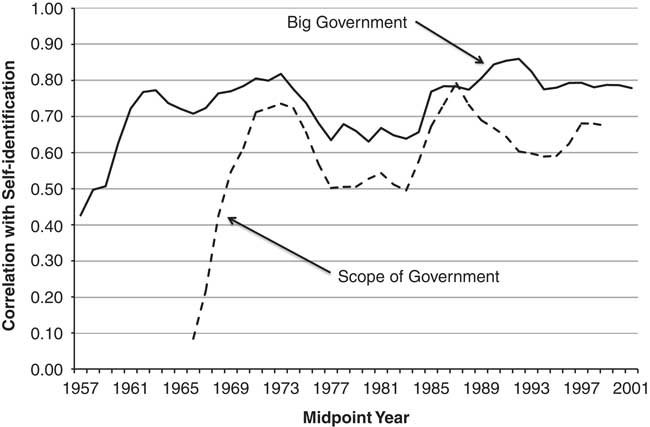
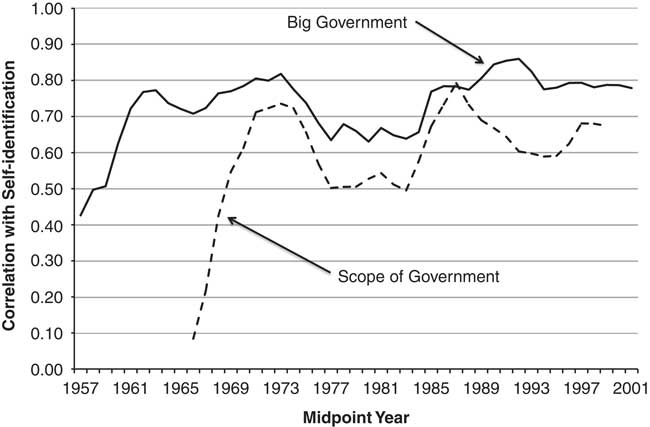
Two series—attitudes toward “Big Government” as a symbol and our scope of government indicator, which captures spending preferences on concrete programs and policies—show a pattern of essential continuity. Much of the left-right discourse and much of the explanation of self-identification is a story of attitudes toward the size of government.
Saying that one favors—or, considerably more often—opposes “big government” is a purely symbolic statement. There are no programs named big government and government makes no abstract decisions about its size and the degree to which it intrudes in daily life. Those come from concrete decisions about actual programs. It would seem at the outset that opposing big government would entail opposing the things that make government big, the specific policies and programs. Support or opposition to specifics is captured in our scope of government indicator.
Opposing big government is powerfully connected to identifying as a conservative, and has always been (see Figure 5). The two are not quite synonyms, but close to it. Operational attitudes toward size of government, captured in our scope of government indicator, are considerably less associated with left and right. This is the expected slippage between symbolic and concrete attitudes. Millions of Americans who vigorously oppose “big government” nonetheless endorse greater spending on the very programs that make government big.
Moving window correlations of issue attitudes and liberal–conservative self-identification, moving window midpoints for 1957–2001 Note: Window size is 21. Comparing “big government” and scope of government.
Declining association
It is not altogether surprising that attitudes toward labor unions are not as powerfully related to left and right as they once were. A casual reading of modern history would tell us that the labor versus management divide was a much more crucial aspect of left versus right in the 1940s and 1950s than it became later. The labor movement has been in decline, along with the phenomenon of deindustrialization, which has undermined its base, over most of the last 50 years or so. And a movement in decline seems to have raised many fewer public issues than did the relatively powerful unions of earlier years.Footnote 14
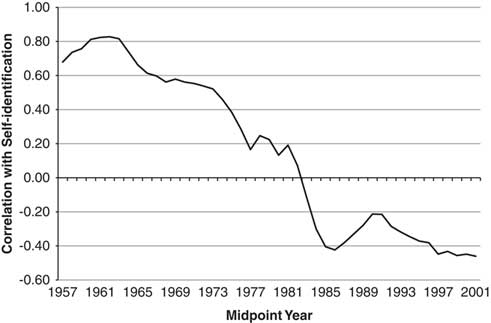
We were nonetheless unprepared to witness the truly radical decline of labor’s association with self-identification shown in Figure 6. After a peak roughly at the time of the election of John Kennedy, the association of labor attitudes with self-identification has declined at a rapid and steady rate. By the early 1980s the association reached 0 and then headed into negative territory.
Moving window correlations of labor attitudes and liberal–conservative self-identification, moving window midpoints for 1957–2001 Note: Window size is 21.

And what of the negative correlation at the end of the series? We regard it as a sort of punctuation point on the truly important finding, the absence of correlation between attitudes toward labor unions and self-identification. Probably labor attitudes were much more meaningful when labor was potent. In its current weakened state it is easy to approve.
Liberalism was once the ideology of support for the “common man” and the “working man.” It is no more. The inference that arises from our analysis is that now Americans choose to identify as liberal, moderate, or conservative without ever considering whether they support or oppose labor unions. So as we speculate about why working-class Americans often consider the party of the right attractive, we need no longer ask what overcomes the natural pull of seeing oneself as labor rather than management. There is no such pull.Footnote 15
Growing association
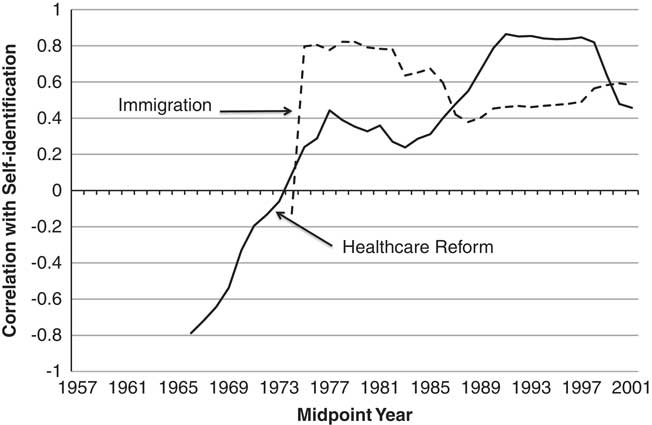
The pattern that has long been expected is the intrusion of new issues (Carmines and Stimson Reference Carmines and Stimson1989; Carsey and Layman Reference Carsey and Layman2006). Some of those, such as attitudes toward healthcare reform (see Figure 7) are extensions of the issue stream that preceded their arrival. Although no issue connection is ever so inevitable as it may seem after the fact, the growing problem of serious gaps in employer-provided healthcare was likely to be associated with the ideology that already supported government-based solutions in welfare, education and—already in the healthcare field—Medicare for the retired. Liberals were likely to support a government solution to the problem of the uninsured and conservatives were equally likely to oppose such an action.
Moving window correlations of issue attitudes and liberal–conservative self-identification, moving window midpoints for 1957–2001 Note: Window size is 21. Comparing immigration and healthcare reform.

Thus, healthcare reform which is now powerfully associated with self-identification (an association which long precedes the battle over the Affordable Care Act) may be seen as just another facet of the scope of government debate. In that sense it is not new, just a continued debate along predictable lines. Immigration, in contrast, is new to the definition of left and right (see Figure 7). With no logical connection to the scope of government debate, one can imagine a different history in which conservatives supported enhanced immigration and liberals opposed it. If the issue had been framed as the introduction of cheap labor, which it surely was, then the pro-labor ideology might have opposed it and the pro-management ideology supported. That the sides of the immigration debate could have been different means that the issue was genuinely novel. As it currently plays, it is the cultural openness of the left toward a diverse and multi-lingual society versus the “America for Americans” conception of the right. It is now strongly associated with the meaning of liberal and conservative and seems unlikely to be less so in the future.
THE PUZZLE RESOLVED
If liberalism—the label, the policies entailed and the set of social groups benefitting from those policies—were genuinely unpopular, our story would be simple. We could just write that Americans had experienced liberalism and—at least as a majority sentiment—rejected it. A majority does hold the label in low regard, with about half as many choosing it as self-description as choose “conservative” (Ellis and Stimson Reference Ellis and Stimson2012).
But it is definitely not the case that liberal policies have been rejected. Such ideas are embraced by a majority in case after case, pretty often even by a majority of those calling themselves conservatives. Witness, for example, the strange coded debate about “entitlement reform” of recent decades. Conservatives are pretty uniformly for it. The rest of America is not so much against it, as confused. It does not know that “entitlement” means Social Security and Medicare.Footnote 16 And it does not know that “reform” means cut. And the reason it does not know these things is that conservatives know that if their intentions were clear, they would be swatted down by an angry electorate which regards even talk of cutting Social Security and Medicare—terms, unlike “entitlement,” which are quite real to ordinary voters—as unacceptable. Conservative politicians, that is, are almost uniformly in favor of entitlement reform, but only in code. Not a one will propose cutting Social Security or Medicare.Footnote 17 There is nothing accidental about the code. If it ever came to be understood by the mass electorate that “entitlement” meant Social Security and Medicare, advocacy of entitlement reform by those seeking election would cease.
The evidence of the popularity of liberal policies is ubiquitous. If one analyzes the universe of survey questions that are related to the left-right divide, leftist responses, those calling for a bigger, more active, government outdistance conservative ones about three to two (Ellis and Stimson Reference Ellis and Stimson2012, 19–24). The exception is questions of a symbolic character. Very few Americans will endorse “big government.” But most of the actual programs that make government big—and all of the biggest ones—are endorsed by heavy majorities. Many are endorsed by majorities of self-described conservatives.Footnote 18 The left versus right dialogue in American politics tends to be asymmetrical. Liberals usually emphasize concrete proposals to change public policy while conservatives emphasize attacks on liberals and liberalism over proposing the conservative alternative. This would be consistent with the evidence just seen, that conservatives know that they are swimming upstream with truly conservative proposals. While we lack a solid research basis for this conclusion, an obvious example is the now seven-year debate over Obamacare. The conservative response has been unlimited damnation of the program with pretty nearly zero effort to propound a conservative alternative.
The Resolution
What we have seen in these pages is that pejorative connotations (race, protest, counterculture, and defiance of God and country) have attached to the symbols of liberalism and, in particular, the word “liberal.” At the same time policy continues on its liberal, post New Deal, path. And the Democratic Party remains competitive, even dominant at the presidential level, while its ideological baggage is tarnished.
From an intellectual point of view that would be hard to understand. But, taking seriously what we know about the affective and cognitive processing of the mass electorate, it becomes possible to understand why a symbol can be tarnished while its substance is unaffected. If millions of voters do not make the intellectual connection between “liberal,” the symbol and the set of policies that—for others—flows from it, then it is no contradiction at all that many despise the symbol and support the policies.
Over seven decades, but particularly since the 1960s, the individuals and groups who have tarnished the symbol are often not strategic actors. The Vietnam War protester carrying the North Vietnamese flag and calling the police “pigs” is not thinking about how to influence public opinion to support his or her ostensible goals. This is what we expect from mass movements, which mix the commitments of the reasoning and the unreasoning fad-followers in similar numbers.
Contrast this with Democratic Party office-seekers, who are strategic in every thought and utterance. This explains how the party and its candidates can be viable, even dominant, while its associated ideological label is deeply tarnished. And, of course, part of that omnipresent strategy is never allowing oneself to be attached to the dirty L-word, while conservative strategy is quite the opposite: use “liberal” as frequently as possible to denigrate one’s opponents, while similarly aligning oneself closely with the popular “conservative.”