Introduction
CHD is the most common congenital anomaly and remains an important cause of morbidity throughout childhood, with many patients requiring repeated diagnostic assessments and catheter-based treatments during follow-up. Reference van der Linde, Konings and Slager1 As catheter-based techniques continue to expand, the paediatric cardiology catheterization laboratory has become a key setting for both diagnostic evaluation and transcatheter intervention across a wide range of congenital cardiac conditions. Reference Feltes, Bacha and Beekman2,Reference Hijazi and Awad3
Safe and efficient completion of catheterization procedures in children depends not only on technical success but also on appropriate anaesthetic management. Children with CHD often have limited physiological reserve, and anaesthetic drugs, airway manipulation, and ventilation strategy can influence haemodynamics and procedural conditions. In practice, both sedation techniques and general anaesthesia are used, and the choice is shaped by patient age, clinical complexity, and procedural requirements. Reference Karagöz, Ankay-Yılbaş, Kanbak, Tümer, Özkutlu and Karagöz4
The balance between sedation and general anaesthesia is clinically important. General anaesthesia provides immobility and controlled ventilation and may facilitate longer or more complex procedures, but it may increase airway-related adverse events in susceptible patients. Sedation can avoid tracheal intubation in selected children but requires careful titration, continuous monitoring, and readiness to escalate support. Prior studies have described anaesthesia management and complication profiles in paediatric catheterization.Reference Karagöz, Ankay-Yılbaş, Kanbak, Tümer, Özkutlu and Karagöz4–Reference Ogawa, Yamana and Noda8 However, comparisons between anaesthesia strategies are difficult because anaesthetic approach is strongly linked to procedure type and baseline risk.
Accordingly, the aim of this study was to evaluate anaesthesia management in children with CHD undergoing procedures in the paediatric cardiology catheterization laboratory at our centre and to examine the association between anaesthesia strategy and peri-procedural outcomes. We assessed patient and procedural characteristics, length of stay, and the frequency and types of complications.
Materials and methods
Study design, setting, and ethics
This retrospective cohort study was conducted in the paediatric cardiology catheterization laboratory of Hacettepe University. This study was approved by the Hacettepe University Non-Interventional Clinical Research Ethics Committee (Date: 21 May 2024; Research No.: SBA 24/520; Decision No.: 2024/09-05). The study was conducted in accordance with the principles of the Declaration of Helsinki. Due to the retrospective design, the requirement for informed consent was waived by the ethics committee.
Participants and unit of analysis
In total, 333 catheterization laboratory patients during the study period were screened. Twenty-two were excluded based on prespecified eligibility criteria (patients aged 18 years and above, n = 21; American Society of Anesthesiologists physical status IV–V, n = 1), leaving 311 eligible patients. Four additional patients were excluded because they did not undergo catheterization procedures (transoesophageal echocardiography-only examination), resulting in a final analytic cohort of 307 catheterization patients.
Peri-procedural management and monitoring
Catheterization procedures were performed in a dedicated catheterization laboratory environment by the paediatric cardiology team. Throughout procedures, patients were continuously monitored with electrocardiography, noninvasive blood pressure, pulse oximetry, and capnography, with additional monitoring (e.g., invasive arterial pressure) used when clinically indicated. Standard temperature management strategies were applied to prevent peri-procedural hypothermia.
Anaesthesia strategy
Anaesthesia management was categorized as general anaesthesia or sedation based on the recorded anaesthesia type for each patient. At our institution, both general anaesthesia and procedural sedation in the paediatric cardiology catheterization laboratory are administered and monitored by the anaesthesiology team; sedation is not provided by the interventional cardiology team. In general anaesthesia cases, airway management and controlled ventilation were provided as clinically indicated. Sedation was administered using intravenous midazolam, fentanyl, ketamine, and/or propofol, alone or in combination, titrated as boluses and/or infusion according to patient characteristics and procedural requirements, with spontaneous ventilation preserved whenever feasible.
Data collection and variables
Data were obtained from catheterization laboratory records, anaesthesia charts, and the institutional hospital information system. Extracted variables included age, sex, weight, comorbidities, previous cardiac surgery history, anaesthesia type, procedure duration, post-procedure disposition (ICU admission), ICU length of stay, total hospital length of stay, and documented peri-procedural complications. For general anaesthesia cases, airway device type (endotracheal tube versus supraglottic airway) was not available in a consistent, structured format across all records and was therefore not analysed. Complications were abstracted from the anaesthesia record, the catheterization laboratory procedure report, and post-procedure clinical documentation. The composite outcome included any peri-procedural adverse event recorded in these sources, including both anaesthesia-related and procedure-related events. Because this was a retrospective study and documentation of transient events can vary, complications were counted when the event was explicitly documented and/or prompted a clinical intervention (e.g., escalation of oxygen therapy or airway support for desaturation; bronchodilator administration for bronchospasm; fluid bolus and/or vasoactive medication for hypotension). Desaturation and hypotension were therefore described as documented episodes requiring active treatment, rather than brief, self-limited changes not requiring intervention.
ICU admission was defined as a recorded post-procedure ICU stay. In our institutional workflow, ICU admission after catheterization is commonly used for planned post-procedure monitoring in patients and/or procedures considered higher risk. In our cohort, ICU admissions were planned except for the cardiac arrest cases requiring emergency surgery and extracorporeal membrane oxygenation, which resulted in unplanned ICU admission.
The primary outcome was any complication (yes/no), defined as the occurrence of at least one recorded complication during or after the catheterization procedure. Specific complication types were also recorded and summarized descriptively. Additional comorbidity and CHD profiles, baseline comparisons, and subgroup regression analyses are provided in the Supplementary material (Tables S1–S6).
Statistical analysis
Analyses were performed using IBM SPSS Statistics (version 28.0; IBM Corp., Armonk, NY, USA). Continuous variables are presented as median [interquartile range] and range and categorical variables as number (percentage). Normality was assessed using the Shapiro–Wilk test. Between-group comparisons (general anaesthesia versus sedation) were performed using the Mann–Whitney U test for continuous variables and the chi-square test or Fisher’s exact test for categorical variables, as appropriate.
To reduce confounding by indication related to procedure type, adjusted analyses were stratified by procedure class (diagnostic versus interventional). The primary adjusted analysis was restricted to diagnostic catheterization/angiography procedures and used multivariable logistic regression to estimate the association between anaesthesia type and any complication, adjusting for age, sex, previous cardiac surgery history, and pulmonary hypertension comorbidity. In the interventional stratum, sparse data with zero events in the sedation subgroup precluded standard logistic regression; therefore, interventional-only regression was performed using Firth penalized logistic regression with anaesthesia type as the predictor. Effect sizes are reported as odds ratios with 95% confidence intervals. Analyses were complete cases; no imputation was performed. All tests were two-sided, and p < 0.05 was considered statistically significant.
Results
Study cohort and baseline characteristics
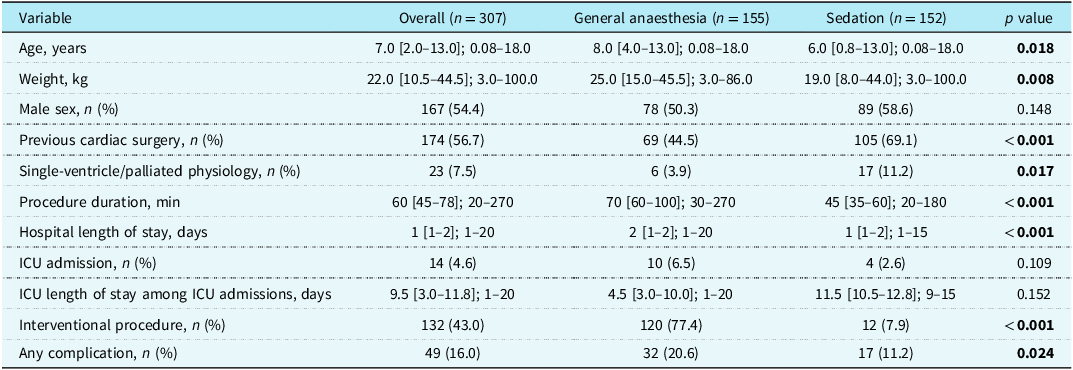
In total, 307 procedures were analysed. The median age was 7.0 years (interquartile range 2.0–13.0; range 0.08–18.0), and the median weight was 22.0 kg (interquartile range 10.5–44.5; range 3.0–100.0). General anaesthesia was used in 155 procedures (50.5%) and sedation in 152 (49.5%). Patients receiving general anaesthesia were older (8.0 years [4.0–13.0] versus 6.0 years [0.8–13.0]) and had higher body weight (25.0 kg [15.0–45.5] versus 19.0 kg [8.0–44.0]) than those receiving sedation (Table 1).
Patient and procedural characteristics by anaesthesia type

Data are presented as median [interquartile range] and min–max for continuous variables and number (%) for categorical variables.
p values compare general anaesthesia versus sedation (Mann–Whitney U for continuous variables; chi-square or Fisher’s exact test for categorical variables, as appropriate). Procedure duration was defined as anaesthesia time from induction to the end of anaesthesia.
ICU LOS = ICU length of stay; IQR = interquartile range; LOS = length of stay; Cath lab = cardiac catheterization laboratory. Bold values indicate statistical significance.
Baseline and procedural characteristics differed between anaesthesia groups. Compared with sedation, general anaesthesia was associated with longer procedure duration (median 70 versus 45 minutes) and longer hospital length of stay (median 2 versus 1 day). Previous cardiac surgery was more frequent in the sedation group than in the general anaesthesia group (69.1% versus 44.5%). Single-ventricle/palliated physiology was present in 23/307 procedures (7.5%) and was more frequent in the sedation group than in the general anaesthesia group (17/152 [11.2%] versus 6/155 [3.9%], p = 0.017). Interventional procedures were substantially more common under general anaesthesia than under sedation (77.4% versus 7.9%) (Table S4).
Detailed comorbidity profiles, primary CHD categories, and previous cardiac surgery distributions are provided in Supplementary Tables S1–S3. Additional baseline comparisons, procedure categories, and subgroup regression models are presented in Supplementary Tables S4–S6.
Procedure types
Overall, 175/307 procedures (57.0%) were classified as diagnostic catheterization/angiography and 132/307 (43.0%) as interventional catheterization. Among interventional procedures, device closures accounted for 72/307 (23.5%) cases (atrial septal defect 47, patent ductus arteriosus 12, ventricular septal defect 13), balloon interventions for 29/307 (9.4%), stent implantation for 11/307 (3.6%), transcatheter pulmonary valve implantation for 13/307 (4.2%), and electrophysiology ablation for 7/307 (2.3%) (Table S4).
Sedation was used predominantly for diagnostic procedures (140/152, 92.1%), whereas interventional procedures were usually performed under general anaesthesia (120/132, 90.9%). Only 12 interventional procedures were performed under sedation, most commonly balloon interventions (n = 4), patent ductus arteriosus device closure (n = 3), and electrophysiology ablation (n = 3); isolated cases included ventricular septal defect device closure (n = 1) and stent implantation (n = 1), with no atrial septal defect device closures or transcatheter pulmonary valve implantations performed under sedation.
Complications and clinical outcomes
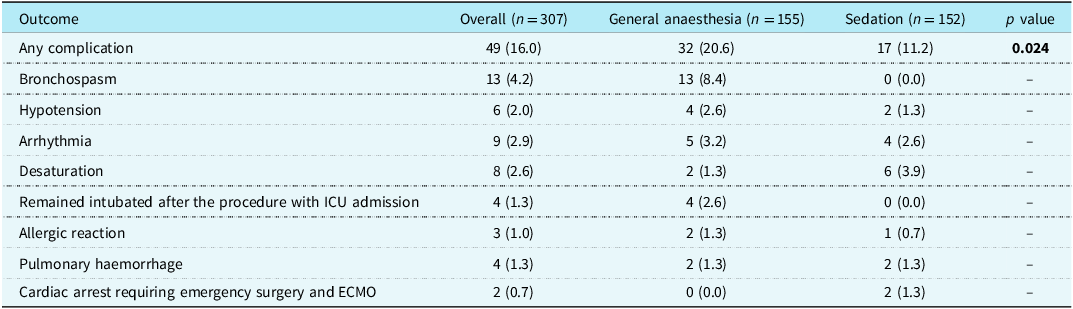
Overall, 49/307 procedures (16.0%) were associated with at least one recorded complication. Complications were more frequent with general anaesthesia than with sedation (32/155 [20.6%] versus 17/152 [11.2%], p = 0.024) (Table 2). The most frequently documented complication was bronchospasm (13/307, 4.2%), which occurred only with general anaesthesia (13/155, 8.4%). Hypotension occurred in 6/307 procedures (2.0%) and was observed in both groups (4/155 [2.6%] versus 2/152 [1.3%]). Desaturation was recorded in 8/307 procedures (2.6%) and was more frequent with sedation than with general anaesthesia (6/152 [3.9%] versus 2/155 [1.3%]). ICU admission occurred in 14/307 procedures (4.6%) and was planned for post-procedure monitoring in all cases except the cardiac arrest cases requiring emergency surgery and extracorporeal membrane oxygenation, which resulted in unplanned ICU admission. Four patients remained intubated after the procedure and were admitted to the ICU for planned postoperative ventilation and monitoring; all were in the general anaesthesia group. Two cardiac arrests requiring emergency surgery and extracorporeal membrane oxygenation occurred in the sedation group; these events are reported separately and required emergent resuscitation and unplanned ICU admission. Both events occurred during diagnostic catheterization/angiography procedures performed under sedation. The exact immediate cause of arrest could not be determined from the retrospective records, and available documentation did not allow reliable differentiation between arrhythmic, haemodynamic, catheter-related, or other mechanisms. Emergency surgery and extracorporeal membrane oxygenation were instituted as part of rescue management after cardiac arrest.
Complications by anaesthesia type

Data are presented as number (%).
The category ‘Remained intubated after the procedure with ICU admission’ refers to patients who were intubated for general anaesthesia during the procedure and remained intubated afterward for planned postoperative ventilation and ICU monitoring. Unplanned ICU admission related to cardiac arrest/ECMO is reported separately under ‘Cardiac arrest requiring emergency surgery and ECMO’.
ECMO = extracorporeal membrane oxygenation. Bold values indicate statistical significance.
Adjusted analyses for complications
Because the anaesthesia strategy was strongly associated with procedure type, adjusted analyses were stratified by diagnostic versus interventional procedures. In the diagnostic catheterization/angiography cohort (n = 175; 27 events), multivariable logistic regression showed that general anaesthesia (versus sedation) was associated with higher odds of any complication (adjusted odds ratio 2.78; 95% confidence interval 1.12–6.91; p = 0.028). Age, sex, prior cardiac surgery history, pulmonary hypertension, and single-ventricle/palliated physiology were not independently associated with the primary outcome in this model (Table S5).
In the interventional cohort (n = 132; 22 events), complications occurred in 22/120 patients (18.3%) managed with general anaesthesia and in 0/12 patients (0.0%) managed with sedation. Given the sparse data and zero-event sedation subgroup, Firth penalized logistic regression was used; the estimated association between general anaesthesia and complications was imprecise (penalized odds ratio 5.71; 95% confidence interval 0.29–112.19; p = 0.251) (Table S6).
Discussion
In this single-centre retrospective cohort of paediatric catheterization laboratory patients, we observed three main findings. First, general anaesthesia and sedation were used in nearly equal proportions overall, but anaesthesia strategy differed markedly by procedure class: interventional procedures were predominantly performed under general anaesthesia, whereas diagnostic procedures were largely performed under sedation. Second, complications were recorded in 16.0% of patients, and the unadjusted complication rate was higher under general anaesthesia than under sedation. Third, when we addressed confounding by indication through stratification and multivariable adjustment within diagnostic catheterizations, general anaesthesia remained associated with higher odds of any recorded complication. These observations support the concept that comparisons between anaesthesia strategies in the catheterization laboratory should account for procedure type and baseline differences, rather than relying solely on pooled comparisons. Reference Feltes, Bacha and Beekman2,Reference Tokel, Gümüş, Ayabakan, Varan and Erdoğan7,Reference Ogawa, Yamana and Noda8
The overall pattern of anaesthesia use in our centre aligns with prior reports that sedation is widely utilized in paediatric catheterization laboratories, with substantial between-centre variation driven by institutional workflow, staffing, and case mix. Reference Özcanoğlu and Özcan5 In our cohort, the strong linkage between general anaesthesia and interventional procedures is clinically intuitive: interventions such as device closure, balloon-based therapies, stent implantation, and valve implantation generally demand immobility, stable operating conditions, and reliable airway control. This tendency is also reflected in procedural anaesthesia reports for transcatheter closure in children, where general anaesthesia is commonly preferred for procedural conditions and airway/ventilation management. Reference Karagöz, Ankay-Yılbaş, Kanbak, Tümer, Özkutlu and Karagöz4 As a result, crude comparisons of complications between anaesthesia types can be misleading because the anaesthesia choice often reflects the anticipated complexity and risk profile of the patient. Reference Feltes, Bacha and Beekman2,Reference Tokel, Gümüş, Ayabakan, Varan and Erdoğan7 The greater use of general anaesthesia in older/heavier children in our cohort likely reflects institutional workflow and procedure mix (interventional procedures requiring immobility and often controlled ventilation), rather than preferential avoidance of sedation in infants. The greater use of sedation among patients with prior cardiac surgery in our cohort likely reflects follow-up diagnostic catheterization/angiography in this subgroup, whereas surgery-naïve patients more often undergo index interventional procedures, which were predominantly managed under general anaesthesia.
A recent multicentre registry analysis by Chenault et al. reported substantially lower rates of anaesthesia-related adverse events (0.8% overall; 0.4% high severity) in congenital cardiac catheterization and found that general anaesthesia was not associated with increased odds of high-severity anaesthesia-related adverse events after accounting for procedural complexity using the PREDIC3T risk category. Reference Chenault, Rahman and Gauvreau9,Reference Quinn, Yeh and Gauvreau10 Our findings are not directly comparable because our primary endpoint was a broad composite of any recorded complication in retrospective clinical documentation, including both anaesthesia-related and procedure-related events, and we counted events when they were explicitly documented and/or required a clinical intervention. Differences in outcome definitions and capture, along with residual confounding by indication and case mix, may therefore explain why we observed higher overall event rates and an association with general anaesthesia in the diagnostic subgroup. In addition, because complications were abstracted from anaesthesia records as well as catheterization and post-procedure documentation, transient anaesthesia-related respiratory events such as bronchospasm may have been captured more completely than in catheterization registry-based studies, in which procedural adverse events may be preferentially recorded.
Respiratory events were prominent in the general anaesthesia group, particularly bronchospasm, which occurred only under general anaesthesia in our cohort. This is plausible given that airway instrumentation, airway irritation, and positive-pressure ventilation can increase the risk of bronchospasm and related respiratory events in susceptible children. Conversely, hypotension and desaturation occurred in both groups, with desaturation numerically more frequent under sedation in our cohort, emphasizing that sedation is not risk-free and requires vigilant monitoring and readiness to escalate support. Contemporary observational studies have similarly suggested that sedation may be associated with fewer high-severity adverse events than general anaesthesia in selected paediatric catheterization populations, although these studies also highlight the importance of careful patient selection and institutional expertise. Reference Mikus, Welchowski, Schindler, Schneider, Mini and Vergnat6,Reference Ogawa, Yamana and Noda8
A key methodological issue in this clinical question is confounding by indication. Since interventional cases were overwhelmingly managed with general anaesthesia, and only a small number of interventional procedures were performed under sedation, it is difficult to isolate the independent contribution of anaesthesia type to outcomes in the interventional setting. We therefore separated diagnostic and interventional procedures and, in the interventional group, used Firth penalized regression because the sedation subgroup had zero recorded events. Reference Firth11,Reference Heinze and Schemper12 The resulting estimate was highly imprecise and should be interpreted as indicating limited information rather than evidence for or against a true association. This limitation is consistent with the broader literature in which adverse events are influenced by both procedural complexity and patient physiology, and robust comparisons require larger, more balanced samples or designs that better address selection effects. Reference Feltes, Bacha and Beekman2,Reference Tokel, Gümüş, Ayabakan, Varan and Erdoğan7,Reference Ogawa, Yamana and Noda8
From a clinical standpoint, our findings suggest two practical implications. First, diagnostic catheterizations performed under sedation in an experienced, well-monitored catheterization laboratory environment may be associated with a lower complication rate than comparable diagnostic procedures under general anaesthesia, even after adjustment for measured factors. Second, general anaesthesia remains central for many interventional procedures, but its benefits must be weighed against potential airway and respiratory events, underscoring the importance of pre-procedural planning, airway risk assessment, and complication preparedness in these cases. Reference Feltes, Bacha and Beekman2,Reference Karagöz, Ankay-Yılbaş, Kanbak, Tümer, Özkutlu and Karagöz4 Rather than advocating a single default technique, our data support an individualized approach in which anaesthesia strategy is tailored to procedure type, anticipated duration, and patient risk profile. Reference Feltes, Bacha and Beekman2
This study has several limitations. The retrospective design limits causal inference and depends on the accuracy and completeness of documentation; minor events may be under-recorded, and the severity of complications could not be graded using a standardized adverse event taxonomy. Practice patterns and outcomes may differ in other centres with different staffing and sedation governance. Syndromic conditions, including Down syndrome, were present in a minority of encounters and may influence peri-procedural risk and anaesthetic planning. Reference Delany, Gaydos and Romeo13 Airway management strategy (endotracheal tube versus supraglottic airway) may influence anaesthetic depth requirements, haemodynamics, and respiratory events, and could confound associations between anaesthetic technique and complications. Because the airway device was not consistently documented in a retrievable, structured format in this retrospective dataset, we could not evaluate device-specific risk. Finally, residual confounding is likely despite stratification and adjustment, and the interventional sedation subgroup was small, limiting the ability to draw firm conclusions for interventional procedures.
In conclusion, in this single-centre cohort of paediatric catheterization laboratory patients, the most robust comparative finding was within diagnostic catheterization/angiography, where general anaesthesia was associated with a higher unadjusted composite complication rate than sedation, and this association persisted within diagnostic procedures after adjustment for measured confounders. Comparisons in interventional procedures were limited by the small sedation subgroup and should be interpreted as descriptive rather than definitive. Future work with larger multicentre cohorts, standardized adverse event definitions, and risk-adjusted designs will be helpful to better define which patients and procedures derive the greatest net benefit from sedation versus general anaesthesia in the paediatric catheterization laboratory. Reference Feltes, Bacha and Beekman2,Reference Tokel, Gümüş, Ayabakan, Varan and Erdoğan7,Reference Ogawa, Yamana and Noda8
Supplementary material
The supplementary material for this article can be found at https://doi.org/10.1017/S1047951126113055.
Acknowledgements
None.
Financial support
This research received no specific grant from any funding agency, commercial, or not-for-profit sectors.
Competing interests
The authors have no conflicts of interest to declare.
Ethical standards
This study was approved by the Hacettepe University Non-Interventional Clinical Research Ethics Committee (Date: 21 May 2024; Research No.: SBA 24/520; Decision No.: 2024/09-05). The requirement for informed consent was waived by the ethics committee.