INTRODUCTION
In August 1906, in a private note, Jena mathematician and posthumously canonized cofounder of analytic philosophy Gottlob Frege (1848–1925) posed himself a question: “What may I regard as the result of my work?”Footnote 1
The early years of the new century had not been kind to Frege. He had devoted his career to constructing a mathematical system based solely on logic, beginning with basic arithmetical concepts and extending to higher analysis. He hoped thereby to demonstrate that human knowledge of mathematical truths depends neither on experience nor on intuition. This ambition ran aground in 1902. In 1904, after a long illness, his wife Margarete died. His teacher, friend, and benefactor Ernst Abbe died the following year. The summer semester of 1905 saw Frege take a sudden leave of absence from teaching while undergoing treatment for serious nervous symptoms.Footnote 2 In the finality of the word “result” (Ergebnis), and in the absence of any allusion to future investigations, Frege's question bears the pathos of a man resigned to speaking of his contributions in the past tense.
Pathos, but not tragedy. To his own subtly mournful question Frege responded assertively, “It is almost all tied up with the Begriffsschrift,” and proceeded to list the key ideas of his career.Footnote 3 “Begriffsschrift,” usually translated as “conceptual notation” or “concept-script,” was Frege's name for his invented system of logical writing (Fig. 1), and also the title of his first book.Footnote 4 Frege followed this note by sketching an “Introduction to Logic,” never finished, which confidently summarized the core arguments of his work.Footnote 5 Despite some setbacks, Frege remained satisfied that he had achieved important insights, which one day logicians would appreciate—and it was all tied up with notation.
An example of Frege's Begriffsschrift, or conceptual notation. This excerpt can be translated, “If A and B are both true, then Φ is true of all objects α.” Gottlob Frege, Begriffsschrift, eine der arithmetischen nachgebildete Formelsprache des reinen Denkens (Halle, 1879), 22. All images from Begriffsschrift are my photographs of the first edition.

Posterity would largely vindicate Frege. Though appreciation of his work remained lukewarm during his lifetime, in the decades after his death mathematical logicians and analytic philosophers came to celebrate his booklet as a founding document of their nascent shared tradition. W. V. O. Quine (1908–2000), a towering figure in postwar Anglophone philosophy, once wrote of Frege, “If anyone can be singled out as the founder of mathematical logic, it is by all odds he.”Footnote 6 Frege has been uncontroversially judged a pillar of analytic philosophy, and he also exerted important influence on the phenomenological tradition through his critical engagement and brief correspondence with a young Edmund Husserl.Footnote 7 Historian of logic Jean van Heijenoort spoke for a broad consensus among postwar logicians and philosophers when he pithily declared, “Modern logic began in 1879, the year in which Gottlob Frege . . . published his Begriffsschrift.”Footnote 8 That consensus has since been powerfully challenged by historically sensitive scholarship showing that Frege's work, whatever its internal merits, exerted little actual influence on the development of logic.Footnote 9 But the narrative of Frege's founding role, now exposed as a myth, had the lasting effect of establishing Frege as a major figure in the history of philosophy.
That myth sidestepped the notation that Frege deemed the principal result of his work. Indeed a glance at the pages of the Begriffsschrift seems to undercut the old heroic narrative: not only does Frege's logic resemble nothing that came before it, but—more surprisingly for so celebrated a work—it looks equally unlike anything that came after. Posthumous canonization notwithstanding, no logician other than Frege ever embraced the script that formed, in his mind, the heart of his work. Given that Frege's skeptical contemporaries and later admirers alike tended to consider his notation merely a nuisance, his unwavering dedication to Begriffsschrift demands explanation.Footnote 10 To promote an inscriptive system that readers found so difficult, so dissimilar to obvious precedents, was hardly the path of least resistance. Why was he so committed to writing this particular way?
To understand Frege's devotion to his notation historically we must understand his ideal for the practical role of writing in logic, mathematics, and science; emphasizing Frege's creation of an inscriptive practice suggests in turn a new perspective on the place of theory in a nonidealist historiography of knowledge. Historians have probed what Andrew Warwick terms the “practice-ladenness of theory” by focusing on the application of paper-based techniques to particular calculations as a constitutive activity of theorizing.Footnote 11 The problem-centered perspective is invaluable, but it falters in the case of Frege. Every line and letter of Begriffsschrift served a single, thoroughly propositional end: to prove that logic was the foundation of mathematics (precisely so that regular problem solving could carry on as before). Calculation therefore provides no bridge across the gap separating an enacted step of Begriffsschrift use from the purpose it ultimately served. Instead Frege's deployment of his notation shows how even grand foundational theories consist in enacted practices of writing that need not be organized around discrete problems.
For Frege, to write in his notation was to create visual evidence, airtight steps in an observable chain of reasoning that rebuilt mathematics drawing only on the laws of logic. If scientific writing can been understood as recruiting its readers as “virtual witnesses” by conjuring “an image of an experimental scene [that] obviates the necessity for either direct witness or replication,” mathematical proofs typically cast their readers as direct witnesses: formalized writing is itself understood to constitute evidence.Footnote 12 Frege applied the mathematical practice of proof-writing to the traditionally prose-bound realm of logic, aspiring to unprecedented certainty at each step. As he put it in a later work, mathematicians have usually accepted the “obvious correctness of each step in a proof” while seeking “merely to persuade of the truth of the proposition to be proven,” whereas Frege strove “to convey insight into the nature of this obviousness.”Footnote 13 His notation aimed both to persuade and to render transparent why it persuaded.
I argue that Frege approached this problem as one of observability: his strategy for proving that mathematics could be derived from logic alone was to design a notation that displayed logical derivations in a fundamentally visual form. Observation is a contested concept with a complicated history; Frege wrote at a time when an ideal of observation as the passive recording of phenomena (in opposition to active experimenting) was ascendant in European science.Footnote 14 He embraced passivity in the sense of banishing subjectivity from logical investigation, but that passive ideal sat uneasily in a system built on depictions of active judging. Observing and asserting were inseparable components of Begriffsschrift practice, which resisted any neat distinction between passive and active use. Lorraine Daston and Peter Galison have influentially emphasized Frege's distaste for subjectivity, presenting him as an exemplar of the epistemic virtue that they call “structural objectivity,” which locates objectivity “in the invariable relations among sensations, read like the abstract signs of a language rather than as images of the world.”Footnote 15 They rightly emphasize the importance of structure in Frege's understanding of what his notation depicted, but risk overdrawing the contrast between structural and visual representation. Frege's pursuit of objectivity remained self-consciously visual: he conceived of notation as a technology for rendering logical relationships as directly observable building blocks of gapless proofs. His defense of Begriffsschrift suggests that it was a kind of diagram, occupying a liminal space between the symbolic and the pictorial, abstract yet partially mimetic.Footnote 16 Frege argued that, unlike existing logical notations, the visual form of Begriffsschrift was “derived from the nature of logic itself [aus der eigenen Natur der Logik].”Footnote 17 He understood this goal as a flight from the linear structure of temporal language toward fuller exploitation of the printed page. Precisely through its two-dimensionality, Begriffsschrift manifested Frege's concept of notation as a representational technology unfettered by human linguistic expectations.
As Frege soon learned, human readers do not flock to systems of writing that frustrate their linguistic expectations; the struggle to attract users became a dominant theme of Frege's career. I explore that theme through Frege's implementation of his notation in the classroom, as revealed in the student notebooks of Vienna circle luminary Rudolf Carnap (1891–1970). Begriffsschrift was a tool for making logical relationships manifest; in teaching it Frege also made manifest the irrelevance of social interaction and dialogue in his logic, even while his persistent commitment to teaching demonstrated an awareness that his notation needed social acceptance to succeed in reshaping mathematical practices.Footnote 18 His deployment of notation in the classroom, while not fundamentally different from his efforts to recruit Begriffsschrift acolytes through his publications, provides a particularly valuable occasion to investigate the performed use of his theoretical techniques. Historians of science have emphasized the pedagogical setting as a site where research practices are sculpted as well as passed on: learning subjects are not infinitely malleable and often their needs reciprocally shape the development of the science they study.Footnote 19 In Frege's case, while the exigencies of pedagogy left little mark on the Begriffsschrift itself, the act of teaching it undermined its purported superseding of language. Teaching Begriffsschrift meant using words to explain it. Therefore instead of replacing spoken language, notation became its obverse in a bifurcated style of argument that separated deduction from commentary, thereby confirming rather than eliminating the place of speech in the script's actual use. Both registers of Frege's bifurcated discourse remained within his own monologue, with the result that he, perhaps unwittingly, imposed a passivity on his students that corresponded to his idealized notion of observation, but precluded the actively written deduction that was its necessary condition.
My aim is to defend the above-outlined historical interpretation of Frege's intervention in logical and mathematical writing practice rather than to analyze that intervention philosophically; I cannot do justice here to the rich ongoing debates over the philosophical soundness of Frege's project.Footnote 20 Regardless of whether Frege was right to regard his notation as an observational technology, I show that he did design and defend it in those terms, thereby advancing a model of theoretical work as a method of non-linguistic writing constitutive of visual evidence. To train a reader to observe that evidence, however, required ongoing translation and commentary that cemented the role of language alongside a notation intended to supplant it, splitting the implementation of Begriffsschrift into two registers, notation and prosaic discussion—superfluous in theory but indispensable in practice.
FREGE'S MICROSCOPE
Frege debuted his notation in 1879, five years after becoming a Privatdozent at the University of Jena. The booklet Begriffsschrift consisted of just under a hundred octavo pages, many bearing only one or two large glyphs and little or no prose. Many readers would have recognized the title as a contextualizing allusion to polymath Gottfried Wilhelm Leibniz's (1646–1716) plans for a logically perfect universal language.Footnote 21 Frege declared his ambition “to test how far one can get in arithmetic through inferences alone, supported only by the laws of thought, which are elevated above all particulars.”Footnote 22 As a mathematician, he was interested in the underlying foundations of his discipline's concepts and techniques. He became convinced that arithmetic and analysis could be built up from logic alone, without knowledge gained by experience or an intuitive notion of number. He was one of the foremost advocates of this position, which around 1930 would acquire the label “logicism.”Footnote 23 Logicism motivated Frege to study logic and, upon finding “a hindrance in the inadequacy of language,” to invent a new way of writing it.Footnote 24 He hoped thereby to escape the deficiencies of the ordinary prose in which logic had customarily been described.
The Begriffsschrift thus had the single, enormous task of establishing the foundations of a sufficiently rigorous mathematics. The foreword of the Begriffsschrift explained that its titular notation “should first of all serve to scrutinize in the surest manner the succintness [Bündigkeit] of a chain of reasoning and to indicate each assumption that wants to sneak in unnoticed, so that its source can finally be analyzed.”Footnote 25 Designed to interrogate and expose every premise and step of reasoning, however trivial, it was a way of writing tailored to the methodological strictness that his logicist project required. Far from being a universal language in the practical sense of suiting all situations, its virtue for Frege lay precisely in its worthlessness for tasks other than formal deduction. To illustrate this specificity, he offered the relationship between the microscope and the human eye as an analogy for that obtaining between his notation and everyday language. The eye, “through its range of use, through the flexibility with which it can adapt to the most diverse circumstances, has a great advantage over the microscope.” Only when “scientific purposes place great demands on sharpness of resolution” does the eye fall short, whereas the microscope is “most perfectly suited for precisely such purposes, though for just that reason useless for all others.”Footnote 26 Just as the microscope served only the most specialized purposes among the various uses of vision, so Begriffsschrift served one specific kind of writing. The notation's limited utility was inseparable from its power.
Frege situated his script in a tradition of notations as engines of scientific progress, emphasizing the practical role of writing in methods of inquiry. He wrote that a notation should be “an implement [Hilfsmittel] devised for particular scientific purposes,” motivated by “the awareness that an improvement in method also advances science,” thereby assimilating notation to method. He invoked Bacon, who “held it more excellent to invent a means, through which everything could be discovered easily, than to discover particulars.” Frege saw his new writing practice as just such an advance, and believed that “all the great scientific progress of modern times has had its origin in an improvement of method.”Footnote 27 He wrote that Leibniz, to whose belief in the possibility of a universal, logically perfect language his title alluded, had “recognized, perhaps even overestimated, the advantages of an adequate method of notation [einer angemessenen Bezeichnungsweise].”Footnote 28 Frege believed that Leibniz's dream of a single universal language had overlooked the virtues of specificity; the way to approach such a project was piecemeal, in individual areas of research. His own Begriffsschrift was closely related to “arithmetical, geometric, and chemical symbolism,” and he dubbed the writing systems of each of these particular sciences “realizations of the Leibnizian idea for individual areas.”Footnote 29 Such praise of compartmentalization was nothing unusual in the German university system, with its robust disciplinary division of labor, that constituted Frege's academic environment.Footnote 30 From Arabic numerals to the infinitesimal calculus, mathematicians had long employed powerful symbolic systems to make new kinds of results attainable; Frege invoked this tradition in the Begriffsschrift’s subtitle: “A Formula Language for Pure Thought Modeled on that of Arithmetic.”Footnote 31 Frege's Germany was also a hothouse of notational innovation in chemistry, as organic chemists in the middle decades of the century had identified a cascade of new substances and developed novel ways of theorizing their structural constitution. Like Frege, contemporary chemists studied structures they could not literally view. Through specialized notation they translated abstract connections between entities into visual structures that facilitated spatial thinking and creative tinkering.Footnote 32 The Begriffsschrift was an analog to the specialized notations already empowering mathematicians and chemists, aiming to apply the power of notation to logic.
To explore how the Begriffsschrift pursued this goal I turn to some concrete elements of its design.Footnote 33 The heart of the Begriffsschrift—its logical foundation and the source of its striking visual character—was the way Frege represented conditionals (die Bedingtheit). (Colloquially we might think of conditionals as statements of the form “If B, then A,” though Frege disparaged this formulation because it connoted causality, which he excluded from his definition.Footnote 34) He made the conditional the primitive logical relation that could obtain between two expressions, expressing other relations such as conjunction and disjunction only in terms of the conditional. His way of writing the conditional gave his notation its characteristic planar quality.
In order to read a basic Fregean conditional, we begin with the “judgment stroke” (a vertical line) and “content stroke” (a horizontal line). Nothing appears in Begriffsschrift without a content stroke. To refer to some content A, one writes “——A.” This expression does not assert that A is true; it merely invokes the idea of A. Frege suggested the phrases “the circumstance that” or “the proposition that” for transcribing (umschreiben) a content stroke without a judgment stroke.Footnote 35 The judgment stroke precedes a content stroke in order to indicate the affirmation of that content: “⎮——A” expresses the judgment that “——A” is true. This aspect of Begriffsschrift embedded an active quality in the system at the outset. Frege explicitly acknowledged that the apprehension of truth lay in acts of judgment. The judgment stroke commemorated the event of the writer affirming any content inferred to be true.
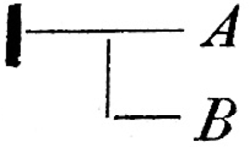
In even the simplest cases, Frege's notation for the conditional does not fit on a single line of text (Fig. 2). Beginning with a judgment stroke, always anchored at an expression's upper leftmost point, a content stroke is followed by a conditional stroke that plunges down. Two more content strokes cantilever out to two letters stacked one on top of the other. The bottom letter represents the antecedent, the top the consequent. As Frege manipulated larger numbers of variables in more complex logical relations, conditionals layered upon conditionals, creating large forking diagrams that sprawled in two dimensions (Fig. 3). Thus Frege's “formula language” did not consist in sequences of characters ordered left to right and arranged in lines ordered top to bottom. The eye of a reader who wished to read a judgment in a linear, speakable form would need continually to dart over and down, in and up, and out again. But such sequential apprehension would be unnecessary for a reader content to work in the medium of Begriffsschrift, which involved its own guarantee that licitly derived judgments were correct and need not be reformulated in linear language for human confirmation.
Frege's notation for the conditional. Most precisely, this symbolism reads, “It does not occur that A is denied but B affirmed (but any other combination of affirmation and negation remains possible).” More colloquially. “If B, then A.” Frege, Begriffsschrift, 5.

A complex conditional. One way this excerpt could be translated is: “If d and c together imply b, and b implies a, then d and c together imply a.” Frege, Begriffsschrift, 40.

That guarantee consisted in one explicit “mode of inference” (Schlussart, also “Schlussweise”) that licensed valid steps from accepted judgments to new ones: given the assertion of a conditional, along with the assertion of its antecedent, one could legitimately assert its consequent (an inferential form classically known as modus ponens). Frege acknowledged that Aristotelian logic included numerous inferential forms, but asserted that any inference deriving from multiple established judgments could be “reduced” to his.Footnote 36 In one sense, this mode of inference purported to specify exactly how the system was to be used in practice. In a wider sense, however, such a schematic cannot say how one decides which judgments to employ and when. The work of using Begriffsschrift consisted in discerning which particular acts of inference served the distant logicist goal.
From the conditional and its mode of inference Frege proceeded to his symbolism for negation, which he described simply as a “small vertical stroke.”Footnote 37 In practice, Frege's typesetter used a small inverted numeral 1 for this stroke (Fig. 4). The book's pages were therefore speckled with upside-down 1s, betraying the quotidian difficulties of typesetting a notation that departed so radically from existing systems of writing. Frege did not acknowledge that his negation strokes were printed as 1s and did not intend for them to convey any numerical meaning. This typographic compromise is unlikely to have confused or distracted readers, but it provided them with frequent reminders that Frege's script, for all its novelty, depended on presses built for traditional European text. In a literal sense, Frege could not completely banish notational precedents from his pages.Footnote 38
Frege's notation for negation. This excerpt reads, “A does not occur.” Frege, Begriffsschrift, 10.

Conditionals and negation were the ingredients out of which Frege crafted other logical connectives such as “and,” “or,” and “either–or.” He did not employ new notation to abbreviate these, keeping the priority of the conditional and negation constantly visible. Frege thereby made the intertwined logical relationships between all of these connectives visually manifest on the page. Figure 5 is a representative example: this compound of negations and a conditional can be translated as simply “Both A and B.” Begriffsschrift offers no more succinct way of writing the conjunction “and.”Footnote 39
The assertion “Both A and B are facts” in Frege's notation. Frege, Begriffsschrift, 12.

“Translated,” here, is Frege's word; he used the German verb übersetzen frequently when introducing notation.Footnote 40 Like translation between ordinary languages, movement between Begriffsschrift and German was not frictionless. One challenge arose in the case of the word “or” (oder), a word that is unproblematically ambiguous in everyday German (or English or French). “A or B” could equally well mean “at least one of the statements A and B is true” or “either A or B is true, but not both.” Whereas German can tolerate a multivalent word, Frege would not permit such vagueness in his logical formula language. He decreed that “or” would only serve to translate the former logical judgment; the latter would instead always be rendered as “either–or” (entweder–oder).Footnote 41 Figure 6 shows both situations expressed in unambiguous Begriffsschrift.
(a) “A or B (and perhaps both)”; (b) two equivalent expressions for “Either A or B, but not both.” Frege, Begriffsschrift, 11–12.

As the two ways of expressing “either–or” in Begriffsschrift demonstrate (Fig. 6b), Frege's constructions of basic logical connections out of conditionals and negations could be redundant. It could also be considered unwieldy to require four letters, four inverted numerals, and seven line segments to denote a simple relationship like “either–or.” But Frege embraced redundancy and unwieldiness, declining to introduce abbreviations for these other connectives. This decision expressed an implicit purpose of his notation: Begriffsschrift was a tool for making logical relationships manifest. Where other logicians might remark that such a relationship existed between “if–then,” “and,” and “or,” but grant each notion its own visual representation corresponding to their primacy in ordinary language, Frege built every judgment, every time, out of conditionals and negations. The interdefinabilities of logical relationships were not just facts but rather the underlying fabric of his notation. To read Frege's metaphor more literally than he intended it, we might indeed consider the Begriffsschrift a kind of microscope: to read it was to see these connections.Footnote 42
LET US DO MORE THAN CALCULATE
Upon publication Frege's Begriffsschrift received moderate attention across several nations and disciplines: seven notices in its first two years in German, French, and English publications.Footnote 43 These reviews were mostly ambivalent; they tended to appreciate Frege's proficiency as a logician but dislike his notation and lament his failure to discuss predecessors. Ernst Schröder (1841–1902) voiced the most detailed disdain for Frege's notation in his fourteen-page review essay in the Zeitschrift für Mathematik und Physik.Footnote 44 Schröder was Germany's leading authority on the algebra of logic, so his review carried particular weight—evidenced not least by Frege's great concern to rebut its criticisms. Far from panning the book, Schröder voiced definite respect alongside several clearly articulated complaints. He declared himself “naturally highly sympathetic” to Frege's “totally idiosyncratic [ganz eigenartige] piece of writing—obviously the original work of an ambitious [strebsamen] thinker of a purely scientific school of thought.”Footnote 45 But his sympathy did not extend to the notation.
Schröder criticized Frege's notation along three lines, all present in a comparison with Leibniz that opened the review. Reading Frege as claiming to present a Leibnizian pasigraphy (a term Schröder used interchangeably with “Begriffsschrift” and “general characteristic”), he began by defining that ideal as a language that facilitates construction of complex concepts from a handful of fundamental ones using only “a few simple, fully determinate, and clearly classified operations.”Footnote 46 In Frege's Begriffsschrift he saw no such thing:
it must be said that Frege's Begriffsschrift promises too much in its title—or more precisely: that the title does not correspond to the content at all. It tends not toward a “general characteristic” but rather—perhaps unknown to the author himself—much more toward Leibniz's “calculus ratiocinator.” This short work makes a start in the latter direction, which I would call very profitable if a great part of what it strives for had not already been achieved from another angle and indeed—as I will prove—in an undoubtedly more suitable manner.Footnote 47
First, Schröder argued that while Frege claimed to have invented a pasigraphy, he had produced instead a logical calculus, a tool for computing simpler forms of given statements. Second, this tool was redundant next to existing systems, which Frege failed to cite. The accusation of redundancy here assumed that despite being “achieved from another angle,” this existing work was basically equivalent to Frege's.Footnote 48 Schröder counted himself among the overlooked predecessors, but focused more on English mathematician George Boole's (1815–64) priority than his own.Footnote 49 Third, the point occupying most of the review, Schröder held that Frege's notation was simply inferior to Boole's.
Instead of arguing that Frege's notation was a calculus comparable to Boole's, Schröder simply carried out a comparison. Reproducing Frege's first expression for “Either A or B, but not both” (Fig. 6b), he deemed it “decidedly clumsy” (entschieden schwerfällig) compared with the equivalent Boolean representation ab 1 + a 1b = 1.Footnote 50 Schröder's diction throughout suggested that the Begriffsschrift's flaws were largely aesthetic. He applied an unstated standard according to which concision was essential to elegance. By that standard, the “tremendous waste of space” allegedly, “in its typographical aspect, inherent” in the Begriffsschrift was a major deficiency.Footnote 51 Furthermore, Frege's “frequently changing choice of letters” seemed to Schröder “only to make the work more difficult to survey, and somewhat to offend good taste.”Footnote 52
In Schröder's eyes, and similarly for other reviewers, these shortcomings were not so grave as to disqualify Frege's system from equivalence with Boole's. He promised that “anyone who wishes to will easily be able to transcribe [Frege's] formulas into the better method of representation himself.”Footnote 53 English logician John Venn declared, “Certainly the merits which [Frege] claims as novel for his own method are common to every symbolic method.”Footnote 54 French mathematician Paul Tannery, even while acknowledging that Frege's “logical point of view is completely out of the ordinary,” referred to the Begriffsschrift as an “algorithm.”Footnote 55 Frege's early readers concurred in reading his script as fundamentally the same sort of technology as the logical calculus they already knew.
Dissatisfied with these reactions to his notation, Frege drafted several rebuttals to Schröder over the following years, only some of which he succeeded in publishing. The defense hinged on an assertion that his and Boole's notations should not be compared because they served radically different ends in practice. In an effort to distinguish his notational goals from Boole's, Frege developed explicit themes that had been only implicit in the Begriffsschrift, revealing an ideal of logical notation that prioritized seeing logical relationships over solving problems. Progress in the realm of writing meant, for Frege, progress away from existing linguistic precedents and toward a more directly visual representation of the logical structure of concepts.
By 1881 Frege had prepared a lengthy rejoinder titled “Booles rechnende Logik und die Begriffsschrift” (Boole's Logical Calculus and the Begriffsschrift). Noting that “many critics” had compared his work to Boole's, and citing Schröder's “thorough study” and “friendly review” in particular, he proposed “to supplement and correct that comparison.”Footnote 56 Frege sent his supplementary corrective to the Zeitschrift für Mathematik und Physick (where Schröder's review had appeared), to the Mathematischen Annalen, and to the Zeitschrift für Philosophie and philosophische Kritik. Each journal's editors rejected it. Though this piece never entered the debate in print, it showcases Frege's most extensive working out of a defense for the Begriffsschrift, elements of which he did succeed in publishing in more succinct forms.
Frege outlined the different practical aims he saw behind Boole's work and his own. He read Boole as “construct[ing] a technique for resolving logical problems systematically, similar to the technique of elimination and working out the unknown that algebra teaches.”Footnote 57 He never quite denied that Boole had achieved that aim, but offered no praise either. Boolean notation repurposes the symbols of arithmetic (+, −, ×, ÷) to denote logical relationships. Conceding that therefore “one is spared the necessity of learning a completely new algorithm,” Frege could not resist observing in a footnote that “the deviations from arithmetic are for all that so fundamental that solving logical equations is not at all like solving algebraic ones. And this greatly diminishes the value of the agreement in the algorithm.”Footnote 58 More importantly, Frege insisted that “such problems will seldom, if ever, occur in science.”Footnote 59 To Frege, Boole's computational project offered imperfect solutions to trivial problems.
In contrast to Boole's algebraic manipulation of known content represented by variables, Frege claimed that his Begriffsschrift was about constructing content from the ground up. “Right from the start I had in mind the expression of a content,” he wrote. “What I am striving after is a lingua characterica in the first instance for mathematics, not a calculus restricted to pure logic. But the content is to be rendered more exactly than is done by verbal language.”Footnote 60 Not an abacus for solving problems already given, but a way to write new, mathematical problems. Frege suggested that a language always required two basic components: first “the formal part which in verbal language comprises endings, prefixes, suffixes and auxiliary words,” and second “the material part proper.” Logical notation ought to fulfill the former task without relying on casual language, to provide a “logical cement that will bind these building stones firmly together,” thereby eliminating the need to string proofs together with words. Boole, by helping himself to the symbols of arithmetic, had created a glue that could not be used to assemble mathematical material: “It would lead to great inconvenience if the same signs were to occur in one formula with different meanings,” namely their different arithmetical and logical meanings.Footnote 61 Perhaps a plus sign could denote “or” in the isolated context of abstract logic, but Frege intended to build mathematics itself with his logical building blocks; he needed the plus sign to mean “plus.”
Frege offered numerous examples of his notation's expressive power, ranging from relatively simple statements about square roots (Fig. 7a) to more intricate technical statements about the continuity of functions (Fig. 7b). He emphasized that he never introduced new names or symbols for concepts like “square root” or “continuous”; rather he built those concepts out of basic arithmetical symbols, used in the traditional way, and his several logical signs. The notational elements that Frege presented at the outset were sufficient to define higher mathematical concepts within the system, and such internal definitions provided the only means of representing higher concepts. Frege entreated the reader, “If in this case the formula seems long-winded by comparison with the verbal expression, you must always bear in mind that it gives the definition of a concept which the latter only names.”Footnote 62 By declining to introduce a new symbol for each additional concept, Frege ensured that the underlying constitution of a complex concept remained present any time that concept appeared on the page.
(a) “There are at least two different square roots of 4”; (b) “The real function Φ(x) of a real variable x is continuous throughout the interval from A to B.” These statements employ Frege's representation for “generality,” which involves writing an expression in terms of a “German letter,” and adding to the content stroke “a concavity in which is written the same German letter.” It indicates that the statement is true for any content one might substitute in place of the German letter. Gottlob Frege, “Boole's logical Calculus and the Concept-script,” in Frege, Posthumous Writings, ed. Hans Hermes, Friedrich Kambartel, and Friedrich Kaulbach, trans. Peter Long and Roger White (Oxford, 1979), 9–46, (a) at 21, (b) at 24; definition of generality quoted from Frege, Begriffsschrift, 19.

By exhibiting concept formation in action, Frege believed he was approaching a notation endogenous to logic itself. He called for symbols to exhibit the structural relations they represent:
Anyone demanding the closest possible agreement between the relations of the signs and the relations of the things themselves will always feel it to be back to front when logic, whose concern is correct thinking and which is also the foundation of arithmetic, borrows its signs from arithmetic. To such a person it will seem more appropriate to develop for logic its own signs, derived from the nature of logic itself; we can then go on to use them throughout the other sciences wherever it is a question of preserving the formal validity of a chain of inference.Footnote 63
The guiding principle that Frege now claimed for his notation, never stated in the Begriffsschrift, was that it should take its shape from the structure of “logic itself.” Taking for granted that logic is the foundation of arithmetic, he reasoned that logic ought not to rely on arithmetic for notation. That Frege insisted that his system's signs themselves bore a meaningful relation to the nature of logic indicates that he had come to think of notation as approaching some kind of mimesis: Begriffsschrift might not just describe logical relations but depict them.
Frege confirmed the value he placed on notation's visual nature by comparing it to speech. Whether spoken or written down, he considered verbal language woefully inadequate to his purposes:
Speech often only indicates by inessential marks or by imagery what a Begriffsschrift should spell out in full. At a more external level, the latter is distinguished from verbal language in being laid out for the eye rather than for the ear. Verbal script is of course also laid out for the eye, but since it simply reproduces verbal speech, it scarcely comes closer to a Begriffsschrift than speech.Footnote 64
Already in the Begriffsschrift Frege had rejected ordinary language for the logical construction of arithmetic. Here he revealed that the specific shortcoming of ordinary written language was the resemblance it bore to spoken language. The deceptively simple essence of notation, Frege suggested, was that it was written. Writing had the potential to be radically different from speech.
Frege considered writing more powerful than speaking for a practical, material—or more precisely topological—reason: whereas ordinary language was confined to linear time, the page extended in two dimensions. In 1882 he published a philosophical defense of his notation titled “On the Scientific Justification for a Begriffsschrift.” Reflecting on the advantages of written symbols over spoken language generally, he emphasized the power of two-dimensionality:
The spatial relationships of the characters on a two-dimensional writing surface can be used for the expression of inner relationships in far more diverse ways than mere following and preceding in one-dimensional time. This facilitates the apprehension of that to which we wish to direct our attention. Indeed simple sequences in no way correspond to the multiplicity of logical relationships by which thoughts are interconnected.Footnote 65
Speech, necessarily occurring in time, can only arrange words one after another. Logic, Frege argued, did not consist in a linear sequence of elements, so it was pointlessly restrictive to write it as a one-dimensional sequence of symbols. In another piece published that same year, he made a similar point: “The Begriffsschrift fully utilizes the two-dimensionality of the writing surface by allowing the assertable contents to follow one below the other, while each of these extends from left to right. Thus the individual contents are clearly separated from each other, and yet their logical relations are easily assessable.”Footnote 66 Deriving the structure of logical notation from the nature of logic itself meant first of all rejecting the traditional temporal structure of writing that records (imagined) speech and therefore retains the latter's limitations. In its place, Frege proposed that writing become fundamentally two-dimensional, rendering individual judgments horizontally and exhibiting their logical relationships by their vertical arrangement.
Here lay the unstated guiding principle of Frege's most elementary logical relation, the conditional. Its verticality was hardly incidental. By freeing his most fundamental building block from the horizontal confines of the printed line of text, Frege indicated that logic must not conform to the linear temporality of speech. In even the simplest connection of two judgments, it was impossible to write linearly. The temptation to mimic the irrelevant temporal structure of speech was gone; the logician had only logic for a guide. Frege's notation made logical relationships literally spatial, arranged and connected on the written page. Connections between judgments became visible material connections in the form of precisely branching lines of ink on paper.
Equipped with this notation, Frege intended to construct arithmetic on purely logical grounds. In 1884 he published Die Grundlagen der Arithmetik (The Foundations of Arithmetic), a polemic against the prevailing philosophies of mathematics that contradicted logicism.Footnote 67 In a rare concession to accessibility, he confined his argument in the Grundlagen to prose, attempting to convince readers of the need for a more rigorous concept of number without scaring them off with notation. Frege launched his systematic project in earnest in 1893 when he published the first of three planned volumes of his magnum opus, Grundgesetze der Arithmetik: Begriffsschriftlich abgeleitet (Basic Laws of Arithmetic: Derived by Begriffsschrift). This work aspired to carry out logicism's central promise to construct arithmetic and analysis without assuming any numerical definitions or postulates, proceeding entirely by formalized deduction from a handful of logical axioms. The first volume of Grundgesetze sold poorly and received little critical attention.Footnote 68 His publisher was left with little reason to invest further. Rather than surrender his life's work, Frege paid the costs of printing volume 2 himself.Footnote 69
TEACHING BEGRIFFSSCHRIFT
Frege's disappointments revolved around a problem of literacy: too few readers learned to read Begriffsschrift. His tribulations illustrate how pedagogy is central to the business of inventing a logical notation, an invention that is irrelevant unless people learn to use it. Frege evidently knew this: in the thirty-nine years between the publication of his first book and his retirement from Jena, he offered a one-hour weekly course on the Begriffsschrift thirty-six times. Given his books’ modest readership, these lectures constitute a noteworthy proportion of the actual historical engagement with Begriffsschrift during Frege's lifetime. His pedagogical success was uneven. There were at least eight semesters when Frege's advertised Begriffsschrift course drew no enrollees; other semesters it did rather well. Most notably, twenty-one students registered in winter 1903–4, the semester immediately following the publication of Grundgesetze, volume 2. For the next three years, enrollment hovered around nine, after which time enrollment figures are unavailable.Footnote 70
Though Frege's students were not numerous, several of them recorded enthusiastic impressions. The famous scholar of Jewish mysticism Gershom Scholem (1897–1982) found himself “drawn to” Frege, reading the Grundlagen and attending Frege's “Begriffsschrift” course in 1916–17. Reminiscing in a 1975 memoir, he described Frege as an exception among Jena's “rather annoying” philosophers and fondly recalled “his utterly unpompous manner.”Footnote 71 Frege's most consequential success as a teacher was to inspire a young Rudolf Carnap to pursue mathematical logic. Carnap attended five of Frege's lecture courses. Two of these focused entirely on the professor's notation. Carnap took the perennial niche offering “Begriffsschrift” in the 1910–11 winter semester, his first course with Frege. In the 1913 summer semester he attended “Begriffsschrift II,” a rare sequel course. Carnap later claimed that word of mouth had brought him to Begriffsschrift; he heard that “somebody had found it interesting.”Footnote 72 He also took Frege's analytic mechanics sequence in winter 1912–13 and summer 1913.Footnote 73 Carnap's final lecture course with Frege, delivered during the summer semester of the year Europe plunged into war, covered “Logic in Mathematics.” As in the Grundlagen, here Frege argued the case for logicism in ordinary language, eschewing Begriffsschrift. Carnap was Frege's only student to make a name for himself in logic, and would later attribute to Frege “the most fruitful inspiration” he received from any of his professors.Footnote 74
Carnap's student notes from these courses have survived to provide a window on Frege's use of Begriffsschrift in a pedagogical context.Footnote 75 Frege had modified his system of writing over the years—it evolved from Begriffsschrift to Grundgesetze, and again in response to the Grundgesetze’s failings (discussed below)—but it always retained the same essential structure and visual character introduced in 1879.Footnote 76 Frege organized his introductory lecture course similarly to that first book. He began with the distinction between content and judgment, the conditional, negation, and the concoction of other logical relations out of these ingredients. By the end of the first semester, Frege had covered the basics of his notation and the ideas he had theorized more recently, such as concept, function, Sinn, and Bedeutung.Footnote 77 It was a thorough primer on the Fregean apparatus—with only glimmers of its intended use to establish the foundations of mathematics. Thus divorced from the notation's animating purpose, perhaps it is unsurprising that his courses on Begriffsschrift rarely drew many students.
The advanced course finally showed the notation in action, albeit even then Frege found time for only a handful of examples due to the arduousness that he had always insisted was the price of rigor. After a particularly long proof, taking up fourteen of the forty-two notebook pages Carnap filled that semester, Frege acknowledged that it had been a long haul: “The deduction is so complicated because every sentence that occurs in it always contains all of its conditions; one does not just keep assumptions in mind. This is important for the rigor of the proof.”Footnote 78 Repetitiveness was no side effect; it was a feature. Frege insisted that the assumptions undergirding a proof always remain visible, implicitly characterizing his notation as an observational instrument: at each step of the deduction, one could see every necessary condition.
At least, this literal visibility of all assumptions was Frege's stated requirement; Carnap's notes fell short of that standard. Figure 8 shows Carnap's Begriffsschrift rendering of the proposition proved in the semester's longest demonstration, in which he has omitted the entire bottom half, indicating only which variables it would feature were he to draw it out. Perhaps Frege's notion of rigor was lost on a carelessly abbreviating Carnap, or perhaps Carnap simply had to abbreviate in order to keep up with a fast-paced lecture. Perhaps Frege himself made this compromise, pronouncing aloud the importance of writing out every assumption even while abbreviating on the board. Frege believed that rigor meant keeping every element of every claim literally in view at every step of the proof, but in practice such diligent Begriffsschrift bookkeeping seems to have been a demand that either he or his students would not always meet.Footnote 79
Carnap's rendering of the proposition “If both a and b are limits as the argument goes to positive infinity, than a and b coincide.” The bottom branch of the outermost conditional should resemble the top branch but feature different letters. Carnap has indicated this by drawing a diagonal dashed line and jotting down the relevant letters rather than writing out the bottom branch in full. Rudolf Carnap, “Frege Seminar Notes: Begriffsschrift/Logik in der Mathematik (Original),” 21, in Series XXIV, Subseries 4, Box 111a, Folder 2a, Rudolf Carnap Papers, 1905–70, ASP.1974.01, Archives of Scientific Philosophy, Archives and Special Collections, University of Pittsburgh Library System.

The fact that mathematical proofs—the entire purpose of the Begriffsschrift—did not appear until the second semester reveals Frege's somewhat resigned approach to a “vicious circle” he perceived in his notation's difficulty: “before people pay attention to my Begriffsschrift, they want to see what it can do, and I in turn cannot show this without presupposing familiarity with it. So it seems I can hardly count on any readers.”Footnote 80 The common image of Frege as an introverted loner, while grounded in actual recollections, risks obscuring his fervent wish to attract new Begriffsschrift users, and his commitment to teaching as one means to achieve that goal. Far from being content to develop his Begriffsschrift in solitude, Frege found himself backed into intellectual isolation by a vicious circle he never escaped. He recognized the social nature of notation and understood that it presented a fundamentally pedagogical problem.
The demands of pedagogy made Frege ironically dependent on the ordinary language that notation was supposed to transcend. Using Begriffsschrift in the classroom meant writing Begriffsschrift while explaining it in ordinary German, thus maintaining parallel registers of notational demonstration and prosaic discussion. Nothing about this necessity was unique to Begriffsschrift; teaching any symbolic system will typically require explaining it in ordinary language. Given Frege's emphasis on escaping the inadequacies of ordinary language, however, the persistence of ordinary language presented a problem for him that would not trouble teachers of, say, algebraic or musical notation. Frege once reflected for his students on the continuing fusion of formal logic with informal explanation: “In a mathematical lecture two things are always mixed together: 1) the pure inferences; 2) the commentary on them. This mixture has the potential to negatively influence mathematical rigor. In Begriffsschrift, assuming a complete understanding of it, words are superfluous.”Footnote 81 Frege invoked an ideal separation of notational wheat from verbal chaff, but in pedagogical practice, to assume “complete understanding” would have been self-defeating. Words were emphatically not superfluous; notation and commentary were “always mixed together.” Whereas Frege's rhetoric presented logical notation as tending ever closer to visual representation of logic itself—and ever farther from ordinary language—his efforts to train readers worked instead toward a bifurcation between Begriffsschrift and German description. Frege's written oeuvre displays the same bifurcation between prose texts and works of notational deduction, which themselves reproduce that bifurcation internally with the labels, signposts, and explanations that never quite disappear from even the most technical passages, but it is particularly apposite in the classroom because learning is precisely the occasion when that which is theoretically unnecessary becomes utterly indispensable. Attending to pedagogy illuminates the prosaic obverse of Frege's notation, the narrative explanation that his imperfect audiences required.
The resulting parallel registers might be said to constitute a kind of dialogue between notation and prose—with both voices belonging to Frege. His students’ recollections, which confirm that Frege's lecturing style combined writing notation on the blackboard and describing it aloud in German, reveal an equally important absence in that mixture: the students never spoke. Frege carried out all the formal writing and all the informal commentary. Carnap later recalled his first lectures with Frege:
Frege looked old beyond his years. He was of small stature, rather shy, extremely introverted. He seldom looked at the audience. Ordinarily we saw only his back, while he drew the strange diagrams of his symbolism on the blackboard and explained them. Never did a student ask a question or make a remark, whether during the lecture or afterwards. The possibility of discussion seemed to be out of the question.Footnote 82
Later, in the advanced Begriffsschrift course with only three students, Frege “felt more at ease and thawed out a bit more. There were still no questions or discussions.”Footnote 83 Wilhelm Flitner, a friend of Carnap's at the time and later an important scholar of pedagogy, corroborated Carnap's description, recounting that
Carnap did not speak a word to Frege during his time as a student, and I too only exchanged a few words with him offhand at his door when I had to deliver something to him. One did not dare approach Frege outside the university . . . In lectures he hardly glanced at his audience; he was engaged solely with the symbols he wrote on the blackboard and explained in a quite introverted manner, and was preoccupied with matters of “logic.”Footnote 84
Even allowing for the embellishments of memory and the influence of a growing mythology of Frege as a unappreciated loner, Carnap and Flitner's recollections suffice to establish that Frege did not encourage dialogue.
Conducting his lectures without interaction, Frege imposed on his students the role of passive observers—witnesses to already visible proofs rather than practitioners of the judging and inferring that produced them. This is not to say that Frege's uninviting comportment was somehow latent in his notation, that the Begriffsschrift was inevitably the work of a man who could not spark conversation. But in his serious, soliloquizing demeanor, Frege accentuated rather than mitigated the outlook built into his notation's design: using Begriffsschrift was ultimately about witnessing visual proof. A witness's passivity was illusory, as the activity of deduction was an active process of writing, of applying Begriffsschrift's mode of inference and making substitutions—but that appears not to have been what Frege's students learned to do in his lectures. It is possible that Frege assigned exercises (presumably now lost) for his students to complete outside lectures, which would have provided important practice actively using notation. Regardless, his lectures did not present logic as a process of give and take between a human investigator and an object of investigation; instead he placed real agency in symbols. If the notation on the blackboard “does the thinking for us,” as he had written in the Grundlagen, why stop to chat with the onlookers behind him?Footnote 85 All that work of devising derivations notwithstanding, he presented Begriffsschrift as a tool less about acting than about seeing.
In Scholem's case, however, Frege's unapproachability admitted a darker explanation: Scholem recalled holding back from any personal interaction because Frege was known as an anti-Semite and a member of the far-right Vaterlandspartei.Footnote 86 Frege's anti-Semitism has become notorious through his so-called “Political Diary,” a set of chauvinist reflections in which, among other grievances, he lamented the supposed ubiquity of Jews, their attainment of civil rights, and the difficulty of identifying them. The entries span a period of one month in 1924, the year before Frege died. The extent to which the diary can be read as a late descent into extreme bitterness, rather than an expression of enduring views, remains a matter of controversy.Footnote 87 Here it suffices to note Scholem's testimony that Frege's anti-Semitism, if possibly less virulent in 1917, was publicly known in Jena by that time.
Carnap and Flitner's descriptions of Frege's aloofness are oddly similar to Scholem's, notwithstanding Scholem's concrete political reason to believe that approaching Frege outside class was not an option for him. Frege's pedagogical bearing seems to have convinced his non-Jewish students that they were equally unwelcome to engage him in dialogue. I do not downplay Frege's anti-Semitism or suggest that Scholem was oversensitive in his interpretation of his teacher's unapproachability. Rather I propose that Frege's distance from his students, consistent with his theoretical outlook on logical notation as a tool for supposedly passive observation, had the effect of reinforcing, for Scholem, Frege's known anti-Semitism. Frege did not explicitly apply his prejudice to logic: on the contrary, in one lecture he asserted that “logic is not only trans-arian [sic], but even trans-human.”Footnote 88 But the topic's neutrality did not imply the teacher's. For a student who knew his background to be objectionable to his professor, it seemed obvious that Frege's withdrawn demeanor was a warning not to approach for precisely that reason. Interpersonal distance provided a blank slate onto which a student might reasonably project a known antagonism. Frege's commitment to an observational concept of notation thus became enmeshed—in ways he likely neither intended nor recognized—with his existing social antipathies.
The entanglement of Frege's social and theoretical outlooks involved more than his specific prejudice against Jews, extending to a general resignation concerning his unpopularity. Convinced that the vicious circle of difficult notation made advertising futile, Frege seems to have resigned himself to awaiting students who demanded no compromises with better-known ways of writing. He confessed similar acquiescence in the foreword to the Grundgesetze: “All that is left for me is to hope that someone may from the outset have sufficient confidence in the work to anticipate that his inner reward will be repayment enough, and will then publicise the results of a thorough examination.”Footnote 89 He craved a larger audience but took little responsibility for the size or makeup of the audience he had.
Why did Frege conclude that he could not do more to recruit readers and listeners, that there was nothing left for him but to wait? I propose that Frege's conceptualization of his Begriffsschrift, together with the aloof pedagogical style it informed, invites (without foreordaining) precisely the resignation he displayed. By making writing a technology of observation, explicitly delineating its mode of inference, Frege cast the writer no less than the reader in a role that aspired to passivity, thereby foreclosing the desirability of creative authorial agency in dialogue with potential audiences. Privileging an objective notion of self-evidence in written notation, independent of particular language-bound users, he suggested that the problem of access was at once inevitable and fundamentally external to logic. Frege's belief that the question of who else was in the room was unconnected to theoretical content was itself a theoretical position, a corollary of his projection of agency onto the structure of notation. Hence Frege, with his trans-Aryan, trans-human conception of logic, could all the same prefer not to teach very many Jews. Hence he could, to my knowledge, never consider the possibility of teaching his notation to women, nor remark on their exclusion from his university during the majority of his teaching career.Footnote 90 Believing that his notation was determined by logic itself, Frege claimed no agency of his own to expand the circle of potential readers, to draw in students who did not already find Begriffsschrift compelling enough to seek it out, and to sit passively as observers and scribes.
And yet in the case of Frege's greatest success as a teacher, Carnap, the student found his own Begriffsschriftlich voice nonetheless. Carnap seems to have enjoyed the predisposition toward logic's “inner reward” that Frege considered prerequisite. Eager to ensure that Frege's lectures would not be canceled for poor enrollment, Carnap recruited others to register with him.Footnote 91 Alongside his lecture notes, there survives one fragment in which Carnap undoubtedly authored his own Begriffsschrift statements, a waggish note to his friend and Frege classmate Kurt Frankenberger, written in their teacher's script (Fig. 9). Carnap introduced new symbolism for indicating the presence of a given person at a specific place and time, then used that notation to assert that Frankenberger had been absent the past two times he might have seen Carnap, and Carnap was about to leave Jena for a month. The question mark, deviating from proper Begriffsschrift usage, invited the reader to draw a conclusion from these premises (presumably that Frankenberg had better visit Carnap before the latter departed). This playful snippet shows that Carnap and Frankenberger understood and even enjoyed the symbolism that their teacher so seriously promoted. That the enthusiasm of two of Frege's best students manifested in active writing and even notational invention, however frivolous, confirms the profound link between pedagogical success and creative use in practice.Footnote 92
Carnap's draft of a Begriffsschrift note to his friend Kurt Frankenberger. Rudolf Carnap, “Frege Seminar Notes,” 5, in Series XXIV, Subseries 4, Box 111a, Folder 3, Rudolf Carnap Papers, 1905–70, ASP.1974.01, Archives of Scientific Philosophy, Archives and Special Collections, University of Pittsburgh Library System.

CONCLUSION
Frege invented a new way of writing logic and spent his career unsuccessfully seeking adherents. Had he been able to finish the Grundgesetze and announce a completed logicist reconstruction of arithmetic, perhaps his notation would have found a wave of eager new readers. Instead, in 1902, with a second volume in press and work begun on a third, Frege received a troubling letter from a young English philosopher named Bertrand Russell. It has become one of the most famous letters in the history of mathematics. Russell began by earnestly avowing his admiration for Frege, then cautiously mentioned “a difficulty only on one point.” He described how a predicate w, defined to be “the predicate of being a predicate which cannot be predicated of itself,” leads to a contradiction when one asks when w can be predicated of itself.Footnote 93 (Later he shared a friendlier formulation: imagine a barber who shaves all and only those men who do not shave themselves—does this barber shave himself? If so, then by definition he does not; but if not, then by definition he does.Footnote 94) Nothing in Frege's system barred such contradictory concepts. From this antinomy, known thereafter as Russell's, it followed that Frege's system was inconsistent. In a postscript to his fateful letter, Russell (surely not maliciously) added notational insult to conceptual injury: he expressed the contradiction in Italian mathematician Giuseppe Peano's (1858–1932) notation, making no attempt to pen his own Begriffsschrift.
Frege promptly sent Russell a moving response, laying bare his bafflement: “Your discovery of the contradiction has surprised me beyond words and, I should almost like to say, left me thunderstruck, because it has rocked the ground on which I meant to build arithmetic.”Footnote 95 He announced that he would “do justice” to Russell's discovery in an appendix to the forthcoming second volume of Grundgesetze, it being already too late to revise the body of the work. The letter closed with a crestfallen exclamation, “If only I could find the right way of looking at it!”Footnote 96 Frege hastily drafted the promised appendix, but within a few years considered that modification equally unsuccessful. He never found a revision to satisfy his critics, posterity, or himself.Footnote 97 Volume 2 appeared in 1903. Contrary to plan, it was the last.
Frege never completed another book and did not publish in Begriffsschrift again, but as the note I quoted at the outset shows, he did not consider his notation a casualty of Russell's antinomy—quite the opposite. It still constituted the core result of his work. In notes from 1906 he contrasted “[s]et theory in ruins” with his Begriffsschrift, “in the main not dependent on it.”Footnote 98 By the end of his life he would lose faith even in logicism, but he left no recorded doubts about the power and importance of his notation.Footnote 99 Frege remained committed to Begriffsschrift, which continued to be central to his pedagogical life.
Frege rejected temporal speech in favor of two-dimensional writing because he held that logic was a structure to be made observable independently of language. He arranged logical relationships between concepts as ink lines on the page, the vertical claws of his many-armed conditionals banishing the temporal linearity of speech that he found so confining. To write in two dimensions, with symbols unfettered by prior logical or mathematical significance, was to make writing fundamentally rather than incidentally visual.
The attendant strangeness, a virtue in Frege's eyes, made heavy demands on teacher and student alike. Begriffsschrift, a theoretically self-sufficient system, in practice required explanation and commentary. Frege's discourse bifurcated into rigorous notation and expository German, solidifying rather than eliminating the role of ordinary language. This mixture, nothing new in technical mathematics or physics, was less familiar as a way to present logic or philosophy. Indeed the trajectory of such bifurcated technical–prosaic discourse in European philosophy, encompassing thinkers as disparate as Bertrand Russell and Jacques Lacan, is a story that merits sustained attention in the historiography of ideas, and one in which Frege is central.
Frege's students silently did their best to copy down both voices of their teacher's dialogue with himself. That these particular students were there at all suggests that they already saw something exciting in his diagrams. They did not say a word. Frege wished for a larger audience, but believed he could do little to attract one: by attributing his notation's structure to logic itself, he abdicated the agency to adapt it in dialogue with a community of potential users. Frege ceaselessly argued that his notation made the logical visible. But the problem of pedagogy, which semester after semester he strove to solve, persistently asked, visible to whom?