



1. Introduction
In X-ray binary systems, accretion onto a compact object such as a neutron star or black hole generates intense X-ray emission close to the compact star. Primary X-rays can either escape directly or interact with the surrounding medium, where they are absorbed, scattered, or reemitted across a broad energy range. The resulting secondary radiation, known as reprocessed emission, provides crucial diagnostics of the geometry, ionization state, and distribution of matter around the accretor. X-ray reprocessing has been observed in a wide variety of astrophysical systems, from active galactic nuclei to accreting compact binaries (Zycki et al. Reference Zycki, Krolik, Zdziarski and Kallman1994; de Jong et al. Reference de Jong, van Paradijs and Augusteijn1996; Suleimanov et al. Reference Suleimanov, Meyer and Meyer-Hofmeister2003) and remains a powerful tool for probing high-energy astrophysical processes. A major challenge in studying X-ray reprocessing in binaries is that the relatively faint reprocessed emission is often overwhelmed by the much brighter primary X-rays. Eclipsing systems offer a unique advantage: during eclipse phases, the primary emission is obscured by the companion star, leaving only the reprocessed signal detectable. This makes eclipsing High-Mass X-ray Binaries (HMXBs) and Low-Mass X-ray Binaries (LMXBs) especially valuable laboratories for isolating and characterizing reprocessing mechanisms. In HMXBs, where the companion is typically a massive supergiant, the dominant reprocessing medium is the dense and often clumpy stellar wind, which can give rise to strong fluorescence lines such as Fe K
 $_{\alpha}$
. By contrast, in LMXBs with low-mass donors, the main reprocessing agent is the accretion disk, whose scale height, inclination, and structural variability strongly influence the reprocessing efficiency. Comparative eclipse studies therefore provide insight into how accretion flows, winds, and disk geometries shape the observed X-ray spectra in different classes of binaries.
We carried out a systematic investigation of X-ray reprocessing in 9 eclipsing HMXB and 4 LMXB systems analyzing XMM-Newton EPIC-pn eclipse and out-of-eclipse (OOE) spectra, aiming to quantify the efficiency of reprocessing, explored system-to-system differences, and identified the physical mechanisms responsible for the observed variability.
2. Observation and data analysis
We selected eclipsing HMXBs and LMXBs from the catalogs of Liu et al. (Reference Liu, van Paradijs and van den Heuvel2000) and Liu et al. (Reference Liu, van Paradijs and van den Heuvel2007) respectively, and searched for suitable XMM-Newton EPIC-pn observations covering eclipse phases, cross-checking with long-term Swift-BAT orbital profiles. A total of 13 observations (11 imaging mode, 2 timing mode) for the 9 HMXBs and 17 observations (all imaging mode) for the 4 LMXBs were reduced with SAS v14.0.0 following standard threads. The details of the data reduction and analysis are provided in Aftab et al. (Reference Aftab, Paul and Kretschmar2019) and Aftab & Paul (Reference Aftab and Paul2024).
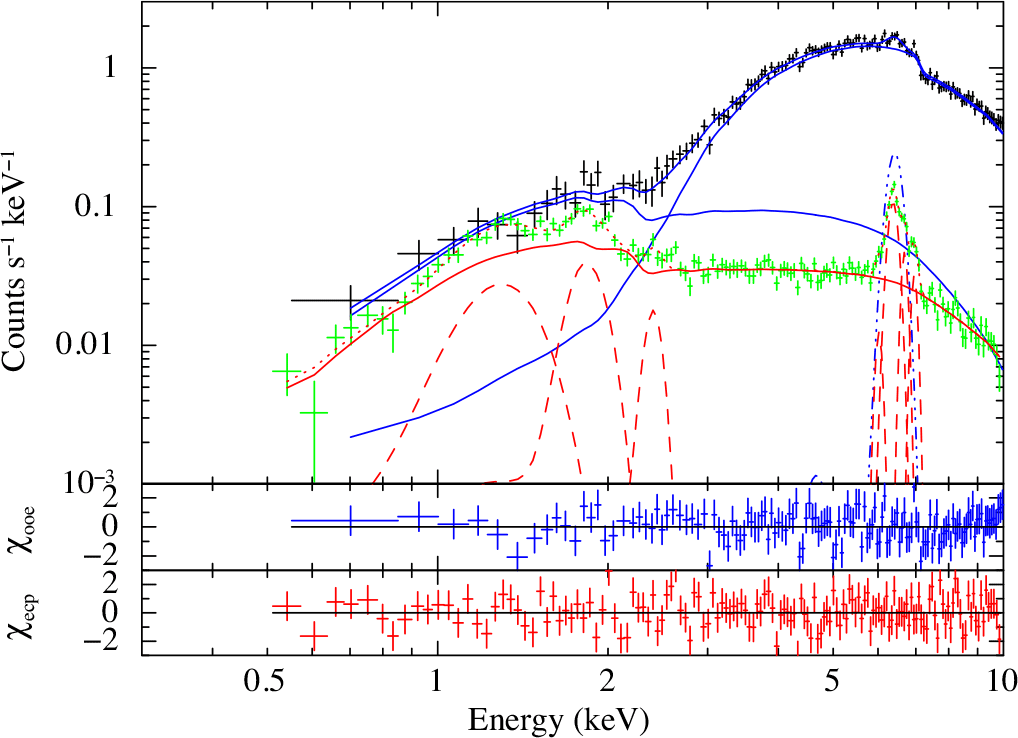
Figure 1 presents the EPIC pn OOE and eclipse spectra of HMXB system 4U 1538
 $-$
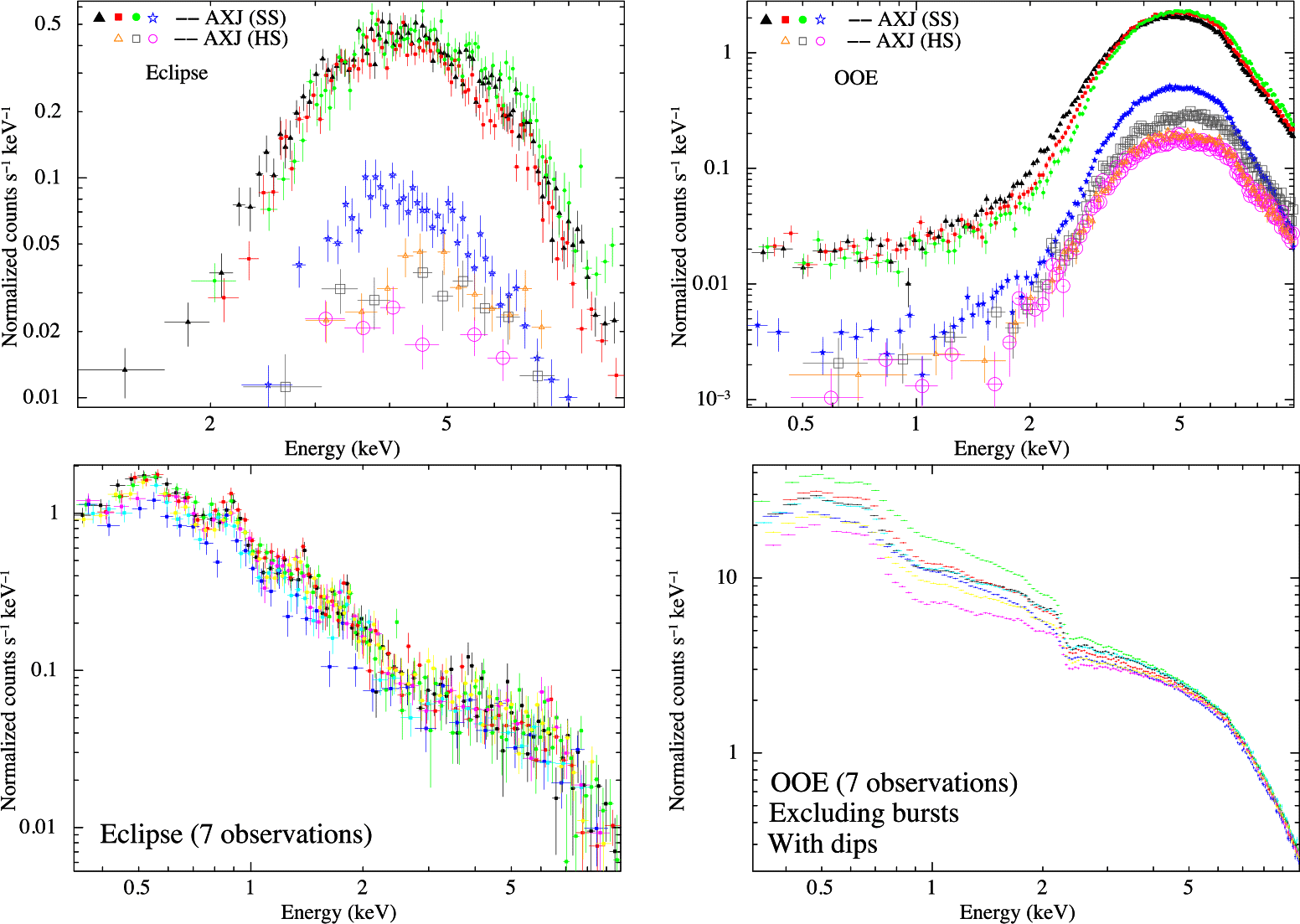
522. Figure 2 shows the composite EPIC-pn eclipse (top-left) and OOE (top-right) spectra of AX J1745.6
 $-$
2901 from seven observations, distinguishing between soft and hard spectral states. The soft-state spectra in both phases are consistently brighter than those in the hard state, with one notable soft-state OOE spectrum being over five times fainter than the other such spectra, accompanied by a corresponding drop in eclipse flux. The figure also shows the composite eclipse (bottom-left) and OOE spectra including dips but excluding bursts (bottom-right) of EXO 0748
 $-$
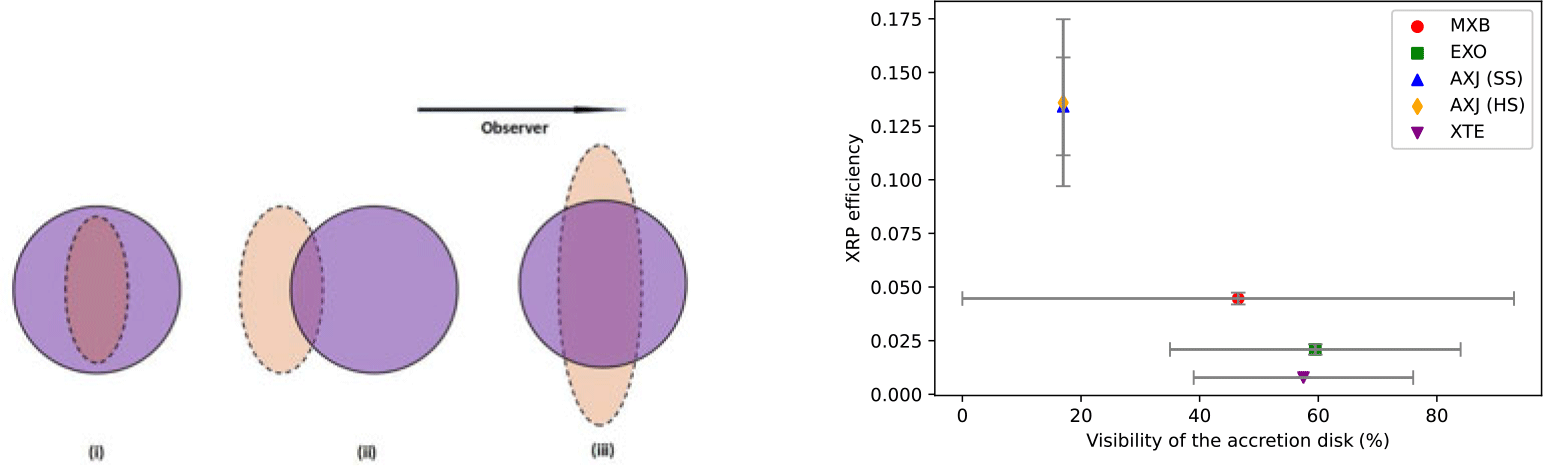
676, from seven EPIC-pn observations. The left panel of Figure 3 illustrates the different geometries of accretion disk occultation at maximum eclipse phase in eclipsing LMXBs, ranging from full to partial coverage depending on system parameters. The right panel of this figure shows the variation of X-ray reprocessing efficiency with visible fraction of the accretion disk area during maximum eclipse in
 $\%$
.
EPIC pn spectra of 4U 1538
 $-$
522 (OBS ID: 0152780201) with OOE data in black and eclipse data in green; model components are shown in blue and red, with corresponding emission lines. Middle and bottom panels show the residuals for the OOE and eclipse spectra, respectively.

Composite eclipse (top-left) and OOE (top-right) spectra of AX J1745.6–2901 from seven EPIC-pn observations. Soft-state (SS) spectra are marked with solid symbols (black, red, green, blue) and hard-state (HS) spectra with hollow symbols (gray, magenta, orange). Soft-state spectra are generally brighter than hard-state spectra in both phases. One soft-state OOE spectrum (blue) is more than five times fainter than the others, with a corresponding drop in the eclipse spectrum. Composite eclipse (bottom-left) and OOE spectra including dips but excluding bursts (bottom-right) of EXO 0748-676 from seven EPIC-pn hard-state observations.

Left: Types of occultation at maximum eclipse in eclipsing LMXBs, (i) The projection of the accretion disk (ellipse) is completely enclosed within the projection of the companion star (circle). (ii) The projection of the accretion disk is partially obscured, intersecting the companion star’s projection at two points. (iii) The projection of the accretion disk is partially obscured, intersecting the companion star’s projection at four points. Right: X-ray reprocessing efficiency (inverse of the OOE-to-eclipse flux ratio) versus the visible fraction of the accretion disk area during total eclipse in
 $\%$
.

3. Discussion
Eclipsing X-ray binaries provide a natural laboratory to investigate reprocessing mechanisms, as the eclipse phases isolate emission reprocessed in the circumstellar environment. Our comparative study of HMXBs and LMXBs with XMM-Newton (Aftab et al. Reference Aftab, Paul and Kretschmar2019; Aftab & Paul Reference Aftab and Paul2024) revealed both common features and striking contrasts in their eclipse spectra. In HMXBs, where the dominant reprocessing medium is the dense stellar wind of the massive companion, the continuum is strongly suppressed during eclipse by factors of
 $\sim$
8-237, while fluorescence lines, particularly the 6.4 keV Fe K
 $_{\alpha}$
feature remains relatively less attenuated (2.5-4.3). This results in large equivalent widths and improved line detectability during eclipse, indicating that the line-emitting regions are extended, in some cases comparable to or larger than the companion star. However, the strength of reprocessing varies significantly between systems, reflecting differences in wind density, structure, and ionization state. 4U 1538
 $-$
522 shows comparable soft excess emission during eclipse and OOE phase (Figure 1), indicates a different origin for the hard and soft X-rays. Supergiant fast X-ray transients (SFXTs) exhibited large equivalent widths of Fe emission lines during eclipse, similar to SgHMXBs, suggesting a comparably Fe-rich reprocessing medium. An exception is Cen X-3, where the equivalent width of the Fe K
 $_{\alpha}$
emission line decreases during eclipse relative to the out-of-eclipse phase, suggesting the presence of a dense, Fe-rich accretion disk or stream close to the compact object. For the first time, emission from hydrogen-like iron was detected in LMC X-4 during the out-of-eclipse phase of one observation. Some observations in HMXBs showed comparable column density during eclipse and OOE phases, suggesting uniform wind density both near and far from the compact object. For some observations the column density during OOE phase is more than that during eclipse, suggesting equatorial or near-equatorial dense outflows from the supergiant. Extending these pictures, Rikame et al. (Reference Rikame, Paul, Sharma, Jithesh and Paul2024) reported flares during eclipses in Vela X-1, LMC X-4, and 4U 1700
 $-$
37, indicating that the reprocessed emission originated within the binary environment itself.
In LMXBs, the OOE to eclipse flux ratios were found to be systematically smaller than in HMXBs, implying more efficient reprocessing despite the less dense environment. In seven observations of AX J1745.6
 $-$
2901 and EXO 0748
 $-$
676, the OOE-to-eclipse flux ratios lay within narrow ranges of 6-10 and 43-54, respectively. Similarly, two observations of MXB 1659
 $-$
298 yielded ratios of 21-24. Such consistency indicates a relatively stable environment around disk-fed systems. Exceptionally, a large OOE-to-eclipse flux ratio, and consequently low X-ray reprocessing efficiency, was observed in the LMXB system XTE J1710
 $-$
281, suggesting a low disk scale height in this system. In EXO 0748
 $-$
676, the eclipse spectrum remain nearly unchanged over two months, while variations in the low-energy OOE spectrum arise from different vertical structures in the accretion disk. Interestingly, Knight et al. (Reference Knight, van den Eijnden, Ingram, Matthews, Motta, Middleton, Mancuso, Buisson, Altamirano, Fender and Roberts2025) observed Type I X-ray bursts during eclipses in this system and attributed them to scattering of the primary emission in the accretion disc wind or the ablated outflow. In AX J1745.6
 $-$
2901, the OOE-to-eclipse flux ratios remain comparable across different intensity states. Notably, Fe K
 $_{\alpha}$
emission was much weaker or absent in LMXB eclipses, highlighting fundamental differences in the reprocessing media. Although all these sources are dipping and eclipsing LMXBs, comparisons revealed significant differences in X-ray reprocessing, likely driven by variations in system geometry, disk structure, accretion rate, and properties of the scattering medium.
4. Summary
In HMXBs, OOE to eclipse flux ratio exhibited a much broader range (
 $\sim$
8-237), with flux ratios fluctuating by up to a factor of three in a single source (
 $\sim$
86-237, LMC X-4) within less than a year. By contrast, in LMXBs this ratio remains confined within narrower limits. The relatively smaller OOE-to-eclipse flux ratios in LMXBs (
 $\sim$
6-54) implied stronger reprocessing effects, even though the surrounding environment in LMXBs is typically less dense and less extended than in HMXBs. Fe emission lines during eclipse were strong in supergiant HMXBs and SFXTs, but these lines were rarely detected in LMXBs. Some HMXBs showed uniform wind density, while others indicated equatorial or near-equatorial dense outflows. Further analysis of larger datasets from HMXBs and LMXBs will provide clearer insights into X-ray reprocessing efficiency and its dependencies in these systems.
 −
 %


