Growing evidence demonstrates that hospital programs dedicated to improving antibiotic use can attenuate antimicrobial resistance, prevent antimicrobial toxicity, and reduce costs.Reference Davey, Brown and Charani 1 , Reference Malani, Richards, Kapila, Otto, Czerwinski and Singal 2 The aim of these antimicrobial stewardship (AS) programs is to help clinicians to improve the quality of patient care and patient safety.Reference Stach, Hedican, Herigon, Jackson and Newland 3 – Reference Nowak, Nelson, Breidenbach, Thompson and Carson 5 Owing to the urgent need to improve antibiotic use and the well-documented benefits of AS, in 2014 the Centers for Disease Control and Prevention recommended that all acute care hospitals implement AS.Reference Fridkin, Baggs and Fagan 6 Although many small community hospitals have successfully implemented AS using part-time infectious diseases (ID) practitioners and clinical pharmacists, some facilities may be too small or resource-limited to afford even part-time specialists and require innovative strategies for AS.Reference Carling, Fung, Killion, Terrin and Barza 7 – Reference Yam, Fales, Jemison, Gillum and Bernstein 9 Nevertheless, the Infectious Diseases Society of America has underscored the importance of implementing AS even in small institutions, such as long-term care facilities, suggesting telemedicine as an efficient solution.Reference Bakken 10 Indeed, telemedicine appears to have the potential to play a critical role in expanding stewardship to various facilities with limited ID resources, including long-term acute care hospitals (LTACHs).Reference Dos Santos, Deutschendorf, Carvalho, Timm and Sparenberg 11
LTACHs are facilities providing inpatient healthcare for long durations (>25 days).Reference Eskildsen 12 LTACH patients are complex and require high-level nursing and medical care.Reference Eskildsen 12 , Reference Munoz-Price, Hota and Nimon 13 Patients coming into LTACHs are colonized with multidrug-resistant organisms at a higher rate than those at acute care hospitals, with 64% of patients colonized with methicillin-resistant Staphylococcus aureus (MRSA) and 14% colonized with vancomycin-resistant Enterococcus.Reference Dos Santos, Deutschendorf, Carvalho, Timm and Sparenberg 11 Likewise, antibiotic consumption in LTACHs exceeds mean antibiotic consumption in acute intensive care units,Reference Wolfenden, Anderson, Veledar and Srinivasan 14 further highlighting the need for AS programs in this setting.Reference Pawar, Tsay and Nelson 15 , Reference Rhee and Stone 16 Limited experience has already demonstrated positive results.Reference Munoz-Price, Hota and Nimon 13 , Reference Pawar, Tsay and Nelson 15 – Reference Pate, Sotrey and Baum 18
We developed a telemedicine AS program at an LTACH using remote access to the electronic medical record to conduct daily audits, with interventions made via email. The primary objective of this analysis was to evaluate the efficacy of this program in terms of reduction of antimicrobial utilization as well as Clostridium difficile infections (CDI). A secondary goal of this project was to highlight the benefits and feasibility of telemedicine stewardship.
METHODS
Setting
New England Sinai Hospital (NESH), which was an affiliate of Tufts Medical Center at the start of this project, is a free-standing 212-bed LTACH in Stoughton, Massachusetts. It has 24-hour in-house physicians and respiratory therapists, a full-service laboratory, pharmacy and radiology departments, as well as 25 to 30 consultants on call. There are 4 inpatient units, with 3 of them supporting mechanical ventilation. There are 2 full-time hospitalists and 3 full-time physician assistants. Nights and weekends are covered by rotating physicians from outside facilities (also known as moonlighters). Patient referrals are primarily from the 5 major teaching hospitals in Boston.
AS Implementation
The AS program was launched in April 2011 as a collaboration between NESH administration, the infection prevention director, and key clinical staff, and members of the Infectious Diseases Division at Tufts Medical Center in Boston. The initial goals of the AS program were to provide antimicrobial oversight and improve quality of care by standardizing antimicrobial prescribing practices among providers at NESH using off-site review of the medical record.
AS program staff consisted of ID physicians and ID-trained pharmacists at Tufts Medical Center. Staff had full access to the electronic medical record at NESH, which contained all clinical laboratory results, including microbiology data, daily progress notes, and medication information. AS staff also reviewed any available clinical and microbiologic data reported from transferring facilities.
Daily pharmacy reports were generated electronically by the AS team, which identified patients receiving 1 or more of the targeted antimicrobials for at least 7 days. Targeted antimicrobials included broad-spectrum antibiotics (eg, cefepime, piperacillin/tazobactam, meropenem), commonly misused antibiotics (eg, oral vancomycin, metronidazole, tigecycline), high-cost agents (eg, daptomycin, linezolid, liposomal amphotericin B), and potentially toxic antibiotics (eg, intravenous vancomycin, colistin). Medical records were reviewed by the AS team member specifically for appropriateness of antimicrobial selection and duration, sufficient monitoring for adverse events, and documentation of follow-up.
Recommendations were communicated with providers at NESH primarily through daily emails. Specifically, recommendations provided by the AS team included (but were not limited to) the following: (1) de-escalate therapy, (2) change or discontinue therapy, (3) obtain more clinical data from the transferring institution, (4) monitor certain laboratory studies, and/or (5) adjust the follow-up plan. Although providers were not required to respond to AS recommendations, they were encouraged to communicate directly with the AS team if they did not agree with a particular recommendation. The AS team made periodic visits to NESH to give educational conferences focusing on current AS initiatives.
AS recommendations from April 1, 2011, through March 31, 2014, were tracked and determined to be “accepted” by providers if changes were instituted within 72 hours of the AS email.
Periods and Outcomes
For the purpose of this analysis, the preimplementation period was defined as April 1, 2010, through March 31, 2011, and the postimplementation period as April 1, 2011, through March 31, 2014. Patient-days (PD) and CDI rates were obtained from hospital quality and administrative databases. Hospital-acquired CDI (HA-CDI) was defined as a positive test for C. difficile in a patient with CDI symptom onset more than 3 days after admission.Reference Pawar, Tsay and Nelson 15 Monthly HA-CDI rates were calculated per 1,000 PD. Antimicrobial utilization information was obtained through pharmacy database records and normalized to defined daily doses (DDD) per 1,000 PD.Reference Nelson 19
We used uninterrupted time-series analysis to measure the impact of the AS program on 3 primary outcomes: (1) CDI rates, (2) overall antimicrobial consumption, and (3) specific antimicrobial group consumption. All targeted antibiotics were captured in total antimicrobial consumption, but further analyses were performed on classes known to have the greatest clinical and ecologic impact (anti-MRSA, anti-CDI, and anti-Pseudomonas). Simple linear regression was used to analyze changes in antimicrobial use and Poisson regression was used to estimate the incidence rate ratio in CDI rates. The time series of count data corresponding to CDI acquisitions were analyzed using the Poisson regression model to estimate the incidence rate ratio associated with the intervention. The coefficient for the binary variable “program” was used to measure the relative change in the CDI rate from just after the program was initiated compared with the month just before the program.
For each outcome, we fitted a 2-slope regression model, with a change-point on April 1, 2011. The model included an intercept, preimplementation period, implementation, and postimplementation period. The slope was expressed as a change in DDD/1,000 PD per month.
RESULTS
AS Team Activities
From April 1, 2011, through March 31, 2014, a total of 885 recommendations about 734 patients were made. AS staff spent approximately 1 to 2 hours per week reviewing cases and providing recommendations remotely. Approximately half of patients were male (51.8%), with a mean (SD) age of 68 (34) years and a median length of stay of 56 days. Overall 30-day (from time of admission) mortality was 4.2% (n=31). Of the 734 patients, 26 (3.5%) were discharged within 30 days of admission.
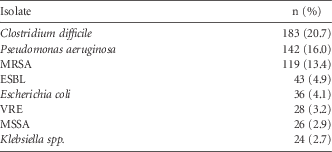
C. difficile colitis was the most common infection seen, representing 185 (20.9%)of the 885 cases, followed by 136 urinary tract infections (15.4%) and 103 cases of osteomyelitis (11.6%). The most frequent pathogens (identified either at NESH or at the transferring institution) were C. difficile (20.7%), P. aeruginosa (16.0%), and MRSA (13.4%). Vancomycin-resistant Enterococcus and extended-spectrum beta-lactamase (ESBL) accounted for 3.2% and 4.9% of all isolates, respectively (Table 1).
Type of Isolates Addressed by 885 Recommendations Using Telemedicine

NOTE. ESBL, extended-spectrum beta-lactamase; MRSA, methicillin-resistant Staphylococcus aureus; MSSA, methicillin-susceptible S. aureus; VRE, vancomycin-resistant Enterococcus.
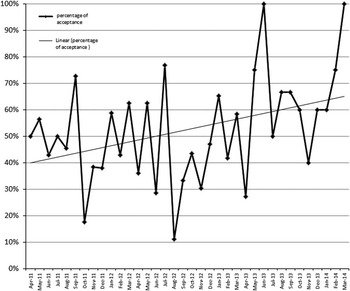
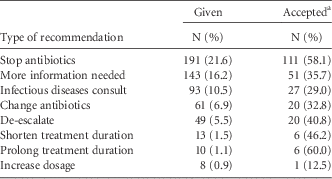
Of the 885 recommendations, a change in treatment was suggested 489 times (55.3%), whereas in 396 cases (44.7%), the AS staff agreed with the current management and recommended no changes. When a change was recommended, the most common recommendation was to stop antibiotics (191 recommendations [21.6%]) (Table 2). Recommendations were followed within 72 h in 48% of cases and the acceptance rate increased over the implementation period (Figure 1).
Recommendation acceptance frequency by month.

Details of 885 Recommendations Made by Antibiotic Stewardship Team

a Recommendations were considered accepted if changes were instituted within 72 hours of the AS email.
Outcomes
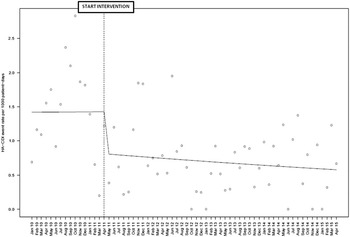
During the preimplementation period there was no change in monthly HA-CDI rates. Immediately following the intervention there was a significant decrease in monthly HA-CDI cases/1,000 PD that was associated with the intervention and maintained throughout the postintervention period (incidence rate ratio, 0.57 [95% CI, 0.35–0.92]; P = .02) (Figure 2).
Hospital-acquired Clostridium difficile infection (HA-CDI) rates by month.

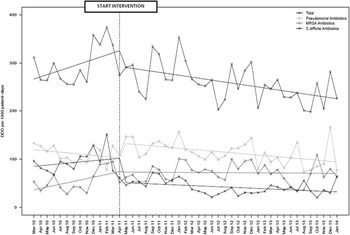
During the preimplementation period, total antibiotic usage was 266 DDD/1,000 PD and it rose by 4.54 DDD/1,000 PD (95% CI, −0.19 to 9.28) per month until April 2011. Upon implementation of the program, usage dropped by 32.8 DDD/1,000 PD (95% CI, −77.0 to 11.4) (P=.14) (Figure 3). This decrease was maintained during the entire postimplementation period (April 1, 2011–March 31, 2014) with a significant change in slope from before to after the program (−6.58 DDD/1,000 PD per month [95% CI, −11.48 to −1.67]; P=.01) (Figure 3).
Antibiotic usage rates by month. C. difficile, Clostridium difficile; DDD, defined daily dose; MRSA, methicillin-resistant Staphylococcus aureus.

We observed a similar trend for anti-MRSA antibiotics, with a significant decrease in usage during the postimplementation period (−2.97 DDD/1,000 PD monthly [95% CI, −5.65 to −0.30]; P=.03) (Figure 3). Anti–C. difficile antibiotics exhibited a decrease by 50.4 DDD/1,000 PD at the time of program implementation (95% CI, −71.4 to −29.2; P<.001) that was maintained for the duration of the postimplementation period (−1.88 DDD [95% CI, −4.23 to −0.47]; P=.11) (Figure 3). There was an increase in usage of anti-Pseudomonas antibiotics immediately after program implementation of 30.6 DDD/ 1,000 PD monthly (95% CI, 4.9–56.3; P=.02), but with ongoing education usage returned to baseline at year 2 and then realized a 9% reduction from baseline at year 3 (−0.10 DDD/1,000 PD [95% CI, −2.75 to 2.95]; P=.94).
DISCUSSION
We developed an effective and sustainable AS program at an LTACH using an electronic medical record via remote access. There were minimal specialist resources required to implement and maintain this program. AS staff reviewed cases 5 days per week and spent a total of approximately 1–2 hours per week providing recommendations remotely. Specialists were paid an hourly rate by the hospital. Over the course of 3 years, we observed increasing rates of acceptance of AS recommendations, a significant decrease in antibiotic usage, and a decrease in HA-CDI rates. The progressive increase in clinical follow-through on our recommendations is in line with previous studies showing recommendation acceptance rates ranging from 35% to 80%.Reference Yeo, Wu, Chung, Chan, Chen and Hsu 20 – Reference Cook and Gooch 23 We suspect the generally low rate of acceptance of our recommendations to obtain an ID consult was due to the limited availablility of full-time on-site ID consultants at the LTACH. Given the decreased antibiotic consumption during the postimplementation period, it is not surprising that the HA-CDI incidence rate decreased. This decrease was likely multifactorial since efforts to decrease transmission of C. difficile within the LTACH were ongoing.
Guidelines recommend development of AS programs to promote optimal antimicrobial use in LTACHs.Reference Bakken 10 , Reference Pawar, Tsay and Nelson 15 Numerous studies have demonstrated the value of AS programs in the hospital setting, but so far few data are available demonstrating the efficacy of AS in LTACHs.Reference Munoz-Price, Hota and Nimon 13 , Reference Rhee and Stone 16 – Reference Pate, Sotrey and Baum 18 , Reference Cook and Gooch 23 – Reference Dubberke, Carling and Carrico 25 A number of factors were critical to the development of a successful AS program at NESH. Most importantly, hospital administration was supportive and NESH staff was receptive to AS experts providing daily feedback regarding selection and use of antimicrobials. Tufts AS staff provided periodic grand rounds lectures at NESH to reinforce concepts of stewardship and maintain open lines of communication. We believe that we engendered a culture of collaboration between the prescriber and the AS team. Not uncommonly, NESH physicians contacted AS staff for advice on antibiotic choice even without an intervention having been made. In addition, the nature of the medical record at NESH, which is almost completely paperless and has wide report-generating functionality, was indispensable to conducting effective stewardship activities remotely.
There are several limitations to acknowledge. We did not account for other concomitant infection control and quality improvement interventions that may have affected CDI and multidrug-resistant organism rates. Additionally, our definition of “recommendation acceptance” allowed for a 72-hour time lag between the recommendation and the corresponding treatment adjustment. We chose this definition due to the presence of moonlighters on weekends, who would be unlikely to modify treatment courses. However, this timeframe may be too generous, erroneously categorizing independent clinician decisions as acceptance of recommendations.
Another limitation may be the use of DDD to evaluate antibiotic consumption instead of days of treatment. DDD and days of treatment are the 2 most common methods used to quantify drug consumption. Days of treatment represent the administration of a single agent on a given day regardless of the number of doses administered or dosage strength. Days of treatment are not affected by changes in dosing. DDD has the ability to compare standardized doses among hospitals, does not require patient-level data, and does incorporate doses, which were a large part of our stewardship intervention. Thus, notwithstanding that DDD has some relative disadvantages, we decided to use DDD/1,000 PD to estimate antibiotic consumption.
The impact of a successful AS program on cost savings has been well established in the literature.Reference Davey, Brown and Charani 1 , Reference Malani, Richards, Kapila, Otto, Czerwinski and Singal 2 , Reference Kaki, Elligsen, Walker, Simor, Palmay and Daneman 4 – Reference Carling, Fung, Killion, Terrin and Barza 7 , Reference Yam, Fales, Jemison, Gillum and Bernstein 9 – Reference Dos Santos, Deutschendorf, Carvalho, Timm and Sparenberg 11 , Reference Rhee and Stone 16 , Reference Pate, Sotrey and Baum 18 , Reference Hermsen, VanSchooneveld, Sayles and Rupp 22 – Reference Dubberke, Carling and Carrico 25 Therefore, we did not perform a cost-effectiveness analysis of our AS program. We were fortunate that when establishing this AS program, the goal of hospital administration was improving quality of care, not cost savings.
There are numerous challenges associated with the development of an AS program in this setting. The management of patients newly admitted to NESH who are being treated for preexisting infection is particularly problematic. These patients typically have long and complex medical histories, and transfer data are often incomplete. Our practice has been to suggest that the treating provider seek more information from the transferring institution, in order to fully understand the rationale for the antibiotic regimen and potential alternatives, and ensure that proper safety monitoring is being completed, which includes follow-up appointments with specialists and adherence to antimicrobial stop dates. There is valid concern that failing to follow the treatment course outlined by the transferring institution could negatively impact future referrals. Another challenge is the varied prescribing and documentation practices of moonlighters, who come from many different home institutions and cover NESH services on evenings and weekends. We did not use on-site clinical pharmacists or ID consultants to implement our stewardship activities, and this undoubtedly limited our effectiveness, as did the fact that our recommendations were not mandatory. However, we are pleased to report that given the demonstrated success of our program, in June 2015 NESH administrators committed to the development of a more comprehensive on-site AS program.
In conclusion, our results indicate a successful approach to AS program implementation in an LTACH, using telemedicine. A program like ours could be feasible for various types of resource-limited facilities. Future research should focus on understanding the reasons for noncompliance with recommendations and ways to improve communication between off-site AS staff and on-site clinicians.
ACKNOWLEDGMENTS
We thank H. Tighiouart, MS, for the statistical analysis and for his help with editing this article; Lawrence Hotes, chief medical officer and vice president of medical affairs at NESH, and Alex White, vice president of medical affairs at Carney Hospital of Steward Health Care System, for supporting the program; and Linda Hayes, infection preventionist at NESH, for her role in implementation of the program.
Financial support. None reported.
Potential conflicts of interest. S.D. reports that she has been on the speakers’ bureau for Forest/Actavis, Merck, and Cubist, has served as a consultant for Durata, and has received research grant funding from Merck. All other authors report no conflicts of interest relevant to this article.