Introduction
Although climate change and other anthropogenic disturbances are frequently reported as drivers of ecosystem change (Clerici et al. Reference Clerici, Cote-Navarro, Escobedo, Rubiano and Villegas2019), armed and resource conflicts in certain parts of the world have been constant, yet less studied factors that nevertheless greatly affect ecosystems and the benefits they provide to society (Machlis & Hansen Reference Machlis and Hanson2008, Ordway Reference Ordway2015). Protected areas (PAs) have been established worldwide to help conserve ecosystems, yet their establishment can further exacerbate conflicts between local actors and PA-related institutions. As such, PAs can represent a threat to the subsistence of local populations since they are based on a ‘fortress conservation’ model where legal mandates and enforcement are more restrictive with regards to natural resource use and extraction (Baral & Heinen Reference Baral and Heinen2006, Reference Baral and Heinen2007, Kalamandeen & Gillson Reference Kalamandeen and Gillson2006, De Pourcq et al. Reference De Pourcq, Thomas, Elias and Van Damme2019). However, in places experiencing active or intermittent armed conflict, little is known about the perceptions of local communities regarding these PAs and how their missions, objectives and governance influence their well-being.
Additional problems related to PAs include poor governability (i.e., lack of the state’s presence in the PA), weak governance (i.e., ineffective and poorly transparent government–societal dynamics), budget constraints (Durán Reference Durán2009, De Pourcq et al. Reference De Pourcq, Thomas, Arts, Vranckx, Léon-Sicard and Van Damme2017) and issues with illegal armed groups and illicit crop cultivation (Díaz & Sánchez Reference Díaz and Sánchez2004). The complex dynamics among PA establishment and management, resource use, community subsistence, urbanization, governance and multidimensional armed conflict exist in many tropical countries, including the Democratic Republic of Congo, Colombia, Central Africa Republic, Mexico and Myanmar (Machlis & Hansen Reference Machlis and Hanson2008, Council on Foreign Relations 2019). Yet, despite the diversity of tropical ecosystems and their socio-ecological complexity, there is little information regarding the perceptions of citizens living in the proximity of PAs (Baral & Heinen Reference Baral and Heinen2007, Takahashi & Selfa Reference Takahashi and Selfa2014). Understanding these perceptions towards management, resources, armed conflicts and the societal benefits of conservation are key for long-term success, as well as for evaluating existing policies and conservation strategies (Anthony Reference Anthony2007, Aditya & Ganesh Reference Aditya and Ganesh2018). Additionally, good governance and community participation in a PA’s decision-making processes make for more effective management and conservation (Radachowsky et al. Reference Radachowsky, Ramos, McNab, Baur and Kazakov2012, De Pourcq et al. Reference De Pourcq, Thomas, Arts, Vranckx, Léon-Sicard and Van Damme2015, Reference De Pourcq, Thomas, Elias and Van Damme2019).
In Colombia, PAs are characterized by poor land tenure regimes, lack of participatory processes in decision-making, disturbance from illegal resource extraction activities and historical occupation and use by actors prior to their establishment (Kalamandeen & Gillson Reference Kalamandeen and Gillson2006, Lele et al. Reference Lele, Wilshusen, Brockington, Seidler and Bawa2010). In addition, in many PAs, the historically intermittent presence of armed conflict (Nolte Reference Nolte2016, De Pourcq et al. Reference De Pourcq, Thomas, Elias and Van Damme2019) has been associated in Colombia with increasing rates of deforestation (IDEAM 2019), internally displaced people and illicit crop cultivation, among other issues (De Pourcq et al. Reference De Pourcq, Thomas, Arts, Vranckx, Léon-Sicard and Van Damme2017). Thus, the presence of armed guerrilla groups might exacerbate the relationship between state institutions and local actors and adversely affect governance processes and potential collaborative initiatives (Nolte Reference Nolte2016). Moreover, Colombia also is a megadiverse country and home to two different biodiversity hotspots, including the Andean biodiversity hotspot and its upper Andean forest and páramo (tropical mountain grasslands) ecosystems (Myers et al. Reference Myers, Mittermeier, Mittermeier, da Fonseca and Kent2000). In addition to the conservation value related to their high floral and faunal diversity and endemism, these ecosystems are essential for the subsistence and well-being of both rural and urban communities (Brown & Kappelle Reference Brown and Kappelle2001). In particular, the páramo is key for maintaining water supply and quality for major metropolitan areas (Clerici et al. Reference Clerici, Cote-Navarro, Escobedo, Rubiano and Villegas2019), and Andean forests are key for carbon storage and climate regulation (Núñez et al. Reference Núñez, Nahuelhual and Oyarzún2006). Nevertheless, they have been affected by anthropogenic activities such as agriculture, mining, ranching and urbanization; indeed, 75% of Colombians now live in cities (Brown & Kappelle Reference Brown and Kappelle2001, Ruiz-Salguero et al. Reference Ruiz-Salguero, Rubiano, González, Lulle, Bodnar and Velásquez2007).
We use Chingaza National Natural Park in Colombia in order to better understand the perceptions of both rural and urban citizens living near tropical highland PAs towards conservation, management and nature’s contributions to people (NCPs). Located near Bogotá with c. 8 million inhabitants, the study area presents a unique opportunity to explore the perceptions of urban and rural citizens regarding a unique, socio-ecologically diverse PA in the highland tropics subject to historical resource and armed conflict. Similarly, although the benefits from nature are often reported in terms of the ecosystem service framework, recently the Intergovernmental Science-Policy Platform on Biodiversity and Ecosystem Services (IPBES) has introduced the NCP concept (Kadykalo et al. Reference Kadykalo, López-Rodriguez, Ainscough, Droste, Ryu and Ávila-Flores2019), which provides for more flexible context-specific conceptualizations of people–nature relations, particularly in low- and middle-income countries, and merits application in tropical contexts such as Colombia.
Our specific objectives are threefold. First, we identify the demographic and environmental factors that could be influencing NCP and conservation-related perceptions by local citizens. Second, we analyse how recent deforestation rates and past guerrilla activities and armed conflicts have affected the community’s perceptions. And third, we assess different actors’ willingness to invest time in conservation-related activities.
Methods
The National Natural Parks System of Colombia (NNPS hereafter) has established 59 PAs that encompass c. 14.2 million ha of the country’s territory, representing c. 11.3% and 1.5% of its continental and marine areas, respectively (PNN 2019). Although the establishment of the NNPS has been important for the conservation of biodiversity and natural capital, it has in some cases amplified resource-use conflicts among actors from the surrounding communities (Durán Reference Durán2009, De Pourcq et al. Reference De Pourcq, Thomas, Elias and Van Damme2019). Historical conflicts have taken place among local actors such as farmers, indigenous people, armed groups and NNPS officials primarily due to the tension between conservation efforts and resource use for economic subsistence and the presence of illegal armed groups (De Pourcq et al. Reference De Pourcq, Thomas, Elias and Van Damme2019). Although the recent increase in the number and size of PAs (SPNN 2018) has led to the development of environmental education, conservation, ecotourism and sustainable management programmes (Durán Reference Durán2009), greater institutional presence has also produced conflicts with local communities (De Pourcq et al. Reference De Pourcq, Thomas, Arts, Vranckx, Léon-Sicard and Van Damme2015, Reference De Pourcq, Thomas, Arts, Vranckx, Léon-Sicard and Van Damme2017, Reference De Pourcq, Thomas, Elias and Van Damme2019).
Study area
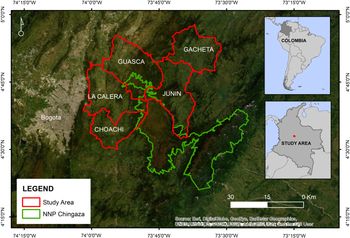
Chingaza National Natural Park and its surrounding area (Chingaza hereafter; Fig. 1) is located in the Eastern Cordillera of the Colombian Andes, was created in 1977 and encompasses 76 600 ha across 11 municipalities belonging to the administrative Departments of Cundinamarca and Meta. Ecosystems such as tropical forests, sub-Andean and Andean forests and páramo are well represented in the Park (Vargas-Rios & Pedraza Reference Vargas-Rios and Pedraza2003). Highland Andean forests and páramos are considered ‘strategic ecosystems’ due to their high conservation value and the benefits they provide, particularly by supplying water to Bogotá (Vargas-Rios & Pedraza Reference Vargas-Rios and Pedraza2003). Nevertheless, these highland ecosystems have experienced degradation and deforestation, loss of native vegetation and hydrologic regime impacts due to mining, ranching and subsistence farming (Gutiérrez-Antolínez Reference Gutiérrez-Antolínez2016, Garavito-González et al. Reference Garavito-González, Gómez-Zarate and Palacio-Tamayo2018).
Study area, including the five municipalities of Choachi, La Calera, Guasca, Gacheta and Junin (red polygons), as well as Chingaza Natural National Park (NNP), Colombia.

Chingaza’s western boundary is c. 30 km northeast of Bogotá, and we focused on the five most populous municipalities closest to Bogotá and surrounding Chingaza’s northern boundary: Gacheta (4°48’69″N; 73°38’10″W), Guasca (4°52’4"N; 73°52’43"W), La Calera (4°43’13"N; 73°58’7"W), Choachi (42°21’4"N; 71°4’28"W) and Junin (4°43’25"N; 73°39’48"W). Portions of four of the five municipalities are included in Chingaza park boundaries; however, we also included Gacheta due to its close proximity to the area (Fig. 1). The municipalities encompass rural and less populated urban areas, their elevation range is 1745–2718 m above sea level and the mean annual temperature range is 13–19°C.
Survey instrument
We used a semi-structured, on-site, in-person survey instrument consisting of 25 different questions (Supplementary Appendix S1, available online) that was designed using literature reviews (e.g., Anthony Reference Anthony2007, Marta-Pedroso et al. Reference Marta-Pedroso, Freitas and Domingos2007, Andrade et al. Reference Andrade, Segura and Sierra2017, De Pourcq et al. Reference De Pourcq, Thomas, Elias and Van Damme2019) and meetings with Chingaza park officials. The draft survey was then pilot tested with 10 different park managers and researchers, and feedback was used to adjust and edit questions in order to reduce survey fatigue.
The survey instruments were administered in each of the different study municipalities’ central plazas, their open air markets and the public areas and streets in-between. Surveys were conducted during Saturday and Sunday market days in order to gain a more representative sample of the population. The municipalities were visited in March and April of 2019. In total, 325 different respondents were surveyed: 92 in Choachi, 83 in Gacheta, 43 in Guasca, 56 in Junin and 51 in La Calera. Our response rate, or the number of respondents who were approached and actually participated in taking the survey after being informed about the scope of the study (Marta-Pedroso et al. Reference Marta-Pedroso, Freitas and Domingos2007), averaged 80% (n = 325), while 20% declined to participate (n = 81).
Once a respondent was approached and was willing to participate, these in-person surveys first began with an introduction to the project objectives, the location and description of the study area were explained and then we proceeded to implement the survey. In the first part, self-reported demographic and socioeconomic background information was collected (e.g., gender, age, education, place of residence, occupation). In a second section, we assessed people’s perceptions of conservation, NCPs, problems associated with nature and governance aspects. Based on conversations with Park personnel and past experiences, we used ‘benefits’ in our instrument rather than more technical metaphors such as ‘ecosystem services’ or ‘nature’s contributions to people’ (Kadykalo et al. Reference Kadykalo, López-Rodriguez, Ainscough, Droste, Ryu and Ávila-Flores2019) so as to not confuse respondents.
Deforestation and armed conflict
Key to meeting our objectives was understanding the influence of armed conflict and deforestation on respondents’ perceptions. To measure the relationship between perceptions regarding insecurity due to armed conflict and visible forest loss occurring in the study area, we used available municipal-level data related to warfare violence in Colombia (Prem et al. Reference Prem, Saavedra and Vargas2014) and Hansen et al.’s (Reference Hansen, Potapov, Moore, Hancher, Turubanova and Tyukavina2013) remotely sensed forest cover change measurements for 2008–2018 from Version 1.6 of their global dataset (Table S1).
The available armed conflict data were compiled by Prem et al. (Reference Prem, Saavedra and Vargas2014), and they detail the number of armed guerrilla attacks and deaths related to combat and other insurgency–military confrontations with various armed groups during 1997–2003 (Table S1). Most of these guerrilla attacks in the studied municipalities occurred between 1994 and 2002. However, we focused on the Fuerzas Armadas Revolucionarias de Colombia (FARC) guerrillas due to their historical presence in Chingaza. The following variables were selected for subsequent analyses: number of attacks, number of confrontations between the military and guerrillas and total deaths related to confrontations and attacks.
Using Hansen et al.’s (Reference Hansen, Potapov, Moore, Hancher, Turubanova and Tyukavina2013) Version 1.6 deforestation data, we report actual deforested area (km2) in 2018 and the overall net change during 2008–2018. Both deforestation and violence data were spatially georeferenced to each of the five study municipalities. We then statistically determined correlates between deforestation data and variables representing armed conflict with specific survey responses such as perceptions of human problems associated with nature (i.e., ‘ecosystem disservices’), anthropogenic problems and restoration activities.
Data analysis
Survey responses were digitized and groups of survey questions and responses were combined and used to create five different perception indices (Table S1). For subsequent statistical analyses, we used two types of tests: χ2 for the binomial variables and Kruskal–Wallis for the ordinal variables. The demographic variables analysed were age, education, occupation, place of birth, place where he/she lived and gender (see Table S1 for variable definitions). Initially, correlation tests were performed using the socioeconomic and demographic variables after response categories were reclassified using a numerical scale: age (1–5), education (1–9), occupation (1–10) and place where he/she lived (1–6; Table S1). We then analysed these variables and specific responses related to NCP perceptions (Index 1) and perceptions related to conservation (Index 4) (Table S1). These correlation analyses were used to identify demographic variables with multicollinearity issues and to assess their use based on Ohyver et al. (Reference Ohyver, Moniaga, Restisa-Yunidwi and Irfa-Setiawan2017) in subsequent analyses. All correlations between demographic variables and perceptions (Table S1) were analysed using Spearman tests.
We used two negative binomial regression models to test our objectives using R v3.5.0 (R Development Core Team 2018). The first was a model used to understand perceptions related to the concept of conservation (Index 4, Table S1), the respondent’s sociodemographic context (age, place where he/she lives), as this can affect perceptions (Sundqvist Reference Sundqvist2018), and their overall perceptions around conservation and NCPs (Milner-Gulland et al. Reference Milner-Gulland, McGregor, Agarwala, Atkinson, Bevan, Clements and Daw2014). We also created two indicators based on the question ‘how much do you agree with a given activity in Chingaza?’ (1–5 scale; see Table S1). Indicator I corresponds to the sum of answers related to passive recreation activities such as horseback riding and extreme sports, while Indicator II corresponds to the sum of answers related to subsistence activities such as agriculture, livestock and forestry. Thus, Indicators I and II provide a better understanding of which activities local people agreed can be carried out in Chingaza. Our first model (Eq. 1) estimated citizen’s conservation-related perceptions (Index 4) (Y i):
 $${Y_i} = {{\rm{\beta }}_0} + {{\rm{\beta }}_1}{X_{1i}} + {{\rm{\beta }}_2}{X_{2i}} + {{\rm{\beta }}_3}{X_{3i}} + {{\rm{\beta }}_4}{X_{4i}} + {{\rm{\beta }}_5}{X_{5i}} + {{\rm{\beta }}_6}{X_{6i}} + {e_i}$$
where β0 is the intercept, and place where they live is X 1i, occupation is X 2i, age is X 3i, response to ‘conserving Chingaza improves well-being?’ (Appendix S1, question 12) is X 4i, passive recreation activities (Indicator I) is X 5i and subsistence activities (Indicator II) is X 6i, while e i corresponds to the error term.
The second model (Eq. 2) estimated the willingness to invest time in conservation-related activities (WITCA) in relation to demographic factors and the perception of benefits (i.e., NCPs) and human problems:
 $${Y_i} = {{\rm{\beta }}_0} + {{\rm{\beta }}_1}{X_{1i}} + {{\rm{\beta }}_2}{X_{2i}} + {{\rm{\beta }}_3}{X_{3i}} + {{\rm{\beta }}_4}{X_{4i}} + {{\rm{\beta }}_5}{X_{5i}} + {{\rm{\beta }}_6}{X_{6i}} + {{\rm{\beta }}_7}{X_{7i}} + {e_i}$$
where WITCA (Y i) is a function of the intercept (β0), age (X 1i), place where he/she lived (‘residence’ hereafter; X 2i), sum of benefits (Index 1; X 3i), sum of human problems (Index 3; X 4i), sum of restoration activities (Index 5; X 5i), governance (Table S1; X 6i) and conservation (Table S1; X 7i).
Calculating the sum of benefits (Index 1), human problems (Index 3) and restoration activities (Index 5) was important for obtaining a better understanding of the perception towards conservation by respondents (Lund et al. Reference Lund, Balooni and Puri2010). In addition, governance and conservation were also included, as they are important for understanding the perceptions of the community (Milner-Gulland et al. Reference Milner-Gulland, McGregor, Agarwala, Atkinson, Bevan, Clements and Daw2014) and overall collaboration and trust between institutional entities and the community (De Pourcq et al. Reference De Pourcq, Thomas, Arts, Vranckx, Léon-Sicard and Van Damme2015).
Results
We assessed the representativeness of our survey population against the municipalities’ demographics and population from Colombia’s national census data (DANE 2005) and found that our demographic composition was in accordance with census data (Table S2). In all of the municipalities surveyed, the proportion of women and men was approximately 50/50 (DANE 2005), except for Guasca (71% women and 29% men). The respondents generally had secondary schooling and the populations of the municipalities were, in general, below 60 years of age (Table S2). The occupation most frequently (36.6%) reported was in services and commerce (Table S3). Similarly, more than 50% of the respondents in each municipality were born in the same municipality where they were surveyed.
Perceptions
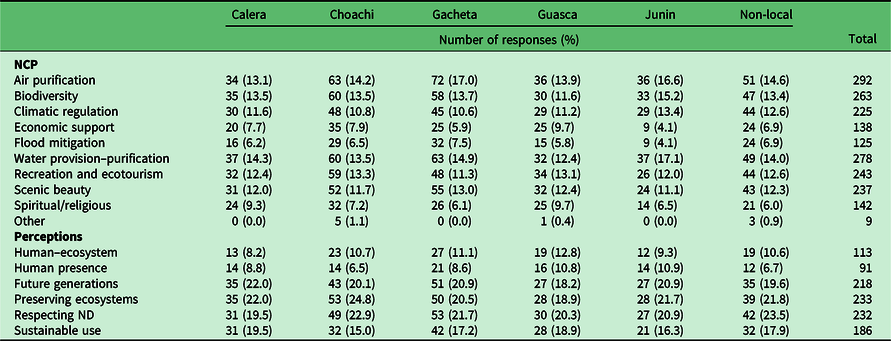
The most frequently identified NCPs were air purification and water provision and purification (Table 1). There were no significant differences between men and women in terms of perceptions towards NCPs and conservation (p > 0.05) (Table 2). The demographic variables that showed significant differences in perceptions regarding benefits or NCPs (Index 1), were anthropogenic activities that cause damage to the ecosystem (i.e., human problems; Index 3), perceptions related to the concept of conservation (Index 4) and restoration activities (Index 5) were place of residence (p < 0.001), age (p < 0.001), education (p < 0.05) and occupation (p < 0.1). Place of residence and age were two of the most influential variables (Tables 1 & 2), as they showed the greatest number and significance in terms of perceptions. In terms of multicollinearity between the demographic variables, age and occupation were not correlated (p > 0.05); therefore, they were selected together along with place of residence (i.e., where he/she lived) and included in the regression models. Similarly, perceptions of NCPs (Index 1), human problems (Index 3) and restoration activities (Index 5) showed significant differences between demographic variables, so they were also included in the regressions. We also found that more than 50% of respondents were willing to work with institutions in the region (Table S3) and WITCA averaged 12.2 hours per month (SD ±11.3).
Perception results from five municipalities near Chingaza Natural National Park, Colombia. Nature’s contributions to people (NCP) or benefits perceived are according to municipality and ‘non-locals’ (not residing in the municipality). Perceived NCPs include air purification, biodiversity, climatic regulation, economic support, flood mitigation, provision and purification of water, recreation and ecotourism, scenic beauty, spiritual and/or religious and other (see Appendix S1, question 3). Conservation perceptions (Index 4) are according to place where the participant lived. Categories associated with the conservation concept include: satisfying human and ecosystem needs simultaneously (human–ecosystem), maintaining human presence in the territory (human presence), ensuring quality of life for future generations (future generations), preserving ecosystems, respecting nature’s diversity (respecting ND) and sustainable use of natural resources (sustainable use) (see Appendix S1, question 11).

Kruskal–Wallis test and χ2 values comparing perceptions among demographic variables in Chingaza Natural National Park, Colombia. Benefits (Index 1), disservices (Index 2), human problems (Index 3), conservation-related perceptions (Index 4) and restoration activities (Index 5; see Table S1).

*p < 0.05, **p < 0.01, ***p < 0.001.
a Marginally significant (p < 0.10).
In general, the responses to the question ‘how much do you agree with these activities in Chingaza?’ (Appendix S1, question 14) were influenced by at least one of the demographic variables (i.e., age, education or place of residence). In addition, both WITCA and governance (Table S1) showed differences among demographic variables, specifically age and education level.
Deforestation and armed conflict
The municipalities with the highest deforestation rates were Guasca and La Calera, while the municipality with the least deforestation was Gacheta (Table S4). In terms of recent temporal deforestation, the largest net changes in deforestation during 2008 and 2018 were in Guasca, La Calera and Choachi, whereas Junin and Gacheta showed relatively minor changes (Table S4).
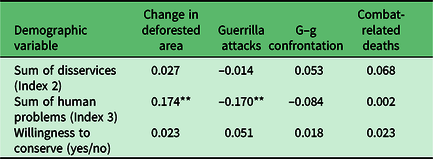
We only found a significant relationship between deforested area (Table S4) and the human problems variable (p < 0.01; Table 3), whereas perception of NCPs (Index 1) and willingness to conserve (yes/no) were not significantly related. In addition, the municipalities with the most reported guerrilla attacks during the analysis period were Choachi and Junin (seven each), while the municipality with the most reports of government–guerrilla confrontations (13) was Gacheta. The municipality with the highest number of deaths due to confrontations was Guasca (20; Table S4). Another significant relationship was between number of guerrilla attacks and perceived human problems (p < 0.01; Table 3).
Spearman correlation test results assessing the relationships of surveyed perceptions of ‘deforestation’ and ‘armed conflict’. ρ values and statistical significance are reported (**p < 0.01). The signs of the ρ values show the trends of the relationships. ‘Change in deforested area’ (second column) refers to the change in deforested area between 2008 and 2018 (Table S1), while columns 3–5 refer to the analysis of armed conflict: ‘guerrilla attacks’, ‘government–guerrilla confrontations’ (G–g confrontation) and ‘combat-related deaths’ (see Table S1). ‘Willingness to conserve’ corresponds to a binary question (Appendix S1, question 15).

Regression models
In the first model (Eq. 1), age and place of residence showed a significant and positive relationship (p < 0.01) with conservation-related perceptions (Index 4; Table S5). In addition, Indicator II (subsistence activities) showed a marginally negative significant relationship (p < 0.1) with conservation-related perceptions, while Indicator I (focused on recreation) also showed a positive relationship with conservation-related perceptions (Table S5). These findings indicate that a respondent’s conservation-related perceptions (Index 4) are less associated with natural resource exploitation and are more in favour of ecotourism and outdoor recreation (Appendix S1, question 14 & Table S3).
For our second model, the WITCA showed a significant relationship (p < 0.05) with conservation (Table S1) and age, and was marginally significantly related (p < 0.1) to restoration activities (Index 5). Tendencies are negative for age and positive for restoration activities and conservation (Table S5). Thus, younger respondents were more willing to invest more hours in conservation-related activities, as well as in performing more activities related to restoration.
Discussion
The most frequently identified NCPs (Index 1) were air purification and provision and purification of water (Table 1). Citizens in the municipalities adjacent to Chingaza were aware of the environmental functions of Neotropical ecosystems, highlighting the benefits from highland Andean forests and páramos (Brown & Kappelle Reference Brown and Kappelle2001, Núñez et al. Reference Núñez, Nahuelhual and Oyarzún2006). These results are consistent with those of Álvarez-Salas et al. (Reference Álvarez-Salas, Gómez-Aguirre and Cano-López2016) and Ruiz-Agudelo and Bello (Reference Ruiz-Agudelo and Bello2014) for a páramo in another Andean department (i.e., Antioquia, Colombia). Similarly, NCPs such as biodiversity, climate regulation, scenic beauty and recreation and ecotourism were also recognized by the population. There is a need to address multiple resource objectives and co-benefits when managing Chingaza as not only are environmental benefits important, but so are cultural ones, as well as ‘biodiversity’, which is not considered an ecosystem service under conventional typologies. Indeed, many of these self-reported benefits such as biodiversity and resource use for poverty alleviation and armed conflict as a ‘cost’ are not commonly accepted terms in ecosystem service framework-related typologies. Thus, the IPBES’ NCP concept can provide studies such as ours with more flexibility in accounting for more context-specific dynamics that do not occur in higher-income countries (Kadykalo et al. Reference Kadykalo, López-Rodriguez, Ainscough, Droste, Ryu and Ávila-Flores2019).
Interestingly, we found that the perception of human problems (Index 3) was significantly related to deforestation and guerrilla attacks (Table 3). Fergusson et al. (Reference Fergusson, Romero and Vargas2014) and Landholm et al. (Reference Landholm, Pradhan and Kropp2019) also found a relationship between deforestation and forest conditions with armed conflict. Canavire-Bacarreza et al. (Reference Canavire-Bacarreza, Diaz-Gutierrez and Hanauer2018) showed that armed conflict exacerbated deforestation, especially in remote regions such as PAs. Other studies report that the impact is ambiguous, as it can increase or decrease forest conversion (Hoffmann et al. Reference Hoffmann, Márquez and Krueger2018). Regardless, both armed conflict and deforestation can affect the supply and demand for NCPs and conservation plans (Baral & Heinen Reference Baral and Heinen2006, Clerici et al. Reference Clerici, Cote-Navarro, Escobedo, Rubiano and Villegas2019). Although government–guerrilla clashes and deaths in combat are important variables associated with warfare, guerrilla attacks are particularly relevant in that they result in historic and recent forced displacements of people and are related to drivers of deforestation (Hoffmann et al. Reference Hoffmann, Márquez and Krueger2018). On the other hand, Canavire-Bacarreza et al. (Reference Canavire-Bacarreza, Diaz-Gutierrez and Hanauer2018) reported an association between PAs and higher levels of violence, as guerrillas move their illicit activities to remote regions, often in these PAs. This has implications for the relationship between the negative environmental effects of deforestation and armed conflict, as this indicates an absence of the state and hence poor governability and governance (Fergusson et al. Reference Fergusson, Romero and Vargas2014).
Chingaza is also facing problems related to urbanization and population growth, and this is a generalized trend throughout the Andean region of Colombia (Brown & Kappelle Reference Brown and Kappelle2001). The study area in the past decades has in fact undergone substantial socioeconomic and land-cover changes related to its close proximity to Bogotá (Clerici et al. Reference Clerici, Cote-Navarro, Escobedo, Rubiano and Villegas2019) as the water supply from Chingaza is particularly important for the city. Similarly, although the respondents did not report illicit crop cultivation, small subsistence farmers are still present in the study area, and they continue to influence conservation-related activities (Hoffmann et al. Reference Hoffmann, Márquez and Krueger2018). Thus, these two factors are those that most influence anthropogenic disturbance in Chingaza’s páramo and Andean forests (Gutiérrez-Antolínez Reference Gutiérrez-Antolínez2016).
Our findings show that place of residence, age and education were key demographic variables that can be used to better target and understand citizens in regard to decision-making (Table 2). Additionally, more than half of the respondents were ‘willing to participate with regional institutions’ in activities related to ecosystem restoration. Such willingness is opportune in that collaboration between community and government entities for improved governance in PAs is key (De Pourcq et al. Reference De Pourcq, Thomas, Arts, Vranckx, Léon-Sicard and Van Damme2015). Similarly, age was a key variable in citizen’s understanding of conservation (Eq. 1). The positive relationship between age and conservation (Index 4) indicates that older people consider other aspects such as sustainable use, conservation and human presence in the NNPS (Appendix S1, question 11) as also important. Studies from the USA have shown that older people differ in conservation perceptions particularly because of the legacy benefits of PAs to future generations (Beaudreau & Levin Reference Beaudreau and Levin2014, Pillemer et al. Reference Pillemer, Wells, Meador, Schultz, Henderson and Cope2016). While understanding conservation as a positive concept, this does not necessarily imply one’s willingness to collaborate on strategies to implement or better understand it (Lund et al. Reference Lund, Balooni and Puri2010). Therefore, this differentiation could be used by NNPS officers to target education and participation efforts, which are necessary for improved management of PAs (Baral & Heinen Reference Baral and Heinen2007). Age was also negatively related to the WITCA (Eq. 2), indicating that younger people are more willing to participate in restoration-related activities (Russell Reference Russell2005, Brien et al. Reference Brien, Townsend and Ebden2008).
The negative relationship between subsistence activities (Indicator II; Table S5) and the sum of perceptions related to the conservation concept (Index 4) shows that conservation in Chingaza’s surrounding communities favour subsistence-related activities (e.g., agriculture, livestock and logging) less than activities associated with recreation, such as ecotourism (Table S5). We note that our study’s findings corroborate local communities’ awareness that anthropogenic activities are leading to ecosystem degradation (Garavito-González et al. Reference Garavito-González, Gómez-Zarate and Palacio-Tamayo2018).
Information such as that provided in this study is key for focusing education programmes and community inclusion in decision-making and policies related to conservation (Anthony Reference Anthony2007, Baral & Heinen Reference Baral and Heinen2007, Aditya & Ganesh Reference Aditya and Ganesh2018). However, a limitation of this study is that the sampling was implemented in more urbanized areas of the municipalities and, although market days were chosen in order to better capture perceptions from heterogeneous types of citizens, the sample corresponding to rural residents was low. Future studies can complement the analysis by using the survey instrument to sample other more rural locations (e.g., trailheads, farms, ranches, etc.), as well as testing these results in other PAs (Marta-Pedroso et al. Reference Marta-Pedroso, Freitas and Domingos2007).
This study explored the perceptions regarding NCPs, conflicts and willingness to participate as volunteers in conservation-related activities of citizens living and working near a socio-ecologically complex PA in the tropical highlands. Despite being an important conservation measure, the creation of PAs has historically been associated with conflicts between local populations and park officials (e.g., Lele et al. Reference Lele, Wilshusen, Brockington, Seidler and Bawa2010, De Pourcq et al. Reference De Pourcq, Thomas, Arts, Vranckx, Léon-Sicard and Van Damme2017, Reference De Pourcq, Thomas, Elias and Van Damme2019). Authors such as Kalamandeen and Gillson (Reference Kalamandeen and Gillson2006) and De Pourcq et al. (Reference De Pourcq, Thomas, Arts, Vranckx, Léon-Sicard and Van Damme2015) have discussed the efficacy of involving the community in the management of these areas and not adhering to strict preservationist objectives as a means towards easing conflicts between different actor groups (Baral & Heinen Reference Baral and Heinen2007). This is particularly relevant in the establishment of PAs that displace local populations and do not include citizen participation in decision-making (Lele et al. Reference Lele, Wilshusen, Brockington, Seidler and Bawa2010). Nevertheless, the history of illegal mining, highland forest and páramo resource use, as well as water use and quality impacts in Chingaza (Garavito-González et al. Reference Garavito-González, Gómez-Zarate and Palacio-Tamayo2018), highlight the need for the effective establishment of conservation measures.
Conclusion
Age and where respondents lived were the most influential demographic factors in people’s perceptions of NCPs and problems from nature in Chingaza. These sociodemographic aspects are also related to the willingness of people to voluntarily invest time in conservation activities. Our findings regarding deforestation and armed conflict – particularly in terms of the guerrilla attacks that occurred in Chingaza – indicate the continuing legacy of war for citizens. This implies that resource conflict problems will continue to occur after the signing of peace agreements with armed groups, as they will continue to influence people’s perception of how human activities can damage ecosystems.
This study contributes to a better understanding of the perceptions towards conservation and NCPs of communities adjacent to a tropical highland PA in the Global South. Similar analyses need to be implemented in other PAs, especially to establish whether the pattern of perceptions found in this study can be generalized or whether they are context-specific. Furthermore, a key finding is that planning of conservation strategies should focus on prioritizing the recreational enjoyment of ecosystems. Similarly, accounting for the relationship between the concept of conservation and the indicators used suggests that the urban and ex-urban communities living adjacent to this PA associate conservation with recreation, but not resource exploitation. Finally, the findings indicate that community participation in governance processes and not only protection strategies is important because people are aware of NCPs and are willing to invest time in conservation.
Supplementary material
To view supplementary material for this article, please visit https://doi.org/10.1017/S037689292000020X
Acknowledgements
We thank the students from the Socio-Ecological Systems 2019-I course and Brayan Polania for assistance with implementing the surveys, as well as the respondents for collaborating with the study. We also thank Gisselle Toro for assistance with the geospatial analyses.
Financial support
This work was finance by Universidad del Rosario through the BigGrants Scheme 2017.
Conflict of interest
None.
Ethical standards
The survey instrument used in this project was approved by the Ethical Committee of Universidad del Rosario.