


Introduction
Studies of the impact of visible difference (disfigurement) have identified that some individuals experience difficulties with unwanted feedback from the public in the form of staring, name-calling and unsolicited questioning (Rumsey, Clarke, White, Wyn-Williams and Garlick, Reference Rumsey, Clarke, White, Wyn-Williams and Garlick2004). Such interactions can leave some individuals feeling isolated and experiencing social anxiety (Rumsey, Robinson and Partridge, Reference Rumsey, Robinson and Partridge1993). Some individuals also experience poor negative self-evaluation and low self-esteem (Kent, Reference Kent2000).
However, many individuals do cope well with the challenges that having a visible difference presents to them (Rumsey et al., Reference Rumsey, Clarke, White, Wyn-Williams and Garlick2004), with factors such as general social support (Brewin, MacCarthy and Furnham, Reference Brewin, MacCarthy and Furnham1989), specific support from health professionals (Kleve and Robinson, Reference Kleve and Robinson1999), coping styles (Moss, Reference Moss, Lansdown, Rumsey, Bradbury, Carr and Partridge1997), self-concept (Moss and Carr, Reference Moss and Carr2004) and perceived severity of the injury (Kleve, Rumsey, Wyn-Williams and White, Reference Kleve, Rumsey, Wyn-Williams and White2002; Moss, Reference Moss2005), contributing to effective coping. Factors shown to have little or no influence on adjustment include time since injury (Kleve and Robinson, Reference Kleve and Robinson1999) and objective measures of the severity of the visible difference (Moss, Reference Moss2005).
Over the last three decades efforts have been made to address the difficulties experienced by some of those who have a visible difference; for example in the UK, both the charitable organization Changing Faces and the UK National Health Service (NHS) provide services offering psychosocial support. These services often involve helping individuals develop social skills to deal more effectively with interactions with others, reduce social anxiety and increase self-esteem (Rumsey et al., Reference Rumsey, Robinson and Partridge1993). However, the provision of services offering such psychosocial interventions remains limited in both overall capacity and geographical availability.
Much research has been conducted into the importance of addressing the psychosocial needs of individuals with visible differences (for example, Rumsey et al., Reference Rumsey, Robinson and Partridge1993), but relatively few interventions have been designed specifically to meet these needs or have been evaluated with sound methodology (for an example see Robinson, Rumsey and Partridge, Reference Robinson, Rumsey and Partridge1996). A recent systematic review of these psychosocial interventions identified limited evidence to support their effectiveness (Bessell and Moss, Reference Bessell and Moss2007). Whilst the interventions showed promise, their methodological flaws (e.g. small sample sizes, inadequate random allocation, and the absence of a no-intervention control group) made it difficult to rigorously assess effectiveness. Although the academic literature surrounding both the difficulties faced by individuals with visible differences, and the types of support that may help people to overcome these difficulties is considerable, in the absence of substantial evidence of effectiveness the current study set out to ascertain whether current psychosocial interventions, adopting social skills/cognitive behavioural approaches, met potential users’ needs. The following studies outline the importance of user involvement in the intervention design process in order to increase both the acceptability and accessibility of such support services.
Needs assessment
One way of trying to ensure that the content of any psychosocial intervention is both useful and acceptable is to conduct a needs analysis looking at the felt needs of potential service-users (Bradshaw, Reference Bradshaw1972). Another way is to talk to health professionals who are experienced in working with the intended population and to design an intervention around the issues they feel need to be addressed. Therefore, a needs assessment with individuals with visible differences and health professionals working in the field was conducted within this first study. These findings then facilitated the development of a new psychosocial intervention – namely an online computer-based programme aiming to increase the availability of psychosocial support to those who have previously found it difficult to access such services. People who have a visible difference and might benefit from online support include those who are socially isolated (possibly as a result of social anxiety), those in remote geographical locations, and those with physical disabilities making it difficult to travel to clinics (Proudfoot, Reference Proudfoot2004). Online interventions have been found to be effective in treating mild depression and anxiety and have proven useful as the first stage in a stepped-care approach to psychosocial intervention (NICE, 2005). The second study aimed to evaluate this newly developed computer-based psychosocial intervention using a social skills/cognitive behavioural approach (known as Face IT), by asking experts and potential users to provide feedback on its presentation and clinical content, as preparation for a subsequent randomized controlled trial (RCT) of its effectiveness being carried out.
Study 1: Method
Participants
Eighteen individuals (eight male, aged 21–57) took part in the study. Three groups of participants were involved. Six (five female) were experts who had previous experience of either designing or running psychosocial interventions for people with visible differences. Five (three female) were individuals who had already taken part in some kind of psychosocial intervention associated with their visible difference (a user group). The final seven (two female) were individuals who had not received any kind of formal psychosocial support in relation to their visible difference (a non-user group). The user group were included in order to ascertain whether there was anything about existing interventions that were either particularly useful or unacceptable for differing types of visible differences. Feedback from a non-user group was important to ensure that any new intervention would be more suitable to them than previous interventions they may have refused, and also to ascertain whether any particular techniques had aided them in coping with their difference.
Design
Participants were asked to take part in a series of individual semi-structured interviews, lasting from 20 to 75 minutes, which took place in a location convenient to the participants. Interviewees were asked to talk about their experiences of either living with a visible difference or working with people with differences, their reasons for seeking or refusing psychosocial interventions and their experiences of taking part in such interventions. They were also asked to comment on any strategies and factors that had proven more or less useful to them.
Participants were then given information outlining the proposed content of the new online intervention, which was designed to be used both within the clinical setting under supervision, and by users in their own homes, and asked to discuss both positive and negative aspects. The first author developed the basic format of the intervention on the basis of the systematic review of the literature and in collaboration with a consultant clinical psychologist working in the field of visible difference. The proposed content adopted a cognitive-behavioural/social skills approach to psychosocial intervention. Users were not asked to be involved in the design outline at this stage as the purpose of the initial draft was to incorporate significant elements from existing intervention models. A qualitative approach was chosen in preference to quantitative design in order to allow participants to express in detail their experiences of living with a visible difference and their experiences of psychosocial intervention. The interviews were recorded and transcribed verbatim. Ethical approval was obtained from the University of the West of England, Bristol.
Analysis
Prior to data collection a code manual was developed based upon the three main research questions identified from previous research. The broad code categories were chosen to reflect information gathered regarding the positive and negative aspects of existing interventions, positive and negative aspects of the current intervention and information pertaining to the kinds of difficulties faced by individuals with visible differences that may prove useful to consider when designing interventions. However, due to the lack of evidence for the effectiveness of existing interventions, it was also important to allow participants’ voices to be heard in order to ensure issues that had not previously been identified were not missed (Fereday and Muir-Cochrane, Reference Fereday and Muir-Cochrane2006). Therefore, an inductive process was also employed.
Interview responses were analyzed using thematic analysis from a realist theoretical approach (Braun and Clarke, Reference Braun and Clarke2006) using both deductive and inductive methods (Fereday and Muir-Cochrane, Reference Fereday and Muir-Cochrane2006). The spoken content of the interviews was analyzed to address the three main research questions, and additional data were coded based upon salient issues that arose in the data that either contradicted, or was not represented in, the existing visible difference literature. The transcripts were first read thoroughly to identify meaningful categories within the data, and were then coded by assigning them descriptive titles.
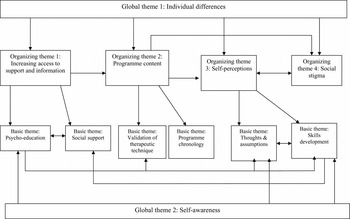
The coded data for each of the three different participant groups were analyzed separately so that differences in the concepts could be identified. Similarities and differences were identified and noted. All the data were then analyzed inclusively, and a thematic map was produced. The transcripts were scrutinized again to ensure that the themes accurately reflected the content of the original data set. The final analysis resulted in 31 categories of data, which were ultimately grouped into two global themes, four organizing themes and six further basic themes using a thematic network to represent how the different categories relate to one another (Figure 1).
Thematic map of identified themes and related sub-themes from needs assessment

Results and discussion
The results obtained from this study were extensive. Therefore, although all the themes identified specific needs of the client population, this paper reports one theme in depth, namely increasing access to service provision as this emerged as being of fundamental importance to participants. A brief outline of the other themes will be provided.
The positive elements included a need to focus on changing aspects of their social behaviour that had negative consequences, addressing unhelpful self-perceptions and negative assumptions people with visible differences may have about their appearance and the way others perceive them. The negative elements included too much emphasis on the “event” that had led to the disfigurement (as opposed to concentrating on the appearance-related distress), and some aspects were criticized for not being practical enough (participants felt there was insufficient focus on building better social skills). The existing intervention design (for Face IT) was criticized for involving users too heavily in exposure therapy without adequate support from a health professional if the Face IT programme was used in clients’ own homes. Participants also felt that the intervention needed to contain more practical tasks to increase motivation to use it. Overall, the design specification was received positively, with participants liking the overall structure, length and content of the proposed intervention.
Individual differences
Individual differences were evident in relation to the suitability of the programme content, the participants’ self-perceived needs, and the impact of social stigma. Individual differences in attitudes towards therapy affected participants’ accessing of support and information services, with some participants actively seeking out support and information, and others not wanting or needing to engage with psychosocial support services.
“My umm experiences have been of people staring . . . I have people asking questions, which I prefer ‘cause then you can explain what it is umm but I have had many reactions including people assuming I have AIDS.” User, Melanie
“Socially, umm, in terms of my interactions . . . I'd say, generally over the past 30 years, umm, I've had fairly positive experiences . . . and interactions with people”. User, Miranda
Self-awareness
Self-awareness was expressed as being a key attribute in learning to cope with difference. Self-awareness referred to an awareness of an individual's own negative and unhelpful thoughts and beliefs about their appearance and beliefs of others. Many of the experts and also the individuals who had experienced the intervention process indicated that the opportunity to identify the problems associated with one's thinking and behaviour led to a change in the way those affected were able to deal with their difference. For example, some individuals with visible differences felt that members of the public were being deliberately cruel when they stared or commented about their appearance. If people assumed that staring or name-calling was caused by a lack of understanding of disfigurement, this often led them to behave more aggressively or to feel more anxious than they would otherwise have done. The consequences of these responses can be that individuals with visible differences find it more difficult to build social support networks (Rumsey et al., 2003).
Participants implied that self-awareness came about through the process of having their thought processes challenged through behavioural experimentation and through psychoeducation.
“It's nice if you do get that moment of illumination of ‘my god, I do that and that's making me feel like this’” User, Graham
Self-perceptions
Participants talked about the need to address issues relating to self-consciousness and self-esteem, as well as addressing a lack of self-efficacy in relation to achieving certain goals. Negative self-perceptions and a lack of self-confidence leave some individuals with visible differences doubting their ability to succeed. There was optimism that the prototype programme could address these negative perceptions, and more specifically address the issue of self-efficacy. By providing individuals with an intervention that could be completed in their own homes, participants felt they would be more able to help themselves, rather than having to rely on others for support and guidance. This was viewed positively. Participants expressed the view that the best way to bolster their self-perception was for the intervention to include techniques that addressed negative thoughts and also taught effective practical social skills.
“I didn't like the way I looked . . . I felt my eyes were disgusting and assumed everyone else would too.” Non User, Terry
Social stigma
Social stigma was a strong theme running throughout the data. Most had experienced some form of social stigma and these experiences demonstrated the need for an appropriate intervention. The participants who had learnt to cope effectively with their difference indicated that social stigma, although partly due to the ignorance of society about visible differences, was also related to factors internal to those affected, such as self-confidence and social support. Some expressed the view that these factors had been protective against more severe forms of stigma.
“I can recall my . . . first father in law . . . sort of stating to his daughter, you know, ‘You can't go marrying, or shouldn't be marrying a one-eyed monster.’” Non User, Terry
“I do know people who have been thrown out of swimming pools, you know because people think they are infectious, contagious and it can be difficult and people make you feel so small.” User, Melanie
Programme content
Participants spent a lot of time evaluating the content and structure of the prototype programme. All participants expressed positive views and considered the length and content to be appropriate, acceptable and useful. There were, however, some issues that participants felt needed to be addressed. A majority felt that additional support should be available if clients required it. For example, some felt that particular sections in the programme, notably the exposure section, may prove challenging for some users if additional support was not available. This theme was associated with two basic themes: validation (the need to validate the use of the social skills approach by including quotes and experiences from other individuals with visible differences) and programme chronology (participants expressed a preference for targeting social skills before trying to address negative thoughts).
“I like the idea that if you feel confident with one thing you can miss it out or you can do it in whatever order, umm, I think that's appealing . . . that makes it just a bit more lifestyle friendly really and less like therapy.” Expert, Bridget
“I also think that it's about the right length, you know, umm, so it's going to be about eight sessions, any less than that I think you'll not really find a lot . . . but any more than that I think you'll lose people.” Expert, Amanda
“Where it says, you know pick a scenario that's going to be a difficult thing to do isn't it, I mean picking something frightening and it's a little dangerous isn't it . . . without there being any support after they've done it.” Expert, Hannah
Increasing access to support and information
The theme of increasing access to support and information represents the overwhelming need for more readily available services for all kinds of visible differences, whether the individuals are coping positively or not. This is associated with two basic themes: psychoeducation and social support. These are factors that were highlighted as the kinds of information and services to which people required further access. Participants revealed a general lack of information for potential service users about the kinds of interventions in existence; many of the non-user participants had not heard of any of the interventions available.
“You don't always realize the kind of support or resources there are available to you.” Non-user group.
One of the reasons given for this lack of awareness amongst potential users was the limited knowledge health professionals have about appearance concerns and relevant services. Whilst the health professionals included in this study were able to demonstrate a detailed knowledge of interventions and the difficulties faced by individuals with visible differences, all participants felt that the majority of health care professionals working outside the field of visible differences are less well informed.
“People with some kind of condition that involves visible difference, . . . go to see GPs who don't necessarily know what steroid creams are available let alone what psychological interventions there might be out there.” User group
Participants identified that the new computer-based intervention needed to be widely advertised to ensure that it reached its target population. Suggestions included widespread advertising within the NHS and also on support group and charity websites in order that potential users could find out about this service without having to rely upon information or guidance from health professionals.
Participants in the study were particularly interested in the remote access possibilities of the proposed new intervention (i.e. being able to access a computer programme online from their own homes). In terms of increasing service provision, it was felt that an intervention that could be delivered outside of the clinical environment would help immensely.
“You can do it in the privacy of your own home . . . it's a more private thing, it's a choice-based thing . . . so there's no pressure, no sort of self-consciousness about it.” User group
“If someone's socially isolated in their bedroom . . . I wasn't going out the house but I was going on the Internet almost every day, and that became your sort of friend”. User group
Participants felt that some health professionals, such as GPs or medical consultants, did not take psychological difficulties associated with a visible difference sufficiently seriously. Those who had received support in the past felt this was only provided once their difficulties had become quite serious. They felt the new intervention could open service provision up to a much wider audience, allowing those who were not yet “in crisis” to access the programme and potentially prevent serious problems from arising.
“It's really important to offer therapy even to people who aren't in desperate need . . . I like the idea that the programme can be dipped into as and when you need it”. Non-user group
“I think it would be good to know about this sort of thing earlier, it should be available when you're diagnosed, because it helps.” User group
Basic theme: psychoeducation
Participants identified two specific forms of support that were needed: psychoeducation and social support. Psychoeducation in the context of this study relates to the need for information regarding the impact that visible difference can have on members of the public who are not visibly different; for example, it can be difficult for people with visible differences to understand what it is like for members of the public to meet someone with an unusual appearance for the first time (Partridge, Reference Partridge1994). Participants who had learnt to cope positively with their difference reported that information of this kind was one of the key factors that helped them to cope more effectively. Also highlighted was the need to offer techniques for dealing with the reactions of others.
“I don't mind people asking me questions about my face, I actually encourage it . . . I'd rather that they approached me rather than that feeling of being isolated from the community.” Non-user group
“If somebody couldn't accept . . . the birth mark, . . . within whatever notional limit I set, then I wouldn't want to know them . . . I've learned over many years now that It's completely natural curiosity, . . . I try to notice that about myself . . . if I see someone with something I haven't seen before I'm going to react that way too.” User group
Basic theme: social support
Another key factor that had led to positive coping in individuals with visible differences was the presence of effective social support. In addition to social support, participants also expressed a desire to meet other people with similar conditions so that they could share their experiences.
“I think people should err be in a group, it's good because you are meeting other people with similar problems and you talk.” Non-user group
“I have been so much better since I joined the forum, and met G, it has been great, they have given me so much support and increased my confidence.” User group
Although both users and non-users were in favour of the idea of social support networks, the experts were more cautious. Although self-help support groups have been used for some time, in recent years the Internet has led to the development of online forums that have allowed individuals to converse more easily (Burrows, Loader, Pleace, Nettleton and Muncer, Reference Burrows, Loader, Pleace, Nettleton and Muncer2000). This has helped to overcome issues of geographical diversity, but has led to concern in some experts. Some felt that allowing individuals to set up virtual support networks may encourage them to become even more insular and to avoid face-to-face interactions.
“I think that the basis of the difficulty here is social anxiety, but if you set up a social support network it's almost like colluding with an agoraphobic and going shopping for them potentially.” Expert group
Conclusion
This study has supported previous research findings that some individuals with visible differences do experience psychosocial difficulties, and illustrated clearly that increased access to service provision and social support are perceived as potentially beneficial. The study has lent some support to the content of existing intervention packages (Kleve et al., Reference Kleve, Rumsey, Wyn-Williams and White2002; Newell and Clarke, Reference Newell and Clarke2000; Papadopoulos, Bor and Legg, Reference Papadopoulos, Bor and Legg1999; Robinson et al., Reference Robinson, Rumsey and Partridge1996), and has informed the further development of a new computer-based intervention for people with visible differences, called Face IT.
The development of Face IT
Introduction
The development of any computer-based intervention involves extensive testing to ensure that programme errors are removed (Williams, Reference Williams2004), that the programme is acceptable, and that it can be utilized by the target audience (Olson and Olson Reference Olson and Olson2003). It is particularly important to perform a usability analysis (an assessment of how easy it is to use a software tool) to ensure that the needs of the target user-group have been met (Williams, Reference Williams2004). Beta testing (asking target users to test a programme) is also an important process and can ensure that no small software errors appear in the final product (Williams, Reference Williams2004). Techniques employed by human factors specialists for conducting such usability analyses include usability checklists, empirical testing, and cognitive walkthroughs, most of which require specialist training (Olsen and Olsen, 2003). In addition to the development process reported in study one, Face IT underwent a usability analysis utilizing an empirical testing approach, as well as the beta-test with both potential users and health professionals working in the field of visible difference. Empirical testing involves assessors using the programme in a similar way to users in the real world and identifying issues and problems (Smilowitz, Darnell and Benson, Reference Smilowitz, Darnell and Benson1994). This method was chosen because it does not require specialist training to conduct and allows the involvement of real world users in the assessment process.
The aims of this second study were to evaluate the usability of the Face IT computer-based social skills/cognitive behavioural intervention and allow modifications to be made in line with user requirements ahead of a full-scale outcome trial. Additionally, the study aimed to further develop the clinical content of the programme on the basis of feedback from experts and potential users.
Study 2: Method
Participants
Twenty-eight individuals (22 female, aged 20–69 years) took part in the study. Fourteen were experts (12 female) with previous experience of designing or running psychosocial interventions for people with visible differences. Fourteen were individuals with visible differences (10 female), who responded to an advert placed on support group websites. Four participants had previously taken part in study one and others were new participants.
Materials
Participants were given access to a prototype version of the Face IT programme to view. Participants were asked to take part in a series of semi-structured interviews. Additionally, they were asked to discuss the proposed content of the new intervention. A brief outline of the Face IT programme can be seen in the Appendix.
Procedure
Prior to taking part in the focus group, all participants were asked to view at least one of the eight sessions of the programme in the presence of a researcher who took notes and observed how they used the Face IT programme. The interviews, lasting 30 minutes to 1.5 hours, consisted of a series of semi-structured questions designed by the researcher relating to the acceptability of the programme's clinical content and the usability of the programme (e.g. how easy or difficult did you find the programme to use?). Interviews were conducted in a location convenient to each participant. Initially, it was intended for all data to be collected via focus groups, as this would allow participants a chance to discuss the programme with others and exchange opinions, but logistical difficulties meant that some participants were interviewed individually. All the non-expert participants were interviewed on a one-to-one basis, as were two experts, whilst the remaining experts attended focus groups consisting of three experts and the researcher. The interviews were recorded and transcribed verbatim by the first author.
The final stage of the study involved asking all participants to view the final version of Face IT in their own homes (a beta-test) and complete a usability evaluation questionnaire (adapted from Ravden and Johnson, Reference Ravden and Johnson1989). The final version of Face IT resulted from amendments following the initial interviews with participants and health professionals. This data were analyzed using descriptive statistics to represent levels of satisfaction with varying aspects of the Face IT programme. From the original 28 participants, seven experts and eight users completed the feedback questionnaires (a response rate of 54%). Additionally, two computing experts trained in usability assessment techniques were also asked to complete the questionnaires in order to assess usability. These individuals did not have experience of visible difference and were recruited purely on the grounds of their software assessment expertise.
Research in action procedure
The study adopted an approach similar to the “action research” method for analyzing the responses from participants (Reason and Bradbury, Reference Reason and Bradbury2001). The process allowed changes to be made at each stage of the research process, rather than all feedback being addressed at the end of the study. This led to any issues relating to programme errors or language being addressed and changed immediately. The study was conducted in five stages, with a selection of experts and users viewing the programme at each stage, and then all participants being given the opportunity to view the completed programme again at the end of the study.
Analysis
Interview responses were analyzed using theoretical thematic analysis (Braun and Clark, Reference Braun and Clarke2006) using both inductive and deductive approaches (Fereday and Muir-Cochrane, Reference Fereday and Muir-Cochrane2006), with the spoken content of the interviews being analyzed in a way that addressed two main research issues; the appropriateness of the clinical content and language and the usability of the programme.
The transcripts were read thoroughly. Any information relating to the programme layout, navigation or content was coded, as were any issues in the programme that had not been addressed, or were supporting or refuting existing literature. Data from the two different participant groups were analyzed separately. Similarities and differences between the two groups were identified. All the data were then analyzed together and a thematic map produced. The transcripts were then revisited to ensure that the themes provided an accurate reflection of the issues outlined by participants.
Results and findings
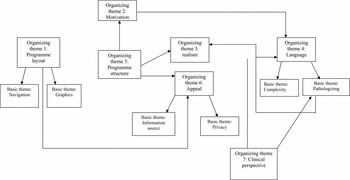
Seven organizing themes and six associated basic themes were identified within the data (see Figure 2). These themes all provide information about the positive and negative aspects of the proposed intervention programme. The data gathered from the research were extensive. This report focuses upon the theme of motivation in some depth, as the issue of motivating individuals to use computer-based interventions, particularly from their own homes, has been highlighted as a potential problem associated with this medium (Yates, Reference Yates and Yates1996). This section is preceded by a brief description of the other themes.
Thematic map of identified themes and related sub-themes from programme evaluation

Programme layout
Many participants, both experts and users, identified that changes needed to be made to the visual aspects of the website, specifically the graphics and the navigation of the programme. Overall, users found the programme simple and easy to use, although the graphics were considered to be too “harsh”, and did not match the tone of the programme. Changes were therefore made to Face IT to facilitate navigation and the graphics were enhanced.
Programme structure
All participants reported that the flow of the eight sessions of the programme provided a good structure for allowing users to gain new skills (e.g. social skills such as body language and verbal communication) and to remain engaged in the process. Many participants appreciated the flexibility of the programme in that sessions did not have to be completed in a set order.
Realism
User participants felt that the programme provided information and support in a way that accurately reflected the reality of living with a visible difference and that this was handled in a sensitive manner. Users particularly liked the use of video exercises, examples and true stories, since these normalized the concerns that some individuals with visible differences experience.
Appeal
Most experts and users felt that the programme could be useful to any individual with a visible difference. It was suggested that the programme may be especially relevant to those who have a difference that cannot be concealed in public because the content focused predominantly on ways of managing the reactions of others to visible difference. Participants also felt that it would be useful for children and adolescents, even though the intention was to use it purely with adults. Being able to use the programme at home, in private, and at a time to suit the individual also added to its appeal. Some user participants suggested that the programme would be useful for individuals who did not necessarily need intensive support, but would nevertheless benefit from information contained in the programme.
Language
The language was adjusted as the programme developed in response to participants’ feedback. There were two main aspects associated with language: complexity and “pathologizing”. Participants had differing opinions on the complexity of the language. Across all time points this issue was revisited with changes being made throughout the process to address the concerns of those who felt that the language was too complex. During the development of the programme it was considered important not to patronize or stigmatize individuals with visible differences, hence a team of health professionals monitored all content throughout the development process. Changes were made and the acceptability of the language was reassessed at each stage of development. User participants in the current study, who were monitoring the language across all data time points, felt that the language used in the programme was supportive and did not patronize people with visible differences.
Clinical perspective
The views offered by experts on the clinical aspects of Face IT varied. Although all favoured a similar framework of cognitive-behavioural intervention in their clinical practice, there were differing perspectives on how interventions should best be undertaken with clients. Different views were expressed in relation to: ways to expose clients to social situations via a computer programme, how to ensure clients manage their anxiety effectively from a remote location, and the terminology used to discuss visible difference within the programme (e.g. visible difference or disfigurement). In relation to exposure, some clinicians took the view that although graded exposure was preferable, flooding would also lead to anxiety reduction, whereas others felt that it was important to undertake graded exposure very cautiously to ensure that no flooding occurred. Additionally, whilst some felt the methods in the programme for anxiety management were sufficient, others felt that the programme needed much more information on anxiety management. Finally, some clinicians found the term “disfigurement” pathologizing, favouring visible difference instead, whereas others preferred disfigurement, because their clients found the term visible difference patronizing.
Motivation
Face IT was designed for use both in clinical settings under the guidance of health professionals and for users to access in their own homes. As such, the programme needs users to remain engaged from a remote location and participants highlighted ways of keeping users motivated throughout a long and potentially challenging course. Participants identified that the language used in the programme and the style of the information was very engaging and would help to keep users sufficiently enthused to log on week after week.
“It's highly engaging . . . I was on it the other day and found myself being very in to it and found it easy to pass the time and engage.” Expert group
“The programme engages you . . . the belief systems bit about perceptions of yourself and . . . others. This empowers you to believe you can change things yourself. It was handled sensitively so it doesn't feel like you're putting all the responsibility on those with appearance issues.” User group
In addition to information, the programme also contained practical elements, including a social skills DVD and relaxation exercises, aspects that were identified by participants as those most likely to keep people motivated at all times.
“What I found personally was engaging, was the things you ask people to do that they could actually do then and there, like the deep breathing exercises . . . I think those sorts of things are almost like an instant pay back and are very, very engaging.” Expert group
“I think it will be popular and I think having the video aspect will increase its popularity. People love that and learning people skills is always important . . . people like to work with material like that.” User group
Although these aspects were identified as helping to increase motivation, participants still expressed concerns about whether this would be sufficient to maintain users’ engagement with the programme throughout the entire 8 weeks of potentially challenging sessions.
“I do wonder maybe though about the momentum for them to carry on . . . you do have a very reassuring tone . . . in a way that's quite reinforcing, but there is a need for them to be quite motivated, you know, right the way through.” Expert group
“If I think back to times in the past where I've felt more self-conscious about my skin and things, umm, it's something so personal . . . I can imagine it being quite a challenge really . . . for some people to get through.” User group
Beta-test results
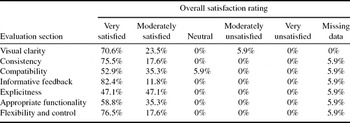
Individuals were asked to rate their overall satisfaction with Face IT in relation to seven distinct aspects. Overall, 94% of respondents were satisfied (either very or moderately satisfied) with each of the following: the visual clarity, consistency, flexibility and functionality of the website, and with the informative feedback and explicitness of the clinical content (Table 1). Eighty-eight percent of respondents felt that the website was compatible with user expectations.
Overall acceptability of individual aspects of the programme

In summary, participants rated the usability of Face IT highly, with most respondents having no, or only minor difficulties using the website. One respondent did however indicate having major issues with the amount of colour on the screen.
Information gained from this study has identified programme errors, problems associated with the visual design and layout, and problems associated with the language used within the programme. The analysis has guided the development of both the clinical content and the visual design of the new computer-based psychosocial intervention, Face IT.
Discussion
The initial needs assessment demonstrated an expressed need for the provision of further psychosocial support within the field of visible differences. The basic theme of psychoeducation hints at a need to include information from individuals in similar situations who have learnt to cope well with visible difference, although there was some debate about how acceptable it was to provide socially isolated individuals with virtual support networks. This theme resulted in the inclusion of quotes from real people in the computer programme. This addition was well received and was considered to add face validity to the programme and the social skills approach.
Health professionals in this study felt that offering remote social networks to individuals who are socially isolated may encourage them to remove themselves further from real-world social interaction. The responses of participants identified a lack of support networks for people with visible differences, and despite some of the reservations of health professionals, the use of virtual support networks should be considered when planning future care and support. This includes providing them with more opportunities to communicate with others with similar conditions. To date, evidence for the effectiveness of support groups, both online and face-to-face, for this population is limited (Bessell and Moss, Reference Bessell and Moss2007), but the technique has been widely utilized, particularly within the field of skin conditions (for an example see Cooper and Burnside, Reference Cooper and Burnside1996). Although the technique requires further investigation it is important to identify the need for choice and variety in psychosocial service provision to ensure that more individuals can access the kind of support they need.
The usability interviews conducted in study two highlighted many aspects of the computer programme that were both acceptable and less acceptable to users. Throughout the interviews users provided feedback on the layout, language and structure of the programme. Overall, users found the cognitive behavioural and social skills information used in the programme acceptable, although minor changes were required. More information was added to support users whilst they are exposing themselves to social situations within the programme and more relaxation methods with detailed descriptions were added to help users manage their anxiety more effectively in these situations. The main areas that required attention were the language, which was addressed in a stepped change process throughout the usability assessment, and the layout of the website. Changes were not made to the basic structure, but participants did highlight a need for more practical tasks within the sessions. As a result, more tasks, such as writing down thoughts and feelings, and relaxation exercises were incorporated to help increase motivation and make the programme more interactive.
This particular usability assessment took the form of an empirical test, where participants were asked to work through a specific session of the programme in a similar way to the end users under supervision. Only users and health professionals took part in the initial usability assessment. This had the disadvantage that no expert knowledge of computing was obtained in relation to the specifics of making a software tool like the Face IT programme more usable (e.g. in relation to whether the level of instruction about how to use the programme was appropriate, or whether the required level of computer literacy was low enough to enable inexperienced users to access the tool effectively). However, professional consultation with web designers, software engineers and a specialist in software usability occurred prior to the usability interviews. Additionally, two software usability experts were asked to take part in the final beta-testing phase. Neither expert identified major problems with the usability aspects of the programme, reiterating the view that all major principles of human factors design were considered.
The beta-test method (in the form of a usability evaluation checklist) was used at the end of the feedback process once all changes had been made. Although respondents indicated high levels of satisfaction, it must be noted that asking users to fill out a checklist whilst evaluating the website in their own homes has potential disadvantages. For example, there is no way of ensuring that the users extensively tested the programme, and as such there is the possibility that some programming errors may have been missed (Smilowitz et al., Reference Smilowitz, Darnell and Benson1994). Smilowitz et al. (Reference Smilowitz, Darnell and Benson1994) found that home beta-testing of software resulted in less programming errors being detected than when programmes were tested under supervision. Therefore, further extensive testing of the programme is required. This is planned as part of an outcome trial to evaluate its effectiveness.
Conclusions
The initial needs assessment identified an expressed need for a support tool that provided users with visible differences with information and techniques for addressing the difficulties associated with negative thoughts and developing social skills techniques. Studies outlined in this paper informed the development and testing of a social skills/cognitive behavioural computer-based psychosocial intervention for people with visible differences, Face IT, in line with user requirements. These studies demonstrate the importance of incorporating the views of users into the design process of interventions to ensure that they are both useable and acceptable to the target audience. The next stage of evaluation will be to test the programme with a larger population and to compare its effectiveness with standard face-to-face support in an RCT in the hope this will provide an effective means of providing psychosocial support to those living with problems associated with a visible difference. The Face IT intervention will be tested in a clinical setting under the supervision of a health professional, and will be assessed against a face-to-face delivery of the programme content and a no-intervention control group.
Acknowledgements
Many thanks to Changing Faces for sponsoring the above research project, all the participants involved in the study and the numerous support groups that helped with the recruitment of participants. Thank you also to Kevin Bessell for his human factors input.
Appendix. Structure of Face IT




Comments
No Comments have been published for this article.