Introduction
In 2001, the Legal Services Commission (LSC) introduced a pilot, the Family Advice and Information Network (FAInS). The pilot followed research that suggested that divorcing and separating couples face a ‘cluster’ of legal and non-legal issues (Genn Reference Genn1999),Footnote 1 and so FAInS was aimed at promoting family lawyers to refer their publicly funded family law clients to other services in an effort to provide clients with a holistic service.Footnote 2 Consequently, family lawyers were seen as a gateway to other services, and the primary aim of this article is to examine the way in which lawyers fulfil this gatekeeping role.
To date, there has been very little research into the referring practices of family lawyers, and the work that has been done has invariably focused on mediation. This is not too surprising and, as our research shows, lawyers predominantly refer their clients to mediation rather than other services. We consider the reasons behind lawyers’ reluctance to use a more diverse range of other services, before turning to lawyers’ perceptions of and referrals to mediation. Our research suggests that while the role of family lawyers is not narrowly restricted to resolving legal issues, it appears that there are limits to their willingness to facilitate clients in resolving non-legal issues.Footnote 3
According to the LSC, the aims of FAInS were to:
• facilitate the dissolution of broken relationships so as to minimise distress to parents and children;
• promote ongoing family relationships and co-operative parenting;
• provide tailored information and access to services through a single gateway (a specialised family law practitioner) that may assist in resolving disputes, or may assist those who are trying to save their relationship;
• identify what specialist support services need to be provided, how they can be best funded and the role that central government plays in this (Walker et al., Reference Walker, Mccarthy, Finch, Coombes, Richards and Bridge2007, p. 17).
FAInS was initially supplied by family law practitioners who were required to complete a programme of professional development, and was piloted across fifteen areas in England and Wales. Most of the FAInS providers involved in the pilot were qualified lawyers, although a few were also qualified legal executives, and all had to have at least two years’ post-qualification experience.Footnote 4
The initial meeting between a FAInS practitioner and their client was conceived to fulfil a diagnostic function, where lawyers could examine with the client the full range of problems, address legal issues and refer the client to other services to attend to non-legal problems. FAInS providers were envisaged as ‘case managers’ who would have an awareness of a full range of services that might benefit clients, and who would act as a ‘gateway’ to these other services. In this way, people facing separation or divorce were to be provided with an integrated service aimed at providing holistic assistance to help resolve their entire cluster of problems. The pilot concluded in March 2007.Footnote 5
The FAInS initiative has not occurred in isolated, and there has been an increasing policy shift towards multi-agency approaches to resolve ‘clusters’ of legal and non-legal issues. MacDonald (Reference Macdonald, Bass, Bogart and Frederick2005) argues that this shift towards joining up multiple agencies represents a change in access to justice policies, and is aimed at providing clients with a greater choice of options and tailoring solutions to individuals’ needs. Further, Courmarelos, Wei and Zhou (Reference Coumarelos, Wei and Zhou2006) claim that this shift has resulted in a move away from uni-dimensional and reactionary legal services, towards services that are proactive and preventative. It has also been claimed that there is a need for evaluation of multi-agency initiatives in order to provide better understandings of the barriers to collaborative partnerships, as well as illustrations of what works well (Salmon, Reference Salmon2004, p. 159). To date, there has been little evaluative attention paid to the application of multi-agency approaches within the legal field, and little consideration more generally of how legal actors may act as gateways to other services (Pleasence, Balmer, Buck, O’Grady and Genn, Reference Pleasence, Balmer, Buck, O’Grady and Genn2004a).
For the most part, the studies that have been done have focused on family lawyers’ perception of, and to a lesser extent use of, mediation. This is possibly because mediation is the service most commonly referred to by family lawyers (a point that is confirmed by our findings; see below). The use of mediation to resolve family disputes first appeared in family law during the 1970s, and since then has gained considerable momentum alongside the so-called Alternative Dispute Resolution movement (Astor and Chinkin, Reference Astor and Chinkin1992). Policy-makers have now embraced mediation as one of the ways in which couples can be assisted to engage in private ordering and consensual decision-making, thus reducing hostility and conflict which can have a negative impact on all concerned, particularly children.
In England and Wales, the pro-mediation movement gained momentum throughout the 1970s and 1980s, with an emphasis on the advantages of mediation in providing child-centred solutions to parental disputes. It was not until the early 1990s, however, that mediation gained much stronger policy attention, especially as it was seen to be a potential solution to the growing legal aid budget required to address family law issues. In 1993, a White Paper emphasised not just the advantages of mediation in encouraging parental agreement and reducing conflict, but also focused on how mediation could reduce the costs associated with cases proceeding to court (LCD, 1993). Despite the policy support for mediation, the number of referrals remained low, and it appeared that this would remain the case as long as mediation was ‘supply-led’ (Piper, Reference Piper and Freeman1993).
Policy support for mediation crystallised in the Family Law Act of 1996, which also encompassed the view that mediation was a helpful way forwards to resolve issues resulting from family breakdown and thus prevent long-drawn-out court battles. As Davis and Bevan (Reference Davis and Bevan2002, p. 175) state:
‘The main “story” of private family law over the past two decades has been the emergence of mediation … Following a long campaign the previous Conservative administration was persuaded of the benefits of mediation in this context, and in the Family Law Act 1996 it for the first time committed public money to the support of mediation services.’
The new Act was initially intended to introduce a number of new initiatives, including mandatory mediation for separating couples. These initiatives were piloted prior to the implementation of the Act, and it was shown that the number of cases referred to mediation by lawyers was relatively low, and that referrals were made to only a small number of suppliers, generally law firms who offered mediation (Davis, Reference Davis2000). Further evaluations also concluded that mediation was not well understood and was the choice of only a minority of couples (Walker, McCarthy, Stark and Laing, Reference Walker, Mccarthy, Stark and Laing2004). As a result of these findings, initial plans to implement mediation for all separating and divorcing couples were revoked, although people in receipt of public funding were required to either attend mediation or demonstrate why it was not appropriate before a grant of legal aid to attend court would be provided.Footnote 6 This stipulation, however, did not boost referral numbers as much as anticipated. This was largely due to the LSC’s inability to insist that private paying parties attend mediation, and if one party was unwilling to attend then mediation was usually deemed inappropriate (Davis and Bevan, Reference Davis and Bevan2002, p. 1760).
The low referral rates following the implementation of the new Act is supported by other research which shows that the majority of mediation referrals are made via lawyers (Samuels and Shawn, Reference Samuels and Shawn1983; Davis, Reference Davis2000; Pleasance, Buck, Balmer, O’Grady, Genn and Smith, Reference Pleasence, Balmer, Buck, O’Grady and Genn2004a, p. 69) and that lawyers do not regularly make referrals (Davis, Reference Davis2000, Genn, Pleasance, Balmer, Buck and O’Grady, Reference Genn, Pleasence, Balmer, Buck and O’Grady2004; Mack, Reference Mack2003, p. 2; Neilson, Reference Neilson1990; Pleasence et al., Reference Pleasence, Buck, Balmer, O’Grady, Genn and Smith2004b, pp. 73–75; Walker et al., Reference Walker, Mccarthy, Stark and Laing2004). This suggests that lawyers may be using their gatekeeping position to block, or at least not to promote, their clients from attending mediation. Several researchers have investigated lawyers’ attitudes towards mediation, with studies producing rather mixed results. On the one hand, some studies have shown that lawyers lack awareness about what mediators do (Felner, Terre, Farber, Primavera and Bishop, Reference Felner, Terre, Farber, Primavera and Bishop1985; Smart and Salts, Reference Smart and Salts1984; Walker et al., Reference Walker, Mccarthy, Stark and Laing2004), and feel that mediation does not provide anything to the service that family law clients already receive (Davis Reference Davis2000; Felner et al., Reference Felner, Terre, Farber, Primavera and Bishop1985; Smart and Salts, Reference Smart and Salts1984).
On the other hand, research has also found that lawyers are quite knowledgeable and supportive of mediation (Lee, Beauregard and Hunsley, Reference Lee, Beauregard and Hunsley1998; Medley and Schellenberg, Reference Medley and Schellenberg1994), although this support has its limits. Galanter (Reference Galanter1985) characterised support for mediation as being either ‘warm’, meaning that lawyers were supportive of the underlying principles of mediation, or ‘cool’, meaning that lawyers found mediation to be more efficient and effective relative to continuing to court. Davis et al. (1994) tested Galanter’s (Reference Galanter1985) conceptualisation, and found that lawyers were generally supportive of mediation; however, their support focused predominantly on cool themes, such as reducing the time taken to reach settlement, and demonstrated little appreciation of other potential benefits of mediation.
At first glance, this lack of referrals may imply that family lawyers take a narrow and legalistic view of resolving their client’s family law issues, and that non-legal issues are ignored. Research suggests, however, that the work of family lawyers is multifaceted, and involves considerably more than the provision of legal advice. Family lawyers also provide practical advice and emotional support to their clients, help their clients build skills in order for them to resolve future problems independently, and boost their clients’ self-confidence (Davis et al., 1994, p. 69; Eekelaar, Maclean and Beinart, Reference Eekelaar, Maclean and Beinart2000; Griffiths, Reference Griffiths1986; Hunter et al., Reference Hunter, Genovese, Melville and Chrzanowski2000, p. 315; Ingleby, Reference Ingleby1992; Mather, Reference Mather, Mcewen and Maiman2001; Mather, Maiman and McEwen, Reference Mather, Maiman and Mcewen1995; Melville and Laing, Reference Melville and Laing2007; Sarat and Felinster, Reference Sarat and Felinster1995).
The reason for this disjunction between family lawyers’ awareness of their client’s non-legal issues and their limited referrals to other services such as mediation, however, is not entirely clear. One possible explanation lies with the way in which family lawyers conceive of their role. Research has shown that while family lawyers may acknowledge their clients’ emotional issues, they primarily conceive of their role as stepping back from their clients’ emotions in an effort to get their clients to ‘move on’, think about the interests of their children and focus on the long-term future rather than their immediate emotional turmoil (Eekelaar et al., Reference Eekelaar, Maclean and Beinart2000). While research has suggested that lawyers may listen to their clients’ concerns, they also feel that they should create a boundary between themselves and their clients’ perspectives (Eekelaar et al., Reference Eekelaar, Maclean and Beinart2000; Mather et al., Reference Mather, Maiman and Mcewen1995; Moorhead et al., 2003).
Elsewhere, we have argued that family lawyers take a ‘client-aligned’ approach to their practice, meaning that they take into consideration their clients’ needs and concerns, but also help to move their clients away from the emotional pain of separation and divorce. For family lawyers, to dwell on the clients’ emotional issues is counter to the dominant construction of professional ethics within family law (Melville and Laing, Reference Melville and Laing2008). It may be that low referring rates to other services is not a negative reaction on the part of family lawyers; rather, it may be an outcome of how family lawyers perceive their professional role.
There also tends to be an assumption that referrals are always in the clients’ best interests, and this may not necessarily be the case. Research suggests that one of the reasons behind lawyers’ reluctance to refer to mediation is that they believe that mediators lack adequate training and skills (Folb and De Bruyn, Reference Folb and De Bruyn1994, p. 323; Mather, McEwan and Maiman, Reference Mather, Mcewen and Maiman2001, p. 75; Neilson, Reference Neilson1990; Richardson, Reference Richardson1988). Some studies have found that lawyers support mandatory mediation (Koopman, Hunt, Faretto, Coltri and Britten, Reference Koopman, Hunt, Favretto, Coltri and Britten1991), although most show that lawyers feel that cases should be screened (Davis, Reference Davis2000; Lee et al., Reference Lee, Beauregard and Hunsley1998; Neilson, Reference Neilson1990; Richardson, Reference Richardson1988) and that parties should be willing rather than compelled to attend (Medley and Schellenberg, Reference Medley and Schellenberg1994). Thus, it may be that lawyers’ reluctance to refer to mediation may reflect their desire to protect their clients’ interests.
While the evidence is limited, it appears that lawyers’ reluctance to refer is even more acute for services other than mediation. Research into family lawyers’ use of services other than mediation is limited, and those who have investigated the subject have not done so in depth. In the UK, Eekelaar et al. (Reference Eekelaar, Maclean and Beinart2000, pp. 112–13) found that family lawyers attempt to divide clients’ issues into discrete problems, such as child contact and financial arrangements, and try to prevent issues becoming too entangled. They also found that most lawyers leave their clients to deal with their personal and emotional issues themselves, that many lawyers were not particularly supportive of mediation, and that their use of other services was very limited.
In a study of contact centres across the UK, Furniss (Reference Furniss2000) found that lawyers were the main source of referrals; however, these referrals were not regular, lawyers varied greatly in their screening practices, were sometimes reluctant to disclose issues such as domestic violence, lacked any specific training in determining whether referrals were appropriate, and did not always explore the needs and concerns of family members. Some referring lawyers lacked adequate knowledge of the services on offer and, even when referring, lawyers did not always provide their clients with necessary information. This study did not report on lawyers who referred to services other than contact centres.
In a study of divorce lawyers in Maine and New Hampshire, Mather et al. (Reference Mather, Maiman and Mcewen1995;Reference Mather, Mcewen and Maiman2001) reinforced the view that family lawyers’ construction of their professional role limits their willingness to examine non-legal issues. Mather et al. (Reference Mather, Maiman and Mcewen1995, p. 289; 2001) found that lawyers’ construction of a professional boundary prevented them from dealing directly with their clients’ emotional and other non-legal issues. Lawyers felt that they lacked the qualifications and time to address non-legal issues, and the few referrals that were made were generally limited to counsellors. In a Dutch study of divorcing couples, Griffiths (Reference Griffiths1986, pp. 147–48) found that approximately one-half of their research participants sought assistance from a professional other than their lawyer. Usually, clients sought help from their family doctor, and some also went to social workers, the child protection agency and mental health agencies for advice. The involvement of non-legal professions appeared to be limited to providing assistance for emotional problems, and occurred before or after, rather than during, divorce proceedings.
Therefore, it seems that while research is limited, the work that has been done suggests that family lawyers do not regularly refer to other services. The reason for this is not clear, although it may be an outcome of lawyers’ reluctance to overstep their professional boundaries or to breach their sense of professional ethics, which prevents lawyers from addressing emotional and other non-legal issues. This article provides further evidence concerning lawyers’ referral patterns, and also provides some important insights into why there is a disjunction between lawyers’ support for services such as mediation and their willingness to send their clients to these services. We conclude by considering whether lawyers are really the most appropriate gatekeepers to assist family law clients in obtaining a holistic service.
Methodology
As we have discussed, most previous research on the referral practices of family lawyers has focused on mediation. Most of this work has been based on questionnaires (Felner et al., Reference Felner, Terre, Farber, Primavera and Bishop1985; Richardson, Reference Richardson1988; Smart and Salts, Reference Smart and Salts1984; Lee et al., Reference Lee, Beauregard and Hunsley1998; Medley and Schellenberg, Reference Medley and Schellenberg1994; Koopman et al., Reference Koopman, Hunt, Favretto, Coltri and Britten1991; Neilson, Reference Neilson1990; Folb and De Bruyn, Reference Folb and De Bruyn1994) and/or interviews (Richardson, Reference Richardson1988; Hunter et al., Reference Hunter, Genovese, Melville and Chrzanowski2000; Davis et al., 1994), and has tended to rely on lawyers’ self-reports of mediation referrals. More innovative methods, such as observation, have been used to study the work of family lawyers (Eekelaar et al., Reference Eekelaar, Maclean and Beinart2000; Wright, 2007; Sarat and Felinster, Reference Sarat and Felinster1995; Griffiths, Reference Griffiths1986), but have not examined in any depth lawyers’ referrals to other services. This article utilises a range of methods and, in contrast to much of the previous research, it provides an insight into lawyers’ actual behaviour, rather than just their attitudes. Thus, this article reveals how lawyers use their gatekeeping position in practice. Whereas previous research has focused just on mediation, this study also investigates lawyers’ attitudes and use of other services.
An evaluation of FAInS was conducted by a consortium of researchers, and investigated the operation of FAInS within six of the fifteen FAInS pilot areas, as a before-and-after comparison of lawyers’ practice (Walker, McCarthy, Finch, Coombes, Richards and Bridge, Reference Walker, Mccarthy, Finch, Coombes, Richards and Bridge2007). Our research was multifaceted and allowed us to triangulate data concerning lawyers’ referrals to other services. First, in order to trace referral rates, we collected extensive data about the family law cases that lawyers dealt with by means of forms that were designed to be filled in by lawyers at the initial meeting, any subsequent meeting and six months after the case was opened. These forms allowed the research team to measure to what extent lawyers discussed, provided information about or referred clients to other services. We collected a total of 1,954 client meeting forms. Forms were meant to be collected for every client and, as far as we are aware, we received a 100 percent response rate.
Second, we conducted twenty-seven semi-structured interviews with lawyers, which included questions on their views and use of services that they refer their clients to, including mediation. For the purposes of this paper, we have classified our interviewees into ‘senior lawyers’, meaning lawyers with at least ten years in practice, and ‘junior lawyers’, to represent lawyers with less than ten years in practice.Footnote 7 We also observed seventy initial meetings between lawyers and their clients.Footnote 8 Our observations were limited to the initial meeting between lawyers and their clients, and it is quite likely that the lawyers did not always feel that it was appropriate to mention other services to their clients at such an early stage, although later referrals would have appeared on the six-month follow-up forms. Nevertheless, our observations allowed us to collect first-hand data on the functioning of lawyers as gatekeepers to other services.Footnote 9
The practitioners involved in this research undertook publicly funded work and, for the most part, family law or childcare matters made up the bulk of their workload. These practitioners all worked in high street firms with an LSC contract. As mediation was mandatory for lawyers in the pre-FAInS stage of our research, this sample should have provided us with lawyers who refer their clients more regularly than those lawyers who do not take on publicly funded clients. Therefore, although our sample is not representative of all family lawyers, it provides a very good window onto the ways in which lawyers discuss mediation, as well as other services, with their clients.
Lawyers’ practice prior to FAInS
One of the explicit aims of FAInS was to position lawyers as the gateway through which clients accessed, where appropriate, other services. For many lawyers, however, it was unclear how FAInS would change their existing practice, as many felt that they were already referring to other services. For others, it was apparent that referring to other services was not considered appropriate to the role of a family lawyer, and lawyers also identified problems with gaps in services, or were uncertain about the quality of the services that were available.
Prior to their FAInS training, lawyers were asked whether they referred their clients to services other than mediation. Approximately two-thirds (twenty-one out of thirty-one) stated that they referred, when appropriate, to other services. They were not asked to provide an exhaustive list of services, although most identified several services to which they regularly referred. The most frequently mentioned service was mediation, followed by those that provided assistance for women who had experienced domestic violence, such as Women’s Aid and women’s refuges. Other commonly mentioned services were Relate and CABx, to which clients were referred for advice on welfare benefits, debt and bankruptcy. Lawyers also stated that they referred clients to other lawyers within their own firm, especially in connection with debt and housing issues. In addition, they mentioned that they might send clients to their GPs for counselling referrals, social services for help with benefits, anger management services and services that provide assistance with housing issues.
It also appeared that some lawyers were proactive in urging the use of other services. For instance, some showed us folders of leaflets that they had put together themselves, and we observed that most firms had leaflets and information sheets displayed in waiting rooms and on noticeboards. Some lawyers claimed to be directly involved with these services, attending meetings, sitting on committees and seeking out information about other services which they then reported back to the firm. One firm had organised a visit to a women’s refuge so that they would have first-hand knowledge of the services on offer.
Despite this, approximately one-third of our interviewees replied that they did not generally refer clients to services other than mediation, or to Relate for help with marital difficulties. The most common explanation for not referring to other services was that they did not consider that referring was part of the role of a family lawyer. The family lawyers that we interviewed stressed that while they may listen to their clients’ concerns, their primary role was to help solve the clients’ presenting legal problems, and that the best way to do this was to ensure that the clients stay ‘focused’. As one practitioner explained in relation to how they conducted the initial client interview:
‘It is a fact-finding session. I like to ask the questions. The clients sometimes go off on a tangent, so I have to guide them. I tell them ‘I’ll ask you the questions’. You need to stop them from taking over, so I guide them, in a gentle way. I tend to ask very specific questions.’ (experienced female lawyer)
For most lawyers, it was important to maintain a professional boundary that allowed them to listen to their clients’ accounts of other issues and to provide some level of emotional support, but they resisted becoming too involved in their clients’ wider issues and emotional concerns. Lawyers seemed concerned that if their clients were given too much encouragement to dwell on the emotional turmoil of separation and divorce, then they would not be assisted in ‘moving on’. This finding is in line with other research that has also found that family lawyers’ conceptualisation of their professional role prevents an in-depth engagement with their clients’ non-legal issues (Mather et al., Reference Mather, Mcewen and Maiman2001; Eekelaar et al., Reference Eekelaar, Maclean and Beinart2000; Melville and Laing, Reference Melville and Laing2008).
In addition, all of the lawyers we interviewed stressed that they faced problems when referring clients to other services. The main problem they raised related to waiting times, as one lawyer stated in relation to a local contact centre:
‘The waiting list can be up to three months. It’s an awful long time to wait to see your child. Especially considering the issue where (a) you have been denied contact, (b) you have then applied for public funding, and it takes four or six or seven or ten weeks. Then you issue your application and you’ve not got a hearing for another four to six weeks. Then you turn up at court and an agreement is reached to go to a contact centre. Then you have to wait another two to three months, and you go six months without seeing your children, which is a very long time.’ (very experienced male lawyer)
Some lawyers were reluctant to refer to services unless they were certain of their quality and had a personal contact within the service. As one lawyer explained:
‘We refer to CAB, although I have had a client return who had been clearly given the wrong advice. I also refer sometimes to Relate and to the local women’s refuge. But you need to know someone in the service. The client likes it if you know who the provider is and if you know a particular individual within the service. You need to be confident of the quality of the service, which you can’t always be.’ (very experienced female lawyer)
Some explained that they did not know a great deal about what services were available. As one lawyer told us:
‘I refer to, first, mediation and then, second, to marriage guidance. But otherwise, no. This may be lack of knowledge on my part. I think a holistic approach is great, but I don’t know who these other services are. I don’t know who do other things.’ (experienced female lawyer)
The need for referrers to be assured of the quality of the service that they may refer their client to has been raised in other research. Salmon (Reference Salmon2004, p. 127) contends that different governing policies, sets of guidelines, reporting requirements and standards of practice between agencies can act as barriers to multi-agency collaboration. It would appear that for lawyers to be willing to refer clients to other services, they need to have a fuller knowledge of the service, meaning that they need to have an awareness of what the service has to offer, the potential benefit of the service to the client, the quality of the service on offer and the way in which standards are maintained.
Lawyers were also asked to identify any gaps in services. In response, several lawyers in two pilot areas raised problems connected with contact centres. They explained that contact centres provided invaluable services for clients, but some had been closed and that those remaining had long waiting lists or were working very restricted hours. A number of lawyers working in one pilot area also felt that counselling services for children were too limited.
These views are supported by other research that suggests that the provision of services for people with family law problems is inadequate (CAB, 2004; Furniss, Reference Furniss2000; Moorhead, Reference Moorhead2004). Research also suggests that some of the main reasons for people with legal and non-legal issues failing to obtain the advice they need were failing to get through on the telephone and the limited opening hours of the service providers (Genn et al., Reference Genn, Pleasence, Balmer, Buck and O’Grady2004, pp. 16–18; Pleasence et al., Reference Pleasence, Buck, Balmer, O’Grady, Genn and Smith2004b, p. 63). For multi-agency approaches to be successful, there needs to be adequate resourcing across the full range of services. Without this, rising referral rates will result in services having to further prioritise cases, leading to even further delays (Salmon, Reference Salmon2004, p. 528; Hague, Reference Hague1998).
Despite these problems, most interviewees did not seem to feel that their relative lack of referring was a problem. Some lawyers felt that their pre-FAInS referral patterns were entirely adequate, and so being involved in FAInS would make no difference to their practice. Lawyers who did not expect to change their practice generally expressed scepticism about the LSC’s motives for introducing FAInS. As one lawyer stated:
‘That is one thing that concerns me about FAInS, that we are expected to refer for the sake of referring: moving publicly funded clients away from lawyers in order to balance the budget. And, in the end, it will be the client who suffers, and they are just pushed from pillar to post, and in the end no one will help them … The Government wants to cut the legal help bill. So if we refer on, it cuts down the bill. It is about shifting the cost.’ (experienced female lawyer)
A few lawyers did not share this view, and some expressed the hope that involvement in FAInS would allow them to extend their knowledge of and contact with other services:
‘This is something that I am hoping that the FAInS thing will actually pull together from my point of view. That we will be able to look at what other resources are around … But to actually have a proper network where we know to send them would be beneficial. There is no other major support organisation other than social services. We don’t have a domestic violence unit, we’re a bit limited. So anything that can assist in us being able to cross-reference I think would be helpful. So that’s really one of the reasons why we decided to go down that [FAInS] route, and because, as a firm, we have made a commitment to publicly funded work, and if we’re going to do it we want to do it properly.’ (very experienced female lawyer)
‘There was the suggestion … that there would be links with other organisations that we might be able to refer clients on to – that’s got to be a good thing. We struggle … we struggle because there are none, to my knowledge anyway.’ (very experienced female lawyer)
Prior to becoming FAInS practitioners, lawyers were required to attend a professional development day, part of which covered lawyers’ awareness of other services. This involved lawyers identifying other services that they knew about or used, and afterwards several lawyers expressed surprise at the number and range of services on offer. At these sessions, the trainers acknowledged concerns relating to waiting times for referrals, uncertainty over the quality of service offered by other agencies, and gaps in services, and they encouraged lawyers to inform the LSC if a particular service was unavailable.
Lawyers expressed mixed views concerning the usefulness of the training days. While some appeared to welcome discussion about the availability of other services, other felt that this exercise was more useful for less-experienced lawyers, and held little value for practitioners who had been working in the field for a long time:
‘I felt we were being told this is how we should do things and really these were things we’d been doing for years … For years and years we’ve been dealing with things other than legal problems and identifying if somebody needs to go and see somebody else about it – ‘Why don’t you go and see so and so?’. We’ve been doing it for years, and then on a training day to be told ‘Here’s a list of your organisations that you can refer to’ and whatever.’ (very experienced male lawyer)
‘I think probably if you’re an experienced care solicitor you are probably more aware than many people. I mean, not always because there’s lots around that pop up, but you get to know which [services] are the good ones and which are the bad ones as well.’ (very experienced legal executive)
These lawyers expressed the view that they were already acting as gatekeepers to other services, and could not see how FAInS would change their existing practice.
The LSC also held sessions at which lawyers were able to meet other service providers, and provided packs containing information about services that operated across England and Wales. These sessions also met with a mixed reception, largely because, beyond these sessions, lawyers were expected to use their own initiatives to locate other services that may be of use. The main objection was that the LSC should have done more to help lawyers develop networks, and that they did not have the time or the resources to do so themselves. Lawyers also responded that the information packs were of limited value, as they needed information about more locally based services. The LSC acknowledged these concerns, although they responded that it was very difficult to keep such information up to date, and again the identification of local services and updating of information was left to the lawyers’ initiative.
Salmon (Reference Salmon2004, p. 527) has argued that one of the biggest hurdles for multi-agency approaches is poor conceptualisation and the lack of any comprehensive underlying model, and it seems that this problem extends to FAInS. Some lawyers appeared to anticipate that FAInS would offer something extra to their existing practice, in that they would be given the opportunity to extend their professional networks. These lawyers expressed frustration when they realised that the collaboration was going to be left to their own initiative.
It would seem that prior to the implementation of the FAInS pilot, the majority of lawyers felt that they referred clients regularly to a diverse range of services. One-third, however, acknowledged that they were not regularly referring to a diverse range of other services, and that the service most commonly favoured consisted of mediation. For some, their reluctance reflected a desire to maintain a professional boundary between themselves and the client, although others also identified gaps in services, long waiting times for some agencies and uncertainty about the quality of some services, all of which posed potential problems for the implementation of FAInS.
Lawyers’ referral patterns to other services during FAInS
Our research suggests that lawyers’ predictions that FAInS would make little difference to their referring practices were largely fulfilled. It appears that lawyers did not change their practice concerning discussing non-legal issues with their clients. This practice included using a very structured approach, which may not have necessarily encouraged clients to discuss non-legal issues, and also clients were largely left to their own initiative when contacting other services.
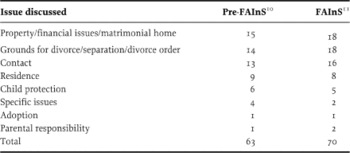
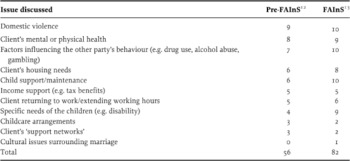
The legal issues lawyers and clients discussed in the cases that we observed are summarised in Table 1. In addition to these issues, lawyers also discussed a large number of factors relevant to the case. These are summarised in Table 2. The number and types of other issues discussed by lawyers and their clients do not appear to have changed much after lawyers became FAInS practitioners. These results suggest that lawyers, both pre-FAInS and during the FAInS pilot, discussed a broad mix of both legal and non-legal issues with their clients.


Our observations also suggested that FAInS had not made a significant impact on lawyer practice. Within a FAInS practice, lawyers were slightly more likely to discuss the specific needs of children than lawyers doing pre-FAInS work, although this change could have been the result of many other factors, such as the type of legal issues also under discussion. Only in a few cases (seven out of thirty pre-FAInS cases, and six out of forty FAInS cases) did lawyers concentrate on a very specific legal issue to the exclusion of other issues, and in most of these instances the case involved a problem with contact.
Observations also revealed that while lawyers were aware of their clients’ non-legal issues, it was apparent that these issues had a clear bearing on the case and a strong legal focus. For example, lawyers would discuss the clients’ experiences of being subjected to domestic violence by the other party as part of their discussions about resolving a contact issue. In cases involving a client who had recently separated, the lawyer would often begin the interview with a discussion about the client’s immediate housing needs. It would seem that lawyers are aware that their clients face non-legal issues, nevertheless the extent to which these issues were explored was still limited. Most lawyers were observed to take a highly structured approach to their initial meeting with a client, and to use short, close-ended questions. This style of interview seemed to produce a question–response mode, and clients were not given much scope to discuss non-legal issues in depth, or to develop their own narrative.
These observations were supported in interviews, and when lawyers were asked how they approached the first meeting with a client, most responded by describing the structure of the initial interview which they used regardless of the specific case. Only a few emphasised that the way that they approached the meeting depended on the client. Some lawyers also explained that they used a ‘checklist’ or ‘pro-forma’ to aid them in this, while other lawyers did not use a form but still kept to a particular structure:
‘I have a client checklist that covers everything. So they then come in and tell us about their particular problems … I take the checklist, which covers all of the bits of information that I want, and then they get advice about peripheral things like making wills, welfare benefits advice if they need that, directing to, if they need, some sort of mediation or counselling, and debt advice or things of that nature. So they get that as part of the package of the first appointment usually.’ (very experienced female lawyer)
‘I don’t have a pro-forma, but the structure is still there. First, get all the personal information, everything that is needed for the divorce petition, then ideally give advice at the end, although this isn’t always the case, depending on the client. Mostly you tend to deal with issues as you go. So, for example, you start with children’s details and so you deal with the children’s issues.’ (experienced female lawyer)
These findings suggest that lawyers are aware of clients’ non-legal issues but, at the same time, they are primarily concerned with placing these issues within a legal framework. Other researchers have also noted that the role of family lawyers primarily consists of shaping their client’s raw, emotional and non-legal issues into legal texts. This process frequently involves constructing non-legal issues as being beyond the boundary for discussion between a family lawyer and their client (Berns, 2000; Mather et al., Reference Mather, Maiman and Mcewen1995; Harrington, 1994; Mather and Yngvesson, 1980; King, 1999; Felinster and Sarat, 1992; Melville and Laing, Reference Melville and Laing2008; King, 1999).
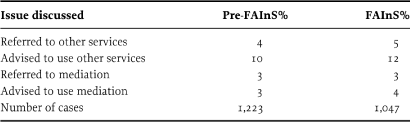
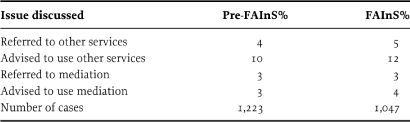
Our results also show that despite lawyers’ awareness of non-legal issues, they made relatively few referrals to services that could have assisted the client in addressing these issues. Analysis of the forms that lawyers completed six months after their cases were opened shows lawyer referral rates to other services. Table 3 presents the number and type of referrals made by lawyers, and shows that only approximately a quarter of clients had been referred to, advised to use, or given information about, other services by their lawyer.
Our observation data provided some reasons for this relatively low referral rate. In approximately half of the pre-FAInS initial meetings between lawyers and clients, lawyers discussed mediation (thirteen out of fourteen). In forty initial meetings between FAInS practitioners and clients, mediation was discussed in just under half (seventeen). This provision of information, however, did not translate into direct referrals. We only observed five (out of forty) instances when clients were provided with written material about other services, and two instances when a lawyer made an appointment with another service on behalf of their client.
Table 3 also shows the percentage of times that lawyers advised their client to use another service, and the percentage of times that lawyers made an appointment on behalf of their client. Lawyers tended to leave the client to their own initiative to make appointments with other services, and so the actual numbers of direct referrals to other agencies that were made by lawyers was very small (17 percent). For some clients who have already found it a difficult step to come and see a lawyer, the need to exert more effort may be too much. There is also evidence from England and Wales that parties can be referred from service provider to service provider without receiving the help that they need. Eventually, the client suffers from such a degree of ‘referral fatigue’ that they give up (Pleasence et al., Reference Pleasence, Buck, Balmer, O’Grady, Genn and Smith2004b, pp. 77–78; Genn et al., Reference Genn, Pleasence, Balmer, Buck and O’Grady2004, p. 31).
Table 3 compares referrals made prior to and after the FAinS pilot. Only a relatively small percentage of clients are referred to other services (4 percent for pre-FAInS and 5 percent for FAInS). For the most part, when referrals are made, the service mentioned is mediation. Table 3 also indicates that referrals generally involve the lawyer discussing a service with the client, rather than making an actual appointment on the behalf of the client. This data provides further evidence that the FAInS pilot had little impact on lawyer practice.
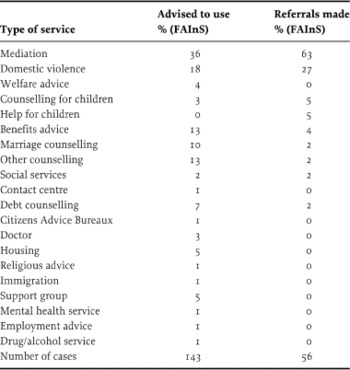
More detailed data was collected concerning the types of services that the client was referred to during the FAInS pilot (Table 4). This data shows that more than eight in ten referrals were to mediation services, with other services being largely restricted to domestic violence services and counselling. This suggests that, not only do lawyers not regularly refer their clients, but the services that they refer on to are very limited. While FAInS was intended to encourage lawyers to refer clients on to other services where appropriate, there was no significant difference between the number of referrals made to services including mediation before or after lawyers starting practising a FAInS approach. This finding also suggests that while some lawyers in interviews seem to be aware of a range of services, this awareness does not regularly translate into making a referral.

Lawyers’ views and use of mediation
Our data suggests that lawyers are reluctant to refer to other services, and that the most frequently referred service is family mediation, although referrals are still quite low. This finding is in line with other research into lawyers’ use of mediation (Mack, Reference Mack2003, p. 2; Davis, Reference Davis2000; Walker et al., Reference Walker, Mccarthy, Stark and Laing2004; Neilson, Reference Neilson1990; Bradshaw et al., 1985; Pleasence et al., Reference Pleasence, Buck, Balmer, O’Grady, Genn and Smith2004b, pp. 73–75; Genn, Reference Genn1999).
The reasons behind lawyers’ relatively low referral rates became clearer when we asked about their attitudes towards mediation. Almost all the lawyers who participated in the interviews stated that they referred some of their clients to mediation. Approximately half of these lawyers, however, explained that they sent their publicly funded clients to mediation only because this is a requirement and that, in their experience, mediation offers very little benefit to these clients.
Lawyers who were less supportive of mediation generally, stated that, in their experience, mediation was very rarely successful. They explained that mediation rarely went ahead as one party would refuse to attend, and even if it did go ahead, the parties had often made up their minds, to the extent that it would be impossible to achieve a negotiated settlement. Several lawyers cited examples of clients returning with agreements made in mediation which the lawyers considered to be too impractical to be useful, or simply not in their clients’ best interests. As one lawyer explained:
‘For financial issues, mediation hasn’t worked as often as I would have hoped. The agreement is not always in the client’s best interests. I have had a client who has signed an agreement that they were not happy with as they felt it was the only way to go.’ (experienced female lawyer)
Most lawyers who expressed reservations about using mediation felt that it only served to delay cases. This delay was caused, first, by the requirement that all publicly funded family law clients must go to mediation, even if the lawyer feels that it is not going to be productive. Lawyers described this mandatory requirement as a ‘hurdle’ they had to get their client over. Second, lawyers felt that mediation delayed cases because the mediation process itself is time-consuming. Several lawyers, all from the same geographical location, told us that they were reluctant to advise their clients to go to mediation as long waiting lists in their area may be detrimental to their clients’ best interests. Some also regarded mediation as a tactic designed to cause disruption in their clients’ contact with their children. As one lawyer stated:
‘They might be able to get a first appointment within a fortnight. Then they [mediators] have to see the other party. Then they see them together. So that is a three-to-four-week process. Which means that the father, because it’s usually the dad, has had no contact with the children for three months. The women know this. They know that they can delay contact. And then the court responds to that and requires there to be phased-in contact because the break has been so long. Women know this, and take advantage of it. They are able to throw a spanner in the work.’ (experienced male lawyer)
In addition, several lawyers felt that the quality of mediation services was uncertain or uneven, and if lawyers did refer it was to specific mediators in their local area in whom they had confidence. Our findings reflect other research, which has also shown that lawyers can be reluctant to refer to mediation if they feel that mediators lack the adequate training and skills (Folb and De Bruyn, Reference Folb and De Bruyn1994, p. 323; Mather et al., Reference Mather, Mcewen and Maiman2001, p. 75; Neilson, Reference Neilson1990; Richardson, Reference Richardson1988).
Lawyers who were less supportive of mediation generally, stressed that they refer clients simply because they have to, and it appears that some of these lawyers convey this message to their clients, as the following remarks show:
‘We refer all our publicly funded clients simply because we have to. They should be able to just get a certificate of [legal] aid straight off without having to bother about this extra hurdle. I tell my clients first off that they have to go to mediation in order to get public funding.’ (experienced male lawyer)
‘To some of them you have to say “Look, I have to send you to mediation. I know it won’t help, but you need to show that you were prepared to go. So just go along with it, and then when it doesn’t work we can get on with things.”’ (experienced female lawyer)
‘I tell my publicly funded clients “This is a hoop you have to jump through”.’ (experienced female lawyer)
‘With publicly funded cases we refer them tongue in cheek. We refer them to mediation, and they just send them back. It doesn’t achieve anything, except to delay the whole thing by two weeks.’ (very experienced female legal executive)
We also observed lawyers telling their clients that mediation would not be helpful. Prior to FAInS, we observed four instances when the lawyer told the client that they thought mediation would not be successful, but that they were required to refer them anyway. Lawyers described mediation as representing the LSC’s ‘carrot and stick’ approach to family law, that mediation could ‘take quite a while’ and that it was best to ‘get over this hurdle’ as soon as possible, and in their experience they never had a client for whom mediation was suitable. Previous research has also shown that the ways in which mediation is initially presented to clients can determine its eventual success or failure (Murnion, Reference Murnion1987; Mathis, Tanner and Whinery, Reference Mathis, Tanner and Whinery1999), and it seems reasonable to conclude that mediation is more likely to fail if the clients take on their lawyer’s negative views.
Once lawyers had become FAInS practitioners, they were allowed to exempt their clients from mandatory mediation.Footnote 16 Relaxing the mandate did not significantly alter the proportion of FAinS lawyers who discussed mediation with their clients. What did change, however, was that lawyers ceased making negative comments about mediation to their clients. Lawyers stopped telling their clients that they were going to refer them to mediation simply because it was an LSC requirement. They did not point out that mediation could be a time-consuming process, or that in their experience it had never been successful. Approximately half of the FAInS practitioners that we interviewed claimed that they were regularly using the exemption, and that the relaxation of the mandate had been strongly appreciated:
‘At least FAInS allows me to exempt straightaway, rather than going through this hurdle. Now solicitors can make a decision about whether we refer to mediation. It skips a stage. If both parties are willing to go to mediation, fine, but that is rarely the case.’ (less experienced female legal executive)
‘We sometimes use the exemption from mediation. If neither party can go or if the issues make mediation inappropriate then we can use the exemption. With the old system you had to refer, when you knew that the parties would just come back anyway. But now it is possible to bypass mediation. It has taken out that hurdle.’ (very experienced male lawyer)
At the time that the FAInS pilot was being conducted, lawyers had to refer their publicly funded clients to mediation, unless they could show good cause for exemption. Exemptions could be made if the lawyer felt that their client was very fearful of the other party, there was a history of domestic abuse, and if the lawyer was a FAInS practitioner. Our findings suggest that under this system, if lawyers were given the ability to select cases to send to mediation, then the number of referrals would not significantly change, and mediation may be more successful. Since the conclusion of FAInS, however, the LSC has taken a different view. The LSC has recently tightened up mandatory mediation, so that the determination concerning whether mediation is appropriate is decided by a mediator and not the client’s lawyer (LSC, 2007a). It seems possible that this change may result in lawyers’ further undermining the potential of mediation by shaping clients’ expectations, and so even though referral rates to mediation may rise, it is possible that settlement rates from mediation will not increase substantially.
In contrast to the lawyers who felt that mediation was a ‘hurdle’ imposed by the LSC, approximately half of our interviewees considered mediation to be helpful. These lawyers claimed that they ‘regularly’ refer both their private and their publicly funded clients to mediation:
‘We would always [refer clients to mediation]. Of course, being publicly funded we have to anyway, but we would always offer information about mediation to every client.’ (very experienced female lawyer)
‘I have always been a supporter of mediation. It makes sense.’ (experienced female lawyer)
‘Even before I knew about mediation I had that approach. It is difficult for me to try and take away that mediation approach, and try to think in the way that other solicitors might think. But nowadays all solicitors will send their clients to mediation … it is part of legal culture here.’ (very experienced male lawyer)
Our data suggested that lawyers varied in their referral rates, with a minority making up the bulk of those who referred their clients to other services, especially mediation. In interviews, lawyers who expressed positive views about mediation were more likely to be trained mediators themselves, were working in a firm which employed a mediator, and were referring clients to mediators whom they knew and in whom they had confidence. Some of the lawyers who appeared to be supportive of mediation stated that, in their opinion, the quality of mediation services had improved ‘vastly’ in recent years. Several lawyers who were members of ResolutionFootnote 17 explained that they were expected to promote mediation and generally to adopt a non-adversarial approach to resolving family law disputes. The introduction of mediation training for lawyers was also seen to have improved family law practice in general. One lawyer remarked:
‘The introduction of mediation, the fact that a lot of solicitors have family mediation training even though they don’t practise family mediation, I think has helped [legal] practice a lot, in making people take a constructive approach.’ (very experienced male lawyer)
These lawyers were also more likely to have positive expectations of FAInS:
‘I think that the FAInS approach will fit in well with my personal approach to family law matters, and to my mediation outlook. It will fit with my way of dealing with clients.’ (very experienced female lawyer)
Lawyers identified a number of advantages in referring clients to mediation. The most frequently mentioned benefit was that mediation is ‘better’ than going to court, because it is less acrimonious, time-consuming, expensive and stressful. Lawyers explained that judgments are imposed by the court, whereas settlements made in mediation are negotiated and agreed upon by the parties. Mediation allows the parties to feel as if they ‘own’ the agreements and the clients have had an active role in negotiating. They explained that mediation allows clients an opportunity to attempt to discuss issues face to face. The opportunity to talk through issues was seen to be more advantageous than an ongoing exchange of letters between lawyers. Lawyers explained that mediation encourages clients to be reasonable and, since the process encourages discussing and negotiating issues, it also promotes a better long-term relationship between parents. Several lawyers also felt that mediation offers clients an opportunity to get issues off their chest and achieve emotional closure.
Lawyers also explained that they usually point out to the client the relative advantages of mediation over going to court, and our observations confirmed this claim. We observed lawyers explaining that mediation could be less stressful and less expensive then going to court, especially if the assets under dispute are minimal. Clients were told that court should be considered a last resort, and that it could sometimes make matters worse. Lawyers also stressed that mediation could provide a more amicable resolution of the dispute, that it would help avoid fighting, and that it would avoid the ‘to-ing and fro-ing’ of letters between lawyers.
The lawyers who were generally more supportive of mediation explained that they were not generally using the exemption from mandatory mediation. These lawyers explained that they usually referred clients to mediation as a matter of course, unless it was clearly inappropriate, and that FAInS had not changed this practice:
‘I think you can’t abuse this. I think mediation is there for a particular purpose. And if there’s any chance that it might work then you want your clients to go, because obviously it’s going to reduce the costs and minimise antagonism between the parties.’ (very experienced male lawyer).
‘I always use mediation – whatever, really – so that’s not changed, except we don’t have to refer to mediation now … But I still tend to refer them [clients] to mediation if I think it will work, rather than going to court.’ (less experienced female lawyer)
‘My view is, if it is appropriate to refer a case to mediation then you should refer to mediation. If it isn’t appropriate then you shouldn’t refer. I have always thought that, and FAInS has made no difference.’ (experienced female lawyer)
Almost all the lawyers, even those who were highly supportive of mediation, explained that mediation was not always appropriate. In particular, lawyers explained that cases involving domestic violence or other forms of power imbalance between parties should not be sent to mediation. Lawyers were sceptical about the value of mediation if the parties were unable to negotiate, if one party was too intimidated by the other to put forward their position or if one party was simply too angry to be willing to talk to the other. They claimed that mediation was more likely to succeed if the parties were able to communicate and were willing to talk.
Lawyers with the most exposure to mediation practice expressed the most positive views, and also appeared to have higher referral rates. Applying Galanter’s (Reference Galanter1985) conceptualisation, it would also seem that lawyers with the most experience of mediation identified ‘warm’ themes for supporting mediation, such as it fits with their focus on promoting parties to reach a settlement that focuses on the best interest of all the parties involved, especially children. This finding differs from previous work which has found that lawyers’ support for mediation focuses on ‘cool’ themes (Davis et al., 1994). It may be that, as the quality of mediation services improves and lawyers’ awareness increases, lawyers with experience of mediation gain an appreciation of the underlying principles of mediation. We also found that lawyers who objected to mediation did so along the line of ‘cool’ themes, such as it added unnecessary delay, and these objections generally came from lawyers with less experience with mediation. This would suggest that another possibility for increasing mediation referrals lies with increasing lawyers’ direct experience with mediation practice, rather than simply telling them about the benefits ‘in theory’.
In summary, it would appear that while the majority of family lawyers claim that they refer their clients regularly and to a diverse range of services, they do not do so in practice. Our research suggests that clients are referred infrequently, and that when referrals are made, clients are usually sent to mediation. Lawyers’ views concerning mediation were clearly divided, with approximately one half describing mediation as ‘hurdle’ that delayed the resolution of a case, and the other half considering that mediation could be helpful in bringing about settlement without recourse to litigation. When mediation was mandatory, lawyers also clearly expressed their respective view to their clients. Thus, lawyers appear to be using their position as a gatekeeper in an effort to shape the attitudes of their clients. Lawyers who were most supportive of mediation tended to be those with the most direct experience of mediation services, and they also tended to hold the view that mediation services had greatly improved in recent years.
Discussion
It would appear that the FAInS intention of offering a seamless holistic service, in which lawyers identify other support services that might be of use to their clients, has met with mixed success. Some lawyers, prior to their involvement in FAInS, were already well connected to a range of support services, especially those providing help for clients who had experienced domestic violence. Other lawyers, however, appeared less willing to refer their clients to other agencies, and FAInS training had not changed their referring practice. Thus, lawyers who had always made regular referrals to other services had continued to do so, and those who rarely referred their clients had continued in the same vein.
We also found that when lawyers refer their clients to other agencies, it is invariably to mediation, although the number of referrals was quite low. In addition, approximately half of the lawyers that we spoke to were sceptical of the value of mediation, and that prior to FAInS, some lawyers used their gatekeeping position to present mediation to their clients as a ‘hurdle’. When the mandate was lifted, the proportion of clients being referred did not change; however, lawyers stopped presenting such negative views, and it could be expected that mediation would be more likely to be successful.
These results suggest that family law practice may involve different lawyer approaches, and we found that lawyers who had considerable direct experience of mediation were relatively supportive of mediation, whereas those with less exposure tended to be more critical. Unlike Davis et al.’s (1994) previous research, support for mediation generally focused on the underlying principles, rather than simply the ‘cool’ themes such as reducing delay.
There appeared to be a number of reasons behind the low referral rates. Some lawyers seemed relatively unaware of what other services were on offer. In addition, some lawyers seemed reluctant to refer due to concerns about delays and gaps in services, and uncertainty about the quality of other service providers. Beyond the ‘logistic’ issues of raising lawyers’ awareness of other services, developing lines of communication and co-operation, moving on from negative past experiences with the LSC, convincing lawyers of the quality of other services, ensuring adequate resourcing across a range of services and avoiding referral fatigue, there are arguably deeper problems blocking lawyers acting as gatekeepers for other services. A cynical perspective may argue that lawyers do not refer so that they do not lose business; however, our research suggests that the blockage to client referrals does not reflect lawyers’ self-interest, but instead their desire to protect their clients’ best interests.
Many of the lawyers who we spoke to, including those who were supportive of mediation, felt that their professional role involved constructing a boundary between their clients’ legal and non-legal issues, and getting their clients to remain focused. It appeared that lawyers were taking a ‘client-aligned’ rather than ‘client-centred’ approach, which meant that they did not want to dwell too much on non-legal, especially emotional, issues in order to encourage their client to ‘move on’. The way in which lawyers construct their professional role suggests that family lawyers may not be the most appropriate gateway for clients to access other services.
Courmaerlos et al. (2006) argue that gatekeepers should have a broad view of the family law system, and suggest that child support agencies, social services or general practitioners may be able to fulfil this role. Courmaerlos et al. (2006) also suggest that multiple gatekeepers may help the development of a holistic service for family law clients. It could also be argued, however, that, as family law clients tend to find the family law system confusing and difficult to navigate (Walker et al., Reference Walker, Mccarthy, Stark and Laing2004), a single gatekeeper provides a clearer pathway for users.
In the UK, a potential gatekeeper who has both a broad view of the family law system as well as an understanding of the legal issues involved, may be the Children and Family Court Advisory Support Service (CAFCASS) officers. In terms of private law cases, CAFCASS officers are already involved in the provision of information, advice and support to children and their families and run dispute resolution programmes. CAFCASS have also already developed a multi-agency approach for dealing with domestic violence (CAFCASS, Reference Cafcass2007, p. 8). CAFCASS officers, however, are not entirely equipped to fulfil the role of gatekeeper to a holistic family law system. Their work is focused on children, and many family law cases do not involve children. While CAFCASS officers are expected to provide proactive services for families that assist in the early resolution of cases (p. 8), their services are primarily connected to the court. As most family law issues are resolved without recourse to the courts, they are not involved in the bulk of family law matters. CAFCASS are also already operating on a tight budget, and have not received any addition to their baseline funding since 2004/2005 (CAFCASS, Reference Cafcass2007).
Another possible solution to finding a more appropriate gatekeeper is to create a new pathway. The Australian government has proposed a single pathway into the family law system. Initially, they suggested that clients access the pathway from an existing government agency with a wide geographical spread, such as Medicare or Centrelink, although they also suggested that a new agency with its own ‘shop front’ may be useful. In addition, it has been suggested that a new professional role, Parenting Support Advisors, is established, and that advisors would provide an assessment of parents’ needs, assistance in reaching an early resolution and identification of cases needing to immediately proceed to court (e.g. entrenched conflict, domestic violence, substance abuse, child abuse). Advisors would also refer clients to other services, such as mediation and counselling, when needed (Commonwealth of Australia, 2003, pp. 89–92).Footnote 18 The Australian government has now decided to set up Family Relationship Centres (FRCs) which are intended to provide information and education for families, including couples facing separation and divorce, to assist in the early resolution of issues and to provide referrals to other services (Family Relationships Online, 2008).
While these proposals have received some support from the legal profession, there have been concerns that there will not be enough FRCs to satisfy demand, and that the qualifications of the proposed Parenting Support Advisors needs to be clarified. There is also concern that while advisors may help with parties’ non-legal issues, that they may not refer parties to lawyers to address legal issues (LCA, 2005). In the past, the legal profession has raised the issue that mediators do not always have legal qualifications and yet provide legal advice, and that the type of settlements that are produced at mediation are not always in the parties’ best interests (Folb and De Bruyn, Reference Folb and De Bruyn1994, p. 323; Richardson, Reference Richardson1988; Neilson, Reference Neilson1990; Mather et al., Reference Mather, Mcewen and Maiman2001, p. 75), and it seems that these concerns are now being extended to the new advisors.
The Australian FRCs seem to have some similarity to the new CLACs and CLANs that have been opened in England and Wales, and it may be possible to extend this new multi-agency approach to family law issues. Thus, it may be possible to set up one-stop shops where lawyers are one service provider within a cluster of other services providers. CLACs and CLANs, however, also appear to face some major problems. To start with, their rollout has been halted (Robins, Reference Robins2008b) and, prior to the current freeze, there appeared to be problems in persuading service providers to bid for contracts with the LSC. There had also been concerns that the implementation of CLACs and CLANs was a mask for funding cuts, would potentially reduce the range of other services on offer and had not been well conceived (Access to Justice Alliance, 2006; Hansen, Reference Hansen2006; LAPG, Reference Lapg2006; Hynes, Reference Hynes2007; Robins, Reference Robins2008a).
Conclusion
Our research suggests that FAInS was not as effective as envisaged in having lawyers assist their clients in receiving a holistic service that addressed both their legal and non-legal issues. Our research found that lawyers had divided views about the usefulness of other services, with one third of our interviewees claiming that they regularly refer to other services, and approximately one half stating that they were supportive of mediation. Despite these views, lawyers rarely made direct referrals to other services, and referrals that were made were largely limited to mediation.
These findings do not mean that multi-agency approaches should be abandoned, but it seems that lawyers may not necessarily be the most appropriate gatekeeper for such a service. While family lawyers certainly discuss non-legal issues with their clients, and there seems little doubt that they play an essential role in resolving family law problems, it seems that their perceived need to keep their clients focused and to draw a boundary between ‘the facts’ and the clients’ emotions, means that non-legal issues are not always fully explored. In addition, it seems that referring to other services is not considered by many family lawyers to be within their professional role.
It has been argued that there has been a recent shift to the use of multi-agency approaches in access to justice policies, and while this may sound like a good idea in theory, in practice it will require considerable work. For such an approach to be successful, there needs to be much more in-depth conceptualisation and development of appropriate models, including identifying the most appropriate gatekeepers. In addition, without adequate resources across the full range of services required, there is the danger that multi-agency approaches become merely a smokescreen and, instead of producing joined-up services, result in even longer waiting times and gaps in services. We have suggested some potential new models for providing a multidisciplinary approach to family law, including suggesting that the dominant way in which family lawyers currently work with clients could be reconceptualised.
It also appears that, in order to identify the most appropriate gatekeeper into the family law system, it is necessary to answer a number of questions. There needs to be consideration of: whether there is the need for a single gatekeeper or multiple pathways; whether the gatekeeper is attached to the broad base of the family law system (such as GPs) or provides a more targeted and specialised service (such as CAFCASS officers); whether an existing gatekeeper will suffice, or a new gatekeeper needs to be created; what are the most appropriate qualifications and professional background for gatekeepers; and how different professional expertise should be best applied. To date, many of these questions have not been answered, and considering the lack of empirical data on the potential of using joined-up services to deliver services for family law clients, we feel that this is an important area for further investigation. We hope that our research has added something to this area, but there is clearly much more work to be done.