The Fair Labor Standards Act (FLSA) of 1938 was a watershed in the development of workers’ rights in the United States. To insure “a fair day’s pay for a fair day’s work,” the act put a national floor under wages, a ceiling on hours, restrictions on child labor, and established a new regulatory apparatus to enforce the law. Footnote 1 It was not the first time minimum standards to protect workers had been established in American history—prior to the New Deal, with federal action blocked by the Supreme Court, progressive reform coalitions succeeded in enacting statutes in a number of states. Footnote 2 Those laws were limited in reach, however, and could not combat the “downward spiral of wages” across entire industries caused by the maintenance of substandard labor conditions by a few employers. Nor could they do much to alleviate the downward pressure on state policy (“race to the bottom”) caused by the free flow of goods produced under those conditions. Footnote 3 The FLSA, by establishing national labor standards and equipping the federal government to protect workers in all states equally, thus sought to reduce the “price of federalism” and stabilize employment relations across the nation. Footnote 4
But the FLSA has always promised more than it has delivered. In addition to initially excluding from coverage many of the workers most in need of protection from exploitation—women, African Americans, and others concentrated in “intrastate” occupations—the core features of the policy have been perennially subject to the powerful force of drift, which as Jacob Hacker and colleagues describe, is “when institutions or policies are deliberately held in place while their context shifts in ways that alter their effects.” Footnote 5
The eroding value of the minimum wage as the cost of living rises is only the best-known example of how drift undermines the FLSA. Overtime, too, follows the same dynamic: so long as the income threshold for overtime eligibility remains static and inflation continues to rise, fewer workers are eligible to collect premium pay. Footnote 6 Most pernicious of all, however, is the declining enforcement capacity of the Wage and Hour Division (WHD), the regulatory agency created by the FLSA to enforce all of the law’s provisions. Growth in the size of the covered workforce, without commensurate increases in the WHD’s staff and funding, has undercut its ability to fulfill its mandate. In 1948, for example, the WHD employed 1,000 investigators and was responsible for protecting 22.6 million workers. Footnote 7 By 2014, it employed about the same number of investigators (1,100) but was now responsible for protecting 135 million workers. Footnote 8
Moreover, fundamental changes in the economy have made it extremely difficult for the WHD to keep up, notwithstanding efficiency gains from technology and its strategic adaptations to make the most of its limited resources. Perhaps the biggest challenge involves what current WHD Administrator David Weil has called the “fissuring” of the workplace, whereby employers have increasingly embraced subcontracting, franchising, and supply chain models in order to cut labor costs and emphasize core competencies. Footnote 9 This approach has yielded many benefits for lead businesses, but as employment responsibilities have been delegated to lower-level companies operating in more highly competitive labor markets, downward pressure has been placed on wages and labor standards. It is in this context that scholars have observed the rise of precarious, low-wage, “bad” jobs; Footnote 10 growing numbers of employees being misclassified as “independent contractors” (causing them to lose both income and FLSA protections); Footnote 11 and more and more workers (including many immigrants) found to be unaware of their rights. Footnote 12 These trends have made the very workers most in need of WHD protection harder to find, less likely to come forward when their rights are violated, and therefore increasingly at risk of workplace abuse and exploitation.
Opportunities to formally update the FLSA over the last two decades have been few and far between, thanks to the familiar litany of political factors that have contributed to the drift of many social and regulatory policies, including a forceful and organized conservative opposition, a divided left, partisan polarization and gridlock, and the declining clout of organized labor. Footnote 13 Political inertia in the context of major economic change has effectively undermined this cornerstone New Deal policy without changing anything about the statute at all.
One of the most troubling consequences of these developments is what workers’ rights advocates have termed “wage theft,” or the failure of employers to pay their employees the full amount they have earned and to which they are legally entitled. Footnote 14 The most pernicious type of wage theft is minimum wage noncompliance—the empirical focus of this study. Violations of minimum wage laws are not the most common or expensive type of wage theft (overtime violations are), but they are widespread and they disproportionately affect the most vulnerable workers in society: immigrants, people of color, less-educated workers, younger workers, women, and low-wage workers who can least afford to be underpaid. Footnote 15 Indeed, when low-wage workers are underpaid by even a small percentage of their income, it can mean major hardships like being unable to pay rent, child care, or put food on the table. Minimum wage violations are also deleterious to society, as they contribute to widening income inequality, wage stagnation, and chronically slow growth in living standards—interrelated problems that are viewed by many as the most pressing of our time. Footnote 16
In a throwback to the Progressive era, workers’ rights advocates have responded to resistance and inaction at the national level with campaigns to enact stronger protections for workers at the state level. Footnote 17 Nascent coalitions of nonprofit workers’ rights groups, immigrant advocacy groups, labor unions, legal clinics, and progressive foundations have come together to design innovative, sometimes experimental policy solutions to better incentivize employers to comply with the law and increase the probability that workers will complain when they are underpaid (or not paid at all). The “wage-theft laws” they have championed have an “everything but the kitchen sink” quality to them: some increase the liquidated damages available to employees; some add new civil and criminal penalties; some create new administrative processes to help agencies address grievances more quickly; others mandate notification and paystub requirements to increase workers’ understanding of their rights; still others establish post-judgment penalties to make it more likely that employers will pay up after being found liable.
But do any of these policies work? Can stronger state-level statutes compensate for drift at the national level and actually defend against wage theft? Or does the centrifugal force of federalism simply pull those states back into the “downward spiral of wages?”
Theoretically, stronger penalties and enforcement capacities should reduce the incidence of wage violations. But because the probability of detection in the United States is so low, the literature on minimum wage compliance has long concluded that in actuality, government-imposed penalties do not seriously affect the employer’s incentives. The compliance decision, instead, is said to turn primarily on economic considerations such as the value of the market wage relative to the minimum wage, the elasticity of demand for labor, and the employer’s ability to pass increased labor costs onto consumers. Footnote 18
This literature, however, has only considered the effects of the admittedly weak FLSA regulatory regime on the employer’s compliance decision. By confining the analysis to the national level, it has eliminated all variation from the costs side of the equation and all but guaranteed the conclusion that the costs are effectively irrelevant to the compliance decision. Overlooked is the rich variety of wage and hour laws that exist at the state level. In some states, the penalties for wage violations are much stronger and the state agencies more capable than those at the national level; in other states, penalties and regulatory agencies are far weaker.
Leveraging this cross-sectional variation and exploiting within-state variation over time, I examine the relationship between the strength of state employment laws and the incidence of minimum wage violations. Systematically measuring the penalty schemes in all fifty states and the District of Columbia and conducting a range of empirical tests, I find that stronger state laws are statistically significantly related to a lower incidence of minimum wage violations. Despite the competitive pressures inherent in the federal system, state-level reforms appear to make a substantial difference for workers in those states. Moreover, among a dozen different wage-theft laws reformers successfully enacted in as many states over the last ten years, I find that the laws that most dramatically increased punitive damages saw the greatest declines in the incidence of minimum wage violations while other types of wage-theft laws did not appear to have any effect.
The upshots of this analysis are several. First, it highlights the role of federalism in shaping the distribution of workers’ rights in the context of FLSA drift. Like their forbearers in the Progressive era, workers’ rights advocates have increasingly turned to the state and local levels to establish stronger protections for workers, and many of these efforts appear to have paid off. But in consequence, the “positive rights” of workers have (again) become highly geographically fragmented and unequal across state lines. Footnote 19 For workers in most New England states, this does not present an immediate problem; but for those who happen to live in, say, Louisiana, drift at the national level and inertia at the state level has left them significantly more vulnerable to exploitation.
Second, it is conspicuous that stronger wage-theft laws have been enacted almost exclusively in states with unified Democratic Party control of state government, or else via ballot amendment processes that circumvented normal legislative politics; and that in both cases, success has been owed to the concerted efforts of ad hoc coalitions of workers’ rights groups. The promise of workers’ rights in the contemporary era, in other words, has become increasingly bound up in partisan politics and the politics of coalition building. To be sure, this heightened politicization is superior to the pre-New Deal system, in which the Supreme Court defended the feudal law of master-and-servant and kept labor relations insulated from politics. Footnote 20 But it is worth observing that in a “period of political free fall, of politics pure and simple,” the capriciousness of partisan politics and the challenges of coalition building provide a precarious foundation for workers’ rights. Footnote 21
Finally, in the context of steep private sector union decline, the thrust of labor politics appears to be changing, moving increasingly out of the workplace and into the political arena, with less emphasis given to union organizing and more attention paid to public policy. The tradeoffs inherent in this shift—the prioritization of individual rights over collective bargaining, mobilization for the short-term versus building solidarity for the long-term, emphasizing political engagement over empowering workers in the workplace—have only just begun to be discussed. Footnote 22 One effect, however, is clear: the labor movement’s policy turn has aided in the development of wholly new organizational forms, sometimes called “alt-labor.” Footnote 23 These groups are not traditional labor unions—many of their workers are forbidden from unionizing and the groups have no collective bargaining rights under the NLRA—but they are sometimes funded by unions and they almost always stand shoulder-to-shoulder with them in policy campaigns and street-level protests. Alt-labor groups include “worker centers” like the Restaurant Opportunities Centers United, the National Day Laborer Organizing Network, and about two hundred smaller community-based centers spread across the states; “workers’ alliances” like the National Taxi Workers’ Alliance and the National Domestic Workers’ Alliance; “employee associations” like OUR Walmart; “associate member” groups formally affiliated with unions, like Working America; nonprofit organizations like the Freelancers Union; faith-based groups like Interfaith Worker Justice; and online collective action platforms like Change.org and Dynamo. Footnote 24 They also include harder-to-define social movements like Fight for $15 and other protest movements that increasingly seek to combine workplace justice and civil rights campaigns (such as Black Lives Matter and immigrants’ rights movements). Footnote 25 These groups and movements, initially rooted in local communities, are increasingly using new technologies to organize nationally (and in some cases globally) and are developing federated structures to foster organizational collaboration across geographic boundaries. Footnote 26 The fight against wage theft has thus been both a cause and a consequence of the burgeoning alt-labor movement: workers’ rights groups have led the charge to enact stronger laws at the state level while their resulting policy campaigns have provided the impetus for further coalition- and movement-building.
The next two sections describe the problem of minimum wage violations in greater detail, discuss the empirical limitations of previous work, and review predominant theoretical frameworks. The subsequent two sections then present empirical tests of the relationship between the strength of state laws and the incidence of minimum wage violations, finding a strong and statistically significant negative relationship. The final section looks beyond the policy effects to consider the political effects of wage theft campaigns, with particular attention given to the rise of alt-labor and the future of labor politics in the United States.
Minimum Wage Violations
Ironically, amid heated debates over whether to raise the minimum wage, the issue of pervasive minimum wage noncompliance has generally flown under the radar. Yet the establishment of a legal minimum wage has never actually insured that workers would get paid that wage. Evidence of noncompliance abounds. Footnote 27
In November 2014, for example, the WHD concluded a major investigation of the garment industry in the greater Los Angeles area. It found that many workers were paid either several cents per piece of clothing stitched or a flat weekly rate amounting to an hourly wage of less than $5 per hour, well below the federal and state minimum wage rates. Over 1,500 workers were owed over $3 million in back wages from the previous year alone. The cases revealed “all the features of a sweatshop,” WHD Administrator David Weil reported. One garment worker, Juan Hernandez, routinely worked 50–70 hours a week for a flat rate of $300 and was allegedly physically abused by a supervisor. When he asked for a raise, he was fired. Only when Hernandez filed a complaint with the California Division of Labor Standards Enforcement (DLSE) did his employer agree to settle. Footnote 28
A recent New York Times exposé of the nail salon industry in New York City similarly revealed that new employees—usually undocumented immigrants—were often required to pay $100 for the opportunity to work, forced to “train” for weeks without pay, and then paid as little as $30 per day for 12-hour days, six or seven days a week, all in violation of federal and state minimum wage and overtime laws. Most workers did not complain for fear of deportation, job loss, or abuse. Footnote 29
Short of filing a lawsuit, which most low-wage workers cannot afford to do, formal complaint processes like the one initiated by Hernandez and strategic “directed” investigations like those conducted by the WHD in southern California are the only ways in which wage violations are formally identified. Neither process works well to protect workers’ rights, however, and neither provides reliable information on the variation and extent of noncompliance. For example, we know that employees recovered at least $933 million in private wage-and-hour lawsuits and administrative rulings in 2012—more than the total amount lost in all bank, residential, convenience store, gas station, and street robberies put together—but those cases only represent the known cases that were successful in recovering back wages for employees. Footnote 30 The full extent of minimum wage noncompliance is unknown.
Part of the problem is the low enforcement capacity of regulatory agencies. As discussed, the FLSA is woefully overburdened and underfunded, and state agencies have likewise suffered major reductions in staff and resources relative to their rising workloads. Footnote 31 Consequently, the probability that any given employer was investigated by the WHD in 2012 was a mere 0.5 percent. Even in the most heavily-targeted industries—retail, fast food, janitorial services—the probability of inspection in a given year did not reach 1 percent. Footnote 32
Equally problematic is the employee-initiated complaint process. Weil and Pyles find that most overtime complaints received by the WHD come from industries with some of the fewest estimated violations; only one industry is among the top ten in both complaints and violations (automotive repair), and only three are among the top twenty in both. Footnote 33 This discrepancy suggests that other factors—fear of retaliation, deportation, or job loss; insufficient knowledge of one’s rights; lack of union representation; and other considerations—likely influence the decision to complain at least as much as the violation itself. Whatever the reason, it is clear that the complaint process is riddled with false negatives.
Official statistics on complaint-based and agency-initiated investigations are thus partial and biased, providing a poor foundation for empirical research. Academic studies in this area reflect these empirical limitations. The most widely-cited study of wage violations, for example, was motivated by these problems to generate new data: it used respondent-driven sampling to survey 4,387 hard-to-reach low-wage workers in New York, Chicago, and Los Angeles in the summer of 2008. Footnote 34 Due to resource constraints, however, that innovative approach has not been replicated. Other studies have examined one or two states at a time Footnote 35 or compared specific industries using available data, Footnote 36 but national estimates of minimum wage violations have not been produced since the early 1980s, Footnote 37 and no existing study has systematically compared noncompliance rates across states. In short, despite the recent emergence of wage theft as a central item on the agenda of the contemporary labor movement, we still know very little about the contours of the problem. And despite recent efforts to design state-level policies that will reduce the incidence of wage violations, no previous empirical work has examined the effectiveness of those policies. Existing scholarly knowledge is derived almost exclusively from theoretical models.
Theories of Minimum Wage Noncompliance
The literature on minimum wage noncompliance focuses on the cost-benefit calculations made by employers given certain constraints. In what has become the seminal work on the subject, Ashenfelter and Smith (hereafter, AS) posit that the expected benefits of noncompliance are a function of the probability of escaping detection (1-λ) times the quantity of labor hired (L) and the divergence between the minimum wage and true market wage (M-w). Footnote 38 The expected costs include the probability of detection (λ) times the penalty (D). The noncompliance incentive is therefore said to rise as the expected benefits exceed the expected costs.
 $$\left( {1 - \lambda } \right)\, * L\left( {M - w} \right)\,\rangle \,\lambda D$$
The full inequality adds the elasticity of demand for labor (η) to the benefit side, such that the noncompliance incentive also rises as the elasticity of demand for labor rises. Footnote 39
 $$\left( {1 - \lambda } \right)\, * \left[ {L\left( {M - w} \right) - \,\left( {L\,/\,w} \right)\left[ {.5{{\left( {M - w} \right)}^2}\eta } \right]} \right]\,\rangle \,\lambda D$$
Put simply, the model suggests that the incentive to violate the law grows as the divergence between the market wage and the minimum wage increases; when changes in the minimum wage produce large employment adjustments; and when either the probability of detection is small or the penalties for noncompliance are small.
As discussed, the probability of detection by the WHD is, in fact, very small, and the expected penalties are also very small. As AS note, most FLSA investigations end in settlements for up to two years of back wages owed, and on average, only about half of the settlements are ever collected. Double damages are available, but if the employer can show that the “act or omission giving rise to such action was in good faith,” the court can choose to award no damages. Footnote 40 Civil or criminal penalties are rare, reserved for cases of employer retaliation, repeat, or “willful” violations. AS conclude that “the requirement that a violating employer merely pay to employees a fraction of the difference between the minimum and the actual wage received does not constitute a penalty for noncompliance at all” (337). Renowned legal scholar Clyde Summers likewise observes that the FLSA’s penalty scheme does “little to deter employers from systematically underpaying their workers. Even in the unlikely event that an employer is successfully sued for half its violations, it still pays to violate the statute.” Footnote 41 In other words, although the compliance incentive should rise as penalties are increased, the expected penalties (D) discounted by the miniscule probability of inspection (λ) are so small that employers in even the most highly-investigated industries will rationally expect the benefits of noncompliance to vastly outweigh the potential costs.
A substantial body of literature has subsequently built on the AS model without disputing their conclusion that the expected costs are effectively equal to zero. Footnote 42 The most serious consideration of policy deterrence can be found in the work of Chang and Ehrlich, and especially Chang’s later work, which builds on Gary Becker’s pioneering work on crime policy to interrogate the premise that the compliance incentive varies in relation to the degree of deterrence established through higher costs and stronger enforcement. Yet even Chang concludes that despite the theoretical importance of higher costs, in practice they are not likely to be raised high enough to offset the employer’s expected benefits because “direct enforcement through policing and prosecutorial activities is socially costly.” As a result, even “risk-averse violators who perceive noncompliance as a favorable game would not be deterred from paying their workers the low, free-market wage.” Footnote 43 For over 35 years, then, scholarship on minimum wage noncompliance has recognized that the expected costs of violating the law should theoretically make a difference while concluding that in practice, they do not.
Upon reading this literature, one might be tempted to wonder why any employer would ever comply. Footnote 44 Some have pointed to non-legal factors, such as the firm’s concern for its public perception, “social license pressures,” mimetic pressures within an organizational field, or normative isomorphism (e.g., human resource professionals promoting norms of conduct) as potential causes of compliance in the absence of stronger and more effective regulation. Footnote 45 Others, examining compliance from an international perspective, have stressed informal institutions, state-society linkages, and public-private enforcement mechanisms. Footnote 46 These studies offer key insights into the wide variety of forces that may cause compliance above and beyond (or instead of) government-imposed penalties.
But it is worth taking a closer look at the costs side of the equation. For the key oversight in the existing literature, I wish to argue, has not been theoretical, but empirical. Previous studies have confined their analysis to the FLSA, the enforcement capacities of the WHD, and the weak penalty scheme that exists at the federal level, and then assumed that one could generalize from there to the labor market as a whole.
What has been missed is that in the U.S. federal system, two layers of laws and agencies simultaneously enforce wage and hour standards at the federal and state levels. The two overlap but are not coterminous. While the FLSA applies to every state, its coverage is not universal: for example, it applies only to enterprises engaged in interstate commerce with an annual business volume of at least $500,000 and to employees at other enterprises who are engaged in tasks related to interstate commerce. Given these limitations, a savings clause was built into the FLSA that allows states to enact their own wage and hour laws that extend more advantageous protections to workers. When they do, the higher standards must be observed, and both state agencies and the federal WHD have the authority to investigate and penalize.
As it turns out, many states do have stronger penalty schemes and give broader authority to their regulatory agencies than the FLSA. The expected costs of noncompliance—the probability of detection (λ) times the penalties for noncompliance (D)—should thus properly be viewed as a function of both the FLSA and the fifty-one subnational regulatory regimes that operate in tandem. Leveraging this state-level variation, the next section tests the hypothesis that stronger state penalty schemes are associated with lower rates of noncompliance.
Do Stronger State Laws Improve Compliance with the Minimum Wage?
Notwithstanding the theoretical literature’s gloomy conclusions regarding the ability of statutory penalties to actually deter minimum wage noncompliance, it is of course intuitive that stronger penalty schemes should help. Indeed, workers’ advocates have operated on that assumption for many years. For example, the National Employment Law Project (NELP), the preeminent national advocacy organization for workers’ rights, has published multiple reports cataloguing the statutory provisions that seem most effective, and regularly calls for their strengthening. Footnote 47 And over the last decade or so, coalitions of workers’ rights advocates have increasingly responded to inertia at the federal level by undertaking major campaigns to enact stronger penalties at the state and local levels, as will be discussed further. Footnote 48 In other words, even without empirical evidence of their effectiveness, activists have come to view stronger state-level penalty schemes as a primary tool in combatting wage theft.
But what does the empirical evidence reveal? To assess the relationship between the strength of state laws and minimum wage noncompliance, two types of data are needed: (1) reliable, comparable data on wage-and-hour laws in all fifty states and the District of Columbia and (2) reliable, comparable estimates of minimum wage violations in every state.
Measuring State Employment Laws
State wage and hour laws are complex and varied. Most states have overlapping minimum wage laws, overtime laws, wage payment laws, child labor laws, industry-specific wage orders, administrative rules, unique coverage rules, and a diverse set of remedial statutes. These laws are not established all at once—they do not have a common cause—but are rather constructed historically, incrementally, and sometimes even unintentionally through disparate legislation. As such, they must be examined carefully so that the relevant portions of the laws can be drawn out for inspection.
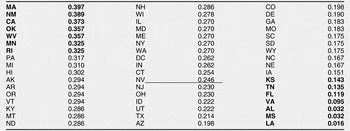
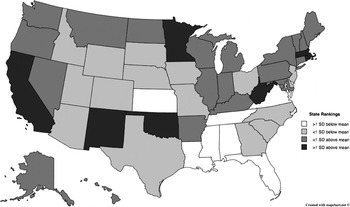
To zero in on the theoretically relevant provisions, each state’s wage and hour laws were systematically coded to measure their penalties for minimum wage noncompliance (D) and the factors pertaining to the probability of detection (λ), which, as discussed earlier, are together expected to vary negatively with the incidence of noncompliance. The primary source was the authoritative multivolume reference guide Wage and Hour Laws: A State-by-State Survey compiled by the American Bar Association, supplemented with direct examination of state statutes and consultation of other sources. Footnote 49 Twenty-five categories were coded and scored, with all scores current through December 31, 2013. Footnote 50 These included measures of the level of damages; the burden of proof; the level of civil penalties and fees; the investigative and adjudicative authorities of the state agency; the availability of criminal penalties; other penalties such as prohibitions on employer retaliation; availability of opt-out class action suits; statutes of limitations; and the employee’s ability to collect attorney fees. More information on the categories and coding is provided in online Appendix A. The State Laws Score variable adds each state’s total points and divides by the total possible number of points, providing a measure of the relative stringency of each state’s penalty scheme. State rankings are presented in table 1 and are shown graphically in figure 1.
State ranking, by State Laws Score (2013)

Note: Mean: 0.237. Bold= +/- 1 standard deviation.
State rankings

States at the top of the list are strong on every dimension: their regulatory agency has strong enforcement powers and can adjudicate claims unilaterally; when found guilty of minimum wage violations, employers are liable for double or treble damages; significant civil and criminal penalties are available; statutes of limitations are at least three years; class action lawsuits are opt-out rather than opt-in; and so on. At the bottom of the list are states like Mississippi, which has no wage and hour laws, and Alabama, which only regulates child labor. Florida has a minimum wage law but lacks enforcement capacity, as its Department of Labor and Employment Security was abolished in 2002. In the middle are states like New Jersey, which has a full slate of laws and a substantial administrative apparatus but no liquidated damages and very small civil penalties.
The rankings are about what one might expect—little surprise that much of the Deep South ranks near the bottom, but it is curious that Oklahoma and West Virginia rank among the top five, Arkansas ranks higher than Illinois, North Dakota ranks much higher than South Dakota, and Kentucky gets twice the score of Kansas. These apparent oddities simply reflect the idiosyncrasies of state statutes and the historical contingencies of their construction. Oklahoma’s mandatory double damages, for example, were enacted in 1965 in conjunction with the establishment of the state’s first-ever minimum wage, called for and signed into law by Oklahoma’s first Republican governor, Henry Bellmon, who believed it would help revitalize the state’s economy. Likewise, West Virginia’s mandatory treble damages provision, established as part of the West Virginia Wage Payment and Collection Act (WPCA) of 1979, reflects the strength of organized labor in the state during that time period as well as the strength of the state Democratic Party during Jay Rockefeller’s tenure as governor. Footnote 51
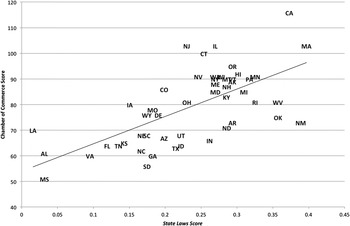
A useful check on the validity of these scores is supplied by a somewhat unlikely source. In 2009, the U.S. Chamber of Commerce commissioned a comprehensive survey of the labor and employment policies of all 50 states. Thirty-four characteristics of each state’s labor and employment regulations were identified and scored by a team of researchers. The scores were then used to examine the relationship between each state’s level of “regulatory burdens” and its record of job creation and economic growth. Footnote 52 The relationship between the Chamber’s score and my State Laws Score is quite strong (refer to figure 2).
Relationship between State Laws Score and Chamber of Commerce Score
Note: p<.000. R2: 0.43.

Estimating Minimum Wage Violations
As noted, the actual number of minimum wage violations is unknown: employer-provided data is not reliable, and WHD data on complaint- and agency-initiated investigations are woefully incomplete. Minimum wage violations in each state must therefore be estimated using survey data. Most useful is the Current Population Survey’s Merged Outgoing Rotation Groups (CPS MORG) data, which the WHD uses to identify “priority industries” for investigations and which remains the top choice of every economist who has sought to develop national or industry-specific estimates of FLSA noncompliance since the 1970s. Footnote 53
The CPS MORG data has many advantages: it is gathered via extensive interviews with around 60,000 households per month; it is representative at the state and national levels (unlike other survey data, such as the Survey of Income and Program Participation [SIPP]); and its individual-level responses permit us to estimate earnings and minimum wage violations relatively easily. The biggest downside is measurement error, as with any survey. Corrections and sensitivity tests are conducted, and there is no reason to believe that response errors vary systematically across states, but measurement error surely still exists. Footnote 54
To maintain consistency with previous research and to make the study as replicable as possible, I estimate employee eligibility for the minimum wage using the FLSA’s eligibility rules and follow the same methodology as the U.S. Department of Labor, the Congressional Research Service, the Minimum Wage Study Commission, and prominent economists who have conducted similar studies. Footnote 55 To estimate hourly wages, reported usual weekly earnings are divided by reported usual weekly hours worked. To estimate whether an individual was paid less than the minimum wage, their estimated wage is simply subtracted from their state’s minimum wage (or, in the case of states without a minimum wage, the federal minimum wage that applies to those workers). Minimum wage violations are thus dichotomous measures of whether an individual’s estimated hourly wage was lower than the legal state minimum. (To address likely measurement error in reported income, sensitivity tests also calculate minimum wage violations as an estimated wage less than $0.05 and $0.25 less than the state minimum as well, with all statistical results holding.) Footnote 56 Statewide violation rates are calculated as the number of estimated violations as a share of the total number of low-wage workers in a state (low-wage defined as wages below 1.5 times the minimum wage), as these are the only workers who are plausible “candidates” for minimum wage violations. Footnote 57
Before turning to the analyses, a few descriptive statistics: an estimated 16.9 percent of low-wage workers experienced a minimum wage violation in 2013. Those workers worked on average 32 hours per week and earned an average hourly wage of $5.92. Had they earned their state’s minimum wage, they would have earned, on average, an hourly wage of $7.68, which means they lost 23 percent of their income ($1.76 per hour). While an estimated income loss of 23 percent may seem high, it is actually toward the lower end of other published estimates. Footnote 58
Interestingly, as a state’s violation rate increases, the average amount of wages lost tends to decrease. Footnote 59 This would seem to be good news for workers in high-violation states, but for the fact that the average amount of wages withheld still falls between $1.15 in Montana and $2.28 in Utah, the distribution is left-skewed, and the standard deviation is only $0.27. The median state (Tennessee) still averaged $1.80 in lost wages. In other words, even though the average amount of lost wages is less in states with higher violation rates, low-wage workers in every state are still losing significant amounts of their income, and the average income lost by state is 24 percent.
The industries with the highest violation rates included private households (26 percent), community and social services (25 percent), personal and laundry services (23 percent), food services and drinking places (22 percent), and real estate (20 percent). Footnote 60 Among covered, nonexempt low-wage workers, the relative odds of experiencing a minimum wage violation were significantly higher for women, those without high school diplomas, and those who lived in a center city. Among all covered, nonexempt workers, the relative odds were also significantly higher for nonwhites, noncitizens (foreign born, not naturalized), and those who did not belong to a union. These variables are used as controls in the following analyses. Footnote 61
Examining the Relationship between State Employment Laws and Minimum Wage Violations
A two-step estimation strategy is employed to account for the mix of individual-level and state-level variables and to ensure that the standard errors are allowed to vary by state. A two-step procedure is especially useful when using CPS data since the survey is not a random sample of households, but a multistage stratified sample that does not use states as its primary sampling unit; the two-step estimation strategy allows us to account for the CPS’s peculiar survey design and use the proper weights in the first step while producing more accurate estimates of standard errors in both stages. Footnote 62
First, I fit a probit regression to the individual-level data to generate estimated coefficients for each of the 50 states and D.C. Individual predictors include age, sex, race, education, citizenship, union membership, and residence in a center city. In the second step, those estimated coefficients become the dependent variable in a linear regression with a number of state-level predictors, including the State Laws Score variable; unemployment rate; state median wage (to capture variation in the “market wage” across states); Gini index (to account for unequal distributions of wages across states); each state’s share of top ten high-violation industries; private sector union density; and an indicator variable for Democratic governor (since the state agency may investigate cases of noncompliance more vigorously if so). Further discussion of the variables, data sources, and analysis is provided in the online Appendix D. Since the State Laws Score variable takes a snapshot of state wage and hour laws in 2013, only data from 2013 are used to test the relationship between state laws and minimum wage violations. Footnote 63
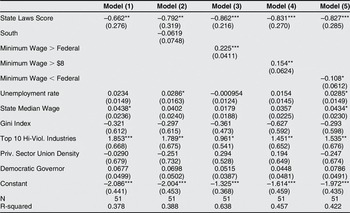
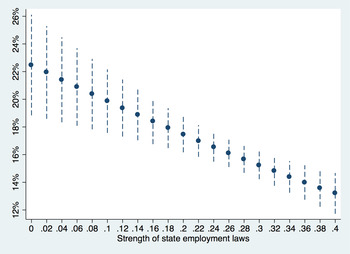
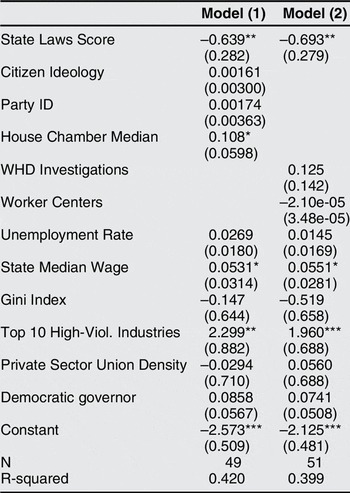
As Model 1 in table 2 shows, even controlling for the demographic and economic factors described above, low-wage workers in states with stronger employment laws had a statistically significantly lower probability of experiencing a minimum wage violation. In substantive terms, figure 3 shows the predicted probabilities of violation at different levels of State Laws Score. The predicted probability in a state with a score of .02 (e.g., Louisiana) was 21.9 percent, while the predicted probability of violation in a state with a score of .40 (e.g., Massachusetts) was substantially lower, at 13.2 percent. The median State Laws Score (e.g., Indiana) had a predicted probability of 16.1 percent.
Relationship between minimum wage violations and strength of state employment laws

Notes: ***p<0.01, **p<0.05, *p<0.1. Standard errors in parentheses. CPS data is provided by the Center for Economic and Policy Research, 2015. CPS ORG Uniform Extracts, Version 2.0.1. Washington, DC.
Predicted probability of minimum wage violation rate given strength of state employment laws, low-wage workers, 2013

While the probability of experiencing a violation remains high even in states with strong penalty schemes, one must keep in mind that a single percentage point increase can mean thousands of additional workers who lose, on average, about a quarter of their income. The human impact of this differential, in other words, is quite large.
To ensure that the results are not driven by southern states—most of which have both weaker penalty schemes and higher rates of violation—Model 2 in table 2 controls for the eleven former Confederate states. And since higher state minimum wages could drive up market wages or reflect differences across states that are not captured by the other controls, Model 3 adds a dummy variable for each of the twenty states that had a minimum wage higher than the federal $7.25 level in 2013. Several of those states’ minimum wages were only slightly higher than the federal level, however, so Model 4 controls only for the ten states with a minimum wage of $8.00 and higher in 2013. Footnote 64 Some states either have no state minimum or a wage floor set lower than the federal level. In practice, that means that the federal rate applies to all covered, nonexempt workers in those states (the pool of workers examined here). But to account for the possibility that a lower state minimum might inflate estimated violation rates, dummy variables for those nine states are included in Model 5. Results show that states with higher-than-federal wage floors are positively and statistically significantly related to a higher incidence of minimum wage violations; but controlling for them does not wash out the effects of the State Laws Score variable, which remains significant at p<.05 or p<.01 in every model.
Still, we cannot rule out the possibility that unobserved factors explain both state minimum wage violation rates and the strength of state wage and hour laws. For example, there may be cultural, ideological, partisan, or deeply rooted historical explanations for the strong negative relationship we observe between the strength of state employment laws and minimum wage violation rates. Hypothetically, states whose citizens are more ideologically liberal or identify more strongly with the Democratic Party could have a stronger “culture of compliance”: their legislatures might be more likely to enact stronger state laws and their employers might be more likely to comply with the law. Conversely, a more conservative state legislature could reflect outsized business influence in the state, which could cause weaker statutes, less vigorous enforcement, and a view among employers that compensation at the “market wage” is legitimate. These factors are very difficult to capture with quantitative measures; nevertheless, the proxy measures displayed in Model 1 of table 3, though statistically significant in bivariate regressions (states with more liberal and more Democratic Party-leaning electorates have higher violation rates), have little explanatory power in multivariate analysis. Only the measure of state legislative ideology is positive (indicating that states with more liberal state legislatures have higher violation rates) and statistically significant at p<0.10. State Laws Score remains statistically significant in each model.
Relationship between minimum wage violations and strength of state employment laws, including more potential confounders

Notes: ***p<0.01, **p<0.05, *p<0.1. Standard errors in parentheses. Data sources in Online Appendix D. CPS data provided by the Center for Economic and Policy Research, 2015. CPS ORG Uniform Extracts, Version 2.0.1. Washington, DC.
Yet there are surely other unobserved factors that matter as well. It could be, for instance, that the WHD works more closely with and investigates more heavily in states with stronger wage and hour laws, thus explaining both higher state laws scores and lower violation rates in those states. Another unobserved factor could be worker centers: if worker centers are concentrated in states with stronger statutory penalty schemes and are instrumental in helping victims complain or file lawsuits, it is conceivable that they could be independently causing the lower violation rates in those states. Indeed, opponents of worker centers argue that they are powerful agents of workers’ rights. Footnote 65 In bivariate regression, worker centers are shown to have a significantly higher presence in states with higher violation rates—suggesting that they are emerging where they are needed most—but they are not independently bringing violation rates down. Interestingly, WHD inspections are more common in states with stronger State Laws Scores, but the WHD’s inspection rate has no apparent relationship to the incidence of minimum wage violations. Footnote 66 As Model 2 in table 3 shows, neither factor is statistically significant in multivariate analysis, and neither diminishes the relationship between state laws and minimum wage violations.
Admittedly, these cross-sectional analyses offer a rather crude look at the relationship between state statutes and violation rates. Much is left out—not least, variation in states’ enforcement capacities. The coding scheme contains measures of state agencies’ authorities (inspection authority, adjudicative powers, and so on), but not standard measures of enforcement capacity (staffing and funding), nor does it capture gubernatorial mandates or the particular dedication and vigor that certain labor commissioners and attorneys general bring to the job. Footnote 67 As several scholars have demonstrated, smart enforcement strategies can make a big difference. Footnote 68 Yet it is quite striking that even in the absence of any more fine-grained measures of enforcement, state laws (mere “parchment barriers,” if you will) are still shown to have a strong negative relationship with violation rates. Footnote 69
But perhaps most interesting of all is the geographic pattern of minimum wage violations that emerges from the data. We have long known that immigrants, racial minorities, women, and certain other demographic characteristics put some individuals more “at risk” of suffering wage violations than others, and that certain industries are more prone to wage violations than others. But as demonstrated here, profound inequalities in workers’ rights also exist across political environments. Indeed, above and beyond known demographic risk factors, a worker’s probability of experiencing a wage violation depends a great deal on where that worker happens to live. Violations happen everywhere, but they are far more prevalent in states with weaker regulatory regimes. Workers in those states often have no choice but to turn to federal agencies and appeal to federal laws for protection—but as shown, the FLSA regulatory apparatus is unable to compensate for weak state laws and equalize protection across state boundaries.
Alt-Labor and the Development of State Wage-Theft Laws
The findings presented here would come as no surprise to the many workers’ rights advocates who have long believed that stronger state-level employment laws can be effective in combating worker exploitation. Their concern, rather, is how much to invest in the laborious process of policy advocacy (drafting legislation, lobbying state legislators, rousing public support, working with administrative agencies, and so on) relative to other activities that might bring gains for workers. Applying direct pressure to major corporations to raise their labor standards, for example—through protests, one-day walkouts, boycotts, and lawsuits—is an alternative strategy that appears to have borne some fruit with recent high-profile wage increases announced by McDonald’s, Wal-Mart, and other major corporations. Footnote 70 Major street-level protests have been successful in a more general sense as well, raising public awareness of wage theft and drawing attention to stagnant low wages and rising inequality (e.g., the prominent Fight for $15 movement), although the tangible benefits to workers from these efforts have been less clear. Some have argued that a better long-term strategy is to redouble efforts at union organizing, to better empower workers and improve their bargaining position in the long run. Footnote 71 Still others have emphasized legal strategies in the hopes of incrementally transforming judicial and administrative standards (such as the evolving definition of “employee”). Footnote 72 During the Obama presidency, still others have focused on bringing change through executive action and the Department of Labor’s rulemaking authority. Footnote 73 Currently, workers’ advocates pursue all of these strategies simultaneously. But as their funding grows more precarious as some of their largest benefactors—traditional labor unions—face tighter resource constraints, they must ask which activities are most likely to pay off in terms of achieving better protections for workers.
While certain strategies may receive less emphasis in the coming years, recent evidence suggests that policy campaigns are becoming increasingly central to the contemporary labor movement. Footnote 74 To a large extent, this policy turn has happened organically—it has been the outgrowth of several overlapping, “intercurrent” historical developments. Footnote 75 Amid the FLSA’s “drift” and the dramatic decline in private sector union membership, many workers have found themselves increasingly on their own. Without union representation or sufficient means to file private lawsuits, low-wage workers have had little recourse when they are underpaid (or not paid at all) other than to file a claim with state regulatory agencies and hope the state will be responsive. This has created incentives for workers to become more politically engaged, to act collectively with other workers, and to push for policies that might strengthen their states’ enforcement capacities and more effectively deter workplace abuse.
Those policy campaigns, in turn, have been politically generative for the broader workers’ rights movement—indeed, they have contributed to the development of alt-labor, which some have called “the new face of the labor movement.” Footnote 76 As Janice Fine has shown, worker centers in the United States have grown dramatically—from only five in 1992 to over two hundred by 2013—and have become increasingly politically active, “successfully [placing] labor standards enforcement on the public policy agenda at the state and national levels.” Footnote 77 To be sure, worker centers do more than just advocate for policy change—they are heterogeneous, “hybrid” organizations that reflect a “bricolage of organizational archetypes ranging from fraternal and mutual aid associations and settlement houses to unions, producer cooperatives, ethnic associations, community organizing and social movement organizations.” Footnote 78 In addition to policy advocacy, they emphasize individual and community empowerment and provide a wide range of services for workers in their communities, including English language classes, leadership training, and helping workers understand their rights, file wage claims, and consider lawsuits. In other words, worker centers are not labor unions (they lack both collective bargaining rights and a dues-paying membership base), nor is political engagement always their top priority. But as they have increasingly come to view the state as the last line of defense against worker exploitation, they have also discovered that policy campaigns can themselves be galvanizing, providing the impetus for significant network-building and collective action. Policy campaigns, in short, have provided points of convergence for the fledgling alt-labor movement and have lent it purpose, focus, and structure. Footnote 79
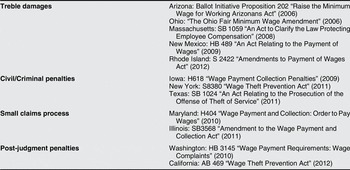
The bills proposed at state and local levels have varied widely. For example, between 2006 and 2013, a dozen bills heralded as major wage-theft laws were successfully enacted at the state level (table 4). Five instituted treble damages, or liability for three times the back wages owed (Arizona, Massachusetts, New Mexico, Ohio, and Rhode Island); three strengthened civil penalties and criminal penalties (Iowa, New York, and Texas); two established new small-claims administrative processes to adjudicate claims under $3,000 (Illinois and Maryland); and two added new post-judgment penalties for offenders who failed to pay up after being found liable, along with other minor changes (California and Washington).
State wage-theft laws enacted (2006–2013)

Why such diversity among laws that were all championed as major wage-theft laws? In part, it reflects the fact that reformers did not know, a priori, which types of laws would be most effective, and the bills were experimental; in part, it reflects the fact that each law was tailored to “fit” existing state capacities and build on what was already in place. For example, California, Maryland, and Washington already had relatively strong regulatory regimes, with double or treble damages and substantial civil penalties, but noncompliance rates that were persistently high (above the mean in all three states during the three years prior). Their reforms thus sought to fortify and improve existing processes and go further in deterring wage violations. Footnote 80 Each law, in other words, must be viewed as a product of its particular historical and political context. Often drafted by workers’ rights groups rooted in their states and local communities, the relationships those groups had built with other groups and state agencies proved critical in shaping the content of the legislation. Nor was this the last time many of these groups came together in unified campaigns, as many continued to collaborate in enforcement efforts and other policy campaigns post-enactment.
In Illinois, for example, three worker centers—Chicago Workers Collaborative, Centro de Trabajadores Unidos, and Latino Union of Chicago—joined forces with Working Hands Legal Clinic to form the “Just Pay for All” coalition that spearheaded the 2010 campaign for policy reform. Several of those groups had worked together on other state- and municipal-level policy campaigns, some dating as far back as 1999, which they viewed as critical to their success. The coalition also pointed to the collaborative relationship it forged with the Illinois Department of Labor (IDOL), which it said “allowed us to learn about the limitations with which the department struggles in combating wage theft, and thus to work with the department and supportive legislators in crafting legislation to overcome those limitations.” Footnote 81 For example, the coalition learned that when employers ignored the IDOL’s findings, as they did 40 percent of the time, the state agency had no authority to issue default judgments—it could only close the case and send it to the (overburdened) state attorney general for enforcement. If the attorney general’s office did not file suit—which it often did not, since it would often cost the state thousands of dollars to try to collect claims in the hundreds—the case would effectively disappear. Footnote 82 It also learned that of the 10,000 claims filed with the IDOL each year, 60 percent were for $3,000 or less. By granting the IDOL authority to unilaterally adjudicate claims under that amount when employers failed to appear—and by adding a new administrative fee of $250 to allow the small-claims process to become self-funded—the legislation sought to accommodate the peculiarities of Illinois’ regulatory regime and maximize its impact while remaining ostensibly cost-neutral. The latter consideration was the primary concern of legislators, as Illinois began that fiscal year “in its worst financial position ever” with $13 billion in debt. Footnote 83 The policy campaign also proved to be a formative organization-building experience for the Just Pay for All coalition: it claimed to have developed a “new cadre of leaders” through the effort, and as it looked ahead it welcomed five additional worker centers, renamed itself “Raise the Floor,” and moved on to other issues such as health and safety, wrongful terminations, and discrimination in the workplace. Footnote 84
Or consider Texas’s wage-theft law—the only statute of the dozen not enacted under unified Democratic government—which passed both houses of the state legislature nearly unanimously after a well-executed campaign by the Workers’ Defense Project, the Labor Justice Committee, and the Paso del Norte Civil Rights Project. Billed as a small technical fix, the law closed a loophole in the existing “theft of service” law that had allowed employers to avoid culpability by paying their employees only a fraction of the wages owed. After enactment, employers were required to make “full payment” of wages owed or face criminal charges and potentially hefty penalties. Success was credited in part to a day of protests at the capitol and in part to a well-publicized study produced by the Workers Defense Project and the University of Texas at Austin which revealed that 20 percent of construction workers in Austin had been underpaid during the prior three years, resulting “in the inability to pay for food and housing.” Footnote 85 With little chance of strengthening the feeble state agency tasked with administering the Payday Law (the Texas Workforce Commission) or passing stronger penalties through the Republican-dominated legislature, workers’ advocates strategically focused their efforts on bolstering the existing “theft of service” law under which wage claims could be pursued by local law enforcement. Footnote 86 Closing the law’s loophole thus widened the only viable channel through which workers could bring the coercive capacities of the state to bear on their behalf. The bigger challenge, however, involved enforcement of the new policy. After enactment, the same workers’ advocacy groups worked to expand their networks and collaborate closely with local police departments to develop and rationalize procedures for investigating grievances. Footnote 87
All other eleven wage-theft bills were passed either during a period of unified Democratic control of state government or via ballot initiatives that circumvented normal legislative politics. But even in Democratic Party-controlled states, party strength was not determinative: the content of the legislation was often shaped by the relative strength of the opposition (usually business groups). In Iowa, for example, despite unified Democratic control of state government (60 percent of seats in the senate, 53 percent in the house, and the governorship), a bill with treble damages and high civil penalties failed in 2008 after meeting with significant opposition from business interests. Footnote 88 One year later, an even larger Democratic majority (64 percent and 56 percent in each house, respectively) opted to seek only a modest increase in civil penalties, from $100 to $500 per violation, to be made available only when employers acted “intentionally,” and tucked the change into a popular bill strengthening protections against child labor, which passed unanimously.
Business groups are not always opposed to wage-theft laws. More recently in Colorado, for example, major business associations including the Colorado Association of Commerce of Industry, the Denver Metro Chamber of Commerce, and the Colorado Competitive Council helped to pass a new wage-theft bill that created a new small-claims administrative process similar to those in Maryland and Illinois. Footnote 89 Their stated reason for supporting the bill was that wage theft gives unscrupulous employers an unfair competitive advantage and tilts the playing field. It is also true, however, that the same business coalitions managed to kill a much stronger bill the previous year—during the same 69th General Assembly in which Democrats held 55 percent of state house seats, 54 percent of state senate seats, and the governorship—that would have also criminalized wage violations and allowed for the recovery of attorney fees and court costs. The final bill stripped out the criminal penalties but kept the small-claims process. Footnote 90
In short, each law was the product of a particular time and place, designed differently for different reasons. Yet each was considered to be a major wage-theft law that would deter wage violations and extend critical new protections to low-wage workers. So how did they fare? Did any of them work to reduce the incidence of minimum wage violations?
Leveraging Within-State Variation to Examine the Relationship between State Wage-Theft Laws and Minimum Wage Violations
The empirical analyses presented earlier would seem to suggest that these new wage-theft laws stood a good chance of being effective. Moving from zero damages to treble damages, for example, would increase a state’s score in the State Laws Score variable by an entire standard deviation; giving the state agency greater adjudicative authorities and adding new civil penalties, likewise, would increase a state’s score by more than half that. Yet because the cross-sectional analysis cannot fully account for all state differences (other than the laws) that could affect both state scores and violation rates, unobserved heterogeneity remains a problem. Footnote 91 The dozen state-level wage-theft laws thus become very useful, analytically, because they allow us to leverage within-state variation to examine the effects of stronger laws while effectively controlling for unobserved, fixed state-level differences. They also enable us to compare the effects of different types of laws and further probe the theoretical proposition that the deterrent effect rises with the expected costs.
Each type of wage-theft law has its own hypothesized degree of deterrence. The strongest deterrence is expected from states that instituted treble damages, which, by making employers liable for up to three times the back wages owed, dramatically increased the expected costs of noncompliance. These were big changes: Arizona and Ohio made the jump from zero to treble damages; Rhode Island went from zero damages in administrative cases and an unspecified amount in civil cases to treble damages in both; New Mexico moved from double to treble; and Massachusetts shifted from “single damages” in most cases (less than the amount of back wages owed as penalty) to mandatory treble damages. Footnote 92 Burdens of proof varied across the states: employers were given a “good faith” excuse in both Arizona and Rhode Island (but in the latter state, consideration also had to be given to whether the violation was “willful”); an executive order waived the mandatory treble damages provision for first-time and “procedural” violations in Ohio after February 2008; and awards were made mandatory in civil actions in Massachusetts and in both agency-initiated actions and civil actions in New Mexico. Despite this variation, each state’s embrace of treble damages signaled to employers that intentional wage violations would be extremely costly, especially in cases involving multiple plaintiffs.
The second strongest deterrent effect would be expected from laws that strengthened civil and criminal penalties for minimum wage violations. New York’s Wage Theft Prevention Act, for example, increased the penalties for minimum wage violations to a minimum of $500 and maximum of $20,000 or imprisonment for up to a year, added a host of other high-ceiling penalties, and increased damages from 25 percent to 100 percent of back wages owed. As described earlier, the amendment to Texas’s Theft of Services law fortified the primary criminal law under which most wage violation claims were brought; and Iowa’s law increased available civil penalties in willful cases.
The third type of wage-theft law, establishing small claims administrative processes in Illinois and Maryland, likely increased the probability of detection (λ) by speeding up the process and making it somewhat easier for employees to file claims. But because they did not add significant damages or penalties, these laws would be expected to have had a more muted effect than the first two types of wage-theft laws.
The final type of bill added post-judgment penalties for employers who failed to pay up after being found guilty. California’s Wage Theft Prevention Act also added a number of other enforcement mechanisms, restitution requirements, notification requirements, and expanded the authority of the Labor Commissioner in several ways, but its chief focus was ensuring that violating employers actually paid up. Washington’s 2010 law likewise addressed the post-judgment phase, doubling the minimum civil penalty to $1,000 (maximum $20,000) and making the penalty mandatory when “repeat, willful violators” failed to pay up within ten days. Since these laws did not increase penalties for the initial act of noncompliance itself, but instead pertained to the post-judgment collection phase, they would be expected to have had the weakest deterrent effect.
To summarize, treble damages, being the most punitive, would be expected to have had the strongest deterrent effect, followed by increased civil and criminal penalties, the establishment of new small-claims administrative processes, and finally post-judgment failure-to-pay penalties.
Two empirical results are of interest to us: (1) changes in the probability of violation after the laws were enacted and (2) whether the effects differed across the four types of laws. A two-step difference-in-difference (DID) analysis enables us to estimate the effect each type of law had on the subsequent probability that a worker would suffer a minimum wage violation in those states. The first step uses the same individual-level predictors as before, and state coefficients are estimated for every year from 2005 to 2014. The second step then regresses the state-year coefficients on the following form:
 $$\eqalign{ & \hskip -75ptY = \alpha + {\delta _{rDD}}Reform{s_t} + \mathop \sum\limits_{k = Alaska}^{Wyoming} {{\beta _k}Stat{e_{ks}}} + \mathop \sum\limits_{j = 2005}^{2014} {{\gamma _j}Yea{r_{jt}}} \cr & <$$><$$>+ \mathop \sum\limits_{k = Alaska}^{Wyoming} {{\theta _k}\left( {Stat{e_{ks}} \times t} \right) + {\rho _1}Unemploymen{t_{st}}} \cr & <$$><$$>+ {\rho _2}StateMedianWag{e_{st}} + {\rho _3}Top10HighViolationIndustrie{s_{st}} \cr & <$$><$$>+ {\rho _4}PrivateSectorUnionDensit{y_{st}} + {\rho _5}DemocraticGoverno{r_{st}} + \varepsilon \cr}$$
where Y is the state-year coefficients from step 1, treatment effects δ rDD are the coefficients on the dummy variable Reform indicating all post-enactment years in the dozen states that introduced a reform (with each of the four types of laws serving as the treatment variables in separate regressions). Dummy variables for every state (s) except one are indexed by the subscript k. Year effects γ t are the coefficients on all year dummies but one, indexed by the subscript j. To relax the common trends assumption of the DID method and allow states to follow nonparallel paths in the absence of the treatment effect, state-specific trends are captured with the parameter θ k on the state-year interaction variable. Because the common trends assumption cannot actually be tested and there are surely state-specific trends that remain unaccounted for, the same state-level control variables as above are included as well. Footnote 93 For each model, the comparison group includes only those states that experienced no changes in their relevant laws.
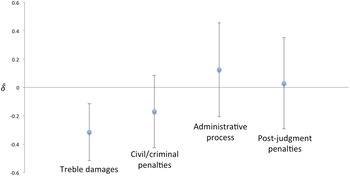
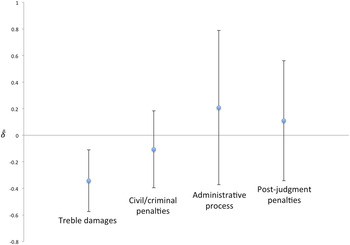
The first difference-in-difference analysis groups all twelve policy reforms together. Results show that the probability of violation in those states dropped significantly after enactment (
 $\hat \delta$
=-.17, p<.01). Disaggregating the laws into the four categories is far more illuminating, however: as shown in figure 4, the introduction of treble damages reduced the probability of minimum wage violations in those states by almost twice as much (
 $\hat \delta$
=-.31, p<.01) and was highly statistically significant. New civil and criminal penalties saw a reduced violation rate as well (
 $\hat \delta$
=-.17), but were not statistically significant. Neither of the final two types of wage-theft laws had a statistically significant effect on the probability of minimum wage violation. Sensitivity tests also calculate minimum wage violations as an estimated wage less than $0.05 and $0.25 less than the state minimum, with all statistical results holding.
Difference-in-differences
Notes: Difference-in-difference analysis, linear probability model. 95 percent confidence intervals shown.

The common trends assumption of difference-in-differences models, however, makes the use of all non-treated states in the comparison group potentially problematic. Even accounting for state-specific trends, all other states would not necessarily be expected to follow the same path as the treated states in the absence of the treatment. In an effort to make the control group as similar as possible to the treatment group, I generate propensity scores on both individual-level and state-level characteristics and use nearest-neighbor matching to identify matched states. The same difference-in-differences regressions as before (minus the control variables) are then run using only matched states. The results are virtually identical to those obtained above (figure 5 ).
Difference-in-differences (with matching)
Notes: Difference-in-difference analysis, linear probability model. 95 percent confidence intervals shown.

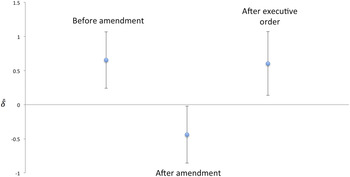
Further purchase can be gained by leveraging a second over-time change in Ohio during this period. As noted, Ohio voters passed a constitutional amendment to add mandatory treble damages effective January 1, 2007. But after only 13 months, Democratic Governor Ted Strickland, responding to pressure from the business community, issued an executive order mandating that “agencies should when appropriate waive penalties for first-time or isolated paperwork or procedural regulatory non-compliance” and the state agency quickly announced its compliance with the order. Republican Governor John Kasich extended the order upon taking office in January 2011, reiterating that “the priority of a strong regulatory system should be compliance, not punishment … Wherever possible, penalties should be waived for first-time violators … enforcement actions should be utilized when necessary for entities that have been unwilling to comply.” Footnote 94
Difference-in-difference analyses examine whether these shifts in enforcement affected the probability of minimum wage violation in Ohio. As above, the 39 states that did not undergo any relevant reforms are used as the comparison group. As figure 6 indicates, after the initial introduction of treble damages in January 2007, there was a statistically significant decline in the probability of violation in Ohio; but once first-time violators were given a pass, the probability of violation shot back up to the range of former levels.
Probability of violation in Ohio before and after constitutional amendment and executive order

This case suggests that while stronger penalties are strongly associated with higher levels of compliance, day-to-day enforcement is critical as well. Unfortunately, enforcement capacity is tricky to measure, and existing data on staffing and funding suffers from missing data and substantial measurement error. Footnote 95 Moreover, as the cases of Ohio, Illinois, Massachusetts, and other states suggest, enforcement can be profoundly influenced by political pressures, the discretion of the labor commissioner, judicial rulings, and procedural idiosyncrasies. Studying the interaction of penalty schemes and enforcement capacities through case-study analysis thus offers a promising path for future research. Footnote 96 Likewise, further within-state, over-time analysis (whether through case studies or by coding state employment laws over a number of years to provide the cross-sectional analysis with greater variation in state laws) would help to better account for the problems of identification and unobserved heterogeneity discussed here.
To summarize, these analyses have demonstrated that the stronger the state’s employment laws, the lower the incidence of minimum wage violations, even when controlling for major covariates. The particular policy route chosen to combat wage violations, however, matters a great deal: only those states that implemented the strongest penalties—treble damages—experienced statistically significant drops in violation rates. Other policy routes—smaller civil/criminal penalties, the creation of new administrative processes to adjudicate small wage claims, the augmentation of post-judgment penalties—did not have statistically significant effects. But the Ohio case suggests that treble damages are not, by themselves, sufficient to deter noncompliance with minimum wage laws; enforcement of the policy is critical as well.
Alt-Labor, Public Policy, and the Future of Labor Politics in the United States
In many ways, labor conditions in the early twenty-first century have come to resemble labor conditions in the early twentieth century. Footnote 97 Low-wage work is often unregulated, precarious, and sometimes dangerous; workers are increasingly vulnerable to exploitation; the possibilities for national reform are blocked by intransigent political forces occupying key institutional veto points; low-wage workers have begun to create new organizational forms (alt-labor), build coalitions to publicize their plight, seize the moral high ground, and press for change; and hopes for improvement hinge on the ability of those coalitions to convince state legislatures to enact stronger protections for workers within their borders.
But whereas statutes to enforce state minimum wages during the Progressive era were of questionable effectiveness, I have shown that in the contemporary era, more robust state-level regulatory regimes are strongly associated with a lower incidence of wage violations. Moreover, during the past decade, in states where new wage-theft laws dramatically increased the expected costs of violating the law, the incidence of minimum wage noncompliance saw statistically significant declines. Stronger penalties, in short, appear to be quite effective in deterring this pernicious type of wage theft.
I hasten to add that in all states, even those that passed strong laws, low-wage workers remain highly vulnerable to wage violations. Although passing more wage-theft laws could make a difference, opportunities for policy reform at the state level are highly uncertain, dependent on the contingent alignment of multiple partisan, coalitional, and institutional factors. Indeed, partisan factors alone appear prohibitive: unified Democratic Party control of state government has been close to a necessary condition for the enactment of stronger policies, yet at the time of this writing, unified Democratic control exists in only seven states, the lowest number since 1860. This may be why progressive reformers are increasingly looking to effect policy change at the city and county level, while opponents are increasingly seeking to use state laws (“preemptive laws”) to limit local governing autonomy. Footnote 98
But in truth, there is only so much that stronger statutes can do. Enforcement has proven to be an ongoing challenge everywhere. Footnote 99 Like the WHD, state agencies are overburdened and under-resourced, and fundamental changes in the nature of employment poses the same kinds of difficulties at both levels. The rise of the “gig economy” and “contingent work”—including the growing use of “freelance contractors” (at businesses like Uber and TaskRabbit), temporary workers, day laborers, and interns—has caused more and more workers to lose both their wage and hour protections and their collective bargaining rights. Much of the onus thus remains on workers to find new ways to assert their rights, combat their exploitation, and develop collective identities in an increasingly fragmented work environment. Footnote 100
Finally, it is worth noting that above and beyond the policy effects of wage-theft laws, the lengthy campaigns to draft and enact those policies have also had durable political effects. As groups banded together and orchestrated protests, developed legislation, helped workers testify about their exploitation, engaged with the media, and lobbied legislators, their collective work cemented coalitional ties and stimulated new campaigns on new fronts. Groups leading the campaign for treble damages in New Mexico, for example—including Somos Un Pueblo Unido, New Mexico Voices for Children, and Vecinos Unidos—continued after enactment to campaign for new policies to expedite wage cases in court, strengthen enforcement procedures, and raise the federal minimum wage. Footnote 101 Similar dynamics can be observed in Illinois and Texas, as described earlier, and in New York, where many of the key groups behind the Wage Theft Prevention Act—including Make the Road New York, the Restaurant Opportunities Center of New York, New York Communities for Change, and the National Employment Law Project—continued in subsequent years to collaborate, to bring in new allies, and to launch new campaigns for anti-discrimination policies, guaranteed paid sick days, minimum wage raises, and more. Footnote 102
Alt-labor groups have also sought to fuse workplace justice, social justice, and civil rights campaigns in the hopes of building “a new brand of social justice unionism … aimed at broad social transformation.” Footnote 103 As the executive director of the New York Communities for Change said, “it’s impossible to organize fast-food and low-wage workers without grappling with the massive movement happening around the murder of black men and women across the country at the hands of police … The majority of workers at these jobs are people of color. It cannot be separated; it’s their everyday lives.” Footnote 104 The civil rights of immigrants and their exploitation in the workplace, likewise, are intertwined and inseparable from the treatment of low-wage workers everywhere. Increasingly, this intersectionality is emphasized in protests and campaigns for economic, social, and racial justice. Policy campaigns to deter wage theft, in other words, have not only helped to build stronger alt-labor coalitions—they have also helped to create a movement out of what might have otherwise remained a disparate set of community worker centers, immigrant advocacy groups, nonprofit organizations, and single-issue protest movements.
The scope of activities undertaken by alt-labor groups is quite large, yet much about these groups, and the future of the labor movement more generally, remains uncertain. Relations between alt-labor groups and traditional unions are still being worked out; funding streams are changing; communication technologies are improving; and the tactics employed are evolving. Footnote 105 One thing that is quite certain, however, is that policy campaigns will remain central to the labor movement in the years ahead. Footnote 106 Part of the reason is instrumental: while the orchestration of massive multi-city demonstrations and major unionization drives are resource-intensive and often disappointing in terms of producing tangible benefits, successful policy campaigns promise durable, generalized benefits while simultaneously serving as a powerful tool for grassroots mobilization and organizational collaboration. The other major reason, as I have shown, is that policies can be a demonstrably effective means of protecting workers’ rights. To be sure, they are a second-best alternative, since stronger employment laws cannot compensate for workers’ diminished power in the workplace or build solidarity and collective identities, as labor unions can. But as traditional labor unions continue their seemingly inexorable decline, the rise of alt-labor, the growing centrality of public policy, and the fusion of social justice movements offer us a glimpse of where U.S. labor politics may be headed in the twenty-first century.
Supplemental Materials
Appendix A. Coding State Wage and Hour Laws
Appendix B. Measurement Error and Estimating Minimum Wage Violations
-
Appendix Table 1. Sensitivity Tests
-
Appendix Table 2. FLSA Exemptions
Appendix C. Descriptive Statistics
-
Appendix Figure 1. Average Wages Lost
-
Appendix Figure 2. Comparing Populations
Appendix D. Statistical Analysis