1. INTRODUCTION
The interaction of intense short pulse lasers with atomic clusters has been a fascinating field of research and has attracted considerable attention in the recent years. The variety of new and interesting nonlinear phenomena have been observed in such interaction (Sprangle et al., Reference Sprangle, Esarey and Ting1990; McPherson et al., Reference Mcpherson, Luk, Thompson, Borisov, Shiryaev, Chen, Boyer and Rhodes1994; Ditmire et al., Reference Ditmire, Zweiback, Yanovsky, Cowan, Hays and Wharton1999; Kumarappan et al., Reference Kumarappan, Krishnamurthy and Mathur2001; Fomichev et al., Reference Fomichev, Popruzhenko, Zaretsky and Becker2003; Kim et al., Reference Kim, Alexeev, Parra and Milchberg2003; Zharova et al., Reference Zharova, Litvak and Mironov2003; Tiwari & Tripathi, Reference Tiwari and Tripathi2006a). Among these, higher-order harmonic generation has been an active research area that produces coherent radiation in the extreme ultraviolet (UV) or soft X-ray region (Reintjes et al., Reference Reintjes, She, Eckardt, Karangelen, Andrews and Elton1977; Parra et al., Reference Parra, Alexeev, Fan, Kim, Mcnaught and Milchberg2000), which can economically be used for routine laboratory work. Hence various authors have developed analytical methods to study harmonic generation from clusters (Krainov & Smirnov, Reference Krainov and Smirnov2002; Tiwari & Tripathi, Reference Tiwari and Tripathi2004). The conversion efficiency of fundamental pulses to harmonics is low without a means for phase-matching between them. Several schemes have been implemented by various researchers theoretically as well as experimentally to make harmonic generation in clusters resonant (Fomytskyi et al., Reference Fomytskyi, Breizman, Arefiev and Chiu2004; Tiwari & Tripathi, Reference Tiwari and Tripathi2006b; Shim et al., Reference Shim, Hays, Zgadzaj, Ditmire and Downer2007). Fomytskyi et al. (Reference Fomytskyi, Breizman, Arefiev and Chiu2004) have utilized the Lagrangian concept of a nonlinear oscillator driven by a sinusoidal force to show that there is a strong resonant enhancement of the third harmonic when the applied field frequency is close to one-third of the core eigen frequency. Tiwari and Tripathi (Reference Tiwari and Tripathi2006b) have studied analytically the third harmonic generation in the phase of exploding clusters. Recently Shim et al. (Reference Shim, Hays, Zgadzaj, Ditmire and Downer2007) have reported the first experimental controlled enhancement of the third harmonic generation from expanding argon gas cluster by pump-probe experiment. In their experiment, the gas jet was heated by the pump to generate clustered plasma, which then allowed to freely expand. A probe then generated third harmonic radiation at controlled time delays. They observed a sharp enhancement of third harmonic generation from cluster expansion at time delay Δt ~ 200–300 fs. Hence the resonant harmonic generation in clusters which was studied earlier theoretically (Kim et al., Reference Kim, Alexeev, Parra and Milchberg2003; Fomyts'kyi et al., Reference Fomytskyi, Breizman, Arefiev and Chiu2004; Fomichev et al., Reference Fomichev, Zaretsky, Bauer and Becker2005), gets verified experimentally considering phase matching effects.
The basic mechanisms in laser–cluster interaction are: The laser field ionizes atoms of the cluster that is, a significant number of electrons are removed from the cluster and get free. The inner free electrons are first accelerated out from the cluster and then driven back into it by the combined effects of the incident laser field and the electrostatic field produced by the laser-driven charge separation. While the outer ionized electrons quickly expelled out of the cluster leaving a net positive charge. This positive charge and the high excitation energy acquired by the cluster cause it to undergo coulomb explosion and convert it into plasma balls via tunnel ionization. Also the recombination of a free electron with the parent ion leads to harmonic generation.
In our study, we want to enhance the third harmonic generation in clusters by satisfying the phase matching condition with density ripple on cluster density and plasma electron density outside the clusters. The wave vector  ${\vec k_{0}}$ of density ripple acts as a virtual photon of zero quantum energy and momentum
 $\hbar {{\ k}_{0}}$ which provides additional momentum to the harmonic photon to satisfy the phase matching condition. The oscillatory velocity of the cluster electrons due to fundamental laser field at
 $({{\rm \omega} _1},{\vec k}_1)$ beats with laser magnetic field to produce a second harmonic ponderomotive force at
 $(2{{\rm \omega} _1},2{\vec k}_1)$. The oscillatory velocity due to this ponderomotive force beats with cluster density ripple
 $(0,{\vec k_{0}})$ to exert a ponderomotive force at
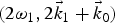 $(2{{\rm \omega} _1},2{\vec k}_1 + {\vec k_{0}})$. The oscillatory velocity due to this ponderomotive force at
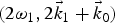 $(2{{\rm \omega} _1},2{\vec k}_1 + {\vec k_{0}})$ couples with cluster electron density oscillations at
 $({{\rm \omega} _1},{\vec k}_1)$ to produce a nonlinear current at
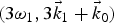 $(3{{\rm \omega} _1},3{\vec k}_1 + {\vec k_0})$, which drives the third harmonic radiation. In Section 2, we have derived the expression for the third harmonic current density. In Section 3, we have solved the wave equation for Gaussian beam in clustered plasma to find the amplitude of the third harmonic field. We have discussed our results in Section 4 and in the last section, conclusion of the present investigation is presented.
2. THIRD HARMONIC CURRENT DENSITY
Consider a clustered gas jet of argon which is formed by adiabatic expansion and hence cooling of gas into a vacuum. Backing pressure, temperature, geometry of nozzle, and other factors are adjusted in such a way that this structured nozzle produces clusters of radius r and space periodic density  ${n_{\rm c}} = n_{{\rm c0}}^{0} + n_{\rm c}^{0} {\rm exp}$
 $(\iota {k_{0}}z)$. Here
 $n_{{\rm c0}}^{0} $ is initial cluster density and
 $n_{\rm c}^{0} $ is initial ripple density of cluster. Such density ripple in plasma and cluster can be produced by using a machining laser (Pai et al., Reference Pai, Huang, Kuo, Lin, Wang, Chen, Lee and LINs2005; Liu & Tripathi, Reference Liu and Tripathi2008) or circular grating axicon assembly to generate hydrogen and argon plasma waveguides in a cryogenic cluster jet in a space periodic manner (Layer et al., Reference Layer, York, Antonsen, Varma, Chen, Leng and Milchberg2007). Wave vector
 ${\vec k_{0}}$ of density ripple is considered to be parallel to z-axis. The free electron density inside cluster is n e, while outside cluster due to intensity dependent ionization rate it varies sinusoidally as
 ${n_{0}} = n_{{\rm 00}}^{0} + n_{0}^{0} {\rm exp}(\iota {k_{0}}z)$, where
 $n_{{\rm 00}}^{0} $ is the initial plasma electron density and
 $n_{0}^{0} $ is the initial ripple density of plasma electrons. Such type of sinusoidal plasma density ripple has already been used by Xia (Reference Xia2014) with cosine component only. A laser beam of frequency ω1 and wave number k 1 propagates through clustered plasma. The electric and magnetic field of laser beam are given by
 $${\vec E}_1 = {\hat x}A_1(z,t)e^{-i({\rm \omega}_{1} t - k_{1}z)},$$
 $${\vec B_1} = c{\vec k}_1 \times {\vec E}_1/{{\rm \omega} _1},$$
where A 1(z, t) = F(z − v g1t) is amplitude of electric field vector and A 1|z=0 = A 0, c is the speed of light in vacuum. The wave number k 1 and group velocity v g1 of the laser beam can be expressed as,
 $${k_1} = \displaystyle{{{{\rm \omega} _1}} \over c}{\left[ {1 - \displaystyle{{{\rm \omega} _{\rm p}^2} \over {{\rm \omega} _1^2}} - \displaystyle{{4{\rm \pi} n_{{\rm c0}}^{0} {r^3}{\rm \omega} _{{\rm pe}}^2} \over {3({\rm \omega} _1^2 (1 + {\rm \iota} \nu /{{\rm \omega} _1}) - {\rm \omega} _{{\rm pe}}^2 /3)}}} \right]^{1/2}},$$
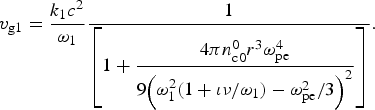 $${v_{{\rm g}1}} = \displaystyle{{{k_1}{c^2}} \over {{{\rm \omega} _1}}}\displaystyle{1 \over {\left[ {1 + \displaystyle{{4{\rm \pi} n_{{\rm c0}}^{0} {r^3}{\rm \omega} _{{\rm pe}}^4} \over {9{{\left( {{\rm \omega} _1^2 (1 + {\rm \iota} \nu /{{\rm \omega} _1}) - {\rm \omega} _{{\rm pe}}^2 /3} \right)}^2}}}} \right]}}.$$
Here 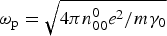 ${{\rm \omega} _{\rm p}} = \sqrt {4{\rm \pi} n_{{\rm 00}}^{0} {e^2}/m{{\rm \gamma} _{0}}} $ is the frequency of plasma electrons,
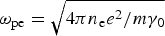 ${{\rm \omega} _{{\rm pe}}} = \sqrt {4{\rm \pi} {n_{\rm e}}{e^2}/m{{\rm \gamma} _{0}}} $ is the plasma frequency inside the cluster, ν is the collisional frequency inside the cluster, −e and m are electronic charge and rest mass, respectively, and γ0 is the average value of relativistic factor, given as
 ${{\rm \gamma} _{0}} \approx {(1 + a_{0}^2 /2)^{1/2}}$, a 0 = eA0/mω1c, a 0 < 1.
When an intense ultra short laser pulse interacts with cluster, the cluster gets ionized. So a highly excited cluster consists of plasma with electrons and multicharged atomic ions. We assume this ionization to be homogeneous across the whole cluster volume so that we can consider the model of ionized cluster as two homogeneously charged spheres: One is positively charged and the other is negatively charged. The center of negatively charged sphere is shifted along the x-axis by a distance x with respect to center of positively charged sphere. The restoring force experienced by the cluster electrons is given as
 $${\vec F_{\rm T}} = \displaystyle{{ - 4{\rm \pi}} \over 3}{n_{\rm e}}{e^2}\vec x - e{\vec E}_1$$
As the cluster expands, its size increases and average electron density inside it decreases. We consider the case when the plasma frequency ωpe has gone down significantly. From the equation of motion of cluster electrons, their oscillatory velocity can be written as,
 $${\vec v_{{\rm c}1}} = \displaystyle{{ - {\rm \iota} e{{\rm \omega} _1}{{\vec E}_1}} \over {m{{\rm \gamma} _{0}}[{\rm \omega} _1^2 (1 + {\rm \iota} \nu /{{\rm \omega} _1}) - {\rm \omega} _{{\rm pe}}^2 /3]}}.$$
Similarly from the equation of motion of plasma electrons, their oscillatory velocity can be written as,
 $${\vec v_1} = \displaystyle{{e{{\vec E}_1}} \over {m{{\rm \gamma} _{0}}{\rm \iota} {{\rm \omega} _1}}}.$$
The wave vector  ${\vec k}_1$ of the fundamental laser increases more than linearly with the frequency ω1 hence,
 ${\vec k}_3\gt 3{{\vec k}_1} $; that is, the momentum
 $\hbar {\vec k_{3}}$ of a third harmonic photon is greater than the sum of the momenta of three pump photons
 $3\hbar {k_1}$. Hence the additional momentum is required to satisfy the phase matching condition. The density ripple provides this additional momentum to third harmonic photon to make the process resonant. For this the wave number k 0 should be as,
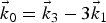 ${\vec k}_0 = {\vec k}_{3}-3{\vec k}_1$. The laser exerts a ponderomotive force
 ${\vec F_2} = ( - e/2c)({\vec v_{{\rm c}1}} \times {\vec B_1})$ on cluster electrons at
 $(2{{\rm \omega} _1},2{\vec k}_1)$. This produces an oscillatory velocity,
 $$\eqalign{{\vec v}_{{\rm c}2} = & \displaystyle{{{{\rm \omega}_1}{e^2}{k_1}A_1^2} \over {{m^2}{{\rm \gamma} _{0}}[{\rm \omega}_1^2 (1 + {\rm \iota} \nu /{{\rm \omega} _1}) - {\rm \omega} _{{\rm pe}}^2 /3]}} \cr \quad & \displaystyle{{{e^{ - \iota [2{{\rm \omega}_{1}}t - 2{k_{1}}z]}}} \over {[4{\rm \omega} _1^2 (1 + {\rm \iota} \nu /2{{\rm \omega} _1}) - {\rm \omega} _{{\rm pe}}^2 /3]}}{\hat z}.} $$
Using  ${\vec v_{{\rm c}2}}$ in the equation of continuity, we obtain the nonlinear density perturbation at (2k 1 + k 0),
 $$n_{{\rm c}2{\rm \omega}, 2{k_1} + {k_{0}}}^{{\rm NL}} = \displaystyle{{{{\vec v}_{{\rm c}2}}.(\vec 2{k_1} + {{\vec k}_{0}}){n_{\rm a}}} \over {2{{\rm \omega} _1}}},$$
where n a = (4π/3)n en cr 3 is the average number of cluster electrons per unit volume.
Using Eq. (8) in Eq. (9) we get,
 $$\eqalign{n_{{\rm c}2{\rm \omega}, 2{k_1} + {k_{0}}}^{{\rm NL}} = & \displaystyle{{{e^2}{k_1}(\vec 2{k_1} + {{\vec k}_{0}}){n_{\rm a}}A_1^2} \over {2{m^2}{{\rm \gamma} _{0}}[{\rm \omega} _1^2 (1 + {\rm \iota \nu} /{{\rm \omega} _1}) - {\rm \omega} _{{\rm pe}}^2 /3]}} \cr \quad & \displaystyle{{{e^{ - \iota [2{{\rm \omega} _1}t - 2{k_1}z]}}} \over {[4{\rm \omega} _1^2 (1 + {\rm \iota \nu} /2{{\rm \omega} _1}) - {\rm \omega} _{{\rm pe}}^2 /3]}}.} $$
This nonlinear density perturbation at (2ω,2k 1 + k 0) causes electrostatic perturbation of potential ϕ2 as,  ${{\rm \phi} _2} = $
 ${{\rm \phi} _2}{e^{ - \iota [2{{\rm \omega} _1}t - (2{k_1} + {k_{0}})z]}}$, which produces a self-consistent space charge field
 ${\vec E_2} = - \vec \nabla {{\rm \phi} _2}$. This space charge field produces linear density perturbation in cluster electrons as,
 $$n_{{\rm c}2{\rm \omega}, 2{k_1} + {k_{0}}}^{\rm L} = \displaystyle{{{{(2{k_1} + {k_{0}})}^2}{{\rm \chi} _{c2}}{{\rm \phi} _2}} \over {4{\rm \pi} e}},$$
where  ${{\rm \chi} _{c2}} = - \displaystyle{{(4{\rm \pi} /3)n_{{\rm c0}}^{0} {r^3}{\rm \omega} _{{\rm pe}}^2} \over {(4{\rm \omega} _1^2 (1 + {\rm \iota} \nu /2{{\rm \omega} _1}) - {\rm \omega} _{{\rm pe}}^2 /3)}}$.
Also the non-linear density perturbation in plasma electrons is
 $$n_{{\rm p}2{\rm \omega}, 2{k_{1}} + {k_0}}^{{\rm NL}} = \displaystyle{{{e^2}{k_1}(\vec 2{k_1} + {{\vec k}_0}){n_{0}}A_1^2 {e^{ - \iota [2{{\rm \omega} _{1}}t - 2{k_{1}}z]}}} \over {8{m^2}{{\rm \gamma} _{0}}{\rm \omega} _1^4}}. $$
Now from Poisson's equation  ${\nabla ^2}{{\rm \phi} _2} = 4{\rm \pi} e(n_{{\rm c}2{\rm \omega}, 2{k_1} + {k_{0}}} + n_{{\rm p}2{\rm \omega}, 2{k_1} + {k_{0}}} )$, we get
 $${\rm \phi}_2 = \displaystyle{{ - 4{\rm \pi} e(n_{{\rm c}2{\rm \omega}, 2{k_1} + {k_{0}}}^{{\rm NL}} + n_{{\rm p}2{\rm \omega}, 2{k_1} + {k_{0}}}^{{\rm NL}} )} \over {{\rm \epsilon} _2^{\prime} {{(2{k_1} + {k_{\rm o}}{\rm )}}^2}}},$$
where  ${\rm \epsilon} _2^{\prime} = 1 - {\rm \omega} _{\rm p}^2 /4{\rm \omega} _1^2 - (4{\rm \pi} /3)n_{{\rm c0}}^{0} {r^3}{\rm \omega} _{{\rm pe}}^2 /(4{\rm \omega} _1^2 (1 + {\rm \iota} {\rm \nu} /2{{\rm \omega} _1}) - {\rm \omega} _{{\rm pe}}^2 /3)$.
Hence the net density of cluster electrons can be written as,
 $$\eqalign{{n_{{\rm c}2{\rm \omega}, 2{k_1} + {k_0}}} = & \; n_{{\rm c}2{\rm \omega}, 2{k_1} + {k_0}}^{{\rm NL}} + n_{{\rm c}2{\rm \omega}, 2{k_1} + {k_0}}^{\rm L} \cr = &\; n_{{\rm c}2{\rm \omega}, 2{k_1} + {k_0}}^{{\rm NL}} \displaystyle{{(1 - {\rm \omega} _{\rm p}^2 /4{\rm \omega} _1^2 )} \over {{\rm \epsilon} _2^{\prime}}} \cr & \quad + n_{{\rm p}2{\rm \omega}, 2{k_1} + {k_0}}^{{\rm NL}} \displaystyle{{(4{\rm \pi} /3)n_{{\rm c0}}^{0} {r^3}{\rm \omega} _{{\rm pe}}^2} \over {(4{\rm \omega} _1^2 (1 + {\rm \iota \nu} /2{{\rm \omega} _1}) - {\rm \omega} _{{\rm pe}}^2 /3){\rm \epsilon} _2^{\prime}}},} $$
where  $n_{{\rm c}2{\rm \omega}, 2{k_1} + {k_0}}^{{\rm NL}} $ and
 $n_{{\rm p}2{\rm \omega}, 2{k_1} + {k_0}}^{{\rm NL}} $ are given by Eqs. (10) and (12), respectively.
Similarly the net density of plasma electrons will be
 $$\eqalign{{n_{{\rm p}2{\rm \omega}, 2{k_1} + {k_0}}} = & \; n_{{\rm p}2{\rm \omega}, 2{k_1} + {k_0}}^{{\rm NL}} \left( {1 + \displaystyle{{{\rm \omega} _{\rm p}^2} \over {4{\rm \omega} _{1}^{\rm 2} {\rm \epsilon} _2^{\prime}}}} \right) \cr & \quad + n_{{c}2{\rm \omega}, 2{k_1} + {k_0}}^{{\rm NL}} \left( {\displaystyle{{{\rm \omega} _{\rm p}^2} \over {4{\rm \omega} _1^2 {\rm \epsilon} _2^{\prime}}}} \right).} $$
The second-order oscillatory velocity  ${\vec v_{{\rm c}2}}$ of cluster electrons beats with first-order magnetic field B 1 to exert a ponderomotive force at (3ω1,
 $3{\vec k}_1$) that is,
 ${\vec F_3} = ( - e/2c)({\vec v_{{\rm c}2}} \times {\vec B_1})$. This force produces a third-order oscillatory velocity,
 $$\eqalign{{{\vec v}_{{\rm c}3}} = & \displaystyle{{ - 3\iota {{\rm \omega} _1}{e^3}k_1^2 A_1^3} \over {2{m^3}{{\rm \gamma} _{\rm o}}[{\rm \omega} _1^2 (1 + {\rm \iota \nu} /{{\rm \omega} _1}) - {\rm \omega} _{{\rm pe}}^2 /3]}} \cr & \quad \displaystyle{{{e^{ - \iota [3{{\rm \omega} _1}t - 3{k_1}z]}}} \over {[4{\rm \omega} _1^2 (1 + {\rm \iota \nu} /2{{\rm \omega} _1}) - {\rm \omega} _{{\rm pe}}^2 /3]}} \cr & \quad \displaystyle{1 \over {[9{\rm \omega} _1^2 (1 + {\rm \iota \nu} /3{{\rm \omega} _1}) - {\rm \omega} _{{\rm pe}}^2 /3]}}\hat x.} $$
The third harmonic nonlinear current density due to atomic cluster at (3ω1,  $3{\vec k}_1 + {\vec k}_0$) is,
 $$\eqalign{\vec J\hskip1pt_{{\rm c}3}^{{\rm NL}} = & - {n_{\rm a}}e{{\vec v}_{{\rm c}3}} - \displaystyle{{{n_{{\rm c}2{\rm \omega}, 2{k_1} + {k_0}}}e{{\vec v}_{{\rm c}1}}} \over 2} \cr = & \displaystyle{{{\rm \iota} {\rm \pi} n_{\rm c}^{0} {n_{\rm e}}{r^3}{{\rm \omega} _1}{e^4}{k_1}A_1^3} \over {{m^3}{{\rm \gamma} _{0}}\left[ {{\rm \omega} _1^2 (1 + {\rm \iota \nu} /{{\rm \omega} _1}) - {\rm \omega} _{{\rm pe}}^{\rm 2} /3} \right]}} \cr & \quad \displaystyle{{{e^{ - \iota [3{{\rm \omega} _{1}}t - (3{k_1} + {k_0})z]}}} \over {\left[ {4{\rm \omega} _1^2 (1 + {\rm \iota \nu} /2{{\rm \omega} _1}) - {\rm \omega} _{{\rm pe}}^2 /3} \right]}} \cr & \quad \left[ {\displaystyle{{2{k_1}} \over {\left[ {9{\rm \omega} _1^2 (1 + {\rm \iota \nu} /3{{\rm \omega} _1}) - {\rm \omega} _{{\rm pe}}^2 /3} \right]}}} \right. \cr & \quad + \displaystyle{{(2{k_1} + {k_0})(1 - {\rm \omega} _{\rm p}^2 /4{\rm \omega} _1^2 )} \over {3{{\rm \gamma} _{\rm o}}\left[ {{\rm \omega} _1^2 (1 + {\rm \iota \nu} /{{\rm \omega} _1}) - {\rm \omega} _{{\rm pe}}^2 /3} \right]{\rm \epsilon} _2^{\prime}}} \cr & \quad + \left. {\displaystyle{{{\rm \pi} n_{0}^{0} (2{k_1} + {k_0}){e^2}} \over {3m{{\rm \gamma} _{0}}{\rm \omega} _1^4 {\rm \epsilon} _2^{\prime}}}} \right]\hat x.} $$
Similarly we can obtain third harmonic nonlinear current density due to plasma electrons at (3ω1,  $3{\vec k}_1 + {\vec k}_0$) as,
 $$\eqalign{\vec J\hskip1.7pt_{{\rm p}3}^{{\rm NL}} = & \displaystyle{{{\rm \iota} n_{0}^{0} {e^4}{k_1}A_1^3 {e^{ - {\rm \iota} [3{{\rm \omega} _1}t - (3{k_1} + {k_0})z]}}} \over {8{m^3}{{\rm \gamma} _{0}}{\rm \omega} _1^5}} \cr & \quad \left[ {\displaystyle{{{k_1}} \over 3} + \displaystyle{{(2{k_1} + {k_0})(1 + {\rm \omega} _{\rm p}^2 /4{\rm \omega} _1^2 {\rm \epsilon} _2^{\prime} )} \over {2{{\rm \gamma} _{\rm o}}}}} \right. \cr & \quad + \displaystyle{{2{\rm \pi} {n_{\rm a}}{e^2}{\rm \omega} _{1}^{\rm 2}} \over {m{{\rm \gamma} _{0}}[{\rm \omega} _1^2 (1 + {\rm \iota \nu} /{{\rm \omega} _1}) - {\rm \omega} _{{\rm pe}}^2 /3]}} \cr & \quad \left. {\displaystyle{{(2{k_1} + {k_{0}})} \over {[4{\rm \omega} _1^2 (1 + {\rm \iota \nu} /2{{\rm \omega} _1}) - {\rm \omega} _{{\rm pe}}^{\rm 2} /3]{\rm \epsilon} _2^{\prime}}}} \right]\hat x.} $$
The self-consistent field  ${\vec E_3}$ of laser imparts an oscillatory velocity
 $\vec {v}_3^{\,L} = e{\vec E_3}/m{{\rm \gamma} _{0}}{\rm \iota} 3{{\rm \omega} _1}$ to plasma electrons at frequency 3ω1 and linear current density at third harmonic due to this field is,
 $$\vec J_{{\rm p}3}^{\,\rm L} = \displaystyle{{ - n_{0}^{0} {e^2}{{\vec E}_3}} \over {m{{\rm \gamma} _{0}}{\rm \iota} 3{{\rm \omega} _1}}}.$$
Hence net current density becomes,  ${\vec J_3} = \vec J_{{\rm p}3}^{\,\rm L} + \vec J_{{\rm p}3}^{{\,\rm NL}} + \vec J_{{\rm c}3}^{{\,\rm NL}} $.
3. THIRD HARMONIC FIELD
The wave equation for third harmonic field E 3 can be derived from Maxwell's equations as,
 $${\nabla ^2}{\vec E_3} = \displaystyle{{4{\rm \pi}} \over {{c^2}}}\displaystyle{{\partial {{\vec J}_3}} \over {\partial t}} + \displaystyle{1 \over {{c^2}}}\displaystyle{{{\partial ^2}{{\vec E}_3}} \over {\partial {t^2}}}$$
Using  ${\vec J_3}$ from Eqs. (17)–(19), the wave equation becomes,
 $$\eqalign{& \displaystyle{{{\partial ^2}{{\vec E}_3}} \over {\partial {z^2}}} - \displaystyle{1 \over {{c^2}}}\displaystyle{{{\partial ^2}{{\vec E}_3}} \over {\partial {t^2}}} - \displaystyle{{4{\rm \pi}} \over {{c^2}}}\displaystyle{{\partial \vec J_{{\rm p}3}^{\,\rm L}} \over {\partial t}} \cr & = {\rm \alpha} A_1^3 {e^{ - \iota [3{{\rm \omega} _{1}}t - (3{k_1} + {k_{0}})z]}}\hat x} $$
where
 $$\eqalign{{\rm \alpha} = & \displaystyle{{ - 12{\rm \pi} {\rm \iota} {{\rm \omega} _1}} \over {{c^2}}}\cr & \left[ {\displaystyle{{{\rm \iota} {\rm \pi} n_{\rm c}^{0} {n_{\rm e}}{r^3}{\omega _1}{e^4}{k_1}} \over {{m^3}{{\rm \gamma} _{0}}({\rm \omega} _1^2 (1 + {\rm \iota} \nu /{{\rm \omega} _1}) - {\rm \omega} _{{\rm pe}}^2 /3)}}} \right.\, \displaystyle{1 \over {(4{\rm \omega} _1^2 (1 + {\rm \iota} \nu /2{{\rm \omega} _1}) - {\rm \omega} _{{\rm pe}}^2 /3)}} \cr & \left\{ {\displaystyle{{2{k_1}} \over {(9{\rm \omega} _1^2 (1 + {\rm \iota} \nu /3{{\rm \omega} _1}) - {\rm \omega} _{{\rm pe}}^2 /3)}}} \right. + \displaystyle{{(2{k_1} + {k_{0}})(1 - {\rm \omega} _{\rm p}^2 /4{\rm \omega} _1^2 )} \over {3{{\rm \gamma} _{0}}({\rm \omega} _1^2 (1 + {\rm \iota} \nu /{{\rm \omega} _1}) - {\rm \omega} _{{\rm pe}}^2 /3){\rm \epsilon} _2^{\prime}}} \cr & \left. { + \displaystyle{{{\rm \pi} n_{0}^{0} (2{k_1} + {k_{0}}){e^2}} \over {3m{{\rm \gamma} _{0}}{\rm \omega} _1^4 {\rm \epsilon} _2^{\prime}}}} \right\} + \displaystyle{{{\rm \iota} n_{0}^{0} {e^4}{k_1}} \over {8{m^3}{\rm \gamma _0\omega} _1^5}} \cr &\left\{ {\displaystyle{{{k_1}} \over 3}} \right. + \displaystyle{{(2{k_1} + {k_{0}})(1 + {\rm \omega} _{\rm p}^2 /4{\rm \omega} _1^2 {\rm \epsilon} _2^{\prime} )} \over {2{{\rm \gamma} _{0}}}} \cr & + \displaystyle{{{2\rm \pi} {n_{\rm a}}{e^2}{\rm \omega} _1^2} \over {m{{\rm \gamma} _{0}}({\rm \omega} _1^2 (1 + {\rm \iota} \nu /{{\rm \omega} _1}) - {\rm \omega} _{{\rm pe}}^2 /3)}} \cr & \left. {\left. {\displaystyle{{(2{k_1} + {k_{0}})} \over {(4{\rm \omega} _1^2 (1 + {\rm \iota} \nu /2{{\rm \omega} _1}) - {\rm \omega} _{{\rm pe}}^2 /3){\rm \varepsilon} _2^{\prime}}}} \right\}} \right].} $$
We assume the solution of Eq. (21) as
 $${\vec E_3} = \hat x{A_3}(z,t){e^{ - \iota [3{{\rm \omega} _{1}}t - (3{k_1} + {k_0})z]}}$$
Using Eqs. (21) and (23), we obtain
 $$\eqalign{\displaystyle{{\partial {A_3}} \over {\partial z}} + & \displaystyle{{3{{\rm \omega} _1}} \over {{c^2}{k_3}}}\left( {1 - \displaystyle{{{\rm \omega} _{\rm p}^2} \over {18{\rm \omega} _1^2}(1+iv/3 {\rm \omega}_1)}} \right)\displaystyle{{\partial {A_3}} \over {\partial t}} \cr & - \displaystyle{{2\iota {\rm \pi} n_{\rm c}^{0} {r^3}{\rm \omega} _{{\rm pe}}^2} \over {3{k_3}{c^2}((1 + {\rm \iota} \nu /3{{\rm \omega} _1}) - {\rm \omega} _{{\rm pe}}^2 /27{\rm \omega} _1^2 )}}{A_3} \cr & = {{\rm \alpha} _3}{[F(z - {v_{{\rm g}1}}t)]^3}} $$
where  ${{\rm \alpha} _3}\, = \,{\rm \alpha} /2{\rm \iota} {k_3}$.
Using the transformations ζ = z − vg1t and η = z, we get,
 $$\displaystyle{{\partial {A_3}} \over {\partial \rm \eta}} + {\rm \beta} \displaystyle{{\partial {A_3}} \over {\partial {\rm \zeta}}} - q{A_3} = {{\rm \alpha} ^{\prime}_3}{A_{0}}{\rm exp}\left( {\displaystyle{{ - 3{{\rm \zeta} ^2}} \over {{\rm \zeta} _{0}^2}}} \right)$$
where  ${\rm \beta} = 1 - \displaystyle{{{v_{{\rm g1}}}\left( {1 - {\rm \omega} _{\rm p}^2 /(18{\rm \omega} _1^2 (1+iv/3 {\rm \omega}_1))} \right)} \over {{v_{{\rm g}3}}\left( {1 + 4{\rm \pi} n_{\rm c}^{0} {r^3}/{{\left( {1 - 27{\rm \omega} _1^2 (1 + {\rm \iota} \nu /3{{\rm \omega} _1})/{\rm \omega} _{{\rm pe}}^2} \right)}^2}} \right)}},$$
 $$q = 2{\rm \iota \pi }n_{\rm c}^{0} {r^3}{\rm \omega }_{{\rm pe}}^2 /3{k_3}{c^2}((1 + {\rm \iota }\nu /3{{\rm \omega }_1}) - {\rm \omega }_{{\rm pe}}^2 /27{\rm \omega }_1^2 )$$
and  ${{\rm \alpha '}_3} = \left( {\displaystyle{{ - {\rm \iota} {\rm \pi}} \over 4}} \right){\left( {\displaystyle{{{{\rm \omega} _{{\rm pe}}}} \over {{{\rm \omega} _1}}}} \right)^2}\left( {\displaystyle{{{k_1}} \over {{k_3}}}} \right){\left( {\displaystyle{{e{A_0}} \over {mc{{\rm \omega} _1}}}} \right)^2}$$
 $$\eqalign{& \displaystyle{{n_{\rm c}^{0} {r^3}{k_1}} \over {\left( {(1 + {\rm \iota }\nu /{{\rm \omega }_1}) - {\rm \omega }_{{\rm pe}}^2 /3{\rm \omega }_1^2 } \right)\left( {(1 + {\rm \iota }\nu /2{{\rm \omega }_1}) - {\rm \omega }_{{\rm pe}}^2 /12{\rm \omega }_1^2 } \right)}} \cr & \left[ {\displaystyle{1 \over {3((1 + {\rm \iota }\nu /3{{\rm \omega }_1}) - {\rm \omega }_{{\rm pe}}^2 /27{\rm \omega }_1^2 )}}} \right. \cr & + \displaystyle{{(1 + {k_{0}}/2{k_1})(1 - {\rm \omega }_{\rm p}^2 /4{\rm \omega }_1^2 )} \over {{{\rm \gamma }_{0}}\left( {(1 + {\rm \iota }\nu /{{\rm \omega }_1}) - {\rm \omega }_{{\rm pe}}^2 /3{\rm \omega }_1^2 } \right){\rm \epsilon }_2^{\prime} }} \cr & \left. { + \displaystyle{{(1 + {k_{0}}/2{k_1})({{\rm \omega }_{\rm p}}/{{\rm \omega }_1}{)^2}} \over {2{{\rm \gamma }_{0}}{\rm \epsilon }_2^{\prime} }}} \right] \cr & {\rm + }\left( {\displaystyle{{ - 3\iota } \over 8}} \right){\left( {\displaystyle{{{{\rm \omega }_{\rm p}}} \over {{{\rm \omega }_1}}}} \right)^2}\left( {\displaystyle{{{k_1}} \over {{k_3}}}} \right){\left( {\displaystyle{{e{A_{\rm o}}} \over {mc{{\rm \omega }_1}}}} \right)^2} \cr & \displaystyle{{{k_1}}} {\left[ {\displaystyle{1 \over 6}} \right. \left. { + \displaystyle{{(1 + {k_{0}}/2{k_1})(1 + {\rm \omega }_{\rm p}^2 /4{\rm \omega }_1^2 {\rm \epsilon }_2^{\prime} )} \over {2{{\rm \gamma }_{0}}}}} \right].}} $$
For Gaussian profile, we can use  $F(z - {v_{{\rm g}1}}t) = {A_{\rm o}}{\rm exp}( - {k_i}{\rm \eta }){\rm exp(} - {{\rm \zeta }^2}/{\rm \zeta }_{0}^2 {\rm )}$, where ζ0 = τ0v g1 is initial laser pulse length and τ0 is laser pulse duration. Following Liu and Parashar (Reference Liu and Parashar2007), k i the absorption coefficent can be written as
 $${k_i} = \displaystyle{{2{\rm \pi}} \over 3}\displaystyle{{{{\rm \omega} _1}} \over c}\displaystyle{{n_{\rm c}^{0} {r^3}{\rm \omega} _{{\rm pe}}^2 \nu /{\rm \omega} _1^3} \over {{{[1 - ({\rm \omega} _{{\rm pe}}^2 /3{\rm \omega} _1^2 )(1 + {{\rm \eta} _1}/f\,{)^{ - 3}}]}^2} + {{[\nu /{{\rm \omega} _1}]}^2}}}$$
where  ${{\rm \eta} _1} = \sqrt {({Z_i}\nu {{\rm \tau} _{0}}m)/(2{m_i})} (e{A_{0}}t)/(m{\rm \omega} fr)$$
 $$1/(1 + {\rm \iota }\nu /{{\rm \omega }_1} - {\rm \omega }_{{\rm pe}}^2 /3{\rm \omega }_1^2 {)^2}.$$
Here Z i is the charge state of cluster atom, m i is mass of ion and f is beam width parameter.
From the solution of Eq. (25), normalized third harmonic wave amplitude can be deduced as,
 $$\eqalign{& \displaystyle{{ \vert {A_3} \vert} \over { \vert {A_0} \vert}} = \left \vert {\displaystyle{{{e^{ - {k_i}{\rm \eta}}} {e^{q{\rm \zeta} /{\rm \beta}}} {{{\rm \alpha ^{\prime}}}_3}{e^{{q^2}{\rm \zeta} _{0}^2 /12{{\rm \beta} ^2}}}\sqrt {3{\rm \pi}} {{\rm \zeta} _{0}}} \over {6{\rm \beta}}}} \right. \cr & \quad \quad \quad \left[ {{\rm erf}\left( {\displaystyle{{6{\rm \beta \zeta} + q{\rm \zeta} _{0}^2} \over {2\sqrt 3 {\rm \beta} {{\rm \zeta} _{0}}}}} \right)} \right. \cr & \quad \quad \quad \left. {\left. { - {\rm erf}\left( {\displaystyle{{6{\rm \beta} ({\rm \zeta} - {\rm \beta \eta} ) + q{\rm \zeta} _{0}^2} \over {2\sqrt 3 {\rm \beta} {{\rm \zeta} _{0}}}}} \right)} \right]\;} \right \vert,} $$
where erf(ϕ) is error function of argument ϕ. Or
 $$\eqalign{& \displaystyle{{ \vert {A_3} \vert} \over { \vert {A_0} \vert}} = \left \vert {\displaystyle{{{e^{ - {k_i}z^{\prime}{{\rm \zeta} _{0}}}}{e^{(q{{\rm \zeta} _{0}}(z^{\prime} - t^{\prime})/{\rm \beta})}} {{{\rm \alpha ^{\prime}}}_3}{e^{{q^2}{\rm \zeta} _{0}^2 /12{{\rm \beta} ^2}}}\sqrt {3{\rm \pi}} {{\rm \zeta} _0}} \over {6{\rm \beta}}}} \right. \cr & \quad \quad \quad \left[ {{\rm erf}\left( {\sqrt 3 (z^{\prime} - t^{\prime}) + \displaystyle{{q{{\rm \zeta} _{0}}} \over {2\sqrt 3 {\rm \beta}}}} \right)} \right. \cr & \quad \quad \quad \left. {\left. { - {\rm erf}\left( {\sqrt 3 ((z^{\prime} - t^{\prime}) - {\rm \beta} z^{\prime}) + \displaystyle{{q{{\rm \zeta} _{0}}} \over {2\sqrt 3 {\rm \beta}}}} \right)} \right]\;} \right \vert} $$
where z′ = z/ζ0 and t′ = v g1t/ζ0.
The third harmonic Poynting vector can be written as
 $${\vec P_3} = \displaystyle{c \over {8{\rm \pi}}} \vec E_3^{\rm \star} \times {\vec H_3} = \displaystyle{{{c^2}} \over {24{\rm \pi} {{\rm \omega} _1}}}(3{\vec k}_1 + {\vec k_{0}}) \vert {A_3}{ \vert ^2}.$$
Also the Poynting vector for the fundamental wave can be written as
 $${\vec P_1} = \displaystyle{c \over {8{\rm \pi}}} \vec E_1^{\rm \star} \times {\vec H_1} = \displaystyle{{{c^2}} \over {8{\rm \pi} {{\rm \omega} _1}}}{\vec k}_1 \vert {A_1}{ \vert ^2}.$$
From Eqs. (29) and (30), we get efficiency of third harmonic generation as,
 $$\left \vert {\displaystyle{{{{\vec P}_3}} \over {{{\vec P}_1}}}} \right \vert = \displaystyle{1 \over 3}(3 + {k_{0}}/{k_1}){\left \vert {\displaystyle{{{{\vec A}_3}} \over {{{\vec A}_{0}}}}} \right \vert ^2}{e^{-2{{\rm \zeta} ^2}/{{\rm \zeta} _0}^2}}. $$
4. NUMERICAL RESULTS and DISCUSSION
We have solved Eq. (28) numerically for the following set of parameters: Laser frequency ω1 = 2.126 × 10¹⁵ rad/s, laser intensity I ≈ 1017 W/cm2, laser pulse duration τ0 = 100 fs, plasma frequency ωp = 1.256 × 10¹⁴, plasma frequency inside the cluster ωpe = 7.565 × 10¹⁵ rad/s, initial ripple density of plasma electrons  $n_{0}^{0} = 5 \times {10^{18}}\;{\rm c}{{\rm m}^{ - 3}}$, free electron density inside the cluster n e ≈ 1.8 × 10²² and ν/ω1 = 0.01. We consider Ar cluster of size r = 100 Å with density
 $n_{\rm c}^{0} = $
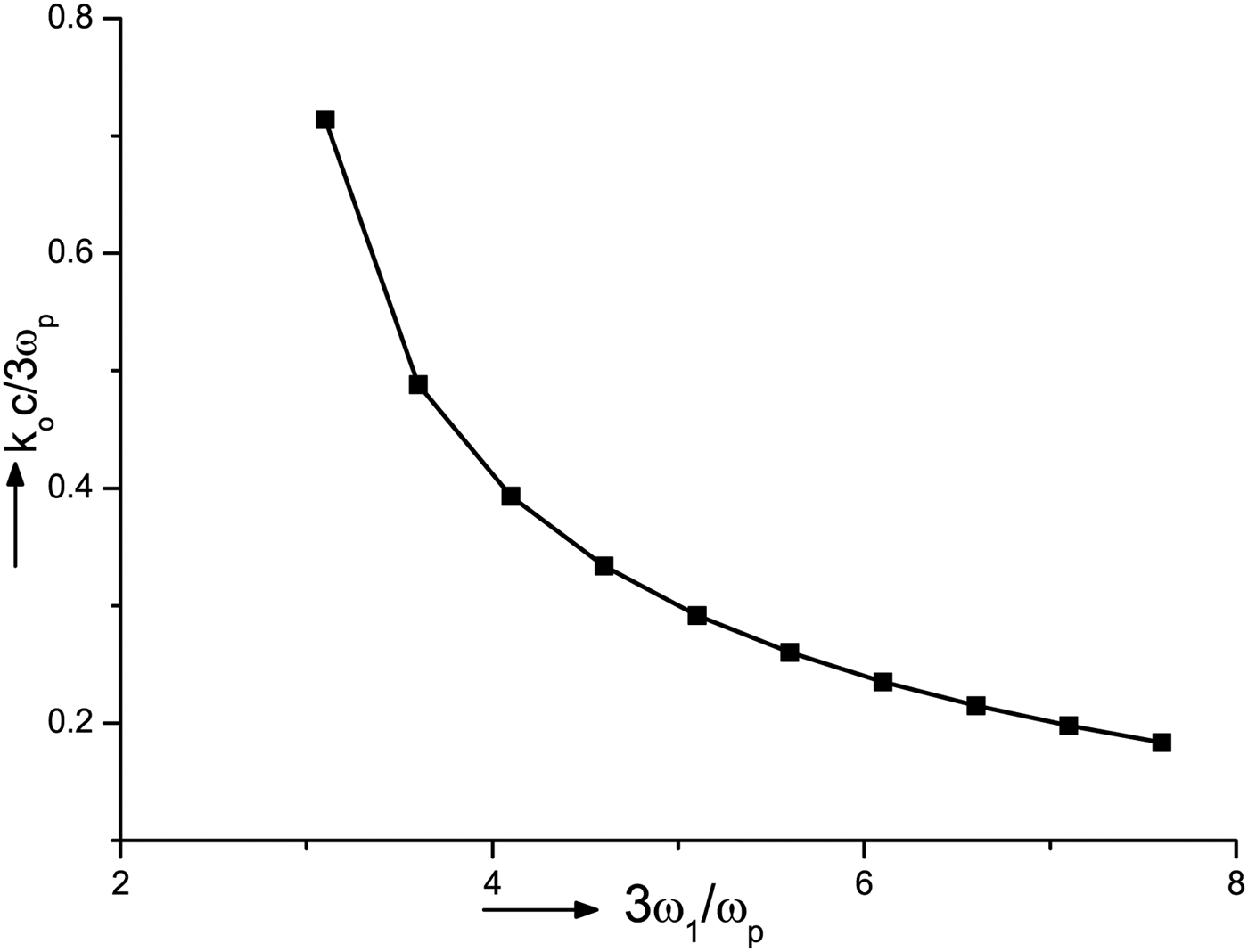
 $2 \times {10^{14}}\;{\rm c}{{\rm m}^{ - 3}}$. In Figure 1, we have plotted normalized wave number of density ripple, k 0c/ωp with normalized third harmonic frequency 3ω1/ωp for
 $n_{\rm c}^{0} {r^3} = 2 \times {10^{ - 4}}$. The normalized wave number of density ripple required for phase matching, decreases with the increase in third harmonic frequency. Figure 2 shows the variation of normalized third harmonic wave amplitude |A 3|/|A 0| with normalized distance of propagation z′ for different values of intensity parameter a 0 = eA 0/mω1c = 0.1, 0.15, 0.2. The other parameters are ωpe/ω1 = 3.558,
 $n_{\rm c}^{0} {r^3}\, = \,2 \times {10^{ - 4}}$, t′ = 4, f = 1 and
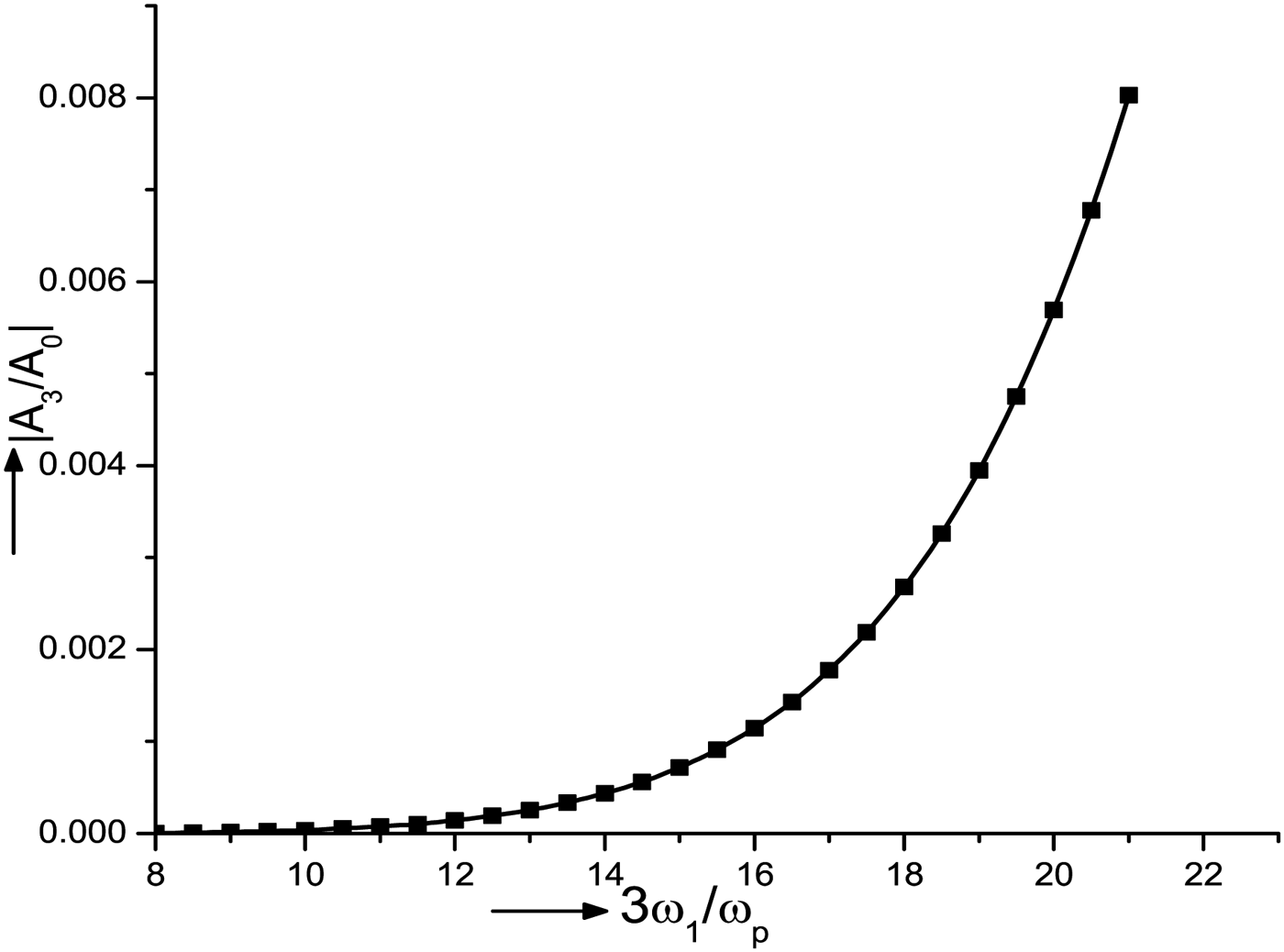
 $\sqrt {{Z_i}m/{m_i}} {{\rm \omega} _{{\rm pe}}}t = 60$. The third harmonic amplitude increases sharply at z′ =4. For z′ =4 in Eq. (28), the exponential term tends to zero and it gives the maximum amplitude of generated third harmonic wave. It is clear from Figure 2 that as we increase the value of a 0 from 0.1 to 0.2, the normalized third harmonic amplitude increases from 0.0090 to 0.0362. The normalized amplitude of the third harmonic also depends upon cluster size and increases with increase in the cluster size at a 0 = 0.2, as depicted in Figure 3. Since atomic clusters are very efficient at absorbing laser energy, so it would be significant to study the effect of laser absorption on third harmonic wave amplitude. Hence in Figure 4 we plot normalized third harmonic wave amplitude with normalized distance of propagation for different values of normalized collisional frequency ν/ω1 = 0.01, 0.02, 0.03. In this plot we observe that if we increase the collision frequency then the laser absorption increases and correspondingly amplitude of third harmonic wave decreases significantly. Therefore, at low value of collisional frequency one can get higher efficiency of third harmonic generation. Figure 5 shows the variation of normalized amplitude of the fundamental wave and third harmonic wave with normalized distance of propagation for different values of normalized time t′ = 2, 3, and 4 at a 0 = 0.2. The other parameters are same as taken in Figure 2. It is clear from Figure 5 that initially the third harmonic wave is generated in the domain of the fundamental laser pulse and as time passes, it starts slipping out of the domain of fundamental laser pulse and its amplitude increases with time. Our results are in contrast in case of plasma where the amplitude of generated harmonic wave saturates with time (Kant & Sharma, Reference Kant and Sharma2004; Rajput et al., Reference Rajput, Kant, Singh and Nanda2009; Kumar et al., Reference Kumar, Rajouria and Magesh Kumar2013). It is due to the group velocity mismatch between the fundamental laser and third harmonic pulse. The group velocity of third harmonic pulse is greater than that of fundamental laser pulse which causes pulse slippage of third harmonic pulse. Figure 6 shows the variation of normalized third harmonic wave amplitude |A 3|/|A 0| with normalized third harmonic frequency. One can clearly see from the figure that initially the third harmonic amplitude increases gradually with third harmonic frequency and after 3ω1/ωp = 16 it increases rapidly.
Variation of normalized wave number of density ripple k 0c/ωp with normalized third harmonic frequency 3ω1/ωp for the following set of parameters, ωpe = 7.565 × 10¹⁵ rad/s,  $n_{\rm c}^{0} {r^3} = 2 \times {10^{ - 4}}$, and ωp = 1.256 × 10¹⁴ rad/s.
Variation of normalized third harmonic wave amplitude |A 3|/|A 0| with normalized distance of propagation z′ for different values of normalized intensity parameter a 0 with ωpe/ω1 = 3.558,  $n_{\rm c}^{0} {r^3} = 2 \times {10^{ - 4}}$, ν/ω1 = 0.01, ω1 = 2.126 × 10¹⁵ rad/s, ωp = 1.256 × 10¹⁴ rad/s, τ0 = 100 fs, and t′ = 4.
Variation of normalized third harmonic wave amplitude |A 3|/|A 0| with normalized distance of propagation z′ for different values of cluster radius r and fixed value of a 0 = 0.2. The other parameters are same as taken in Figure 2.
Variation of normalized third harmonic and fundamental wave amplitude with normalized distance of propagation z′ for different value of normalized collisional frequency ν/ω1 and fixed value of a 0 = 0.2. The other parameters are same as taken in Figure 2.
Variation of normalized third harmonic and fundamental wave amplitude with normalized distance of propagation z′ for different value of t′ and fixed value of a 0 = 0.2. The other parameters are same as taken in Figure 2.
Variation of normalized third harmonic amplitude |A 3|/|A 0| with normalized third harmonic frequency 3ω1/ωp at a 0 = 0.2 and z′ = 4 for the same parameters as taken in Figure 2.
5. CONCLUSION
Resonant third harmonic generation in clusters with density ripple is analyzed. Density ripple of cluster electrons provides additional momentum to satisfy the required phase matching condition and makes the third harmonic generation process resonant. Third harmonic efficiency depends upon the intensity of the fundamental wave as well as on the size of the cluster. A significant enhancement in the third harmonic efficiency is observed with the increase in the intensity of the fundamental laser pulse and the cluster radius. The increase in collisional frequency of electrons causes more absorption of laser beam by cluster and hence decrease in third harmonic efficiency. Third harmonic efficiency is maximum at low value of collisional frequency. An interesting effect of third harmonic pulse slippage is also seen. Since the group velocity of third harmonic pulse is greater than that of fundamental pulse,the third harmonic pulse moves ahead of the fundamental pulse and its amplitude increases with time. The effect of harmonic generation can serve as a diagnostic tool for the presence of clusters and measurement of their size in cluster experiments. The extreme UV and X-rays emitted in harmonic generation can be used in lithography (Kubiac et al., Reference Kubiac, Bernardez, Krenz, Connell, Gutowski and Todd1996) and microscopy (Kirz et al., Reference Kirz, Jacobsen and Howells1995).
Acknowledgment
The authors are grateful to Prof. V. K. Tripathi for his valuable suggestions.