Introduction
The relation between foreign direct investment (FDI) and intellectual property rights (IPRs) is a central point in today’s concerns about economic development. FDI has historically been a significant component of modern economic growth and has benefited both pioneering nations looking for new markets and developing countries lacking in capital, skills, technologies, or entrepreneurship. It is commonly accepted that foreign investment decisions depend on ownership, location, and internationalization advantages. Footnote 1 Ownership value is also related to intangible assets such as innovative, mercantile, and organizational skills that other firms and investors do not have, as proposed first by Stephen H. Hymer, Footnote 2 and then by resource-based and evolutionary theories of the firm. Footnote 3 Indeed, during the first stages of the investment development path, FDI usually takes place through the acquisition of intangible assets such as patents and trademarks. Footnote 4 Thus, ownership should be related to the level and scope of IPRs in the recipient countries, whose patent and trademark institutions may be designed in distinct ways that favor or retard foreign applications. That might also influence the receptivity and location processes, Footnote 5 even if, as Chandler suggests, “the research organizations of modern industrial enterprises remained a more powerful force than patent laws in assuring the continued dominance of pioneering mass production firms in concentrated industries.” Footnote 6
Although dozens of works have engaged in exploring such a complex trade-off between FDI and IPRs, there are no definitive conclusions yet, as usually occurs in social science key discussions. Thus, it is possible to find both theoretical and empirical studies that support the assertion that stronger IPRs increase FDI, and just the opposite, while others eclectically claim that many and distinct institutional and economic factors that concern source and recipient countries determine that relationship. It seems plausible that without assuring certain institutional stability and a private property rights minimum (for tangible and intangible assets), it may be difficult to encourage FDI. In fact, the notion that IPR reinforcement favors both FDI and technology transfers is common in the specialized literature. Footnote 7 Nevertheless, some of these scholars qualify their findings and results depending on the type of industry or on the recipient country’s level of development. For instance, based on recent U.S., German, and Japanese FDI data, Mansfield showed that firms in the chemical and machinery and equipment industries reported that IPRs strongly influence FDI decisions, while companies in transport, metals, food, sales, and distribution do not. Footnote 8 Regarding the development level, although some works find a positive correlation between IPRs and FDI in developed countries, they also show that less-developed economies may benefit from a weaker IPR level, and that the absence of sufficient IPR protection does not reduce FDI in certain countries. Footnote 9 Furthermore, other analyses have demonstrated that, in certain circumstances, low levels of IPRs not only do not reduce FDI but to maintain control over production knowledge, they may even increase it, Footnote 10 and that strengthening IPRs above a certain point could actually decrease FDI because it could be replaced by licensing. Footnote 11
Other scholars are more critical of IPRs than the mainstream economic thought. Boldrin and Levine strongly support the notion that IPR protection is overestimated and that it should be widely reduced everywhere to promote social good, especially in a context of global innovation markets. Footnote 12 In some of their recent works, they reflect on IPR and FDI links and, although admitting that small countries with very low IPR protection may experience certain FDI inflows, they claim that it would not be scalable and that continuous strengthening of IPRs would just lead to a Nash equilibrium solution concerning international FDI. Applying a zero-sum-game logic, intangible assets’ owners would prefer to locate in countries with strong IPRs, which increases the stock of capital in the country but reduces it everywhere else, especially in countries with low IPRs. In the absence of international cooperation, the tendency will be to strengthen IPRs everywhere, although the total amount of FDI would be the same as if all countries were guaranteeing low levels of IPRs and not strong monopolies. Footnote 13 In fact, some previous empirical work that analyzed U.S. investments in thirty-three developed countries claimed similar findings, sustaining that IPR (patent) protection was insignificantly correlated with FDI inflows and that developing economies should be well aware of these results. Footnote 14
Thus, the effects of IPRs on FDI seem to be theoretically ambiguous Footnote 15 and empirically contradictory. Footnote 16 Moreover, recent studies stress the need to take into account multiple unobserved country-specific factors (institutions, culture, development level, schooling standard, imitative capacities, social capital level, etc.) that strongly determine the relationship between the level and scope of IPRs and FDI. Footnote 17 Herein, we claim that historical dynamics and long-term approaches also have to be included both in the theoretical framework and, especially, in the empirical research. Scholars lack detailed long-term analyses and data that would, first, contribute to the development of general theories concerning FDI and IPR phenomena, and second, allow for testing the distinct theoretical hypothesis. In fact, the majority of today’s research focuses only on recent periods and on how IPRs influence FDI. It is necessary to reverse the question and explore the historical evidence.
Based on our research, we claim that FDI and IPR extensions over the long term are parts of the same coevolutionary process. The expansion of international business (IB) throughout the nineteenth century, and especially corporate and multinational IB from the 1870s onward, become key for understanding local IPR reinforcement and international IPR agreements. Hence, our initial hypothesis is that it was the expansion of IB and capitalism that drove the growth and widening of IPRs, not the opposite. The business globalization required, and continues to require, a worldwide defense of intangible assets for maximizing revenues. This process spread throughout the world during the twentieth century, until reaching the current international situation and concerns, of which many scholars continue to ask erroneous questions. IPRs, as understood today, are more the consequences of than the causes of FDI expansion. IPRs are strategic tools that multinational enterprises (MNEs) have helped to develop and have learned to manage. Likewise, FDI recipient countries have been able to tune these tools either to favor foreign investors or to hinder foreign intellectual monopolies.
As far as we know, there are no previous long-term theoretical or empirical analyses of FDI and IPR links such as the one we have carried out based on significant FDI proxies and outstanding IPR data for Spain, a lagging country of the European periphery. Spain was the recipient of notable European and North American FDI during the nineteenth and twentieth centuries, and it developed a “hybrid” IPR system that, while fitting international standards, required actual investments to maintain intellectual monopolies. In this work, we draw a widespread picture of the historical role and origin of foreign capital in the Spanish economy, and compare it with the evolution of foreign IPRs in the country from a macro-level perspective. Through painstaking and long-term research on thousands of original files at the archive of the Spanish Patent and Trademark Office, we were able to study thoroughly all of the intellectual monopolies granted to foreigners in Spain (between 1820 and 1939 for patents and between 1850 and 1916 for trademarks), which includes information on applicants; on protected technologies and products; and also on monopolies’ actual duration, on compulsory working clauses, and on license and assignment practices.
With this work, we, first, wanted to find out whether the character of the Spanish IPR regime had any influence on the evolution of FDI in the long term; second, we wanted to deepen the research into the relationship between FDI and foreign IPRs in Spain regarding countries of origin and sectors of activity; and, finally, we wanted to disentangle the distinct IPR management strategies that followed foreign applicants from countries with different investment interests in Spain.
In the next section, we examine how IPRs became a global issue as the international economy expanded. In the following sections, we characterize foreign investments in Spain over the long term; provide aggregate data on the evolution of foreign patents and trademarks in Spain before World War II; explain foreign IPR duration and licensing as ways to measure distinct IPR strategies; and in the last section we provide several concluding remarks.
Global IPRs for Global FDI
Over the last two hundred years, the history of FDI has, overall, followed an upward, but not linear, trend with major ebbs and flows. Based on the booming of the Atlantic economy in the eighteenth century, which created lucrative opportunities for merchants, the processes of national market integration and international globalization accelerated rapidly in the nineteenth century. Additionally, the technological changes of the First Industrial Revolution and, especially, those of the Second Industrial Revolution, resulted in a reduction of transport and communication costs. The spread of modern economic growth created a worldwide search for markets and raw materials that reinforced the extension of multinational corporations, Footnote 18 imperialistic attitudes, Footnote 19 and adoption of the gold standard. Footnote 20 By 1914, a remarkably integrated global economy was in place, not only in capital flows but also in trade, migration, prices, and technologies.
The outbreak of World War I broke this trend and was the beginning of a progressive dismantling of the global economic framework, which was definitively destroyed by economic and political shocks. Footnote 21 The European FDI was eliminated through wartime requisition and the Russian Revolution. The Wall Street crash of 1929 represented the “coup de grace” for the global economy, Footnote 22 which collapsed during the 1930s and World War II. Barriers to the mobility of people, trade, capital, knowledge, and technologies were erected, despite FDI proving its flexibility through new corporate strategies and cartel agreements. Footnote 23
During the so-called Golden Age of Capitalism, after World War II, the global economy was slowly rebuilt, with the progressive removal of trade barriers and exchange controls, at least between North America and Western Europe. Footnote 24 MNEs were the primary drivers of the flow of foreign investment across the globe. However, almost half of the world’s economy (USSR, China, and other communist countries) remained disconnected from global capitalism, and significant restrictions on FDI remained. Despite the oil shocks in the 1970s, MNEs continued their strategies of building integrated businesses in some regions, such as Europe; this integration became global in the 1980s and, especially, in the 1990s. As Jones points out, by the twenty-first century, almost two-fifths of world trade was intrafirm. Footnote 25 MNEs were, once again, the primary drivers of the integration of countries, such as China, into the world economy. However, the influence of location and geography seemed as strong as ever.
In this long-term framework, an increasing flood of international foreign investments improved legal certainty for businesses and firms among distinct countries. Gradually, over the nineteenth and twentieth centuries, North Atlantic economic, political, and legal systems converged across elementary points. As in other fields, private property rights soon emerged as the most suitable way to manage intangible goods (facilitating, therefore, the “ownership” factor). Given the increasing economic significance of new inventions and ideas, distinctive signs and writings, and the difficulties of excluding imitators, emerging liberal governments began enacting patent, trademark, and copyright laws. The changes began in England when the 1624 Statute of Monopolies was passed, and the privileges granted to inventors of new technologies were distinguished from additional arbitrary economic privileges. Footnote 26 Although it was not perfect, and perhaps because of that, the statute remained in force until 1852, providing a basic framework for invention protection and diffusion during the First Industrial Revolution.
The newly independent United States in 1790 Footnote 27 and the revolutionary France in 1791 Footnote 28 were the countries that established fully modern patent laws. During the first half of the nineteenth century, many other countries also enacted patent legislation, including the Netherlands (1809), Austria and Hungary (1810), Sweden (1819), Portugal (1837), Spain (1811–1826), distinct Italian and German states existing prior to their unifications, and several newly formed Latin American nations. From 1850 to World War I, patents were in force in nearly every relevant economy. Footnote 29 Furthermore, throughout the twentieth century, guarantees of ownership of inventions and IPRs in general were widened and adapted to an increasingly complex industrial and economic world, led by corporations and MNEs.
New modalities such as trademarks, utility models, industrial designs, and commercial names appeared. Distinctive signs, for instance, traditionally had been used for highlighting local craft workshops and goods in the guild system, as well as outside of guilds, during the “Ancient Regime” in the eighteenth century. Footnote 30 As occurred with invention protection during the nineteenth century, albeit belatedly, fully modern trademark laws were passed in numerous countries and national registries were established. To our current knowledge, Spain pioneered modern national trademark legislation in 1850, followed by France in 1857, and several other countries during the second half of the nineteenth century, including the United States (1870) and the United Kingdom (1875–1876). Austria, Belgium, the Netherlands, Sweden, Norway, Portugal, and some German and Italian states had already enacted trademark laws starting in 1862. Footnote 31
The Second Industrial Revolution is associated with certain well-known technological, economic, and institutional shifts that also affected IPRs. Even as an international and integrated market for products and factors soared, protectionist and nationalist policies reentered the stage. Firms progressively changed their commercial and productive strategies toward innovation, product differentiation, international investments, and the establishment of foreign subsidiaries. In this process, defending IPRs globally became crucial. Although the majority of countries guaranteed “de facto” intellectual protection to foreigners, aliens were not always treated as nationals in all patent and trademark laws, especially at early stages of legal development. Footnote 32 Thus, the globalization of IPRs began, first, by including foreigners in national legislation; second, through the means of bilateral agreements among distinct countries for respectively guaranteeing the same rights to citizens from both nations involved; and, finally, by the signing of a general international treaty wholly focused on the subject: the 1883 International Union for the Protection of Industrial Property, which remains in force today.
E. Penrose’s classical study, Economics of the International Patent System, Footnote 33 clearly described the path to the agreement. After negotiations, revisions, and amendments, the Convention of Paris of March 20, 1883, calling for an International Union for the Protection of Industrial Property, was finally approved and signed; in 1884, fourteen countries exchanged ratifications. Footnote 34 This first agreement showed a “contradiction” that still occurs frequently today between the necessity for negotiating an international common framework, which usually might benefit all the players as a group, and the strong will for defending particular domestic interests. The notion of a “universal law” on IPRs was soon rejected, after the differences among distinct legal traditions and patent and trademark requirements were realized. Thus, in 1883–1884, several general principles emerged: regarding national treatment for foreigners (Article 2); priority rights for registering previous patents, trademarks, or industrial designs in the signing countries (Article 4); Footnote 35 security that importing one’s own patented objects or under one’s own trademarks from abroad would not forfeit IPRs (Article 5); and temporal protection in international exhibitions (Article 11).
Nonetheless, there was no initial agreement on how to abolish controversial points, such as compulsory licenses if the “public” (national) interests should require them or the right to revoke patents and trademarks if they were not implemented. In many countries, the national legislation obliged IPR owners to invest in and manufacture protected machines, procedures, or products within the country; otherwise, owners would lose their monopoly. The right to establish such compulsory working clauses was finally included in the 1883 agreement (Article 5)—with opposition from Belgium and the United Kingdom—and in further treaty revisions—with opposition from Italy (1886) and the United States (1890). In the 1911 revision, Germany and the United States (two countries with increasing investments and interests abroad) fought against compulsory working clauses, with strong opposition from the Netherlands, Spain, Australia, France, and, the United Kingdom. The final results were (1) the introduction of at least a three-year period for working the patent, and (2) the possibility for the patentee to justify that patent’s failure to work. Finally, in a 1925 conference, patent revocation, due to compulsory working clause requirements, was substituted with the mandatory offer of patent licenses: only if the licenses were not adequate could patents be revoked. Footnote 36
The 1883–1884 agreement also established the International Bureau for the Protection of Industrial Property—the predecessor of the current World Intellectual Property Organization (WIPO)—in Bern, Switzerland. There were new amendments to the Convention of Paris in Rome 1886, in Madrid 1890, in Brussels 1897–1900, in Washington 1911, and in The Hague 1925. The treaty was also revised and developed in London in 1934, in Lisbon in 1958, and in Stockholm in 1967 and 1979, although the basic principles established at the end of the nineteenth century remain in force in 174 signing countries. In 1934, for instance, the inventor’s right to be mentioned in the patent was introduced, which clearly demonstrates the extent to which corporations had already captured the international system. Complementary agreements to the Convention of Paris also emerged in some of the conferences or meetings, such as:
-
• the 1891 Madrid Arrangements (1) for the Repression of False Indications of Source on Goods, and (2) for the International Registration of Trademarks;
-
• the 1925 Hague Agreement for the International Deposit of Industrial Designs and Models;
-
• the 1958 Lisbon Agreement for the Protection of Appellations of Origin and their International Registration;
-
• the 1977 Budapest Treaty for International Recognition of the Deposit of Microorganisms for Patent Purposes;
-
• the 1989 Madrid Protocol, relating to the Madrid Agreement concerning the International Registration of Marks; and significantly,
-
• the 1970 Washington Patent Cooperation Treaty (PCT).
From 1886 onward, several agreements that focused on copyright (literary and artistic works, phonograms, etc.) completed the extension and globalization of IPRs. Footnote 37
Some of the aforementioned treaties and their revisions established international registries that allowed—and still allow today—for the possibility of an easy extension of rights among contracting countries through a single application to the International Bureau. The most significant are the 1891 agreement on the arrangement for international trademarks (currently ratified by 56 countries); the 1925 agreement on industrial design (60 countries); and the 1970 PCT (146 countries). Although national states retain the final decision and can reasonably oppose certain concessions in their territories, these agreements have become a significant shortcut for defending IPRs, especially for multinational corporations, which can cheaply and easily “buy time” and generate “right expectations” in many countries through a simple international application. In addition, regional-level convergence in IPR issues soared in distinct world areas, Footnote 38 as occurred in the European Union through the means of the European patent (1973); the community trademark (1994); the community industrial design (2002); the current, and still controversial, European Unitary patent (2012); and several copyright directives, such as those affecting computer programs (1991) and copyright duration (1993). Footnote 39
Nevertheless, the most significant and recent step toward IPR globalization has probably been the creation of the World Trade Organization (WTO) in 1994, whereby an Agreement on Trade-Related Aspects of Intellectual Property Rights (commonly known as the TRIPS) was developed. Footnote 40 The TRIPS was crucial to defend developed countries’ commercial interests against illegal copying of technology, industrial design, and distinctive signs, especially in small- and medium-size underdeveloped economies that could face severe trade sanctions. Even big economies, such as China’s, had problems entering the WTO because the prevalence of fake activities became a particular barrier to trade with certain countries, such as the United States during the 1990s. Footnote 41
As international treaties, arrangements, and agreements on IPRs spread, national laws evolved and adapted to comply with new rules. In that long process, corporations certainly influenced IPR institutions at both domestic and international levels in their eagerness to expand the ownership and control of their intangible assets. For some critical scholars, such internationalization was not neutral but actually enhanced the rights of IPR holders as “tools of power and control over technology and people.” Footnote 42 For mainstream scholars, strong international IPRs are required for guaranteeing legal certainty in the new “knowledge economy” and for promoting both innovation and technology transfers. Footnote 43 In either case, FDI and IPRs have undoubtedly coevolved in the same direction, which is that of globalization.
Foreign Investment in Spain before World War II
Since its early days, foreign influence has been a strong and positive determinant of Spain’s economic and business modernization. The available evidence demonstrates that Spain, as a less-developed economy, was a major recipient of foreign capital as well as a net importer of technology throughout the long nineteenth century (c.1800–1936). Footnote 44 However, the FDI data in Spain lack continuity and reliability for many periods. Even though some authors have tried to calculate those flows over time, Footnote 45 we prefer to use other proxies for FDI, such as the number of foreign businesses operating in Spain between 1820 and 1914 and the amount of global capital (in million pesetas) invested in Spain by sectors and countries between 1851 and World War I. In our opinion, such data, although not perfect, are more reliable for approaching long-term inward FDI because they were collected from outstanding information existing in significant European and American archives. Footnote 46
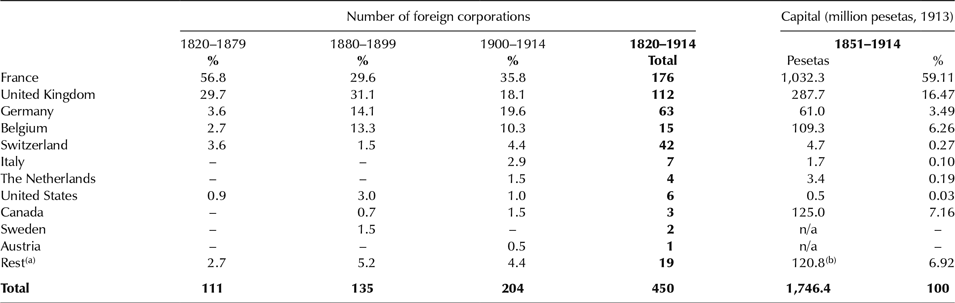
As Table 1 shows, before World War I, four main investors in the Spanish economy stand out: France, the United Kingdom, Germany, and Belgium. Among them, French capital and institutions were the most prominent influence in the Spanish economy. Footnote 47 In reality, France’s hegemonic position was not only a consequence of geographical proximity (location) but also of institutional receptivity. French investment focused principally on railways and mining, as well as on certain public utilities, activities that required a friendly legal framework, industry-oriented financial institutions, and adequate human resources needed to increase the receptivity of the country. The significant advantage of French investors operating in Spain was based on investment banks, developed for sustaining international businesses, a process that became highly visible during the belle époque through the Rothschild and Péreire families. Footnote 48 Less prominent enterprising families also played roles in nineteenth-century Spain. For instance, families such as the Cros, the Lebon, the Mahou, the Delclaux, and the Rivière achieved dominant positions in Spanish chemical, gas, beer, glass, and metal industries. Footnote 49 With the assistance of Spanish partners, and with their capability to integrate quickly into their new environment, these firms demonstrated a remarkable ability to survive.
Foreign corporations operating in Spain (1820–1914) and their capital in million pesetas (1851–1914)
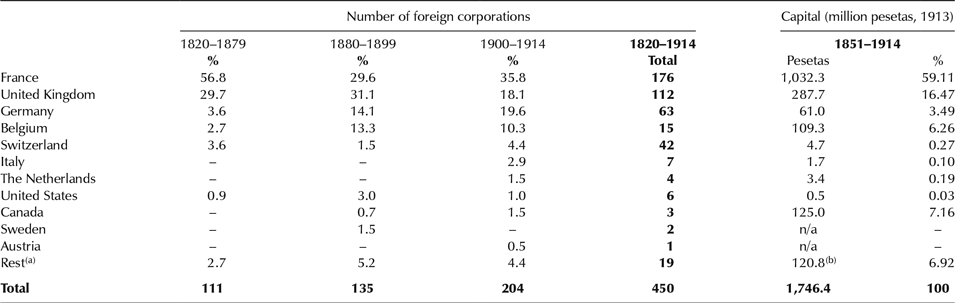
Source: T. Tortella, Guide to Sources of Information.
(a) “Rest” includes firms from Norway, Argentina, Czechoslovakia, Denmark, and Mexico. In the case of capital, “Rest” cannot be disaggregated; thus, we do not know the exact amount invested by firms from Sweden and Austria.
Even though French investors had to face Spain’s chronic political instability, a narrower-than-expected domestic market, and mounting protectionism, the French investment pattern proved strikingly persistent. The fact that fourteen of the twenty-five largest Spanish industrial firms in 1917 were under French control gives an idea of how important French capital and know-how had become on the eve of World War I. Footnote 50 Among such companies, we find economic interests in railways (Compañía de los Caminos del Hierro del Norte de España, Compañía de los Ferrocarriles de Madrid a Zaragoza y Alicante), public utilities (Catalana de Gas y Electricidad, Gas Lebon), and metallurgy (Sociedad Minera y Metalúrgica de Peñarroya). Footnote 51 Unsurprisingly, French investment left a strong imprint on Spanish institutions, business administrations, and managerial practices, including on IPRs. It influenced the design of laws that regulated foreign investment in Spain, especially in railways (1855), banking (1856), and mining (1859). Footnote 52 Likewise, the modern Spanish patent system was decreed under Joseph Bonaparte’s French government in 1811, and the subsequent Spanish laws of 1820 and 1826, in force until 1878, retained their original French influence. Footnote 53 Spain and France also followed similar patterns of premodern local trademark protection, and the 1850 Spanish and 1857 French trademark laws were the first in Europe to grant trademarks on a national scale. Footnote 54
The British imprint was comparatively weaker and delayed to the last quarter of the nineteenth century (see Table 1). Although British companies also showed an interest in Spain, their subsidiaries seldom established strong links with the existing entrepreneurial structure. This pattern became evident in mining. In other industries in which British capital and know-how were relevant, such as alcoholic beverages, textiles, metal, shipbuilding, and hotels, their competitors were quick to adopt British business practices. British heritage was particularly intense in southwest Spain (Jerez, Huelva) and the urban and industrialized areas of the north coast (Bilbao). The largest British companies with Spanish subsidiaries included Tharsis Sulphur & Copper, Rio Tinto, Vickers, and Coats. In some joint ventures, local partners played crucial roles. Basque and Catalan financial groups and industrial dynasties, such as Urquijo, Ybarra, Gandarias, and Portabella, were the most important, as was King Alfonso XIII, who attracted many British investors to his businesses. Footnote 55
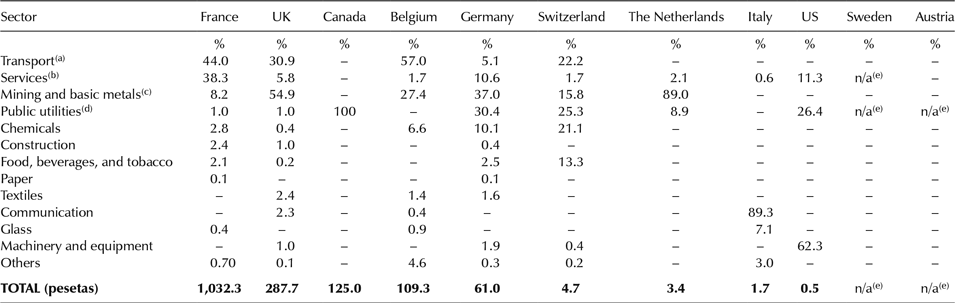
Another major investor in Spain was Belgium (Table 2). From the mid-nineteenth century to the 1890s, they focused on railways (Ferrocarril Central de Aragón, Ferrocarriles del Este de España); banking (Banco Comercial Español); and mining (Real Compañía Asturiana de Minas), often associated with French and British interests. Footnote 56 When the Germans increased their investments in Spain, the Belgians were frequently linked with their neighbors. This was the case for trams (Tranvías Eléctricos de Murcia, Tranvías del Este de Madrid, Tranvías de Galicia); electricity (Sociedad Española de Lámparas Eléctricas “Z,” Société Financière de Transport et d’entreprises Industrielles–SOFINA); chemicals (Solvay); and even ventures such as the Palace Hotel in Madrid. This switch in partners could explain the importance of Belgian capital in Spain until World War I and its apparent withdrawal in the interwar period. Footnote 57
Main direct investors in Spain by country and sector, 1851–1914 (in millions of pesetas, 1913)

Source: T. Tortella, Guide to Sources of Information.
(a) Includes shipbuilding and automobiles.
(b) Includes banking and finance, general trade, and commission agents.
(c) Includes iron and steel.
(d) Includes electricity, gas, and lighting.
(e) The amount of capital is not available, but we found two Swedish firms in services and one (as well as one Austrian firm) in public utilities.
The development of the first globalization provoked large losses for French and British investors, who had to face increasing competition from German and U.S. firms. These newcomers drove the second industrialization wave on scientific and financial bases substantially different from the first industrial wave, and which required deepening intangible asset protection and ownership. Despite Spain’s mounting protectionism starting in the 1880s, foreign capital found no barriers before World War I. In fact, Spain became one of the countries in which the great powers fought to keep their political and economic hegemony. Protectionism and economic nationalism had a strong influence on the dealings of foreign firms in Spain, actually encouraging direct investment, joint ventures, and some friendly takeovers of foreign assets by national companies.
The trends at the end of the nineteenth century continued during the interwar period. Officially, French capital kept its historical leadership. Footnote 58 Nevertheless, it was no longer focused exclusively on railways, mining, and utilities, but was now on more cutting-edge activities. This was the case of Air Liquide, Rhône Poulenc, Sociedad Española del Oxígeno, Sociedad Ibérica de Construcciones Eléctricas, Péchiney, and Saint Gobain. Despite the change of path, French FDI was threatened by strong German investments in sectors such as the electrical industry (Siemens, AEG, Telefunken, and Osram); chemical and pharmaceutical industries (IG Farben, Footnote 59 Continental, Schering, Merck, Boehringer, La Minera/Fodina, Abelló Oxígeno Linde); insurance (Plus Ultra, Deutsche Lloyd); and trams, often associated with Belgians, as mentioned previously.
Thus, despite their official “preponderance,” French businesses in interwar Spain began to show weaknesses. French firms lost power within the international cartels that ruled most of the science-based industries in which Spanish partners had passive roles. This slippage was a concern for the French authorities, which became worried about the rise of competitors’ influence in Spain. André Barthe, reporter of the French Chamber of Commerce in Madrid at that time, summarizes the mood of French capitalists: “Malgré les avertissements, les jouets sont allemands, les machines sont américaines et les objets de la mer sont anglais … Il ne reste pas grand-chose à obtenir, mais ce qu’il reste devra être combattu” (“Despite the warnings, toys are German, machines American, ship equipment English … there is not much to get but what remains has to be fought”). Footnote 60
Unsurprisingly, the Second Industrial Revolution in Spain had a strong German imprint. German companies held close ties with industrial banks, particularly Deutsche Bank. Its Spanish subsidiary, the Banco Alemán Transatlántico, played an important role in the strategy and operations of the largest German firms in prewar Spain. Although most of those firms were mainly commercial, German investment was strongly industrial, linked to the science-based sectors, and sustained by patents and partnerships with Spanish domestic industrial firms. The German influence especially increased between the Spanish Civil War and the end of World War II. Footnote 61
The U.S. investments in Spain were not outstanding before World War I. Although Tortella’s work in Table 1 do not systematically collect data on all U.S. ventures, recent studies focusing on investments found no more than fifteen North American firms operating in Spain before 1914, mainly in food industries, light machinery, chemicals, and services (banking and insurance). Footnote 62 Even though other evidence reveals early U.S. investments cloaked in joint ventures with Spanish capitalists or other foreign firms, Footnote 63 we conclude that the North American direct presence was scarce. Notwithstanding, during the interwar period, U.S. investments began to increase in Spain, reaching 72.2 million (current U.S. dollars) in 1929. Footnote 64 Eventually, during the 1950s, and mainly from the 1960s onward, U.S. MNEs joined traditional French, German, and British interests in the Spanish economy, and spread significant investments throughout distinct economic sectors. Footnote 65 However, France and Germany gradually recovered their prominence in the Spanish economy, especially after Spain’s entry into the European Union in 1986, which was strongly supported by these two countries. In fact, France and Germany were the partners that benefited most from the new Spanish economic framework within the EU. Footnote 66
Foreign Intellectual Property in Spain before World War II
Industrialization and globalization were phenomena linked with capital formation. During the nineteenth and twentieth centuries, the investments for generating and expanding capital goods were increasingly related to the creation or discovery of new information, a process with serious appropriation problems. Footnote 67 The development of national and international IPRs—patents, trademarks, industrial design, or copyrights—were necessary responses to safeguard information embedded in new inventions, designs, and knowledge. Thus, from the beginning, foreign investors, capitalists, inventors, and firms had to manage and deal with distinct IPR regimes from countries at different development stages, connected more often by international agreements. It is reasonable to think that the two issues, FDI and IPRs, were closely related and that complementary strategies for investment and intellectual protection existed.
As we have shown, Spain was the recipient of significant FDI from the most developed European economies throughout the nineteenth century and the first third of the twentieth, with a gradual presence of North American investments starting in the 1880s. From 1820 to 1826, Spain established a basic patent system Footnote 68 that was completed with the 1834 copyright act, Footnote 69 the 1850 trademark law, Footnote 70 and finally the 1878 patent law. Footnote 71 The industrial property laws of 1902 and 1929 jointly ruled inventions and distinctive signs and extended the protection to new modalities, such as utility models and industrial design (drawings and models). Footnote 72 This IPR system remained in force in Spain until 1986, when it joined the European Union. The new laws of 1986 and 2015 (patents), 1988 and 2001 (trademarks), 2003 (industrial design), and 1987, 1996, and 2014 (copyright) Footnote 73 updated the IPR framework to the European standards.
Previous works have described the pre-1986 Spanish IPR system as “hybrid.” Footnote 74 Location and receptivity theories predict that less-developed countries with few comparative advantages in international markets (which certainly includes markets for innovation) need to establish a basic legal framework to attract FDI. In this case, the Spanish IPR laws brought just enough protection to fit basic international standards and to allow foreigners to register intangible assets but, at the same time, they maintained harsh domestic protections through compulsory working clauses (for patents and trademarks); patents of introduction (which allowed the registering of others’ inventions if they were not implemented within the national territory); and discriminatory measures against foreign trademark owners, who, before 1883, had to open an industrial establishment in Spain. Footnote 75 These domestic restrictions on intangible ownership do not seem to have stopped foreign patenting and trademarking during the period studied. On the contrary, as occurred with FDI in the Spanish economy, foreign IPRs constantly increased.
Such restrictions were not very different from what originally occurred in many other countries in their early development stages. The United States, for instance, discriminated against foreigner patentees until 1861 and did not recognize foreign copyright at least until 1891, Footnote 76 and similar measures existed in Japan’s patent law from 1871 to 1899. Footnote 77 During the nineteenth century, many countries promoted “patents of introduction or importation” to encourage the adoption of foreign technologies without respecting original foreign patents Footnote 78 ; or, as in France between 1844 and 1883, a first patent abroad blocked the possibility of a domestic patent even to the original inventor. Footnote 79 In the early stages of development, all trademarks were restricted to domestic (or foreign resident) manufacturers.
In Spain, except for the aforementioned trademark supposition (and without any restrictions for signing countries after the 1883 Convention of Paris), foreign applications were fully accepted from the beginning, although other domestic protection measures, such as patents of introduction or compulsory working clauses, remained active until 1986. Thus, a complete national register for both domestic and foreign industrial property, from 1820 for patents and from 1850 for trademarks, is available. Thanks to an outstanding agreement between the Oficina Española de Patentes y Marcas (Spanish Patent and Trademark Office; OEPM) and the Universidad Autónoma de Madrid (Autonomous University of Madrid; UAM), our research group, over the last twelve years, was able to analyze and catalog in detail Spain’s first 150,000 patent files (1820–1939) and 36,000 trademark files (1850–1916). Footnote 80
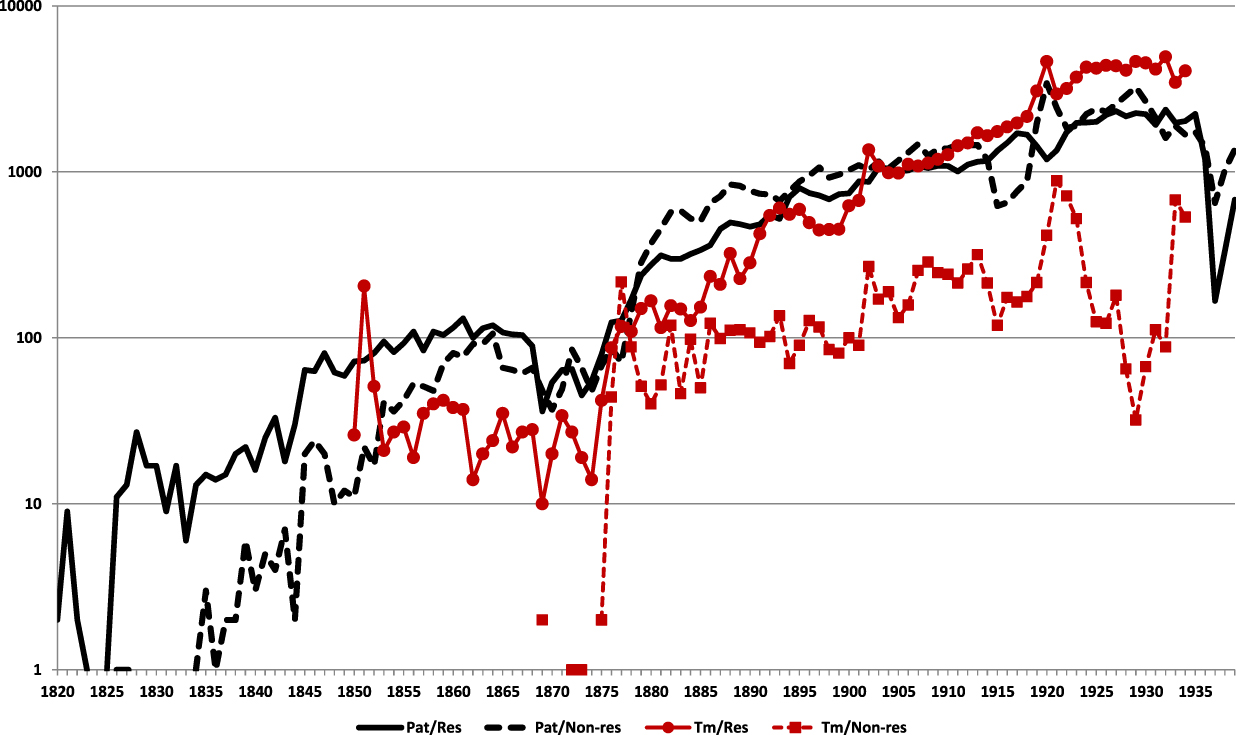
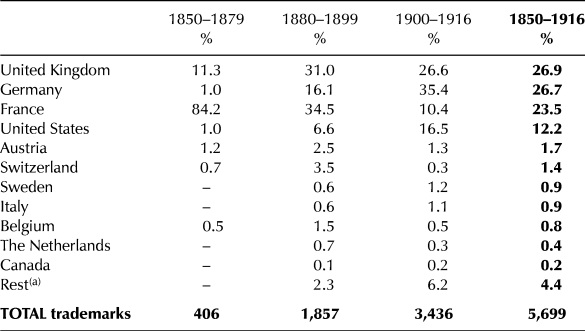
Figure 1 disaggregates the patent and trademark applications in Spain by place of residence and reveals two distinct phases regarding foreign participation. In the first phase, before the 1870s, domestic applicants for patents, and especially for trademarks, exceeded nonresidents. Furthermore, among those residents, very few were foreigners. During this first period, the IPR system was just established and annual grants were scarce, corresponding to a phase of political instability, especially before 1845 and between 1864 and 1876. Notwithstanding, this phase saw the first modern economic growth linked to railways, banking, and certain industrial activities that were highly concentrated in Catalonia, in Madrid, in the Basque Country and some other areas of the north, in Andalusia, and along the Mediterranean coast. Footnote 81 Thus, industrial foreign investment was hard to find before 1845, and until the 1880s (see Table 1), it was dominated by French proximity and influence. This coincides with France’s supremacy in its number of patents and trademarks in Spain before 1880 (Tables 3 and 4).
Patents and trademarks in Spain by applicant’s residence, 1820–1939 Sources: Archivo Histórico Nacional; Gaceta de Madrid (for patents 1820–1826); OEPM (for patents 1826–1939, trademarks 1850–1916); and WIPO (for trademarks 1917–1934).

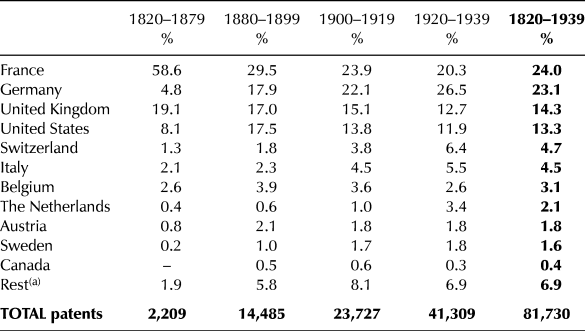
Foreign patents in Spain by applicant’s country of residence, 1820–1939

Sources: Same as Figure 1.
(a) “Rest” comprises 69 countries, each with less than 1 percent of patents.
Foreign trademarks in Spain by applicant’s country of residence, 1850–1916

Sources: Same as Figure 1.
(a) “Rest” comprises twenty-four countries with less than 0.4 percent of trademarks, but the table does not show Cuba (0.9 percent), Argentina (0.8 percent), or Denmark (0.4 percent).
As Figure 1 demonstrates, from the end of the 1870s to 1939, a new phase in industrial property arose. The numbers of patents and trademarks in Spain increased during this period, as did foreign interest in applying for them. The growth in nonresident patents and trademarks can be explained by technological shifts linked to the Second Industrial Revolution, the appearance of new goods and selling strategies, increased international competition among North Atlantic economies, and new corporate strategies for managing intangible assets outside the national borders, along with Spanish institutional and economic improvements. Starting in 1880, foreign patentees outstripped domestic ones throughout the entire period analyzed, with World War I being the only exception. In fact, a significant percentage of Spaniards, as well as foreign residents living in Spain, applied for “patents of introduction” for alien technologies, which made Spanish technological dependence even higher. Footnote 82 The number of foreign trademark owners also grew during this period: first, after bilateral agreements for trademark protection between Spain and France (1876), the United Kingdom (1876), and the United States (1882); and, second, after the 1883 International Agreement on Industrial Property was signed. Footnote 83 However, unlike patents, domestic trademarks always outnumbered foreign ones. Trademarks protect product distribution within a domestic market, so it seems reasonable that resident industrialists, manufacturers, and businessmen dominated national scenarios. Similarly, protectionism and especially the impact of World War I and the commercial contraction during the interwar period were matters that negatively affected the international spread of trademarks (see Figure 1).
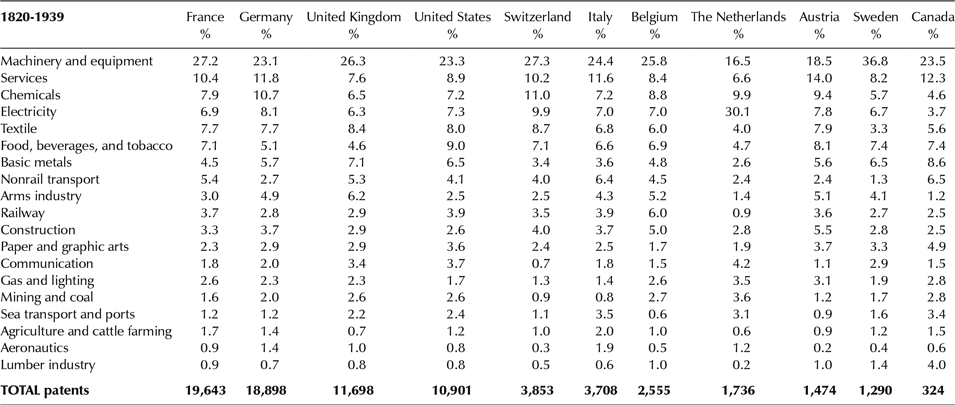
Unsurprisingly, the majority of foreign patent and trademark applications came from the same group of developed countries that invested in the Spanish economy throughout the long nineteenth century (see Tables 1, 3, and 4). Three countries—France, Germany, and the United Kingdom—comprised 73 percent of the firms operating in Spain and 79 percent of the capital invested before World War I. Until World War II, they also obtained almost 62 percent of the patents and 77 percent of the trademarks for which nonresidents in Spain applied. Thus, as the main foreign investors, they were also the main users of the Spanish IPR system. The first was France, which dominated this scenario before 1880; this was followed by the United Kingdom, which maintained participation in patents during the period studied and increased its trademark applications after 1880; and then by Germany, which over time intensified its presence throughout the IPR system, even more than our FDI data show.
Therefore, the industrial property data indicate that while France was initially Spain’s principal investor, it gradually lost ground and influence to Germany after the Second Industrial Revolution. Patent series confirm the scientific and technological bases for German expansion, not only prior to World War I but also in the 1920s and 1930s, when Germany became the most significant foreign patent owner in Spain (see Table 3). As the trademark proxy shows, Germany was the leader in several new knowledge-intensive industrial sectors, and it seemed to know how to penetrate foreign consumption markets after the first globalization process emerged (see Table 4). The United Kingdom also extended its investment in trademarks starting in 1880; while France, the leader in trademarking during the first three-quarters of the nineteenth century, slipped until World War I.
As noted above, U.S. investments in Spain were anecdotal before World War I and, although they increased, investments did not especially stand out during the interwar period. However, the United States incrementally increased its ventures in Europe during the last quarter of the nineteenth century. Significant early U.S. investments in most developed European countries occurred through the expansion of American corporations. For example, in the 1880s, several of Edison’s electric lighting firms were established in France, Germany, and the United Kingdom. Footnote 84 During the 1890s, Babcock Wilcox subsidiaries were set up first in Great Britain and then in France and Germany Footnote 85 ; and during the 1900s, the American Radiator Company set up subsidiaries in many countries. Footnote 86 Before World War I, Europe, and especially the United Kingdom, received roughly 20 percent of U.S. direct investment. Footnote 87 Nevertheless, the United States’ role as an international financial power became critical only after World War I, and especially after World War II via FDI. Footnote 88
A strong component of U.S. international expansion was, and still is, based on scientific and technological knowledge added value. As happened in Germany, but on an even larger scale, U.S. innovation processes and policies changed the entire United States’ economy and entrepreneurial context. Thus, from the beginning, management of IPRs was a critical concern for U.S. international interests. When Europe became a business target, U.S. companies began to apply for thousands of patents and trademarks. Before World War II, U.S. IPR strategies in Europe had to include distinct countries, regardless if they were recipients of direct investments. Proof of this is seen in the increased presence of U.S. intangible assets in Spain throughout the period studied—around 13 percent of both foreign patent and foreign trademark applications—which ranked the United Sates fourth among foreign IPR owners.
Meanwhile, Canada and Belgium, which were more relevant in direct investment before World War I, were less represented in the Spanish IPR system. As mentioned previously, during the period studied, Belgian investments in Spain were centered on railways and mining, and Canadian ventures were concentrated in an electrical entrepreneurial conglomerate (Barcelona Traction). Footnote 89 As some literature has shown, these sectors required significant amounts of fixed capital, which led to natural monopolies and made IPR protection less crucial for some firms, especially in mining, metals, and transport. Footnote 90 Finally, five countries—Switzerland, Italy, the Netherlands, Austria, and Sweden—began to compete internationally starting in 1880, made small investments in Spain, and applied for a few patents and trademarks.
As Table 5 shows, and as shown in the literature, patents from all the aforementioned countries were especially concentrated in heavy industries, such as those related to machinery and equipment, the chemical sector, and electricity, and to lesser extents in basic metals, mining, or transport industries. Footnote 91 However, light industries (including textiles, food, beverages, and tobacco) and the service sector also attracted significant foreign innovation activity. Whether some industries were more or less inclined to use IPRs, heavy industries had greater scientific or technical complexity and required heavier investments, which matches what we discussed above. In fact, the FDI sectorial structure in the Spanish economy (see Table 2) revealed a similar concentration in transport, mainly railways, and also shipbuilding (France, the United Kingdom, and Belgium); in mining and basic metals (the United Kingdom, Belgium, and Germany); in the chemical industry (mostly Germany but also Belgium and Switzerland); electricity and public utilities (Canada and Germany); and in distinct service activities (mainly France). Outside of these sectors, foreign ventures in “machinery and equipment” (that is, in establishments that produced general machinery, engines, or drives for multipurpose uses) were scarce. Although this does not fit well with the concentration of patents in this sector (Table 5), this is also not a contradiction. The issue was that generic advances for multipurpose machinery (e.g., steam engines, boilers, certain mechanisms) were usually patented for broad and neutral uses, not specific ones. Investments were clearly targeted to specific sectors, but multipurpose patents were classified as only “machinery and equipment.” Footnote 92
Patents in Spain from the most significant foreign countries grouped by economic sector, 1820–1939

Sources: Same as Figure 1.
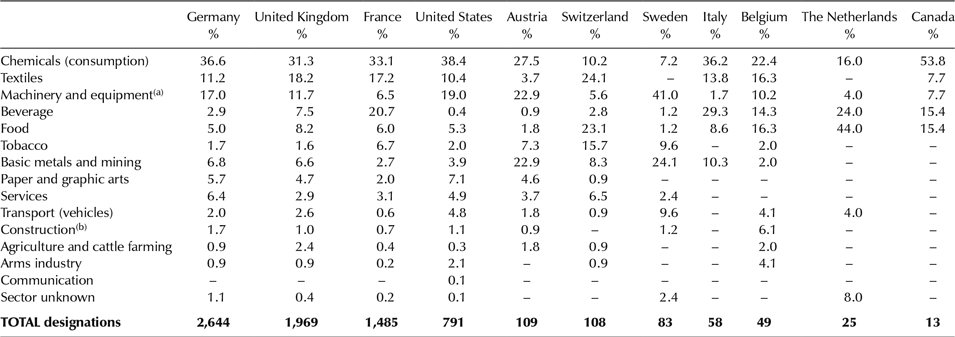
Trademark analysis offers complementary information on foreign intangible assets in Spain. We focused on goods because a trademark could designate different products and be classified in distinct industries. We counted 5,444 trademarks registered in Spain between 1850 and 1916 from the eleven countries we studied: these trademarks designated 7,334 goods. Footnote 93 Trademarks first spread through Spain’s consumer industries that commercialized high-demand products linked to basic necessities, and then they spread to machinery and other heavy sectors. Footnote 94 After 1880, capital industries designed new durable goods, which increased in demand over time as the Spain’s average income rose.
Table 6 shows the concentration of foreign trademarking in Spain. Products protected under foreign trademarks—between 30 percent and 38 percent of German, French, British, and U.S. trademark designations—were strongly related to consumer chemical products (such as perfumery, cosmetics, pharmaceutical preparations, lubricants, matches, soaps, paints, varnishes, colorants, etc.). Foreign trademarks also significantly focused on textiles, food, beverages, and tobacco-related goods. The protected textile trademarks were chiefly from the United Kingdom and France; the latter was also, not unexpectedly, the origin of the majority of drink trademarks, which, comprised almost 21 percent of registered French goods.
Trademark designations of goods and services in Spain from the most significant foreign countries grouped by economic sector, 1850–1916

Sources: Same as Figure 1.
(a) Machinery and equipment includes electricity and lighting.
(b) Construction includes lumber.
Contrary to what was usual among residents, Footnote 95 there were significant percentages of foreign trademarks in capital goods, such as machinery and equipment (including electricity and lighting) and metallic products, especially by the United States, Germany, and the United Kingdom (19 percent, 17 percent, and 11.7 percent, respectively). Again, this fits well with the aforementioned Spanish technological dependence on heavy sectors, which the most advanced countries targeted either for direct investment or for exporting and selling machinery. As seen in Table 6, as compared with the United States, Germany, the United Kingdom, and France, other countries registered just a few trademarks. Although it is also possible to analyze a country’s trademark specialization during the period studied (e.g., Switzerland in food and textiles; Austria and Sweden in machinery and metallic products; Italy in drinks), the lack of evidence calls for limiting further conclusions.
Therefore, although the investment, patent, and trademark sectorial classifications have particularities that could introduce some distortions—it is not the same to classify the activity of a firm, a patent for a technology, or a trademark for a commercial product—and despite the fact that distinct industry trends toward IPR protection could exist, our findings support a remarkable macro-level connection between FDI and IPRs. France, Germany, and the United Kingdom were both main investors and owners of patents and trademarks. As noted earlier, the United States ranked fourth among countries with industrial property in Spain, although Spain was only part of a wider European approach by the United States prior to post-World War I and World War II investment. The patent and trademark data also matches the rest of the countries with business ventures in Spain before 1914. For all of the countries studied, the heavy sectors and more complex industries in Spain stood out as investment targets, as occurred with protected technologies and, to a certain extent, with trademarks, although these were mostly linked to consumer goods and light industries.
Foreign Intangible Assets in Spain: Patent and Trademark Management Strategies
As discussed in the previous section, U.S. patent and trademark activity in Spain seems to have been a consequence of a wider European strategy that preceded the strong FDI that materialized after World War II. To what extent was this IPR policy successful? French firms and businessmen were outstanding investors in the Spanish market throughout the nineteenth century, but then they lost ground in industrial property acquisitions as compared with increased German interest in guaranteeing patents and trademarks. Was this related to the evolution of France’s and Germany’s business management style in Spain? Most significantly: What were patents and trademarks for in a lagging country on the European periphery, such as Spain?
It was not easy for foreign IPR owners to overcome the “liability of foreignness.” Footnote 96 Although aliens were progressively treated as nationals, the obligation to demonstrate patent and trademark working within the country in order to keep a monopoly was more difficult in certain periods, Footnote 97 which especially affected foreigners. As noted earlier, the United States fought this type of clause in international treaties, which fits with our findings regarding the strategy of the United States for assuring IPRs that preceded major investments. U.S. intellectual monopolies could be difficult to enforce without direct ventures in Spain or without licenses to third parties, which would decrease patent and trademark values. (In fact, currently, the TRIPS, which is strongly supported by the United States, and other major international agreements do not allow such compulsory working clauses and mandatory licenses. If such clauses and licenses do exist, it is sufficient to demonstrate patent or trademark working in any other WTO member country.)
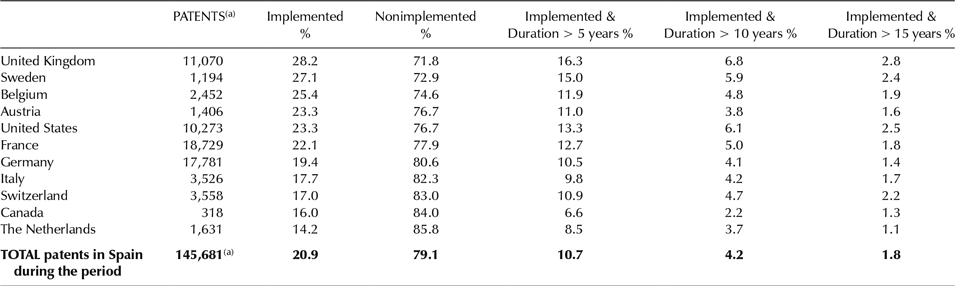
IPR holders had to pay annual fees to maintain their monopolies, which would have been worthwhile only if there were superior revenues. Schankerman and Pakes pioneered this approximation with a simple model based on patent renewals for estimating their private value, using data from several countries between 1950 and 1976. Footnote 98 Although historical context undoubtedly must be taken into account, Footnote 99 we think that renewal data are interesting to check for both patents and trademarks. In the case of patents, compulsory working data and renewal fees can be combined to assess the monopoly value. The recipient was required to demonstrate that the patented object was implemented in Spain within one to three years (a usual requirement in less-industrialized or nationalistic economies); Footnote 100 otherwise, the technology would pass into the public domain. Once the patentee had overcome the implementation requirements, subsequent installments had to be paid until the end of the monopoly, which was usually twenty years. Footnote 101 Trademark compulsory working was implicit in their duration, as they could be immediately challenged by other firms, businessmen, or agents if the trademarks were abandoned or not operating in the Spanish market for one to five years, depending on the law, Footnote 102 even if the periodical installments were paid.
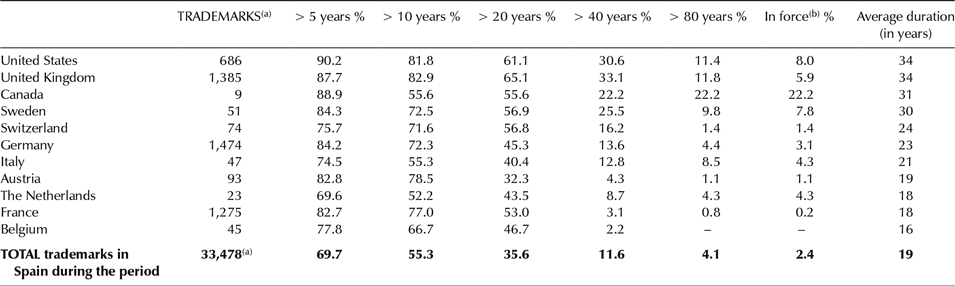
Tables 7 and 8 show the foreign IPR duration for the periods studied. In the case of the patent system, an average of 79 percent of the grants did not pass compulsory working clauses and, therefore, theoretically expired before the fourth year. Furthermore, when we checked the implemented patent duration, only 10.7 percent lasted between six and ten years; 4.2 percent lasted between eleven and fifteen years; and just 1.8 percent lasted between sixteen and twenty years. Notwithstanding, there were significant differences among countries, as can be seen in Table 7. If we suppose that longer monopoly duration reveals greater value of the patented technologies and better links to active business in the Spanish economy (through direct investment or simply licensing IPRs), then the United Kingdom seems to have taken better advantage of the system; that is, it had a higher implemented patent rate and duration. When the implemented patents that extended more than five years are checked, five other countries stand out from the system average. In order, they are: the United States, Sweden, Switzerland, Belgium, and France. Germany and Austria were near the average; Italy, the Netherlands, and Canada were below it.
Patents in Spain from the most significant foreign countries by implementation and duration, 1820–1939

Sources: Same as Figure 1.
(a) The values were calculated based on an average of 95.3 percent of patents. The remainder had no implementation data.
Trademarks in Spain from the most significant foreign countries by duration, 1850–1916

Sources: Same as Figure 1.
(a) The values were calculated based on an average of 95.2 percent of trademarks. Although expired, the remainder had no expiration date.
(b) Trademarks still in force during the period 2000–2010, when the database was collected.
A focus on foreign trademarking shows that a similar pattern emerges. Distinctive signs were, and remain, the only industrial property that can be indefinitely extended as far as renovation fees are concerned. Footnote 103 Thus, trademarks may last years, decades, or centuries; some can accumulate significant market value and support firms’ long-term success, and a handful can become global and well-known brands as part of corporations’ essential intangible assets (i.e., ownership advantage). Footnote 104 Table 8 shows the duration data for foreign trademarks granted in Spain between 1850 and 1916. We were able to find trademark expiration dates, and even those still in force, when we collected the database between 2000 and 2010. Footnote 105 The United States and the United Kingdom were, again, the most effective IPR managers in Spain, based on their trademarks’ endurance. Both countries demonstrate persistence in trademarking in the European periphery and, thus, in maintaining IPRs for product distribution and commercialization. In general, only 4.1 percent of foreign trademarks that entered the Spanish market before 1916 lasted more than eighty years, and 2.4 were in force at the beginning of the twenty-first century. In the case of the United States and the United Kingdom, such percentages were significantly higher: between 11 percent and 12 percent for the former, and between 6 percent and 8 percent for the latter.
When we analyzed the endurance of French trademarks over the long term, the data demonstrated a remarkable lack regarding the accumulation of added value on trademark assets. Although we need to qualify our findings with information from the international and European trademark registries at the WIPO and the OHMI, Footnote 106 ceteris paribus, French firms and businessmen do not seem to have achieved the same trademark management success as their U.S. and UK counterparts, despite being the main foreign investors in the Spanish economy during the period studied. Even Germany, which profusely used the Spanish trademark system, fell behind the United States and the United Kingdom, although it clearly exceeded the results on France. Other countries took too few trademarks in Spain before 1916 for us to establish solid conclusions, although trademarks’ endurance for Sweden and Italy was remarkable, while that for Austria, the Netherlands, and Belgium was not.
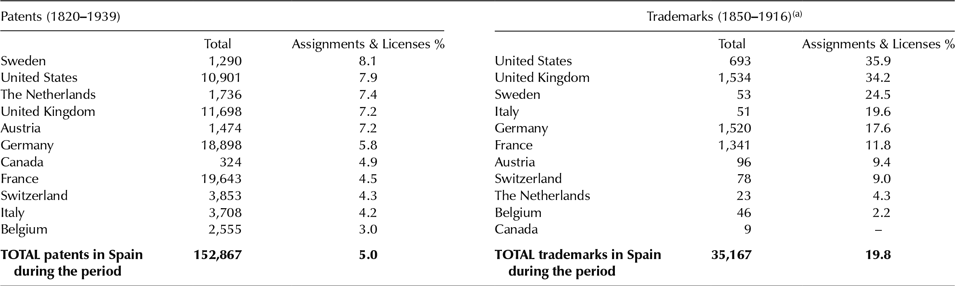
Table 9 rounds off our findings by showing the percentages of foreign IPR assignments and licenses during the periods studied. The aggregated data demonstrate, first, that there was more transference of trademarks than of patent rights: for an average of 5 percent of the documented assignments in the patent system, there were almost 20 percent among trademarks, a modality that could be indefinitely renewed, and thus was subject to more property alterations, including inheritances or firm status shifts. Second, the United States and the United Kingdom were both very active in commercializing IPRs, as were Sweden, the Netherlands, Austria, and, to a lesser extent, Germany, in the case of patents; and as were Sweden and Italy in that of trademarks. Finally, other main investors in the Spanish economy, including France, Belgium, Switzerland, and Canada, remained below the average in IPR assignment rates.
Patents and trademarks in Spain from the most significant foreign countries by percentage of assignments and licenses

Sources: Same as Figure 1.
(a) Although these are trademarks applied for between 1850 and 1916, they could have been licensed at any time during their existence.
These data could help to uncover distinct strategies related to foreign IPR management in the European periphery. Firms and industrialists from certain countries with high rates of direct investment and businesses in Spain, such as France, Belgium, Switzerland, and Germany (see Table 1), may have been less motivated to license technologies and trademarks to competitors or local firms. However, firms, manufacturers, and traders from countries with fewer direct interests in Spain before World War II, such as the United States, Sweden and the Netherlands, although increasingly competent in technological and mercantile issues, may have found a noteworthy business in applying for and commercializing IPRs among domestic manufacturers or foreign residents. The United Kingdom, despite being a main investor in Spain (although decreasing from 1900 onward), appears to have developed a market-oriented outlook on IPR business similar to the United States.
To sum our findings of foreign investors in Spain, first, the United States and the United Kingdom stand out for their IPR management during the period studied. Even though they were not the leaders in FDI, they took advantage of the opportunities provided by the Spanish IPR system because they recognized the growing importance of intangible assets in an increasingly linked world. They reached higher rates of implemented patents (those which overcame the compulsory working clauses), enduring trademarks, and assignment businesses. The United States was especially successful in these activities and used them widely across Europe. French scholars underline that the major U.S. contributions to France during the first third of the twentieth century was technology transfer through patents and licenses. Footnote 107 This confirms that U.S. international expansion was preceded by a conscientious IPR strategy: flood patents and trademarks into Europe, and other parts of the world, and then defend such intangible assets. In this process, increasing size, influence, and internationalization of U.S. corporations was essential.
Patent and trademark compulsory working clauses and duration data suggest that French, as well as Belgian, investors may have neglected IPR management in Spain to a certain extent, at least in trademark-related issues. Conversely, Germany’s focus on industrial science and technology and its desire for external markets led to effective patents and trademarks abroad. This undoubtedly led to Germany’s growth over France in Spain before World War II. Footnote 108 Nevertheless, France has always been strongly embedded in the Spanish economy, which reinforced its role as a main investor and location for technology transfer during the second half of the twentieth century. In fact, France, Germany, the United States, the United Kingdom, Switzerland, Italy, Belgium, the Netherlands, and Sweden were, respectively, the origin of the main technology transfer contracts signed with Spanish firms during the 1960s and early 1970s. Footnote 109
Finally, the empirical evidence shows that even on the European periphery in a lagging country with a hybrid IPR system—which, on the one hand, fit the international standards, but, on the other hand, had mechanisms for eluding intellectual monopolies that did not lead to direct investments in the domestic economy—patent and trademark management was a key issue for foreign investors from pioneering and developed nations. For different reasons and with distinct successes, these countries continuously applied for and obtained IPRs in Spain. Data reveal that, from the most advance economies, the majority of IPR extensions to Spain may have been a defensive move and a product of the processes of industrial expansion and IPR internationalization. In fact, many patents and trademarks did not last particularly long. Nevertheless, they could have had significant effects for foreign investors and exporters by ensuring at least three to four years of total protection, as well as by preventing later domestic industrial monopolies. The data also show that a percentage of successful patents and trademarks lasted a long time, which points to deliberate and proactive IPR strategies designed to support FDI or the buying and selling of intangible assets. The latter became a thriving industry over the second half of the twentieth century, and remains so in the twenty-first century.
Concluding Remarks
This article focuses on the long-term links between FDI and IPRs, especially in the case of Spain over the last two centuries. As a backward economy at the European periphery, Spain was the recipient of large FDI inflows from outward-looking North Atlantic economies. Using the OLI paradigm as a basic framework for understanding FDI decision making, we state that there were ownership and location advantages related to the administration of intangible assets. Furthermore, ownership advantages were related to innovative, mercantile, and organizational skills that included international IPR management competences. Thus, particular location and receptivity factors regarding intangible asset protection, such as the character and scope of distinct domestic IPR institutions, have to be taken into account, even though it is not yet clear how such IPR managerial and institutional conditions fit into the jigsaw puzzle of Spain’s economy.
Some of these topics have attracted IB scholars, and, to a lesser degree, business and economic historians. However, only IB scholars have analyzed the specific relationship between FDI and IPRs and have focused on how IPRs influenced FDI over short-term periods. Nonetheless, the results lack permanent answers. As we stated in the Introduction, there is conflicting theoretical and empirical evidence concerning the effects of strengthening IPRs on FDI. The mainstream scholars point out that reinforced IPRs leads to increased FDI, although other scholars’ theoretical and empirical works suggest the opposite. Footnote 110 We suggest that additional historical research needs to be conducted in order to offer fresh long-term evidence and insights.
In fact, when the long term is introduced into the analysis, FDI and IPRs seem to be distinct parts of the same process, and they coevolved starting in the late nineteenth century (and onward) as the international economy developed. Furthermore, the evidence suggests that increasing IB and FDI were the sources for, not the effect of, extending IPRs. The 1883 International Union for the Protection of Industrial Property was the beginning of a long road toward global IPR enforcement that has led to today’s WIPO. Such enforcement was developed when international exchanges of labor, capital, goods, and technologies expanded with the emergence of the Second Industrial Revolution and MNEs. As the world’s economy and countries’ corporations expanded, so too did IPRs at national, continental, and global levels. Moreover, during the so-called second globalization, the significant World Trade Organization was developed based on the 1994 TRIPS agreement, which oversees strong IPR controls and related trade sanctions at a scale never seen before. Throughout this process, developed and developing nations pursued distinct economic and IPR strategies. The former were interested in protecting—and monopolizing—their increasing (corporate) intangible asset production; the latter sought shortcuts to promote industrialization and impede long-term foreign intellectual monopolies that do not lead to actual direct investments. Today, however, leading economies might be “kicking away the ladder” Footnote 111 by requiring of developing and underdeveloped countries standards that leading economies did not respect in the past.
The findings of our long-term case study demonstrate, first, that despite that the Spanish IPR system required actual investments (hindering foreign intellectual monopolies), FDI activity and foreign patent and trademark applications did not decrease during the period studied. Evidence from the Netherlands (which rescinded its patent system between 1869 and 1912), Switzerland (which did not pass a patent law until 1888), and Denmark (which had essentially no protection before 1876 and weak protection thereafter) shows that low level or no IPRs did not diminish domestic innovation rates (although they were determined in certain directions), Footnote 112 industrialization, or foreign investment inflows. Footnote 113 Thus, our historical evidence accords closely with those scholars whose work shows that FDI would have expanded to the same extent with low-level IPRs Footnote 114 and that insufficient IPR protection does not reduce FDI. Footnote 115
Second, our research demonstrates that during the nineteenth century and the first half of the twentieth century, FDI and IPRs were strongly related in Spain in the sense that they shared the same source countries and similar sectorial patterns. FDI inflows to Spain came from nineteenth-century pioneers and first followers, which were mainly France, the United Kingdom, and Belgium; and with increasing participation from Germany; other North European economies, such as Switzerland and the Netherlands; and the United States. France—the leader of FDI in Spain—lost ground starting in 1880, while Germany and other newly industrialized countries gained it, especially in highly scientific-based industries. Thus, our long-term IPR data match the FDI evolution quite well. Before 1880, France, followed by the United Kingdom, dominated the patent and trademark systems in Spain. However, after that year, the increasing presence of German and U.S. IPR applications challenged the French leadership. By the eve of World War I, Germany had surpassed France in both patents and trademarks in Spain; the United States’ rate of applications had grown even faster than its investments in the country; and the United Kingdom had maintained its level of participation. These three countries, and especially the new international challengers, Germany and the United States, highly prized their intangible assets abroad. This was true in sectors that the newcomers had begun to lead internationally, including machinery and equipment of every kind, chemicals, electricity, and metallurgy. Science, technology, human capital, and knowledge of how to innovate and how to sell became essential in these new heavy and intermediate industries with high added value. In fact, FDI and foreign patenting in Spain were highly concentrated in those sectors, although the data also show significant patent activity in the textiles, in food, beverage and tobacco industries, and in the wide service sector. Trademarks were usually related to consumer products, but our analysis of foreign applications reveal significant biases toward capital and intermediate goods.
Third, through exploring IPR licensing and IPR duration and by checking compulsory working clauses and installment payments, our work reveals that the United States and the United Kingdom significantly stood out regarding length of IPRs and assignment proportion. France, Belgium, and even Germany were less effective in maintaining their rights in Spain, and were also less inclined to commercialize them. Footnote 116 Thus, we can state in this seminal work that, at least from a macro-level perspective, the countries with major FDI in Spain (France, Belgium, and Germany) seemed to be less worried about enlarging IPRs than those with less FDI (United States, Sweden, the Netherlands, and even the United Kingdom, whose major investments in Spain proportionally decreased from 1880 to 1914). This fits well with the notion that direct investments may provide more control over innovation and marketing activities. If that is the case, IPR owners may not be interested in licensing technologies or trademarks to potential competitors, or may not care to extend IPRs beyond certain points, although further research and case studies are needed. These arguments match those of scholars who support that FDI occurs even with low level or no IPRs, and they especially match scholars who support that FDI increases intangible assets control over local IPR weaknesses. Footnote 117
Finally, our findings suggest that defense of IPR enforcement turned into a key issue for the United States, and to certain extent for the United Kingdom. The United States realized early on the increasing significance of monopolizing enduring IPRs abroad as global economic and managerial strategies, whether or not it preceded FDI. We cannot forget here that patent and trademark rights could also be negotiated and licensed to third parties and, therefore, become a profitable business. This fits with some of Mansfield’s findings for more recent periods: U.S. companies are generally more worried than other countries’ firms about IPR protection abroad. For example, surveys from U.S. chemical companies reveal a higher concern about IPRs than German or Japanese MNEs in the same sector. In Mansfield’s own words: “US firms might be expected to require stronger protection before exposing or transferring their most advantage technology.” Footnote 118 Our work demonstrates that those key issues were raised early in the international business agenda of the United States. Today’s world technological and economic leaders embrace these successful long-term strategies.