Introduction
The term disaster refers to a serious disruption in the functioning of a community or a society at any scale due to dangerous events that lead to losses and effects in 1 or more environmental, economic, material, and human aspects. 1 They have a significant impact on human mental, emotional, and physical well-being. Besides, mortality rates and economic problems are growing due to increasing population exposure, urbanization, and changing ecosystems. Reference Jose and Dufrene2 Iran is a country that has experienced numerous destructive earthquakes. The recorded evidence and seismo-tectonic studies suggest that large earthquakes may hit almost any part of the country. Reference Ghafory-AshtIany, Jafari and Tehranizadeh3 In addition, Iran is exposed to dangers such as floods, droughts, landslides, political conflicts, and wars in neighboring countries. Reference Fekete, Asadzadeh and Ghafory-Ashtiany4 Iran’s risk class for natural hazards is 6.7 out of 10. 5
Any type of disaster can occur at any time, and preparedness for response to these disasters is of the highest priority for health care agencies. Reference Jose and Dufrene2 The World Health Organization also recommends that health care workers in all countries, regardless of the frequency of such accidents in their own country, should have the highest level of knowledge and preparedness to manage disasters. 6,Reference Al Thobaity, Plummer and Williams7
Therefore, current students who are future practitioners in any health discipline, must acquire expert knowledge and mature attitudes so that they can serve as competent practitioners in the face of disasters. Reference Jose and Dufrene2 Nurses, who are the largest group of health care personnel and play an important role in disaster management, must also be prepared to effectively respond to disasters. Reference Xia, Yang and Chen8 The International Council for Nurses (ICN) framework emphasizes 4 competencies for disaster nursing that correspond to the phases of disasters: prevention, preparedness, response, and recovery. Reference Hutton, Veenema and Gebbie9 It is noteworthy that the American Association of Colleges of Nursing (AACN) considers disaster response training as 1 of the basic training elements of the undergraduate nursing curriculum. 10 Therefore, preparing nursing students who are supposed to be in the front line of dealing with affected and dead people in disasters in the future has always been highlighted, and is the most important concern in nursing education. Reference Jose and Dufrene2
There is little documented reporting of the inclusion of mass casualty incident (MCI) care training in nursing undergraduate programs, Reference Currie, Kourouche, Gordon, Jorm and West11 while disaster-distinguishing features that may include resource constraints, casualties, and environmental clutter require prior preparation for taking effective action in disastrous situations. However, many nurses never receive any training. Reference Currie, Kourouche, Gordon, Jorm and West11,Reference Inkaew and Chompunud12 A US study of 1348 nursing students found that their overall readiness to respond to MCI was low. Reference Schmidt, Davis and Sanders13 Thus, including disaster preparedness training is critical for nursing students. Reference Unver, Basak and Tastan14 Bennur and Gulcihan, Reference Koca and Arkan15 found that a 6-module training program had a positive effect on nursing students’ knowledge and self-efficacy regarding disaster response. Xie et al. Reference Xia, Li, Chen, Jin and Zhang16 conducted an experimental study using a pre-test and post-test control group design to evaluate the effectiveness of a 7-hour disaster preparedness program in nursing students in China. The study content included fundamentals of disaster, triage, and family preparedness that were implemented with various teaching methods. The results showed that students who received the program had greater increase in their knowledge and skills, as related to disaster preparedness, than those in the control group immediately after the program and 3 months later. Unver et al. found that nursing students training with high-fidelity simulation increased the perception of nursing students regarding their preparedness for disasters. Reference Unver, Basak and Tastan14
In the Iranian Nursing Curriculum, the compulsory course entitled ‘Disasters, Emergencies, and Unexpected Events’ aims to educate nurses about disasters and emergencies. However, the content of the course is theoretical and such content is not enough for improving nurses’ competence to deal with disasters. Reference Zarea, Beiranvand, Sheini-Jaberi and Nikbakht-Nasrabadi17 Various studies in Iran have found that nurses, despite being important members of the health care team, have not received sufficient training to deal with disasters and do not consider themselves physically, mentally, and educationally prepared to cope with disasters. Reference Ghanbari, Maddah, Khankeh, Karimloo and Ardalan18–Reference Moghadam, Saeed, Khanjani and Arab20 Problems such as insufficient course units related to triage and emergency nursing, sporadic training, and training techniques are all reasons for the inadequacy and inefficiency of disaster nursing training in Iran. Reference Jalalinia and Alhani21 The benefit of disaster management training is to ensure that all nurses receive basic disaster response training that can then be developed and refreshed through practice and training in the workplace. Previous research has shown that disaster response training has been effective on students’ self-perceived knowledge, attitude, and skills, Reference Zinan, Puia and Kinsley22 willingness to participate in response teams Reference Arbon, Ranse and Cusack23 and also on students’ clinical reasoning and decision-making skills, motivation, and self-confidence about the response to MCI. Reference Strout, Saber and Caruso24 These studies suggest that learning about the MCI response can also be achieved through short-term training.
Studies on nursing students’ and nurses’ preparedness to deal with disasters are very few in Iran and limited to studies designed for working nurses. Reference Ghanbari, Maddah, Khankeh, Karimloo and Ardalan18,Reference Tajbakhsh, Emami, Varahram, Bahrambigi and Ghazanchaei25,Reference Nejadshafiee, Sarhangi, Rahmani and Salari26 According to our search, no study has been conducted to improve the ability and self-efficacy of nursing students in Iran. Therefore, the present study aims to design, implement, and evaluate a training program to prepare nursing students to respond to disasters.
Methods
Study design
This study was conducted using a pre-test, and post-test design with a single group to design, implement, and evaluate disaster management training for nursing students.
Procedure
The training program was developed through interviews with experts including a director of Emergency Operations Center, 3 academics in the field of health in disasters and emergencies, 2 nursing faculty with teaching experience in disasters, and emergencies, as well as reviewing an unexpected events course and the literature on training needs, Reference Öztekİn, Larson, Altun Uğraş and Yüksel27 objectives, content, and strategies/methods. Reference Inkaew and Chompunud12,Reference Nakhaei, Sh and Saadatjou28–Reference Xia, Yang and Chen30 Moreover, the evaluation method was identified using the curriculum development approach proposed by Harden. Reference Harden31 For this purpose, the first 6 disaster experts were selected using purposive sampling, and data was collected through in-depth structured interviews with the experts. Harden curriculum planning steps were used to develop the interview questions. Probing questions were also asked where necessary. An example of questions asked in the interview was: What educational content do you think should be considered to prepare nursing students to deal with disasters?
Then, the results of the data analysis of interviews were completed by reviewing the literature. Hence, if in the literature review, the training needs, as well as the objectives, content, strategies, and methods were mentioned, which were not present in the extracted codes of the interviews, those codes were extracted from the literature and added to the interview codes. National databases (Scientific Information Database at https://www.sid.ir, and Magiran at https://www.magiran.com) and international databases (PubMed and Science Direct) were used to review the previous studies in the literature. The articles were searched using the keywords ‘Nursing Students,’ ‘Disaster,’ ‘Mass Casualty Incidence,’ ‘Education,’ ‘Preparedness,’ and ‘Train.’ No time limit was considered for Persian articles. English articles were limited to those published from 2010 to 2020. In the end, the training program was developed in 2 (theoretical and practical) parts (Table 1).
Content of disaster management training program for nursing students

The implementation phase of the program lasted from June 5, 2020 to the end of August 2020. To this end, the developed program was announced to nursing students via a public call through the Students Scientific Committee. A total of 92 students enrolled in the program. A pre-test designed on a free online surveying Iranian platform (Porsline, https://survey.porsline.ir) was administered to them. All students completed the pre-test. The developed theoretical program was implemented online by 3 disaster health professors, a psychologist, and a nursing faculty member through Adobe Connect software for 2 consecutive days. The training method included lecturing and presenting scenarios for triage practice. The students were allowed to participate and ask questions. For this purpose, whenever the students had questions about the presented content or needed further explanation, they raised their hand to be given a microphone or typed their questions in the chat box. The classes were held interactively with students. The theoretical training sessions were recorded through Adobe Connect software and its link with PowerPoint slides were made available to the students. To implement the practical training program, the students were divided into groups each with 8 to 10 members. They received face-to-face training on resuscitation (basic life support), dressing, bandaging, and patient transfer in 3 stations using mannequins. The duration of the practical period was 6 hours for each group. The practical instructions were provided by 3 faculty members in the Clinical Skills Center of the Faculty of Nursing. After the practical training, the students had the opportunity to practice and receive feedback. A supervisor monitored the entire training project process. Finally, to evaluate the effectiveness of the training program, the post-test was administered to the students a week later and 2 months later through the Porsline. At this stage, in addition to the pre-test questions, the students answered an additional question on a 5-point Likert scale to assess their general satisfaction with the program. Furthermore, face-to-face interviews were conducted with 5 students who were selected randomly to get their feedback about the program with questions such as: please share your experience of participating in this program? and what is your opinion about the program? The interviews were recorded with students’ informed consent, and then transcribed and analyzed. Data saturation was reached with interviews.
Sampling
Sampling in the program development phase: The participants (6 experts) were selected using purposive sampling and the sampling procedure continued until data saturation. In qualitative studies, the number of participants is sufficient when the collected data is saturated. Saturation means that no new categories or themes appear upon collecting additional data. Reference Jalalinia and Alhani21
Sampling in the implementation and assessment stage: The participants who attended the training program and assessed its effectiveness were selected using convenience sampling from a nursing school at Jiroft University of Medical Sciences in southeast Iran. A total of 92 students participated in this study. The participants were studying in the second to eighth semesters and had passed Nursing Principal and Skills course (students who were studying in the first semester were not included in the study because they had not passed the Nursing Principles and Skills course). Also, 5 students were selected randomly to get their feedback about the program.
Instruments
The Disaster Response Self-Efficacy Scale (DRSES) was used in this study to collect the data. This tool was designed to assess Chinese nursing students’ readiness to deal with disasters. Reference Li, Bi and Zhong32 The content validity of the instrument was 0.91 and its reliability values measured through Cronbach’s alpha and the test-retest test were 0.91 and 0.95, respectively. The validity of this tool was assessed and confirmed through exploratory and confirmatory factor analysis. Factor analysis revealed 4 sub-scales (disaster assessment competency, disaster emergency rescue competency, disaster psychological nursing competency, disaster role quality, and adaptation competency) and 22 items explained 59.2% of the total variances of the instrument. The items in the instrument are scored using a 5-point Likert scale (1 = No confidence at all, 2 = basically no confidence, 3 = little confidence, 4 = basically confident, 5 = complete confidence). A higher rating was representative of a higher self-efficacy score in disaster response. Reference Li, Bi and Zhong32 The tool was translated into Persian and the translated version was confirmed by a proficient English professor. Furthermore, the qualitative content validity of the instrument was checked and confirmed by 6 faculty members who were experts in crisis and disaster management. A question was added to the questionnaire to measure the students’ satisfaction with the training program using a 5-point Likert scale ranging from completely dissatisfied to completely satisfied. The Cronbach’s alpha of DRSES in the present study was 0.95.
Ethical considerations
This research project was registered by the Ethics Committee of the National Agency for Strategic Research in Medical Education under code 984116. The students were reassured about their voluntary participation, the right to leave the study at any stage, and the confidentiality of their information.
Data analysis
Analysis of the data related to program evaluation: The qualitative data collected from the interviews with the experts and students were analyzed by the content analysis method proposed by Granheim and Landman. Reference Graneheim and Lundman33 Also, the quantitative data collected in the program evaluation stage were analyzed using the SPSS program version 19 (IBM, Armonk, New York, USA) with descriptive and inferential statistics. The data related to participants’ demographic characteristics and their satisfaction with the program were analyzed using descriptive statistics. Kolmogorov-Smirnov test results showed a normal distribution of pre-test, post-test, and follow-up scores. The repeated measures Analysis of Variance (ANOVA) and Least Significant Difference (LSD) post hoc test were used to evaluate the effectiveness of the program. The significance level was set at P < 0.05.
Results
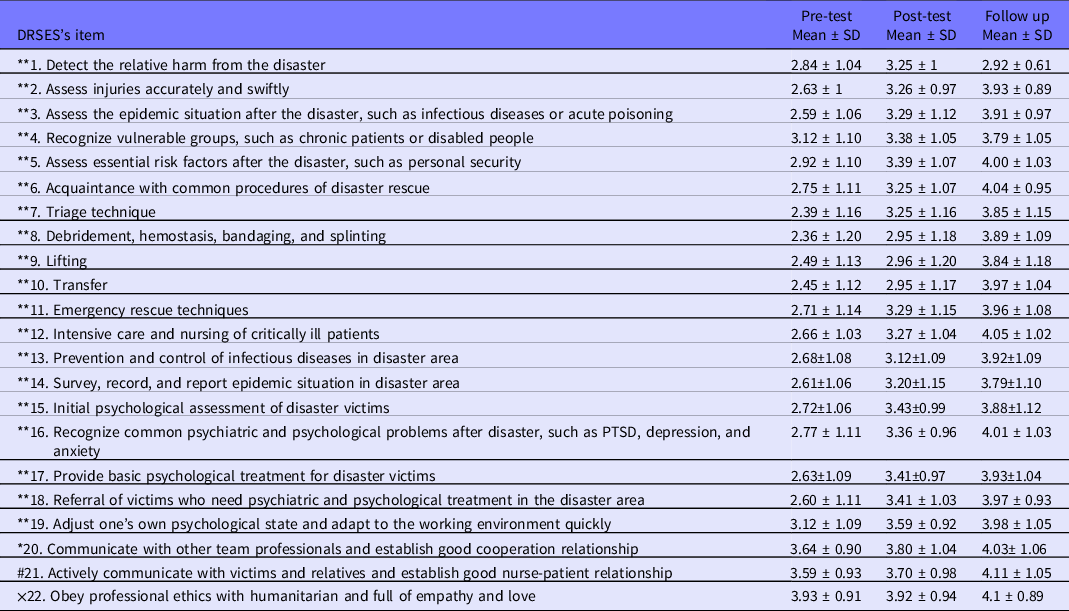
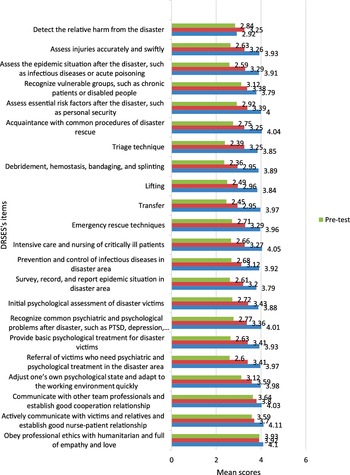
Of 169 nursing students, 92 participated in this study. The average age of the participants in this training course was 21.5 ± 2.4, with the age range of 18 - 34 years. Also, 23 of the participants (25%) were male while the rest were female. 7 students (7.6%) were studying in the first year (only those who were studying in the second semester), 35 (38%) were studying in the second year, 31 (33.7%) in the third year, and 19 (20.7%) in the fourth year. 44 students (47.8%) stated that they had experienced disasters. Of these 44, 29 participants (31.5%) reported that they had experienced earthquakes, 7 students (7.6%) experienced floods, and 11 students (12%) experienced road accidents. The results of the t-test showed that the mean DRSES scores of students who had experienced at least 1 disaster and those who did not have such experience were not significant in any of the 3 measures (pre-rest, 1 week after education, and 2 months later) (P > 0.05). The results of the repeated measures ANOVA showed that there were statistically significant differences between the students’ mean DRSES scores on the pre-test, post-test, and follow-up (2 months later with P < 0.0001). In general, the students’ mean score increased from 61.4 on the pre-test to 75.2 on the post-test and 87.6 in the follow-up phase (Table 2). The results of the LSD post hoc test showed the differences were significant between pre-test and post-test (P < 0 .001), pre-test and follow-up (P < 0.001), and post-test and follow-up test (P < 0.001). The survey of each item revealed that the highest increase in post-test score compared to pre-test was related to items 7 and 18 while the least increase was related to items 20, 21, and 22. In the follow-up, the highest increase was related to items 8 and 10, while the least increase was related to items 20 and 22. When compared to the pretest, items 20 and 22 were the only items that had a noticeable increase in both post-test and follow-up (Table 3 and Figure 1).
Average scores of nursing students on the disaster response self-efficacy tool in pre-test, post-test, and follow-up

Mean scores of DRSES’s items in the pre-test, post-test, and follow-up

**(P < 0.001), #(P = 0.001), *(P < 0.05), ×(No significance)
Mean scores of DRSES’s items in the pre-test, post-test, and follow-up.

1 week after completing the training program, 21 students (22.8%) were completely satisfied with the program, 51 students (55.4%) were satisfied, 16 students (17.4%) were relatively satisfied, 2 students (2.2%) were dissatisfied, and 2 students (2.2%) were completely dissatisfied. Furthermore, 2 months after the training intervention, 49 students (53.3%) were completely satisfied, 37 students (40.2%) were satisfied, and 6 students (6.5%) were relatively satisfied with the program.
Analysis of the qualitative data
The analysis of the data collected from the interviews with 5 students revealed 2 main categories and 5 sub-categories. These are: increased readiness (the usefulness of the program and attitude change) and Content evaluation (new content, strengths, weaknesses, and suggestions).
Increased readiness
The students’ higher readiness after completing the program shows the usefulness of the program for them, meeting their learning needs, and changing their attitudes towards relief in disasters.
The usefulness of the program
All students generally stated the training program was useful for them and they were satisfied with participating in it. The students also reported that they needed to complete this program because Iran is a disaster and accident-prone country and people expected them, as members of medical staff, to participate in relief operations and that this program met their needs. The participants considered the presentation of more detailed materials and the comprehensiveness of the training as the reasons for the usefulness of the training program. They reported that the program helped them get familiar with the duties of rescuers, teamwork, the importance of relief operations, first aid, and the ethical and psychological issues associated with disaster relief. Most of them stated that they were ready to participate in relief operations and that their sense of self-efficacy and usefulness in relief operations had increased. 1 participant said, ‘For example, I didn’t know anything about resuscitation principles, that is, I couldn’t help if someone needed resuscitation, but now I have learned all the basics and gained this confidence to start acting if I come across such a situation.’
Attitude change
The participants stated that their attitudes toward participating in disasters changed, their sense of altruism increased, and in the event of a disaster they felt compelled to participate in relief operations voluntarily. They also believed that their ability to empathize with affected people and their skills to listen to them increased and that they were able to put themselves in the place of affected people. 1 of the participants stated, ‘I used to think that when there was a flood or an earthquake or any natural disaster, we could just donate money. But now I realize that our presence there can certainly be helpful even if we could help 1 person.’
Content evaluation
Content evaluation refers to students’ views on the strengths and weaknesses of the training program and their suggestions for improving the program in the future.
New content
The participants stated that the program provided more details about disasters compared to previous disaster-related courses. They also stated their satisfaction with the up-to-date content of the program. In particular, the participating students reported that the topics related to psychological and moral issues in disasters opened a new window for them to better understand disaster-related issues. 1 of the participants stated, ‘I was very impressed by the discussion of psychology and professional ethics that should be observed about the affected people and the ethical issues that were instructed during the program, and I liked these materials because they are necessary points that unfortunately may not be addressed.’
Strengths of the program
The students considered the presentation of the courses in theory and practice, experiences reported by the instructors, practical points mentioned by the instructors, the full coverage of physical and psychological aspects of disasters, the use of experienced and knowledgeable professors, and the students’ free admission to the program as the strengths of the training program. According to 1 of the participants, ‘The use of experienced on- and off-campus professors was 1 of the strengths of the program.’
Weaknesses and suggestions
The participants considered the intensive nature and online mode of the course, the instructors’ failure to provide timely answers to the students’ questions, the large volume of the covered materials, and presenting the materials in a short time as the weaknesses of the program. They suggested that the program could be repeated regularly with a face-to-face modality. The participants also stated that the instructed materials must be practiced under more realistic and maneuvering conditions. Moreover, the instructions should be mainly case-oriented, with short video clips screened, and with more break time between the sessions. 1 of the students stated, ‘The courses are better to be held face-to-face so that the students can ask their questions. It’s also very good that the courses are organized in shorter time intervals, for example, once a year.’
Discussion
The data in the present study showed that the nursing students’ DRSES scores increased from the pre-test to 1 week later. 2 months after the training, the students also scored higher as compared to the pre-test, and 1 week after the training program. These results were in line with the previous studies. For example, a study in China found that knowledge and disaster preparedness scores in the students who attended the disaster training course were higher than the students in the control group and the scores of the 2 groups of students were also significantly different until 1 month later. Reference Xia, Li, Chen, Jin and Zhang16 Davis et al. (2020) showed that a short simulation-based training course can increase nursing students’ disaster response knowledge and readiness. Reference Davis, Manning, Germain, Hayes and Pigg34 Smith (2015) also showed that students who took the disaster training course gained more confidence in disaster management, triage, and communication in a disaster situation. Reference Smith, Farra, Dempsey and Arms35 Alim et al. found that a training course increased the knowledge and skills related to the nurses’ roles in different stages of disasters. Reference Alim, Kawabata and Nakazawa36 Chilton and Alfred also showed that the knowledge and skills of nursing students for individual disaster preparedness after a training intervention were significantly different between the control and intervention groups. Reference Chilton and Alfred37 Many studies claim that nursing students who have received disaster training better prioritize patient care. Reference Pang, Chan and Cheng38,Reference Uslu, Unver and Karabacak39
The increase in the DRSES scores in the post-test and follow-up can be explained through Bandura’s social cognitive theory. Self-efficacy is defined in Bandura’s social cognitive theory as ‘people’s judgments of their capabilities to organize and execute courses of action required to attain designated types of performances. In Bandura’s theory, enactive mastery experiences are the most influential sources of self-efficacy beliefs. Reference Bandura40 Therefore, students’ better understanding of disaster preparedness after completing the program in this study leads to an increase in their belief in self-efficacy in response to disasters. Since the recordings of the lecturers and PowerPoints were made available to the students, the students may have seen them again, or followed the disaster response contents on social media, due to their sensitivity to the disaster-related contents. This had subsequently increased their follow-up DRSES scores compared to 1 week after the program. On the other hand, probably the current program was in accordance with the learning needs of the learners, which had increased the scores of the students in the post-test and follow-up.
The lack of change in the 2 items: ‘Communicate with other team professionals and establish good cooperation relationship’, and ‘Obey professional ethics with humanitarian values full of empathy and love,’ that were related to communication and ethical skills may reflect the program that is strong in other items but weak in these items. Similar to our results, Zinan et al, Reference Zinan, Puia and Kinsley41 in New England revealed that the ethical skills of nursing students did not improve significantly following a mass casualty incident simulation program. Meanwhile, Kim and Lee found a significant increase in post-test. Reference Kim and Lee42 These differences in the research results may be related to previous knowledge of participants or may be related to the programs. It seems that teaching non-technical skills as communication and ethical skills requires modern teaching methods such as problem- based learning and learner-centered education. Reference Hung, Lam and Chow43,Reference Li, Wang, Zhu, Zhu and Sun44
The collected data from the students about the training program also showed that almost all of the students were satisfied with the program 1 week after the program and 100% of them were satisfied with the program in the follow-up stage. This finding could demonstrate Iranian nursing students’ educational needs and motivation for disaster preparedness programs and indicate their acceptance. Kim et al. Reference Kim and Lee42 reported nursing students’ satisfaction with a disaster simulation-based program as 45.5% which is lower than the value reported in the present study. This difference may be related to the method or the learning needs of the learners in the 2 studies. This qualitative data analysis also showed the students’ positive views about the program, supporting the results reported by Alim et al. Reference Alim, Kawabata and Nakazawa36 In the present study, 80% of the students evaluated the content of the disaster management training course as new and interesting. The training instruction presented by Alim et al. Reference Alim, Kawabata and Nakazawa36 contained theoretical content presentation, practice, and drill. However, the training program used in the present study contained no maneuver. A comparison of these results shows that students welcome any training method that enhances their knowledge and skills to cope with disasters. The students in the present study considered the intensive nature of the program, and the large volume of the materials covered in a short time as the weaknesses of the program. Similarly, Alim et al. Reference Alim, Kawabata and Nakazawa36 reported that 83% of nursing students who were selected to receive feedback from a disaster training program believed that ‘there was limited time for disaster training.’ Furthermore, the students participating in Kalanlar’s study also believed that the disaster management training course should be held regularly throughout the undergraduate program. Reference Kalanlar45
During a disaster, nurses are expected to play a role beyond their usual knowledge and ability, Reference Yin, He and Arbon46 despite this, incorporating disaster management training into the curriculum is difficult due to the extensiveness of nursing curricula. Reference Jose and Dufrene2,Reference Kenner and Pressler47 Research has also shown that students do not volunteer for disaster relief unless they are well prepared, Reference Chilton and Alfred37 thus, extracurricular disaster management courses are essential to increase nursing students’ awareness of disasters. Reference Unver, Basak and Tastan14 This is so that interested students will have the opportunity to participate in these courses and will acquire knowledge and skills in the disaster field.
Strengths and limitations
The limitations of this study were that it relied heavily on online theoretical content teaching and not doing educational drills due to the COVID-19 epidemic. Another limitation is that qualitative data collection related to course evaluation came from a limited number of students, although we were concerned about data saturation.
Intervention study, use of theoretical and practical training, quantitative and qualitative evaluation of the program, and their students’ follow-up for 2 months are the strengths of the present study.
Conclusions
Although there is no consensus in literature on the length and educational content of disaster management courses for nursing students, the results of the present study showed that blended short-term training courses (held online and face-to-face) have a positive effect on students’ disaster preparedness. Holding such courses is necessary for nursing students due to the increase in the frequency and severity of recent disasters in the world and Iran and ensures that all nurses have received the basic level of disaster response education. Considering that the current educational curriculum for nursing students in Iran does not prepare them to deal with disasters, it is recommended to use the educational program designed in this study as a short-term training course for nursing students.
Data availability statement
The datasets used or analyzed during the current study are available and may be provided by the corresponding authors on reasonable request.
Acknowledgements
The authors would like to express their sincere gratitude to the National Agency for Strategic Research in Medical Education. We would also like to appreciate the valued cooperation of the nursing students who helped us in this study. This project was funded by the National Agency for Strategic Research in Medical Education. Tehran. Iran. Grant No. 984116.
Author contributions
All authors (F R, M N, and N D) conceptualized the study, and all were major contributors in writing the manuscript. All authors approved the final manuscript.
Conflict of interest
The authors declare that they have no conflicts of interests.