INTRODUCTION
How is it that ‘Barbies are for girls’ whereas ‘trucks are for boys’? Why is it ‘weird’ for him to be the owner of a women's shoe shop but not for her? And why does it suddenly become ‘less weird’ if he's gay?
While answers to these sorts of questions have been pursued by a range of scholars working in a diverse array of disciplines, ethnomethodological and conversation-analytic researchers—alongside interactional (Couper-Kuhlen & Selting Reference Couper-Kuhlen and Selting2018) and sociocultural (Bucholtz & Hall Reference Bucholtz and Hall2005) linguists, social constructionists (Berger & Luckmann Reference Berger and Luckmann1967), and various others—begin their investigations from the perspective that such distinctions are not intrinsic or innate to individuals, but rather are normative constructs that are socially defined. What this means is that the lines in the sand—e.g. between what is good, appropriate, expected, normative, and so on for the category women vs. what is good, appropriate, expected, normative, and so on for the category men—become relevant precisely because members of society, as they interact with one another, make them relevant. As Kitzinger, drawing on Garfinkel (Reference Garfinkel1967) and West & Zimmerman (Reference West and Zimmerman1987), succinctly puts it, social constructs like heteronormativity are ‘embodied and displayed endogenously, in the details of conduct’ (Reference Kitzinger2005a:478). Accordingly, despite just how mundane, routine, and preexisting the normative roles and distinctions between, for example, men and women may seem in a given society, these distinctions must nonetheless be conceptualized as achievements in that they are consistently produced and reproduced in and through the conduct of social actors.
The present study uses Conversation Analysis (CA) to examine one concrete, recurrent interactional practice through which various norms related to social identities and roles are routinely reconstituted in everyday conversation. I begin by providing some background on the notion of accountability from an ethnomethodological and conversation-analytic perspective, focusing on the solicitation and provision of accounts as social actions. I then introduce the specific accounting practice under examination here—which I call category accounts—first by drawing on scripted television shows and commercials, and then turning to its operation in naturally occurring conversation. While I take as a case-in-point, for the purposes of this article, accounts broadly associated with gender and sexuality categories, it must be underscored that the analysis presented here can also be applied to examine the interactional achievement and reconstitution of racial/ethnic, religious, professional, and a range of other social identities as well (see e.g. case (10) below).
In addition to the substantive contribution of the article to our understanding of language, identity, and normativity, I also aim to illustrate a theoretical and methodological point—namely that in examining the production and reproduction of normativity in social interaction, we must look not only at what participants say, but also where in conversation they say it, and for what purpose. That is, in addition to attending to the content of turns-at-talk, we must also consider what that content is being mobilized to do in terms of action, and where that action occurs within a sequence of actions. Such a perspective, I argue, will allow us to uncover some of the more subtle, participant-distributed ways that social norms are collaboratively recreated in the immediacy of moment-by-moment conduct.
ACCOUNTS AND ACCOUNTING PRACTICES
Following from its ethnomethodological origins, Conversation Analysis (CA), in its broadest conceptualization, is interested in uncovering ‘members’ methods’ (Garfinkel Reference Garfinkel1967) for the production and recognition of action; that is, how their actions, ‘which Members do in such a way as to be recognizable as such to Members, are done, and done recognizably’ in talk-in-interaction (Sacks Reference Sacks1992:236). As such, the provision of accounts—and ‘account-ability’ more generally (Garfinkel Reference Garfinkel1967)—have always featured heavily in conversation-analytic research (for a concise overview, see Robinson Reference Robinson2016a).
In surveying the extensive literature on accounting practices, Antaki (Reference Antaki1994:56) writes that ‘an offense against some kind of social norm’ usually provides the impetus for the provision of an account. A canonical example from the CA literature is that of dispreferredFootnote 1 responses to, for instance, offers and invitations, as seen in (1) below (Drew Reference Drew1984; Heritage Reference Heritage1984b).
(1) SBL:1:1:10:456–462Footnote 2


By providing an account as part of her dispreferred response (here, a declination), Amy presents herself as unable—rather than unwilling—to have coffee with Bea. That is, her declination is contingent on her running the ad in the paper as opposed to, for example, a more general lack of interest in spending time with Bea. In volunteering such accounts, speakers treat their action-in-progress as accountable, as requiring explanation (Heritage Reference Heritage and Antaki1988), with the provision of the account working to stave off any potential threats to face that might otherwise be gleaned from the dispreferred action (Brown & Levinson Reference Brown and Levinson1987). Accounts offered in such environments thus constitute part of what Goffman called ‘remedial exchanges’—‘a “distributive justice,” a sort of payment or compensation for harm done’ (Reference Goffman1971:51; see also Heritage & Raymond Reference Heritage and Raymond2016; Heritage, Raymond, & Drew Reference Heritage, Raymond; and Drew2019).
When a speaker is not forthcoming with an account of their ‘untoward behavior’ (Scott & Lyman Reference Scott and Lyman1968), one can be solicited by a co-participant. This can be done overtly, in an ‘on record’ fashion—for instance with why-questions (Bolden & Robinson Reference Bolden and Robinson2011)—or it can be done covertly, or ‘off record’—for instance by asking a known-answer question (C. Raymond & Stivers Reference Raymond and Stivers2016). Both of these strategies are seen in case (2), in which the participants are discussing Shirley's low score on a law school entrance exam. Geri asks her if she is “g'nna take it agai:n?” using a so-prefaced, declaratively formed question that is strongly tilted in favor of a yes-response (G. Raymond Reference Raymond2004; Bolden Reference Bolden2009; Heritage Reference Heritage2012). Shirley's answer, however, is an immediate and unvarnished “nNo”.
(2) Frankel:TC:1:1:4

When Shirley does not offer an account for her decision (lines 2–3), Geri solicits one by requesting confirmation of something that she was just told with “No:?” (C. Raymond & Stivers Reference Raymond and Stivers2016). When an account is again not forthcoming (lines 5–6), Geri moves to a more on-record version of soliciting an account with “Why no:t.” (line 7) (Bolden & Robinson Reference Bolden and Robinson2011). In this particular case, the account that is eventually provided in line 8 is treated as somewhat incomplete in that Geri works to unpack it further in her subsequent turn (line 9).
In ethnomethodological and conversation-analytic research, the term account is also used more broadly to refer to participants’ descriptions of the world (see Garfinkel Reference Garfinkel1967). Heritage (Reference Heritage1984b:136) observes that members of society are routinely ‘engaged in descriptive accountings of states of affairs to one another’, which in turn reveal how they go about parsing their reality. This is because, in providing such descriptions, participants ‘name, characterize, formulate, explain, excuse, excoriate, or merely take notice of some circumstance or activity and thus place it within some social framework (locating it relative to other activities, like and unlike)’ (West & Zimmerman Reference West and Zimmerman2009:116, my emphasis). This more general sense of account, though, is nonetheless related to the use of the term as described above. Take, for example, cases (3) and (4) below (C. Raymond & Stivers Reference Raymond and Stivers2016).
(3) SS:57:20

(4) KD:18:40

Examples such as these illustrate how participants’ descriptive accounts both reflect and constitute their understandings of the world. In (3), Leanna classifies Jim Carrey's movies as “dumb humor” and “stupid funny” in accounting for her dislike of them; and in (4), in the context of earlier claims to not like the taste of alcohol (data not shown), Jim accounts for his recommendation to try a wine called “Franzia” by categorizing it as the “sweetest stuff” around. In and through these descriptive accounts, then, the participants have effectively drawn lines in the sand—between movies that are “stupid funny” and those that are not, and between wine that is sweet and wine that is not—and thus ‘the social world, indeed what counts as social reality itself, [has been] managed, maintained and acted upon through the medium of ordinary description’ (Heritage Reference Heritage1984b:137, my emphasis; see also Edwards Reference Edwards1991). Accounts thereby constitute a ‘members’ method’ (Garfinkel Reference Garfinkel1967) for continuously re-achieving a shared description and understanding of reality.
CATEGORY ACCOUNTS
If participants can, in and through their contributions to social interaction, categorize movies, wine, and other such aspects of a shared reality, then it follows that they may do the same with regard to humans and their conduct as well. And indeed, macro-categories such as gender and sexuality (e.g. West & Zimmerman Reference West and Zimmerman1987; Hopper & LeBaron Reference Hopper and LeBaron1998; Stokoe & Smithson Reference Stokoe and Smithson2001; Weatherall Reference Weatherall2002; Jefferson Reference Jefferson2004a; Kitzinger Reference Kitzinger2005a,Reference Kitzingerb; Land & Kitzinger Reference Land and Kitzinger2005; Speer Reference Stokoe2005; Speer & Stokoe Reference Stokoe and Stokoe2011; Stokoe Reference Stokoe2012a,Reference Stokoeb; C. Raymond Reference Raymond2013; Cashman & Raymond Reference Cashman and Raymond2014; Ostermann Reference Ostermann2017; inter alia), race and ethnicity (e.g. Whitehead Reference Whitehead2009; Whitehead & Lerner Reference Whitehead and Lerner2009; Hill Reference Hill2016; inter alia), and a whole host of other social identities (e.g. Antaki & Widdicombe Reference Antaki and Widdicombe1998; Egbert Reference Egbert2004; Heritage & Raymond Reference Heritage and Raymond2005; G. Raymond & Heritage Reference Raymond and Heritage2006; Heritage & Clayman Reference Heritage and Clayman2010; Heritage Reference Heritage2012; C. Raymond Reference Raymond2012, Reference Raymond2016a,Reference Raymond, Moyna and Rivera-Millsb, Reference Raymond2018; Kitzinger & Mandelbaum Reference Kitzinger and Mandelbaum2013; Bolden Reference Bolden2014, Reference Bolden2018; Clayman Reference Clayman2016; C. Raymond & White Reference Raymond and Clark White2017; inter alia) have been shown to be ‘demonstrably relevant and procedurally consequential’ (Schegloff Reference Schegloff, Alexander, Giesen, Munch and Smelser1987, Reference Schegloff, Drew and Heritage1992) for how interactants produce and understand action with one another.Footnote 3 This, of course, was a large part of Sacks's (Reference Sacks1992:249) initial investigations into what he called ‘category-bound’ activities and predicates, that is, activities ‘taken by Members to be done by some particular or several particular categories of Members’ (my emphasis). And, as the aforementioned authors have clearly shown, participants can do this in extremely complex and subtle ways. The present study builds on this work by investigating a particular practice of accounting.
In what follows, I describe a specific environment and type of account that I call a category account. As the label suggests, these are descriptions of the world—specifically, of particular membership categories—that are offered, in their sequential context, as accounts for conduct (be it one's own or that of another). I argue that the collaborative solicitation and provision of these sorts of accounts offer profound insight into participants’ own practical, commonsense reasoning (Garfinkel Reference Garfinkel1967) about the invoked categories—especially with regard to what constitutes normative, expected conduct for the category or categories in question, and what does not. Category accounts therefore provide us with a concrete means to investigate the procedural relevance of macro-categories as a participants’ resource in social interaction.
The first case that drew my attention to category accounts came from a scripted television show called American dad! (C. Raymond Reference Raymond2013). In the episode titled ‘Jack's back’, the father character, Stan, is contacted by his own long-lost father, Jack, who had abandoned the family during Stan's youth. In this scene, Stan and his son, Steve, go to retrieve Jack from prison. Upon seeing Jack in the driver's seat of the car, Stan presumes he is attempting to steal the car and desert the family yet again, so he shoots out the car's tires to halt the vehicle.
(5) American dad! ‘Jack's back’: 7:20–7:37

In line 8, Stan uses the metaphor that the car is making a “black tinkle” that is coming from the “whosie-what'er” to announce that the car's transmission is leaking fluid as a result of one of the gunshots. He then receives confused looks from Jack and Steve, accompanied by a two-second silence, thereby casting this utterance as in some way problematic. In the environment of this demonstrated confusion and lack of uptake (Pomerantz Reference Pomerantz1984), Stan then accounts for his prior turn, stating that his mother taught him about cars in his father's absence (line 11). This account depicts members of the category ‘mothers’ (or perhaps ‘women’ more generally) as not possessing technical vehicle vocabulary (and consequently not being able to teach it to their children), while at the same time depicting members of the category ‘fathers’ (or perhaps ‘men’ more generally) as indeed possessing this vocabulary (and able to teach it to their children). This is of course tied to the normative category-bound activities associated with men and women with respect to cars, vehicle maintenance, and the like. That Stan lacks this technical vocabulary, substituting nontechnical metaphorical language for the technical terminology, is oriented to by the co-participants as confusing and accountable (lines 9–10), and Stan endeavors to explain the reason for his conduct by offering the account. Moreover, it is noteworthy that Stan does not take Jack's and Steve's silence as indicative of, say, a problem of hearing, or a problem of understanding what part of the car, specifically, he was referring to in line 8. Rather, through his provision of a category account, he reveals his interpretation of their confusion as derived from a problem of understanding why he formulated what he said in the way that he did, and he mobilizes background knowledge about normative, appropriate behavior for gender categories as a means to deflect responsibility for this moment of deviance from category-normative conduct, thereby explaining it away.
I soon came across several other instances of the same sequential structure in on-screen interaction. In the following television commercial for the store Big Lots, for example, a young boy of about ten years old asks Lottie (the Big Lots mascot, a personified orange exclamation point) about the availability of various toys on sale.Footnote 4
(6) Big Lots ‘Barbies’

In this case, the boy's questions about “Hot Wheels” (toy cars) and “Nerf sets” (toy guns) are answered quickly and affirmatively (lines 6–9). In response to the third item that the boy lists (“Barbies”), however, Lottie cuts off an incipient affirmative response (“Ye-”) to initiate repair on the boy's question via a repeat. Repeats such as this specify that what is at issue for the initiator of the repair is not a problem of hearing, but rather of understanding (Schegloff, Jefferson, & Sacks Reference Schegloff, Jefferson; and Sacks1977; see also Dingemanse et al. Reference Dingemanse, Roberts, Baranova, Blythe, Drew, Floyd, Gisladottir, Kendrick, Levinson, Manrique, Rossi and Enfield2015; Kendrick Reference Kendrick2015). As in the prior case, the boy does not respond by providing an explanation of, for example, what Barbies are, or what specific kind of Barbie he's looking for—either of which might, in principle, be the source of Lottie's lack of understanding and corresponding initiation of repair. Rather, the boy's means of resolving this hitch in progressivity is to account for his having asked about Barbie availability: It would be a gift for his little sister. This account is then positively assessed in the immediately subsequent turn as the progressivity of the interaction is reengaged, thereby suggesting that why he was asking about Barbies in the first place was indeed the cause of the trouble. Across this sequence, then, these participants have collaboratively categorized the boy's asking about Barbie dolls as accountable, while also normalizing and legitimizing his asking about them if they are meant as a gift for his sister.
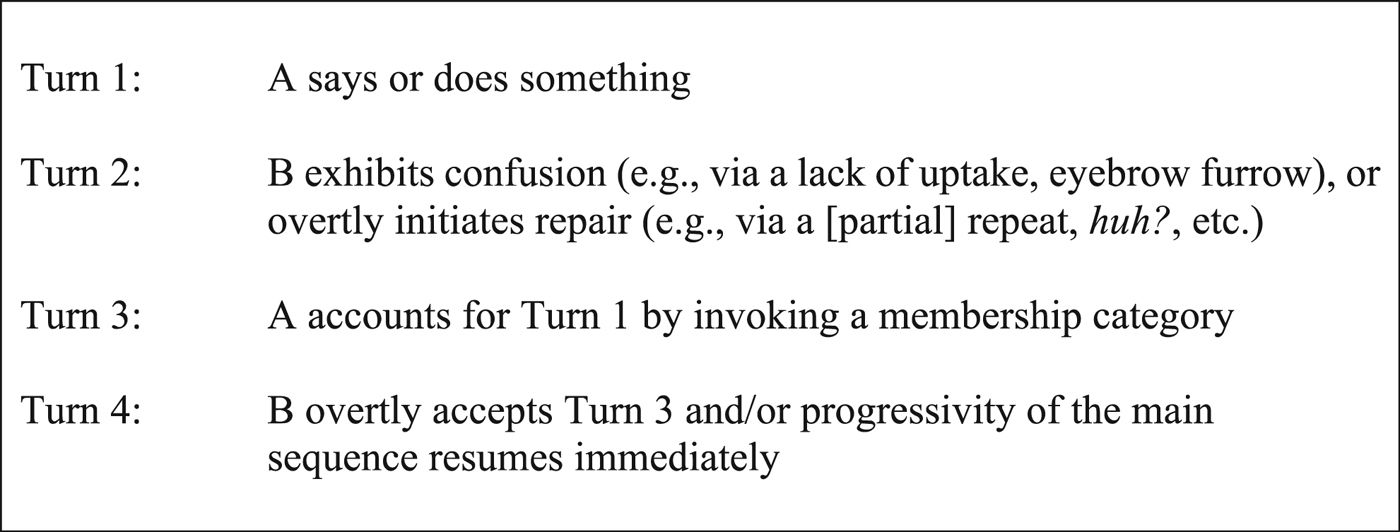
Cases such as these seemed to illustrate a particular, collaboratively and sequentially produced orientation to the normativity of conduct (and departures therefrom) based on invoked identities and membership categories, specifically gender-related categories in these two examples. Broadly speaking, the structure appeared to look something like the schematic in Figure 1.
Schematic of category accounts in repair sequences.

That is, in the first turn, A produces or describes some bit of conduct. That bit of conduct is then retroactively cast as a deviation from normative ‘category-bound’ activites or predicates (Sacks Reference Sacks1992) by the sequence that follows: A form of repair that betrays a lack of understanding something about the prior turn (but does not necessarily specify what is not being understood), which a participant then attempts to resolve through the provision of an account that invokes a membership category. By providing category accounts in this particular sequential context, speakers display their own analysis of the impetus for their interlocutor's repair initiation, conveying that it was a deviation from a given membership category's expected, normative conduct (conveyed in a prior turn) that is being taken as causing the problem of understanding for the recipient. Moreover, that recipients routinely accept category accounts in this context, closing the repair space and immediately returning to the main sequence, suggests that providers of category accounts are justified in their treatment of such initiations of repair as account solicitations.
Importantly, it is the progression of these actions in a sequence of actions that reconstitutes the normativity (and deviations therefrom) of the identities and associated activites or conduct in question. That is, “It's for my li'l sister” does not, in and of itself, present the boy's asking about Barbie dolls as a deviation and the gift for his sister as normative. Rather, it is that this turn is provided as an account, as part of a sequence oriented to remedying confusion, that normative category-bound activities and departures therefrom are re-created. Similarly, an assertion that “Mom taught me about cars cuz you were gone” does not, in and of itself, draw a line between men's and women's presumed knowledge of cars; however, its production as an account, within a sequence dedicated to remedying a failure of understanding why a prior turn about cars was formulated in the way it was, makes this line between the categories of ‘men’ and ‘women’ (with relation to automotive knowledge, at least) much clearer. By the end of these sequences, then, each participant has performed part of this normativity-reproducing end result, with neither being the sole author thereof. Accordingly, these sequences reveal a truly participant-distributed means of orienting to and reconstituting normative associations between identities and conduct.
The appearance of category account sequences in televised (i.e. scripted) interaction proved intriguing in that such sequences constituted a concrete, yet subtle, means through which gender normativity was being performed on-screen for viewer consumption (for more detailed discussion on this point, see C. Raymond Reference Raymond2013). Given that on-screen talk does not always accurately reflect how real-life conversationalists use language, however, the question remained as to whether this same sequential structure could be identified in naturally occurring conversational data as well. As I began to examine such corpora, it became evident that category account sequences do indeed routinely occur in naturally occurring social interaction, which likely explains their salience such that writers can (and do) incorporate them into their scripts.
In the following case (7), taken from mundane conversation between two close friends, Ann launches a telling about the events from the night prior. The recipient of the telling, Jen, does not know “Betty Smith” personally but does know of her. (Note the full name reference in line 1; Sacks & Schegloff Reference Sacks, Schegloff and Psathas1979.) Observe how the condition of Betty's apartment is accounted for in lines 7 and 8.
(7) Wkend_Dinner_08:30

Here we have the same sequential progression that we saw in prior (scripted) examples, but in this case, the category-deviance is in regard to a third party, external to the present conversation. First, Ann self-repairs to include an increment (Ford, Fox, & Thompson Reference Ford, Fox;, Thompson, Ford, Fox and Thompson2002) that negatively assesses Betty's apartment as “so: disgusting” (line 5). In response to Jen's initiation of repair in line 6, then, Ann produces a category account: Betty grew up as the only girl among four brothers. As seen above, this treats Jen's initiation of repair not as a problem of hearing or identifying a referent, as might otherwise be expected (Jefferson Reference Jefferson and Sudnow1972; Schegloff, Jefferson, & Sacks Reference Schegloff, Jefferson; and Sacks1977; Du Bois Reference Du Bois and Chafe1980; Kendrick Reference Kendrick2015), but rather as a problem of understanding; and what Ann takes to be the problem at hand is understanding why Betty would have such an untidy apartment. The account invokes the categories of ‘brothers’ and ‘sisters’ as relevant and distinct when it comes to norms of cleanliness, but also the categories of ‘boys’ and ‘girls’ more generally, given that Ann was the “only gir:l” among the brothers. This account is accepted by Jen, who explicitly closes the repair space in line 8 with her change-of-state token “Oh.” (Heritage Reference Heritage1984a) and an overt claim of understanding “I: see::.”, thereby providing for the resumption of Ann's telling in line 9.
It is crucial to note again that a turn-at-talk asserting that Betty was the only girl out of four brothers does not, in and of itself, evoke any norms linking cleanliness to gender. But as soon as we take into consideration the action import and sequential position of the turn—as an account offered to remedy an interlocutor's demonstrated lack of understanding about an unclean apartment—then the normative associations being tapped into and mobilized by the participants become much more evident. The same can be said of the initiation of repair in line 6, which, on its occurrence, could be used to indicate other (i.e. not gender-related) problems of understanding as well. Nonetheless, what is subsequently offered by Ann to resolve the trouble, and what is accepted by Jen as having been sufficiently informative, is a category account based in gender normativity. Thus it is across this collaboratively constructed sequence of actions that the normative associations between gender and cleanliness are ‘talked into being’ (Heritage Reference Heritage1984b)—that is, through practices that are distributed across the participants.
Building a collection of the use of this practice in naturally occurring interaction also revealed how the structure described above can be modified and condensed.Footnote 5 In many cases, the format of the initiation of repair is relatively open (e.g. Drew Reference Drew1997; Robinson Reference Robinson2014), thereby placing the burden on the first speaker to detect what, specifically, the problem is, and offer a solution to it. It is noteworthy that category accounts routinely occur in this slot, where repair initiators have not overtly indicated that membership category norms are the cause of the confusion. Nonetheless, category accounts can also be solicited more explicitly. In such cases, Turns 2 and 3 in the schematic from Figure 1 are joined as the category account is proactively offered up for confirmation by the would-be repair initiator. This is seen in (8) below in which Molly and Lauren are discussing Molly's first week as a new employee at a women's shoe store. At this point in the talk, Molly is in the process of describing some of her coworkers.
(8) Vid_7_9:32

Here, Molly announces that the owner of the shoe store is a guy, which at minimum presents this information as newsworthy (lines 4–5). Despite Molly's having projected more to say about the owner, Lauren interdicts to offer up a category account for confirmation: “Is he gay?” (line 6). Thus, rather than simply displaying confusion or using an open-class repair initiator like Huh?, thereby leaving it up to Molly to figure out what the trouble is and repair it (as in previous cases), here Lauren does the work for Molly to target what specifically is at issue for her (see Dingemanse et al. Reference Dingemanse, Roberts, Baranova, Blythe, Drew, Floyd, Gisladottir, Kendrick, Levinson, Manrique, Rossi and Enfield2015). Requesting this particular bit of information, at this particular moment in the sequence-in-progress, casts a “gu::y[’s]” ownership of a women's shoe store as an accountable deviation from normativity, with sexuality overtly invoked as a means to account for it: A heterosexual man's ownership of a women's shoe store is thus collaboratively constructed by the participants as less than normative, while for a homosexual man it is collaboratively constructed as making more sense. Indeed, despite the fact that Molly disconfirms the category account offered by Lauren for this particular man (line 8), she nonetheless immediately goes on to overtly legitimize Lauren's having offered it as an account in the first place—”He didn't seem gay, but you would think that he would be, you know?” (lines 10–11)—thereby simultaneously legitimizing the normative associations thus re-created between gender, sexuality, and women's shoe store ownership, even in the context of the account not applying to this particular owner of a women's shoe store.Footnote 6
Consider an additional case of this sort. In (9), Sara is complaining to Ali about how a guy she was interested in “ignored” her for another woman. The participants then proceed to look up this woman on their phones via social media and negatively assess her for quite some time, calling her physical appearance “literally pretty rough”, “decently beat”, and “huge” (data not shown, but see Raclaw, Robles & DiDomenico Reference Raclaw, Robles and DiDomenico2016:373–77 for a detailed analysis of that portion of the talk). We enter the exchange toward the end of this extended assessment sequence, where Ali summarizes the difference in attractiveness between Sara and this other woman as “hu:ge” (line 1) and describes the guy's choosing the other woman over Sara as a “joke” (lines 7–8).
(9) Vid_9_24:15

In this case, the prior telling and assessment sequence as a whole set up that Sara's romantic interest is interested in a woman deemed by Sara and Ali to be significantly less physically attractive than Sara. In lines 10–13, then, Ali offers up a category account for confirmation, thereby casting such behavior as accountable. By asking if this individual belongs to the category ‘nice guys’, she makes relevant a distinction between ‘nice guys’, on the one hand, and other sorts of guys, on the other. By offering up the former category (‘nice guys’) as a possible account for why this individual is giving his attention to a physically inferior woman, Ali sequentially reestablishes the commonsensical norm of men prioritizing women's looks over other attributes, with a deviation from that normative conduct actively oriented to as requiring explanation. In this case though, as in the case prior, this category account turns out to be disconfirmed. Interestingly, here, this prompts Ali to offer an alternative category account in line 15, namely via the category ‘assholes’, and this is confirmed by Sara.
In all of the cases seen thus far, through the provision of accounts in particular sequential positions, participants collaboratively reconstitute normative associations between some bit of conduct and a membership category. That participants do this so routinely and so unproblematically reveals the strength of the social norms and category-bound activities being mobilized to do this accounting. There are, however, instances where participants actually diverge in their understandings of what constitutes normative conduct and departures therefrom. This is precisely what occurs in extract (10), in which Clara is announcing who her roommates will be for next year.Footnote 7 The phrase she uses in launching this telling is that she has found out who her “house sisters” are going to be (data not shown). She then goes on to list and describe the different members of the household, one of whom is “a: French guy. (.) Dominique” (line 1). Likely due to the prior description of the house as being comprised of “house sisters” and “girls”, Juan initiates repair on the mention of this member of the household. Clara responds by providing a category account, which Juan actively does not endorse. (Note that these participants are bilingual Spanish-English speakers; the o sea in line 10 is a Spanish discourse marker that, for our purposes here, can be roughly translated as like or I mean.Footnote 8)
(10) CallFriend_6093

In response to Juan's request for clarification that a “gu:y” will indeed be living in what has been thus far described as a “gir:l house” (lines 3, 5), Clara invokes as her (and, with “we”, her housemates’) account a “need” to have guys live in the house. She immediately expands her account to assert that she and her house sisters “would never live in a house alone” (line 7). By categorizing not having any men live in the house as the equivalent of living “alone” (despite the fact that she has just listed several women who will be living there together) underscores the commonsensical normativity—for her—of the need for men to live in the house. In this case, though, her interlocutor does not endorse or align with this normative (for Clara) expectation: A half-second gap emerges after Clara's provision of the account, and Juan is heard to be holding back a burst of laughter that erupts in line 9. Clara orients to Juan's lack of agreement with her stance, interdicting his laughter to offer a second category account—this time related to ethnicity, and repeated in line 12—in pursuit of affiliative uptake. Note that, by virtue of its sequential positioning and indexical “that”, this ethnicity-based category account is also gendered in that it points back to the earlier lines 6–7: That members of the category ‘women’ do not (or should not) live in a house without members of the category ‘men’ is something that pertains to ‘men’ and ‘women’ who are members of the category ‘Latin’. Juan's well-prefaced (Heritage Reference Heritage2015) response in line 13 disagrees with this second account more specifically than he did with the first; but in the environment of a lack of engagement with his disagreement, he opts to exit the sequence in lines 15–16 with a sequence-closing idiomatic expression (Drew & Holt Reference Drew and Holt1998).Footnote 9
DISCUSSION
This article has examined a sequentially deployed practice that ‘talks into being’ (Heritage Reference Heritage1984b) associations between membership categories and normative conduct. We began with cases in which participants collaboratively cast behavior as deviating from normativity—and therefore as accountable—by one speaker initiating repair with a relatively ‘open’ format, and the other speaker providing a category account to explain away the deviance. That membership categories are so routinely used to do this underscores the pervasiveness (and potential omnirelevance; Garfinkel Reference Garfinkel1967:118; Weatherall Reference Weatherall2002) of the specific social norms that the participants are tapping into.Footnote 10 That is, although a whole range of possible problems of speaking, hearing, and understanding can be indexed with a look of confusion, an open-class repair initiator, or a (partial) repeat of the prior turn (see Kendrick Reference Kendrick2015 for an overview), in many of these cases, a category is immediately targeted and mobilized as the repair solution. Moreover, in cases where we might expect the specific format used to initiate repair to be taken as indicating a problem of speaking or hearing (i.e., not one of understanding), the provision of a category account is particularly interesting, as such instances suggest that participants may prioritize addressing normativity-related repairables over other sorts of repairables.Footnote 11 Regardless of the particular format used to solicit them, however, category accounts retroactively treat the source of confusion exhibited just previously as resulting from a misfit between some category member and their behavior, thereby displaying an understanding of what lies at the root of the confusion, and in so doing reestablishing the association between the identities and norms in question. It was also shown that participants can offer up category accounts for confirmation. In such instances, a speaker solicits confirmation of something that would—for them—normalize the departure from normative conduct that was just introduced into the interaction.
The analysis developed here is one that is derived from the conversationalists’ own orientations to commonsensical normativity. That is, in this study, it is the participants themselves who—through their very solicitation and provision of accounts—reveal what sorts of conduct constitute accountable deviations from social norms. We therefore see interactants’ orientations to and mobilization of ‘commonsense knowledge of social structures over the temporal “succession” of here-and-now situations’ (Garfinkel Reference Garfinkel1967:68; see also Edwards Reference Edwards1991). And indeed, as was shown in the last example, it is possible for participants to disagree with regard to what is commonsensical, as well as what suffices as an account.
Sequentiality plays a crucial role in the practice analyzed here (on which, see also Schegloff Reference Schegloff2007b; Stokoe Reference Stokoe2012a). What we examined were not instances of one speaker simply asserting that some behavior is normative or not normative for a certain membership category. Rather, normativity is invoked and reconstituted collaboratively, in sequences of action. As single turns-at-talk, asserting that someone was the “only gir:l out of four brothers” (see (7)), or asking if an individual is gay (see (8)), do not, in and of themselves, tap into normative gender- and sexuality-based constructs about cleanliness or profession, respectively. But it is in the provision of such turns as accounts, in sequences devoted to remedying problems of understanding some prior (description of) conduct, that normativity is reconstituted, distributed across interactants’ individual turns/actions. In this way, the ‘technical exploration’ (Schegloff Reference Schegloff, Alexander, Giesen, Munch and Smelser1987:299) of the practice in question—in terms of its action type and sequential position—serves to operationalize, systematize, and ground our observations in the orientations of the participants, thereby revealing one way in which macro-categories like gender and sexuality can become demonstrably relevant and procedurally consequential for what the participants are doing with one another, as well as how they are doing it.
At face value, one might assume that such moments in social interaction could challenge or otherwise disturb participants’ views and understandings of social-identity categories—that is, that the accumulation of such anomalous occurrences could, over time, erode commonsense knowledge about social categories and the conduct normatively associated with them. However, these sequences actually work to legitimize and reconstitute social actors’ background knowledge and commonsense associations through the very act of accounting for (what they deem to be) deviations from them. ‘The exceptions with their explanations’, writes Heritage (Reference Heritage and Antaki1988:140), ‘thus become ‘the exceptions that prove the rule’ because the provision of such explanations maintains the rule's presuppositional status both as a rule of conduct and as a rule of interpretations’. Accordingly, when a boy asks about purchasing Barbie dolls, thereby potentially deviating from some social norm, participants do not redefine or recategorize the membership categories of ‘boys’ and ‘girls’, or ‘brothers’ and ‘sisters’, in terms of their ‘category-bound’ associations with Barbies as toys (see Heritage Reference Heritage, Giddens and Turner1987:246–67, Reference Heritage2011; Pollner Reference Pollner1987; Sacks Reference Sacks1992:vol. 1:394; Heritage, Raymond, & Drew Reference Heritage, Raymond; and Drew2019; Raymond Reference Raymond2019). Similarly, when interactants encounter a man using ‘women's language’ (Lakoff Reference Lakoff1975) in referring to car parts, they do not erase the line in the sand between men's and women's expected (non)use of technical vehicle vocabulary. On the contrary, these deviations from social norms are interactionally built and oriented to in the talk as just that—deviations that are accountable. As opposed to chipping away at our conception of what is shared, commonsensical, and normative, then, these moments actually expose a ‘self-motivating, self-sustaining and self-reproducing normative organization’ (Heritage Reference Heritage and Antaki1988:140), which consistently reaffirms and reconstitutes what is (and what should be) accountably shared and normatively commonsensical about the world—at the ground level of turn-by-turn talk.
CONCLUSIONS AND AVENUES FOR FUTURE RESEARCH
It is relevant to note that, even in cases where the category account offered up for confirmation turns out to be incorrect and is disconfirmed, that the particular account was offered—that is, the commonsensical foundations that provided for its being offered as a potential means to explain away a moment of deviance—very routinely goes unchallenged. Thus, even when a category account fails to adequately explain away apparently deviant conduct on this particular occasion, the norm(s) thereby invoked are nonetheless reconstituted. We saw this most explicitly in excerpt (8). Future research might therefore specifically target instances in which the participants actually do negotiate what, exactly, the relevant norm is, whether or not it is legitimate, and who has the authority to assert it (e.g. case (10)). Such moments may prove difficult to locate, but they would offer profound insight into the on-the-ground negotiation of so-called ‘commonsense’ normativity, thereby further underscoring that normativity is itself an interactional achievement. Such moments of negotiation would also shed light on some of the concrete interactional means through which participants can effectively resist reproduction of normative constructs and associations, as opposed to reifying them.
Although the present analysis underscored the collaborative, participant-distributed nature of the sequences explored here, future studies might dedicate more focused attention to first speakers’ topicalization of normativity-divergent behavior in the first place: Are there specific practices that speakers routinely use to frame what they are about to say (or what they have just said) as at variance with a norm, perhaps in the service of staving off the accounting sequences examined here? One example of such a practice might be the use of the phrase ‘No homo!’, a discourse interjection that is used immediately following some behavior that could be considered homosexual, as part of an effort to ‘negate’ such a ‘transgression’ (Brown Reference Brown2011).Footnote 12 It might additionally be noted that, in a plurality of cases in the present dataset (most obviously in example (7) reproduced here), first speakers are seen to interrupt the projected forward trajectory of their action-in-progress to interpolate the information on which the second speaker then initiates repair. This initial design may make the subsequent repair initiation more prone to being heard as related to normativity concerns, or it may even set up for its occurrence.Footnote 13
Additionally, I have been designedly conservative in my assigning of specific labels to the macro-categories invoked by participants. In some cases, categories and identities may be relatively straightforward; but in others, overlapping categories are difficult to disentangle. On the occurrence of a category account like “Is he gay?”, is it possible to separate the norms associated with gender from those associated with sexuality? Researchers are often quick to assign labels to different features of identity, distinguishing X from Y for the purposes of their analysis. However, it would also be worth considering whether such separations are altogether necessary if—for the particular participants in question and at a particular moment—both identities X and Y are intertwined.
What all of these possible future directions have in common is that they not only prioritize the participants’ orientations to the relevance of macro-categories, but they also look for such relevance beyond individual turns-at-talk. The vast majority of category accounts in my collection are offered quickly and unproblematically, and are achieved in the course of some other trajectory of action. As seen in many of the examples presented here, they routinely occur as insert and side sequences (Jefferson Reference Jefferson and Sudnow1972; Schegloff Reference Schegloff2007a) which, once closed, occasion the immediate resumption of the in-progress course of action. One might therefore be inclined to view them as less interesting, or perhaps less important, with regard to their ability to reinforce divisions between membership categories, than episodes of interaction wherein social identity categories become the main topic, project, or business of the talk (e.g. in hate speech, slurs, epithets, or other overt disparagements). Nonetheless, momentary digressions from the main business of the interaction, such as the ones examined here, are just as norm-sustaining as those other, more overt practices (if not more so), specifically because of their ubiquity and frequent en passant status in terms of the overall structure of the interaction. That is, despite what might be conceived of as the covert nature of such interactional achievements—or indeed perhaps because of that covertness—each time such a practice is deployed, a scintilla of ‘seen but unnoticed’ (Garfinkel Reference Garfinkel1967:36) weight is added to the normative scales. Given this, scholars interested in the links between language, identity, and normativity—perhaps especially those interested in social change—must bear in mind that it is not only in the content of single turns (or of items within turns) that norms and stereotypes associated with categories like gender, sexuality, and ethnicity are recreated. It is also in the ‘seen but unnoticed’ provision of content to accomplish particular actions, within sequences of action, that the lines between social categories are most pervasively and recurrently drawn in mundane social interaction.