Much has been said and written on the epistemology, history and practice of archaeology in Germany, and German-language archaeology in Europe, in numerous articles, monographs and conference volumes in both German and English (e.g. Härke Reference Härke1989; Veit Reference Veit and Shennan1989; Kossack Reference Kossack1992; Klejn Reference Klejn1993; Marchand Reference Marchand1996; Kossack Reference Kossack1999; Härke Reference Härke2000; Sommer Reference Sommer, Biehl, Gramsch and Marciniak2002; Leube Reference Leube2002; Halle Reference Halle2005; Arnold Reference Arnold2006). Still, archaeology in Germany is poorly understood – even within Germany itself. Some factions continue to accuse others of being atheoretical or even anti-theoretical. The discourse has been very much driven by coping with the social and political legacy of nationalist and racist abuse of archaeological evidence. At the same time, German archaeology seeks a position within European archaeologies. Is it still a ‘mainstream archaeology’ (Neustupny Reference Neustupny1998), especially in relation to Central and Eastern Europe? Has it ever been? Is it old-fashioned and needing to catch up with Western European archaeologies?
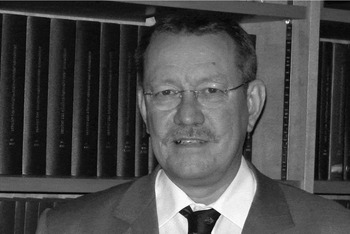
Today the situation of archaeology in Europe in general and in Germany in particular is hard to assess; it is even harder to predict where both are going. A scholar who currently is very well placed to help to clarify these issues and to promote a better understanding of both archaeologies and their relationship to each other is Friedrich Lüth (fig. 1), Erster Direktor of the Römisch-Germanische Kommission (RGK), the largest research institute for prehistoric archaeology in Germany, as well as president of the European Association of Archaeologists. This interview is thus different from others that have been published in Archaeological dialogues; it does not focus on the achievements of a single archaeologist, it is not intended to review her or his lifework, it is not looking back, but looking forward and into the wide field of academic discourses and scientific communications. It illuminates how one of the leading science managers in Germany evaluates the strengths (and, less so, weaknesses), structures and status of German archaeology. And discussing curricula, funding, legal frameworks and so on we shed some light on the constant rephrasing of archaeology's disciplinary identity, its location between the ‘two cultures’ – with German archaeologists tending to push it towards the sciences rather than the humanities – and its search for good practice in times of insecurity (cf. Dawdy Reference Dawdy2009).Footnote 1
Friedrich Lüth

Prof. Lüth, first I want to thank you for taking the time for this interview. Let me start with a question of European scope. You are not only Erster Direktor of the Römisch-Germanische Kommission (RGK), but at the same time president of the European Association of Archaeologists (EAA), you are one of the founders of Europae Archaeologiae Consilium (EAC), and you are advising the European Council in Strasbourg in heritage matters – why are European issues so important for your work?
If you want to practise archaeology on a large scale, you can do so only on the European level. Where we limit our research to the borders of nation states we exercise national archaeology. But of course scrutinizing archaeological cultures means looking at territories beyond national borders, and when we look at the genesis of Europe from the last postglacial times to today we see phenomena which appear and develop across Europe in various landscapes, and these landscapes hardly coincide with modern political boundaries. So, if you want to practise European archaeology or archaeology in Europe seriously and meaningfully you can only do so on a European scale.
At its Annual Conference in 2009 also the Verband der Landesarchäologen (Association of State Archaeologists) has dealt with a comparison of the situation and the structures of archaeological practice in Germany and in Europe. Footnote 2Do you think these topics have been dealt with insufficiently in the last decades in Germany?
I wouldn't say so. In 1995 at the First Annual Meeting of the EAA in Santiago de Compostela a Round Table of European heritage managers was organized. Already at that time the Verband der Landesarchäologen had started to think about how to use this EAA forum to bring together all European heritage managers and to start discussing problems and structures and to look for ways how to align different methods and how to build bridges where borders impede communication and research. The heritage managers met to draft the European Convention on the Protection of the Archaeological Heritage (the Malta Convention), and a logical consequence was that on the one hand structures were created on the political–administrative level at the European Council and the nation states, and on the other hand the Heritage Managers’ Round Table was inaugurated.
Another consequence – and the Verband der Landesarchäologen was strongly committed to this – was the foundation of the EAC, also in two meetings here in Frankfurt at the RGK. One aim was to keep structures within Europe transparent after the fall of the ‘Iron Curtain’ and to level the different approaches of the various nation states – without touching their sovereignty – with respect to the European goals of archaeology concerning research and heritage management, without having to change structures within these states considerably.
So the answer to the question whether it was something novel for the Verband der Landesarchäologen to focus on the European dimension, is ‘no’. We have consequently been doing so every year since 1995, and also the colloquia we have organized always included at least two contributions from our European neighbours. Topics like volunteers in archaeology or the submarine cultural heritage, which we will be treating at this year's meeting in Schwerin, or like different research traditions or the implementation of the ‘Bologna’ process in each country – all this has always been related to the European level.
You are talking about borders within Europe which the Heritage Managers tried to bridge with EAA meetings and Round Tables etc. Does this also hold true for academic archaeology? Is archaeology as it is practised in German academia similarly well connected to other European archaeologies?
Of course, we see varying structures here. The successor states to the countries beyond the former ‘Iron Curtain’ still have the typical ‘academy structures’ to a considerable degree, i.e. academies doing research, which we in Western Europe never had in this form. Rather, here the universities were the main research bodies, at least during the first decades after the war and into the 1970s. Later also larger Landesdenkmalämter (State Heritage Boards) maintained a research department, and of course the German Archaeological Institute (DAI) with the RGK conducted research. Not always were things run cross-nationally, across borders. And if you think of financial support, the strategies for the promotion of research were national, i.e. in binational projects German funding bodies have always financed the German part of the investigation, not the foreign one.
As far as I can say, only in the last ten or fifteen years has a rethinking held sway. This is in particular due to the former president of the German Research Foundation (DFG), Ernst-Ludwig Winnacker, and to the so-called ‘tandem projects’. They are based upon cooperation agreements between the DFG and its partner institutions in other European states. These agreements enable the projects to operate as real tandems, where each national institution funds its own side on the premise that also the other side will be funded. Examples are co-operations with the Agence national de recherche in France, the Arts and Humanities Research Council, the Czech Grantova Agentura and Russian institutions.
I would like to take a closer look at the situation of archaeology in Germany and formulate three questions concerning academic archaeology, heritage archaeology and the young academics. The first concerns academic archaeology. Currently its position seems determined by the implementation of the ‘Bologna’ reforms or even the reform of the reforms, as well as by the ‘Excellence’ initiative. Set off by federal politics and endowed with large sums of federal money, this initiative has led to a hierarchization of university institutes and growing student numbers. How would you characterize the situation of academic archaeology in Germany?
I think that archaeology has won a lot through the ‘Excellence’ initiative. The aim of it was to concentrate resources and money where excellence already existed. Whether we like this or not is a secondary question. The ‘Bologna’ process probably will reveal that only those universities that are particularly committed to archaeology and provide particular resources for research and teaching are fit to manage extra ‘Excellence’ project efforts, in addition to the everyday work, and allot it to the strong backs of a broad staff. If you think back about the time before ‘Bologna’, there were a number of institutes in Germany comprising only a one-person or two-person staff. The curricula which ‘Bologna’ requires, however, cannot be tackled by a one-person institute, therefore a sensible concentration of forces is required. Again, whether this is considered something positive or not I do not take into account here, but a change of structures was one of the goals of ‘Bologna’. However, I don't know whether anybody predicted the radical form it now takes. Perhaps the current outcome is not the best possible. But I wouldn't say that the state-funded ‘Excellence’ initiative leads to a hierarchization of universities into A, B and C qualities.
In any case, if you don't invest, you don't gain a dividend. Therefore it comes as no surprise that those universities which had invested before the ‘Excellence’ initiative have been served well through this initiative. And also archaeology departments gain support from the initiative where they are promoted by the university. However, to hear that the scope for research is cut in favour of teaching is worrying, because the institutes at universities are as much institutions for research as for education. Before we change structures again we have to think about how to regain space for research, either allotting more research time to researchers or hiring more staff.
Where the students are concerned, I don't think that large numbers of students are a problem, far from it. In the long run, a large number of students is a potential, if they receive a good training and a sensible, solid degree, that will pay off for archaeology, no matter whether they will work within archaeology or change into other fields, where they will act as multipliers, something we already see in other countries with other traditions, e.g. in Great Britain. Also in Scandinavia we will have to screen the market for similar developments.
How do you judge the situation of heritage management? Here, too, I see tensions between, on the one hand, the commercializing of public archaeology, excavations in particular, and, on the other hand, downsizing budgets for public heritage management, while at the same time the public interest in archaeology seems to increase, as re-enactments and theme festivals with large numbers of visitors and considerable media response indicate.
Since new heritage protection laws were launched in many German Bundesländer in the 1970s, archaeology has managed quite well to attract the public and has seen a tremendous increase in public attention. Today it is part of archaeology's self-image to define itself as part of public life and history. And despite current economic tensions I don't see any challenge to this basic position. Of course, wherever money is involved and is getting shorter the justified question arises whether resources are intelligently allotted. Being dependent on public finances we always have to compete for public and political support, we always will be part of public opinion. And this is appropriate, since also other branches such as nature protection have their public relevance and take part in this competition, therefore we cannot lean back saying that we have reached a saturation level in our society – we continuously have to articulate and present our claims.
We are not so much practising heritage protection (Denkmalschutz) – a word I don't really like, it sounds like polishing glass cabinets – but ‘the management of change’. Both archaeological and architectural heritage management deal with the changes of objects – changes that are sought for through industrial or urban development, changes brought by the ageing of monuments or buildings. This management of change is what characterizes archaeology and architectural heritage management. Accepting that we have to manage changes means accepting that we are not protecting or conserving things but are training them for the future under different requirements. Financial shortages, of course, make us think about our core business again. What are the main duties of a State Heritage Board; what are the obligations of a regional authority; what aims need public money and control; what tasks can be privatized and run by profit organisations?
The good thing about the Federal Republic is the plurality of the system. Each of the sixteen different Bundesländer has its own heritage law. Everywhere things are directed and defined differently. This plurality is responsible both for the kaleidoscopic picture we see and for the security of the heritage management. In contrast to a centralized governance of heritage management, the plurality of the federal system also ensures a long-term quality management. If the political framework changes – something we currently see in France, for example, with changes in how the budget of the INRAP is calculated in relation to consumed land – if politics interferes centrally and changes laws, this leads to enormous structural changes with negative effects on both heritage management and research. I wouldn't assume similar dramatic consequences for the Federal Republic of Germany. Nevertheless, we are always challenged to define exactly our core business in a changing social and political framework.
Don't you see an advantage in a centralized system with a central institution, especially where the management of excavations is concerned? The INRAP as the central institution for ‘preventive archaeology’ is run by money coming in through the ‘polluter-pays principle’ based upon the Valetta guidelines, and it manages and is responsible for consistently high standards of excavation throughout the country.
Well, let's go back to the Valetta convention. It simply says that investment measures must include means for the protection of monuments. These come from either public or private sources. The convention does not stipulate that it is always the investor who has to pay. Each European country is free to interpret this rule. The INRAP variant is unique, since it calculates the land consumption – also in regions where no monuments are threatened. This, in a sense, is a tax. The constitution of the Federal Republic of Germany does not include a possibility for such a monument tax, and probably nobody even thinks about it. Here you can't raise a tax for a monument that you don't have, it doesn't work that way in Germany. This model cannot be transferred to other states.
Each German Bundesland implemented the Valetta treaty differently. In the ‘new states’ of the former GDR and also in some of the ‘old states’, the ‘costs-by-cause principle’ is either an openly stated part of the law or indirectly inferred from the law on the basis of the Valetta convention, which has been a federal law since 2002. Therefore, across the Bundesländer, rescue archaeology is financed in very different ways. However, no law will ever save you from the decision of to what degree you investigate a threatened monument. Every heritage manager has to make this decision every time anew. Again, I think that the plurality of systems enables standardized comparison and control. Both comparison and plurality will be lost if we opt for a centralized system. Plurality also flattens peaks and depths, which necessarily emerge having sixteen different systems. Here you can always either align to the average or look to the Bundesland that is currently very strongly committed to heritage management.
Plurality also characterizes the university institutes: the orientation of a chair and an institute depend heavily on the chairholder and the ‘school’ he or she establishes. Is this situation similar to other European countries? Does this situation result in an advantage or a disadvantage, especially for the internationality of archaeology?
This is no easy question. If you take a look at Great Britain, for example, you see the archaeology institutes in Oxford or Cambridge, two time-honoured institutions, which have had or still have leading scholars for certain facets of archaeological research. Certain scholars, such as Colin Renfrew, for example, have strongly influenced certain research landscapes. Also in Scandinavia ‘schools’ existed and some institutes played very significant roles, and we also see differences between, say, Stockholm and Uppsala. In Denmark it was always a shift from Aarhus to Copenhagen and back. So I think that this always very much depends on the person appointed to a chair who influences research from there. If you take a look at Kiel, for example, the main focus was the Early Middle Ages when Müller-Wille was chairholder. Today the focus has shifted to the Neolithic with Johannes Müller. We can thus say that rather than continuity in research topics this institute focuses upon having remarkable researchers able to maintain and develop a high standard of pre- and protohistoric research, irrespective of the period. But still, if you look at places like Heidelberg, Berlin, Tübingen, Freiburg or Munich and the new professors there, you can see that ‘schools of thought’ are in fact established – in a healthy manner. All these institutes are internationally oriented and connected. I don't think that ‘schools’ have had a negative effect on the discipline; rather the bundling of resources and topics has been positive.
You have mentioned the new professors at archaeological institutes – do you think the appointments of recent years are leading to a modernization and reorientation of the discipline or rather to the strengthening of traditions?
Well, it depends on what modernization means. Actually, the research orientation of all these institutes has changed more or less dramatically. I have mentioned Kiel; in Munich there was a shift from the Middle Ages to the Bronze Age, at the Free University of Berlin from the Bronze Age to the Neolithic. And I wouldn't say that these shifts were rather conservative – as your question seems to imply – since all these chairs are multidisciplinarily oriented. The institutes are integrated in large-scale research networks. I think that this multidisciplinarity is the right step into the future.
Does the new multidisciplinarity also change the way archaeology is practised?
Previous generations also have drawn on the sciences, but they have not pursued research questions together with and integrated in the sciences in this way, this is an evident shift. To commission an anthropological analysis or to communicate with anthropology about new interpretative models, these are two different things. As far as I can see, all archaeology chairs today are on a modern track. That is, they are deliberating together with the sciences about how to advance their own and the other discipline on the basis of new research questions, how to open up new dimensions of research.
Let's talk about current research topics for a moment. It has been argued that German and Continental European archaeology on the one hand and Western European and Scandinavian archaeology on the other are drifting apart in how certain questions are developed, how topics are approached and how data is dealt with. What is your impression?
Well, about twenty years or so ago we might in fact have been talking in two different languages about the same topic. There was a ‘de-materialized’ theoretical form of research, unlike in Germany and other Continental European traditions where we moved from the artefact to the interpretation. In other places, ‘artefact-free’ conclusions were used to drive interpretations which sometimes led to bizarre situations. A British colleague recently told me that the replacement of a vacant post of a curator at the British Museum was problematic, because among the native candidates none had sufficient knowledge of the material – indispensable for a curator – so that they had to appoint a foreigner. If this means that – while research in Britain was of high standard – they haven't educated for their own market, we can say that we are happy to help out. But I don't think that we have to take this to extremes. The ‘happy medium’ is crucial: the right mixture of theory and practice. This means that the best way probably is a prehistoric research along with the artefacts and excavation results, which nevertheless need not remain void of theory. And we are observing that approaches in Britain and Scandinavia are changing. Think, for example, of Kristian Kristiansen, who is at home with theoretical archaeology, as everybody will agree, and who also has an exquisite knowledge of the material. These researchers who can turn their eyes in both directions will shape research in European archaeology.
It was Kristiansen (Reference Kristiansen2004) who criticized the widening gap between different ‘languages’ – not so much the difference between a theoretical and a materially oriented archaeology, as that between an archaeology shaped by and integrated into the sciences and an archaeology directed by idealistic concepts and dealing with topics such as agency, personhood, gender etc. – terms that don't even have an appropriate equivalent in the German language. Do you agree? Is this widening gap a problem for Europe, and where is Germany positioned?
I don't see a problem here for archaeology in Europe. Rather, this is part of global tendencies, influenced by North American research. In addition there is also the Russian and Eastern European tradition. These different traditions cannot be defined or criticized as widening gap. I rather think that the problem is much simpler: it is mainly one of language competence, a problem of the possibilities of accessing texts written by colleagues in different languages and incorporating them into one's own thought. It was also Kristiansen (Reference Kristiansen and Kobylinski2001) who investigated language competence as it is reflected in journals, and who came to a depressing conclusion for Europe. He demonstrated quite clearly where the limits of perception are. If you see it critically you have to admit that Scandinavian and British research has ignored the Continental European research to a considerable degree, probably due to a lack of language competence. We would be well advised to see to it that in the future knowledge will be transferred in a way that bridges language barriers. However, this does not mean that we are all supposed to publish in English or Swedish or German. Rather we have to find a means of making archaeological work published in different languages accessible to colleagues who have poor or no command of these languages. So far I've been talking about major languages only – what do we expect from Latvians, Hungarians or Bulgarians? Are they all supposed to write in English or in German? That would be lopsided. We have to create systems to make accessible literature in different languages. Let's face it: forty, fifty years ago our colleagues, of course, did read literature in other languages. Even if it was tedious and time-consuming. Today we can use modern systems to translate from one language into another rather than having to express ourselves cumbersomely in a foreign language. And this is even more true with profound matters we can express much more elegantly in our own language. If you accept language as a critical reason, many points of view, including Kristian's view that one side doesn't grasp the work of the other, are defined exactly along this barrier. By helping to overcome this barrier we are helping to make scholarship more transparent. This also applies to south-western and south-eastern Europe. Who does in fact read excavation reports in Greek? And who has taken notice of the Greek discussions on methodology?
Then again, countries like Denmark, Norway and the Netherlands have launched their own anglophone journals, such as Danish archaeology or Norwegian archaeological review, to move in the opposite direction in order to get over that barrier. Isn't that more reasonable? Isn't it even inevitable that we will be publishing in English more and more, including our German colleagues?
I suggest we need to think about ways to make German literature accessible. There are still Eastern European traditions using German as the main foreign language rather than English, and we shouldn't enter a contest. Also, the Romance language traditions can communicate between each other with more ease. I don't know if it makes sense to convert everybody to English. If I were an Englishman, I would fear for my own language, which has to be simplified to gain a broad consensus. So why don't we rather make the publications accessible via abstracts and summaries as well as keyword systems upon which we all agree, as we have done with DYABOLA.Footnote 3 Then I can access any book, article and note I need and I can decide whether I need to have it translated, maybe using computer programs, which will become simpler over the next ten or fifteen years.
Then nobody has to give up their own language. And for heaven's sake, we shouldn't aim for the United States of Europe with English as the official language. Rather we are a pluralistic entity from Lisbon to the Urals, where not everybody has to speak the same language. It would be sad if we were to lose our linguistic identity. All we need is to get our ideas across. This is the crucial point: we need to build bridges over these trenches.
What could or does the EAA as an anglophone association do in this respect?
In fact this is a recurring topic in our discussions. We are thinking about having a main topic for each annual meeting with main papers held in the plenary session that will be translated simultaneously. This won't be a heavy financial strain and would enable speakers to give their lecture in their own languages, having it translated into some of the major languages – of course not all sixty languages of the European Council. The European journal of archaeology already publishes summaries in German and French.
The problem of communication within Europe is not only a problem of languages, but also of approaches to different topics, of how research questions are formulated and discussed. You have mentioned cases where British or Scandinavian research was conducted ‘artefact-free’, in a ‘de-materialized’ manner. Don't we also need to build bridges between different attitudes towards research questions and material? Of course it is not the case that anybody working on the basis of a theoretical concept ignores the material, and anybody starting by scrutinizing the material works without a theoretical basis. But we deal differently with both.
Exactly. I strongly believe this is part of the plurality that we need to accept. It is not forbidden to do archaeology without material. There are younger colleagues, including yourself, who have looked into theories and have implemented theoretical approaches without applying them immediately to the material. The good thing is that these things, too, are possible. This is part of the freedom of research which is accepted, and I don't see any discrepancy here.
But again, I think that we have to find a middle ground – neither purely materially oriented archaeology without theory, nor pure theory without knowledge of data, makes any sense. We have to decide for each project where to introduce one or the other. If you are comparing different theories you don't have to place the material in the centre. And if you compare the composition of bronze objects you don't need to start with theories. At later stages in the research process, however, one cannot be done without the other. If you want to apply theories on migrations to prehistory you need to have a good knowledge of the data, otherwise you cannot reasonably come to interpretations. And somebody who defines forms, decorations and the material composition of certain objects in fine detail will not be able to turn the picture into an interpretation without theoretical approaches.
However, I cannot analyse bronze objects across Europe without having an initial research question.
Exactly. No question, no answer.
You have emphasized the plurality of approaches. Are all approaches promoted in a similar manner or is it easier, to put it provocatively, for traditional, conservative approaches to get the funding than for those having a theoretically oriented attitude? Again: isn't there not only a difference in practice, but also in attitude; that is, in how questions and materials are presented and discussed?
I'm not in a position to distribute any money – you would have to ask the German Research Foundation (DFG) – but I think that more theoretically oriented topics will also be funded; this is also reflected in projects listed by the DFG. Also the Ministry of Education's new funding budgets finance ‘frontier research’, where sciences and humanities are brought together. However, I don't think that some sort of quota arrangement is the right way, because we always should enable the best application to gain a grant. And the DFG warrants this, because applications are always appraised by reviewers as well as a DFG panel: that is at least eight or ten eyes. Therefore I don't worry that certain directions will not be promoted as a matter of principle.
You have mentioned multidisciplinarity as an innovation and emphasized that the archaeological is integrated into the scientific realm. Sabine Wolfram (Reference Wolfram and Härke2000) criticizes this attitude as the ‘Vorsprung durch Technik’ symptom, i.e. German archaeology's belief in the objective explanatory value of scientific data, which is not matched by a similarly intensive tackling of research questions and approaches. Dealing with migrations, for example, the current approaches are based upon isotope analysis but not upon a discussion of assumptions and premises included in the prevailing migrationist model.
The critique of German archaeology's orientation towards sciences is as old as the orientation itself. Think, for example, of V. Milojcic [professor in Heidelberg 1956–78] and the dispute about radiocarbon dating. Milojcic, quite a conservative archaeologist, argued strongly against the radiocarbon method. We should be careful with the assumption that German archaeologists in general are true believers in science. There is also a strong fraction which is very sceptical, maybe because of difficulties of integrating results from some scientific disciplines in a meaningful way. Some decades ago, Gerhard Körner, the director of the museum in Lüneburg, in the book Ein Königreich an der Luhe [Körner and Laux Reference Körner and Laux1980] named it the Heilsverlangen: the humanities, he said, expect solutions from the sciences, because they have lost faith in their own methods. I don't know if such a sharp critique is justified. Our subject includes all approaches, the predominantly conservative ones relying on archaeological methods as well as those integrated into archaeometry and using scientific methods. To be able to discuss the results you have to understand both sides, to be able to sketch the bigger picture you have to look in both directions.
The same holds true, I think, for the terms and models used to create these pictures, for example in interpretations of migration processes and their archaeological visibility. The concepts we are using need to be discussed with similar intensity. While such discussions are possible and are not actively foreclosed, the question whether they are in fact promoted and supported remains.
Yes, I think in fact they are. At most universities this is discussed in seminars in connection with particular regional or chronological themes. I don't know if this is always reflected in the literature. But look at Hermann Müller-Karpe, for example, who just has published his huge book on the history of religions [Müller-Karpe Reference Müller-Karpe2008]. He started as a researcher who issued a handbook on artefacts in pre- and protohistory and edited a publication series on prehistoric bronze finds (PBF) – and now that he has developed a thorough knowledge of the archaeological material has progressed into theoretical spheres.
It is always a question where to start. Do I start with the material and end up in theory, or do I start with a theory and have to move towards the material? I think it is always an interplay. Everything is allowed and everyone can research in every direction and everything gets promoted. If you want to write a paper or a thesis, nobody will set up any restrictions. And if you apply for research money and it is well formulated and apt, then the community will fund this research.
Is this community still rather following a positivist stance? Has it remained untouched by postmodern questions such as postcolonial studies or agency?
No, I don't think it has remained untouched. But indeed it doesn't place a particular emphasis on these topics. Nevertheless, several researchers are dealing with these matters, and not all of us have to do it. For example, Ulrich Müller in Kiel has integrated these things into his research of the Middle Ages, and also in Freiburg and Tübingen different theoretical approaches taken from other disciplines are treated more or less intensively and integrated into their own research and their interpretations. But we cannot expect every professor to be able to master everything equally well. And I think that's fine.
Research projects could retain a scholar whose task is to deconstruct the epistemological background and theoretical framework, the history of concepts and models. How could this have been achieved for the RGK projects on ‘Langobard migrations’ Footnote 4or for the SINCOS Footnote 5project to allow a better understanding of the preconceptions and presuppositions on which interpretations have been and still are built?
With these two projects this didn't really suggest itself. The Langobards project's aim is to answer the question if and how new methods, i.e. scientific methods, will lead to new insights into possible migrations or other phenomena on the basis of new proxy data. The question of whether or not migration can be identified cannot be answered without new proxy data. Research into the Langobards was mainly antiquarian or palaeo-anthropological, but not based on genetics and isotopes. So the question now was how to gain new proxy data to approach mobility (rather than migration) through the integration of new scientific methods. Therefore I didn't have to put the topic ‘migration’ on the theoretical agenda again, rather I had to understand first whether it is possible to gain new proxy data from the existing sources, which then can be made accessible for the research into migrations. This then would be the second step, not the other way round. Without new proxy data, while submerging in theory, we wouldn't be able to get beyond the migration research of the 1980s and 1990s and what has been published in Freiburg in particular.
Meanwhile, a couple of publication series exist that attempt a different approach, for example the Tübinger archäologische Taschenbücher (e.g. Trebsche, Müller-Scheeßel and Reinhold Reference Trebsche, Müller-Scheeßel and Reinhold2010). The publications in these series start from a particular problem or question rather than from the material. However, one might accuse these publications of being too superficial and eclectic, since they produce rather short and very diverse articles. Do you think this can also be a viable way forward, or do you find this way of practising archaeology problematic?
I think it is important to have such a forum. And we should question critically our archaeological practice and the prevailing archaeological models again and again and reflect upon them against the background of other philosophical and sociological developments. All the time different theories – evolutionism for example – have been considerably influencing archaeological thought, and why should this be different today? But you will not succeed in having each scholar struggling constantly with the question whether the discipline is moving in the right direction or not. Only a few of us can do this, and they will point out new directions or will be the critical mirror of the archaeological community.
The critical mirror, the deconstructivist, could be part of a project, to get back to this point. As far as I know, at a recent conference in Berlin on isotopic research and migrations,Footnote 6where also the DFG-funded project on the so-called cannibals at the LBK site of Herxheim and the issue of Neolithic migration was presented, no critical mirror was involved. I think this will lead to problems in coping with these new data and in interpreting them in respect to the practices at, for example, such an exceptional site as Herxheim (cf. Boulestin et al. Reference Boulestin, Zeeb-Lanz, Jeunesse, Haack, Arbogast and Denaire2009).
I did not participate in this conference, but looking at the projects on migrations and the design of our Langobards project, the agenda is how to standardize methods. We as archaeologists have to learn to understand the proxy data provided by the sciences, and we have to learn to understand what we can do with them and what we can't, what is our scope for interpretation. So a first phase of three or four years of the Langobard project comprises data acquisition, in the second phase the data will be analysed, then interpreted, and finally everything needs to be checked against the theoretical background. Thus such a project always in the end has to integrate theoretical archaeology. The theoretical archaeologists will have to reflect the new pictures the new proxy data enable the generation of.
It doesn't make much sense to do it the other way round. Of course, critical reflection has to be part of the interpretation, I agree. However, for ‘frontier research’, where we are testing new methods and gaining new data, you cannot do this before you know what kind of data you will get. In the Langobards project we are trying to learn how to apply new scientific data. If you add in a new piece of scientific information the same way you used to add your own archaeological data, you will be very sad to learn that the scientist time and again changes the datum and you are forced to change your model again and again accordingly. This is so because we are accustomed to generating what we might call ‘absolute’ structures and models. The scientist does so with respect to individual samples, but he abandons things quickly if he has new data. None of us likes to publish an article which soon becomes obsolete due to new proxy data. It is a difficult process between humanities and sciences to accept science's flexible attitude and to learn its particular ‘language’.
Let's get back to German archaeology's position in Europe. The RGK is participating in a number of international, European projects, for example in Kosovo, Serbia and the Baltic. However, no such concept as ‘world archaeology’ seems to exist, as it may exist in the UK. Is the German attitude towards practising archaeology internationally and towards positioning itself within Europe very different from Western European attitudes?
The RGK is part of the German Archaeological Institute (DAI), and the DAI is an internationally operating institute, so we are part of a worldwide network. We are doing research in America, on Easter Island, through all of Asia and in the South Seas, in Africa and all of Europe (and I hope that I haven't forgotten a continent). To be able to cooperate with local researchers it is reasonable that the DAI has created so-called ‘research clusters’. Discussing sedentism and the emergence of complex societies – the topic of Cluster 1 – we are looking on all continents at how phenomena developed in different contexts, how we can give birth to models or align our terminologies. For example, the Neolithic package discussed in Europe may also exist in different forms on other continents. And we have to find a consensus on how to apply the term ‘Neolithic’ on a worldwide scale. In its clusters the DAI draws together the leading German scholars, from the coast to the Alps, and so for example in Cluster 1, in which I'm participating, we also integrate foreign scholars in cluster conferences and occasions where we want to include the global aspect of certain phenomena. It would be unfair to accuse German archaeology of looking into Germany or Europe only.
One of the duties of the RGK, according to its statutes, is to bring together national and foreign research in what Carl Schuchhardt once called ‘Alteuropa’. We pursue this goal through our international projects – that is, we are not moving through Europe as ‘scholarly colonialists’ trying to impose German methods or to evangelize for German archaeology. Rather, we approach our European colleagues with our knowledge and our abilities, trying to generate projects with them, to learn how things are done there and to apply our methods in other contexts – if they are wanted – to see if they are as successful as they are here. We are not only doing research in the Balkans or the Baltic, but we are purposefully using the possibilities for cooperation which the ‘tandem projects’ offer. So we are very happy about our new research project together with the University of Paris 1 on the Michelsberg Culture, a project spanning from Normandy into central Germany, because the Neolithic Michelsberg Culture is a typically German–French culture. The project, running for four years, consists of mixed teams that are doing excavations together, developing databases for ceramics together, etc., thus creating transparency between both traditions. This is how we understand modern research in Europe.