Introduction
The Alcarreña sheep is an endangered Spanish breed, according to the Official Catalogue of Livestock Breeds of Spain, and is included in the Domestic Animal Diversity Information System (DAD-IS, 2016). The most recent census documented 8 009 breeding animals (7 714 ewes and 295 rams; MAGRAMA, 2014). The breed originated in the Alcarria region (Cuenca and Guadalajara provinces) in Castilla-La Mancha. Like many other breeds of its type, it is characterized by its adaptation to a particularly harsh environment and by having a sustainable, pasture-based, small-scale, production model. To motivate farmers to preserve the breed, the Alcarreña Sheep Breeders Association (AGRAL) was founded in 1998, and a Stud Book was created in 2005. In 2011, the Conservation Program of the Alcarreña Sheep breed was approved; however, the production system of the breed has not been fully characterized and field surveys are necessary to increase the understanding of their technical and economic farm characteristics.
In the Spanish market, lamb is a traditional product that, in many cases, is protected by some Protected Geographical Indications (PGI) such as “Cordero de Extremadura”, “Navarra”, “Manchego”, or “Ternasco de Aragón” (MAGRAMA, 2015). Within those PGIs, consumers can find two types of products: those that have carcass weights between 5 and 8 kg (suckling lambs), and those that have carcass weights between 8 and 16 kg (weaned-finished lambs). When carcass weights exceed the maximums permitted, especially, for suckling lambs the meat has held less appeal to Spanish consumers. Although studies have shown that the reduction in consumer appeal is not a function of meat quality, heavy carcasses can increase the productivity of the farms (Sañudo et al., Reference Sañudo, Santolaria, María, Osorio and Sierra1996); however, breed has a strong influence on those results (Martínez-Cerezo et al., Reference Martínez-Cerezo, Sañudo, Panea and Olleta2005a). Therefore, it is necessary to quantify the influence of slaughter weight on consumer preferences for individual breeds.
In 2009, the Alcarreña meat breed received the distinction of “Marca de Calidad Colectiva” (Mark of Collective Quality), which includes two categories: Alcarria suckling lamb (carcass weight between 4.5 and 8 kg) and Alcarria lamb (carcass weight between 10 and 15 kg). Although the breed standard has been defined, no studies have provided a full standardization of the breed's meat products.
The first objective of this study was to identify the technical-economic features of the farms (e.g., flock size, social structure among the farmers, facilities, feeding and reproductive strategies of the Alcarreña breed based on information obtained from all of the farms that belonged to AGRAL. The second objective was to quantify the effects of slaughter weight on the sensory characteristics of Alcarreña lamb meat.
Material and methods
Surveys
Surveys, which were conducted with all of the farmers (n = 12) who belonged to AGRAL, included the following data: identity of the farm, social (age of the farmer, responsibilities of family members, generational continuity, when livestock activity rearing began and economic data (labour, other activities), subjective opinion of the farmer about the Alcarreña breed, and farm characteristics (size, land, agriculture, pasture area, facilities, installations, reproductive management, type of lamb produced and percentage replacement).
Animals
Thirty Alcarreña lambs were assigned to one of three groups based on their slaughter weight (12, 19, or 23 kg). The first group was designated “Alcarria suckling lamb” and the other two groups were designated “Alcarria lamb”. After lambs were slaughtered at a local abattoir and 3 days of maturation, carcasses arrived at the Laboratory of Food Technology of the University of Salamanca. Carcass length and leg and chest circumferences were measured (cm). Samples from the Longissimus dorsi (left ribs) between the L1-L6 vertebrae were vacuum packed, and frozen and stored at −20 °C until the analyses. The following physico-chemical characteristics of the carcasses were recorded: pH (pH-meter puncture HANNA HI 99163), fat cover and meat colour between the 8th and 9th vertebrae after 1 h of exposure to air, which was estimated based on the L*a*b* system using a colorimeter (MiniScan XEPlus, Hunter Lab) equipped with a 25-mm measuring head and diffuse/8° optical geometry. CIELab parameters were calculated for the Commission internationale de l'éclairage (CIE) illuminant D65 and 10° standard observer conditions. Fat content was measured by extraction in ether (AOAC, 1990), moisture was measured using an infrared moisture analyser (Sartorius MA100) (Lurueña-Martínez et al., Reference Lurueña-Martínez, Vivar-Quintana and Revilla2004), water holding capacity was estimated based on the Grau and Hamm (Reference Grau and Hamm1953) Technique (as described by Sañudo, Sanchez and Alfonso (Reference Sañudo, Sanchez and Alfonso1998)), and ash content was measured by incineration in muffle (ISO R-936). For texture analysis, samples were wrapped in foil and cooked on a double grill pan at an internal temperature of 70 °C. Texture analysis was performed on 1-cm2 cross-section portions using the TX-T2 iplus (Stable Micro Systems) texture analyser equipped with a Warner-Bratzler probe (WBSF). Fatty acid content of the subcutaneous fat tissue was extracted with methanol/chloroform (Folch, Lees and Sloane Stanley, Reference Folch, Lees and Sloane Stanley1957). The extractions were subjected to methylation in a basic medium using potassium hydroxide (KOH) in anhydrous methanol (Murrieta, Hess and Rule, Reference Murrieta, Hess and Rule2003) and analysed by gas chromatography (GC 6890 N, Agilent Technologies, USA) using an automatic injector and flame ionization detector (FID) detector (Lurueña-Martínez, Vivar-Quintana and Revilla, Reference Lurueña-Martínez, Vivar-Quintana and Revilla2004). The fatty acids were identified based on retention time of fatty acid standards (47885-U Supelco, Sigma-Aldrich, Germany), and a mixture of CLA (0563 Sigma-Aldrich, Germany). Fatty acid contents (SFA: total saturated fatty acids, MFA: total monounsaturated fatty acids, PFA: total polyunsaturated fatty acids, CLA: total conjugated linoleic acid) were calculated based on chromatogram peak areas and were expressed as g per 100 g total fatty acid methyl esters.
Sensory analyses were performed by a trained analytical taste panel. Samples were slow-thawed at 4–6 °C before being cut into 1-cm-thick portions. One portion was used for the sensory analysis of raw meat and the other portion was wrapped in foil and cooked on a double grill pan to an internal temperature of 70 °C. After the recruitment, selection and training of the participants, the taste panel comprised ten individuals who were trained to perform Quantitative Descriptive Analysis. Members evaluated the samples based on a list of descriptors that had been chosen and defined during training. The assessments involved five attributes for raw meat and 15 attributes for cooked meat. To establish the range of values of each attribute, we used photographs, and standards for odour, texture and taste. The evaluations were performed based on a 9-point structured scale in which 1 and 9 represented the lowest and highest values of the attribute, respectively.
ANOVA and LSD Fisher Tests were used to identify significant differences between groups.
Results and discussion
In our knowledge, this is the first report on the technical characteristics of the farms of the endangered Alcarreña sheep breed, and the first description of the quality of the lamb meat.
Surveys
The average age of the Alcarreña sheep farmers was 52 years, which is similar to the average age of Xisqueta breed farmers (Avellanet, Aranguren-Méndez and Jordana, Reference Avellanet, Aranguren-Méndez and Jordana2005) and 10 years older than the average age of Manchega breed farmers (Pérez-Guzmán et al., Reference Pérez-Guzmán, Oliver, Altares, Gallego and Montoro2002). Eight percent of the Alcarreña sheep farms could guarantee continuation into the next generation, which is less than the proportions reported for Rasa Aragonesa (54 percent; GTE Oviaragón, 2009) and Xisqueta farms (30 percent; Avellanet, Reference Avellanet2002). Fifty-eight percent of the Alcarreña sheep farmers had children in school; therefore, they could not be assured that they will have generational renewal, and 33 percent confirmed that they did not have generational renewal. Mean time spent in the sheep industry by Alcarreña sheep farmers was 22 years, and most of them had inherited the farm from their parents. Only 17 percent of the farmers had owned sheep for <10 years. About 75 percent of the farmers received on-farm (mostly intermittent) support by family members, typically, either during peak seasons (lambing periods) or at the time of crop harvest (92 percent of the farms included croplands (cereals, lavender, sunflower, olive trees) and some were involved in producing wicker (a traditional industry in the area). Furthermore, some were involved in the service sector (bar, butcher, or kiosk). Two of the farmers were veterinarians.
All of the farmers in the study have always had Alcarreña sheep, and they valued its hardiness, productivity and the small size of the breed, which is considered more manageable and less demanding in terms of food than the other breeds. Another important reason for farmers to maintain the Alcarreña breed is the appeal of EU subsidies for the maintenance of pure indigenous breeds that are endangered, which was, for 75 percent of the farmers, the most important reason for maintaining the breed. Sixty-seven percent of the farmers were satisfied with the Alcarreña breed and did not indicate any detractions, although 25 percent cited low performance and 17 percent noted low prolificacy as detractions.
All of the farms were in the Alcarria region and, with the exception of one farm in the province of Guadalajara, the farms were in the province of Cuenca. On an average, the farms were 1 464 hectares, most of which was common pastures (mean = 1 315 ha). On an average, 10.2 percent of each farm were crops.
The average area of all facilities on a farm was 1 770 m2, and an average of 1.82 buildings/farms. Fifty-four percent of the farms received electricity from generators, 29 percent received power from the electrical grid, 8 percent had both sources of power on their farms, 8 percent had solar panels and 8 percent had no electricity on their farms. All of the farms had water (29 percent had running water and 71 percent receive water from springs or other natural sources).
Mean flock size was 827 heads, which was higher than the flock sizes reported for Rasa Aragonesa (GTE Oviaragón, 2009), Manchega (MAGRAMA, 2014), Castellana (Alonso, González and Redondo, Reference Alonso, González and Redondo2001) and Ripollesa (Milán and Caja, Reference Milán and Caja1999) farms. The average number of rams per flock was 23, which corresponded to a ram/ewe ratio of 1:36. Only 25 percent of the farms had flocks that were entirely Alcarreña sheep. The average “per capita” total forage area was 1.72 ha/sheep and 2.31 m2/sheep in the facilities. On an average, each farm had 1.83 workers and 464 sheep/workers. Eighty-three percent of the farms had employees, which was a higher proportion than that reported among Rasa Aragonesa farms (19 percent; GTE Oviaragón, 2009).
On 25 percent of the farms, rams were kept with ewes year round. Most (75 percent) of the Alcarreña sheep farms used a reproduction system that involved three lambings within 2 years, which was common on Castellana (90 percent; Alonso, González and Redondo, Reference Alonso, González and Redondo2001), Segureña (78 percent; Marín-Bernal, Navarro-Ríos and Puntas, Reference Marín-Bernal, Navarro-Ríos and Puntas2008) and Xisqueta (72 percent; Avellanet, Aranguren-Méndez and Jordana, Reference Avellanet, Aranguren-Méndez and Jordana2005) sheep farms. Hormonal treatments were used on 25 percent of the farms (progestagen sponges or melatonin implants). Mean number of lambing periods per farm was 2.67/year. Lambings were concentrated in June, September and November.
All of the Alcarreña farms used controlled grazing, with weather as the only limiting factor; thus, most of the farms were classified as extensive.
To achieve 100 percent liveweight maintenance requirements, only 17 percent of the farms used food resources produced on the farm. On an average, lambs stayed with their mothers for 42 days, and were weaned at a mean liveweight of 12.9 kg. In Segureña lambs, the average age and weight at weaning is about 50 days and 14.5 kg, respectively (Marín-Bernal, Navarro-Ríos and Puntas, Reference Marín-Bernal, Navarro-Ríos and Puntas2008). Weaning occurs rarely on Ripollesa farms before slaughter, and lambs remain housed on farms until they are sold (Milán and Caja, Reference Milán and Caja1999).
Alcarreña lambs are sold as suckling lambs or are fattened on the farm or in external feedlots. Mean age and liveweight at sale was 52.67 days and 17.42 kg (range 11–27 kg), respectively. Mean Spanish lamb weight at sale was 16.09 kg (MAGRAMA, 2014); thus, Alcarreña lambs were sold at a slightly higher weight than the other breeds of Spanish lambs.
On Alcarreña sheep farms, mean replacement was 24 percent/year, and replacements were ewe lambs that were in the best condition on the same farm, with the racial standard of the breed taken into account. The average replacement rate of various breeds of sheep in Spain is 15–20 percent (MAGRAMA, 2014).
Lambs
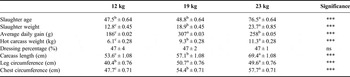
Cold carcass weights confirmed that the first group of animals in our study corresponded to “Alcarria suckling lamb” and the other two groups corresponded to “Alcarria lamb” (Table 1). With the exception of dressing percentage, the carcass characteristics of the three “weight-based groups” of lambs differed significantly (P < 0.001). It is important to note that 12 and 19-kg lambs were the same age at slaughter (Table 1), which is likely due to the genetic variability of the breed. In fact, the genetic improvement scheme of the Alcarreña breed states that daily growth is one of the most important traits to be considered.
Characteristics of the Alcarreña lambs, which were slaughtered at one of three liveweights (mean ± SD).

ns: not significant differences (P > 0.05). ***P ≤ 0.001. Different letters in the same row: P < 0.05.
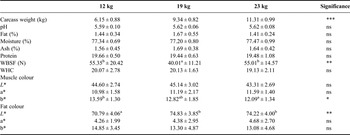
Slaughter weight did not have a significant effect on basic physicochemical meat characteristics (Table 2); however slaughter weight and WBSF were significantly correlated; the meat of lambs slaughtered at 19 kg was softer than the meat from lambs in the other two groups, which had the highest cutting forces, and did not differ significantly (P < 0.01).
Mean (±SD) physico-chemical variables of the meat from Alcarreña lambs, which were slaughtered at one of three live weights.

ns: not significant differences (P > 0.05). *P ≤ 0.05; **P ≤ 0.01; ***P ≤ 0.001. Different letters in the same row: P < 0.05.
WBSF, Warner-Bratzler Shear Force; WHC, water holding capacity.
The meat from 23-kg lambs was significantly (P < 0.05) less yellow (b*) than was the meat from 12-kg lambs (Table 2). In another study, the meat from lambs fed milk was slightly less yellow than the meat from grazing lambs (Ripoll et al., Reference Ripoll, Joy, Muñoz and Albertí2008).
Fat lightness and slaughter weight were significantly (P < 0.05) positively correlated, which might have been related to the decrease in brown adipocytes as animals grow (Cannon and Nedergaard, Reference Cannon and Nedergaard2004), and to a change in diet from milk to grazing and concentrates (Ripoll et al., Reference Ripoll, Joy, Muñoz and Albertí2008).
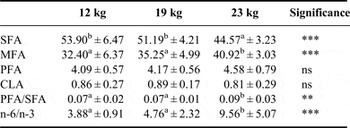
Slaughter weight was significantly (P < 0.001) negatively correlated with SFA (P < 0.001), which resulted in an increase in the PUFA/SFA ratio (P < 0.01), and significantly positively correlated with MFA (Table 3). CLA and PUFA did not differ significantly between slaughter weights, although the n-6/n-3 ratio and slaughter weight were significantly (P < 0.001) correlated. The lipid profile of the meat from the 23-kg lambs differed significantly from the profiles of the lighter lambs, mainly because of a change from a milk diet (Lurueña et al., Reference Lurueña-Martinez, Palacios, Vivar-Quintana and Revilla2010) to a diet of concentrates and forage (Santos-Silva, Bessa and Santos-Silva, Reference Santos-Silva, Bessa and Santos-Silva2002). The lipid profiles of the 12 and 19-kg lambs did not differ significantly.
Mean (±SD) concentrations of the fatty acids (g/100 g) of Alcarreña lambs, which were slaughtered at one of three live weights.

ns: not significant differences (P > 0.05). **P ≤ 0.01; ***P ≤ 0.001. Different letters in the same row: P < 0.05.
SFA, total saturated fatty acids; MFA, total monounsaturated fatty acids; PFA, total polyunsaturated fatty acids; CLA, total conjugated linoleic acid.
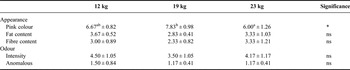
The colour of the raw meat differed significantly (P < 0.05) among the slaughter-weight groups; specifically, the meat from the 19-kg lambs was slightly darker than the meat from the 23-kg lambs, but indistinguishable from the meat from the 12-kg lambs (Table 4), probably because of the lower intramuscular fat content of the meat, which was detected by the panelists.
Mean (±SD) values of the variables of the qualities of the raw meat from Alcarreña lambs, which were slaughtered at one of three live weights.
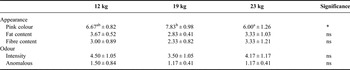
ns: not significant differences (P > 0.05). *P ≤ 0.05. Different letters in the same row: P < 0.05.
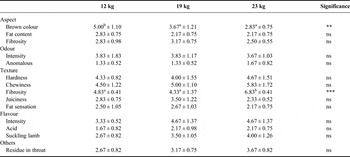
The colour intensity of the cooked meat and slaughter weight were negatively correlated; specifically, the meat from the 19 and 23-kg lambs were significantly (P < 0.01) clearer than the meat from the 12-kg lambs (Table 5). Those results parallel the assessments of instrumental fat colour, but not those of the appearance of the raw meat, and are unlike to those of other studies (Sañudo et al., Reference Sañudo, Santolaria, María, Osorio and Sierra1996) that showed a correlation between raw meat colour and slaughter weight. The hardness and fibrosity of the meat from the 19-kg lambs was significantly (P < 0.001) lower than that of the meat from the 23-kg lambs, but not significantly different from that of the 12-kg lambs. Those results parallel the results of the instrumental texture evaluation, which indicated that the WBSF was lowest in the 19-kg group, but they differ from other studies (Sañudo et al., Reference Sañudo, Santolaria, María, Osorio and Sierra1996), which reported an increase in hardness with slaughter weight. Flavour characteristics did not differ significantly among the slaughter-weight groups, although they tended to increase with slaughter weight, which has been reported elsewhere (Jeremiah, Tong and Gibson, Reference Jeremiah, Tong and Gibson1998; Martínez-Cerezo et al., Reference Martínez-Cerezo, Sañudo, Panea and Olleta2005a, Reference Martínez-Cerezo, Sañudo, Panea, Medel, Delfa, Sierra, Beltrán, Cepero and Olletab), because of the changes in the lipid profile (Sink, Reference Sink1979).
Mean (±SD) values of the variables of the sensory properties of the cooked meat from Alcarreña lambs, which were slaughtered at one of three live weights

ns: not significant differences (P > 0.05). **P ≤ 0.01; ***P ≤ 0.001. Different letters in the same row: P < 0.05.
Conclusions
In conclusion, Alcarreña sheep breed farms were characterized by a mean age of their owners that was below the average for Spanish sheep farms in general, although generational renewal was not assured on most of the Alcarreña farms. Alcarreña sheep flocks were larger than the average size of Spanish sheep flocks. Farmers emphasized the positive qualities of the breed, which is reared under an extensive management system, permitted to graze year round, and follows a three-lambings-in-2-years reproductive calendar. The analyses of carcass and meat qualities showed that the differences between the 12 and 19-kg slaughter weights were minor, although the meat from the 19-kg lambs was softer and had clearer fat. Meat and fat colours and lipid composition were the most important distinguishing characteristics of the meat from the 23-kg lambs. Meat fibrosity was lowest in the 19-kg lambs, and colour and slaughter weight were inversely correlated.
Acknowledgements
We thank the farmers of the Alcarreña Sheep Breeders Association (AGRAL) for their collaboration, and Bruce MacWhirter for the English revision of the article.