I. Introduction
Economic systems and activities are profoundly shaped by culture. Max Weber (Reference Weber1930) argued that differences in societal culture help explain why capitalist production first emerged in Western countries and not in China. Specifically, protestant ethics supported the rise of impersonal institutions and the “corporate entity” in the West, whereas Confucianism emphasized personal ties and implicit agreements (Greif and Tabellini (Reference Greif and Tabellini2017)), which constrained both the demand and supply of external finance and hampered formal financial development in China (Chen, Ma, and Sinclair (Reference Chen, Ma and Sinclair2022)).
From an economic perspective, culture comprises deeply held values, beliefs, and intuitions about right and wrong (Nunn (Reference Nunn2012)). A large literature documents systematic differences in decision-making among individuals with distinct cultural backgrounds, even when they face the same environment (e.g., Nisbett and Masuda (Reference Nisbett and Masuda2003), Talhelm, Zhang, Oishi, Shimin, Duan, Lan, and Kitayama (Reference Talhelm, Zhang, Oishi, Shimin, Duan, Lan and Kitayama2014)). Such differences correlate with cross-regional variation in political institutions, social structures, and economic development (e.g., Guiso, Sapienza, and Zingales (Reference Guiso, Sapienza and Zingales2003), (Reference Guiso, Sapienza and Zingales2024), Nunn (Reference Nunn2008), Algan and Cahuc (Reference Algan and Cahuc2010), Nunn and Wantchekon (Reference Nunn and Wantchekon2011), Alesina and Giuliano (Reference Alesina and Giuliano2015), Michalopoulos and Papaioannou (Reference Michalopoulos and Papaioannou2015), Bursztyn, González, and Yanagizawa-Drott (Reference Bursztyn, González and Yanagizawa-Drott2020), and Nunn, Qian, and Jaya (Reference Nunn, Qian and Jaya2021)). Yet how societal culture shapes business activities and corporate policies remains underexplored (Guiso et al. (Reference Guiso, Sapienza and Zingales2024)). Examining firm-level activities is essential for understanding cultural effects on the economy, given the substantial heterogeneity in corporate practices across firms and countries (Bertrand and Schoar (Reference Bertrand and Schoar2003), Bloom and Van Reenen (Reference Bloom and Van Reenen2007)).
We address this gap by examining how societal culture shapes firm behavior through relational contracting with stakeholders. Building on cultural and institutional economics, we conceptualize culture as the informal institutional foundation for a firm’s implicit, norm-based agreements with employees, suppliers, customers, communities, and other stakeholders (Guiso, Sapienza, and Zingales (Reference Guiso, Sapienza and Zingales2004), (Reference Guiso, Sapienza and Zingales2006), (Reference Guiso, Sapienza and Zingales2008a), (Reference Guiso, Sapienza and Zingales2008b), Gibbons and Henderson (Reference Gibbons and Henderson2012), Alesina and Giuliano (Reference Alesina and Giuliano2015), Blader, Gartenberg, Henderson, and Prat (Reference Blader, Gartenberg, Henderson and Prat2015), and Macchiavello and Morjaria (Reference Macchiavello and Morjaria2023)). In cultures rooted in interpersonal relationships, these relational contracts substitute for formal rules and legal enforcement (Greif and Tabellini (Reference Greif and Tabellini2017)), lowering transaction costs and facilitating resource exchange, particularly where formal institutions are weak (Allen, Qian, and Qian (Reference Allen, Qian and Qian2005)). To sustain these relational contracts over the long term, firms invest more heavily in building and maintaining stakeholder relationships, driven largely by concerns about repeated interactions, reputation, and the implicit threat of retaliation.
We test this mechanism in the Chinese context, where Confucianism has dominated for over two millennia and continues to shape contemporary social norms and business practices (Fei (Reference Fei1992), Greif and Tabellini (Reference Greif and Tabellini2017), and Chen et al. (Reference Chen, Ma and Sinclair2022)). Confucianism emphasizes bilateral relationships and interpersonal trust that align naturally with relational contracting (Fei (Reference Fei1992)). We assemble a novel data set from Qing Dynasty (1644–1911 CE) local chronicles, hand-collecting 1,547 historical Confucian academies.Footnote 1 A firm’s exposure to Confucianism is measured by the number of these academies located within 100 km of its current headquarter, yielding a firm-level proxy that is more granular than city- or province-level measures.
As an interpretive guide, we reference the five Confucian virtues: benevolence (Ren), righteousness (Yi), propriety (Li), wisdom (Zhi), and trustworthiness (Xin). These virtues serve as normative principles for social behavior, describing how long-run interpersonal relationships form and are maintained, particularly where formal contracts are incomplete, and they continue to inform interactions in modern China (Hwang (Reference Hwang1987), Huang (Reference Huang2003)). We map them to observable corporate policies that reflect firms’ investments in and strength of stakeholder relationships: social contribution (benevolence), stakeholder protection (righteousness), business courtesy expenses (propriety), patenting (wisdom), and trade credit received (trustworthiness).
Empirically, we find that all five behaviors are positively associated with a listed firm’s exposure to Confucianism, consistent with the prediction that firms embedded in relationship-oriented cultures invest more in maintaining stakeholder ties. The results are robust to alternative measures of Confucian influence used in prior work, including the local presence of Confucian temples and genealogies, and are not driven by other prevailing cultures or CEOs’ cultural traits, indicating that the broader relationship-based societal environment rather than individual leaders’ preferences accounts for the effects.
Some may argue that Confucian academies were not solely centers for disseminating Confucianism but also venues for rudimentary education, implying that our findings could reflect education and human capital rather than culture. To address this concern, we incorporate multiple measures of both historical and contemporary human capital. The Confucianism measure remains significant throughout, underscoring an incremental cultural effect beyond education. We also show that the results are not driven by key Qing-era geographical and demographic characteristics.
A further concern is that the presence of Confucian academies may correlate with regional economic development in the Qing period, generating persistent effects that explain current outcomes, or that omitted factors related to both Confucianism and firm behavior spuriously drive our correlations. We, therefore, employ an instrumental variables (IV) approach. Our first instrument is the shortest distance between a listed firm and the nearest academy founded by Zhu Xi (1130–1200 CE). Zhu Xi’s academies were pivotal in popularizing Confucianism and served as prototypes for subsequent schools. Given that high historical transport costs led to clustering of schools around these sites, proximity predicts greater Confucian exposure (Chen et al. (Reference Chen, Ma and Sinclair2022)). Importantly, the locations of Zhu Xi’s academies were shaped by his personal experiences, mourning rituals, and official appointments rather than regional economic conditions (Chen et al. (Reference Chen, Ma and Sinclair2022), Gu, Sun, and Zhou (Reference Gu, Sun and Zhou2024)). We present evidence supporting this exclusion restriction. As an additional robustness check, we restrict the sample to firms within 1,500 km of the centroid of the three Zhu Xi’s academies (excluding Far West regions with few listed firms, such as Tibet and Xinjiang) and find that results are qualitatively unchanged.
Our second instrument is the total number of small rivers in the region of the firm’s headquarter. Confucian schools were typically sited away from smaller rivers (unlike along the Yangtze or Yellow Rivers) to avoid inundation risks and to preserve books, and to ensure tranquil environments for learning as areas nearer rivers were more exposed to trade, transport, and conflict (Gilgan (Reference Gilgan2022)). Accordingly, river density is negatively correlated with the historical presence of Confucian schools. Conditional on controls for local economic development, this geographical feature is unlikely to affect contemporary firm policies through noncultural channels. The IV estimates again confirm a large and significant effect of Confucianism on corporate policies.
We interpret higher stakeholder orientation (i.e., the “five virtues” reflected in corporate behaviors) among firms with greater exposure to Confucian culture as evidence of investment in maintaining relational contracts with stakeholders. In other words, Confucian norms help firms form self-enforcing agreements with employees, customers, and communities, substituting for formal contracts. An alternative values-based explanation is that Confucian ethics directly shape a firm’s and its stakeholders’ preferences for virtuous or prosocial actions. To disentangle these mechanisms, we perform a horse-race test including other cultural influences in China (e.g., Buddhism, Taoism, and Western values) that are rich in spiritual and ethical insights—thus also promote virtue—but lack the mechanisms to regulate worldly interpersonal relationships in a contract-like manner. The results show that only Confucian cultural exposure has a significant effect on stakeholder-oriented practices, indicating the observed impacts reflect firms’ investment in stakeholder relationships and are uniquely attributable to Confucianism rather than other religious or foreign values.
We then examine how the strength of formal institutions moderates the influence of Confucian culture. Using provincial marketization scores and the presence of non-Chinese (often Western) directors as proxies for a more market-oriented, rule-based environment, we find that Confucianism’s effect is much weaker in these settings. This pattern is consistent with a substitution effect between culture-driven relational governance and formal contracting institutions. In provinces and firms with strong legal frameworks or international governance influences, companies rely less on relational contracts and thus invest less in maintaining stakeholder ties. This aligns with the idea that robust formal institutions let firms focus more narrowly on explicit agreements and shareholder outcomes, reducing the need for informal relationship building (Greif and Tabellini (Reference Greif and Tabellini2017)).
Our study contributes to the burgeoning literature on stakeholder governance (or “stakeholderism”) by highlighting an institutional mechanism through which culture shapes firm behavior. Traditional corporate governance theory posits that firms should focus on maximizing shareholder value, as shareholders are the residual claimants (Jensen (Reference Jensen2001)). Recent work, however, challenges this view by emphasizing firms’ implicit contracts with stakeholders and the role of broader objectives (e.g., Tirole (Reference Tirole2010), Allen, Carletti, and Marquez (Reference Allen, Carletti and Marquez2015), Magill, Quinzii, and Rochet (Reference Magill, Quinzii and Rochet2015), Hart and Zingales (Reference Hart and Zingales2017), and Liang and Renneboog (Reference Liang and Renneboog2017)). Meanwhile, some challenge the feasibility of a stakeholderism model (e.g., Amis, Barney, Mahoney, and Wang (Reference Amis, Barney, Mahoney and Wang2020), Bebchuk and Tallarita (Reference Bebchuk and Tallarita2020)). We add novel evidence to this debate by showing that, in the absence of strong formal institutions, Confucian culture supports relational contracts that induce firms to invest heavily in stakeholder relationships as a way to secure trust, cooperation, and access to critical resources. In such environments, culture-based relational governance effectively compels firms to balance stakeholder interests and shareholder goals when legal enforcement is weak. Our findings also provide an institutional rationale for the Friedman Doctrine’s emphasis on shareholder value (Friedman (Reference Friedman1970)). When market and legal institutions are well developed, firms can depend on explicit contracts and formal enforcement rather than on culture-based accommodations to stakeholders. In these mature environments, culture-based relational contracting plays a smaller incremental role, making it easier for shareholder interests to prevail.
We further contribute to institutional economics by clarifying how relational contract illuminates culture’s role in corporate behavior. Relational contracts—informal, self-enforcing agreements upheld by the value of future relationships and social norms—facilitate cooperation when formal contracting is limited (Baker, Gibbons, and Murphy (Reference Baker, Gibbons and Murphy2002), Gibbons and Henderson (Reference Gibbons and Henderson2012), and Blouin (Reference Blouin2022)). Whereas Western economies have historically relied on formal corporate institutions as the primary locus of cooperation, Confucian society provided a relationship-based institutional alternative (Greif and Tabellini (Reference Greif and Tabellini2017)). Direct evidence on how such governance operates in modern firms, however, has been scarce. We argue that Confucian culture serves as an informal institutional foundation for relational contracting and that norms of reciprocity, trustworthiness, and reputation create incentives for firms and stakeholders to honor obligations, thereby substituting for legal enforcement (Gibbons and Henderson (Reference Gibbons and Henderson2012), Macchiavello and Morjaria (Reference Macchiavello and Morjaria2023)). By showing that greater historical exposure to Confucian culture predicts heavier investment in stakeholder relationships, we document that relation-specific investments act as the “glue” binding firms and stakeholders under informal enforcement, consistent with the view that cultural norms of trust and repeated cooperation can sustain long-term agreements even where formal institutions are weaker.
II. Conceptual Framework and Hypothesis Development
A. Conceptual Framework
To explain how societal culture exerts a lasting influence on corporate behavior, we build on institutional and organizational economics, which view culture as underwriting relational contracts between firms and stakeholders (Baker et al. (Reference Baker, Gibbons and Murphy2002), Gibbons and Henderson (Reference Gibbons and Henderson2012), Blouin (Reference Blouin2022)). In cultures grounded in interpersonal trust, ethical norms, and ritual, relationship-based arrangements can substitute for formal rules by functioning as implicit agreements. According to Williamson (Reference Williamson1975), relational contracts are nonverifiable agreements specifying mutual obligations that stand in for explicit, court-enforceable contracts. In a repeated-game framework, cooperation is sustained by the value of future interactions, credible threats of retaliation, and the desire to avoid disgrace (Macchiavello and Morjaria (Reference Macchiavello and Morjaria2023)). The salience of such contracts varies across firms with their exposure to relationship-oriented societal cultures.
Firms are nexuses of explicit and implicit contracts among multiple parties (Coase (Reference Coase1937), Williamson (Reference Williamson1975)). Because information frictions and weak legal enforcement make exhaustive formal contracting costly or impractical, firms frequently rely on unwritten, norm-shaped agreements that are self-enforcing ex post (Baker et al. (Reference Baker, Gibbons and Murphy2002), Gibbons and Henderson (Reference Gibbons and Henderson2012)). Relative to explicit contracts, relational contracts enable parties to incorporate local knowledge, adapt to new information, and make credible commitments without courts. The continuation value of the relationship provides incentives to honor obligations, and expectations of repeated dealings and potential retaliation deter opportunism. A standard relational contracting model predicts that opportunistic behavior is less likely when the perceived value of the relationship to one party increases or when their perceived outside options decrease (Kranton (Reference Kranton1996)).
Societal culture buttresses these agreements. Norms of trust and ethics raise beliefs about counterpart reliability, encouraging entry into new informal partnerships and expanding the scope of relational contracting (Guiso et al. (Reference Guiso, Sapienza and Zingales2004), Gibbons and Henderson (Reference Gibbons and Henderson2012), Macchiavello and Morjaria (Reference Macchiavello and Morjaria2023)). When honesty, reciprocity, and reputation are emphasized, stakeholders are more willing to commit effort, capital, and knowledge in anticipation of reciprocal treatment, and firms are more willing to protect stakeholder interests. This results in stronger and more durable stakeholder relationships in relationship-based cultures.
This logic resonates strongly in the Confucian context. In Confucian societies, bilateral personal relationships form the foundational structure of social organization, and order has historically been maintained through personal ties and clan networks rather than formal legal codes (Chen et al. (Reference Chen, Ma and Sinclair2022), Jia and Kung (Reference Jia and Kung2025)). Fei (Reference Fei1992) characterizes this as a “differential mode of association” (chaxu geju), in which concentric circles of personal ties, governed by reciprocity and hierarchy, structure social and economic cooperation. Within this system, disputes are typically resolved through mediation and moral suasion rather than litigation (Fei (Reference Fei1992)). Frequent interpersonal interactions, combined with the importance of reputation and “face” (mianzi), generate strong reciprocal obligations: parties are expected to fulfill bilateral rights and duties in order to maintain relationships, and social disgrace from breaching trust raises the perceived cost of defection (Greif and Tabellini (Reference Greif and Tabellini2017)). In this sense, Confucian culture provides an alternative, relationship-based institution for cooperation and contracting with informal, relationship-based enforcement mechanisms that substitute for formal legal enforcement. This extensive reliance on personal ties naturally encourages high relation-specific investments, as parties devote resources to building and preserving relationships that support ongoing cooperation (Greif and Tabellini (Reference Greif and Tabellini2017)).
Taken together, Confucianism—an archetypal relationship-based culture—facilitates relational contracting between firms and stakeholders. These implicit agreements, grounded in trust, reputation, and long-term reciprocity, historically served as a primary mode of economic organization and continue to shape modern corporate conduct. We, therefore, expect firms embedded in regions with stronger, historically preserved Confucian culture to place higher value on stakeholder relationships and commit more resources to sustaining them. This mechanism implies that culture can substitute for formal contracting by encouraging interactions that yield greater stakeholder engagement, resource sharing, and mutual trust. Building on this conceptual foundation, the next subsection develops testable hypotheses linking Confucian cultural exposure to firm-level outcomes.
B. Institutional Background and Hypothesis Development
Confucianism, originating from the teachings of Confucius (551–479 BCE), has been the predominant value system governing practical affairs in China since the Han Dynasty and has also influenced societies such as Singapore, Vietnam, South Korea, and Japan. Central to Confucianism is an emphasis on informal norms and interpersonal relationships, captured by five core virtues: benevolence (Ren), righteousness (Yi), propriety (Li), wisdom (Zhi), and trustworthiness (Xin). Shaped through repeated interactions over a long history, these virtues became guiding principles for social conduct and interpersonal relationships. Benevolence embodies compassion and responsibility toward others; righteousness entails integrity and acting ethically even at personal cost; propriety concerns observance of etiquette and rituals that govern respectful interaction; wisdom refers to prudent judgment and intellectual development; and trustworthiness denotes credibility and consistency between words and actions. These norms continue to structure contemporary interpersonal relations and business practices even as formal rules and market institutions have expanded.
Since firms more exposed to Confucianism rely more on relational contracts with stakeholders, they invest more in stakeholder relationships to sustain such contracts. Stakeholders include parties affected by or essential to a firm’s operations—employees, customers, suppliers, creditors, and local communities. Accordingly, we hypothesize that Confucian influence is associated with greater social contribution, stronger protection for vulnerable stakeholders (e.g., employees and trading partners), and greater maintenance of professional etiquette in dealings with business counterparts. These behaviors map naturally to benevolence (Ren), righteousness (Yi), and propriety (Li) and arise in institutional environments where relational contracts substitute for formal contracting and legal enforcement.
The strength of bilateral relationships is also reflected in how hierarchy and trust are established within and across firms. Innovation typically occurs in hierarchical teams (Lahiri, Pahnke, Howard, and Boeker (Reference Lahiri, Pahnke, Howard and Boeker2019)). When mutual rights and obligations are well defined and enforced by reputation and repeated interaction, collaborative research and implementation become easier. In addition, prior research has used innovation outputs as observable proxies for relationship-specific investments, as they often reflect the extent to which firm-specific knowledge is generated with particular counterparts in mind (Dasgupta, Zhang, and Zhu (Reference Dasgupta, Zhang and Zhu2021)). Stable and long-term business relationships encourage firms to invest more in innovation, given the highly uncertain timing and likelihood of innovative success (Dyer and Singh (Reference Dyer and Singh1998)). Similarly, trade credit represents trust-based, informal financing between firms and their suppliers and customers. Firms that reliably care for their counterparties are thus more likely to receive such credit. These activities align with wisdom (Zhi) and trustworthiness (Xin) and are likewise products of a relationship-based institutional environment. Hence, we further hypothesize that firms more influenced by Confucianism will generate more innovation (e.g., patent output) and receive more trade credit.
Taken together, these corporate policies capture how firms establish and maintain relationships with stakeholders. The mapping to the five virtues should not be read as evidence for a preference-based mechanism whereby firms simply “practice” Confucian values. Rather, both the virtues and the corresponding behaviors are interpreted as outcomes of an institutional setting in which interpersonal relationships and relational governance substitute for formal contracting. In the sections that follow, we test the relations between these five corporate policies and firms’ exposure to Confucianism and examine the underlying mechanisms.
III. Data and Sample
This study utilizes data from multiple sources: i) firms’ exposure to Confucianism, measured using firm headquarters’ coordinates and the number of nearby Confucian academies from local chronicles (Difang Zhi) of the Qing Dynasty; ii) firm financials, social contribution, employee and supplier/customer protection, and ownership structure from the CSMAR database; iii) population divorce rates, city-level GDP, employment, total wages, and FDI from the China National Bureau of Statistics; iv) firm headquarter locations from WIND; v) river counts and lengths from the National Census for Water of China; vi) province-level marketization scores from Fan, Wang, and Zhu (Reference Fan, Wang and Zhu2011); vii) Taoist and Buddhist cultural proxies (numbers of temples) from Yang (Reference Yang2011); viii) survey evidence on general attitudes from the China Family Panel Studies (CFPS) 2010; ix) contemporary education and intergenerational co-residence from the China Population Censuses (2000, 2010); and x) additional materials from regional archives and historical documents.
A. Confucianism Measure
Our main explanatory variable is firms’ exposure to Confucianism, constructed from historical archives in the spirit of work linking deep historical factors to contemporary outcomes (e.g., Acemoglu, Johnson, and Robinson (Reference Acemoglu, Johnson and Robinson2001), (Reference Acemoglu, Johnson and Robinson2002), Nunn (Reference Nunn2008), Nunn and Wantchekon (Reference Nunn and Wantchekon2011), Lowes and Montero (Reference Lowes and Montero2021)). Specifically, we count private Confucian academies from the Qing Dynasty in each firm’s surrounding area. Private academies were key venues for disseminating Confucian values and a major component of preindustrial education. By the mid-sixteenth century, academies hosted regular gatherings where scholars exchanged ideas. Through repeated social interactions, Confucian values permeated local communities. Unlike official, government-funded schools that focused on civil service examination preparation, private academies were more accessible and provided elementary instruction in Confucian principles (Elman (Reference Elman1989)). Supported by local elites, academies flourished and gradually supplanted official schools as primary institutions for transmitting Confucian thought. This role accords with North (Reference North1990) view of culture as knowledge and values transmitted intergenerationally through education and imitation. Thus, regions with higher academy density cultivated a larger share of the population steeped in Confucian culture, implying that firms headquartered there are more exposed to Confucian norms through interactions with local community and stakeholders.
A natural concern is that our Confucianism measure may proxy for education or human capital, since academies also provided rudimentary instruction (Chen, Kung, and Ma (Reference Chen, Kung and Ma2020)). We address this by controlling for contemporary local education levels throughout the analysis, as detailed in the following. A second concern is whether the presence of Confucian schools more than a century ago predicts today’s cultural environment, given the possibility that cultural imprints decay over time. Giuliano and Nunn (Reference Giuliano and Nunn2021), however, document that China is one of the world’s most culturally persistent countries, largely due to its climatic stability. This environmental consistency, combined with China’s long and continuous history of repeated intergenerational interactions, has helped ensure that Confucian values remain deeply embedded and are transmitted over time. In addition, we conduct validity tests, detailed in Section III.D, which further confirm the cross-regional persistence of Confucianism.
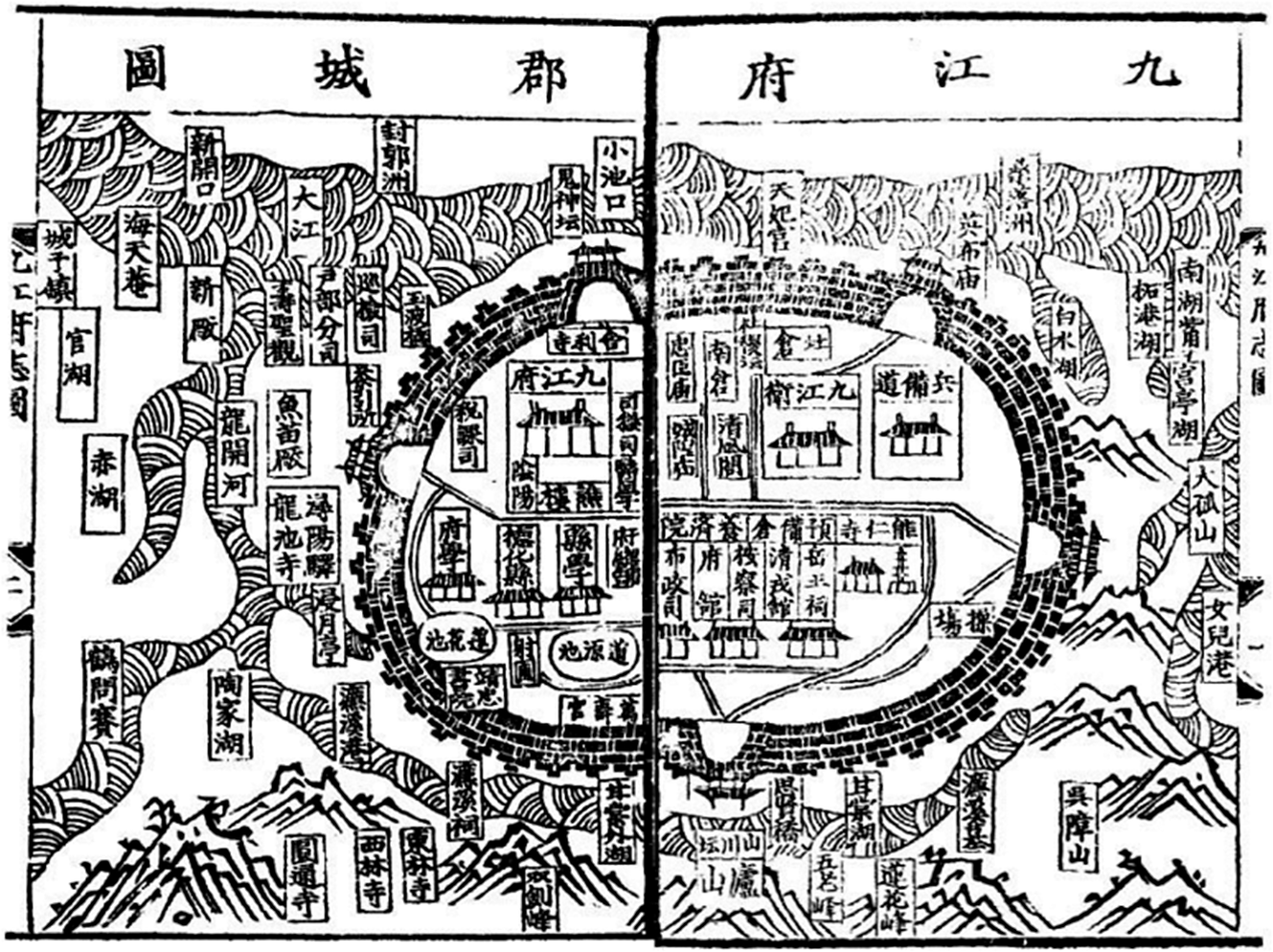
To build the Confucian academy data set, we consult county-level local chronicles (Difang Zhi) from city archives. These chronicles, compiled by local governments and elites, document a locality’s history, geography, economy, administration, biographies, and education. They have been updated since the twelfth century and cover both densely and sparsely populated areas (Dennis (Reference Dennis2015)). A typical chronicle includes a “School” section (Xuexiao Zhi) listing local schools, which allows precise identification of Confucian academies’ locations. Figure 1 reproduces a representative page from a chronicle. We focus on Qing-era chronicles from 1796 to 1840 to obtain comprehensive records from the final imperial period, excluding entries outside present-day Mainland China due to administrative boundary changes.Footnote 2
Figure 1 is a one-page snapshot of a local chronicle of Jiujiang county. Source: Selected Ming Dynasty Local Gazetteers.

FIGURE 1 Long description
A traditional Chinese woodblock print map divided into two vertical panels.
At the center is a circular fortified city wall with crenellations and several gatehouses. Inside the walls, various administrative buildings, temples, and schools are depicted as traditional tiled-roof structures with vertical labels. Key internal sites include the Jiujiang Prefectural Office and the Confucian School.
Moving outward from the city walls, the landscape is densely packed with geographical and architectural features. To the West and South, stylized wavy lines represent the Yangtze River and local lakes, interspersed with labels for ports and islands. To the North and East, jagged, overlapping triangular shapes represent mountain ranges, with specific peaks and temples labeled.
Numerous rectangular text boxes are scattered across the entire map, identifying specific landmarks, government offices, and natural features in traditional Chinese characters.
At the very top of the map, six large characters are arranged horizontally across the two panels, reading from right to left, identifying the location as the Jiujiang Prefectural City Map.
We identify 1,547 Qing-period Confucian academies and geocode their historical sites. For each publicly listed firm, we count the number of academies located within a 100-km radius of its headquarters using the coordinates of both firms and academies. To smooth the distribution, we use the logarithm of 1 plus this count in our baseline specifications.Footnote 3 , Footnote 4
B. Dependent Variables
Our main dependent variables are five firm-level metrics that reflect corporate investment in stakeholder relationships and are naturally aligned with the core virtues of Confucianism: i) social contributions (benevolence), ii) stakeholder protection (righteousness), iii) courtesy expenses (propriety), iv) patenting (wisdom), and v) trade credit granted by other firms (trustworthiness). Specifically:
Social Contribution: This is defined as the ratio of the sum of total tax contributions, employee payments, interest expenses, and donations to total assets. This variable reflects the firm’s overall commitment to its stakeholders and society beyond simply shareholder return.
Stakeholder Protection: This is an ordinal variable indicating whether the firm has adopted measures to protect employees and suppliers, as reported in its annual and corporate social responsibility reports.
Courtesy Expenses: This represents business-related entertainment and administrative expenses net of personnel costs. They are measured as the natural logarithm of management fees minus the total salaries of all executives, supervisors, and board directors, plus 1.
Patenting: This is measured as the natural logarithm of the number of authorized patents held by the firm, plus 1.
Trade Credit: This is defined as the sum of accounts payable and notes payable scaled by total assets.
C. Controls
We include firm-level controls that may correlate with both culture and corporate policies: firm size (logarithm of total assets), profitability (ROA), leverage (debt-to-assets), revenue growth, cash flow from operations, and an indicator for state ownership (SOE). To capture cross-regional economic conditions, we control for city-level GDP, population, and total employee wages. To distinguish Confucianism from education and human capital, we follow Chen et al. (Reference Chen, Kung and Ma2020) and control for average years of schooling at the city level (2010 National Population Census). All continuous variables are winsorized at the 1st and 99th percentiles. The Appendix provides detailed variable definitions.
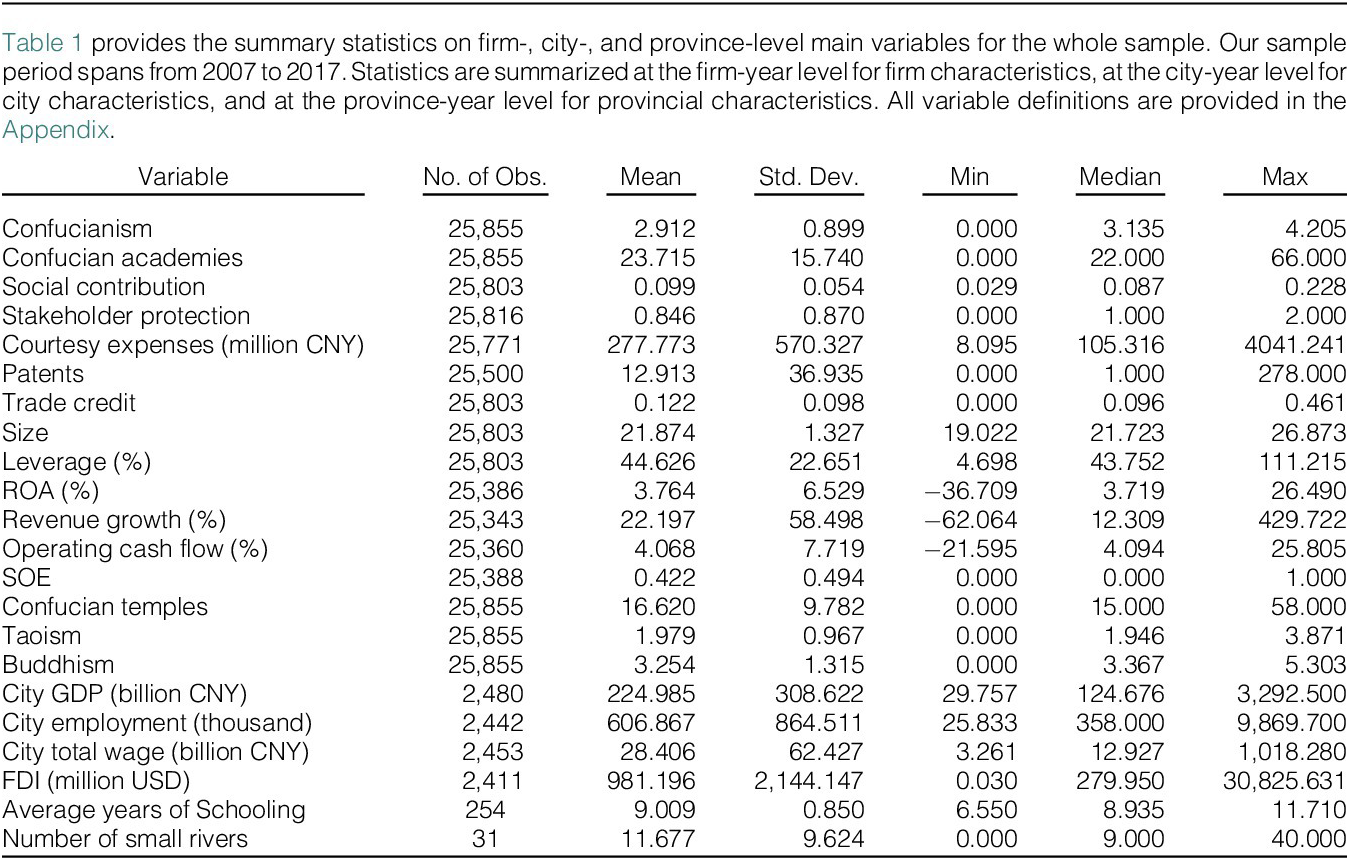
Table 1 reports summary statistics for 25,343 firm-year observations from 2007 to 2017.Footnote 5 The average number of Confucian academies within 100 km of a firm is 23. Social contributions and stakeholder protection vary widely across firms. Courtesy expenses average about 277 million CNY (≈40 million USD) with a standard deviation of 570 million CNY (≈82.5 million USD). Firms hold on average 12 patents (std. dev. = 37). The mean trade credit-to-assets ratio is 0.122 (std. dev. = 0.098). At the city level, average GDP is about 225 billion CNY (≈32.6 billion USD), mean employment exceeds 600,000, total employee wages average 28 billion CNY (≈4.1 billion USD), and average years of schooling are around 9.

TABLE 1 Long description
The table contains 7 columns: Variable, No. of Obs., Mean, Std. Dev., Min, Median, and Max.
Key data points include:
* Confucianism: 25,855 observations, mean 2.912, median 3.135.
* Confucian academies: 25,855 observations, mean 23.715, max 66.000.
* Social contribution: 25,803 observations, mean 0.099.
* Stakeholder protection: 25,816 observations, mean 0.846.
* Courtesy expenses (million C N Y): 25,771 observations, mean 277.773, max 4041.241.
* Patents: 25,500 observations, mean 12.913, max 278.000.
* Trade credit: 25,803 observations, mean 0.122.
* Size: 25,803 observations, mean 21.874.
* Leverage (%): 25,803 observations, mean 44.626.
* R O A (%): 25,386 observations, mean 3.764, min minus 36.709.
* Revenue growth (%): 25,343 observations, mean 22.197, min minus 62.064.
* Operating cash flow (%): 25,360 observations, mean 4.068.
* S O E: 25,388 observations, mean 0.422.
* Confucian temples: 25,855 observations, mean 16.620.
* Taoism: 25,855 observations, mean 1.979.
* Buddhism: 25,855 observations, mean 3.254.
* City G D P (billion C N Y): 2,480 observations, mean 224.985.
* City employment (thousand): 2,442 observations, mean 606.867.
* City total wage (billion C N Y): 2,453 observations, mean 28.406.
* F D I (million U S D): 2,411 observations, mean 981.196.
* Average years of Schooling: 254 observations, mean 9.009.
* Number of small rivers: 31 observations, mean 11.677.
D. Validation Test
To validate that our coordinate-based Confucianism measure captures a time-persistent cultural influence, we conduct an out-of-sample test on life attitudes central to Confucian family ethics. Familial collectivism—viewing the family as society’s fundamental unit—is a hallmark of Confucianism (Cheng (Reference Cheng1944), Ip (Reference Ip2009)). We examine four dimensions: i) old-age support, ii) attitudes toward divorce, iii) the perceived importance of children’s education, and iv) intergenerational co-residence.
The results are presented in Table IA1 in the Supplementary Material. First, following Chen, Chen, and He (Reference Chen, Chen and He2019), we construct a CFPS-based index of old-age support at the family level, which reflects the extent to which filial piety is valued in a household. We then regress it on our province-level Confucianism measure and find a positive correlation (column 1). Second, using provincial divorce statistics from the China National Bureau of Statistics (2010–2017), we find that academy density is negatively correlated with divorce rates (column 2). Third, using CFPS data on parental expenditure for children’s education, we find a positive association with Confucian exposure (column 3). Finally, using the 2000 and 2010 Population Censuses, we compute the share of households with four generations co-residing and show it is positively related to Confucianism (column 4). Collectively, these patterns support the view that our historical, coordinate-based measure captures persistent regional variation in Confucian social norms.
IV. Main Results
A. Baseline Results
We estimate the relation between exposure to Confucian culture and firm behavior using panel OLS:

where
$ {Y}_{i,t} $
 denotes one of firm
$ i $
 ’s five policies: social contribution (benevolence), stakeholder protection (righteousness), courtesy expenses (propriety), number of patents (wisdom), and trade credit (trustworthiness). The key explanatory variable, Confucianism, is the natural logarithm of 1 plus the number of Confucian academies within a 100-km radius around the firm’s headquarter.
$ Control{s}_{i,t-1} $
 includes the firm- and city-level covariates described in Section III.C, measured at
$ t-1 $
 .
$ FE $
 denotes year and industry fixed effects. Standard errors are clustered at the firm level to address heteroskedasticity and within-firm autocorrelation.Footnote
6
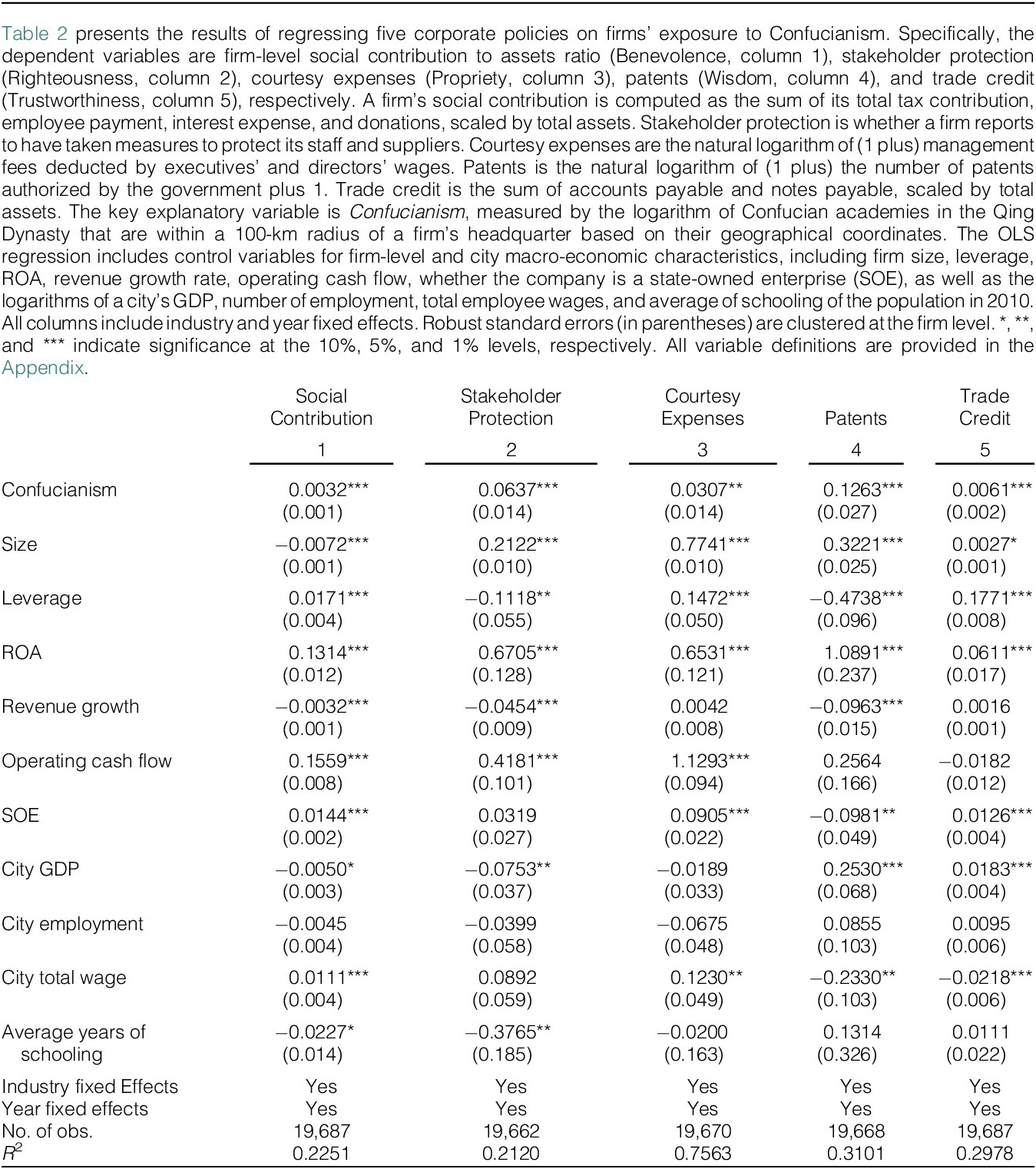
Table 2 reports positive and statistically significant coefficients for Confucianism across all five outcomes. Firms located near more historical Confucian academies exhibit higher social contributions, stronger stakeholder protection, greater courtesy expenses, more patents, and higher trade credit, consistent with greater investment in stakeholder relationships under culture-supported relational contracting. The effects are economically meaningful. For example, a 10% increase in the number of Confucian academies around a firm is associated with a 3.71 million yuan (0.54 million USD) increase in social contribution, a 0.6% increase in stakeholder protection, a 0.83 million yuan (0.12 million USD) increase in courtesy expenses, a 1.2% increase in the number of patents, and a 7 million yuan (1.02 million USD) increase in trade credit.

TABLE 2 Long description
A regression table with five columns representing dependent variables: 1 Social Contribution, 2 Stakeholder Protection, 3 Courtesy Expenses, 4 Patents, and 5 Trade Credit.
The primary independent variable is Confucianism, which shows positive and statistically significant coefficients across all models: 0.0032*** for Social Contribution, 0.0637*** for Stakeholder Protection, 0.0307** for Courtesy Expenses, 0.1263*** for Patents, and 0.0061*** for Trade Credit. Standard errors are provided in parentheses below each coefficient.
Control variables include:
- Size: Negative for Social Contribution -0.0072***, positive for others.
- Leverage: Positive for Social Contribution 0.0171***, negative for Stakeholder Protection -0.1118** and Patents -0.4738***.
- R O A: Positive and significant across all columns, ranging from 0.0611*** to 1.0891***.
- Revenue growth: Negative for Social Contribution, Stakeholder Protection, and Patents.
- Operating cash flow: Positive for Social Contribution 0.1559***, Stakeholder Protection 0.4181***, and Courtesy Expenses 1.1293***.
- S O E: Positive for Social Contribution, Courtesy Expenses, and Trade Credit; negative for Patents.
- City-level controls: City G D P, City employment, City total wage, and Average years of schooling.
Bottom rows indicate:
- Industry fixed Effects: Yes for all.
- Year fixed effects: Yes for all.
- Number of observations: Approximately 19,662 to 19,687.
- R-squared values: 0.2251 for Social Contribution, 0.2120 for Stakeholder Protection, 0.7563 for Courtesy Expenses, 0.3101 for Patents, and 0.2978 for Trade Credit.
B. Alternative Human Capital Measures
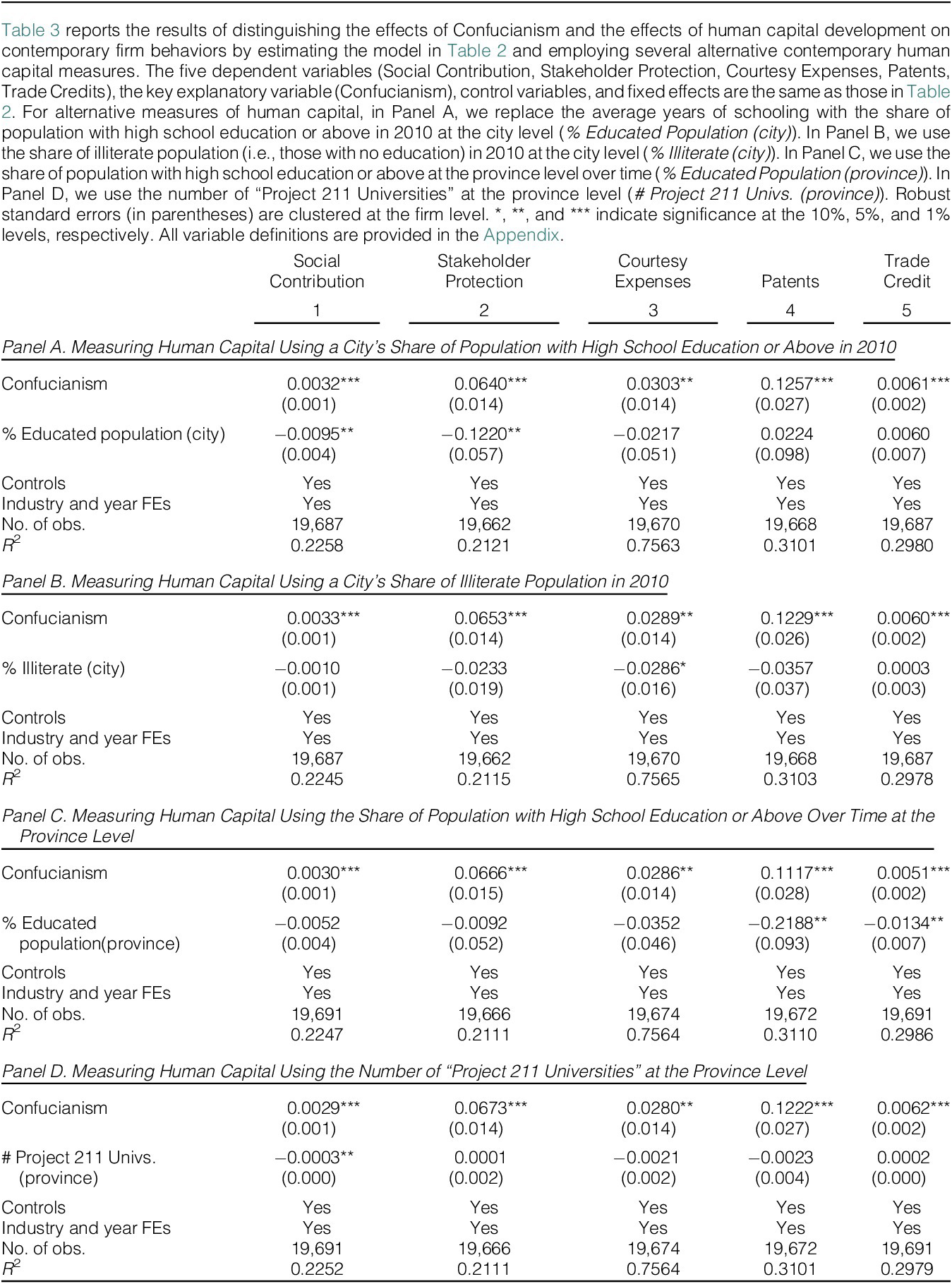
Because Confucian academies also provided rudimentary education, the baseline effects could reflect education rather than culture. We, therefore, replace the baseline control for average years of schooling with alternative proxies for contemporary human capital at different margins: i) the share of the population with high-school education or above at the city levelFootnote 7; ii) the city-level illiteracy rate; iii) the provincial share with high-school education or above; and iv) the provincial number of “Project 211” universities.Footnote 8 While the illiteracy rate captures the lower end of human capital, the other measures reflect higher levels of educational attainment, collectively covering both ends of the spectrum of regional education levels.Footnote 9
Across Panels A–D of Table 3—using, respectively, % Educated Population (city), % Illiterate (city), % Educated Population (province), and # Project 211 Universities (province) to control for contemporary human capital—the coefficient of Confucianism remains positive and statistically significant, with magnitudes similar to the baseline. These results indicate that the Confucianism effects are not driven by contemporary education or human capital. For parsimony, we retain average years of schooling as the human capital control in subsequent tests.

TABLE 3 Long description
The table is titled Alternative Human Capital Measures and consists of five columns representing different dependent variables: 1 Social Contribution, 2 Stakeholder Protection, 3 Courtesy Expenses, 4 Patents, and 5 Trade Credit. All panels include Controls, Industry and year F E s, Number of observations (approximately 19,600 to 19,700), and R-squared values.
* Panel A: Measuring Human Capital Using a City’s Share of Population with High School Education or Above in 2010. Confucianism shows positive coefficients across all columns, ranging from 0.0032 to 0.1257, all significant at the 1 percent or 5 percent level. The educated population variable shows negative coefficients for Social Contribution (-0.0095) and Stakeholder Protection (-0.1220).
* Panel B: Measuring Human Capital Using a City’s Share of Illiterate Population in 2010. Confucianism remains positively significant across all columns. The illiterate population variable shows a negative coefficient for Courtesy Expenses (-0.0286) significant at the 10 percent level.
* Panel C: Measuring Human Capital Using the Share of Population with High School Education or Above Over Time at the Province Level. Confucianism coefficients are positive and significant. The educated population at the province level shows significant negative correlations with Patents (-0.2188) and Trade Credit (-0.0134).
* Panel D: Measuring Human Capital Using the Number of Project 211 Universities at the Province Level. Confucianism coefficients are positive and significant. The number of Project 211 universities shows a small negative correlation with Social Contribution (-0.0003) significant at the 5 percent level.
C. Alternative Culture Measures and Specifications
We assess robustness using alternative proxies for exposure to Confucian culture and by adding further geographic and socioeconomic controls. Following Kung and Ma (Reference Kung and Ma2014) and Chen et al. (Reference Chen, Kung and Ma2020), (Reference Chen, Ma and Sinclair2022), we first employ two measures: i) the density of nearby Confucian temples and ii) the prevalence of genealogies (clan records).
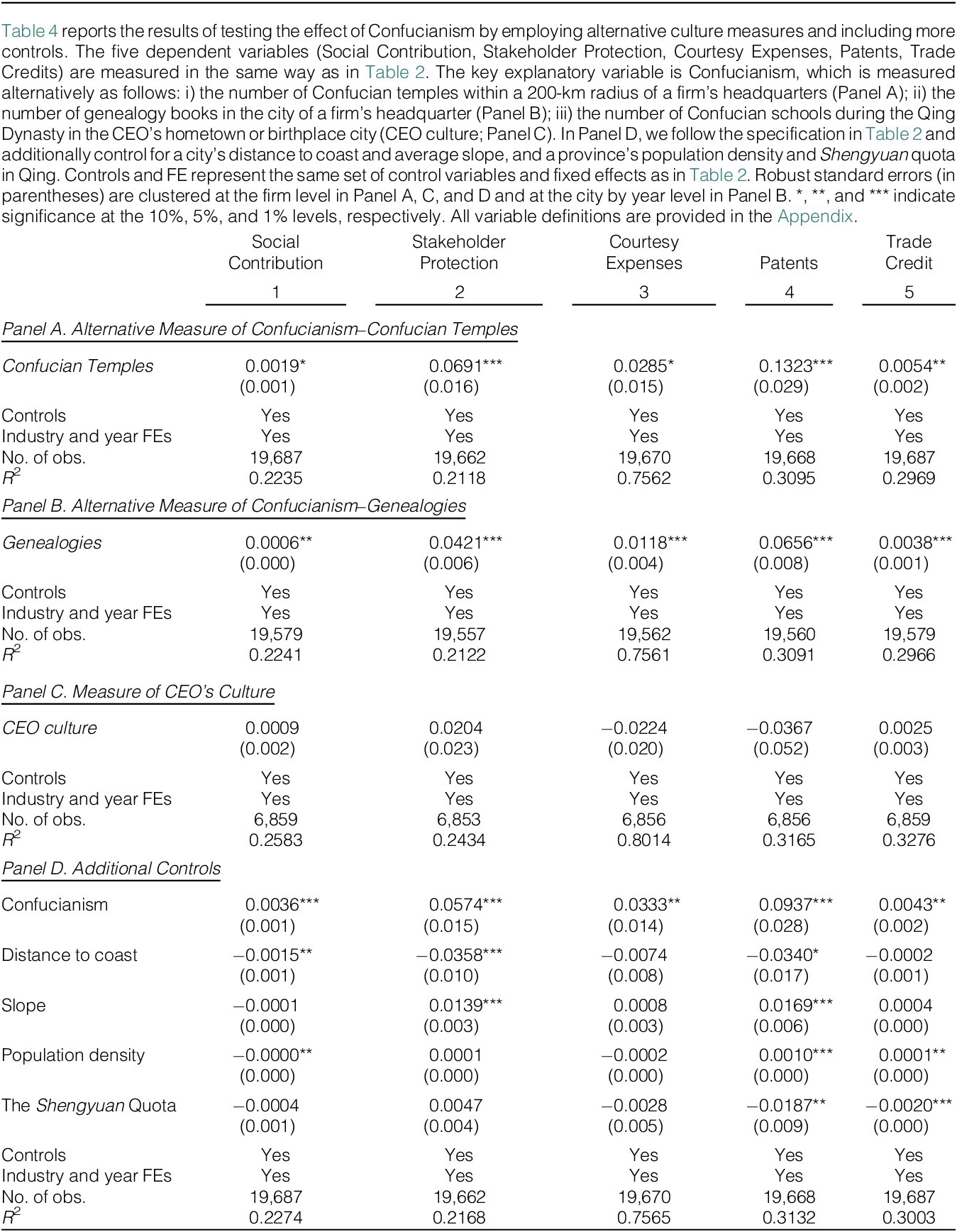
Confucian temples. Confucian temples were constructed across China by local governments under imperial auspices to promote Confucianism as orthodox ideology (Kung and Ma (Reference Kung and Ma2014)). Local communities conducted regular sacrificial rites to honor sages in these temples (Chow (Reference Chow1996)), reinforcing diffusion of Confucian norms in adjacent areas. We compile a comprehensive list of temple locations from chinakongmiao.org and the CNRDS data set, and define Confucian Temples as the natural logarithm of 1 plus the number of Confucian temples within 200-km radius of a firm’s headquarter.Footnote 10 We re-estimate equation (1) by using this alternative culture measure as the explanatory variable. Panel A of Table 4 presents the results. We show positive and statistically significant coefficients of Confucian Temples across all specifications, consistent with the baseline results.

TABLE 4 Long description
The table is organized into five columns representing dependent variables: (1) Social Contribution, (2) Stakeholder Protection, (3) Courtesy Expenses, (4) Patents, and (5) Trade Credit. All panels include Controls, Industry and year F E s, Number of observations, and R-squared values.
Panel A: Alternative Measure of Confucianism—Confucian Temples. The coefficient for Confucian Temples is positive and significant across all columns: 0.0019* for Social Contribution, 0.0691*** for Stakeholder Protection, 0.0285* for Courtesy Expenses, 0.1323*** for Patents, and 0.0054** for Trade Credit.
Panel B: Alternative Measure of Confucianism—Genealogies. The coefficient for Genealogies is positive and significant across all columns: 0.0006** for Social Contribution, 0.0421*** for Stakeholder Protection, 0.0118*** for Courtesy Expenses, 0.0656*** for Patents, and 0.0038*** for Trade Credit.
Panel C: Measure of C E O’s Culture. The coefficient for C E O culture is not statistically significant in any column, with values ranging from -0.0367 to 0.0204.
Panel D: Additional Controls. This panel includes Confucianism alongside geographic and historical controls. Confucianism remains positive and significant across all columns (e.g., 0.0937*** for Patents). Other controls include Distance to coast (mostly negative), Slope (positive for Stakeholder Protection and Patents), Population density, and The Shengyuan Quota (negative for Patents and Trade Credit).
Genealogies (clan strength). Confucianism emphasizes kinship-based obligations—filial piety, continuity and honor, hierarchy, and moral responsibility (Greif and Tabellini (Reference Greif and Tabellini2017)). From the Song Dynasty onward, lineage organizations proliferated, and genealogies served to honor ancestors, codify hierarchies, and preserve intergenerational ties. Using Shanghai Library’s Comprehensive Catalogue of Chinese Genealogy (Reference Wang2009), we construct a city-level Genealogies measure defined as the (log) number of genealogy books, normalized by prefecture population in 2006, after excluding incomplete and nonmainland China records. We again re-estimate equation (1) by using this genealogy measure as the explanatory variable. Panel B of Table 4 presents the results. We find positive and significant coefficients of Genealogies, reinforcing that regions with stronger clan structures, which are rooted in Confucian traditions, exhibit the predicted outcomes.
Across both alternative measures, the results are directionally consistent and statistically robust, indicating that the relationship between Confucian exposure and stakeholder-oriented corporate policies is not an artifact of a particular historical proxy but reflects a broader pattern of culture-supported relational governance.
CEO culture. We next consider whether the results reflect the culture of the CEO rather than societal culture. We replace our regional Confucianism measure with a proxy for CEO culture, defined as the number of Qing-era Confucian schools located in the CEO’s hometown or birthplace city (mapped to contemporary administrative divisions). To construct this proxy, we hand-collected CEOs’ hometown/birthplace from annual reports and executive résumés. When unavailable, we used the board chair’s hometown/birthplace as a substitute. Panel C of Table 4 presents the results. We show that the CEO culture proxy is insignificant across all columns, indicating that the documented effects are unlikely to be driven by individual executives’ Confucian values or personal upbringing and instead reflect the broader societal cultural environment in which the firm operates.
Historical socioeconomic controls. Finally, we examine whether Confucianism proxies simply capture historical socioeconomic development. We add Qing-era geographic and demographic controls closely linked to historical economic conditions. To capture transportation advantages, we include Distance to coast (the log distance from a city centroid to the nearest coastline) and Slope (the average terrain slope within 2017 city boundaries, computed from CHGIS V4 DEM). To proxy historical population pressure and talent supply—both related to local education—we add province-level Population density (averaged over 1776, 1820, 1851, and 1910) and the quota of promoted scholars (Shengyuan) awarded at prefectural civil exams (the entry tier of the imperial examination system).Footnote 11 Detailed variable definitions are provided in the Appendix. Panel D of Table 4 reports that the coefficients on our Confucianism measure remain positive, statistically significant, and quantitatively similar to the baseline estimates, suggesting that the results are not artifacts of historical geography or demography.Footnote 12
D. Instrumental Variable Analysis
Despite controlling for a wide range of firm- and city-specific covariates, concerns may remain that unobservable factors jointly influence both the regional strength of Confucianism and corporate policies. To address these concerns, we implement an IV strategy based on historical events and physical geography. We employ two instruments that are plausibly related to the historical diffusion and siting of Confucian schools but are orthogonal to unobserved determinants of contemporary firm behavior, conditional on controls.
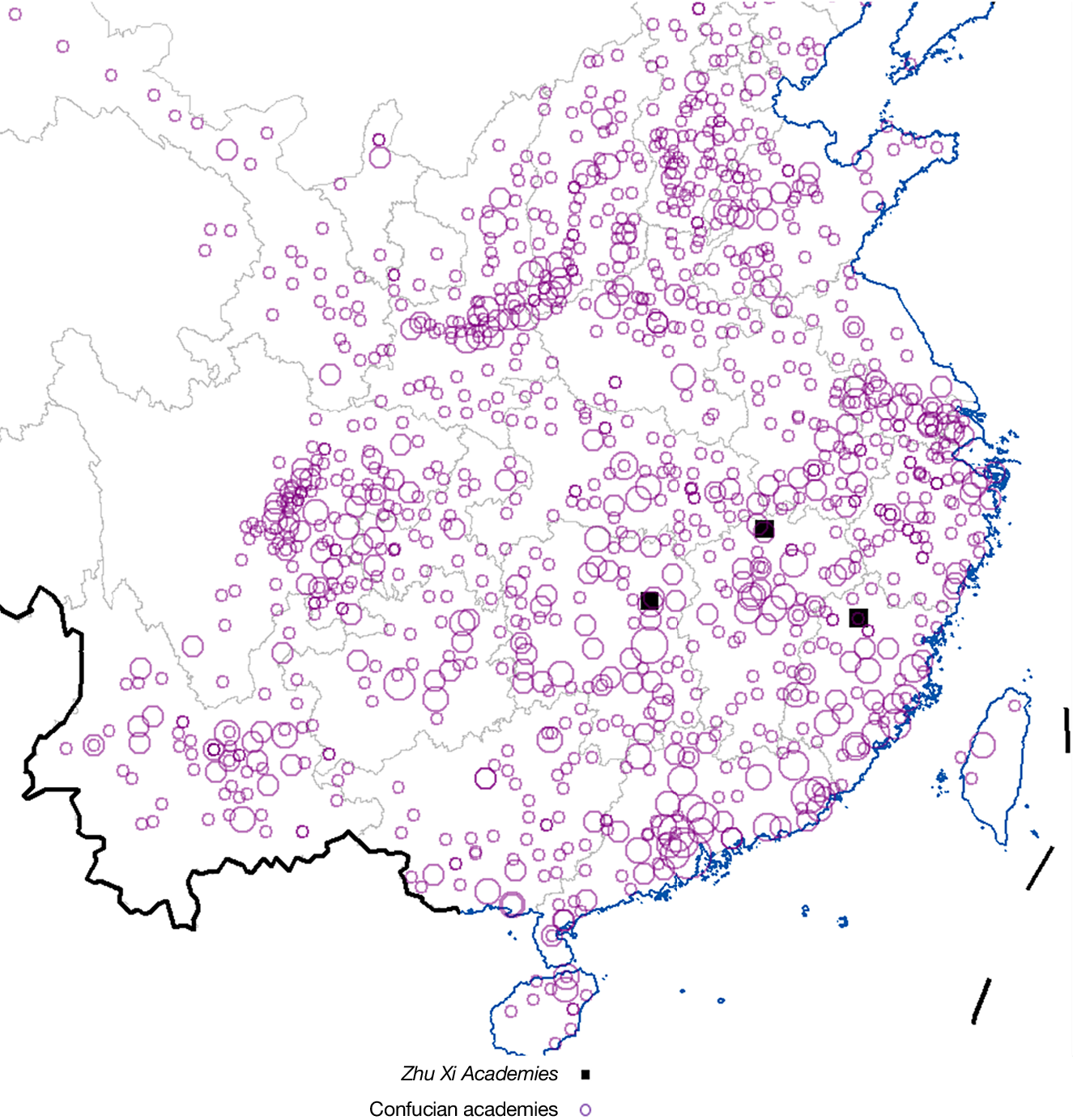
The first instrument is the shortest distance from a listed firm’s headquarter to the nearest academy founded by Zhu Xi, a renowned Confucian scholar of the Song Dynasty and one of the most influential Confucian philosophers after Confucius and Mencius (Chan (Reference Chan1989)). Zhu Xi’s commentaries on the Four Books, the core Confucian texts, became the standard interpretation for centuries (Elman (Reference Elman2000), Gardner (Reference Gardner2007)). He founded three academies—Yuelu Academy in Changsha (in Hunan province), Hanquan Academy in Jianyang (Fujian), and White Deer Grotto Academy in Jiujiang (Jiangxi)—that are often referred to collectively as the “Zhu Xi Academies” and widely regarded as prototypes for subsequent Confucian schools across China. The rationale is that Zhu Xi’s teaching activities, public lectures, and collaborations with other scholars centered on these academies (Chan (Reference Chan1989)). His disciples compiled and disseminated his manuscripts, but the spread of his teachings was constrained by high transportation and communication costs at the time (Chen et al. (Reference Chen, Ma and Sinclair2022)). Consequently, regions proximate to the Zhu Xi Academies were more intensely exposed to Confucian thought during the Song period, which, in turn, encouraged local elites to establish additional Confucian schools in subsequent dynasties, including the Qing, thereby entrenching Confucian values at the grassroots level. Figure 2 depicts the spatial clustering of Confucian schools around the locations of the Zhu Xi Academies, with larger symbols indicating higher concentrations of schools.
Figure 2 plots the geographical distribution of Confucian schools and the three Zhu Xi Academies across different regions in China. Bigger circles indicate more Confucian schools at the same locations.

FIGURE 2 Long description
A geographical map of China displays the distribution of educational institutions using two distinct markers.
* Confucian schools are represented by purple open circles of varying sizes. Larger circles indicate a higher concentration of schools at a specific location. These circles are densely packed across Central, Eastern, and Southern China, with notable clusters along the Yangtze River basin and the Southeastern coast. The density decreases significantly toward the Northwest and Northern border regions.
* Zhu Xi Academies are represented by three solid black squares. These are located in the Southeastern quadrant of the map. One is positioned in a more central-inland location, while the other two are situated further East, closer to the coastal provinces.
A legend at the bottom center identifies the black square as Zhu Xi Academies and the purple circle as Confucian academies.
The exclusion restriction requires that the instrument affects contemporary firm outcomes only through the Confucian exposure channel. We argue that the locations of the Zhu Xi Academies were not chosen for economic reasons and are orthogonal to regional economic development, both historically and today. Historical records show that Zhu Xi’s siting decisions were shaped by personal experiences and official appointments rather than local economic fundamentals (Chen et al. (Reference Chen, Ma and Sinclair2022)). For example, he established Hanquan Academy in Jianyang, where he resided for over 10 years to observe the Confucian mourning ritual after his mother’s burial (Liu (Reference Liu2006)). He rebuilt the White Deer Grotto Academy while serving as prefect in Jiujiang, and, after being appointed Governor of Changsha in 1193, he founded Yuelu Academy. These choices reflect personal and administrative contingencies rather than economic optimization. Moreover, historians document substantial discontinuities in the geography of economic development between the Song (1127–1279 CE) and the Qing (1644–1911 CE), as well as between Imperial and modern China, driven by changes in resource endowments, farming technologies, peasant wealth, the purchasing power of silver, and exogenous shocks such as wars and natural disasters (Perkins (Reference Perkins1969), Brandt, Ma, and Rawski (Reference Brandt, Ma and Rawski2014), Deng (Reference Deng and David2015)). These discontinuities further reduce the likelihood that proximity to Zhu Xi Academies correlates with modern economic development in ways that could confound our estimates.
A remaining concern is that the instrument might correlate with pre-Qing human capital and thus indirectly influence the distribution of Qing-era Confucian schools and, ultimately, contemporary firm behavior. To mitigate this, in the IV analysis, we explicitly control for historical education by adding a proxy for local intellectual stock prior to the Qing: the number of prominent Confucian Scholars in the Ming Dynasty. Using the History of Chinese Thought in the Ming Period, we manually identify these scholars and construct a firm-level variable by counting the number of Scholars whose hometown is located in the same city as the firm’s headquarter (mapped to contemporary administrative divisions). We include this measure alongside the contemporary human capital control (i.e., average years of schooling) in the IV specifications to alleviate concerns that the instrument operates through historical education rather than culture.
Our second instrument is the number of small rivers with drainage areas exceeding 10,000 square kilometers in the province where a firm is headquartered. The rationale is that, in ancient China, small rivers posed meaningful inundation risks that could damage school buildings and book collections without offering the transportation benefits associated with major rivers (Chen et al. (Reference Chen, Kung and Ma2020), Glomb, Lee, and Gehlmann (Reference Glomb, Lee and Gehlmann2020)). In addition, Confucian teachings emphasize solitude, quietness, and the purity of nature as conducive to learning (Gilgan (Reference Gilgan2022)), and historical sources note that schools were commonly located in peaceful, often mountainous areas (Wu (Reference Wu2005)). For both reasons, Confucian schools tended to site away from small rivers, implying a negative relation between small-river density and the local prevalence of schools.Footnote 13
This instrument is unlikely to directly affect contemporary corporate policies once we control for local economic development, since small rivers, unlike the Yangtze or Yellow Rivers, generally did not lower transport costs or systematically raise agricultural productivity (Bai and Jia (Reference Bai and Jia2016), Chen et al. (Reference Chen, Kung and Ma2020)). To further address potential confounding, we explicitly control for current local economic development in the IV regressions.Footnote 14
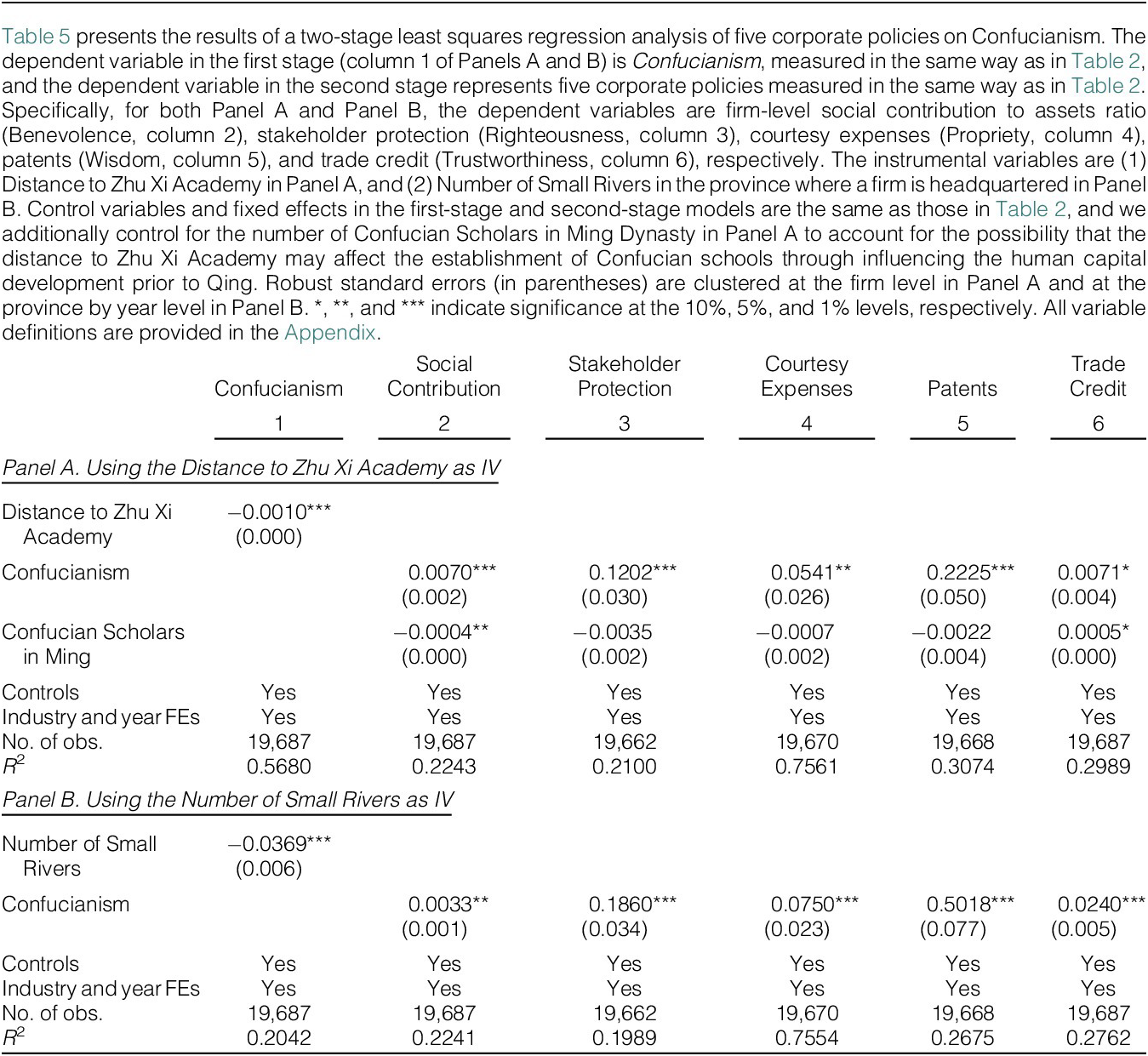
We estimate two-stage least squares using the same set of controls as in the baseline regressions. Table 5 reports the results. Panel A uses Distance to Zhu Xi Academy as the instrument and Panel B uses Number of Small Rivers. In both panels, column 1 presents the first-stage estimates. The instrument coefficients are negative and statistically significant, indicating that firms located closer to a Zhu Xi Academy and those in regions with fewer small rivers exhibit higher values of our firm-level Confucianism measure. These patterns are consistent with the historical diffusion logic: that subsequent schools concentrated near centers of Confucian influence and avoided flood-prone small-river areas. Columns 2–6 report the second-stage estimates for the five outcomes. Across all specifications and for both instruments, the coefficients of Confucianism are positive and statistically significant, indicating that greater exposure to Confucian culture causally predicts higher social contributions, stronger stakeholder protection, greater courtesy expenses, more patenting, and higher trade credit. The IV magnitudes are comparable to (and in some cases larger than) the OLS coefficients, reinforcing our interpretation of culture-supported relational contracting as the mechanism linking Confucian exposure to stakeholder-oriented corporate policies.

TABLE 5 Long description
The table consists of six numbered columns (1 through 6) with the following headers: Confucianism, Social Contribution, Stakeholder Protection, Courtesy Expenses, Patents, and Trade Credit.
Panel A: Using the Distance to Zhu Xi Academy as I V.
* Distance to Zhu Xi Academy: Column 1 shows -0.0010 with a standard error of 0.000.
* Confucianism: Coefficients across columns 2 to 6 are 0.0070, 0.1202, 0.0541, 0.2225, and 0.0071 respectively.
* Confucian Scholars in Ming: Coefficients across columns 2 to 6 are -0.0004, -0.0035, -0.0007, -0.0022, and 0.0005.
* Controls and Industry/Year F E s: All columns marked Yes.
* Number of observations: Approximately 19,662 to 19,687.
* R-squared: Ranges from 0.2100 to 0.7561.
Panel B: Using the Number of Small Rivers as I V.
* Number of Small Rivers: Column 1 shows -0.0369 with a standard error of 0.006.
* Confucianism: Coefficients across columns 2 to 6 are 0.0033, 0.1860, 0.0750, 0.5018, and 0.0240.
* Controls and Industry/Year F E s: All columns marked Yes.
* Number of observations: Matches Panel A.
* R-squared: Ranges from 0.1989 to 0.7554.
We also conduct robustness checks tailored to the spatial distribution of the instruments. Zhu Xi Academies and subsequent schools are predominantly concentrated in eastern and southern China, whereas listed firms are distributed nationwide. To account for this discrepancy and ensure overlap between treated and comparison areas, we restrict the sample to regions within a 1,500-km radius of the centroid of the three Zhu Xi Academies, thereby excluding sparsely populated western regions with few listed firms (e.g., Xinjiang, Qinghai, Tibet) while preserving maximal coverage of both firms and academies.Footnote 15 Section 2 of the Supplementary Material shows that re-estimating the IV models on this restricted subsample yields qualitatively similar results: the coefficients on the Confucianism variable remain significantly positive across outcomes in Table IA2 in the Supplementary Material. These findings further corroborate the robustness of the causal effect of historical Confucian exposure on modern stakeholder-oriented firm behavior.Footnote 16
V. Underlying Mechanism
To explore the underlying mechanisms of the cultural effects, we disentangle an institutional channel—relational contracts between firms and stakeholders—from a preference channel—managerial or societal tastes for prosocial conduct shaped by culture. Two tests guide the analysis. First, we run a placebo-style horse-race against alternative cultural influences that also promote virtuous behavior but do not center on interpersonal, bilateral ties. Second, we examine settings where stronger formal institutions should reduce reliance on relational governance. In such cases, the attenuation of cultural effect would support the institutional channel.
A. Confucianism Versus Other Cultures
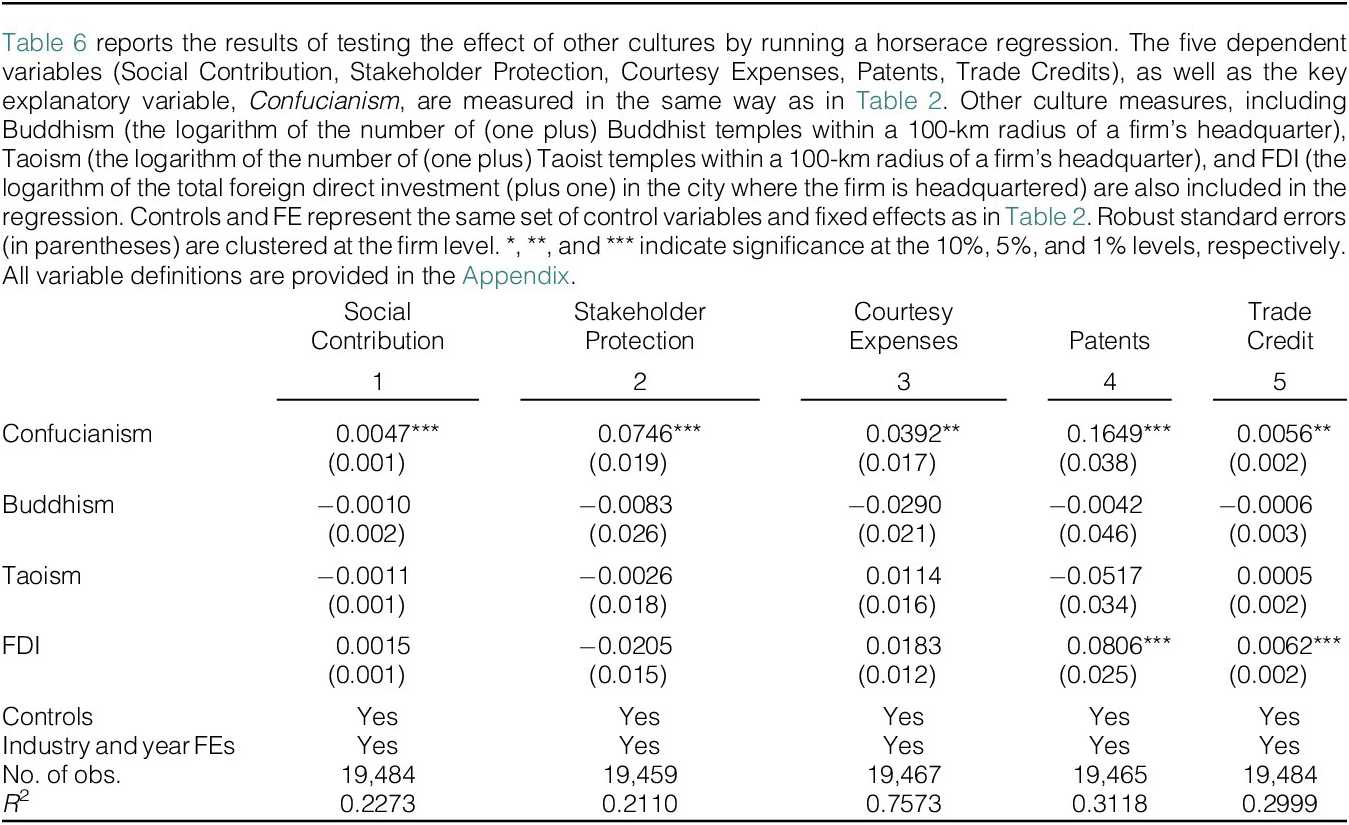
China also hosts other long-standing cultural and religious traditions, most notably Buddhism and Taoism, with broad adoption (Kung and Ma (Reference Kung and Ma2014)). While these traditions encourage prosocial conduct and self-cultivation, they place less emphasis on interpersonal, role-based obligations as a substitute for legal contracting and therefore are less directly connected to bilateral enforcement in exchange (Freiberg (Reference Freiberg1977)). We, therefore, estimate horse-race specifications that include firms’ exposure to other traditions alongside Confucianism. Specifically, we control for the numbers of Buddhist and Taoist temples within the firm’s vicinity to proxy for Buddhism and Taoism, respectively, and use city-level FDI as a proxy for exposure to Western cultural values (detailed variable definitions are provided in the Appendix). Table 6 shows that the Confucianism coefficient remains positive and statistically significant across all five corporate policies, whereas the alternative culture proxies do not display a pattern consistent with relational-contract predictions. These results indicate that the effects we document reflect firms’ maintenance of stakeholder relationships and are uniquely attributable to Confucianism’s relationship-centered norms rather than to general cultural preferences.
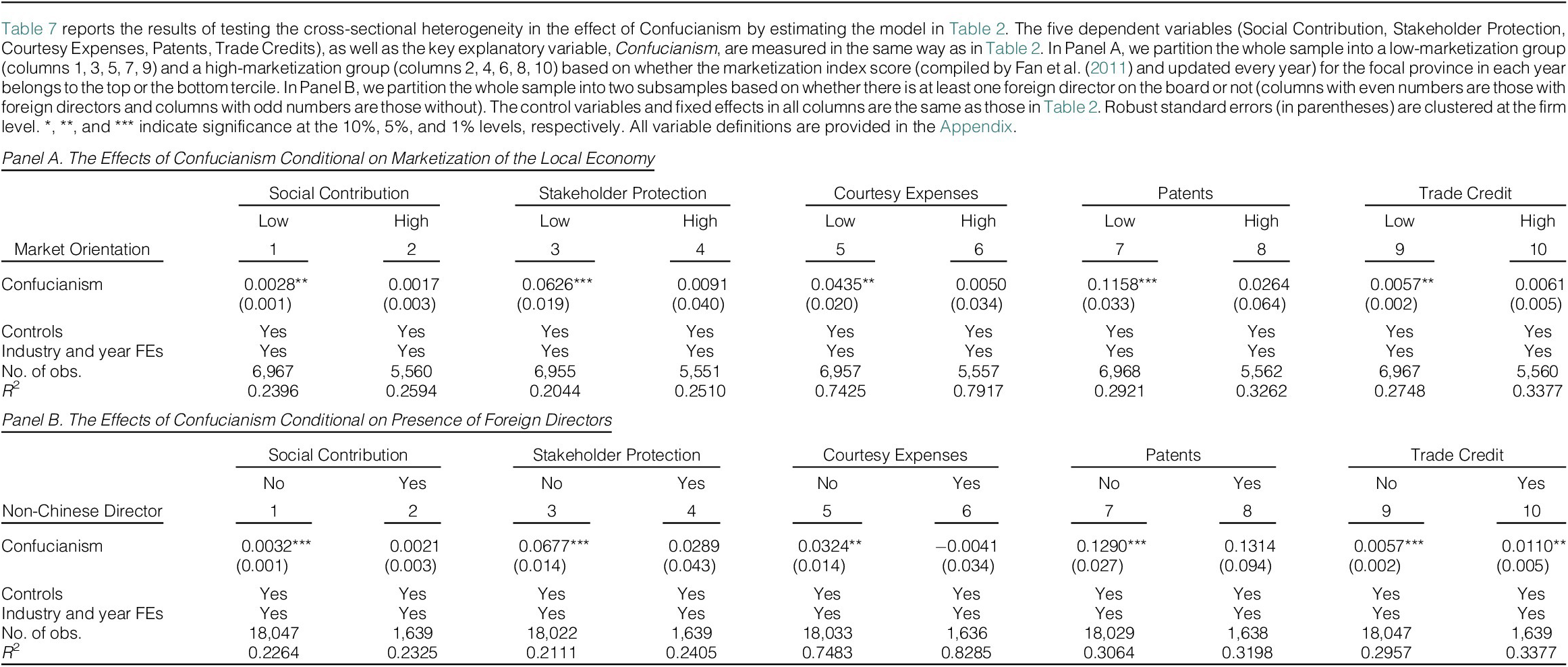
Table 6 reports the results of testing the effect of other cultures by running a horserace regression. The five dependent variables (Social Contribution, Stakeholder Protection, Courtesy Expenses, Patents, Trade Credits), as well as the key explanatory variable, Confucianism, are measured in the same way as in Table 2. Other culture measures, including Buddhism (the logarithm of the number of (one plus) Buddhist temples within a 100-km radius of a firm’s headquarter), Taoism (the logarithm of the number of (one plus) Taoist temples within a 100-km radius of a firm’s headquarter), and FDI (the logarithm of the total foreign direct investment (plus one) in the city where the firm is headquartered) are also included in the regression. Controls and FE represent the same set of control variables and fixed effects as in Table 2. Robust standard errors (in parentheses) are clustered at the firm level. *, **, and *** indicate significance at the 10%, 5%, and 1% levels, respectively. All variable definitions are provided in the Appendix.

TABLE 6 Long description
The table consists of 5 numbered columns representing dependent variables: 1 Social Contribution, 2 Stakeholder Protection, 3 Courtesy Expenses, 4 Patents, and 5 Trade Credit.
Independent variables and their coefficients (with standard errors in parentheses) are as follows:
* Confucianism: Shows positive significance across all columns. 0.0047*** (0.001) for Social Contribution; 0.0746*** (0.019) for Stakeholder Protection; 0.0392** (0.017) for Courtesy Expenses; 0.1649*** (0.038) for Patents; and 0.0056** (0.002) for Trade Credit.
* Buddhism: No significant results. Coefficients range from -0.0006 to -0.0290.
* Taoism: No significant results. Coefficients range from -0.0517 to 0.0114.
* F D I: Shows positive significance for Patents (0.0806***) and Trade Credit (0.0062***).
Bottom rows indicate that Controls and Industry and year F Es were applied (Yes) for all models. The number of observations is approximately 19,400 across all columns. R-squared values range from 0.2110 to 0.7573, with the highest value in column 3.
B. Regional Market Development
If Confucianism operates through relational governance, its impact should weaken where formal contracting institutions are stronger, because formal rules, courts, and market intermediaries substitute for informal, culture-based enforcement (Baker et al. (Reference Baker, Gibbons and Murphy2002), Greif and Tabellini (Reference Greif and Tabellini2017), Macchiavello and Morjaria (Reference Macchiavello and Morjaria2023)). By contrast, under a pure preference channel, stronger market institutions would not make the effects different or even amplify them if well-functioning markets raise the returns to reputation or enable the expression of prosocial preferences (Bénabou and Tirole (Reference Bénabou and Tirole2010), Edmans (Reference Edmans2011)). To test these competing predictions, we use the annually updated marketization index for 31 provinces (Fan et al. (Reference Fan, Wang and Zhu2011)), which measures the development of market systems along five dimensions: government–market relations, private-sector development, product markets, factor markets, and the growth of intermediaries and a market-friendly legal environment (Fan et al. (Reference Fan, Wang and Zhu2011)). We sort province-year observations into terciles and compare estimates in the top (high market orientation) and bottom (low market orientation) terciles. Panel A of Table 7 shows that the Confucianism effect is strong and significant across all five outcomes in low market-orientation regions but attenuates and becomes insignificant in high market-orientation regions. This pattern is consistent with substitution between culture-based relational governance and formal contracting institutions, supporting the institutional (relational-contract) mechanism over a pure preference-based interpretation.

TABLE 7 Long description
The table is divided into two sections: Panel A and Panel B.
Panel A: The Effects of Confucianism Conditional on Marketization of the Local Economy.
It compares Low and High Market Orientation across five categories:
* Social Contribution: Low (0.0028**), High (0.0017).
* Stakeholder Protection: Low (0.0626***), High (0.0091).
* Courtesy Expenses: Low (0.0435**), High (0.0050).
* Patents: Low (0.1158***), High (0.0264).
* Trade Credit: Low (0.0057**), High (0.0061).
Controls, Industry, and year F Es are included for all. Number of observations ranges from 5,551 to 6,968. R-squared values range from 0.2044 to 0.7917.
Panel B: The Effects of Confucianism Conditional on Presence of Foreign Directors.
It compares the absence (No) or presence (Yes) of a Non-Chinese Director:
* Social Contribution: No (0.0032***), Yes (0.0021).
* Stakeholder Protection: No (0.0677***), Yes (0.0289).
* Courtesy Expenses: No (0.0324**), Yes (-0.0041).
* Patents: No (0.1290***), Yes (0.1314).
* Trade Credit: No (0.0057***), Yes (0.0110**).
Controls, Industry, and year F Es are included for all. Number of observations ranges from 1,636 to 18,047. R-squared values range from 0.2111 to 0.8285.
C. Market Orientation of the Corporate Board
Market orientation is also reflected at the firm level through board composition. Boards with foreign (non-Chinese) directors tend to import diverse perspectives and advanced managerial practices (Giannetti, Liao, and Yu (Reference Giannetti, Liao and Yu2015)). Under the institutional view, the impact of Confucianism should therefore weaken when boards are more market-oriented, because firms can rely more on formal governance and less on relational contracts. By contrast, a pure preference-based view would not necessarily predict attenuation by board composition, since directors from different cultures may share generic prosocial preferences. Thus, only if Confucian virtues work through relational contracting should board composition matter.
Panel B of Table 7 reports estimates from samples split by board composition: firms with at least one foreign director versus firms with exclusively Chinese directors. Among firms with foreign directors, the association between Confucianism and corporate policies is generally weak (only column 10 remains significant). In contrast, among firms with exclusively Chinese directors, coefficients of Confucianism are positive and statistically significant across all outcomes. These results support the institutional channel: Confucianism’s influence on corporate policy is substantially attenuated in firms with foreign directors, consistent with market-oriented boards substituting formal contracting for culture-based relational governance.
VI. Post Hoc Analysis: Additional Evidence on Relational Contracting
We provide further evidence on how Confucian culture is associated with corporate policies in ways consistent with relational contracting. Confucian doctrines beyond the five virtues—notably the “Three Cardinal Guides” (Sangang: ruler–subject, father–son, husband–wife)—codify norm-based hierarchies and bilateral obligations that function as informal institutions. Viewed through a relational-contracting lens, these prescriptions coordinate expectations, allocate authority and duties, and support self-enforcement through reputation and repeated interaction. Although they may also embody value and preference components (e.g., deference and patriarchy), our interpretation in this section emphasizes their institutional role in structuring relational contracting.
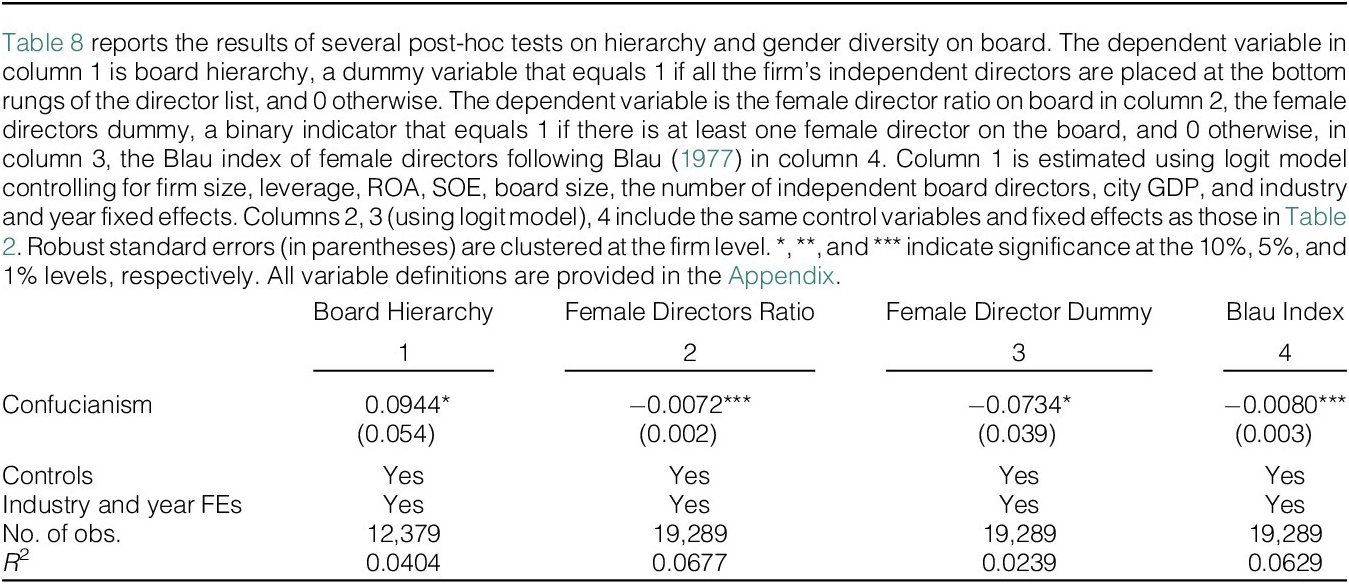
First, we examine board hierarchy. In many Chinese firms, directors are listed by seniority or influence rather than alphabetically, which we interpret as an organizational manifestation of culture-based hierarchy (Zhu, Ye, Tucker, and Chan (Reference Zhu, Ye, Tucker and Chan2016)). We construct an indicator equal to 1 if board members are not listed alphabetically and regress this indicator on Confucian exposure with controls and fixed effects. Column 1 of Table 8 shows a positive and significant association. From the perspective of relational contracting, a clearer hierarchy can reduce ambiguity about residual control and relational obligations, thereby lowering ex post bargaining and facilitating self-enforcement in repeated interactions within the board and between the board and other stakeholders.

TABLE 8 Long description
The table consists of four numbered columns. Column 1 is Board Hierarchy. Column 2 is Female Directors Ratio. Column 3 is Female Director Dummy. Column 4 is Blau Index.
Row 1, Confucianism:
- Column 1: 0.0944 asterisk with 0.054 in parentheses below.
- Column 2: minus 0.0072 triple asterisk with 0.002 in parentheses below.
- Column 3: minus 0.0734 asterisk with 0.039 in parentheses below.
- Column 4: minus 0.0080 triple asterisk with 0.003 in parentheses below.
Row 2, Controls: Yes for all four columns.
Row 3, Industry and year F E s: Yes for all four columns.
Row 4, Number of observations:
- Column 1: 12,379.
- Columns 2, 3, and 4: 19,289.
Row 5, R-squared:
- Column 1: 0.0404.
- Column 2: 0.0677.
- Column 3: 0.0239.
- Column 4: 0.0629.
Second, we study board gender composition. Confucianism historically constrained women’s public roles. We analyze the fraction of female directors, an indicator for at least one female director, and the Blau (Reference Blau1977) gender-diversity index. Columns 2–4 of Table 8 show negative and significant associations with Confucian exposure. We view these patterns as descriptive evidence of cultural persistence. Institutionally, more homogeneous, status-ordered boards may find it easier to rely on shared norms and expectations to govern relationships through relational contracting.
Third, we consider precaution under uncertainty. Confucian teachings emphasize preparedness for hardship, and firms embedded in such norms may be more inclined to hold precautionary buffers that help sustain relational obligations when adverse shocks occur. Following Dessaint and Matray (Reference Dessaint and Matray2017), we implement a difference-in-differences design using earthquakes as exogenous shocks, exploiting distance to the epicenter to measure shock intensity. Consistent with a precautionary motive (Kim, Mauer, and Sherman (Reference Kim, Mauer and Sherman1998), Opler, Pinkowitz, Stulz, and Williamson (Reference Opler, Pinkowitz, Stulz and Williamson1999), and Bates, Kahle, and Stulz (Reference Bates, Kahle and Stulz2009)), Section 4 of the Supplementary Material shows that firms with greater Confucian exposure increase cash holdings more after earthquakes. In terms of relational contracting, larger cash buffers can help firms honor implicit commitments to employees, suppliers, and other stakeholders when formal contracting is strained by shocks.
Taken together, these post hoc patterns are consistent with Confucian exposure co-varying with organizational forms and behaviors that facilitate relational contracting—clear hierarchies, shared norms, and precautionary slack. While some of these outcomes can also be interpreted as reflecting underlying cultural values and preferences, we view them primarily as complementary evidence that Confucian culture shapes institutional features that support relational contracting.
VII. Conclusion
This article reframes the link between culture and firms around an institutional mechanism: societal culture sustains relational contracts between firms and stakeholders—self-enforcing, norm-based agreements that substitute for formal contracting and are maintained through repeated interaction. Using historical exposure to Confucianism, the dominant relationship-oriented culture in China, we show that culture’s impact on corporate policy is best interpreted as relation-specific investment in stakeholder ties rather than the mere expression of prosocial preferences.
We construct a granular firm-level proxy for Confucian exposure—the number of Qing-era Confucian academies within 100 km of a firm’s headquarter—and find that more exposed firms make greater social contributions, provide stronger stakeholder protection, spend more on courtesy and etiquette, innovate more, and receive more trade credit. These outcomes align with the predictions of relational contracting, in which firms invest to maintain the support of employees, trading partners, communities, and other stakeholders.
These results remain robust to extensive checks that account for human capital, other potential confounds, and alternative cultural proxies (Confucian temples and genealogies). They are also supported by instrumental-variable analyses that leverage distance to Zhu Xi Academies and provincial small-river density, which predict historical diffusion of Confucian institutions but are plausibly orthogonal to modern outcomes conditional on controls, including Ming-era scholar stocks. Moreover, when exposure to Buddhism, Taoism, and Western cultural proxies (FDI) is included alongside Confucianism, only the relationship-centered Confucian measure remains positive and statistically significant, indicating that our findings are not driven by generic virtuous preferences. We further show that the effects of Confucianism attenuate in high-marketization provinces and in firms with foreign directors, a board attribute associated with more market-oriented governance, consistent with substitution between informal, culture-based relational contracting and formal contracting institutions.
Conceptually, the findings offer a firm-level account of how societal culture enters corporate governance: by raising the continuation value of bilateral relationships, culture encourages relation-specific investment that lowers transaction costs and sustains cooperation. The influence of culture is also state-contingent. Its marginal role declines as market and legal institutions deepen, while in weaker formal environments, culture-based relational contracting remains pivotal. Policy aimed at improving stakeholder welfare should, therefore, consider how formal reforms interact with entrenched informal institutions, acknowledging where they substitute for, and where they complement, existing cultural arrangements.
The analysis also points to open questions. Beyond its institutional role, does Confucianism have intrinsic value implications for corporations? Max Weber (Reference Weber1930) argued that Confucianism impeded the rise of modern capitalism in China, yet China’s subsequent transformation suggests a more nuanced relationship. Identifying which elements of Confucianism most directly increase the surplus from relational contracts, how they interact with modern compliance and disclosure regimes, and whether similar mechanisms operate in other relationship-oriented cultures would deepen our understanding of how culture as a foundation for relational contracting shapes corporate and macroeconomic outcomes.
Appendix. Variable Definitions
- Confucianism:
-
The natural logarithm of (one plus) the number of Confucian academies within a 100-km radius of a firm’s headquarter.
- Social Contribution:
-
Social contribution (summing up total tax contribution, employee payment, interest expense, and donations) divided by total assets.
- Stakeholder Protection:
-
The sum of binary indicators of whether a firm reports to have taken measures to protect its staff and suppliers.
- Courtesy Expenses:
-
The natural logarithm of management fees deducted by executives’ and directors’ wages plus 1.
- Patents:
-
The natural logarithm of the number of patents authorized by the government plus 1.
- Trade Credit:
-
The sum of accounts payable and notes payable divided by total assets.
- Size:
-
The natural logarithm of a firm’s total assets plus 1.
- Leverage:
-
The ratio of debt to total assets of a firm.
- ROA:
-
The ratio of a firm’s net profit to total assets.
- Revenue Growth:
-
The annual revenue growth rate of a firm.
- Operating Cash Flow:
-
The cash flow generated by operating activity dived by total revenue.
- SOE:
-
A binary variable that equals 1 if the ultimate owner of the firm is the state, and 0 otherwise.
- Buddhism:
-
The natural logarithm of the number of Buddhist temples within a 100 -km radius around a firm’s headquarters plus 1.
- Taoism:
-
The natural logarithm of the number of Taoist temples within a 100-km radius around a firm’s headquarters plus 1.
- Confucian Temples:
-
The natural logarithm of 1 plus the number of Confucian temples within a 200-km radius of a firm’s headquarters.
- Genealogies:
-
The log-transformed number of genealogy books normalized by the population of the respective prefecture in 2006.
- CEO Culture:
-
The number of Confucian schools during the Qing Dynasty located in the CEO’s or board chairperson’s hometown or birthplace city based on contemporary administrative divisions.
- Board Hierarchy:
-
A binary variable that equals 1 if all the firm’s independent directors are placed at the bottom rungs of the director list, and 0 otherwise.
- Women Directors Ratio:
-
The ratio of female directors to all directors on the board.
- Women Directors Dummy:
-
A binary variable that equals 1 if there is at least one female director on the board, and 0 otherwise.
- Blau Index:
-
The Blau index of gender diversity in the board: $ Blau=1-{\sum}_i{P}_i^2 $
 , where
$ {P}_i $
refers to the percentage of female or male board members (Blau (Reference Blau1977)).
- Cash Ratio:
-
The ratio of a firm’s cash to its total assets.
- City GDP:
-
The natural logarithm of the city’s GDP (in billion RMB).
- City Employment:
-
The natural logarithm of the number of residents currently employed in the city (in thousand).
- City Total Wage:
-
The natural logarithm of total employee wages in the city (in thousand RMB).
- Average Years of Schooling:
-
The average years of schooling in 2010 measured at the city level.
- The Share of Educated Population at the City Level:
-
The share of population with high school education and above in 2010 measured at the city level.
- The Illiteracy Rate at the City Level:
-
The share of population with no education in 2010 measured at the city level.
- Distance to Coast:
-
The natural logarithm of the distance between a city’s centroid and the closest point on the coast plus 1.
- Slope:
-
The average slope within each city, measured by matching CHGIS V4 DEM with city boundary in 2017.
- The Share of Educated Population at the Province Level:
-
The share of population with high school education and above over the sample period measured at the province level.
- The Number of “Project 211 Universities”:
-
The number of “Project 211 Universities” at the province level.
- FDI:
-
The natural logarithm of total foreign direct investment (in million USD) plus 1.
- Number of Small Rivers:
-
The number of small rivers, excluding major ones that cross many provinces such as the Yangtze River and the Yellow River, with drainage areas greater than 10,000 square kilometers in the province where a firm is headquartered.
- Distance to Zhu Xi Academy:
-
The shortest distance between a listed firm’s headquarters and the nearest Zhu Xi Academy. The three Zhu Xi Academies are Yuelu Academy in Changsha, Hunan province; Hanquan Academy in Jianyang, Fujian province; and White Deer Grotto Academy in Jiujiang, Jiangxi province.
- Confucian Scholars in Ming:
-
The number of prominent scholars in the Ming Dynasty whose hometown’s center point is within a 100-km radius around a firm’s headquarters.
- Population Density:
-
The average of a provincial population density in 1776, 1820, 1851, and 1910.
- Shengyuan Quota:
-
The quota for the shengyuan (promoted scholar) degree for counties in the Qing Dynasty, aggregated at the province level.
- Marketization Index:
-
The index constructed by Fan et al. (Reference Fan, Wang and Zhu2011) that captures the development of market orientation of a province each year. This index is assessed in five fields with 23 component indicators. The five fields are the level of resource allocation by governments and the market, market intermediaries and the legal environment for the market, the development of the nonstate enterprise sector, the development of the product market, and the development of labor, financial, and technology markets. This paper focuses on the development of market intermediaries and the legal environment for the market.
- Perspectives on Raising Children:
-
The percentage of respondents who choose “for old-age support” in response to the question “why do you want to have children?” at the family level.
- Divorce Population Ratio:
-
The percentage of divorced pairs to the average population between 2010 and 2017 at the provincial level.
- Education Expenses:
-
The natural logarithm of the amount of money that a family spends on children’s education plus 1.
- Intergenerational Coresidence Ratio:
-
The percentage of households with four generations living under the same roof at the provincial level in 2000 and 2010.


Supplementary Material
To view supplementary material for this article, please visit http://doi.org/10.1017/S002210902610283X.
Funding Statement
Zhang acknowledges the financial support received from the Fundamental Research Funds for the Central Universities (Grant No. 63242144).