Adjustment disorder (AD), a profile characterized by the development of emotional and/or behavioral symptoms in response to a stressful event, is among the most common diagnoses in clinical practice, in primary care (PC) settings as well as mental health units (MHUs) (American Psychological Association, 2014; Casey, Reference Casey2009). However, we found highly variable prevalence rates, depending on the population and the methods utilized. The studies consulted assert that AD is the reason for 10% to 35% of first appointments at MHUs, and 11% to 18% of first appointments in PC settings (Casey, Reference Casey2009).
The AD profile is considered residual and not very serious, but there is evidence that it lowers quality of life and poses socioeconomic costs in PC, sometimes more than physical illness (Casey, Dowrick, & Wilkinson, Reference Casey, Dowrick and Wilkinson2001; Fernández et al., Reference Fernández, Saameño, Pinto-Meza, Luciano, Autonell, Palao and Serrano2010). One of the most dramatic outcomes of AD is suicidal behavior; studies have reported suicide rates 12 times higher than in other psychological disorders (Gradus et al., Reference Gradus, Qin, Lincoln, Miller, Lawler and Lash2010).
Likewise, there is an association between mood and behavioral disturbances observed in people with AD, and their influence on perceived health and quality of life. The relationship between mood and physical health may occur via direct or indirect pathways (Barra, Reference Barra2003):
Physiological functioning and the immune system may change as a function of negative life events.
A person’s appraisal of his or her health may vary according to their mood.
Certain health-related behaviors (eating, drinking alcohol, smoking, or exercising) can be used as emotional regulation strategies.
When stress levels are high, people with low perceived social support are more predisposed to physical ailment than those with higher levels of social support.
With regard to AD’s public health impact, the prominent clinical guidelines advocate for stepped care (National Institute for Health and Care Excellence, 2011), that is, conducting initial group intervention at PC units, and then if that is not enough, patients proceed to the next level of treatment to receive more individualized, intensive treatment at a MHU (Cano, Reference Cano2011).
The current scientific literature offers no empirically validated treatment to intervene in AD (Simón, Molés, & Quero, Reference Simón, Molés and Quero2017), but there is evidence that psychotherapy is an adequate treatment option in various emotional disorders (Batterham et al., Reference Batterham, Christensen, Mackinnon, Gosling, Thorndike, Ritterband and Griffiths2017; Kaplan & Sadock, Reference Kaplan and Sadock1998; Linde et al., 2015). Specifically, individual cognitive behavioral therapy (CBT) is recommended for anxiety and depression in PC (Butler, Chapman, Forman, & Beck, Reference Butler, Chapman, Forman and Beck2006; Cape, Whittington, Buszewicz, Wallace, & Underwood, Reference Cape, Whittington, Buszewicz, Wallace and Underwood2010; Cuijpers, Smit, & van Straten, Reference Cuijpers, Smit and van Straten2007; Høifødt, Strøm, Kolstrup, Eisemann, & Waterloo, Reference Høifødt, Strøm, Kolstrup, Eisemann and Waterloo2011; Ministerio de Sanidad y Consumo, 2008). It has also proven effective in a group format (Burgos, Ortiz, Muñoz, Vega, & Bordallo, Reference Burgos, Ortiz, Muñoz, Vega and Bordallo2006; Osma, Castellano, Crespo, & García-Palacios, Reference Osma, Castellano, Crespo and García-Palacios2015; Sundquist et al., Reference Sundquist, Lilja, Palmér, Memon, Wang, Johansson and Sundquist2015).
Focusing on AD treatment, we found that various studies in Spain successfully applied a CBT-based treatment protocol in patients with AD, even making use of new information and communication technologies (Egea, Trigo, & Bernal, Reference Egea, Trigo and Bernal2014; Molés, Quero, Pérez, Nebot, & Botella, Reference Molés, Quero, Pérez, Nebot and Botella2015; Sanz-Cruces et al., Reference Sanz-Cruces, García-Cuenca, Cuquerella-Adell, Cano-Navarro, Jordá-Carreres, Blasco-Gallego and Carbajo-Álvarez2016). Around the world, CBT has yielded favorable results in studies of adolescents and adults with AD, improving psychosocial functioning and reducing anxious and depressive symptomatology (Pelkonen & Marttunen, Reference Pelkonen and Marttunen2005; van der Heiden & Melchior, Reference van der Heiden and Melchior2012).
Yet currently, most patients with AD do not get access to adequate psychological treatment. We observed that only 31.8% in MHUs and 30.5% in PC do (Fernández et al., 2007); thus they are big psychopharmaceutical consumers (Carta, Balestrieri, Murru, & Hardoy, Reference Carta, Balestrieri, Murru and Hardoy2009). Moreover, psychological treatment can have a better cost-benefit ratio than psychopharmaceutical treatment (Hollinghurst, Kessler, Peters, & Gunnell, Reference Hollinghurst, Kessler, Peters and Gunnell2005; Pastor, Reference Pastor2008).
Patients who suffered a stressful event that overwhelms their ability to cope, and inflicts suffering and disorientation on their lives, are being treated in the public health system primarily with a pharmacological approach (Casey, Reference Casey2009; Kovess-Masfety et al., Reference Kovess-Masfety, Alonso, Brugha, Angermeyer, Haro and Sevilla-Dedieu2007). That said, in recent years, researchers are actively investigating the adequacy of psychological treatment of AD, and results have been promising. With that in mind, our objective is to study the efficacy of a group CBT program for PC patients with an AD diagnosis. The present research hypothesis is that patients treated with group CBT will thereafter present lower psychopathology, lower suicide risk, and better perceived health-related quality of life than patients on a waiting list.
Method
Participants
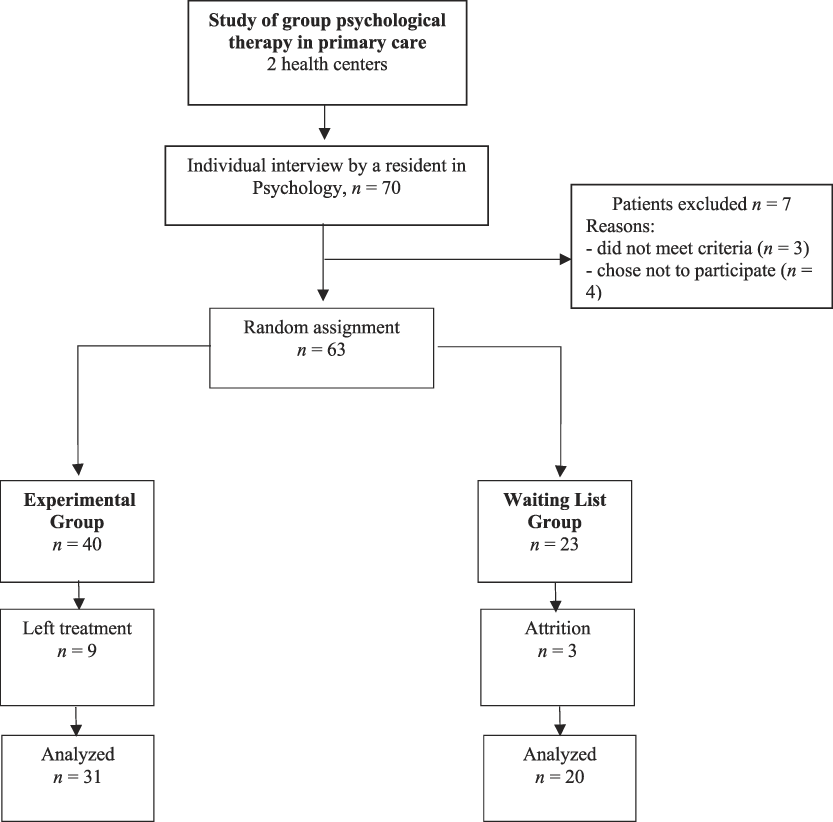
This study was conducted in cooperation with primary care physicians (PCPs) at two health centers in Valencia. PCPs referred a total of 70 patients with Adjustment Disorder to the Mental Health Unit for assessment, and proposed group psychological treatment. Of the 70, 63 were accepted, having met the inclusion criteria (adult diagnosed with AD or exhibiting anxious and depressive symptomatology) and exclusion criteria (diagnosed with a Personality Disorder, or presenting antecedents of serious mental illness or substance dependence). Participants were randomly assigned to the waiting list group (n = 23) or experimental group (n = 40), and after attrition the final sample consisted of 51 patients (Figure 1).
Sample Selection Process.

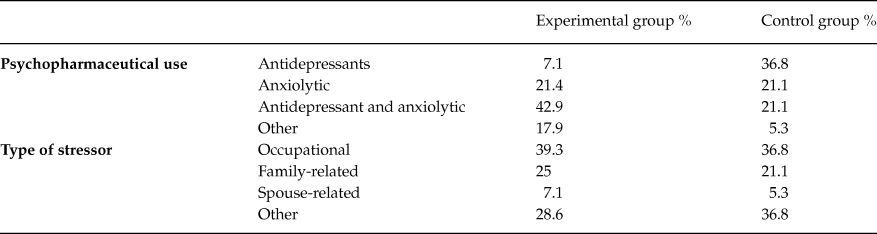
Participants were 19 to 70 years old (M = 42.31, SD = 12.72) and 54.9% were women. 87.2% were taking psychopharmaceuticals, generally a combined treatment of anxiolytic and antidepressant (34%). Accordingly, 31.9% visited a psychiatrist (psychopharmaceuticals are controlled substances) at the Mental Health Unit during the course of the study, but none attended individual psychotherapy sessions. In 38.3% of cases, the stressor that triggered AD was occupational. For more detailed data analysis, see Tables 1 and 2.
Descriptive Statistics and Means Differences on Sociodemographic Variables in the Experimental and Control Groups

Descriptive Statistics Pertaining to Psychopharmaceutical Use and Type of Stressor in Experimental and Control Groups

Variables and Instruments
Presence of psychopathology . Revised Symptom Check-List (SCL–90–R), Spanish adaptation by González de Rivera et al. (Reference González de Rivera, Derogatis, de las Cuevas, Gracia, Rodríguez, Henry-Benítez and Monterrey1989). This questionnaire assesses psychological distress using 90 Likert-type items, anchored at 0 and 4 and divisible into nine symptom dimensions: Somatization, obsessive-compulsive, interpersonal sensitivity, depression, anxiety, hostility, phobic anxiety, paranoid ideation, and psychoticism. Furthermore, it provides three global distress indices: Global Severity Index (GSI), Total Positive Symptoms (TPS), and Positive Symptoms Distress Index (PSDI). Its internal consistency is, on all dimensions, greater than or equal to .80, and its test-retest reliability is .70 (Derogatis & Savitz, Reference Derogatis, Savitz and Maruish2000).
Health-related quality of life. SF–12 Health Survey, Spanish adaptation by Alonso, Prieto, and Antó (Reference Alonso, Prieto and Antó1995). This captures health-related quality of life profiles and is applicable to people with or without physical or psychological alteration. It assesses the respondents’ mental and physical state, and higher scores indicate better perceived health. Similarly, items are scored, aggregated, and transformed on a 0–100 scale. With respect to its psychometric properties, Cronbach’s alpha ranged from .71 to .94 (Alonso et al., Reference Alonso, Prieto and Antó1995).
Risk of suicide. The Suicide Risk Scale (SRS; Rubio et al., Reference Rubio, Montero, Jáuregui, Villanueva, Casado, Marín and Santo-Domingo1998) is a 15-question self-report scale with response options yes (1) and no (0). Total scores are considered the sum of affirmative responses. The questions relate to past suicide attempts, the intensity of current suicidal ideation, feelings of depression and desperation, and other aspects associated with suicide attempts. On the Spanish validation, scores over 6 are considered at-risk, Cronbach’s alpha is .90, and test-retest reliability Cronbach’s alpha is .89 (Rubio et al., Reference Rubio, Montero, Jáuregui, Villanueva, Casado, Marín and Santo-Domingo1998).
Procedure
Following AD diagnosis and referral by a PCP, a third-year Resident in Psychology (RIP) conducted an initial diagnostic interview, gathering information on aspects of interest to the study. He or she meanwhile gauged the individual’s acceptance or rejection of the referral for group psychological treatment. Following the inclusion and exclusion criteria, after collecting signed informed consent paperwork, we administered pre-treatment psychometric tests.
Patients were assigned to the waiting-list group if after assessment, group therapy could not begin due to lack of patients, or because holidays or vacation time would interrupt the course of treatment. When it became possible to start group treatment, subjects were contacted and the psychometric tests repeated, thus providing post-intervention data for the waiting-list group and pre-intervention data for the experimental group.
Five treatment groups were formed with 6–8 subjects each, and then eight weekly one-hour sessions were led by a fourth-year RIP. Patients attended an average of 5.75 sessions. Following treatment, we again evaluated all patients in the experimental group (Figure 1). The treatment’s structure and contents are detailed in Table 3.
Treatment Sessions Plan

Data Analysis
This study’s data were analyzed in the program SPSS, version 22.0. Patients’ data was only included if they attended five or more therapy sessions. We calculated descriptive statistics; carried out Shapiro-Wilk tests of normality; ran t tests for independent samples to analyze basic between-groups differences when the assumption of homogeneity of variance was met; and used Cohen’s d to calculate effect size (ES). Additionally, the Mann-Whitney U test and Rosenthal r were used when the assumption of homogeneity of variance did not apply. According to Cohen (Reference Cohen1988), values ≈ .20 indicate small ES, medium ≈ .50, and high ≈ .80.
A simple between-groups ANCOVA was done, with two treatment conditions – experimental group and control group – to observe if there was an effect on emotional symptomatology. The covariable was pre-intervention score, having verified that all the pertinent assumptions were met. Partial eta squared was used to measure effect size, recognizing that values ≈ .02 indicate a small ES, ≈ .15 medium, and ≈ .30 large.
Results
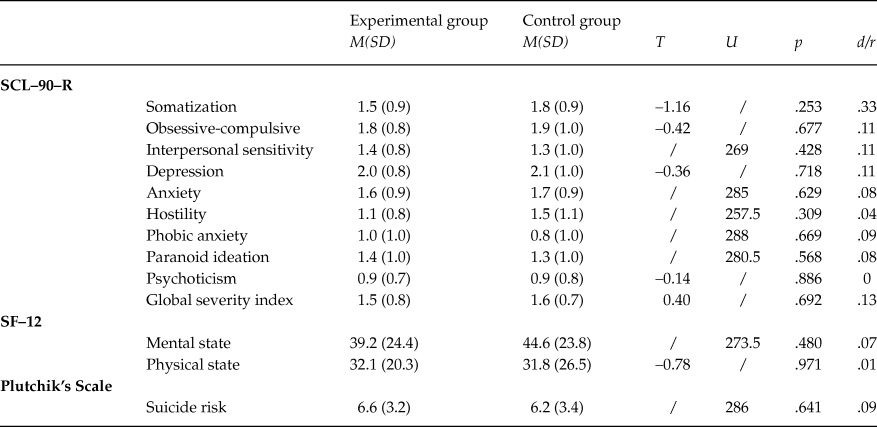
Pre-treatment results broadly suggested a high presence of psychopathology – particularly depressive, anxious, somatic, and obsessive-compulsive symptomatology – indicated by high global severity indexes in both groups. This was accompanied by a noticeable decline in quality of life related to physical and mental health, and by worrisome scores on risk of suicide. Prior to intervention, no statistically significant differences were observed between groups (control and experimental) on any of the aspects evaluated; small effect size was observed on all parameters. Therefore the two groups were considered similar prior to their respective experimental conditions (Table 4).
Analysis of Differences between the Experimental and Control Groups Pre-treatment

Note: Effect size (Cohen’s d and Rosenthal’s r) = small ≈.20; medium ≈ .50; large ≈ .80.
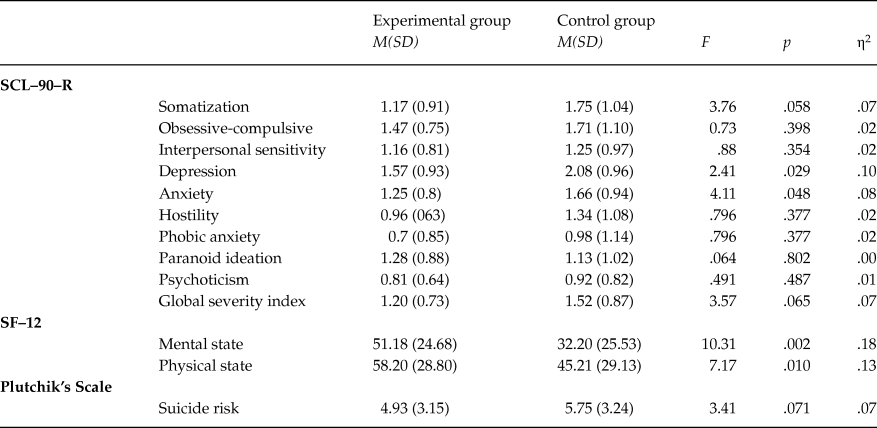
We tested the assumptions that have to be met in order to conduct ANCOVA. The covariable had a statistically significant effect on post-treatment scores, whereas no statistically significant effect occurred between the covariable and the independent treatment variable. We also tested for homogeneity of regression slopes and confirmed there was no statistically significant interaction between the covariable and the treatment variable. Moreover, we observed that patients who had attended group therapy scored lower on depressive and anxious symptomatology, and showed improved quality of life related to physical and mental health compared to patients who did not receive treatment. The difference was statistically significant, and the effect size small or medium in all cases (Table 5).
Analysis of Pre- and Post-treatment Differences between the Experimental and Control Groups

Note: Effect size (η2) = small ≈ .02; medium ≈ .15; large ≈ .30.
Discussion
Although the tenets of PC consider actions from a biopsychosocial view, and even though a high percentage of PC visits cannot be treated from a purely biomedical perspective, the reality is that few patients actually receive comprehensive care on demand (Pastor, Reference Pastor2008). In our study examined two groups – experimental and control – that were statistically similar on demographic variables, the time interval between pre- and post-treatment assessments, and the variables examined.
In terms of our objective, results were consistent with expectations. However, the hypothesis we proposed was only partially confirmed in that patients who attended group therapy showed reduced emotional symptomatology and improved quality of life, but did not reduce their risk of suicide.
With respect to the SCL–90–R questionnaire, we observed the biggest changes on the dimensions targeted by treatment: Depression and anxiety. These results are consistent with past research as well as systematic reviews of the effectiveness and efficiency of group CBT versus individual intervention for this type of issue (Huntley, Araya, & Salisbury, Reference Huntley, Araya and Salisbury2012; Segarra, Farriols, & Palma, Reference Segarra, Farriols and Palma2011; van der Heiden & Melchior, Reference van der Heiden and Melchior2012).
We believe it was important to improve depression and anxiety indexes given that patients scored most severely on those items. Nonetheless, other items tapping anxious symptomatology – like phobic anxiety and somatization – did not show a significant reduction in severity. This finding leads us to consider how we might potentiate strategies to reduce anxious symptomatology, including third-generation techniques like mindfulness, which has proven effective in other group interventions (Sanz-Cruces et al., Reference Sanz-Cruces, García-Cuenca, Cuquerella-Adell, Cano-Navarro, Jordá-Carreres, Blasco-Gallego and Carbajo-Álvarez2016).
The present study also evaluated the impact of psychological treatment on physical distress, using items on the SF–12 to assess physical state, and items on the SCL–90–R to detect somatizations. On the first aspect, subjects reported better perceived health, yet they showed no significant improvement on the second. Sánchez-García (Reference Sánchez-García2014) reported the same apparent contradiction; in their case, 65.38% of participants reduced their physical distress while somatization did not change. That said, we believe the two instruments evaluate non-equivalent constructs such that the SF–12 detects health-related quality of life profiles, while the SCL–90–R’s somatization index determines if specific somatic symptoms are present. Ergo, patients may improve their mood and feel better physically, but continue to present somatic symptoms that are harder to eradicate through psychological treatment.
In relation to suicide risk, please note that the sample’s pre-treatment index was worrisome. We realize suicide risk is an issue of keen interest when it comes to this diagnostic category (Gradus et al., Reference Gradus, Qin, Lincoln, Miller, Lawler and Lash2010). With that in mind, we propose that future interventions expand the program to teach participants, through CBT, to manage and curb suicidal ideation and suicide attempts.
Notwithstanding the contributions discussed above, these results can only be considered preliminary given the present study’s limitations.
The characteristics of this sample, and the type of sampling utilized, complicate the generalizability of results to the general population. Convenience sampling was used, which can affect the validity of results since they may be due to uncontrolled variables, like patients’ motivation or availability to receive treatment, among other considerations. The therapists conducting diagnostic interviews or treatment were not blind, whereas patients were. Furthermore, there was no long-term follow-up to confirm the intervention’s effects were stable over time. Future research should increase the sample size and use structured diagnostic interviews, plus self-report measures that enable clinical diagnosis, to increase the study’s validity. That being said, this study was conducted in a real-life clinical environment in a place patients were familiar with, which reduces reactivity bias in the assessment context, and thus enhances validity.
In light of these results, we conclude that the data show that multi-component, short-term, cognitive-behavioral intervention is a useful tool to reduce anxious and depressive symptomatology in the context of adjustment disorder. Furthermore, it improved patients’ health-related quality of life.
By way of conclusion, there is a high demand in current PC to treat emotional distress in response to stressful life events, such as losing a job or significant other. These adaptive profiles with symptoms of anxiety, depression, and physical distress cannot be referred to specialized units, so they end up being treated with pharamaceuticals, or by PCP’s who lack the space and the tools necessary to treat such cases. Group therapy by a clinical psychologist offers an ideal space to foster health, through therapeutic aspects like developing social skills, learning coping skills, and feeling solidarity in pain.
The healthcare system faces numerous challenges to instituting this type of intervention, because while there are spaces and appropriately trained professionals, the figure of the clinical psychologist does not currently exist in PC. For implementation to happen, further studies on the efficiency and effectiveness of psychological treatment are needed, along with awareness raising – for politicians, healthcare workers, and patients alike – about the importance of comprehensive healthcare that attends to patients’ needs on a biopsychosocial level.