NOMENCLATURE
- Cp
-
pressure coefficient
- Cy
-
side force coefficient
- Cyx
-
local side force coefficient
- Cl
-
lift coefficient
- Cd
-
drag coefficient
- D
-
base diameter
- L
-
overall length of body
- U ∞
-
free stream velocity
- α
-
angle-of-attack in pitch plane
- X
-
axial distance from the tip
- Ø
-
azimuthal angle in circumference
- LV
-
left vortex
- RV
-
right vortex
- S
-
reference area (πD2/4)
-
 $\overline {C{y_x}} $
-
integrated side force
$\ ( {\mathop \smallint \limits_0^X C{y_x}dx} )$


1.0 INTRODUCTION
Modern fighter aircraft and tactical missiles are required to operate at high angles of attack to have better performances in terms of super manoeuvrability and high agility. It is well established that a slender body subjected to high angles of attack experiences significant side force and yawing moments(Reference Allen and Perkins1). Extensive research has been done in the past few decades with goal of understanding the associated complex flow phenomenon existing around the slender body at higher angles of attack. At lower angles of attack (α < 30°), the flow separates and attaches in the leeward side, leading to the formation of a primary vortex. The boundary layer developed along the circumference might separate and form a secondary vortex. The vortices generated on both the sides are observed to be symmetric in nature. This is shown in Fig. 1(a) around a cross-section at an axial distance from the apex of the body. With further increase in the angle-of-attack (α > 30°), the vortices become asymmetric as shown in Fig. 1(b), which is dominated by convective instabilities(Reference Lamont and HUNT2-Reference Degani and Levy11). These features have a similarity to the flow field experienced for cylinders placed in a cross-flow. However, in the present case, the flow exists along the longitudinal direction as well. The asymmetry in the flow field gives rise to side force and hence the yawing moments(Reference Allen and Perkins1-Reference Keener, Chapman, Cohen and TALEGHANI6). At very high angles of attack (α > 65°), the flow is more dominated by the global instabilities, so the phenomenon of vortex shedding starts appearing on the body in the downstream(Reference Lamont and HUNT2-Reference Bridges7,Reference Ma and Liu19) . At these angles of attack, the flow on the body appears as an inclined cylinder placed in a cross-flow(Reference Ramberg20,Reference Yeo and Jones21) . The magnitude of side force mainly depends upon the several factors such as the Reynolds number, angles of attack, roll angles, etc.(Reference Lamont and HUNT2-Reference Keener, Chapman, Cohen and TALEGHANI6) The repeatability and reproducibility of results in the experiments were observed to be of major concern. Even a micro-disturbance at the tip could alter the overall side force(Reference Zilliac, Degani and Tobak5) at different roll angles because the incoming flow will experience different surface roughness. Possibly due to these reasons, side force changes with roll orientation. Keener et al(Reference Keener, Chapman, Cohen and TALEGHANI6) reported that surface roughness of the nose tip is mainly responsible for the generation of asymmetric vortices and hence the side force. The side force measured by rotating the whole body or by rotation of the nose only yielded almost the same result(Reference Keener, Chapman, Cohen and TALEGHANI6). The complexities associated with the flow over the slender body at high angles of attack are highlighted in the review articles(Reference Bridges7,Reference Deng, Tian and Wang17) . Computation of flow over the slender body at high angles of attack becomes a challenging task as the asymmetry of the vortices can be achieved only by placing a suitable perturbation at the nose tip in an azimuth plane(Reference Degani and Schiff8-Reference Degani and Levy11). To achieve results that are in good agreement with experimental results, the shape, size and location of the perturbation had to be optimised(Reference Levy, Hesselink and Degani10). Computations made with perturbation showed good agreement with the experimental results(Reference Cummings, Forsythe and Squires9). Large eddy simulations (LES) with a very high grid size on the slender body at α = 50° indicated the shedding phenomenon in the downstream of the body with a Strouhal number of 0.052(Reference Ma and Liu19). The asymmetry of the vortices was induced using a nose tip perturbation. However, such unsteady phenomena in the flow are very difficult to confirm using computations only.
Flow around slender body at angles of attack(Reference Degani and Levy11): (a) low angle (b) high angle.

Experimental studies with active and passive control techniques such as strakes, trips, grooves, modification of nose shapes, dimpled surfaces, blowing, etc., to control the side force have been reported(Reference Rao12-Reference Deng, Tian and Wang17). It is reported that side force could be reduced substantially up to an angle-of-attack of 40°. However, the side force changes its behaviour with an increase in angle of attack. The above-mentioned control methods have a major concern in that, with the change in roll angles, the shape of the nose will be altered, and hence behaviour will be different at different angles of attack and roll angles. The use of a circular ring has the advantage of geometrical symmetry. The experimental results obtained with a rectangular cross-section circular ring that extends throughout the circumference of the body about the body axis, placed at an axial distance of X/D = 3.5 and having a height of 5% of the local diameter and width of 1.4 mm, indicated a reduction in side force at almost all the roll angles at different angles of attack(Reference Lua, Lim, Luo and Goh14). At angles of attack in the range of 40-50°, the direction of side force is reversed. However, the reason for this was not known. Experimental and computational studies made by Kumar and Prasad(Reference Kumar and Prasad18) revealed the possible cause of the reduction in the side force with the use of a ring. It seems that the use of a circular ring could be an attractive proposition as a passive device to reduce the side force. It could be also noted that the use of a ring having a height of 5% of local diameter (1.25 mm) could be considered as a significant disturbance to the flow. Therefore, it is worthwhile to obtain the details of the flow over a slender body with a circular ring of different heights to obtain its effect on the side force reduction. It is expected that the details obtained from this study will be highly beneficial in designing the devices that may reduce the side force effectively on the slender body at all the angles of attack. The present investigations adopt experiments and computations to arrive at a suitable height of the circular ring fixed at an axial location on the body that will lead to minimum side force and help us to understand the underlying mechanism that reduces the side force. To the best of our knowledge, the effect of the height of the ring on the side force has not been reported in the literature, which is the primary focus of this investigation.
2.0 EXPERIMENTAL TECHNIQUES
All the experiments have been made using a subsonic wind tunnel at Birla Institute of Technology, Mesra, Ranchi, which has a test section size of 0.6 m × 0.6 m with a turbulence intensity of less than 0.5%. Experiments have been made at a Reynolds number of 2.9 × 10⁴ based on the base diameter of the model. The present model (shown in Fig. 2) has an overall length of 400 mm and a base diameter of 25 mm which has a ratio of L/D = 16 (the similar as reported in Lua et al(Reference Lua, Lim, Luo and Goh14)). It has an ogive nose with a slenderness ratio of 3.5 and a semi-apex angle of 16.25°, which corresponds to the dimensions of the model used in Lua et al(Reference Lua, Lim, Luo and Goh14). It is definite that the nose tip perturbation and surface roughness of the present model will be different than the model used by Lua et al(Reference Lua, Lim, Luo and Goh14); hence, variations in the result can be expected. Rectangular cross section circular rings (Fig. 3) having different heights of 0.31 mm, 0.62 mm, 0.87 mm and 1.25 mm, respectively, and width of 1.4 mm were used at an axial location of X/D = 3.5. The largest height of the ring (1.25 mm) corresponds to 5% of the local diameter. For the experiments, two different models having the same dimensions were fabricated. The model used for force measurement was fabricated as a single integral unit. This model was mounted on a six-component strain gage balance having an accuracy better than 0.2%. A computer-controlled incidence mechanism having an accuracy better than 0.1° was adopted for changing the angle-of-attack at the desired step during the test itself. A calibrated three-axis accelerometer was used to measure the angle-of-attack. A low-noise DC power supply of 3 volts was applied to excite the strain gauge balance. The data were acquired and analysed using a data acquisition system, adopting NI-DAQ card and a signal conditioner having a gain of 1-1,000. A low-pass filter with a cut-off frequency of 10 Hz was used during all the force measurements. As the side force of a slender body is observed to be a function of roll angle, experiments were made at different roll angles (Ø) that indicated that the side force remained almost similar in the roll angle (Ø) range of 300-360°. Hence, all the experiments have been made with the model fixed at Ø = 360°. This method is similar to the method reported by Kumar et al(Reference Kumar, Viswanath and Ramesh15). The details of the force measurement are reported by Kumar and Prasad(Reference Kumar and Prasad18).
Model details with pressure ports.

Circular ring placed at X/D = 3.5.

To obtain the pressure distribution along the circumference and longitudinal direction on the complete body at a fixed roll angle, a large number of pressure ports are required, which is restricted by the size of the model. The presence of a large number of pressure ports might affect the flow field. Therefore, in this investigation, it was planned to provide pressure ports along a single generator (at Ø = 0°) of the model and rotate the model to obtain the pressures around the circumference at different axial locations. The measurement of pressures using rotation of the model is a very difficult and challenging task as the rotation of the complete model will change the roll angle of the model and hence the circumferential pressure distribution obtained will not be justifiable. Ref. (Reference Keener, Chapman, Cohen and TALEGHANI6) reports that the flow field over a slender body at an angle-of-attack is affected by the roughness of the initial portion of the model that leads to different behaviour at different roll angles. Using this fact, it was planned to fix a small portion of the nose, such that it is kept stationary and rotate the remaining aft portion only (which forms the major part of the overall body under study). It ensures that the roughness of the nose portion is fixed. In order to accomplish this, the model was fabricated which had two parts. A small length of 25 mm (shown hatched in Fig. 2) was kept stationary by fixing a thin wire (diameter of 50 μm) at an axial distance of 20 mm at Ø = 0° and the bottom wall of the test section. The aft portion of the model was rotated in desired steps by making use of a stepper motor and suitable bearing. Due to this, a small gap (≃100 μm) resulted between the stationary and rotating part, which was filled with a viscous fluid. The diameter of the wire was arrived at after making experiments with the use of wires of different diameter ranging from 50-200 μm. The comparison of circumferential pressure at a given axial location obtained by providing pressure ports along the circumference and obtained by a single pressure port with the rotation of the model indicated good agreement with the use of a single wire of 50 μm diameter and hence it was adopted for further experiments. The details of these comparisons are discussed by Kumar and Prasad(Reference Kumar and Prasad18). Also, it is to be noted that a wire with a diameter of 50 μm fixed in the windward direction is likely to have a minimum disturbance on the leeward side flow field. The pressure was measured using pressure transducers having a range of ±1 psid. A computer controlled mechanism was used to rotate the model at the desired step and hold for the duration required for data acquisition. After much experimentation, a step rate of 18° and data acquisition of 2 seconds at a sampling frequency of 0.2 KHz was used for all the experiments. Further processing of data was done to obtain pressure and local side force distribution along the body. The use of a thin wire for holding the front portion stationary was adopted for pressure measurements only (no such arrangements were necessary for measurement of forces/moments). The detail of the model used for pressure measurement, the location of circular ring and pressure ports, etc. is shown in Fig. 2.
For oil flow visualisation, a mixture of carbon soot, oleic acid and thick lubricating oil was sprayed on the model. The stabilised surface flow pattern on the model was photographed using a Digital Single-Lens Reflex (DSLR) camera. Such experiments were made without a ring and also with circular rings having different heights.
3.0 COMPUTATIONS
Computations were made using FLUENT commercial software that uses the finite volume approach for solving the incompressible Reynolds-averaged Navier-Stokes equation. The present computations were made adopting unsteady, segregated and implicit schemes. Second-order discretisation was used for temporal, spatial and turbulence equations. As the flow over the slender body at this speed is expected to be laminar(Reference Lamont3), computations were made adopting a laminar-flow assumption for the case without a ring. Laminar-flow computations made with circular ring did not yield proper results, and the convergence history was also found to be unsatisfactory. The residuals of the solution were of the order of 10−2, which was not acceptable. The overall side force was observed to be fluctuating with time and was not comparable with the present experiments. Variation in the grids, domain, boundary condition, etc. did not help in improving the results. This is likely because the adoption of such rings forces the boundary layer into a transitional state(Reference Lua, Lim, Luo and Goh14) and it will be difficult for a laminar solver to model such flows. Hence, computation with a ring has been made using S-A turbulence model only. The studies made with other turbulence model (k-ε, k-ω, Menter's SST, etc.) did not show results comparable with experimental results(Reference Kumar and Prasad18). Necessary grid sensitivity tests, convergence studies, and comparison with the results reported in the literature were made and are reported by Kumar and Prasad(Reference Kumar and Prasad18).
Figure 4 shows the spherical domain adopted in the present computation as it showed better residuals in comparison to the rectangular and cylindrical domain. The inlet and outlet domain is kept at a distance of 40 D from the centre of the body. A suitable micro perturbation having a length of 0.04 D, height of 0.004 D and width of 0.004 D (as shown in Fig. 5) was placed at a location of X/D = 0.08 at an azimuthal angle (Ø) of 90°. The first cell distance normal to the body surface was fixed as 4×10⁻⁵ D which gave a value of y+ < 5 near to the body surface. The grids were highly clustered around the tip and as well around the ring. An undisturbed freestream velocity of 17 m/sec was specified at the inlet while outflow condition was specified at the exit boundary where the unknown solution is extrapolated from the interior grids. Computations were made for the case of experimental data of Lamont, 1982 (Re = 3 × 10⁶ and α = 40°) that indicated reasonable agreement. In addition, computations performed by Lua et al (Reference Lua, Lim, Luo and Goh14) with and without a ring also showed reasonable agreement that has been discussed by Kumar and Prasad(Reference Kumar and Prasad18). These comparisons ensured the capability of the commercial codes to model such complex three-dimensional flows and consequently it was used for all other computations.
Computational domain.

Close view of grid near perturbation.

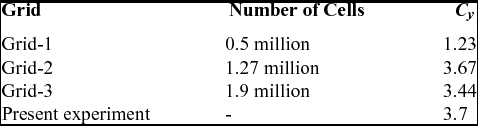
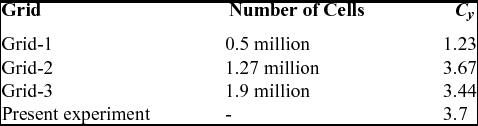
Laminar computations made with a grid of 1.27 × 10⁶ (arrived at after suitable grid independence test) indicated reasonably good agreement with the measured local side force as seen from Fig. 6. However, a difference of around 20% was observed in the overall side force. Therefore, computations were made adopting laminar flow up to a distance of 3.25 D from the tip (i.e. about 0.25 D ahead of the location of the ring) and the rest of flow was assumed to be turbulent. This approach indicated better agreement with the local side force and overall side force as seen from the results presented in Fig. 6 and Table 1. The possible reason for the better agreement of local as well as overall side forces could be that the Reynolds number increases along the length of the model and flow is likely to be turbulent downstream. The convergence history of the side force coefficient for the case of with and without a ring is shown in Fig. 7 indicates negligible or minor fluctuations in the side force with increased flow time. This is indicative of the presence of convective instability of the flow as reported in the literature. Moreover, the nonfluctuating side force after adoption of the ring also indicates that the ring disturbs only the vortex development and thereby causes the side force to decrease. Computations were made with different grids—Grid 1 (0.5 million), Grid 2 (1.27 million) and Grid 3 (1.9 million)—and adopting combined laminar and turbulent flow. The residuals of mass flow and momentum were monitored while the computation and results were analysed only after ascertaining that the residual of continuity has converged to the order of 10−4. The convergence history of overall side force on the slender body was monitored to ensure that it had attained a steady state. Overall side forces obtained with the above grids are shown in Table 1. The values obtained with Grid 2 and Grid 3 indicate reasonably good agreement with present experimental results and hence Grid 2 was used for further laminar-turbulent computations. Computations with the presence of a 5% ring indicated that at the angle-of-attack of 50°, the side force was in agreement within 7% with the corresponding measured value.
Comparison of measured and computed local side force at α = 50°.

Grid sensitivity study for slender body without ring
Convergence history of side force.

4.0 RESULTS
Figure 8 shows the comparison of the measured side force coefficients of the model without a ring at different angles of attack with the result of Lua et al(Reference Lua, Lim, Luo and Goh14), which indicates fairly good agreement for most of the cases. The side force experienced is negligible up to angles of attack of 20° and starts increasing with increase in the angle-of-attack. The maximum value is observed at an angle-of-attack of about 50°. Lua et al(Reference Lua, Lim, Luo and Goh14) have shown that adoption of a circular ring having a height of 5% of the local diameter leads to an appreciable reduction in the side force at angles of attack in the range of 20-40°. The present experiments performed using a similar model with and without a similar circular ring fixed at an axial location of X/D = 3.5 also indicated similar results. The differences observed between the measured and reported values could be due to the difference in the wind tunnel and/or finishing of the model. It could be seen that, in general, the side force has been reduced up to 40° due to the ring. However, it may also be noted that the side force has reversed its direction beyond the angle-of-attack of 40° due to the adoption of the ring. The variation of computed local side force coefficients for fully turbulent and laminar-turbulent cases along the length of the body obtained through the integration of pressure distribution in the circumference is shown in Fig. 9. It clearly indicates that the presence of ring modifies the flow in the X/D range of 2-8 only. For X/D > 8, the local side force remains almost unaffected. It indicates that the presence of ring must be modifying the flow, which changes the direction of the side force (see Fig. 8). The detailed reasoning for the reduction of the side force due to ring is discussed by Kumar and Prasad(Reference Kumar and Prasad18). Therefore, it is worthwhile to obtain the details of flow field on the slender body with a ring having different heights placed at the same axial distance that may lead us to arrive at a height such that the side force is reduced and also does not change its direction. It may be noted that the reversal of side-force direction will also call for the application of a control force in a reverse direction in practical cases, which may not be desirable. Hence, studies were made with rings of different heights.
Side force coefficient at different angles of attack.

Computed local side force coefficients with and without ring at α=50°.

The experiments were made with rings of different heights but placed at the axial location of X/D = 3.5. The measured side force is shown in Fig. 10. Reduction in the side force is observed in all the cases. Use of ring having a height of 1.25% has almost a similar trend to using no ring except that the magnitude of the side force is lower. It is observed that the range of angle-of-attack for which the side force is negligible has increased to 30°, which is 10° higher in comparison to the case without a ring. Further increase of height of ring does not change this angle. However, the increase in height to 2.5% and 3.5% has further reduced the side force in the angle-of-attack range of 35-50°. The side force experienced is very small in the angle-of-attack range of 45-50°. The reversal of the direction of side force is experienced with a ring having a height of 3.5%. However, its magnitude in a negative direction is much lower in comparison to the negative value observed for a ring having a height of 5%. This indicates that for the present configuration, the use of ring having a height in the range of 2.5% to 3.5% placed at the axial location of X/D=3.5 will lead to minimum side force at all angles of attack and flow conditions. To understand the basic mechanism behind the reduction in side force due to the ring, detailed investigations have been made at α = 50°, as it is observed that the value of side force is fairly large at this angle-of-attack over the body without a ring.
Effect of ring height on measured side force coefficients at different angles of attack.

Figure 11 shows the oil flow visualisation result observed on the leeward side of the slender body at α = 50° for cases without a ring and with a ring of different heights. The asymmetry in the flow in the no-ring case starts very close to the tip of the nose. The accumulated line (view from top) indicates the secondary separation line that changes its direction along the length of the model. It indicates that the leeward side of the body is dominated by asymmetric vortices depending on its strength in the left and right side of the body. With the inclusion of a 1.25% ring, the separation line was locally disturbed in the X/D range of 3.5-5, while further in the downstream direction, the pattern was almost similar to the no-ring case. Such local disturbances due to the presence of the ring might change the overall side force of the body. With the change in the height of ring, the asymmetry of vortices and switching over of the dominance of the vortices from left to right could be observed.
Oil flow visualisation at α = 50° for ring of different height.

The pressure distribution along the circumference at a few axial locations presented in Fig. 12 indicates the asymmetry of flow. The variation of local side force coefficient along the length of the model obtained from integration of such pressure distribution is presented in Fig. 13. It is observed that use of ring significantly influenced the local side force coefficient up to X/D = 8. Beyond this, the influence is marginal. It could be observed that the cyclic behaviour has almost similar having crest and trough occurring at an axial location within 0.5 times the diameter. The variation in the magnitude of peaks is more up to X/D = 8. Beyond this, the difference is not significant. It is also observed that the location of the zero side force is within 0.5 times diameter of the model. Similar behaviour of the local side force coefficient is also reported by Kumar and Prasad(Reference Kumar and Prasad18) for the cases of a 5% ring and no ring. The variation in the height of the ring clearly indicates that the change in the side force distribution is significantly dictated by the flow over the slender body till X/D = 8. Contribution to the side force from the body beyond X/D = 8 is not expected to be very significant. This indicates that any attempt to reduce the side force must be made in the front portion of the body to change the flow field up to X/D = 8, which could be effective in reducing the side force.
Computed pressure distributions with varying ring heights at α = 50°.

Local side forces with varying ring heights at α = 50°.

To obtain more insight of the prevailing flow field, the contours of vorticity magnitude at limited axial locations for different ring heights are shown in Fig. 14. This clearly indicates the change in direction of dominating vortices with a change in the height of the ring. As seen in Fig. 14, the presence of the ring seem to disturb the local flow field that restricts the growth of the left and right vortex LV2 and RV1 respectively along the axial direction. The increase in the height of the ring further delays the growth of vortices, due to which a sudden drop in the local side force is observed at X/D ≈ 3 onwards. The delayed growth of the left vortex LV2 dominates the flow on the leeward side at those locations, and the local side force further drops in comparison to the no-ring case as observed in Fig. 13. The flow could be better visualised with the streamlines in different cross flow planes presented in Fig. 15. The existence of the variety of possible flow fields (for example, the presence of separation bubbles, attachment and detachment points) could be clearly seen. It is noted that these vortices are due to cross-flow velocity at the different axial locations. However, the velocity component along the body will also influence the growth of the flow field in the longitudinal direction. There is the possibility of lifting off vortices from the surface due to prevailing pressure distribution along the longitudinal direction. Also, the movement of vortices is likely to take place at different azimuth angles. Similar flow features were also observed using the vectors of velocity magnitude at various cross-flow planes (Fig. 16). The difference in the flow field due to the ring can be well observed using the velocity vectors at X/D = 4, 5 and 6.
Vorticity contours with varying ring heights at α = 50°.

Streamlines with varying ring heights at α = 50°.

Vectors of velocity magnitude with varying ring heights at α = 50°.

An attempt was made to obtain the growth of vortices along the body as shown in Fig. 17. In the no-ring case, the asymmetry of the vortices starts from the apex itself, propagates further in the downstream direction and then lifts off. The presence of the ring at X/D = 3.5 affects the vortices downstream. Negligible effects are observed with a ring having a height of 1.25%. An increase in the ring height affects the both the left and right vortices. Contours of vorticity magnitude at different locations X/D = 4, 5, 6 and 7 indicate that an increase in the height of the ring delays the growth of second left vortex (LV2). These phenomena are qualitatively observed from the oil flow visualisation (Fig. 11). In addition, the presence of the ring also alters the vortex on the right side to some extent as seen from the vorticity magnitude contours. The delay in the formation of the left vortex (LV2) leads to the changes in the local side-force coefficients in the X/D range of 4-8, which is the main reason for the reduction in the overall side force. The local side-force coefficients and hence the overall side force are observed to be a function of the ring height. It was observed that the presence of ring altered the second left vortex (LV2), so an attempt was made to locate the circumferential location of the vortex core as presented in Fig. 18. It is clearly observed that wing rings of 3.5% and 5%, the appearance of the vortex (LV2) starts from X/D = 6, which is a clear indication of the delay in vortex formation in comparison to the no-ring case, whereas with a decrease in the height of ring, the circumferential location of the vortex core shifts towards the no-ring case.
Vorticity contours for rings of different heights at α = 50°.

Circumferential location of left vortex (LV2) with varying ring heights at α = 50°.

In order to obtain the contribution of different portions of the model towards the overall side force, the local side forces at different axial locations were integrated. Figure 19 shows the integrated side force along the length of the model. Using a 1.25% ring reduces the side force by almost 20%, which is further reduced with an increase in height of the ring. The location of the maximum side force is around X/D = 5; beyond this, it has an oscillatory nature. The oscillations are due to the reversal of the dominance of the vortices along the length of the model as discussed earlier. Without a reversal of direction, the side force is minimal with a ring of 2.5%. Use of a 3.5% ring leads to the small value of side force that has oscillations in both the directions. The overall side force experienced with different ring heights obtained through computation and experiments shown in Fig. 20 indicates that use of ring having a height of 3% will have a negligible side force for the present case. Although there is a difference in values obtained from computation and experiments, the trend seems to be similar. The presence of a ring changes the overall flow field and hence it is expected that drag and lift will also get affected. The change in the drag and lift on the body due to the presence of the ring shows a maximum change of about 2-5% in the values of drag and lift coefficient as seen from Fig. 21. This indicates that the presence of such rings will not significantly influence the lift and drag of the body for the present flow conditions.
Variation of the integrated side force (computed) with different ring heights at α = 50°.

Comparison of computed and measured overall side force with varying ring heights at α = 50°.

Effect of varying ring height on the lift and drag of the slender body at α=50°.

Investigations of the flow field were also done at different angles of attack using the measurement of the local side force coefficients shown in Fig. 22(a) and (b) at α = 45° and 40°, respectively. The results obtained clearly show the delay in the lift of vortices with the decrease in the angle of attack. It is well observed from the results that use of a ring at different angles of attack shifts the zero crossing of the side force upstream, similar to the case observed for α = 50°. This upstream shifting of the zero crossing of local side force is mainly responsible for the reduction in the side force. Computations were also made at different angles of attack and with varying ring heights that indicated reasonable agreement with the measured side force (Fig. 23(a) and (b)). However, details of all those results are not included in this paper. Further studies with different locations and sizes of the ring and speeds of incoming flow will give more understanding of the underlying mechanism of reduction and control of side force and could be of practical importance in the design of fighter aircraft and missiles.
Measured local side force coefficients at different angles of attack.

Comparison of measured and computed side force coefficients.

5.0 CONCLUSION
Experiments and computations were made to obtain the details of the flow field over a slender body at high angles of attack at a free stream velocity of 17 m/s corresponding to a Reynolds number of 2.9 × 10⁴ based on the base diameter. The effect due to the presence of a circular ring placed at a distance of 3.5 times the base diameter has been studied. It is observed that computations adopting a laminar-turbulent flow condition give results which are in better agreement with measured values. Detailed analysis of the flow was made using an angle-of-attack of 50°, as the side force observed at this angle-of-attack was fairly high. Experiments indicated the presence of asymmetric vortices on the leeward side of the body that are mainly responsible for the side force occurring on the body at high angles of attack. A sinusoidal behaviour of the local side force was observed along the body due the growth and lifting of the asymmetric vortices along the body. Computations and experiments indicated that use of a circular ring having a height of 3% placed at a distance of 3.5 times the base diameter on this slender body leads to minimum side force for the present flow condition. The use of such rings marginally affects the lift and drag of the body.