Among children undergoing paediatric congenital heart surgery, 10–20% experience 30-day unplanned hospital readmission and 4% of surgeries result in death.Reference Yang, Chen, Correa, Devine, Mathews and Honein 1 – Reference Knowles, Bull, Wren and Dezateux 4 Repeated hospitalisations among children place an emotional and financial burden on the patient’s family, as well as a strain on the health care system.Reference Mackie, Gauvreau, Newburger, Mayer and Erickson 5 To reduce unplanned readmission and mortality, prediction models have been developed to aid clinicians in identifying those at greatest risk of adverse events.Reference Kansagara, Englander and Salanitro 6 However, there has been little emphasis on the prediction of readmission or mortality following congenital heart surgery in children, particularly with an assessment of biomarkers compared to clinical models alone.Reference Tregay, Wray and Bull 7 , Reference Polineni, Parker and Alam 8
Two well-established biomarkers in the adult heart failure literature are soluble suppression of tumorgenicity 2 and N-terminal prohormone of brain natriuretic peptide.Reference Gaggin and Januzzi 9 Emerging data have supported the use of these biomarkers for diagnosis and monitoring for paediatric heart disease.Reference Fernandes, Maher and Deshpande 10 A paediatric heart transplant study found elevated soluble suppression of tumorgenicity 2 levels predicted episodes of acute rejection.Reference Mathews, Lott and Isse 11 Others have reported elevated soluble suppression of tumorgenicity 2 and N-terminal prohormone of brain natriuretic peptide levels predicted poor functional characteristics and clinical outcomes among children with idiopathic or heritable pulmonary arterial hypertension.Reference Chida, Sato and Shintani 12
Other biomarkers that may have additive predictive value include proteins galectin-3 and glial fibrillary acidic protein.Reference Yang and Wang 13 , Reference Dumic, Dabelic and Flogel 14 In adults, elevated galectin-3 was associated with an increased risk of cardiovascular-related hospitalisation or death.Reference Opotowsky, Baraona and Owumi 15 Recent studies have identified glial fibrillary acidic protein as an early marker of brain injury among children undergoing surgery for CHDs.Reference Magruder, Hibino and Collica 16 – Reference Vedovelli, Padalino and D’Aronco 18
Although these biomarkers are established in the adult population, research highlighting the ability of these biomarkers to predict readmission or mortality among children undergoing congenital heart surgery is limited. Therefore, the purpose of this study was to evaluate added predictive ability of novel biomarkers against clinical risk factors alone and 30-day unplanned readmission or mortality after paediatric congenital heart surgery.
Methods
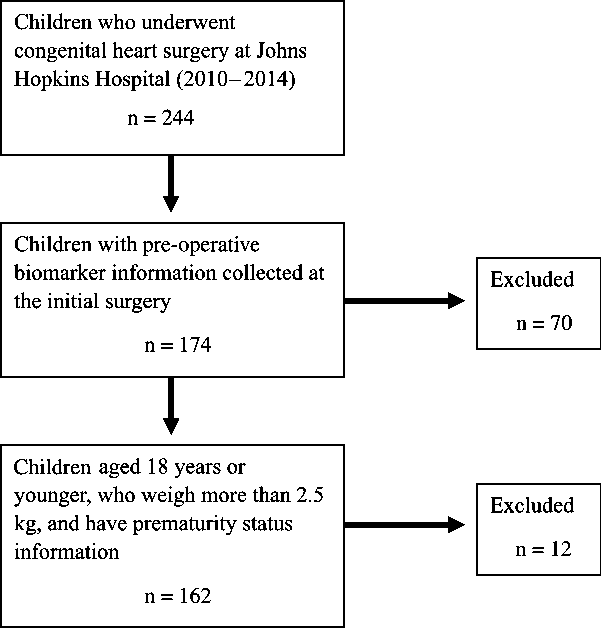
The current study analyses a prospective cohort of children who underwent congenital heart surgery at Johns Hopkins Hospital between 2010 and 2014 (n = 244). Children were excluded if they were >18 years of age (n = 9), weighted 2.5 kg or less at the time of birth (n = 1), had an unknown prematurity status (n = 2), or did not have pre-operative biomarkers collected (n = 70). The final cohort consisted of 162 children undergone congenital heart surgery (Fig 1).
Patient flow diagram for the final paediatric cohort (n = 162).

Patient, clinical, and outcome data were collected using a software platform that is approved by The Society of Thoracic Surgeons as being suitable for submission of data to The Society of Thoracic Surgeons Congenital Heart Surgery Database. Blood samples were collected immediately prior to surgery and at the end of bypass. Biomarkers were measured using Meso Scale Discovery as previously described.Reference Magruder, Hibino and Collica 16 , Reference Bembea, Savage and Strouse 19 – Reference Brown, Jacobs and Alam 25 Institutional Review Board approved this study for the prospective cohort with child/parental consent.
Outcome
The composite study endpoint was unplanned readmission or mortality within 30 days following discharge from the index surgical admission and verified via data linkage between state all-payers’ claims data, chart review, and the National Death Index using Social Security numbers and date of birth. Mortality included in-hospital mortality during the index surgical admission or mortality within 30 days after discharge from the surgical admission. Readmissions were defined as the first unplanned admission within 30 days of an index hospitalisation where the congenital heart surgery occurred.
Predictive models
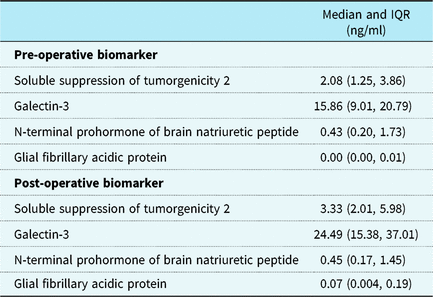
We developed three predictive models. The first was a clinical risk model adapted from The Society of Thoracic Surgeons Congenital Heart Surgery Database Mortality Risk Model.Reference O’Brien, Jacobs and Pasquali 26 A backwards stepwise regression model included cardiopulmonary bypass time, any pre-operative risk factor, STAT mortality category, prior cardiothoracic operation, and any major complication. The second model was an augmented clinical risk model with the addition of pre-operative galectin-3, soluble suppression of tumorgenicity 2, N-terminal prohormone of brain natriuretic peptide, and glial fibrillary acidic protein. The third model was an augmented clinical risk model with the addition of a pre- and post-operative galectin-3, soluble suppression of tumorgenicity 2, N-terminal prohormone of brain natriuretic peptide, and glial fibrillary acidic protein. Biomarker ranges are outlined in Table 1.
Pre- and post-operative biomarker means and ranges

IQR = Interquartile range; ng/ml = nanogram/milliliter
Statistical analysis
Descriptive statistics and univariate analyses were used to describe the sample and compare patient and clinical characteristics by 30-day readmission or mortality. Multi-variate logistic regression and the area under the receiver-operating characteristics curveReference Hajian-Tilaki 27 , Reference Cook and Ridker 28 were utilised to explore variables to be included in the models. The two models were evaluated via area under the receiver-operating characteristics curve, net reclassification improvement, and integrated discrimination improvement analyses.Reference Pencina, D’Agostino, Pencina, Janssens and Greenland 29 , Reference Cook and Paynter 30 The discriminating ability of the regression model was determined by the area under the receiver-operating characteristics curve and bootstrap to calculate 95% confidence interval’s around the receiver-operating characteristics curve.Reference Hanley and McNeil 31 , Reference Efron and Tibshirani 32 See online supplement for detailed methods.
Results
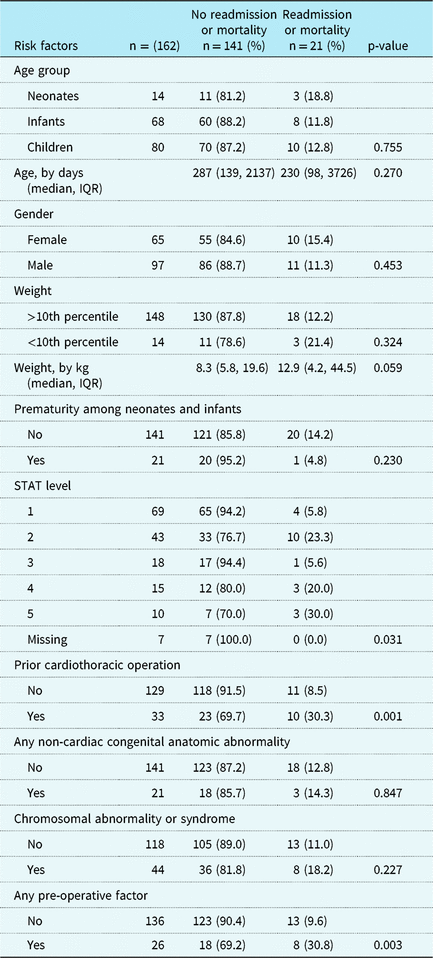
There were 162 children included in this study (Table 2), 8.6% (n = 14) were neonates, 42.0% (n = 68) were infants, and 49.4% (n = 80) were children aged 1–18 years. Unplanned readmission or mortality at 30 days occurred in 21 children and had a significantly higher likelihood of having a prior cardiothoracic operation, any pre-operative factor, and higher STAT category (Table 2).
Children and procedural characteristics by readmission or mortality status (n = 162)

IQR = Interquartile range
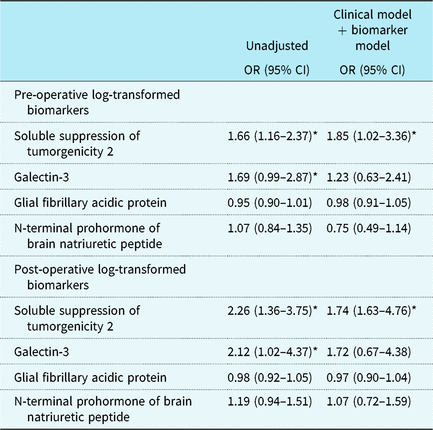
The association of biomarkers and readmission or mortality is described in Table 3. The odds of experiencing 30-day hospital readmission or mortality increased by 66% with each additional unit increase in pre-operative log-transformed soluble suppression of tumorgenicity 2 (unadjusted odds ratio: 1.66; 95% confidence interval: 1.16–2.37). After adjusting for covariates based on The Society of Thoracic Surgeons mortality risk model, the odds of readmission or mortality increased by 85% with each additional unit increase in pre-operative log-transformed soluble suppression of tumorgenicity 2 (adjusted odds ratio: 1.85; 95% confidence interval: 1.02–3.36).
Pre- and post-operative biomarker panel to predict 30-day readmission or mortality after paediatric congenital heart surgery

CI = confidence interval; OR = odds ratio
* p-value < 0.05
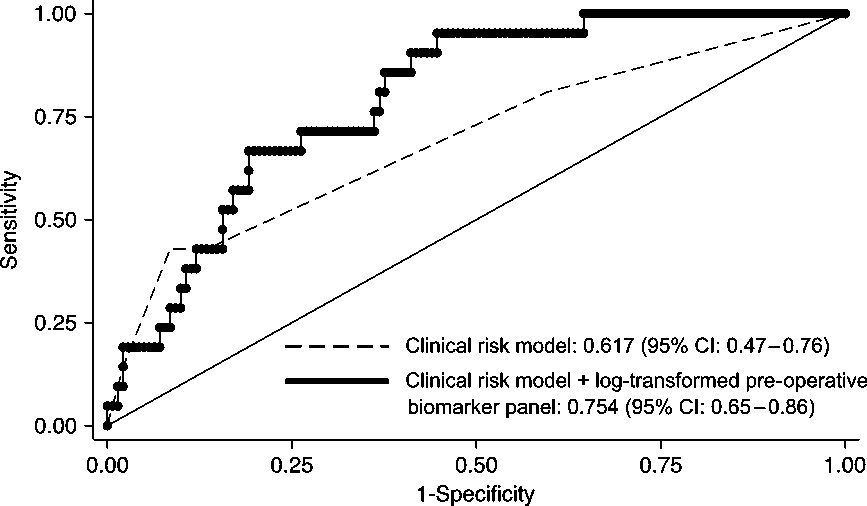
Figure 2 illustrates the added statistically significant predictive value of pre-operative log-transformed biomarker model (receiver-operating characteristics curve of 0.754; 95% confidence interval: 0.65–0.86) compared to the clinical model alone (receiver-operating characteristics curve: 0.617; 95% confidence interval 0.47–0.76; p = 0.012). This finding suggests the biomarkers significantly improve the ability to discriminate between children with and without readmission or mortality at 30 days. The added predictive value of pre-operative biomarkers was supported by a net reclassification improvement of 0.056 (p-value: 0.648) and integrated discrimination improvement of 0.0571 (p-value: 0.007) results.
Area under the receiver-operating characteristics curve for the clinical risk model with and without pre-operative log-transformed biomarkers. CI=confidence interval.

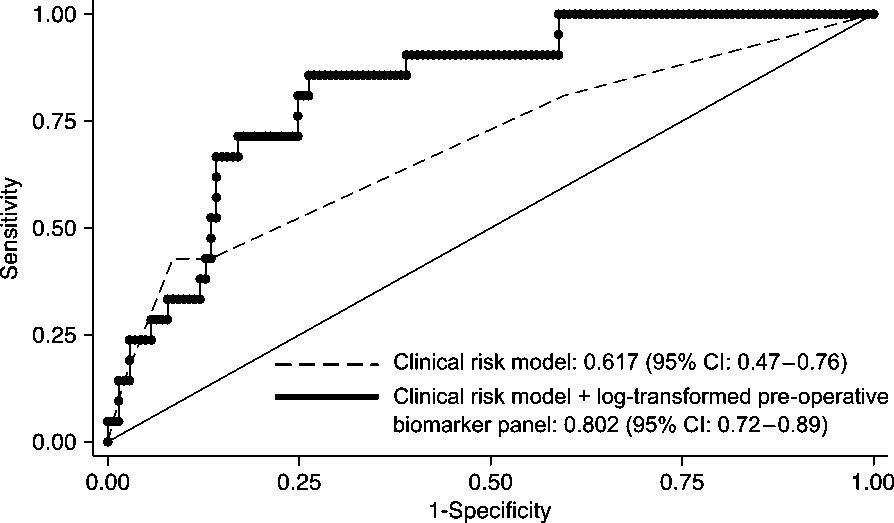
Figure 3 illustrates the added predictive value of pre- and post-operative log-transformed biomarkers with an area under the receiver-operating characteristics curve of 0.802 (95% confidence interval: 0.72–0.89) compared to the clinical model alone (p = 0.003), demonstrating inclusion of both pre- and post-operative biomarkers further improves discrimination between children with and without 30-day readmission or mortality. The added predictive value of pre- and post-operative biomarkers resulted in a net reclassification improvement of 0.097 (p-value: 0.467) and integrated discrimination improvement of 0.082 (p-value: <0.001).
Area under the receiver-operating characteristics curve for the clinical risk model with and without pre- and post-operative log-transformed biomarkers. CI=confidence interval.

Discussion
We are the first to report that biomarkers have the potential to improve risk prediction for 30-day readmission or mortality following paediatric congenital heart surgery. The addition of novel and clinically available biomarkers resulted in a statistically significant improvement in the performance of predictive models from receiver-operating characteristics curve value of 0.617–0.802 (p = 0.003).
Pre- and post-operative log-transformed soluble suppressions of tumorgenicity 2 and galectin-3 were associated with 30-day unplanned readmission or mortality after paediatric congenital heart surgery. After adjusting for clinical characteristics and the novel pre-operative biomarker panel, pre-operative soluble suppression of tumorgenicity 2 remained significantly associated with 30-day readmission or mortality. Therefore, pre-operative soluble suppression of tumorgenicity 2 values may be used to improve pre-emptive identification of children at greatest risk of 30-day hospital readmission or mortality following congenital heart surgery. An improved understanding of a child’s statistically estimated risk of readmission or mortality can be helpful when determining the appropriate timing of surgery, surgical alternatives, tailored operative care, or hospital discharge approaches.
Soluble suppressions of tumorgenicity 2 and galectin-3 are cardiac biomarkers indicative of myocardial fibrosis and remodeling.Reference Meeusen, Johnson and Gray 33 These are well-established biomarkers in the adult heart failure literature that have shown to be predictive of hospitalisation and mortality.Reference Tang, Shrestha and Shao 34 – Reference Yancy, Jessup and Bozkurt 36 However, research to support the paediatric application of soluble suppression of tumorgenicity 2 and galectin-3 is limited. Soluble suppression of tumorgenicity 2 has been linked with acute rejection after the heart transplantation in children, as well as functional class among children with idiopathic or primary pulmonary hypertension.Reference Mathews, Lott and Isse 11 , Reference Chida, Sato and Shintani 12 Determination of normative soluble suppression of tumorgenicity 2 levels for children with CHD, as well as patient and clinical care factors responsible for soluble suppression of tumorgenicity 2 elevations are needed. Mohammed and colleagues found elevated galectin-3 levels to be associated with the presence of heart failure in children with CHD.Reference Mohammed, Gafar and Hussien 37 Galectin-3 levels have also been shown to differ between Ross heart failure classes, and ventricular size and function.Reference Mohammed, Gafar and Hussien 37 A greater understanding of the role of galectin-3 among children who underwent paediatric congenital heart surgery is needed.
Although N-terminal prohormone of brain natriuretic peptide is a well-established adult cardiac biomarker, it was not associated with 30-day unplanned readmission or death in this study. This is an important finding as the use of biomarkers for the assessment and management of morbidity in adults might not translate directly to children. This could be due to heart structural differences, growth and development influence on biomarker assessment, and differences in the pathogenesis of diseases.Reference Goldman, Becker, Jones, Clements and Leeder 38 Although N-terminal prohormone of brain natriuretic peptide has been shown to be associated with paediatric diagnosis of CHD and more complex cardiac defects, less is known about N-terminal prohormone of brain natriuretic peptide with unplanned repeated hospitalisations.Reference Cantinotti, Passino, Storti, Ripoli, Zyw and Clerico 39 , Reference Holmgren, Westerlind, Lundberg and Wahlander 40 In contrast, glial fibrillary acidic protein has been shown to be beneficial in identifying and monitoring brain injury during cardiac surgery.Reference Magruder, Hibino and Collica 16 Although related to many important poor outcomes,Reference Opotowsky, Baraona and Owumi 15 , Reference Vedovelli, Padalino and D’Aronco 18 it might not be, as indicated from the current study, associated with paediatric unplanned readmission or mortality.
There are increasing efforts to identify children at increased risk of readmission following congenital heart surgery.Reference Chave and Marques-Vidal 41 – Reference Parker, Everett and Stabler 48 Kogon and colleagues identified ethnicity, pre-operative failure to thrive, and post-operative length of stay as significant predictors of readmission.Reference Kogon, Jain, Oster, Woodall, Kanter and Kirshbom 2 Others reported arrhythmia, post-pericardiotomy syndrome, and infectious complications were the most common readmission diagnoses,Reference Parker, Everett and Stabler 46 or they found infectious complications to be a common readmission diagnosis in children who had previously undergone Norwood palliation for hypoplastic left heart syndrome.Reference Parker, Everett and Stabler 47 The most common variables used to determine the risk of adverse outcomes following paediatric congenital heart surgery are based on the estimated risk of mortality following surgery, as defined by The Society of Thoracic Surgeons Congenital Heart Surgery Database Mortality Risk Model. In addition to clinical data, our study demonstrates that adding biomarkers to paediatric CHD risk models significantly improves the prediction of readmission and mortality.
There are several limitations to consider. We initially applied covariates from the contemporary version of The Society of Thoracic Surgeons Congenital Heart Surgery Database Mortality Risk Model in our risk adjustment.Reference O’Brien, Jacobs and Pasquali 26 , Reference Parker, Everett and Stabler 48 Due to the limited number of events in our cohort, we were unable to adjust for all covariates and elected to perform a backwards stepwise regression model informed by The Society of Thoracic Surgeons Congenital Heart Surgery Database mortality risk model. Second, the occurrence of our composite endpoint was dominated by readmission, which occurred more frequenty than mortality. The relatively small proportion of patients with our combined endpoint after congenital heart surgery may have obscured some of the statistical associations between the biomarkers and our model covariates. In addition, a larger sample size would have improved our power to assess the performance of the biomarkers in the pre-operative setting. Third, we included only patients for whom both pre- and post-operative samples had been collected. It is possible that this approach may lead to sampling bias if biomarker collection was associated with CHD severity. Finally, this is single-center prospective study where the study population could be more homogeneous than a multi-center study.
Our findings indicate that these biomarkers can be used for the early identification of children at increased risk of readmission or death after paediatric congenital heart surgery. The addition of biomarkers significantly improves discrimination of a clinical model to predict readmission or mortality following paediatric congenital heart surgery. Clinical application of novel biomarkers may be helpful when determining the appropriate timing of surgery, surgical alternatives, operative care approaches, and/or readiness for hospital discharge. In addition to these clinical applications, our findings can inform future research determining patient and clinical care factors responsible for elevated levels of cardiac biomarkers.
Acknowledgements
None.
Financial Support
This research is supported by the National Heart Lung and Blood Institute R01HL119664 (PI: Brown). All authors are research staff or investigators on the grant.
Conflicts of Interest
None.
Supplementary material
To view supplementary material for this article, please visit https://doi.org/10.1017/S1047951119001471.