Significant Outcomes
A systematic literature search identified eight original studies investigating the interaction between genetic variations in eight genes involved in the HPA-axis and SLE in depression. Gene–environment interactions may partly explain why some people react differently to stress than others.
Our results suggest that three genes (FKBP5, CRH, and CRHR1) in the HPA-axis possibly moderate the effects of stressful life events in depression. FKBP5 was the most prevalent gene, and rs1360780 was the best studied polymorphism.
No gene–environment interactions were found, and little research was available for five other genes involved in the HPA-axis (ACE, AVP, CRHR2, NR3C1, and NR3C2).
Limitations
Despite following the recommended guidelines for systematic reviews, relevant literature may have been missed.
The included gene–environment interaction studies are based on candidate gene studies. This approach is hypothesis-driven, resulting in selection bias.
Future research in this field will likely shift from candidate gene interaction studies towards genome-wide environment interaction studies, with a systematic characterisation of multiple environmental factors in large samples.
Introduction
Depression is a significant cause of morbidity in today’s society, with a total of 322 million people suffering from the disorder worldwide (Depression – Fact Sheet, 2017, World Health Organization, 2017). The proportion of the global population living with depression is estimated to be 4.4%, and is more common in females (5.1%) than in men (3.6%) (World Health Organization, 2017). This disorder has a modest heritability of 30–40% (Bigdeli et al., Reference Bigdeli, Ripke, Peterson, Trzaskowski, Bakanu and Abdellaoui2017), and is complex since the aetiology is caused by an interplay between genetic and environmental factors (Sullivan et al., Reference Sullivan, Neale and Kendler2000). Gene–environment (G × E) interactions suggest that genes can control an individual’s sensitivity to environmental exposures (Assary et al., Reference Assary, Vincent, Keers and Pluess2017), and may therefore partly explain why some individuals react differently to stress compared to others. Especially childhood maltreatment (CM) and stressful life events (SLEs) have drawn attention in previous depression research (Heim & Nemeroff, Reference Heim and Nemeroff2001, Heim et al., Reference Heim, Plotsky and Nemeroff2004, Harkness et al., Reference Harkness, Bruce and Lumley2006, Pariante & Lightman, Reference Pariante and Lightman2008, Zimmermann et al., Reference Zimmermann, Bruckl, Nocon, Pfister, Binder and Uhr2011, Ulrike, Reference Ulrike2013, Peyrot et al., Reference Peyrot, Milaneschi, Abdellaoui, Sullivan, Hottenga and Boomsma2014, Mazurka et al., Reference Mazurka, Wynne-Edwards and Harkness2015). SLE is the object of exposure in this review.
Hypothalamic–pituitary–adrenal axis
The hypothalamic–pituitary–adrenal (HPA) axis represents the major neuroendocrine stress response system (Heim et al., Reference Heim, Newport, Mletzko, Miller and Nemeroff2008) and has shown to be hyperactive in depression (Aborelius et al., Reference Aborelius, Owens, Ploysky and Nemeroff1999, Bremmer et al., Reference Bremmer, Deeg, Beekman, Pennix, Lips and Hoogendijk2007). According to the diathesis-stress model, individuals carrying certain genetic risk variants (in genes involved in the HPA-axis) are more vulnerable to the effects of environmental adversity, making them more susceptible to develop psychiatric disorders (Monroe, Reference Monroe1991, Mazurka et al., Reference Mazurka, Wynne-Edwards and Harkness2015). The role of HPA-axis genes in different stress conditions (e.g. SLE or CM) has also been supported by a vast amount of non-clinical data (Meaney et al., Reference Meaney and Weaver2005, Sanchez, Reference Sanchez2006, Gillespie et al., Reference Gillespie, Phifer, Bradley and Ressler2009, Rogers et al., Reference Rogers, Raveendran, Fawcett, Fox, Shelton and Oler2013, Matosin et al., Reference Matosin, Halldorsdottir and Binder2018).
Corticotrophin releasing hormone (CRH) and arginine vasopressin (AVP) are secreted from the hypothalamus in response to stress. These hormones activate the anterior pituitary to secretion of adrenocorticotropic hormone (ACTH), which subsequently stimulates the adrenal cortex to production of corticosteroids (mainly cortisol in humans) (Van Bodegom et al., Reference Van Bodegom, Homberg and Henckens2017).
CRH mediates its effect on its receptor, CRHR1, and to a lesser extent, CRHR2. Corticosteroids bind to glucocorticoid receptors (GR, NR3C1) and mineralocorticoid receptors (MR, NR3C2) in a negative feedback loop. The sensitivity of the glucocorticoid receptor is regulated by FK506-binding protein (FKBP5) (Van Bodegom et al., Reference Van Bodegom, Homberg and Henckens2017), which decreases the GRs affinity for cortisol (Binder, Reference Binder2009).
The angiotensin converting enzyme (ACE) converts angiotensin 1 into active angiotensin 2, thus playing an essential role in the renin–angiotensin system, in upregulating blood pressure. Several studies have established a relationship between the angiotensin system and the stress response, and angiotensin 2 has previously been linked to regulation of the HPA-axis (Aguilera et al., Reference Aguilera, Alexander, Luo and Akbasak1995, Armando et al., Reference Armando, Volpi, Aguilera and Saavedra2007, Dempster et al., Reference Dempster, Burcesu, Wigg, Kiss, Baji and Gadoros2009). The ACE gene is therefore also included in this review.
We hypothesised that genes in the HPA-axis moderate an individual’s sensitivity to SLE in depression. Further understanding of the psychopathology of depression, and identification of genetic risk factors and their interaction with environmental factors, will most likely ease diagnosis and treatment of the disorder, which obviously is of great clinical importance. Thus, this study aimed to identify original studies investigating the interaction between genetic variations in eight genes involved in the HPA-axis and SLE in depression.
Methods
Following the recommended guidelines (Welch et al., Reference Welch, Petticrew and Tugwell2012), a systematic literature search was conducted, using the Pubmed, Embase, and PsychINFO databases. The searches were performed on 2018/06/18. Initially, keywords were combined covering the selected genes involved in the HPA-axis, SLE, and depression: ((((((“Gene-Environment Interaction” [MeSH]) OR (“Genetic predisposition to disease” [MeSH]) OR (HPA-axis) OR (“Polymorphism, Single Nucleotide “[MeSH]))) AND ((AVP OR ACE OR CRH OR CHRH1 OR CRHR2 OR NR3C2 OR NR3C1 OR FKBP5))) AND ((((Negative life events OR Stressful life events OR Life change events[MeSH))])) AND ((((mood disorders[MeSH]) OR (affect[MeSH]) OR depression) OR depressive disorder*). Filters: Publication date from 2000/01/01 to 2018/06/18.
Furthermore, in order to be certain that all relevant papers were detected, an individual search for each gene was conducted, using the gene name in abbreviation and spell out forms.
Initially, titles and abstracts were screened, and subsequently full-text versions of relevant records were evaluated. Furthermore, reference lists from these were scanned, in order to identify further eligible articles.
We included articles that addressed at least one of the eight genes involved in the HPA-axis, and considered G × E interactions with SLE as exposition in depression. Other inclusion criteria were that it had to be original research, published in a peer-reviewed journal in English, and be human studies.
From each included study, we extracted information on author, year of publication, gene, genetic variants, number of samples (cases/controls), exposure, assessment of exposure, assessment of depression severity, study design, outcome assessment, major findings, and p values.
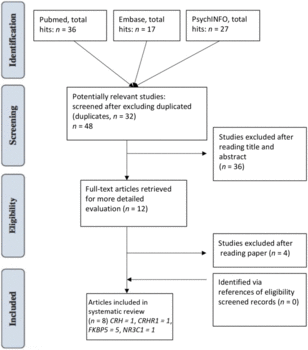
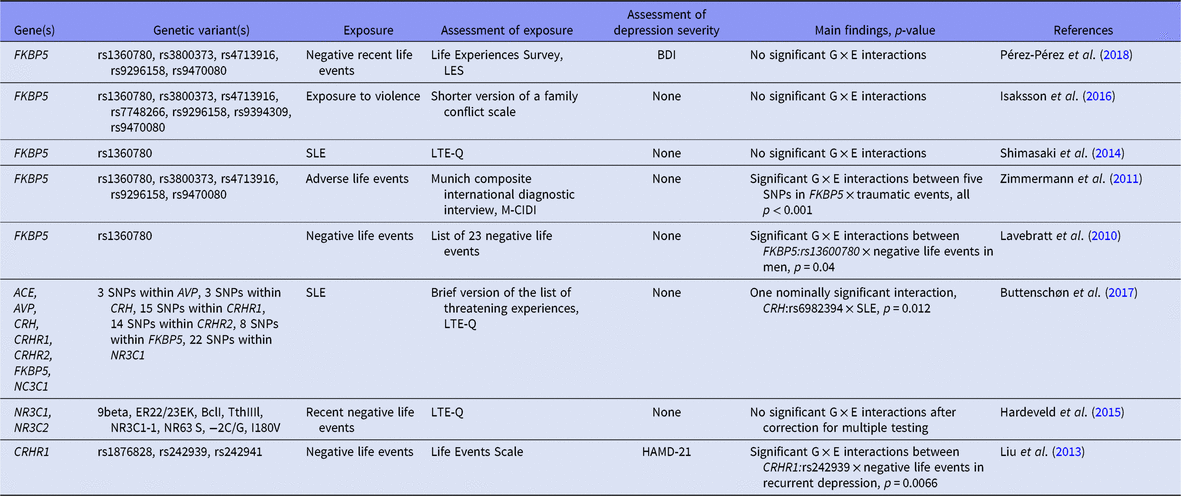
After excluding duplicates (n = 32), the literature search yielded 48 potentially relevant studies. Of these, 31 were not relevant to the main objective, three were not primary research, and two were not human studies. Following full-text evaluation of the remaining 12 studies, further four studies were excluded. Thus, eight articles were included in the final review (see PRISMA flowchart in Fig. 1). The extracted information from each study is presented in Table 2. Eligibility assessment was performed independently by two reviewers (CN and HNB), and any disagreements were resolved through discussion.
PRISMA Flowchart illustrating the literature search with identification, screening, eligibility and inclusion of final papers.

Population characteristics of the eight included articles

Studies examining the effects of GxE interactions between HPA-axis genes and SLE in depression

Results
A pooled total of 9,802 participants were analysed in eight studies, consisting of four different study types. A total of 5,327 participants were analysed in case–control studies (Lavebratt et al., Reference Lavebratt, Aberg, Sjöholm and Forsell2010, Liu et al., Reference Liu, Liu, Yao, Yang, Xiao and Wan2013, Shimasaki et al., Reference Shimasaki, Kondo, Saito, Esaki, Otsuka and Mano2014, Hardeveld et al., Reference Hardeveld, Spijker, Peyrot, De Graaf, Hendriks and Nolen2015, Buttenschøn et al., Reference Buttenschøn, Krogh, Nielsen, Kaerlev, Nordentoft and Mors2017), 3,505 in cross-sectional studies (Isaksson et al., Reference Isaksson, Comasco, Åslund, Rehn, Tuvblad and Andershed2016), and 970 in cohort studies (Zimmermann et al., Reference Zimmermann, Bruckl, Nocon, Pfister, Binder and Uhr2011, Pérez-Pérez et al., Reference Pérez-Pérez, Cristóbal-Narváez, Sheinbaum, Kwapil, Ballespí and Peña2018). Moreover, the studies varied considerably in sample sizes, and included from 86 to 3,505 participants. Table 1 depicts the population characteristics.
A total of 97 SNPs were examined in the eight included studies, hereof three SNPs in CRH, 16 SNPs in CRHR1, 14 SNPs in CRHR2, 26 SNPs in FKBP5, 26 SNPs in NR3C1, two SNPs in NR3C2, eight SNPs in ACE, and two SNPs in AVP. The most prevalent SNP was FKBP5:rs1360780, which was investigated in five studies (Lavebratt et al., Reference Lavebratt, Aberg, Sjöholm and Forsell2010, Zimmermann et al., Reference Zimmermann, Bruckl, Nocon, Pfister, Binder and Uhr2011, Shimasaki et al., Reference Shimasaki, Kondo, Saito, Esaki, Otsuka and Mano2014, Isaksson et al., Reference Isaksson, Comasco, Åslund, Rehn, Tuvblad and Andershed2016, Pérez-Pérez et al., Reference Pérez-Pérez, Cristóbal-Narváez, Sheinbaum, Kwapil, Ballespí and Peña2018). In FKBP5, only one study (Lavebratt et al., Reference Lavebratt, Aberg, Sjöholm and Forsell2010) made gender-specific G × E interaction analyses and reported a difference.
Exposure to SLE was assessed through different questionnaires. The LTE-Q was used in three studies (Shimasaki et al., Reference Shimasaki, Kondo, Saito, Esaki, Otsuka and Mano2014, Hardeveld et al., Reference Hardeveld, Spijker, Peyrot, De Graaf, Hendriks and Nolen2015, Buttenschøn et al., Reference Buttenschøn, Krogh, Nielsen, Kaerlev, Nordentoft and Mors2017), otherwise different lists of traumatic events were utilised (Lavebratt et al., Reference Lavebratt, Aberg, Sjöholm and Forsell2010, Liu et al., Reference Liu, Liu, Yao, Yang, Xiao and Wan2013, Isaksson et al., Reference Isaksson, Comasco, Åslund, Rehn, Tuvblad and Andershed2016, Pérez-Pérez et al., Reference Pérez-Pérez, Cristóbal-Narváez, Sheinbaum, Kwapil, Ballespí and Peña2018). One study (Zimmermann et al., Reference Zimmermann, Bruckl, Nocon, Pfister, Binder and Uhr2011) applied a diagnostic interview.
Outcome was assessed either by self-rating questionnaires on depression [Major Depression Inventory (Lavebratt et al., Reference Lavebratt, Aberg, Sjöholm and Forsell2010, Buttenschøn et al., Reference Buttenschøn, Krogh, Nielsen, Kaerlev, Nordentoft and Mors2017), Hospital Anxiety and Depression Scale (Isaksson et al., Reference Isaksson, Comasco, Åslund, Rehn, Tuvblad and Andershed2016), Depression Self Rating Scale (Isaksson et al., Reference Isaksson, Comasco, Åslund, Rehn, Tuvblad and Andershed2016), Beck Depressive Inventory (BDI) (Shimasaki et al., Reference Shimasaki, Kondo, Saito, Esaki, Otsuka and Mano2014, Pérez-Pérez et al., Reference Pérez-Pérez, Cristóbal-Narváez, Sheinbaum, Kwapil, Ballespí and Peña2018)], or diagnostic interviews [M– CIDI (Zimmermann et al., Reference Zimmermann, Bruckl, Nocon, Pfister, Binder and Uhr2011), CIDI (Reed et al., Reference Reed, Franz, Pfister, Steiger, Sonntag and Trenkwalder1998, Hardeveld et al., Reference Hardeveld, Spijker, Peyrot, De Graaf, Hendriks and Nolen2015), SCID-I (First Michael et al., Reference First Michael, Williams Janet, Robert, Gibbon and Williams1995, Liu et al., Reference Liu, Liu, Yao, Yang, Xiao and Wan2013), and SCAN (Wing et al., Reference Wing, Sartorius and Üstün1998, Buttenschøn et al., Reference Buttenschøn, Krogh, Nielsen, Kaerlev, Nordentoft and Mors2017)]. All participants were of Caucasian origin, beside two studies (Liu et al., Reference Liu, Liu, Yao, Yang, Xiao and Wan2013, Shimasaki et al., Reference Shimasaki, Kondo, Saito, Esaki, Otsuka and Mano2014), which included Asian subjects.
Two (Liu et al., Reference Liu, Liu, Yao, Yang, Xiao and Wan2013, Pérez-Pérez et al., Reference Pérez-Pérez, Cristóbal-Narváez, Sheinbaum, Kwapil, Ballespí and Peña2018) studies assessed depression severity, using the Hamilton Depression Rating Scale 21-Item (HAMD-21) (Hamilton, Reference Hamilton1967) scale and BDI (Beck et al., Reference Beck2018) mean score.
Finally, many of the studies were adjusted for multiple testing using a Bonferroni correction (Zimmermann et al., Reference Zimmermann, Bruckl, Nocon, Pfister, Binder and Uhr2011, Liu et al., Reference Liu, Liu, Yao, Yang, Xiao and Wan2013, Shimasaki et al., Reference Shimasaki, Kondo, Saito, Esaki, Otsuka and Mano2014, Hardeveld et al., Reference Hardeveld, Spijker, Peyrot, De Graaf, Hendriks and Nolen2015, Isaksson et al., Reference Isaksson, Comasco, Åslund, Rehn, Tuvblad and Andershed2016) in order to counteract the problem of multiple comparisons. Only three studies (Lavebratt et al., Reference Lavebratt, Aberg, Sjöholm and Forsell2010, Buttenschøn et al., Reference Buttenschøn, Krogh, Nielsen, Kaerlev, Nordentoft and Mors2017, Pérez-Pérez et al., Reference Pérez-Pérez, Cristóbal-Narváez, Sheinbaum, Kwapil, Ballespí and Peña2018) did not apply this correction.
FKBP5
Six studies (Lavebratt et al., Reference Lavebratt, Aberg, Sjöholm and Forsell2010, Zimmermann et al., Reference Zimmermann, Bruckl, Nocon, Pfister, Binder and Uhr2011, Shimasaki et al., Reference Shimasaki, Kondo, Saito, Esaki, Otsuka and Mano2014, Isaksson et al., Reference Isaksson, Comasco, Åslund, Rehn, Tuvblad and Andershed2016, Buttenschøn et al., Reference Buttenschøn, Krogh, Nielsen, Kaerlev, Nordentoft and Mors2017, Pérez-Pérez et al., Reference Pérez-Pérez, Cristóbal-Narváez, Sheinbaum, Kwapil, Ballespí and Peña2018) investigated the interaction between variants in FKBP5 and SLE. The most prevalent SNP was FKBP5:rs1360780, hence represented in five studies (Lavebratt et al., Reference Lavebratt, Aberg, Sjöholm and Forsell2010, Zimmermann et al., Reference Zimmermann, Bruckl, Nocon, Pfister, Binder and Uhr2011; Shimasaki et al., Reference Shimasaki, Kondo, Saito, Esaki, Otsuka and Mano2014, Isaksson et al., Reference Isaksson, Comasco, Åslund, Rehn, Tuvblad and Andershed2016, Pérez-Pérez et al., Reference Pérez-Pérez, Cristóbal-Narváez, Sheinbaum, Kwapil, Ballespí and Peña2018). Two studies (Lavebratt et al., Reference Lavebratt, Aberg, Sjöholm and Forsell2010; Zimmermann et al., Reference Zimmermann, Bruckl, Nocon, Pfister, Binder and Uhr2011) reported an interaction between rs1360780 and SLE in depression, whereas three (Shimasaki et al., Reference Shimasaki, Kondo, Saito, Esaki, Otsuka and Mano2014, Isaksson et al., Reference Isaksson, Comasco, Åslund, Rehn, Tuvblad and Andershed2016, Pérez-Pérez et al., Reference Pérez-Pérez, Cristóbal-Narváez, Sheinbaum, Kwapil, Ballespí and Peña2018) did not find a significant interaction. Zimmermann et al. (Reference Zimmermann, Bruckl, Nocon, Pfister, Binder and Uhr2011) found interactions between five SNPs and traumatic events in the onset of depression. Lavebratt et al. (Reference Lavebratt, Aberg, Sjöholm and Forsell2010) found an association between depression and the T allele and TT genotype of FKBP5:rs1360780 given negative life events in men, but not in the combined sample of men and women. However, in one study (Isaksson et al., Reference Isaksson, Comasco, Åslund, Rehn, Tuvblad and Andershed2016), p values were close to significant (p < 0.001, yet only p < 0.004 would be considered significant after correction for multiple testing).
Furthermore, 12 SNPs in FKBP5 (rs9470080, rs9394309, rs9380524, rs9366890, rs9296158, rs7748266, rs4713916, rs4713902, rs3800373, rs17614642, rs13192954, and rs10498734) were examined (Zimmermann et al., Reference Zimmermann, Bruckl, Nocon, Pfister, Binder and Uhr2011, Isaksson et al., Reference Isaksson, Comasco, Åslund, Rehn, Tuvblad and Andershed2016, Buttenschøn et al., Reference Buttenschøn, Krogh, Nielsen, Kaerlev, Nordentoft and Mors2017, Pérez-Pérez et al., Reference Pérez-Pérez, Cristóbal-Narváez, Sheinbaum, Kwapil, Ballespí and Peña2018). Three studies (Isaksson et al., Reference Isaksson, Comasco, Åslund, Rehn, Tuvblad and Andershed2016, Buttenschøn et al., Reference Buttenschøn, Krogh, Nielsen, Kaerlev, Nordentoft and Mors2017, Pérez-Pérez et al., Reference Pérez-Pérez, Cristóbal-Narváez, Sheinbaum, Kwapil, Ballespí and Peña2018) did not find significant G × E interactions between five SNPs and SLE, whereas another study (Zimmermann et al., Reference Zimmermann, Bruckl, Nocon, Pfister, Binder and Uhr2011) reported significant interactions.
Remaining genes
The remaining genes were only investigated to a limited extent. One study (Buttenschøn et al., Reference Buttenschøn, Krogh, Nielsen, Kaerlev, Nordentoft and Mors2017) reported a nominally significant interaction between CRH:rs6982394 and SLE.
Another study (Liu et al., Reference Liu, Liu, Yao, Yang, Xiao and Wan2013) found an interaction between CRHR1:rs242939 and SLE in adult recurrent depression, but found no interaction between rs1876828, rs242941, and SLE, respectively. This gene was also investigated by Buttenschøn et al. (Reference Buttenschøn, Krogh, Nielsen, Kaerlev, Nordentoft and Mors2017), who did not find significant interactions between SNPs in CRHR1 and SLE.
No significant G × E interactions were found for ACE (Buttenschøn et al., Reference Buttenschøn, Krogh, Nielsen, Kaerlev, Nordentoft and Mors2017), AVP (Buttenschøn et al., Reference Buttenschøn, Krogh, Nielsen, Kaerlev, Nordentoft and Mors2017), CRHR2 (Buttenschøn et al., Reference Buttenschøn, Krogh, Nielsen, Kaerlev, Nordentoft and Mors2017), NR3C1 (Hardeveld et al., Reference Hardeveld, Spijker, Peyrot, De Graaf, Hendriks and Nolen2015, Buttenschøn et al., Reference Buttenschøn, Krogh, Nielsen, Kaerlev, Nordentoft and Mors2017), or NR3C2 (Hardeveld et al., Reference Hardeveld, Spijker, Peyrot, De Graaf, Hendriks and Nolen2015). However, G × E interactions for these five genes were investigated in two studies only (Hardeveld et al., Reference Hardeveld, Spijker, Peyrot, De Graaf, Hendriks and Nolen2015, Buttenschøn et al., Reference Buttenschøn, Krogh, Nielsen, Kaerlev, Nordentoft and Mors2017).
Discussion
In summary, eight original studies investigating the interaction between genetic variations in eight genes involved in the HPA-axis and SLE in depression were included in the final review. Six studies investigated the interaction between SNPs in FKBP5 × SLE, (Lavebratt et al., Reference Lavebratt, Aberg, Sjöholm and Forsell2010, Zimmermann et al., Reference Zimmermann, Bruckl, Nocon, Pfister, Binder and Uhr2011, Shimasaki et al., Reference Shimasaki, Kondo, Saito, Esaki, Otsuka and Mano2014, Isaksson et al., Reference Isaksson, Comasco, Åslund, Rehn, Tuvblad and Andershed2016, Buttenschøn et al., Reference Buttenschøn, Krogh, Nielsen, Kaerlev, Nordentoft and Mors2017, Pérez-Pérez et al., Reference Pérez-Pérez, Cristóbal-Narváez, Sheinbaum, Kwapil, Ballespí and Peña2018), two studies investigated CRHR1 (Liu et al., Reference Liu, Liu, Yao, Yang, Xiao and Wan2013, Buttenschøn et al., Reference Buttenschøn, Krogh, Nielsen, Kaerlev, Nordentoft and Mors2017), and NR3C1 (Hardeveld et al., Reference Hardeveld, Spijker, Peyrot, De Graaf, Hendriks and Nolen2015, Buttenschøn et al., Reference Buttenschøn, Krogh, Nielsen, Kaerlev, Nordentoft and Mors2017) respectively. The remaining five genes were investigated only in one study each. CRH, ACE, AVP, and CRHR2 were all investigated in the study by Buttenschøn et al. (Reference Buttenschøn, Krogh, Nielsen, Kaerlev, Nordentoft and Mors2017), whereas NR3C2 was investigated in Hardeveld et al. (Reference Hardeveld, Spijker, Peyrot, De Graaf, Hendriks and Nolen2015).
The systematic method according to the PRISMA flowchart (Welch et al., Reference Welch, Petticrew and Tugwell2012) ensured a high level of classification on the research topic, which was a clear strength in our study. In spite of our thorough search strategy, it cannot be excluded that relevant literature could have been missed.
SLEs were measured differently, for example, some studies focused on it in the form of exposure to violence, whereas others applied broader definitions such as negative life events. In order to include all relevant studies, we chose a broad definition of adversity, but future research may benefit from employment of narrower definitions of exposure. This would imply greater extern validity for future studies.
The heterogenic nature of psychiatric disease is another potential issue, and it has previously been argued that different subtypes of depression exist, depending on whether early adverse experiences exist or not (Monroe, Reference Monroe1991). In this study, we did not distinguish between different types of depressions. Moreover, depression severity was assessed only in two studies (Liu et al., Reference Liu, Liu, Yao, Yang, Xiao and Wan2013, Pérez-Pérez et al., Reference Pérez-Pérez, Cristóbal-Narváez, Sheinbaum, Kwapil, Ballespí and Peña2018). Consequently, the relative impact of severity of depression symptoms in this review is not of great magnitude, although the results could have been substantial.
Another limitation is the search period, which was confined to studies published in the period between 2000/01/01 and 2018/06/18. Thus, potential relevant studies conducted before or after these dates were not included in our study.
The fact that the studies were based on different study designs implicated a greater flexibility, which in turn decreased the specificity of our work.
The description and interpretation of the statistics in the studies vary in degree of detail. Thus, it is plausible that some of the G × E interactions investigated in this review could have been G × E correlations (rGE), or a combination of rGE and G × E (Briley et al., Reference Briley, Livengood and Derringer2018, Reference Briley, Livengood, Derringer, Tucker-Drob, Fraley and Roberts2019). We might have benefitted from combining the two types of interplay (Briley et al., Reference Briley, Livengood, Derringer, Tucker-Drob, Fraley and Roberts2019). Furthermore, it has been argued that a pervasive problem exist in the G × E literature, due to a lack of proper control for confounders (Keller, Reference Keller2013) – that is, in the statistical models used to test G × E interactions, the majority of studies have not controlled for the potential confounding influences each confounding variable might have on the interaction term. To the best of our knowledge, none of the original studies included in this review controlled for potential confounders in the G × E analyses.
Candidate gene studies, where one or few polymorphisms are selected for investigation (Uher, Reference Uher2014), comprise the vast majority of G × E research currently available. This approach is hypothesis driven, resulting in selection bias. Furthermore, candidate gene studies have been criticised for the lack of replication of results, and limited ability to include all possible causative genes and polymorphisms (Ioannidis et al., Reference Ioannidis, Ntzani, Trikalinos and Contopulos-Ioadinnis2001, Tabor et al., Reference Tabor, Risch and Myers2002). These issues will also concern our study. In general, G × E interaction studies are still lacking behind the rest of medical genetics, given the difficulties in assessment of environmental variables (Uher, Reference Uher2014) – for example, it is hard to gather information about SLEs in hundred thousands of cases. Moreover, G × E interaction studies are challenged by statistical power, due to small sample sizes. Another issue is the polygenic character of psychiatric disorders including depression, meaning that a large number of genes influence the phenotype (Videbech & Rosenberg, Reference Videbech and Rosenberg2013). To our knowledge, only a handful of genome-wide gene–environment interaction studies (GWEIS) exist with SLE as exposure (Dunn et al., Reference Dunn, Wiste, Radmanesh, Aimli, Gogarten and Sofer2016, Ikeda et al., Reference Ikeda, Shimasaki, Takahashi, Kondo, Saito and Kawase2016, Otowa et al., Reference Otowa, Kawamura, Tsutsumi, Kawakami, Kan and Shimada2016, Coleman & Eley, Reference Coleman and Eley2018).
Future directions
Future studies using a GWEIS approach with a systematic characterisation of multiple environmental factors in large samples will be the important next step in G × E interaction research (Loannidis, Reference Loannidis2005, Uher, Reference Uher2014). In order to obtain this goal, collaborative work between countries and research departments is needed (Peyrot et al., Reference Peyrot, Milaneschi, Abdellaoui, Sullivan, Hottenga and Boomsma2014).
A GWEIS (Dunn et al., Reference Dunn, Wiste, Radmanesh, Aimli, Gogarten and Sofer2016) observed only one genome-wide significant interaction between a variant located 14 kb from CEP350 (rs4652467) and SLE in depression in an African–American sample (n = 7,179). This underscored the need for more and larger GWEIS.
In addition, the application of a uniform definition of SLE exposure will improve the interpretation and comparison of G × E studies and the possibility to perform future meta-analyses.
G × E research implies a mechanistic understanding of the world – that genetics and certain environmental factors interact into a given phenotype. Depression is a highly complex disorder, and the empirical study of the interplay between genes and environment is challenged, since determining which combinations of processes are responsible for a given phenotype among a multitude of potential models, seems difficult. However, identification of genetic risk factors and their interaction with environment factors will most likely ease diagnosis and treatment in depression, which is of great clinical relevance. The importance of continued research in this field must be emphasised, since it is still lacking behind other fields of research.
Conclusion
Our results suggest that three genes involved in the HPA-axis possibly moderate the effects of SLE in depression. However, given the original studies included in this review, it is neither possible to confirm nor reject interactions between genes in the HPA-axis and SLE in depression. It is crucial for future research to include larger sample sizes, large scale and identical assessments of environmental factors, and to perform GWEIS in order to increase the power of research in G × E interactions.
Acknowledgements
We are thankful to research librarian Karen Sigaard, Aarhus University Library Psychiatry, Denmark, for advice regarding search strategies and helpful discussions.
Author contributions
CN made the initial draft of the paper and contributed substantially to the design of the study. HNB designed the study and revised the manuscript. Both authors conducted comprehensive and systematic literature searches and approved the final version of the manuscript.
Conflicts of interest
The authors declare no conflicts of interest.