Introduction
The wild soybean (Glycine soja Sieb. et Zucc.) is known to be the closest undomesticated relative, even wild ancestor, of cultivated soybean [Glycine max (L.) Merr.], which is thought to be an important gene source for the improvement of cultivated soybean, especially with respect to stress tolerance and yield-related factors, such as high numbers of nodes, branches and pods (Concibido et al., Reference Concibido, La Vallee, Mclaird, Pineda, Meyer, Hummel, Yang, Wu and Delannay2003). It is known that transferring these elite genes/alleles is difficult by using only phenotypic judgement. However, with the assistance of molecular markers, it becomes much easier to pyramid genes/alleles from different sources, even wild relatives. The molecular marker-assisted selection for crops has permitted a systematic and efficient approach to introgression experiments of wild germplasm (Tanksley and McCouch, Reference Tanksley and McCouch1997).
A chromosome segment substitution line (CSSL) population is developed from a continuously backcrossing procedure, with each line carrying a single (a few) chromosome segment from a donor genotype in the genetic background of the recurrent parent (Eshed and Zamir, Reference Eshed and Zamir1994). The establishment of CSSLs has provided materials to study the genetics of individual segments of the donor parent, including detection of the qualitative trait loci (QTL)/alleles on a segment. Wang et al. (Reference Wang, He, Yang, Xiang, Zhao and Gai2013) developed a CSSL population designated as SojaCSSLP1 using N24852 (wild) as the donor and NN1138-2 (cultivated) as the recurrent parent and then used it to detect the wild QTL/segments for seed and growth traits.
In the wild soybean, the number of branches on the main stem (BN) and the number of pods per plant (PN) are greater than those in cultivated soybeans and therefore might be potential merits in the improvement of soybean canopy and yield as the number and distribution of branches can determine the canopy architecture for light interception as well as lodging resistance and the pod number may directly influence the seed yield (Asanome and Ikeda, Reference Asanome and Ikeda1998; Foroutan-pour et al., Reference Foroutan-pour, Dutilleul and Smith1999; Wang et al., Reference Wang, Graef, Procopiuk and Diers2004; Li et al., Reference Li, Pfeiffer and Cornelius2008a; Hao et al., Reference Hao, Cheng, Yin, Cui, Zhang, Wang and Yu2012). The objective of this study was to identify the QTL/segments associated with BN and PN using an improved CSSL population based on Wang's SojaCSSLP1 line.
Materials and methods
Plant materials and trait evaluation
Through substitution and addition of lines and markers to make the wild segment size and distribution more reasonable, SojaCSSLP1, along with its derivatives SojaCSSLP2, was improved and renamed as SojaCSSLP3 comprising 158 lines with 198 simple sequence repeat (SSR) markers. The genetic constitutions of the lines are shown in Fig. S1 (available online). The trials were carried out in three environments, including Jiangpu Station of Nanjing Agricultural University in 2010 (designated as E1) and in 2011 (E2) and Experiment Farm of Anhui Science and Technology University in 2011 (E3). A randomized complete-block design was used for the trials, and all lines were planted with three replications, with each line being planted in three rows per plot and with each row being 200 cm long and 50 cm apart. Two traits, BN and PN, were evaluated at maturity in four plants in the middle row of each plot in all environments.
SSR markers and genetic linkage map
A total of 198 pairs of SSR primers with polymorphism between the two parents were selected from SoyBase (http://soybase.com/resources/ssr.php) and used to determine the genotypes of the 158 lines. The genetic linkage map reported by Song et al. (Reference Song, Marek, Shoemaker, Lark, Concibido, Delannay, Specht and Cregan2004) was used in the present study.
Identification of wild QTL/segments for BN and PN
The analysis of variance revealed a very significant genotype × environment interaction; therefore, the QTL/segment detection was carried out for individual environments using the inclusive composite interval mapping method (RSTEP-LRT-ADD model) of ICIM version 3.0 (Li et al., Reference Li, Ye and Wang2007) and checked with multiple comparisons among the lines significantly different from NN1138-2. Thresholds for QTL detection were set as P= 0.05 and calculated using 1000 permutations.
Results and discussion
Phenotypic analysis of BN and PN
The frequency distributions of BN and PN in SojaCSSLP3 varied widely within and among the environments (Table 1). The population means were similar to or slightly greater than those of NN1138-2, which indicates that most of the genotypes of lines had recovered to the recurrent parent and the individual donor segments had improved the BN and PN of the lines. (Table S1, available online). The analysis of variance revealed that the genotype, environment and genotype × environment interaction were all significant (P< 0.05). The performance of certain CSSLs was significantly different from that of NN1138-2 with respect to BN and PN in different environments, respectively (Fig. S2, available online).
Identification of wild QTL/segments for BN and PN
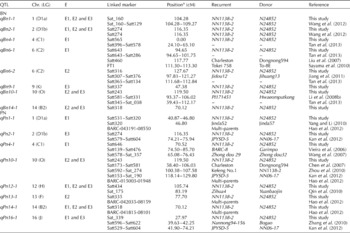
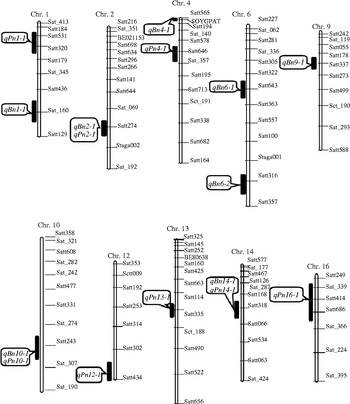
A total of four, five and five wild QTL/segments associated with BN and five, four and five QTL/segments associated with PN were identified in E1, E2 and E3, respectively. The genotypes of these loci were further analysed through multiple comparisons among the CSSLs significantly different from NN1138-2 (Fig. S2, available online). Their phenotypic variance explained, additive effect and logarithm of the odd score are given in Table S2 (available online). Over the three environments, a total of eight wild QTL/segments were associated with BN and PN, respectively. For BN, two QTL/segments (qBn1-1 and qBn2-1) were identified in all the three environments, two in two environments and four in one environment. For PN, two QTL/segments (qPn12-1 and qPn14-1) were identified in all the three environments, two in two environments and four in one environment (Table 1). Among the detected QTL/segments, three were associated with both traits (qBn2-1 and qPn2-1, qBn10-1 and qPn10-1, and qBn14-1 and qPn14-1 in Table 1 and Fig. 1). However, the total contribution of the detected QTL/segments in an environment was only 8.08–13.81% for BN and 5.72–11.61% for PN, while the corresponding heritability was 68.10–75.66% and 82.24–95.47%, respectively. There is a large part of the genetic variation that is not explained by the detected QTL/segments, and this might be due to undetected minor QTL on other segments.
Comparison of qualitative trait loci (QTL)/segments found to be associated with the number of branches on the main stem (BN) and number of pods per plant (PN) in this study with those reported in the previous literature

Chr., chromosome; LG, linkage group; E, environment; E1, Jiangpu, 2010; E2, Jiangpu, 2011; E3, Fengyang, 2011.
a Position of the QTL in a linkage group based on the consensus map (Song et al., Reference Song, Marek, Shoemaker, Lark, Concibido, Delannay, Specht and Cregan2004).
Distribution of qualitative trait loci (QTL)/segments associated with number of branches per plant (BN) and number of pods per plant (PN).

Comparisons of the detected QTL/segments with those reported in the literature
The previous QTL mapping results in soybeans were mostly obtained from intraspecific populations. In the present study, SojaCSSLP3, an interspecific CSSL population, was used for identifying allelic variation in G. soja, not present in cultivated soybeans. On comparing the results of the present study with those reported in the literature, four (qBn1-1, qBn2-1, qBn9-1 and qBn14-1) of the eight QTL/segments associated with BN were found to be not yet reported and to be newly detected in SojaCSSLP3. Among the eight QTL/segments associated with PN, qPn2-1 might also be a new one in SojaCSSLP3, as its location was far from that reported in the literature (Table 1). In the present study, some loci were found to express allelic differentiation only in the cross between G. max and G. soja and some loci in crosses between G. max and G. soja and between G. max and G. max; this implies that the former loci have not differentiated among G. max lines yet and remain at the early stage of domestication.
Potential utilization
Previous studies have demonstrated that the high-yielding soybean has more branches and pods than ordinary cultivars under both high and low planting densities (Ao et al., Reference Ao, Zhao, Zhu, Li, Zhang, Wang, Yu, Li, Yao, Xie and Han2013). We expected to identify a positive allelic variation in BN and PN in G. soja to improve the canopy structure, plant growth and yield of the cultivated soybeans by using this CSSL population. Fortunately, all the detected wild alleles of BN and PN exerted positive effects (Table S2, available online) and there were potential choices for selecting elite wild alleles for breeding programmes as these varied greatly in the population. Among the detected QTL/segments, the utilization of those repeatedly identified over environments and conferring both traits should be prioritized. Furthermore, the detected wild segments may provide materials for further characterization, cloning and pyramiding of the alleles of the two traits.
Supplementary material
To view supplementary material for this article, please visit http://dx.doi.org/10.1017/S1479262114000495
Acknowledgements
This study was supported by the China National Key Basic Research Program (2011CB1093 and 2010CB1259), the China National High-tech R & D Program (2011AA10A105 and 2012AA101106), the National Natural Science Foundation of China (31071442 and 31271750), the MOE 111 Project (B08025), PCSIRT (IRT13073), NCET-12-0891, the Jiangsu Higher Education PAPD Project and the Anhui Provincial College Program for Natural Science (KJ2013A077).