Introduction
Strategy implementation remains an area of concern (Lê & Jarzabkowski, Reference Lê and Jarzabkowski2015; Pretorius, Reference Pretorius2016; Micheli & Mura, Reference Micheli and Mura2017; Nienaber, Reference Nienaber2017a, Reference Nienaber2017b; Köseoglu, Yazici, & Okumus, Reference Köseoglu, Yazici and Okumus2018) despite decades of study and from a variety of viewpoints. The breakdown in strategy implementation should be of concern because it adversely affects enterprise performance, and ultimately wealth creation, to the detriment of society. Research has calculated that the performance gap, in terms of financial results, varies between 30 and 37%; that is, actual performance fell short of planned performance (Mankins & Steele, Reference Mankins and Steele2005; Tait & Nienaber, Reference Tait and Nienaber2010). Previous research has identified factors that both hinder and facilitate strategy implementation (Alexander, Reference Alexander1985; Robert, Reference Robert1991; Sandy, Reference Sandy1991; Nutt, Reference Nutt1999; Beer & Eisenstat, Reference Beer and Eisenstat2000; Mankins & Steele, Reference Mankins and Steele2005; Yang, Guohui, & Eppler, Reference Yang, Guohui and Eppler2008; Cocks, Reference Cocks2010; Schaap, Reference Schaap2012; Van der Merwe & Nienaber, Reference Van der Merwe and Nienaber2015; Pretorius, Reference Pretorius2016; Köseoglu, Yazici, & Okumus, Reference Köseoglu, Yazici and Okumus2018). However, few of these studies attempted to use theories outside of the strategy literature to explain this seemingly elusive phenomenon (Bourgeois & Brodwin, Reference Bourgeois and Brodwin1984; Guth & MacMillan, Reference Guth and MacMillan1986; Argyris, Reference Argyris1989; Govindarajan & Fisher, Reference Govindarajan and Fisher1990; Kim & Mauborgne, Reference Kim and Mauborgne1991, Reference Kim and Mauborgne1993; Skivington & Daft, Reference Skivington and Daft1991; O'Reilly, Caldwell, Chatman, Lapiz, & Self, Reference O'Reilly, Caldwell, Chatman, Lapiz and Self2010; Franco-Santos, Lucianetti, & Bourne, Reference Franco-Santos, Lucianetti and Bourne2012; Küpers, Mantere, & Statler, Reference Küpers, Mantere and Statler2013; Barrick, Thurgood, Smith, & Courtright, Reference Barrick, Thurgood, Smith and Courtright2015; Lê & Jarzabkowski, Reference Lê and Jarzabkowski2015; Scott, Cavana, & Cameron, Reference Scott, Cavana and Cameron2015; Nienaber, Reference Nienaber, Nienaber and Martins2016; Reference Nienaber2017a, Reference Nienaber2017b; Micheli & Mura, Reference Micheli and Mura2017; Martins & Nienaber, Reference Martins and Nienaber2018). This observation seems strange as strategy draws on multiple disciplines including, but not limited to, economics, business economics, management, psychology, and sociology. Moreover, in study after study, the recurring reason for the failure of strategy implementation is the unavailability of resources, particularly human resources, whether leaders or employees. In particular the ‘absence’ of human competence (knowledge, skills, attitude, health, and well-being), in whatever guise it takes, contributes to the strategy implementation failure (Alexander, Reference Alexander1985; Drucker, Reference Drucker1985; Robert, Reference Robert1991; Sandy, Reference Sandy1991; Grant, Reference Grant1996; Beer & Eisenstat, Reference Beer and Eisenstat2000; Martins & Terblanche, Reference Martins and Terblanche2002; Mankins & Steele, Reference Mankins and Steele2005; Cheese, Thomas, & Craig, Reference Cheese, Thomas and Craig2008; Cocks, Reference Cocks2010; O'Reilly et al., Reference O'Reilly, Caldwell, Chatman, Lapiz and Self2010; Kauppila, Reference Kauppila2014; Lê & Jarzabkowski, Reference Lê and Jarzabkowski2015; Craig & Lopez, Reference Craig and Lopez2016; Pretorius, Reference Pretorius2016; Teece, Peteraf, & Leih, Reference Teece, Peteraf and Leih2016; Heyden, Fourné, Koene, Werkman, & Ansari, Reference Heyden, Fourné, Koene, Werkman and Ansari2017; Michaelis & Markham, Reference Michaelis and Markham2017; Nienaber, Reference Nienaber2017a, Reference Nienaber2017b; EY, 2018). Human resources form part of resources of the enterprise, which are the cornerstone of competitive advantage (Porter, Reference Porter1985; Barney, Reference Barney1991; Martins & Terblanche, Reference Martins and Terblanche2002; Lockwood, Reference Lockwood2007; García-Granero, Llopis, Fernández-Mesa, & Alegre, Reference García-Granero, Llopis, Fernández-Mesa and Alegre2015; Teece, Peteraf, & Leih, Reference Teece, Peteraf and Leih2016). Competitive advantage refers to something an enterprise does better or differently than its competition in attracting customers by offering value, and is the hallmark of a sound strategy (Porter, Reference Porter1985; Barney, Reference Barney1991; Peteraf & Barney, Reference Peteraf and Barney2003; Gunter McGrath, Reference Gunter McGrath2013; Grant, Reference Grant2018).
Engagement, strategy implementation, and leadership
Recently, employee engagement has come to the fore as a possible solution to improve strategy implementation (Anitha, Reference Anitha2014; Barrick et al., Reference Barrick, Thurgood, Smith and Courtright2015; Nienaber, Reference Nienaber, Nienaber and Martins2016, Reference Nienaber2017a, Reference Nienaber2017b). Employee engagement is a means of engendering employee support, among other things, because employees are clear on their role. This means employees know what to do, denoting their competence, showing what is meaningful to them, reflecting autonomy, indicating what is beneficial for relationships, and signalling relatedness (Hogan, Curphy, & Hogan, Reference Hogan, Curphy and Hogan1994; Kauppila, Reference Kauppila2014; Heyden et al., Reference Heyden, Fourné, Koene, Werkman and Ansari2017). All of these aspects were shown to have a positive impact on their well-being. However, not all authors agree on the concept ‘employee engagement’, except that it relates to well-being (Kahn, Reference Kahn1990, Reference Kahn1992; Schaufeli, Salanova, González-Romá, & Bakker, Reference Schaufeli, Salanova, González-Romá and Bakker2002; Saks, Reference Saks2006). Generally, authors differentiate between two kinds of engagement, namely work engagement and employee engagement. The former focuses on the individual level and the latter on a broader level, such as the team and enterprise (Saks, Reference Saks2006; Schaufeli & Salanova, Reference Schaufeli and Salanova2011). However, different conceptualisations of engagement result in different measurement instruments (see e.g., Kahn, Reference Kahn1990; Schaufeli et al., Reference Schaufeli, Salanova, González-Romá and Bakker2002; Saks, Reference Saks2006; Macey & Schneider, Reference Macey and Schneider2008; Rich, Lepine, & Crawford, Reference Rich, Lepine and Crawford2010; Anitha, Reference Anitha2014; Nienaber & Martins, Reference Nienaber and Martins2015; Anthony-McMann, Ellinger, Astakhova, & Halbesleben, Reference Anthony-McMann, Ellinger, Astakhova and Halbesleben2017). Some authors have questioned the validity of several of these instruments (Mills, Culbertson, & Fullagar, Reference Mills, Culbertson and Fullagar2012; Viljevac, Cooper-Thomas, & Saks, Reference Viljevac, Cooper-Thomas and Saks2012; Byrne, Peters, & Weston, Reference Byrne, Peters and Weston2016), which is not uncommon for multi-levelled, multi-dimensional constructs (Lockwood, Reference Lockwood2007; Aguinis & Edwards, Reference Aguinis and Edwards2014) such as engagement. However, measurement instruments whose validity is less than optimal do not deliver ideal results, and improvement efforts following measurement may accordingly fall short. Nevertheless, research has suggested that the broader level of engagement might be a better way of studying engagement because it is a holistic way of accounting for managing the workforce in pursuit of enterprise goals, which is achieved by strategy, the vehicle used to arrive at the enterprise's future destination, which is survival and growth (Ansoff, Reference Ansoff1988; Saks, Reference Saks2006; Mone, Eisinger, Guggenheim, Price, & Stine, Reference Mone, Eisinger, Guggenheim, Price and Stine2011; Barrick et al., Reference Barrick, Thurgood, Smith and Courtright2015; Nienaber & Martins, Reference Nienaber and Martins2015; Gutermann, Lehmann-Willenbrock, Boer, Born, & Voelpel, Reference Gutermann, Lehmann-Willenbrock, Boer, Born and Voelpel2017; Reijseger, Peeters, Taris, & Schaufeli, Reference Reijseger, Peeters, Taris and Schaufeli2017; Grant, Reference Grant2018; Martins & Nienaber, Reference Martins and Nienaber2018). Nonetheless, employee engagement has received far less attention than work engagement (Byrne, Peters, & Weston, Reference Byrne, Peters and Weston2016).
Irrespective of the level of engagement, studies have found that as little as 24% of the global workforce is highly engaged, and this number is falling (Aon Hewitt, 2017). This state of affairs naturally has dire consequences for strategy implementation, given that employees implement the strategy (Jarzabkowski & Spee, Reference Jarzabkowski and Spee2009; Jarzabkowski, Kaplan, Seidl, & Whittington, Reference Jarzabkowski, Kaplan, Seidl and Whittington2016) of the enterprise in executing their daily tasks. Hence, it stands to reason that strategy implementation is affected by support from employees, among other things (Pretorius, Reference Pretorius2016; Heyden et al., Reference Heyden, Fourné, Koene, Werkman and Ansari2017) and role clarity (Kauppila, Reference Kauppila2014). Thus, this theoretical paper attempts to answer the research question of how employee engagement can drive strategy implementation through dimensions of organisation. In this paper it is argued that leadership, at all hierarchical positions in the enterprise, is offered an opportunity to unlock the engagement of the majority of its workforce, with positive consequences for strategy implementation, enterprise performance, and ultimately society's well-being.
Leadership, for purposes of this paper, means the ability of a person, particularly those in a formally appointed hierarchical role, stemming from his or her behaviour, to guide others' activities and conduct in a systematic effort to achieve a desired outcome, like enterprise goals, within a system of cooperation, coupled with other resources, which are all connected (Fayol, Reference Fayol and Merrill1916; Parker-Follett, Reference Parker-Follett and Graham1933; Barnard, Reference Barnard and Merrill1948; Hogan, Curphy, & Hogan, Reference Hogan, Curphy and Hogan1994; García-Granero et al., Reference García-Granero, Llopis, Fernández-Mesa and Alegre2015; Chua & Ayoko, Reference Chua and Ayoko2019). This ability to guide behaviours stems in part from the culture of the enterprise and signal acceptable behaviours (Martins & Terblanche, Reference Martins and Terblanche2002; García-Granero et al., Reference García-Granero, Llopis, Fernández-Mesa and Alegre2015; Costanza, Blacksmith, Coates, Severt, & DeConstanza, Reference Costanza, Blacksmith, Coates, Severt and DeConstanza2016; Craig & Lopez, Reference Craig and Lopez2016; Michaelis & Markham, Reference Michaelis and Markham2017; Grant, Reference Grant2018) in support of enterprise performance.
Practical example anchored in theory
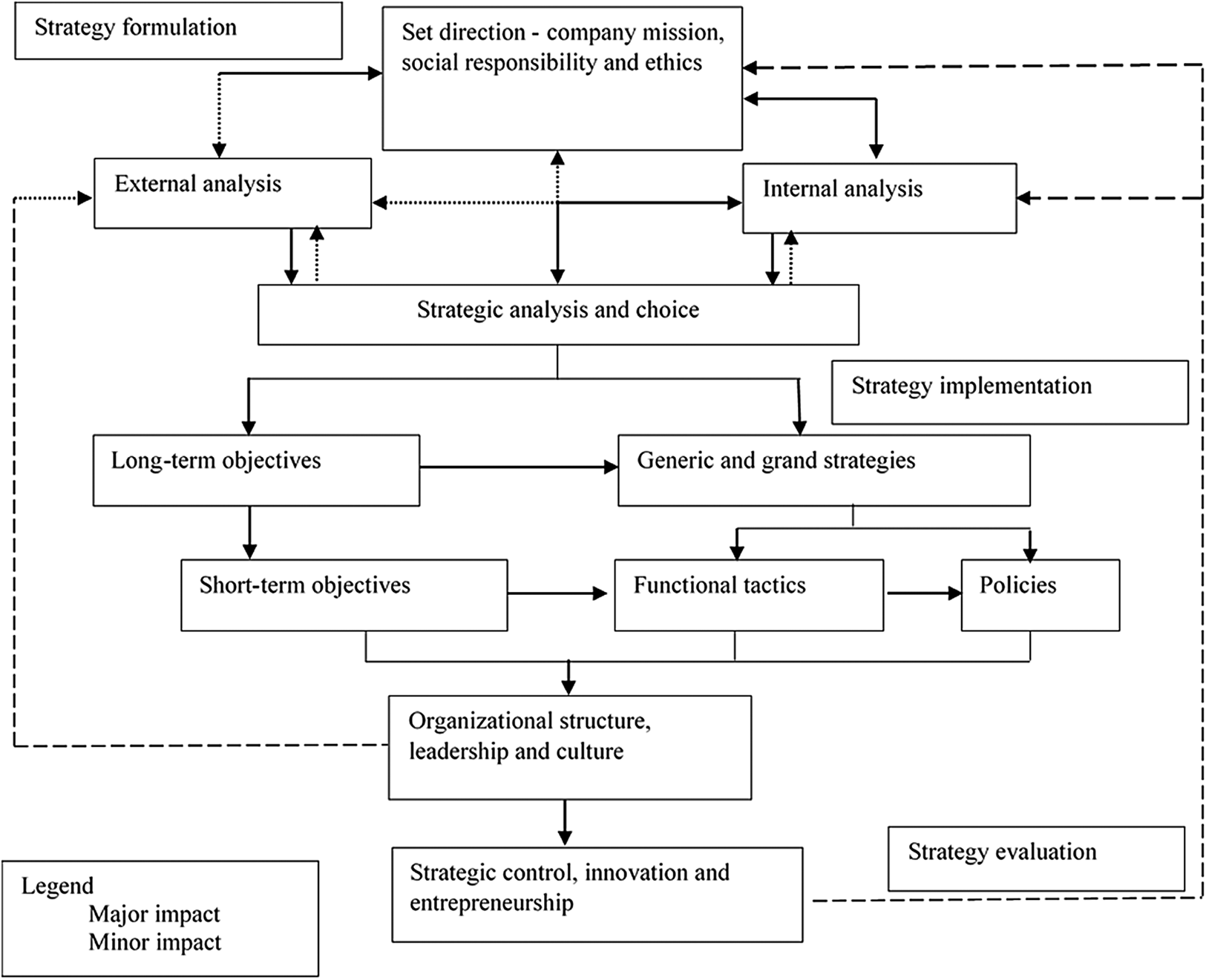
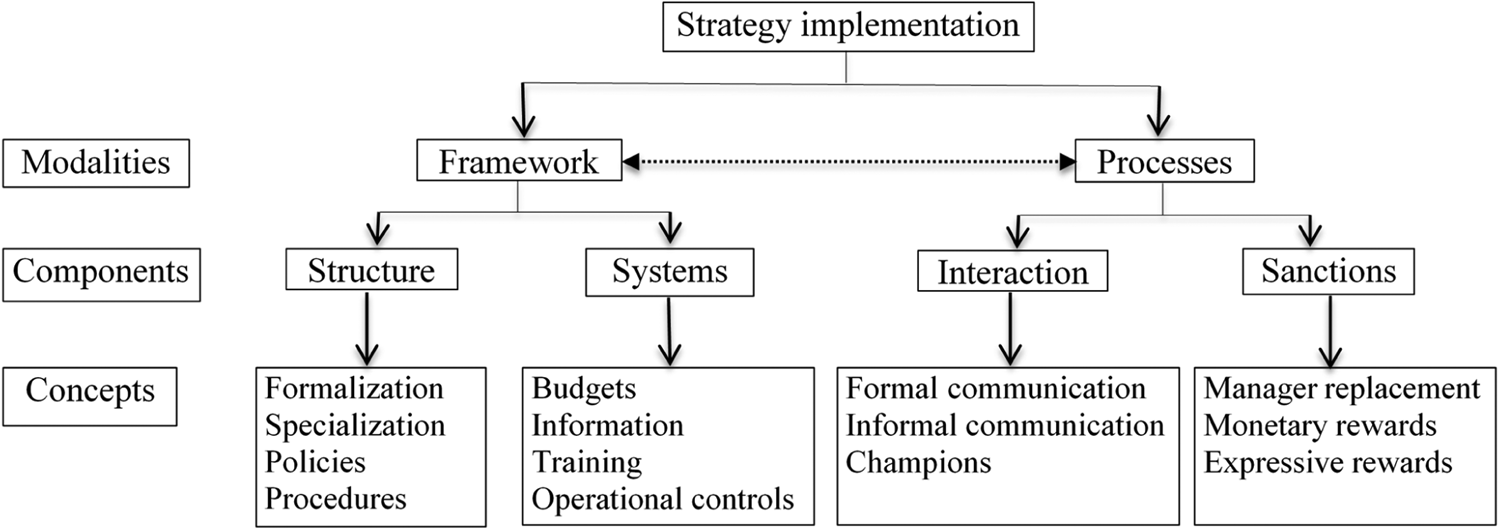
This theoretical paper uses the survey results of Nienaber and Martins (Reference Nienaber and Martins2015) to examine employee engagement and the factors that have an impact on engagement, showing how these factors affect strategy implementation by using the strategy implementation model of Skivington and Daft (Reference Skivington and Daft1991). The model of Skivington and Daft (Reference Skivington and Daft1991), illustrated in Figure 2, overlaps with most strategy-shaping models presented in the strategic management literature and illustrated in Figure 1. Moreover, the Skivington and Daft model contains more details than most other models, for example that of Lafley and Martin (Reference Lafley and Martin2013), enhancing its usefulness. The Skivington and Daft (Reference Skivington and Daft1991) model is in line with the ideas of Chandler (Reference Chandler1962); it is supported by Harris and Ruefli (Reference Harris and Ruefli2000) and akin to Fayol's (Reference Fayol and Merrill1916) notion of organising, command and coordination (see Wren, Reference Wren2005). This examination demonstrates that both dimensions of organisation (‘framework’ and processes) have an impact on employee engagement and consequently the degree of strategy implementation and as a result, enterprise performance.
Typical strategy shaping model from Pearce and Robinson (Reference Pearce and Robinson2009: 2).

Structural model of strategy implementation adapted from Skivington and Daft (Reference Skivington and Daft1991: 48).

Enterprises that succeed in addressing these complex, interrelated, aspects will benefit, especially if they ensure that strategy implementation aligns with strategy formulation via the appropriate use of culture, policies, processes, procedures, practices, resource allocation (‘framework’), communication, and sanctions (processes). At the same time these aspects serve as mechanism(s) for coordination and control (Fayol, Reference Fayol and Merrill1916; Parker- Follett, Reference Parker-Follett and Graham1933; Barnard, Reference Barnard and Merrill1948; Chandler, Reference Chandler1962; Guth & MacMillan, Reference Guth and MacMillan1986; Skivington & Daft, Reference Skivington and Daft1991; Hogan, Curphy, & Hogan, Reference Hogan, Curphy and Hogan1994; O'Reilly et al., Reference O'Reilly, Caldwell, Chatman, Lapiz and Self2010; Floyd, Cornelissen, Wright, & Delios, Reference Floyd, Cornelissen, Wright and Delios2011; Franco-Santos, Lucianetti, & Bourne, Reference Franco-Santos, Lucianetti and Bourne2012; Galbraith, Reference Galbraith2012; Schaap, Reference Schaap2012; Kauppila, Reference Kauppila2014; García-Granero et al., Reference García-Granero, Llopis, Fernández-Mesa and Alegre2015; Scott, Cavana, & Cameron, Reference Scott, Cavana and Cameron2015; Costanza et al., Reference Costanza, Blacksmith, Coates, Severt and DeConstanza2016; Micheli & Mura, Reference Micheli and Mura2017; Nienaber, Reference Nienaber, Nienaber and Martins2016, Reference Nienaber2017a, Reference Nienaber2017b; Grant, Reference Grant2018).
This paper contributes to refinement of theory on and practice of strategy implementation by demonstrating how leadership can engender support from employees by activating employee engagement via dimensions of organisation. In particular, this paper brings to the fore the dimension of ‘processes’ which is not visible in typical strategy-shaping models, illustrated in Figure 1, and thus taking care of the implicit component that affects strategy implementation. Moreover, this paper shows that there is interplay between the ‘framework’ and processes dimensions of organisation, affecting employee engagement and consequently strategy implementation. This integration of different approaches is original as it has not been done before and enhances our understanding of strategy implementation, which is consistent with the ideas proposed by Chandler (Reference Chandler1962). As such, it contributes to knowledge creation by providing answers to previously unanswered questions, albeit incrementally, which is typical of progress in social sciences (Jaccard & Jacoby, Reference Jaccard and Jacoby2010). At the same time this theoretical paper lends support for the view of Stergiou and Airey (Reference Stergiou and Airey2018: 158) that ‘theory can emerge through conceptual inquiry’.
Structural Model of Strategy Implementation
From the outset, it is necessary to mention that Skivington and Daft (Reference Skivington and Daft1991) explain that their structural model of strategy implementation builds on prior theory, specifically that put forward by Weber (1949), Chandler (1962), Selznick (1949) and Crozier (1964) (as cited by Skivington and Daft, Reference Skivington and Daft1991:46–47) Later studies found support for Chandler's (Reference Chandler1962) notion, while others reported conflicting results and some were inconclusive (see e.g., Harris & Ruefli, Reference Harris and Ruefli2000; Floyd et al., Reference Floyd, Cornelissen, Wright and Delios2011), which is not uncommon in applied disciplines such as management. However, this paper is not about the strategy/structure debate, but how organisational structure can facilitate employee engagement and consequently drive strategy implementation and as a result enterprise performance, ultimately benefitting society. Organisation, as described by Skivington and Daft (Reference Skivington and Daft1991), forms part of a typical strategy-shaping model as put forward in the literature and demonstrated in Figure 1.
However, the model of Skivington and Daft (Reference Skivington and Daft1991) contains more details than most models (e.g., Lafley & Martin, Reference Lafley and Martin2013) making it useful, as mentioned earlier. In their model, illustrated in Figure 2, Skivington and Daft (Reference Skivington and Daft1991) describe that strategy is implemented through ‘organisation’, representing enduring tasks and activities, which is split between the dimensions ‘framework’ and ‘processes’.
Framework
According to Skivington and Daft (Reference Skivington and Daft1991), ‘framework’ is by nature enduring and systematic and draws together the activities and resources of the enterprise, which is consistent with Grant (Reference Grant2018). ‘Framework’ consists of structure and subsystems. Structure embodies the formal configuration of roles, authority, division of labour, policies, and procedures. Subsystems allocate resources and reinforce central control. By implication, the formal configuration of structure arranges the official reporting and responsibilities as well as the coordination between the interdependent parts of the enterprise, while policies and procedures guide thinking, decisions and actions (processes) in the enterprise. This description suggests interaction between ‘framework’ and processes. Subsystems consist of ‘budgets, management information systems, technical training systems, operational controls and reports that provide for resource allocation and vertical control’ (Skivington & Daft, Reference Skivington and Daft1991: 48), which all relate to the formal, impersonal aspects of the enterprise.
‘Framework’, as proposed by Skivington and Daft (Reference Skivington and Daft1991), and as discussed here, influences employees' engagement levels as it affects their competence required to do their job as embodied/specified in roles. Competence commonly denotes knowledge, skills, attitudes, and health required to discharge one's duties/role successfully. However, according to White (Reference White1959), competence refers to an individual's capacity to interact effectively with his or her environment, which encompasses learning, particularly the opportunity to demonstrate mastery of learning. Learning means finding and correcting errors, where errors signify a discrepancy between intention and reality (Argyris, Reference Argyris1989: 6). White (Reference White1959) characterises competence as an inborn drive to learn to do, with the intention of deriving pleasure in exercising a function successfully irrespective of its sensual value. Thus, competence reflects the individual's desire to master his or her environment and attain valued outcomes within it (White, Reference White1959), which facilitates getting ahead (Hogan & Kaiser, Reference Hogan and Kaiser2008). According to White (Reference White1959: 317), competence thus means fitness or ability, and its synonyms include capability, capacity, efficiency, proficiency, and skill. Hence, competence is considered to be wider than mere knowledge, skill, attitude, and health. White (Reference White1959) also points out that the general trend of competence (i.e., the effective interactions with the environment) is towards autonomy, or self-determination, which is characteristic of being human.
Autonomy aims to resist control, which is in effect domination, and dominating powers of the environment to its sphere of influence (White, Reference White1959). Autonomy represents the experience of volition and self-endorsement of one's behaviour and not the product of manipulative or distorting external forces (DeCharms, Reference DeCharms1996). Autonomy equates to moral action, which means that a person can be his or her authentic self without harming others or infringing on others' autonomy. Therefore, autonomy gives meaning to people (Hogan & Kaiser, Reference Hogan and Kaiser2008). Individuals, in their own right, in considering aspects of their behaviour, seek and welcome stimulation, and contact with the environment in which they value slight pressures and moderate excitement, while enjoying novelty and variety for their own sake. Moreover, context must create a reason for the individual to willingly comply to behave autonomously (Ryan & Deci, Reference Ryan and Deci2006; Chua & Ayoko, Reference Chua and Ayoko2019), which is facilitated by dimensions of organisation. Thus, the ‘framework’ dimension of organisation has an impact on employees' competence and autonomy, which in turn influence employees' level of engagement and consequently strategy implementation.
Processes
According to Skivington and Daft (Reference Skivington and Daft1991), processes apply to the patterns of interaction, both emotional and political (added) between enterprise members, which are episodic and attributable to individuals. This view resonates with Mencl, Wefald and van Ittersum (Reference Mencl, Wefald and van Ittersum2016). Processes reflect the informal structure of the enterprise, which has an equally significant effect on employee engagement and consequently strategy implementation as well as enterprise performance. Processes consist of interaction and sanctions among enterprise members, which serve to create shared meaning and achieve consensus and cooperation. ‘Framework’, in particular policies, procedures, leadership, and culture, partially regulate processes, while individuals' personality, and specifically identity (Goffman, Reference Goffman1959; Hogan & Kaiser, Reference Hogan and Kaiser2008), partly encourage or discourage effective action. As explained by Skivington and Daft (Reference Skivington and Daft1991), processes therefore signal and enforce acceptable behaviour and are deemed to be significant in maintaining the stability of the enterprise and effecting change when necessary.
The need to belong (Baumeister & Leary, Reference Baumeister and Leary1995: 497), which facilitates getting along with others (Hogan & Kaiser, Reference Hogan and Kaiser2008), explains interaction, which forms part of processes. According to Baumeister and Leary (Reference Baumeister and Leary1995: 500), one of the basic needs of human beings is to form and maintain at least a few lasting, positive and significant interpersonal relationships. They continue that satisfying this need involves meeting two criteria, namely (i) a need for frequent, affectively pleasant interactions, which are free from conflict and negative affect, with a few others; and (ii) that these interactions must take place in the context of a temporally stable and enduring framework of affective concern for each other's well-being, which provides a relational context to interactions (Baumeister & Leary, Reference Baumeister and Leary1995: 500). They highlight that the perception of a bond is essential for satisfying the need to belong, while the absence of relatedness constitutes serious deficiency and causes a range of ill effects. As such, the fundamental need of relatedness significantly produces human behaviour, emotion, and thought.
In addition, Baumeister and Leary (Reference Baumeister and Leary1995) maintain that the affective mechanism of relatedness stimulates learning by making positive social contact reinforcing and desirable, while social withdrawal and chastising interactions (e.g., when relationships are broken, threatened, or refused) including relationships with disliked people, are avoided. Human thought, or cognitive activity, reflects an inescapable concern with shaping relationships, while emotional responses follow from perceived or real outcomes that pertain to broken, threatened, or refused relationships. Moreover, satisfying the need for relatedness also contributes to intensification in goal-directed activity directed at developing relationships which seem to be able to overcome some hostile tendencies. In addition, Baumeister and Leary (Reference Baumeister and Leary1995: 508) maintain that being accepted, included, or welcomed leads to a variety of positive emotions (e.g., happiness, elation, contentment, and calm), whereas being rejected, excluded, or ignored leads to potent negative feelings (e.g., anxiety, depression, grief, jealousy, and loneliness and a decline in health, happiness, and adjustment).
This view is consistent with Kaiser and Hogan (Reference Kaiser and Hogan2010) and Chua and Ayoko (Reference Chua and Ayoko2019) and can illuminate employee engagement and thus strategy implementation. Leadership, at the strategic level, fosters engagement by positioning the team for the future by setting direction, making courageous moves, and supporting innovation, while at lower hierarchical levels, leadership engenders engagement by directing the team to accomplish near-term goals by laying down the details of implementation, allocating resources, and monitoring performance. Moreover, leadership, at all hierarchical levels, fosters engagement by creating an environment in which others can perform through empowerment, participation, and support, facilitating getting ahead (competence) and getting along (relatedness).
Well-being
Top management, with the support of leadership at all hierarchical levels, uses ‘framework’ (as proposed by Skivington & Daft, Reference Skivington and Daft1991) to implement strategy by adjusting the structure of the organisation, by changing the design, by way of redefining roles and responsibilities and thus addressing competence and autonomy; amending policies and procedures, altering budget allocations, enacting new operational criteria and the like, in support of successfully executing duties/roles. Top management, with the assistance of leadership at all hierarchical levels, especially at the lower hierarchical positions, uses processes to implement strategy by creating new meaning by way of communication, power, and sanctions and thus attends to relatedness. Accordingly, both dimensions of organisational structure, that is, ‘framework’ and processes, affect competence, autonomy, and relatedness, the three fundamental psychological needs of people (Ryan & Deci, Reference Ryan and Deci2006; Chua & Ayoko, Reference Chua and Ayoko2019), which serve as levers of motivation (Hogan & Kaiser, Reference Hogan and Kaiser2008) and are thus vital in the willing cooperation of employees to realise enterprise performance.
Job stressors
Likewise, job stressors, the conditions, or sources of stress at work that require an adaptive response from employees (Jex, Beehr, & Roberts, Reference Jex, Beehr and Roberts1992), originate from both dimensions of organisation, that is, ‘framework’ and processes. Job stressors can be either negative (hindrance stressors) or positive (challenge stressors). Hindrance stressors frustrate goal achievement and involve enterprise politics, red tape, mistreatments and interpersonal conflicts (processes), enterprise constraints, role conflict, role ambiguity, and concerns about job security and workload (‘framework’) (Karasek & Theorell, Reference Karasek and Theorell1990; Chen, Westman, & Hobfoll, Reference Chen, Westman and Hobfoll2015). Challenge stressors facilitate goal achievement and encompass job control or autonomy, like having the opportunity to use the breadth of one's skills and decision latitude, job demands like task variety and a degree of complexity, learning opportunities and high levels of responsibility. Challenge stressors allow individuals to demonstrate their competence, which is rewarding, motivational and worth the effort and accordingly enhance well-being (Karasek & Theorell, Reference Karasek and Theorell1990; Chen, Westman, & Hobfoll, Reference Chen, Westman and Hobfoll2015). Therefore, challenge stressors originate from the ‘framework’ dimension of organisation.
The presence of hindrance stressors and absence of challenge stressors result in, or increase, the experience of occupational stress. Occupational stress, including mental illness, is on the rise – to such an extent that the World Health Organization (2014) has called it a world-wide epidemic. This is evident in the low levels of employee engagement and breakdown in strategy implementation. More importantly, research has found that occupational stress influences the well-being of society as it spills over from the work environment to the family and society rather than the other way around (Karasek & Theorell, Reference Karasek and Theorell1990; Giorgi, Shoss, & Leon-Perez, Reference Giorgi, Shoss and Leon-Perez2015). Hence, employee engagement has consequences for society at large.
Leadership has a duty to create healthy enterprises in which their employees can thrive and perform (Karasek & Theorell, Reference Karasek and Theorell1990; Chua & Ayoko, Reference Chua and Ayoko2019). Hence, leadership at all hierarchical levels should take care not to thwart the satisfaction of the fundamental human needs for competence, autonomy, and relatedness, as it can result in negative functional consequences for health (mental and physical), performance, and well-being (Karasek & Theorell, Reference Karasek and Theorell1990; Ryan & Deci, Reference Ryan and Deci2006; Hogan & Kaiser, Reference Hogan and Kaiser2008; Giorgi, Shoss, & Leon-Perez, Reference Giorgi, Shoss and Leon-Perez2015), for the individual, enterprise, and ultimately society. These negative functional consequences include deviant behaviour resulting in derailing strategy implementation, jeopardising enterprise goal achievement. Leadership can create healthy enterprises by attending to structural dimensions of organisation. Leadership should know their employees, explicitly what they are capable of doing, that is, matching competence to roles specified in structure, which is part of ‘framework’.
In addition, leadership should empower employees to utilise their competence autonomously, by providing for supportive policies and procedures which are part of ‘framework’, and by appropriate resource allocation, which forms part of subsystems, while reinforcing competence and autonomy by appropriate processes (both interaction and sanctions), which influence relatedness. By acknowledging and utilising employees' competence, leadership shows respect and builds trust, which affects work outcomes (Kaiser & Hogan, Reference Kaiser and Hogan2010; Chua & Ayoko, Reference Chua and Ayoko2019).
In so doing leadership displays a concern for the well-being of their employees and acts with integrity. However, if leadership violates integrity, it causes harm to their employees, their engagement levels and consequently strategy implementation and enterprise performance. Ultimately the well-being of society will be damaged as negative consequences spill over to the environment. Violating integrity can take many forms ranging from disregarding the views of others to imposing goals on reportees, without their agreement or regard for their long-term well-being (Padilla, Hogan, & Kaiser, Reference Padilla, Hogan and Kaiser2007). This conduct is typical of a top-down management style (see Lee & Puranam, Reference Lee and Puranam2016; Heyden et al., Reference Heyden, Fourné, Koene, Werkman and Ansari2017), which seeks to dominate.
Structural aspects of organisation and strategy-shaping models
As mentioned, structural aspects of organisation, as described here, form part of the typical strategy-shaping model in standard texts and illustrated in Figure 1. The dimension ‘framework’ is visible, while the dimension processes is implicit. Regrettably, attention to strategy implementation and control as illustrated in Figure 1 is largely neglected in favour of strategy formulation, while relevant stakeholders are often excluded from the formulation process (Bourgeois & Brodwin, Reference Bourgeois and Brodwin1984; Cocks, Reference Cocks2010; Franco-Santos, Lucianetti, & Bourne, Reference Franco-Santos, Lucianetti and Bourne2012; Kauppila, Reference Kauppila2014; Lê & Jarzabkowski, Reference Lê and Jarzabkowski2015; Jarzabkowski et al., Reference Jarzabkowski, Kaplan, Seidl and Whittington2016; Pretorius, Reference Pretorius2016; Micheli & Mura, Reference Micheli and Mura2017; Köseoglu, Yazici, & Okumus, Reference Köseoglu, Yazici and Okumus2018), adversely affecting implementation and control. This exclusion adversely affects employee engagement.
Employee Engagement
As mentioned earlier, a variety of employee engagement conceptualisations which are accompanied by their own measurement instruments exist in both the academic and practitioner (consulting) literature. As stated before, some of these instruments' validity is less than optimal (Mills, Culbertson, & Fullagar, Reference Mills, Culbertson and Fullagar2012; Viljevac, Cooper-Thomas, & Saks, Reference Viljevac, Cooper-Thomas and Saks2012; Byrne, Peters, & Weston, Reference Byrne, Peters and Weston2016). Furthermore, few researchers have published validation studies (Nienaber & Martins, Reference Nienaber and Martins2015; Byrne, Peters, & Weston, Reference Byrne, Peters and Weston2016; Martins, Reference Martins2016) that enhance causal inferences (Purcell, Reference Purcell2014). The validated instrument of Nienaber and Martins (Reference Nienaber and Martins2015), for a diverse, multi-cultural, emerging economy context, builds on existing theory developed internationally, while adapted for context (Johns, Reference Johns2006; Jack et al., Reference Jack, Zhu, Barney, Brannen, Prichard, Singh and Whetten2013), which is a sound scientific practice, and actionable for practitioners. Martins and Nienaber (Reference Martins and Nienaber2018: 1686) point out that South Africa was ranked low on the World Competitiveness Report, reflecting a weak competitiveness position, owing to, inter alia, the ‘human factor’. Martins and Nienaber (Reference Martins and Nienaber2018: 1685) indicate that they followed the typical steps associated with instrument development and validation as suggested by Hinkin (Reference Hinkin1998), commencing with a literature review, covering both conceptual and empirical papers, to facilitate item generation. Nienaber and Martins (Reference Nienaber and Martins2015: 405–406) explain that the initial items were discussed with experts in the fields of Human Resource Management and Industrial and Organisational Psychology. Based on these discussions, some items were rephrased, some items added and some deleted, before it was administered to a permission-based database. Nienaber and Martins (Reference Nienaber and Martins2015: 414) note that this database was comprised of 285,000 persons, active in all Standard Industrial Classification Sectors, reflecting the economically active profile of South Africans, giving permission to participate willingly in on-line surveys. Thus, the sample was appropriate for purposes of the study, although a convenience sample, which is in line with the recommendations of Bono and McNamara (2011, cited in Nienaber & Martins, Reference Nienaber and Martins2015: 414). Construct validity was assessed by examining exploratory factor analysis, followed by an independent sample performing confirmatory factor analysis, while the model fit and loading magnitude indicated the adequacy of the proposed factor structure (Martins & Nienaber, Reference Martins and Nienaber2018: 1686). The Nienaber and Martins (Reference Nienaber and Martins2015: 405–407) instrument consisted of 69 questions, nine of which collected biographical information and 60 collected responses to engagement statements, on a 5-point Likert-type scale, which is appropriate to measure opinion, belief, and attitude (DeVellis, Reference DeVellis2013). This scale consisted of six factors measuring engagement at individual, team/unit, and enterprise levels. Each of the six factors consisted of five or more items with factor loadings of at least 0.40 and the scale was solid (Hinkin, Reference Hinkin1998; Costello & Osborne, Reference Costello and Osborne2005; Henson & Roberts, Reference Henson and Roberts2006; Hair, Celsi, Money, Samouel, & Page, Reference Hair, Celsi, Money, Samouel and Page2016). The validity, discriminant validity, convergent validity, and reliability of this instrument have been established (Nienaber & Martins, Reference Nienaber and Martins2015; Martins, Reference Martins2016; Gallant, Reference Gallant2017; Gallant & Martins, Reference Gallant and Martins2018; Martins & Nienaber, Reference Martins and Nienaber2018). According to Nienaber and Martins (Reference Nienaber and Martins2015: 415–416), the Cronbach's alpha for the six factors ranged between 0.813 and 0.942. The indices of the base model were all at levels recommended by the relevant scholars in the field (GFI 0.893; RMSEA 0.048; NFI 0.0947; TLI 0.0942; CFI 0.0947; PFI 0.918) (Gallant, Reference Gallant2017; Gallant & Martins, Reference Gallant and Martins2018; Martins & Nienaber, Reference Martins and Nienaber2018: 1686). Engagement at individual level comprises trait, state, and behavioural engagement. Variables at the team/unit level such as job design, leadership, and trust as well as variables at the enterprise level such as vision, mission, goals, and strategy, anchored in the competitive advantage of the enterprise, influence engagement at the individual level (Nienaber & Martins, Reference Nienaber and Martins2015).
Activating and enacting employee engagement
The instrument of Nienaber and Martins (Reference Nienaber and Martins2015) is based on Kahn's (Reference Kahn1990) definition of engagement, which is deemed a broader concept than that of Schaufeli et al. (Reference Schaufeli, Salanova, González-Romá and Bakker2002), as pointed out before. Employees ‘do’ engagement and are influenced by the context in which they work (Nienaber, Reference Nienaber2017b). Ideally, context should create in the individual a reason to comply willingly to behave autonomously (Ryan & Deci, Reference Ryan and Deci2006; Chua & Ayoko, Reference Chua and Ayoko2019), as mentioned earlier. Nienaber (Reference Nienaber2017b) argues that employee engagement is activated by the drivers of engagement proposed by Cheese, Thomas, and Craig (Reference Cheese, Thomas and Craig2008) and accomplished by job design as offered by Hackman and Oldham (Reference Hackman and Oldham1975), and briefly explained in this section, based on Nienaber (Reference Nienaber2017b).
Essentially, engagement refers to ‘employees’ choice to willingly and fully invest their authentic selves physically, cognitively and emotionally in their work roles that promote connections to work and to others, personal presence and active, full role performances’ (Kahn, Reference Kahn1990: 700), addressing the need for competence, autonomy, and relatedness discussed earlier. Kahn (Reference Kahn1992) explains that the state of engagement enables people to articulate their thoughts and feelings, to question assumptions and to innovate, while individual and enterprise variables have a bearing on engagement. These variables range from identity to leadership and trust to job design and strategy and competitive advantage (Nienaber & Martins, Reference Nienaber and Martins2015). These individual and enterprise variables are present in the structural model of strategy implementation of Skivington and Daft (Reference Skivington and Daft1991). They were summarised by the psychological conditions of meaningfulness, safety, and availability proposed by Kahn (Reference Kahn1990, Reference Kahn1992).
Psychological meaningfulness
According to Kahn (Reference Kahn1990: 703–708), psychological meaningfulness indicates how significant it is for employees to bring their authentic self to the workplace given the return they receive for doing so. Task characteristics (clearly delineated, challenging, having variety), role characteristics (identities that enterprise members are implicitly required to assume, which they may like or dislike), and work interactions (interpersonal interactions with co-workers and clients), affect psychological meaningfulness and consequently what employees are expected to do. Task characteristics and role characteristics influence competence as well as autonomy and can be classified as ‘framework’ (structure), while work interactions have an impact on relatedness and are classified as processes (interaction and sanctions) in the structural model of strategy implementation discussed in the previous section.
Psychological safety
Kahn (Reference Kahn1990: 708–713) points out that psychological safety refers to how safe it is for employees to bring their authentic self to the workplace without fear of negative consequences for their self-image, status, or career. Interpersonal relationships (e.g., support and trust), group dynamics (e.g., unacknowledged and/or unconscious roles affecting conscious working), management style and processes (e.g., openness and support), and enterprise norms (shared expectations about the general behaviours of system members) influence psychological safety. Interpersonal relationships have an impact on relatedness and can be classified as processes (interaction and sanctions). Group dynamics affect competence as well as relatedness and can be classified as both ‘framework’ and processes. Management style and processes affect relatedness and can be classified as processes (both interaction and sanctions). Enterprise norms influence relatedness, competence, and autonomy and can be classified as both ‘framework’ and processes.
Psychological availability
Kahn (Reference Kahn1990: 714–717) claims that psychological availability relates to how prepared employees are to bring their authentic self to the workplace, based on whatever personal resources they have available at a particular moment to do their job. Depletion of physical energy (e.g., as a result of long working hours, heavy workloads) and depletion of emotional energy (e.g., frustration about getting the job done), insecurity (e.g., a lack of self-confidence) and outside (non-work) lives influence psychological availability (Kahn, Reference Kahn1992). Resources (physical and emotional energy) are part of ‘framework’ (subsystems) and processes (interaction and sanctions), while insecurity is part of processes (interaction and sanctions). Resources and insecurity have an impact on competence, autonomy, and relatedness.
Drivers of engagement
Cheese, Thomas, and Craig (Reference Cheese, Thomas and Craig2008: 163–165) propose six drivers of engagement, enacting employee engagement as follows:
• Content of the work comprises, among other things, the physical and emotional demands the job makes on the employees (psychological availability), the sense of achievement that the job offers employees (psychological safety), the opportunity to learn new things, and the question of whether the job is meaningful and leads to some form of satisfaction (psychological meaningfulness) (Cheese, Thomas, & Craig, Reference Cheese, Thomas and Craig2008: 164). As such, content of the work forms part of both ‘framework’ (structure and subsystems) and processes (interaction and sanctions) and it has an impact on competence, autonomy, and relatedness.
• Coping includes whether the employees are equipped with the means to handle the job, like competence, technology, resources, and training as well as a favourable working environment consisting of supportive managers, colleagues and work practices and processes that reduce effort rather than adding to it (psychological safety and psychological availability), and above all whether the goals are achievable (psychological meaningfulness) (Cheese, Thomas, & Craig, Reference Cheese, Thomas and Craig2008: 164). Accordingly, coping forms part of both ‘framework’ (structure and subsystems) and processes (interaction and sanctions) and has an impact on competence, autonomy, and relatedness.
• Compensation signifies the employees' belief that they are fairly remunerated and recognised for their contribution (psychological safety and psychological availability) (Cheese, Thomas, & Craig, Reference Cheese, Thomas and Craig2008: 164). Compensation forms part of both ‘framework’ (subsystems) and processes (sanctions) and has an impact on competence, autonomy, and relatedness.
• Community encompasses a feeling of positive social interactions (psychological safety) in the workplace and whether the work is believed to be fulfilling, meaningful, enjoyable, and fun (psychological meaningfulness) and done in a supportive or collaborative environment rather than a hostile environment (psychological availability) (Cheese, Thomas, & Craig, Reference Cheese, Thomas and Craig2008: 164–165). Hence, community forms part of both ‘framework’ (structure and subsystems) and processes (interaction and sanctions), and has an impact on competence, autonomy, and relatedness.
• Congruence entails the agreement between the individual and enterprise values, and alignment of expectations. It includes values that have been met (psychological safety) (Cheese, Thomas, & Craig, Reference Cheese, Thomas and Craig2008: 165). Congruence forms part of both ‘framework’ (structure and subsystems) and processes (interaction and sanctions), and has an impact on competence, autonomy, and relatedness.
• Career covers the alignment between the career, life expectations, and aspirations of the individual, including work–life balance, whether the enterprise is investing in employees and whether employees can shape their own destiny (psychological availability, safety, and meaningfulness) (Cheese, Thomas, & Craig, Reference Cheese, Thomas and Craig2008: 165). Career forms part of both ‘framework’ (structure and subsystems) and processes (interaction and sanctions), affecting competence, autonomy, and relatedness.
Job design
Job design, as explained by Hackman and Oldham (Reference Hackman and Oldham1975), can enact employee engagement, which in turn can activate (or restrain) the drivers of engagement proposed by Cheese, Thomas, and Craig (Reference Cheese, Thomas and Craig2008). Job design suggests that positive personal and work outcomes, for a given employee, are made possible by the simultaneous presence of three psychological states. These psychological states are (i) experienced meaningfulness of the work (affecting autonomy), (ii) experienced responsibility for the outcome of the work (affecting competence), and (iii) knowledge of the outcome of the work (affecting relatedness) (Hackman & Oldham, Reference Hackman and Oldham1975: 160). The presence of five interacting core job dimensions, that is, skill variety, task identity, task significance (enhancing meaningfulness), high autonomy (increasing experienced responsibility for work), and high-quality feedback (improving knowledge of results of the job), create these three psychological states (Hackman & Oldham, Reference Hackman and Oldham1975: 160). The first four core job dimensions are part of ‘framework’ (structure) and the fifth of processes (both interaction and sanctions). Obviously, to be effective, job design should follow from and be aligned with the goals of the enterprise, which stem from the mission and vision. In sum, leadership activates employee engagement by knowing employees' abilities (competence), trusting them to do their best by giving them the opportunity to apply their skills (autonomy), and recognising them for their contribution to goal achievement (relatedness). Performance management accounts for these aspects, which links to the strategy of the enterprise (Mone et al., Reference Mone, Eisinger, Guggenheim, Price and Stine2011; Franco-Santos, Lucianetti, & Bourne, Reference Franco-Santos, Lucianetti and Bourne2012; Micheli & Mura, Reference Micheli and Mura2017).
The Nienaber and Martins (Reference Nienaber and Martins2015) Survey Results
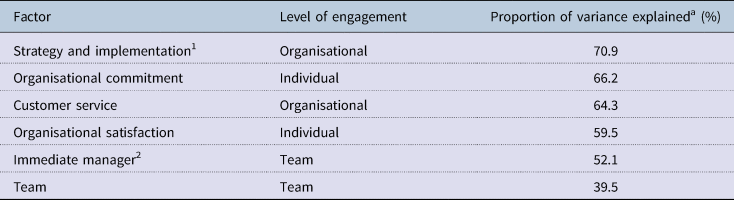
The Nienaber and Martins (Reference Nienaber and Martins2015) survey, discussed earlier, returned 4,099 responses, representing all industrial sectors, reflecting the profile of economically active persons, across occupations, hierarchies, age, and education; with about an equal number of male and female respondents. The current author performed regression analyses on the data collected by the survey administered in 2015 (with the permission of the original developers of the instrument, namely Nienaber & Martins) to determine the proportion of variance in employee engagement explained by the six factors (excluding the factor studied) (Hair et al., Reference Hair, Celsi, Money, Samouel and Page2016). The factors were treated as the independent variable and employee engagement as the dependent variable. The assumptions of regression, namely normality, linearity, equality, co-linearity, and outliers, were tested and satisfied (Hair et al., Reference Hair, Celsi, Money, Samouel and Page2016). The results of the regression analyses are reflected in Table 1.
The proportion of variance in employee engagement explained by the six factors comprising employee engagement

a Excluding the factor.
Source: Calculated from survey results (used with permission); 1Nienaber (Reference Nienaber2017a); 2Nienaber (Reference Nienaber2017b).
Martins and Nienaber (Reference Martins and Nienaber2018) renamed: Customer service – Team orientation; Immediate manager – Effectiveness of managerial tasks; Team – Team commitment.
The information in Table 1 shows that the factor strategy and implementation explained the most (70.9%) of the variance in employee engagement, while team explained the least (39.5%) of the variance in employee engagement, which is consistent with Nienaber (Reference Nienaber2017a). All six factors explain a significant proportion of the variance (>25% according to Heiman, Reference Heiman2014) in employee engagement. According to Nienaber (Reference Nienaber, Nienaber and Martins2016: 30), respondents rated strategy and implementation the most unfavourable (3.40) of all factors making up employee engagement, followed by the immediate manager, which respondents rated the second most unfavourable (3.58). Respondents rated team the most favourable (4.05) of the engagement factors followed by organisational (enterprise) satisfaction, which respondents rated the second most favourable (3.80).
Items that can be improved to enhance employee engagement
According to Nienaber (Reference Nienaber, Nienaber and Martins2016: 31), the items below were among those that scored the lowest in the survey:
1. ‘My immediate manager does a good job of ‘managing the work’ – that is making appropriate work assignments, scheduling the work, setting priorities, etc. for me and my team’ (3.39);
2. ‘The organisational leadership gives employees a clear picture of the directions the organisation is headed’ (3.37);
3. ‘The way we do things around here encourages high performance’ (3.37);
4. ‘My immediate manager gives me regular feedback that helps me to improve my performance’ (3.33);
5. ‘Risk-taking is encouraged in the organisation’ (2.87); and
6. ‘I am satisfied with the way that my work performance is evaluated’ (3.24).
It was not surprising that these items formed part of the factors strategy and implementation (points 2, 3, and 5) and immediate manager (points 1, 4, and 6). Martins and Nienaber (Reference Martins and Nienaber2018) re-labelled this dimension ‘effectiveness of managerial tasks’ to reflect the meaning more clearly. These items can be classified as ‘framework’ and/or processes according to the structural model of strategy implementation proposed by Skivington and Daft (Reference Skivington and Daft1991), and they have an impact on the psychological conditions of meaningfulness, safety, and availability as well as the need for competence, autonomy and relatedness, as discussed previously. Point 2 refers to the vision of the enterprise (‘framework’), while point 3 refers to the culture (‘framework’ which is enforced by processes) of the enterprise, and point 5 clearly refers to risk-taking (both ‘framework’ and processes). These items can also be classified according to the drivers of engagement as classified by Cheese, Thomas, and Craig (Reference Cheese, Thomas and Craig2008). Point 1 refers to job design (‘framework’) and can be classified as drivers of engagement, that is, content and coping (see Cheese, Thomas, & Craig, Reference Cheese, Thomas and Craig2008). As discussed earlier, job design should be aligned with the vision of the enterprise (point 2). It is clear that point 4 refers to feedback (‘framework’ – subsystems and processes – interaction and sanctions), which forms part of job design (see Hackman & Oldham, Reference Hackman and Oldham1975). In addition, feedback can influence all six drivers of engagement proposed by Cheese, Thomas, and Craig (Reference Cheese, Thomas and Craig2008). Point 6 refers to performance evaluation (‘framework’ – subsystems and processes), which may or may not form part of feedback, and, as discussed earlier, have an impact on employee engagement. This brief clarification shows that the dimensions strategy and implementation and immediate manager are intertwined and not detached. As discussed earlier, Skivington and Daft's (Reference Skivington and Daft1991) structural model of organisation to implement strategy facilitates coordination via the ‘framework’ dimension and cooperation via the process dimension. This approach makes it possible to convert formulated plans into action, which is consistent with Grant (Reference Grant2018). At the same time the structural model of organisation to implement strategy provides for an integrative mechanism, preventing fragmentation in formulating and implementing strategy, which is consistent with Jarzabkowski et al. (Reference Jarzabkowski, Kaplan, Seidl and Whittington2016).
Given the proportion of variance explained by the different factors comprising employee engagement, it would be wise to attend to the factors of strategy and implementation, and immediate manager (effectiveness of managerial tasks), because they were scored as the most unfavourable by respondents, while they explain a significant proportion of variance in employee engagement. Hence, the items mentioned above should be a priority in unlocking employee engagement, which will simultaneously facilitate strategy implementation. These items form part of the structural model of organisation to implement strategy of Skivington and Daft (Reference Skivington and Daft1991) as discussed earlier. Encouraging risk-taking together with performance evaluation and feedback will simultaneously have an impact on the other items, albeit indirectly, and improve the levels of employee engagement and degree of strategy implementation (also see Nienaber Reference Nienaber2017a, Reference Nienaber2017b).
Risk-taking
Risk-taking refers to the willingness to take action and allocate resources (‘framework’/subsystems) in pursuit of opportunities with uncertain outcomes (Costanza et al., Reference Costanza, Blacksmith, Coates, Severt and DeConstanza2016; Teece, Peteraf, & Leih, Reference Teece, Peteraf and Leih2016), and is associated with innovative behaviours. Innovative behaviours include embracing new ideas and experimentation (Craig & Lopez, Reference Craig and Lopez2016). Innovative behaviours result from employees' competence, especially their knowledge (Drucker, Reference Drucker1985; Barney, Reference Barney1991; Grant, Reference Grant1996; Martins & Terblanche, Reference Martins and Terblanche2002; Lockwood, Reference Lockwood2007; Cheese, Thomas, & Craig, Reference Cheese, Thomas and Craig2008; Michaelis & Markham, Reference Michaelis and Markham2017). Processes reinforce or restrain innovative behaviours (interaction and sanctions). Innovative behaviours benefit adapting to changing conditions (Martins & Terblanche, Reference Martins and Terblanche2002; García-Granero et al., Reference García-Granero, Llopis, Fernández-Mesa and Alegre2015; Costanza et al., Reference Costanza, Blacksmith, Coates, Severt and DeConstanza2016; Teece, Peteraf, & Leih, Reference Teece, Peteraf and Leih2016); and shaping a competitive advantage (García-Granero et al., Reference García-Granero, Llopis, Fernández-Mesa and Alegre2015), while driving employee engagement (Reijseger et al., Reference Reijseger, Peeters, Taris and Schaufeli2017). Thus, risk-taking is one of the acceptable behaviours modelled by the behaviour (processes – interaction and sanctions) of leaders at all hierarchical levels (García-Granero et al., Reference García-Granero, Llopis, Fernández-Mesa and Alegre2015; Costanza et al., Reference Costanza, Blacksmith, Coates, Severt and DeConstanza2016; Craig & Lopez, Reference Craig and Lopez2016), in accordance with the mission statement and aligned with policies and procedures (‘framework’/structure) of the enterprise (Costanza et al., Reference Costanza, Blacksmith, Coates, Severt and DeConstanza2016). The culture (‘the way we do things here’) of the enterprise encourages or discourages risk-taking (Martins & Terblanche, Reference Martins and Terblanche2002; Costanza et al., Reference Costanza, Blacksmith, Coates, Severt and DeConstanza2016; Craig & Lopez, Reference Craig and Lopez2016; Michaelis & Markham, Reference Michaelis and Markham2017), which is regulated by policies and procedures (‘framework’/structure) and reinforced by processes (interaction and sanctions). Thus, as pointed out before, leadership at all hierarchical levels guides behaviour that is acceptable, including risk-taking. Hence, risk-taking forms part of both ‘framework’ (structure) and processes (interaction and sanctions) that regulate acceptable behaviour in the enterprise. Moreover, risk-taking, as explained here, can activate or restrain psychological meaningfulness, safety and availability and it has an impact on individuals' need for competence, autonomy, and relatedness, and thus the employee engagement.
The immediate manager
As representative of the enterprise (‘framework’/structure), the immediate manager administers performance evaluation (‘framework’/subsystem; processes – interaction and sanctions) in accordance with performance management (‘framework’/subsystems) and in alignment with the strategy of the enterprise (Mone et al., Reference Mone, Eisinger, Guggenheim, Price and Stine2011; Franco-Santos, Lucianetti, & Bourne, Reference Franco-Santos, Lucianetti and Bourne2012; Micheli & Mura, Reference Micheli and Mura2017). Nienaber (Reference Nienaber2017b) points out that according to Mone et al. (Reference Mone, Eisinger, Guggenheim, Price and Stine2011), performance evaluation supports enterprise performance by practices resulting in employees enhancing their competence (means and skills) (like recruitment, selection, and training) to do their job; the motivation to do their work (relatedness) (e.g., performance contracting or setting goals, performance appraisal, compensation, benefits, career development, and job security); and the opportunity to contribute to performance (autonomy) (building a climate of trust and empowerment such as encouraging innovation and improving work processes, providing resources and decision-making authority to perform effectively and have control over work, and treating employees respectfully and fair). All of these practices can be classified according to the drivers of engagement proposed by Cheese, Thomas, and Craig (Reference Cheese, Thomas and Craig2008), and job design of Hackman and Oldham (Reference Hackman and Oldham1975), that have an impact on employee engagement. In this role, the immediate manager plays an essential part in engendering employee engagement. Thus, their behaviours are of crucial importance, which foster trust, among other things (Nienaber & Martins, Reference Nienaber and Martins2015). The structure of the organisation, including but not limited to culture, policies, procedures, processes, and subsystems, of which performance evaluation forms part, binds immediate managers; thus, their interpersonal skills (both emotional and political) to interact with employees are imperative (Cheese, Thomas, & Craig, Reference Cheese, Thomas and Craig2008; Mone et al., Reference Mone, Eisinger, Guggenheim, Price and Stine2011; Mencl, Wefald, & van Ittersum, Reference Mencl, Wefald and van Ittersum2016). Interaction during the performance evaluation may or may not result in useful feedback aimed at improving the performance of the incumbent in pursuing enterprise goals, and possibly establishing a shared meaning and support for the enterprise's direction. At the same time, feedback from the incumbent may result in the immediate manager communicating change imperatives to top management that may result in modifications of structural aspects to enhance performance. It is especially communication that may alter work relationships (especially about structural aspects of the organisation) resulting in (enhanced) employee engagement, strategy implementation, and ultimately enterprise performance. Thus, both ‘framework’ (structure and subsystems) and processes (interaction and sanctions) are involved in performance feedback and evaluation.
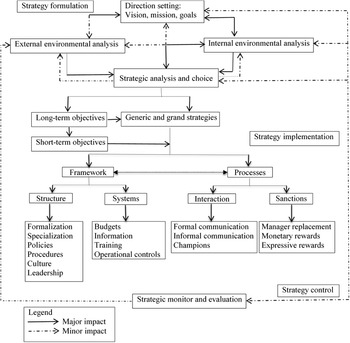
From the above discussion, it is apparent that although the state of engagement of individual employees is involved, the state of employee engagement is influenced by interwoven enterprise factors (context), adding to its complexity. However, part of the leadership task is to make enterprises ‘work’ by transforming complexity into performance, which is admittedly more easily said than done. Though, dimensions of organisation proposed by Skivington and Daft (Reference Skivington and Daft1991) are a helpful tool to accomplish performance, which is illustrated in Figure 3.
Adapted strategy-shaping model.

Conclusions and Recommendations
Strategy implementation failure is understandable, given its complex nature. However, a well-defined strategy founded on competitive advantage is the first step towards facilitating implementation. In addition, this well-defined strategy should be unambiguously communicated (processes), to create shared meaning and to engender the support (cooperation) of enterprise members. It must unequivocally outline the priorities to enable strategy implementation to secure enterprise performance. Moreover, a well-defined strategy should be supported by an appropriate organisational structure (both ‘framework’ and processes) as discussed in this paper. In summary, ‘framework’ signals to employees what they need to do: it has an impact on their competence, which should have meaning for them, as well as on autonomy. It also has an effect on cooperation, which affects relatedness, which is in turn influenced by processes. Dimensions of organisation (both ‘framework’ and processes) seem to be the deal-maker or deal-breaker regarding unlocking employee engagement to facilitate strategy implementation, and thus enterprise performance.
Many classical strategy-shaping models still use the three-phase model, namely planning, implementation, and control, and form part of teaching curricula. The structural aspects of organisation, especially ‘framework’, are visible in the strategy implementation phase which covers issues like policies, procedures, budgets, leadership, culture, and organisational structure (see Figure 1). On the other hand, processes (interaction and sanctions) are implicit in such standardised models (see Figure 1). Nevertheless, theory and practice generally, neglect to attend to the strategy implementation and control phases of these models, favouring the strategy planning phase. Strategy implementation and control are understandably more difficult to calibrate and even more challenging to change than the formulation of strategy. However, enterprises that successfully address structural aspects, in particular the process dimension, in support of strategy, should succeed in unlocking employee engagement, enabling their employees to implement strategy productively in pursuit of enterprise performance. Processes (both interaction and sanctions) enforce organisational control, as part of structural aspects of the organisation, and may either stifle or promote strategy implementation. The resulting environment can be either conducive or unfavourable to high performance, which is characterised by risk-taking. Risk-taking is in turn regulated by ‘framework’ (structure and subsystems), specifically culture and resource allocation, and reinforced by processes (interaction and sanctions), specifically evaluation and feedback about performance, to align risk-taking with the goals of the enterprise. Hence, ‘framework’ and processes are rather interrelated than mutually exclusive.
Both ‘framework’ and processes have an impact on the three fundamental psychological needs of people, namely competence, autonomy and relatedness, the levers of motivation, which are important in cooperation and which influence the level of engagement and thus strategy implementation. At the same time, addressing the need for competence, autonomy, and relatedness can alleviate or add to work-related stress, which spills over to the environment, affecting the well-being of society.
The Nienaber and Martins (Reference Nienaber and Martins2015) survey did not provide reasons for the low scores of the particular items, and thus further exploration is necessary, especially the role of processes as such and the role of the individual administering the processes. Nevertheless, this paper shows that the structural model of organisation proposed by Skivington and Daft (Reference Skivington and Daft1991) can be used to activate and enact employee engagement and enhance the well-being of enterprise members while improving strategy implementation and consequently enterprise performance, thus ultimately benefitting society. The implication is that strategy implementation fails owing to internal factors that are within the control of leadership at all hierarchical positions, rather than ones that are external, to the enterprise.
The conclusions arrived at in this paper are in line with those of previous studies such as Anitha (Reference Anitha2014), Barney (Reference Barney1991), Barrick et al. (Reference Barrick, Thurgood, Smith and Courtright2015), Bourgeois and Brodwin (Reference Bourgeois and Brodwin1984), Chua and Ayoko (Reference Chua and Ayoko2019); Cocks (Reference Cocks2010), Franco-Santos, Lucianetti, & Bourne (Reference Franco-Santos, Lucianetti and Bourne2012), Govindarajan and Fisher (Reference Govindarajan and Fisher1990), Guth and MacMillan (Reference Guth and MacMillan1986), Gutermann et al. (Reference Gutermann, Lehmann-Willenbrock, Boer, Born and Voelpel2017), Heyden et al., (Reference Heyden, Fourné, Koene, Werkman and Ansari2017), Jarzabkowski et al. (Reference Jarzabkowski, Kaplan, Seidl and Whittington2016), Kauppila (Reference Kauppila2014), Lê and Jarzabkowski (Reference Lê and Jarzabkowski2015), Micheli and Mura, (Reference Micheli and Mura2017), Mone et al. (Reference Mone, Eisinger, Guggenheim, Price and Stine2011), Nienaber (Reference Nienaber, Nienaber and Martins2016, Reference Nienaber2017a, Reference Nienaber2017b), O'Reilly et al. (Reference O'Reilly, Caldwell, Chatman, Lapiz and Self2010), Pretorius (Reference Pretorius2016), Schaap (Reference Schaap2012), and Scott, Cavana, and Cameron (Reference Scott, Cavana and Cameron2015). In addition, this paper supports the view that it is beneficial to study engagement at a level that is broader than the individual.
Further study is recommended especially regarding how ‘framework’ and processes interact and influence the need for competence, autonomy, and relatedness and consequently affect employee engagement, strategy implementation, and enterprise performance.
Limitations
As with all studies, this one is not without limitations. Specifically, it uses the survey results of one employee engagement measurement instrument, albeit adapted from the established international engagement literature, and validated for context. However, the Nienaber and Martins (Reference Nienaber and Martins2015) employee engagement study is one of a few published validated studies that enhance causal inferences (Purcell, Reference Purcell2014).
Contribution
The strength of this paper is that it integrates existing scholarship, which is present in diverse literature, providing a more comprehensive understanding of, and valuable new insights into, successful strategy implementation for both practitioners and academics. In particular it illuminates how both dimensions of organisation, that is, ‘framework’ and processes, influence employee engagement, and thus well-being, and consequently cooperation to the benefit of strategy implementation and therefore enterprise performance and ultimately the well-being of society. Moreover, this paper confirms Chandler's (Reference Chandler1962) observation that enterprises allocate a nation's resources, including human competence (i.e., subsystems). The success or failure of resource allocation affects the performance of the enterprise as well as the well-being of the nation.
Effective resource allocation, including human resources, depends on the availability of relevant information (subsystems) and the means to carry out the decisions (‘framework’ and processes). Thus, clear lines of authority (structure) and communication (processes) are imperative to allocate resources effectively, in the absence of which resources will be haphazardly or intuitively allocated, to the detriment of the enterprise's performance. Thus, the absence or deficiency of organisational structure (both ‘framework’ and processes) can lead to wasteful and inefficient use of resources, adversely affecting the competitiveness of the enterprise. The contribution of this paper may be incremental but is typical of advancement in social sciences (Jaccard & Jacoby, Reference Jaccard and Jacoby2010). It also supports the view of Stergiou and Airey (Reference Stergiou and Airey2018: 158) that ‘theory can emerge through conceptual inquiry’.
Implications
The implications of this paper include that rigorously developed and refined theory provides a sound platform for action by practitioners to the benefit of society at large. In this way, theory assists practitioners in their attempts to contribute to the betterment of society. Practical implications include that enterprises that address structural aspects of organisation, both ‘framework’ and processes, may enhance employee engagement, strategy implementation, and enterprise performance. This, however, may be more easily said than done.
Author ORCIDs
Hester Nienaber, 0000-0003-1537-143X.
Hester Nienaber fulfils the role of Research Professor at the College of Economic and Management Sciences at the University of South Africa; and she is a Visiting Research Professor at Northern Arizona University, School of Hotel and Restaurant Management, Flagstaff, Arizona. Her research theme is ‘shaping competitive advantage by unlocking human competence’. She has a number of publications in peer reviewed journals (solely and co-authored with colleagues around the globe); participates in peer reviewed conferences; and review papers for journals and conferences. Currently, she is an NRF-rated researcher; recipient of Emerald Literati Network best paper award (2011) and recipient Excellence in Tuition Award 2010.