


Introduction
Paranoia is the belief that others will cause the person harm, and ranges from common social-evaluative concerns through to persecutory delusions in which the person anticipates intended physical, social or psychological injury (Freeman and Garety, Reference Freeman and Garety2000; Freeman et al., Reference Freeman, Garety, Bebbington, Smith, Rollinson and Fowler2005). In line with the cognitive model (Beck, Reference Beck1976; Clark and Beck, Reference Clark and Beck2010), paranoia, as a threat belief, is typically associated with anxiety (Startup, Freeman and Garety, Reference Startup, Freeman and Garety2007). Indeed, current clinical models emphasize the central role of anxiety in persecutory delusions, and the impact of high arousal states on cognitive processing and the maintenance of distressing psychosis (see Freeman and Garety, Reference Freeman and Garety1999, Reference Freeman and Garety2004; Freeman, Garety, Kuipers, Fowler and Bebbington, Reference Freeman, Garety, Kuipers, Fowler and Bebbington2002).
Freeman, Garety and colleagues propose that persecutory delusions are maintained by processes that either lead to the receipt of confirmatory evidence (e.g. confirmatory, attentional and memory biases) or that prevent the processing of disconfirmatory evidence (e.g. safety behaviours) (Freeman et al., Reference Freeman, Garety, Kuipers, Fowler and Bebbington2002). While confirmatory, or reasoning biases have been examined in some detail, attentional processing remains relatively under-researched in people with psychosis. There is also emerging evidence that cognitive strategies initiated at times of threat are likely to contribute to the maintenance of mental health problems (Coles and Heimberg, Reference Coles and Heimberg2005; Wells, Reference Wells2000; Wells and Davies, Reference Wells and Davies1994). The extent to which people with paranoia deploy cognitive control strategies and attentional processes, and the role of these in the maintenance of distress and disability, has not yet been established. This paper examines the use of strategic cognition and attentional focus in threat conditions, in order to improve our understanding of these processes in paranoia.
Strategic cognition
When categories of cognition are experienced as intolerable, people may attempt to influence or control these thoughts, images and sensations in order to reduce associated distress. These strategies may be more or less effective; paradoxically, particular strategies may increase the likelihood of the unwanted internal events, thereby exacerbating rather than relieving distress (Wells, Reference Wells2000). “Strategic cognition” refers to a particular class of control strategy that influences the allocation of internal and external resources directed at actively managing distress (Newman Taylor, Graves and Stopa, Reference Newman Taylor, Graves and Stopa2009; following Wells, Reference Wells2000).
Experimental studies of thought suppression are not unequivocal, but suggest that when anxious individuals consciously try to avoid certain thoughts, their frequency may increase (see Abramowitz, Tolin and Street, Reference Abramowitz, Tolin and Street2001). The one study of thought suppression in paranoia (in a non-clinical group) found that this strategy was associated with paranoid thinking, and that anxiety was a significant predictor of both paranoid beliefs and use of suppression (Jones and Fernyhough, Reference Jones and Fernyhough2008).
Wells and Davies (Reference Wells and Davies1994) propose five further categories of “thought control strategies” triggered by the experience of distressing cognition. These include distraction (focusing on something other than the thought), punishment (thinking negatively about or behaving negatively towards oneself in reaction to a thought), reappraisal (concentrating on the thought in order to assess validity), worry (replacing the thought with another anxiety provoking thought), and social control (discussing the thought with others and seeking advice). There is growing evidence that worry and punishment strategies are associated with mental health problems in clinical groups (Abramowitz, Whiteside, Kaley and Tolin, Reference Abramowitz, Whiteside, Kalsy and Tolin2003; Amir, Cashman and Foa, Reference Amir, Cashman and Foa1997; Coles and Heimberg, Reference Coles and Heimberg2005), and that these strategies may reduce following effective cognitive behavioural therapy (Bryant, Moulds and Guthrie, Reference Bryant, Moulds and Guthrie2001). Findings regarding the use of reappraisal, distraction and social control strategies have been less consistent, but may be associated with positive mental health (see Coles and Heimberg, Reference Coles and Heimberg2005).
The investigation of thought control strategies in paranoia, and psychosis more broadly, has yielded similar results, identifying punishment and worry as more likely in clinical (Morrison and Wells, Reference Morrison and Wells2000) and non-clinical groups (Morrison, Wells and Northard, Reference Morrison and Wells2000; Newman Taylor et al., Reference Newman Taylor, Graves and Stopa2009) compared with non-clinical controls. There is some evidence that distraction may be used less (Morrison and Wells, Reference Morrison and Wells2000; Yamauchi, Sudo and Tanno, Reference Yamauchi, Sudo and Tanno2009) and mixed results for social control strategies (see Newman Taylor et al., Reference Newman Taylor, Graves and Stopa2009; Yamauchi et al., Reference Yamauchi, Sudo and Tanno2009). While these provide useful preliminary data on the use of control strategies in paranoia, the studies are all limited by a correlational design.
Attentional focus
Self-focused attention is defined as “an awareness of self-referent, internally generated information” (Ingram, Reference Ingram1990, p.156). Public self-focus is characterized by attentiveness to features of the self that are presented to others, and private self-focus involves attentiveness to internal aspects of the self such as feelings and memories (Govern and Marsch, Reference Govern and Marsch2001). Self-focused attention perpetuates anxiety because focusing on oneself when the content of current cognition is threatening contributes to the continuous generation of distress (Clark and Wells, Reference Clark, Wells and Heimberg1995). Furthermore, excessive self-focused attention can prevent an individual from registering external cues inconsistent with the information being processed, thereby preventing the person from obtaining disconfirmatory evidence about their critical self-beliefs (George and Stopa, Reference George and Stopa2008).
The “self-as-target” bias (when individuals construe other people's behaviours as directed towards them) is one of the defining features of paranoia. Self-focussed attention is therefore likely to be highly relevant to the maintenance of paranoia. Fenigstein (Reference Fenigstein1984) and Fenigstein and Vanable (Reference Fenigstein and Vanable1992) examined the relationship between self-consciousness and paranoia in university students and found that focusing attention on the self increases the experience of the self-as-the target of other people's thoughts and actions, and the experience of paranoid cognition.
More recently, Bodner and Mikulincer (Reference Bodner and Mikulincer1998), and Ellett and Chadwick (Reference Ellett and Chadwick2007) aimed to bring attentional focus under experimental control to investigate self-focused attention and paranoid cognition in student samples. Both studies used an unsolvable computer task to produce a failure condition, and manipulated self-awareness using a video camera focused either on the experimenter (low self-awareness condition) or the participant (high self-awareness condition). These studies produced mixed findings regarding the relationship between self-focused attention and paranoia. Bodner and Mikulincer (Reference Bodner and Mikulincer1998) concluded that low self-focused attention induces more paranoia, while Ellett and Chadwick (Reference Ellett and Chadwick2007) argued that high self-focused attention induces more paranoia. It is difficult to draw firm conclusions, however, as neither study used a measure of paranoia prior to the experimental manipulation or a measure of self-focused attention. The differences found may therefore have been a result of differences between the samples recruited. This is addressed in the design of the current study.
Rationale and hypotheses
The current research used an experimental design to investigate strategic cognition and attentional focus in people with high and low levels of non-clinical paranoia. A threat activation task was developed drawing on previous studies (Bodner and Mikulincer, Reference Bodner and Mikulincer1998; Ellett and Chadwick, Reference Ellett and Chadwick2007) to activate mild experiences of paranoia in both groups. Ethical approval was sought and achieved for this study. It was hypothesized that:
-
(i) The threat activation task would be effective in inducing anxiety in both groups.
-
(ii) The threat activation task would lead to greater paranoid thinking in the high paranoia group, compared with the low paranoia group.
-
(iii) Participants in the high paranoia group would use more suppression, punishment and worry strategies following threat activation, compared with the low paranoia group.
-
(iv) Participants in the high paranoia group would show greater self-focused attention following threat activation, compared with the low paranoia group.
Method
Participants
Participants were students recruited from a British university research pool. We used gpower analyses to calculate sample size. As these calculations gave sample sizes varying from 34 to 102 depending on the analysis, we used the comparable studies completed by Bodner and Mikulincer (Reference Bodner and Mikulincer1998) and Ellett and Chadwick (Reference Ellett and Chadwick2007) as a guide, and aimed to recruit around 60 participants. Two hundred and ninety-one people were screened to identify high and low paranoia groups. Normative percentile scores from the paranoia scale (Fenigstein and Vanable, Reference Fenigstein and Vanable1992) were used to determine the high (above the 84th percentile: +1SD of 53 or greater), and low (below the 16th percentile: -1SD of 32 or less) groups. Selecting participants who are one standard deviation above or below the mean is preferable to the alternative of using a median split to select high and low paranoia groups. This is because the former approach creates groups that are more clearly distinguished in terms of the variable under investigation (cf. Stopa and Clark, Reference Stopa and Clark2000). Seventy-five participants completed the experimental study: 19 were excluded on rescreening as they no longer fell into the group to which they had been allocated, leaving a total of 56 participants. The final high paranoia group comprised 24 women (85.7%) and 4 men (14.3%) with a mean age of 20.36 years (SD = 2.67). The final low paranoia group was made up of 25 women (89.3%) and 3 men (10.7%) with a mean age of 22.00 years (SD = 5.36).
Measures
Paranoia Scale (PS; Fenigstein and Vanable, Reference Fenigstein and Vanable1992). The PS is a 20-item scale designed to measure sub-clinical paranoia. Participants rate the extent to which each statement is applicable to them using a 5-point scale (1 = not at all applicable to me, 5 = extremely applicable to me). Fenigstein and Vanable (Reference Fenigstein and Vanable1992) report good test-retest (0.70) and internal reliability (0.72) on their original sample.
State Trait Anxiety Inventory for Adults (STAI; Spielberger Gorsuch and Lushene, Reference Spielberger, Gorsuch and Lushene1970). The STAI assesses both “state” and “trait” anxiety. It consists of 40 self-report items, 20 assessing state anxiety and 20 assessing trait anxiety. State anxiety is assessed on a 4-point scale (1 = not at all, 4 = very much so) and trait anxiety similarly (1 = almost never, 4 = almost always). Spielberger et al. report good internal consistency (state = 0.69; trait = 0.77).
Paranoia and Depression Scale (PDS; Bodner and Mikulincer, Reference Bodner and Mikulincer1998). The PDS is a 17-item self-report scale designed to measure the extent to which participants experience depressive and paranoid cognitions during a threat activation task. For each item, participants rate on a 6-point scale (1 = not at all, 6 = very often) the degree to which they experienced a series of 10 depressive and 7 paranoid like responses during the task. Bodner and Mikulincer report good internal consistency (0.82).
White Bear Suppression Inventory (WBSI; Wegner and Zanakos, Reference Wegner and Zanakos1994). The WBSI measures the conscious desire to suppress thoughts. The questionnaire consists of 15 items that are answered on a 5-point scale (1 = strongly disagree, 5 = strongly agree). Wegner and Zanakos report excellent internal reliability (0.91).
Thought Control Questionnaire (TCQ; Wells and Davies, Reference Wells and Davies1994). The TCQ is designed to assess the use of various strategies that individuals use to control unpleasant and unwanted thoughts. The measure consists of 30 self-report items and produces 5 subscales: worry, punishment, reappraisal, social control and distraction. Participants rate the frequency with which they use each strategy on a 4-point scale (1 = never, 4 = always). Wells and Davies report good internal consistency for each of the subscales: distraction (0.80), punishment (0.75), reappraisal (0.72), worry (0.85), and social control (0.67).
Situational Self Awareness Scale (SSAS; Govern and Marsch, Reference Govern and Marsch2001). The SSAS is a 9-item scale with three subscales that quantifies levels of public and private self-awareness and awareness of surroundings. Items are rated on a 7-point scale (1 = strongly disagree, 7 = strongly agree). Govern and Marsch report good internal reliability for surroundings (0.69), private (0.69) and public (0.80) self-awareness.
Threat Activation TaskFootnote 1
The computerized threat activation task was based on studies completed by Bodner and Mikulincer (Reference Bodner and Mikulincer1998) and Ellett and Chadwick (Reference Ellett and Chadwick2007). The task comprises three concept learning problems, each of which consists of 10 trials. Two configurations of shapes are presented on a computer screen in each trial. Each configuration comprises an external figure (either a triangle or a circle) and internal figures (a combination of one or more of a blue or yellow square, a thick or thin line and a trapezium). The place of the shapes in each configuration changes from right to left and vice versa in each trial.
Participants are told that one shape is always “correct” in each problem and that their task is to identify the correct shape. The expectation is that participants attempt this first through trial and error and then through a process of learning on the basis of feedback. For each of 10 trials, participants are asked to indicate which of the two figure combinations on the screen includes the correct shape. The task is always unsolvable, and for each trial the program randomly provides five correct and five incorrect feedback messages. At the end of the set of 10 trials, participants are asked to select the correct shape. The computer then generates the message “that is incorrect”. Once participants completed the task, a feedback screen was presented that displayed their scores compared to fictional high scores described as the average scores of other participants.
Procedure
Participants were screened using an on-line survey system called “psychobook” which is available to all psychology students at the university. In line with university procedures, students received research credits or a small payment to complete the study. Those who fell beyond pre-determined cut-off scores were invited to take part in the experimental study, which took approximately 40 minutes. The second screening took place at the start of the experimental study, prior to the threat activation task. The participant entered a room and was asked to sit in front of a laptop. The room was set up with a two-way mirror and a video camera focused on the participant. A television monitor displayed the image of the participant from the camera. Participants were given a demographics sheet, the PS and the STAI to complete. Following this, the participant completed the threat activation task. During the task, the experimenter sat behind the participant and could be seen both on the television monitor and in the two-way mirror. The experimenter wrote on her notepad after every problem was completed.
Following the threat activation task, the STAI, PDS, TCQ and SSAS were completed. Finally, the participant was given a self-esteem task designed to induce positive mood (Tamir, Robinson and Clore, Reference Tamir, Robinson and Clore2002) and de-briefed.
Results
The data were analyzed using SPSS version 17 with an alpha level of 0.05. All data were normally distributed.
Effects of the threat activation task on anxiety and paranoia
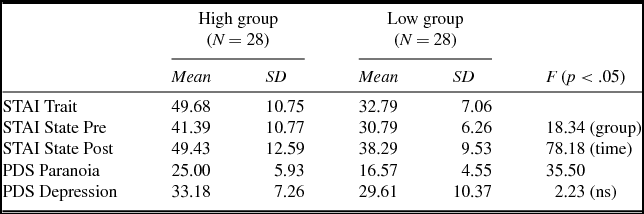
Table 1 shows the descriptive statistics for the STAI and PDS. To compare the anxiety scores of the groups before and after the task, a two-way factorial ANOVA was conducted. There was a significant main effect of group, F(1, 54) = 18.34, p < .05 and time, F(1, 54) = 78.18, p < .05, but no group by time interaction, F(1, 54) = 0.09, p > .05. Participants in the high paranoia group reported more anxiety than participants in the low paranoia group. All participants reported more anxiety after the task.
Descriptive statistics: STAI and PDS scores

PDS scores were compared between the two groups using one way ANOVAs. There was a significant effect of group on paranoid thoughts, F(1, 54) = 35.5, p < .05. The high paranoia group experienced more paranoid thoughts during the experimental task than the low group. There was no significant effect of group on depressive thoughts, F(1, 54) = 2.23, p > .05, which indicates that the two groups did not differ on the number of depressive thoughts experienced.
Strategic cognition and attentional focus
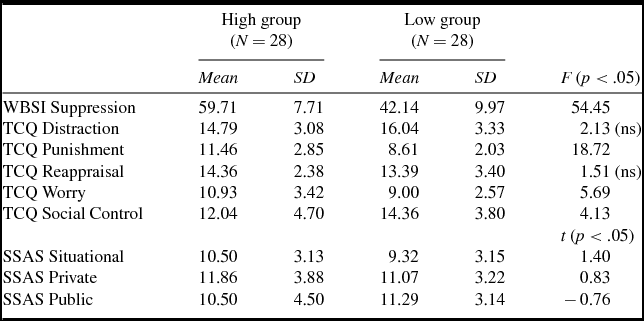
Table 2 gives descriptive statistics for the TCQ, WBSI and SSAS. A MANOVA was run to identify any differences in the use of strategic cognition. There were significant differences between the groups on suppression, F(1, 54) = 54.45, p < .05, punishment, F(1, 54) = 18.72, p < .05, worry, F(1, 54) = 5.69, p < .05, and social control, F(1, 54) = 4.13, p < .05. The high paranoia group scored significantly higher than the low paranoia group on measures of thought suppression, worry and punishment and significantly lower than the low paranoia group on social control. There were no significant differences between the two groups on distraction, F(1, 54) = 2.13, p > .05, or reappraisal, F(54) = 1.51, p > .05.
Descriptive statistics: thought control strategies and self-focused attention

T-tests revealed no significant differences between the two groups on any of the dimensions of self-focused attention; situational t(54) = 1.40, p > .5, private, t(54) = 0 .83, p > .05, and public t(54) = −0.76, p > .05.
Discussion
Summary of results
This study used an experimental design to investigate strategic cognition and attentional focus at times of threat, in individuals with high and low levels of non-clinical paranoia. The high paranoia group showed higher levels of trait and state anxiety compared with the low group. This adds to the growing body of literature indicating that paranoia and anxiety co-occur, and provides indirect support for cognitive models that emphasize the role of anxiety in paranoia (Freeman et al., Reference Freeman, Garety, Kuipers, Fowler and Bebbington2002).
Following the threat activation task, both groups showed a significant increase in anxiety. The high paranoia group also reported more paranoid thoughts during the task. No group differences were found in depressive cognition. This provides evidence that the threat activation task was effective in eliciting anxiety, and led to greater paranoid thinking for those in the high group.
Previous studies using similar tasks (Bodner and Mikulincer, Reference Bodner and Mikulincer1998; Ellett and Chadwick, Reference Ellett and Chadwick2007) did not measure anxiety or paranoia before threat induction, and therefore did not test whether the task induces anxiety or paranoid cognition. The results of the current study show that this version of the task was effective in manipulating anxiety in all participants, and activated a greater degree of mild paranoia in the high compared with the low paranoia group.
Having established that the threat activation task was effective, we then examined the extent to which strategic cognition was initiated following threat activation. As hypothesized, participants in the high paranoia group used more suppression, punishment and worry cognitive control strategies. This is consistent with and extends previous correlational studies to show that particular cognitive strategies are more likely to be used by people with non-clinical paranoia in interpersonal threat situations.
Insofar as suppression can lead to increases in unwanted thought, this strategy may contribute to the maintenance of distressing paranoia either because the thought content is associated with distress and/or because the very presence of the intrusions represents a failure in achieving the goal of mental control (Jones and Fernyhough, Reference Jones and Fernyhough2008). In learning theory terms, suppression is likely to maintain distress through a failure to habituate to aversive emotional stimuli; the person never gets a chance to learn that his or her most feared consequences are unlikely to ensue.
The use of punishment suggests that people with paranoia respond to aversive cognition with chastisement. This may maintain paranoia by reinforcing a view of the self as flawed in some way (such as guilty, bad or worthless) and deserving of punishment – beliefs commonly hypothesized to underpin vulnerability to paranoia. Like suppression, the greater use of worry in the high paranoia group, that is replacing unwanted or unpleasant thoughts with other thoughts, may negatively reinforce paranoia through avoidance of distressing cognition (cf. Borkovec, Alcaine and Behar, Reference Borkovec, Alcaine, Behar, Heimberg, Turk and Mennin2004). The high paranoia group also used less social control. We made no predictions about the use of social control given mixed findings in the literature to date. If replicated, it may be that this strategy may be another route to reducing opportunity for obtaining disconfirmatory evidence about feared consequences.
Surprisingly, there were no differences on measures of attentional focus. This is perplexing because it is inconsistent with both theory and past research. It is possible that the effect of the threat activation task increased self-focus in all participants, particularly as the experimental manipulation included a video camera and two-way mirror, which may have acted as self-focus manipulations. The lack of a baseline measure of attentional focus was an omission, and without this it is not possible to draw firm conclusions from the present findings.
Limitations
Sampling and measurement issues limit the study. The sample was not epidemiologically representative as it consisted of predominantly female, self-selected university students. As a laboratory study, the design also lacks ecological validity.
Although participants showed an increase in anxiety following the threat activation task, it is not possible to say whether this was associated with perceived interpersonal threat (being scrutinized and judged by the researcher) or another form of threat prompted by the task but not necessarily interpersonal in nature. It would be valuable to assess the nature of the threat activated by the task in future studies.
Perhaps most importantly, comparison measures of state paranoia and attentional-focus were not used before and after the threat task. Although we can say that the threat activation task was effective in inducing anxiety, and that those in the high paranoia group showed greater paranoid thinking than the low group when under threat, further work is required to map out exactly what is happening in this task. It may be that the task initiates paranoia in vulnerable individuals. Alternatively, it may be that the task heightens social anxiety processes, which in turn leads to paranoia in this group. Similarly, without a baseline measure of attentional focus, we cannot determine the impact of the task on self-focus. It is possible that the task increased self-focus in all participants, and acted as a self-focus manipulation.
Conclusions and implications
The threat activation task was effective in eliciting anxiety. In people with high non-clinical paranoia, this also led to greater paranoid thinking. Strategic cognition following threat activation varied with level of non-clinical paranoia; those in the high group used more suppression, punishment and worry, and less social control. If these differences are replicated in clinical groups, the strategies may be implicated in the maintenance of distressing psychosis through the mechanisms described above. Cognitive control strategies may therefore be a valuable target for therapeutic intervention.
Strategic cognition might usefully be incorporated in cognitive behavioural formulations of distressing paranoia and addressed in therapy (Newman Taylor and Stopa, Reference Newman Taylor and Stopa2013). Interestingly, Startup and colleagues have recently examined the impact of a worry based intervention (drawn from the generalized anxiety disorder literature) for people with persecutory delusions. The early results are promising; a brief intervention of just four sessions reduced distress associated with delusions and this was maintained at 2-month follow-up. There was also a trend to reduction in frequency of paranoid thoughts (Foster, Startup, Potts and Freeman, Reference Foster, Startup, Potts and Freeman2010; Startup et al., Reference Startup, Freeman and Garety2007). Our study, together with others’ work on cognitive control strategies, suggests that it may also be important to focus on suppression and punishment in therapeutic work aimed at alleviating distress in paranoia.



Comments
No Comments have been published for this article.