Introduction
Besides their ecological importance (Willoughby, Reference Willoughby2018; Ling et al., Reference Ling, Kriegisch, Woolley and Reeves2019), sea urchins are of commercial importance (Lauzon-Guay & Scheibling, Reference Lauzon-Guay and Scheibling2007; Rahman et al., Reference Rahman, Arshad and Yusoff2014). Sea urchins have been overfished around the world because of the increasing market requirements (Cirino et al., Reference Cirino, Ciaravolo, Paglialonga and Toscano2017), leading to a reduction in supply. Stock enhancement, which introduces small sea urchins into the field, is an important approach to meeting the increasing market requirements of sea urchins. Water flow greatly affects a series of fitness-related behaviours, including movement (Morse & Hunt, Reference Morse and Hunt2013), grazing (Kawamata, Reference Kawamata1998; Tamaki et al., Reference Tamaki, Kusaka, Fukuda, Arai and Muraoka2009) righting (Challener & McClintock, Reference Challener and McClintock2017) and covering (James, Reference James2000; Dumont et al., Reference Dumont, Drolet, Deschênes and Himmelman2007). Because these behaviours link to survival and growth, water flow is important for stock enhancement of sea urchins. Nevertheless, information is still limited on appropriate flow velocities for stock enhancement of sea urchins, although the effects of high water velocity were documented in the field (Lawrence, Reference Lawrence and Jangoux1996).
Sea urchins use their tube feet to attach to the sea bottom, effectively resisting the dislodgement risk in water flow (Morse & Hunt, Reference Morse and Hunt2013). The adhesion of tube feet regulates the movement of sea urchins and thus plays an important role in their foraging and risk avoidance (Cohen-Rengifo et al., Reference Cohen-Rengifo, Moureaux, Dubois and Flammang2017; Tamaki et al., Reference Tamaki, Muraoka and Inoue2018). Further, righting behaviour is essential to maintain activity in water flow (Lawrence, Reference Lawrence1975; Hagen, Reference Hagen and Bruno1994). Besides, covering behaviour plays a role in the response to waves, by increasing their weight (Crook, Reference Crook2003; Dumont et al., Reference Dumont, Drolet, Deschênes and Himmelman2007). However, quantitative studies of these fitness-related behaviours are still insufficient at certain flow velocities, despite their important implications for stock enhancement.
The sea urchin Mesocentrotus nudus is a commercially important species appropriate for stock enhancement, but not for long-line culture. In Japan, stock enhancement of M. nudus provides high-quality gonads and thus great commercial benefits (Agatsuma, Reference Agatsuma and Lawrence2020). Stock enhancement of M. nudus has also been important in China to meet the increasing market demands (~US$ 20 kg−1 in Chinese markets) (Wang et al., Reference Wang, Wu, Fang and Wang2006; Ding et al., Reference Ding, Zheng, Sun, Hu, Yu, Zhao and Chang2020). Releasing size is an important concern in the stock enhancement of M. nudus (Agatsuma & Kawai, Reference Agatsuma and Kawai1997). For example, M. nudus (test diameter >20 mm) were reseeded in April and harvested when the test diameter reached ~70 mm in Dalian, China. For the purposes of studying stock enhancement, we thus used M. nudus of test diameter of ~30 mm for the present study in April. The maximum flow velocity was ~90 cm s−1 in the Changshan Islands, which is the major field for the stock enhancement of M. nudus in China (Zhang, Reference Zhang2019). Therefore, the maximum flow velocity was set as 90 cm s−1 for the adhesive ability experiments. High flow velocity (>20 cm s−1) significantly inhibits the feeding and foraging of M. nudus (Agatsuma, Reference Agatsuma and Lawrence2013), seriously affecting their survival and growth. Thus, we set 20 cm s−1 as the maximum flow velocity, 10 cm s−1 as the medium flow velocity and 2 cm s−1 was set as the control flow velocity for the experiments of movement, righting and covering behaviours.
The main purposes of the present study were to investigate (1) the mean flow velocities to trigger dislodgement and to stop the movement of M. nudus and (2) the effects of velocities (2, 10 and 20 cm s−1) on movement, righting and covering behaviours of M. nudus. A better understanding of behavioural responses to water flow can provide valuable information on stock enhancement of M. nudus.
Materials and methods
Sea urchins
Mesocentrotus nudus were collected locally in the intertidal of Heishijiao in August 2017 and were cultured in the Key Laboratory of Mariculture & Stock Enhancement in North China's Sea, Ministry of Agriculture and Rural Affairs, China, until the experiments started in April 2018. One-third of the seawater in the tanks was changed every 3 days. The sea urchins were fed fresh kelp (Saccharina japonica) and wakame (Undaria pinnatifida). We used different sea urchins for each behavioural experiment. Before the experiment, test diameter and height were measured by a digital Vernier calliper (16EWR, Mahr Co., Germany). They were weighed using an electronic balance (JJ1000Y, G&G Co., USA). A total of 45 sea urchins were involved in the righting, covering and movement experiments. There was no significant difference in test diameter (29.97 ± 0.30 mm), test height (14.52 ± 0.24 mm) and body weight (10.69 ± 0.35 g) (P = 0.221 for test diameter, P = 0.771 for test height, P = 0.556 for body weight).
Experimental facility
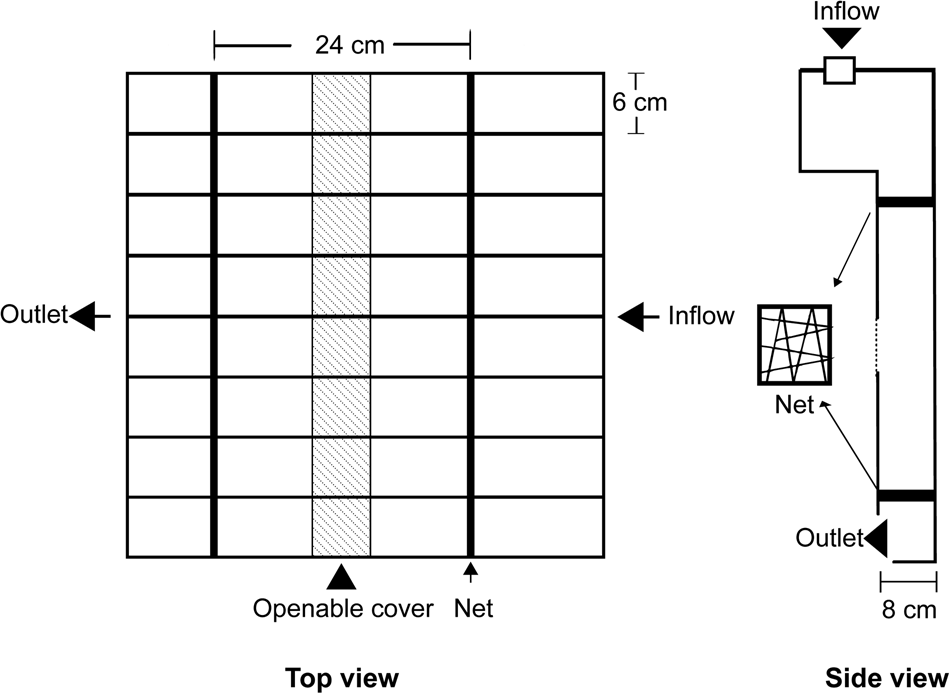
The experimental facility was a one-level tank made by acrylic material with eight separate runways (length × width × height = 420 × 60 × 80 mm) to exclude potential interference between individuals (Figure 1). Water flow regulators were independent to ensure the consistency of water flow in each of the eight separated runways. The experimental area was limited between the two nets in the runway (length × width × height = 240 × 60 × 80 mm) to ensure flow stability (Figure 1). Flow velocity was controlled by a ball valve and measured using a flow meter (JDC Electronic SA Co., Switzerland). Water flow was unidirectional. Water circulation was supported by a water pump (200 W, 20,000 l h−1, Jebao, China). We investigated the dislodgement and immobilization velocities within the maximum flow velocity (90 cm s−1) in a single runway. Further, three flow velocities (2 cm s−1, 10 cm s−1 and 20 cm s−1) were used for the experiments of movement, righting and covering behaviours.
Diagram of the facility used for measuring behaviours of Mesocentrotus nudus. The area of a runway is 24 × 6 × 8 cm (length × width × height), with two nets to limit the experimental area. The lid can be opened to put sea urchins into the facility. It was closed during the experiment.

Dislodgement and immobilization velocity
We individually assessed the velocity that dislodged M. nudus from the bottom (Tuya et al., Reference Tuya, Cisneros-Aguirre, Ortega-Borges and Haroun2007). After sea urchins adhered to the bottom and moved normally, we increased the flow velocity from 0 cm s−1 to that which detached sea urchins (the maximum was 90 cm s−1) within 3 min. The flow velocity was constantly accelerated for each trial. The flow velocity that detached sea urchins was recorded as the dislodgement velocity (N = 10). If the maximum flow did not dislodge the sea urchin, we recorded the dislodgement velocity as 90 cm s−1.
To measure the flow velocity that prevents the movement of M. nudus, we recorded the flow velocity that caused the sea urchin to stop moving. After the individual adhered to the bottom and moved normally, flow velocity was gradually increased until the sea urchin stopped moving. The immobilization velocity was that at which the sea urchin did not move within 15 s (N = 5).
Movement
We individually recorded the movement direction and distance and subsequently calculated the movement velocity of sea urchins at 2, 10 and 20 cm s−1 using a camera (FDR-AXP55, SONY Co., Japan). The experimental duration was 15 min. Since the water flow was unidirectional, we recorded the movement of sea urchins along with the water flow as downstream movement and against the water flow as upstream movement, respectively. Total movement distance, movement time, the distance of downstream and upstream movement were recorded using a video in the movement experiment. Movement velocity, upstream and downstream movement velocity were subsequently calculated (N = 5).
Covering behaviour
Covering is the behaviour in which sea urchins hold material (for example, particles and debris) on their aboral surface with their tube feet (Lawrence, Reference Lawrence1976). Twenty clear, white, round polished shells of small scallops (Mizuhopecten yessoensis, 20 ± 0.22 mm in diameter) were randomly placed in the experimental area for each experiment. The number of shells used for covering was measured for each sea urchin 15 min after the beginning of the experiment at each flow velocity (N = 5).
Righting response time
Righting response time refers to the time needed for a sea urchin to resume its normal posture with the aboral side up after being inverted to the aboral side down (Lawrence, Reference Lawrence1976). We measured the righting response time of M. nudus exposed to the three flow velocities within 5 min. When the individual did not right, we recorded the righting response time as 300 s (N = 5).
Statistical analysis
Normal distribution and homogeneity of variance were analysed using Kolmogorov–Smirnov test and Levene's test, respectively. One-way ANOVA was used to compare the movement velocity between the three flow velocities. Least-Significant Difference (LSD) test was used for post hoc comparisons when significant differences were found in the ANOVA. We analysed righting response time, covering and movement using the Kruskal–Wallis test and movement direction in a flow velocity using the Mann–Whitney U test, because of the heterogeneity of variance and/or abnormal distribution of the data. Statistical analyses were performed using SPSS (Version 22.0). A probability level of P < 0.05 was considered significant.
Results
Dislodgement and immobility velocities
The mean dislodgement velocity of M. nudus was 73.50 ± 7.7 cm s−1 (N = 10). The mean flow velocity that inhibited M. nudus movement was 33.40 ± 2.7 cm s−1 (N = 5).
Movement
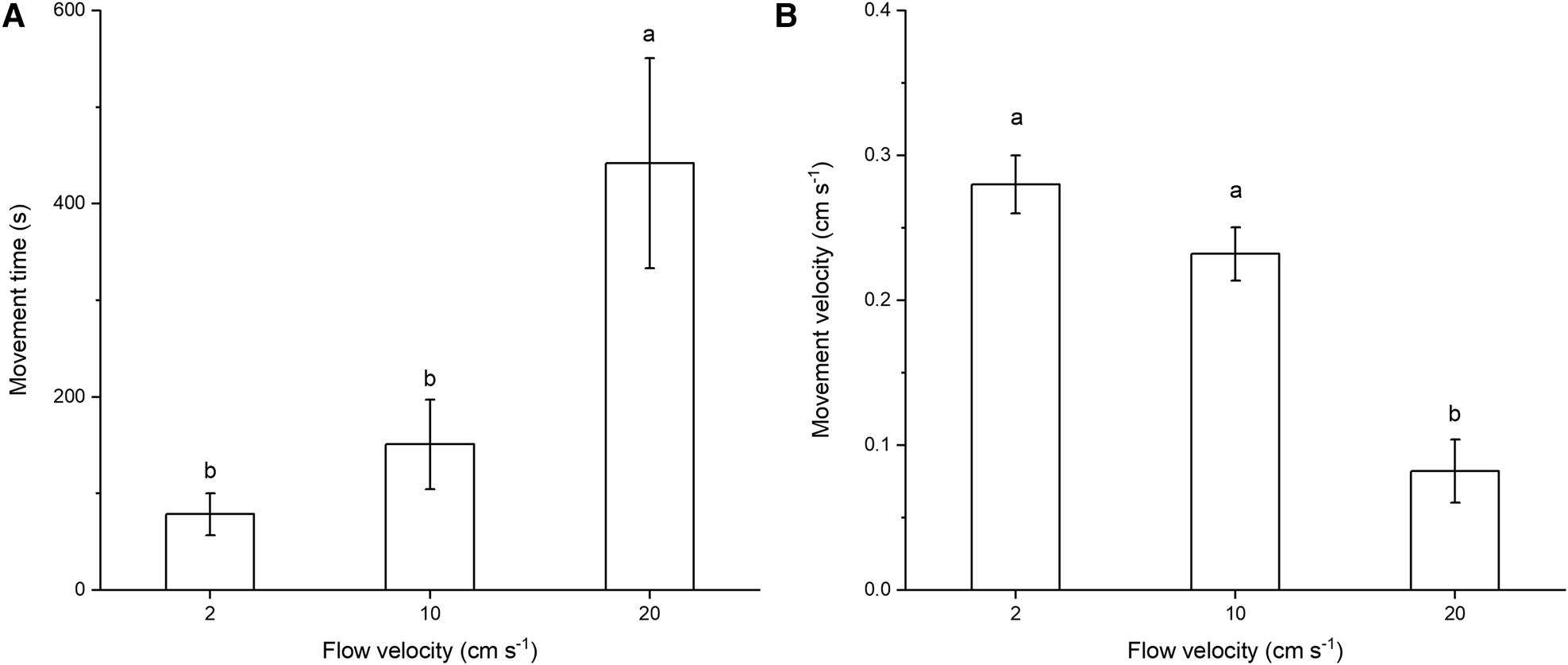
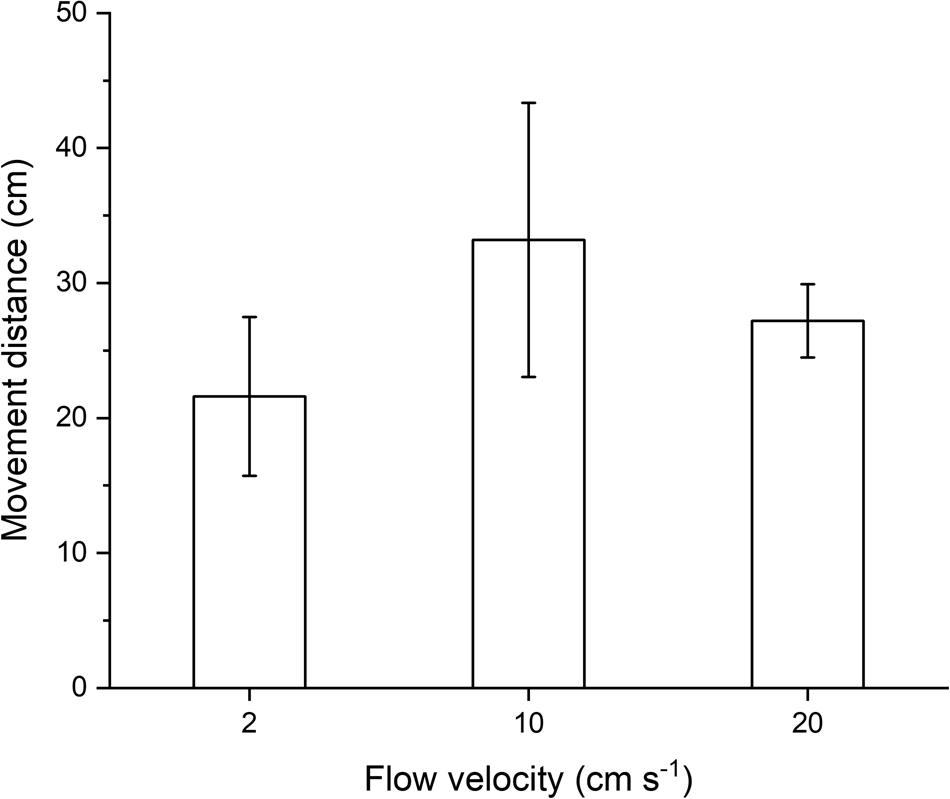
Flow velocity significantly affected movement time (P = 0.041, Figure 2A) and movement velocity (P < 0.001, Figure 2B), but not movement distance (P = 0.842, Figure 3). The movement time of M. nudus exposed to 20 cm s−1 was significantly longer than that at 2 cm s−1 (P = 0.036), while there was no significant difference between 2 cm s−1 and 10 cm s−1 (P = 0.965). Movement velocity of M. nudus exposed to 2 cm s−1 (P < 0.001) and 10 cm s−1 (P < 0.001) was significantly higher than that at 20 cm s−1. However, there was no significant difference of movement velocity between 2 cm s−1 and 10 cm s−1 (P = 0.117).
Total movement time (A) and movement velocity (B) of Mesocentrotus nudus at 2, 10 and 20 cm s−1 flow velocity (N = 5, mean ± SE). Different letters above the bars refer to the significant difference among experimental groups.

Movement distance of Mesocentrotus nudus during 15 min at 2, 10 and 20 cm s−1 flow velocity (N = 5, mean ± SE).

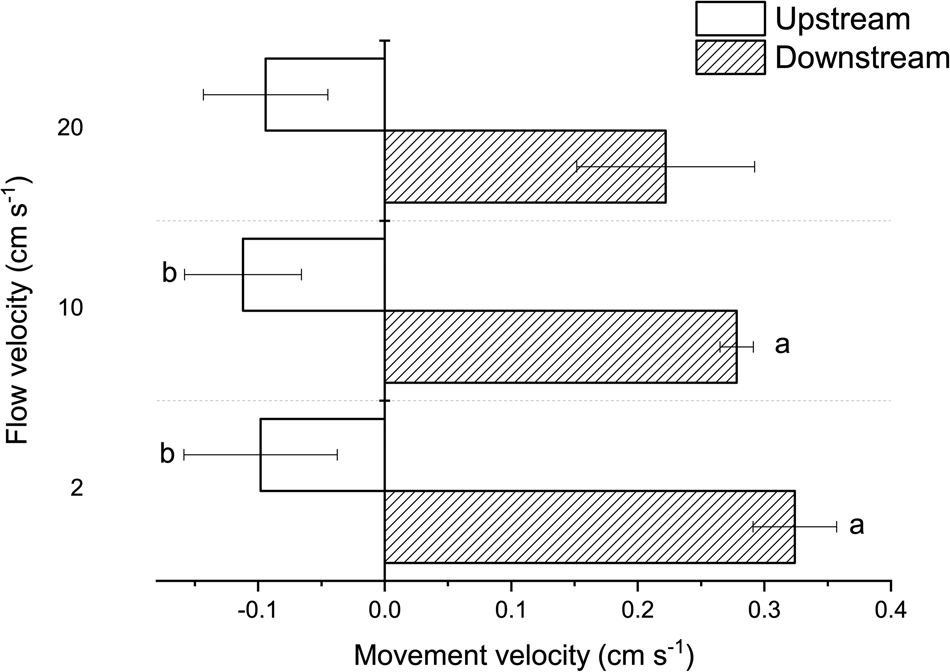
Neither movement distance (P = 0.405 and 0.482), movement velocity (P = 0.400 and 0.803), nor movement time (P = 0.664 and 0.082) varied significantly at 2 cm s−1, 10 cm s−1 and 20 cm s−1 in downstream and upstream movement. However, the velocity in the downstream movement was significantly higher than that in the upstream at 2 cm s−1 (P = 0.016) and 10 cm s−1 (P = 0.008) (Figure 4). There was no significant difference in movement velocity between downstream and upstream at 20 cm s−1 (P = 0.222).
Movement velocity of Mesocentrotus nudus upstream and downstream at 2, 10 and 20 cm s−1 flow velocity (N = 5, mean ± SE). Different letters beside the bars refer to the significant difference among experimental groups.

Covering behaviour
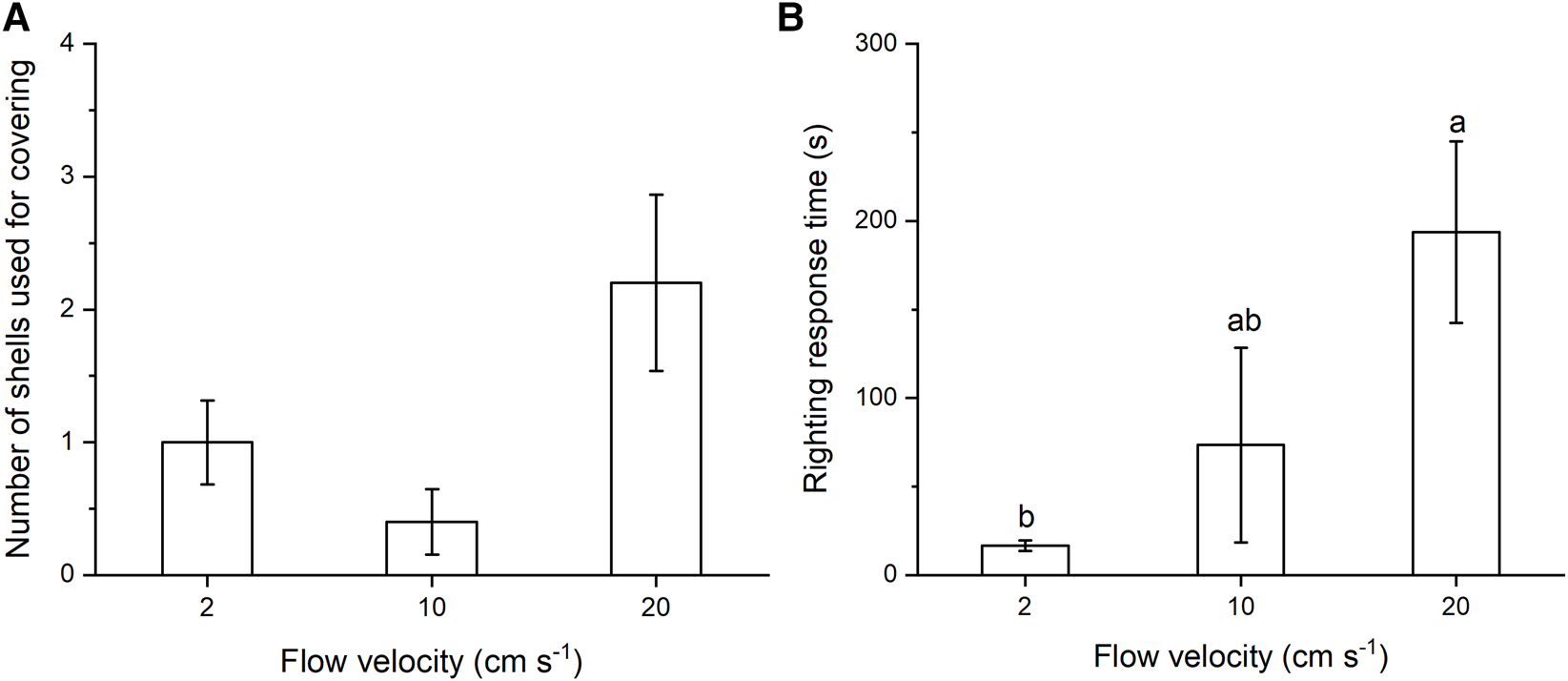
There was no significant difference in the number of shells used for covering among 2 cm s−1, 10 cm s−1 and 20 cm s−1 (P = 0.073, Figure 5A).
Number of shells used for covering (A) and righting response time (B) of Mesocentrotus nudus at 2, 10 and 20 cm s−1 flow velocity (N = 5, mean ± SE). Different letters above the bars refer to the significant difference among experimental groups.

Righting response time
Righting response time of M. nudus exposed to 20 cm s−1 was significantly longer than that at 2 cm s−1 (P = 0.015). However, there was no significant difference of righting response time among M. nudus at 2 cm s−1 and 10 cm s−1 (P = 1.000, Figure 5B).
Discussion
Sea urchins use tube feet to attach to the sea bottom to prevent dislodgement at high water flow velocities (Santos & Flammang, Reference Santos and Flammang2008). This is essential for the survival and consequently for stock enhancement of M. nudus. In the present study, we found that the dislodgement velocity was 73.50 ± 7.7 cm s−1 for M. nudus (~30 mm test diameter). The dislodgement velocity of M. nudus was greater than that of the sea urchin Diadema antillarum (test diameter of 22–27 mm), but less than that in the sea urchin Arbacia lixula (test diameter of 23–29 mm) (Tuya et al., Reference Tuya, Cisneros-Aguirre, Ortega-Borges and Haroun2007). This suggests that differences of adhesion ability exist among sea urchin species with different spine size, orientation and the number of tube feet available for attachment (Sharp & Gray, Reference Sharp and Gray1962; Tuya et al., Reference Tuya, Cisneros-Aguirre, Ortega-Borges and Haroun2007). Alternatively, the disparity may be partially due to the test diameter which is slightly larger in the present study, considering adherence is size-independent according to the safety factor evaluated by the attachment ability of the sea urchin A. lixula (Santos & Flammang, Reference Santos and Flammang2007). The current result indicates that tube feet of M. nudus could not adhere at a flow velocity of ~70 cm s−1 and is thus easily dislodged (Agatsuma, Reference Agatsuma and Lawrence2013). Therefore, the reseeding of M. nudus is probably not appropriate in the areas with a flow velocity of more than ~70 cm s−1.
Movement occurs when the flow velocity is in the safe range (Santos & Flammang, Reference Santos and Flammang2008). In the present study, 33.40 ± 2.7 cm s−1 was the flow velocity that inhibited the movement of M. nudus. This result generally agrees with the finding of Kawamata (Reference Kawamata1998) that M. nudus ceased movement at >40 cm s−1. The partial disagreement between the two studies is probably because of the difference of test diameter, which is ~30 mm in the present study and 55–86 mm in Kawamata (Reference Kawamata1998). These results indicate that small M. nudus could be reseeded in areas with a flow velocity below 30 cm s−1. This is because movement is the basis for the other fitness-related behaviours such as foraging (Agatsuma, Reference Agatsuma and Lawrence2013) and sheltering (Tamaki et al., Reference Tamaki, Muraoka and Inoue2018) of sea urchins (Santos & Flammang, Reference Santos and Flammang2008; Morse & Hunt, Reference Morse and Hunt2013).
To better understand the behavioural responses of M. nudus to water flow, we investigated their movement, displacement direction, covering and righting behaviours at flow velocities below 33.40 ± 2.7 cm s−1 (2, 10 and 20 cm s−1). In the present study, movement velocity was reduced by more than half at 20 cm s−1, compared with that at 2 cm s−1. This result is consistent with the report that movement velocity significantly decreased under high-velocity water currents in M. nudus (Kawamata, Reference Kawamata1998; Agatsuma, Reference Agatsuma and Lawrence2013) and Strongylocentrotus droebachiensis (Morse & Hunt, Reference Morse and Hunt2013). A reasonable explanation is that sea urchins probably use more energy to maintain body stability at high water velocity (Morse & Hunt, Reference Morse and Hunt2013). There was no significant difference in movement distance among the three flow velocities. However, movement time was longer at 20 cm s−1 than those at 2 cm s−1 and 10 cm s−1. Shorter movement time probably impacts the capacity to find shelter and consequently increases the risk of predation in the field, although M. nudus can retain movement and other behaviours, including sheltering (Tamaki et al., Reference Tamaki, Muraoka and Inoue2018) and grazing (Kawamata, Reference Kawamata1998) at 20 cm s−1. Further, flow velocity affected the movement velocity of the sea urchins in the two directions. Downstream movement velocity of M. nudus was significantly higher than upstream movement velocity at 2 cm s−1 and 10 cm s−1 (P = 0.016 and P = 0.008), but not at 20 cm s−1 (P = 0.222). This result indicates that M. nudus tends to move downstream at low flow velocities, while this trend decreases at high flow velocities. This result is consistent with the finding of Morse & Hunt (Reference Morse and Hunt2013) that sea urchins tended to move downstream and upstream at low and high flow velocities, respectively. Twenty cm s−1 significantly limits the movement direction of M. nudus and is probably detrimental to its escape from adverse environments. This suggests that flow velocity above 20 cm s−1 markedly affects the movement of M. nudus and thus probably is not appropriate for reseeding.
Covering behaviour supports the sea urchin Lytechinus anamesus to stabilize under wave exposure (Lees & Carter, Reference Lees and Carter1972). Sea urchins cover themselves with objects to increase their weight, partly because light individuals are susceptible to strong water flow (Crook, Reference Crook2003). In the present study, however, no significant difference in covering behaviour was found between 2, 10 and 20 cm s−1. This suggests that 20 cm s−1 may not affect the stability of M. nudus. Righting response time of M. nudus is significantly longer at 20 cm s−1 (16.60 ± 3.11 s) than at 2 cm s−1 (193.80 ± 51.26 s, P = 0.015). This indicates that righting behaviour is weakened at high flow velocities. However, this result is not consistent with the finding of Challener & McClintock (Reference Challener and McClintock2017) that L. variegatus improved righting behaviour at high flow velocity. This disagreement is probably because of the difference of the sediment and flow type, which was a smooth surface and unidirectional water flow (2–20 cm s−1) in the present study but sand surface and in waves (60 cm s−1) in Challener & McClintock (Reference Challener and McClintock2017). Notably, the present study is a laboratory investigation and probably different from the hygrographic conditions in the field.
Conclusions
In conclusion, a velocity below 30 cm s−1 would be indicated to be appropriate for reseeding of M. nudus (test diameter of ~30 mm) to avoid dislodgement and to ensure their movement. Flow velocity of 20 cm s−1 significantly affected the righting (P = 0.015) and movement behaviours (P < 0.001) of M. nudus. Sea areas with a flow velocity less than 20 cm s−1, preferably 2–10 cm s−1, would be expected to be appropriate for stock enhancement of M. nudus. The present study provides valuable information for stock enhancement of M. nudus. Future investigations, however, should be carried out on the effects of long-term water flow on feeding and growth of M. nudus both in the laboratory and the field.
Acknowledgements
We thank Prof. John Lawrence for academic and editorial suggestions. All authors have no conflict of interest.
Financial support
This work was supported by the National Natural Science Foundation of China (grant number 41506177), Laboratory for Marine Fisheries Science and Food Production Processes, Qingdao National Laboratory for Marine Science and Technology, China P. R. (grant number 2017-1B05), a grant for innovative talents in universities in Liaoning Province (for Chong Zhao), Chinese Outstanding Talents in Agricultural Sciences (for Yaqing Chang).