





Highlights
-
• Verbal fluency (VF) taps into the development of children’s lexical-semantic abilities.
-
• We show VF data from 345 children, autistic and non-autistic, monolingual and multilingual.
-
• Multilingualism measured with a continuous, language exposure entropy.
-
• Neurotypical group: Multilingual VF advantage emerges over primary school years.
-
• Autistic group: No effect of multilingualism on VF.
-
• Conclusion 1: Multilingualism benefits lexical-semantic development of non-autistic children. Conclusion 2: Multilingualism is not detrimental to lexical-semantic development of autistic children.
1. Introduction
The majority of people in the world are multilingualFootnote 1 (Bennett & Verney, Reference Bennett and Verney2019; Grosjean, Reference Grosjean2024), and children are no exception. The more recent literature is rich in studies investigating the effect of multilingualism on the cognitive and linguistic development of children. Findings are mixed, including mainly null effects (i.e., no difference in performance between multilinguals and monolinguals) or positive effects (i.e., better performance in multilinguals than monolinguals) for a wide range of abilities (Bialystok, Reference Bialystok2009), the latter including metalinguistic knowledge (Adesope et al., Reference Adesope, Lavin, Thompson and Ungerleider2010; Bialystok et al., Reference Bialystok, Majumder and Martin2003; Campbell & Sais, Reference Campbell and Sais1995; Galambos & Goldin-Meadow, Reference Galambos and Goldin-Meadow1990) and executive functions (EFs; see Bialystok, Reference Bialystok2001; Bialystok & Craik, Reference Bialystok and Craik2022; also Adesope et al., Reference Adesope, Lavin, Thompson and Ungerleider2010; Grundy, Reference Grundy2020; Grundy & Timmer, Reference Grundy and Timmer2017; van den Noort et al., Reference Van den Noort, Struys, Bosch, Jaswetz, Perriard, Yeo, Barisch, Vermeire, Lee and Lim2019 for meta-analyses).
While for non-autistic children the effect of multilingualism on their cognitive and communicative development seems to be largely positive, the picture is still less clear for children facing cognitive and linguistic challenges during their development. Among these, the effect of multilingualism could be particularly relevant for children diagnosed with Autism Spectrum Disorder (ASD): As we outline in more detail below, multilingualism benefits the development of exactly those cognitive and linguistic abilities that are often challenging or delayed in autism. This is all the more pertinent because families of autistic children are often advised to expose their children to only one language (Hampton et al., Reference Hampton, Rabagliati, Sorace and Fletcher-Watson2017), with the goal of reducing potentially confusing input (Yu, Reference Yu2013), despite the social and emotional impact of this practice (Halle et al., Reference Halle, Whittaker, Zepeda, Rothenberg, Anderson, Daneri, Wessel and Buysse2014; Han & Huang, Reference Han and Huang2010; Kim & Roberti, Reference Kim and Roberti2014; Kremer-Sadlik, Reference Kremer-Sadlik, Cohen, McAlister, Rolstad and MacSwan2005; Opitz & Degner, Reference Opitz and Degner2012; Yu, Reference Yu2013). Given our current relative lack of knowledge, more research on the influence of multilingualism on the cognitive and linguistic development of autistic children is clearly needed (see Davis et al., Reference Davis, Hampton and Fletcher-Watson2022).
Here, we present the results of a study investigating the influence of multilingualism on the development of lexical-semantic abilities in 345 children, ranging from 3 to 13 years in age. The participant group includes neurotypical (in the following, non-autistic) children as well as children diagnosed with ASD (in the following, autistic children). Both of these groups include monolingual and multilingual children. In contrast to earlier studies, we operationalise multilingualism not as a binary predictor but rather as the continuous measure of language exposure entropy (Gullifer & Titone, Reference Gullifer and Titone2020). This measure reflects the amount of predictability of which language a child will be exposed to. In this way, it allows to resolve different linguistic experiences, for example, of children exposed to mainly one language, children exposed to multiple languages with one language input being more frequent (e.g., the society majority language versus a heritage language spoken mainly during communication with extended family), or children exposed to multiple languages in their daily lives, within multilingual school or family settings, thereby providing a continuous ‘degree’ of multilingualism rather than a binary distinction between monolingual and multilingual experiences (see below for a detailed explanation of language exposure entropy). Children’s lexical-semantic abilities are assessed via measurements of VF, including both semantic and phonemic VF. Our research has the two following goals:
-
(1) To provide an assessment of the influence of multilingualism on both types of VF for a high number of non-autistic children, using a continuous measure of multilingualism relevant for the development of lexical-semantic abilities.
-
(2) To assess whether the effects of multilingualism on VF found in non-autistic children are similar for autistic children, or whether language entropy has a different effect, given the unique cognitive and linguistic developmental trajectories of autistic children.
In the following Background section, we give an overview of the literature on VF tasks, with special attention to the literature on (a) the performance of autistic children in VF tasks, (b) the role of multilingualism for VF in children and (c) the general influence of multilingualism on the cognitive and communicative development of autistic children. This will allow us to illustrate which gaps in the literature we are aiming to fill and to formulate more specific research questions before presenting our study.
2. Background
2.1. Verbal fluency tasks
VF tasks provide a simple, yet highly informative measure of participants’ verbal and cognitive abilities (Shao et al., Reference Shao, Janse, Visser and Meyer2014). In this task, participants are asked to produce as many words as they can within a short time span, usually 60 seconds. In semantic VF tasks, the produced words must be members of a specific semantic category (e.g., animals, proper names, etc.), allowing speakers to draw on semantic networks. In phonemic or letter VF tasks, the produced words must begin with a specific letter or phoneme (e.g., the letter m). VF tasks provide a host of different measures: the numbers of correct words produced, errors, fluency difference scores depicting semantic in contrast to phonemic fluency, as well as the number and size of produced clusters in both kinds of tasks (see Patra et al., Reference Patra, Bose and Marinis2020, for an overview of different measures available and their interpretation). Due to the high number of participants and languages included in our study, our own analysis will focus on the numbers of words produced.
The number of words produced in a VF task is obviously related to the participant’s vocabulary size and lexical access abilities (e.g., Aita et al., Reference Aita, Beach, Taylor, Borgogna, Harrell and Hill2019; Pino Escobar et al., Reference Pino Escobar, Kalashnikova and Escudero2018). Another aspect of cognition reflected in the number of produced words is executive control abilities (Pino Escobar et al., Reference Pino Escobar, Kalashnikova and Escudero2018), since participants have to suppress the production of words that do not match the requirements of the VF task. Participants usually produce a higher number of words in semantic than in phonemic VF tasks (Shao et al., Reference Shao, Janse, Visser and Meyer2014). It has been argued that this reflects the fact that the lexicon is organised in semantic networks, making phonemic VF tasks the more taxing ones: Semantically associated words beginning with an inappropriate letter will be coactivated in both kinds of VF task but must be inhibited for phonemic ones (see Friesen et al., Reference Friesen, Luo, Luk and Bialystok2015; Luo et al., Reference Luo, Luk and Bialystok2010). Thus, while both types of VF reflect a mix of abilities, for semantic VF the contribution of linguistic and lexical abilities is thought to be higher, whereas executive control is thought to contribute more to phonemic VF (Luo et al., Reference Luo, Luk and Bialystok2010; Sandoval et al., Reference Sandoval, Gollan, Ferreira and Salmon2010; Shao et al., Reference Shao, Janse, Visser and Meyer2014). While the comparison of semantic and phonemic VF can illuminate the relative influence of linguistic and executive control skills in different participant populations, it should not be mistaken for a direct measure of executive control. Indeed, Shao et al. (Reference Shao, Janse, Visser and Meyer2014), who monitor correlations between independent EF measures and phonemic and semantic VF, find no differences between both VF measures (see also discussion in Paap et al., Reference Paap, Myuz, Anders, Bockelman, Mikulinsky and Sawi2017).
In non-autistic children, age is an important predictor of VF task performance (Kavé et al., Reference Kavé, Kigel and Kochva2008; Koren et al., Reference Koren, Kofman and Berger2005), with the age range between 6 and 12 showing a strong development (Brocki & Bohlin, Reference Brocki and Bohlin2004; García et al., Reference García, Rodríguez, Martín, Jiménez, Hernández and Díaz Megolla2012; Korkman et al., Reference Korkman, Kemp and Kirk2001; Matute et al., Reference Matute, Rosselli, Ardila and Morales2004). During this age range, children begin producing more words with increasing ages (Koren et al., Reference Koren, Kofman and Berger2005; Nieto et al., Reference Nieto, Galtier, Barroso and Espinosa2008; Sauzéon et al., Reference Sauzéon, Lestage, Raboutet, N’Kaoua and Claverie2004).
2.2. VF performance of autistic children
VF tasks have proven useful in investigations of the verbal abilities of autistic children. Autism is a widespread neurodevelopmental condition affecting social communication as well as a number of factors that influence VF performance (APA, 2022). For verbal autistic speakers, lexical abilities are usually not affected (Arunachalam & Luyster, Reference Arunachalam and Luyster2016; Ellawadi et al., Reference Ellawadi, Fein and Naigles2017; Schaeffer et al., Reference Schaeffer, Abd El-Raziq, Castroviejo, Durrleman, Ferré, Grama, Hendriks, Kissine, Manenti, Marinis, Meir, Novogrodsky, Perovic, Panzeri, Silleresi, Sukenik, Vicente, Zebib, Prévost and Tuller2023), with vocabulary knowledge sometimes reported as a particular strength (Kjelgaard & Tager-Flusberg, Reference Kjelgaard and Tager-Flusberg2001; but see Bowler et al., Reference Bowler, Limoges and Mottron2009; Toichi & Kamio, Reference Toichi and Kamio2002, for reports of deficits in the semantic system). However, a number of studies find lexical deficits in autistic children compared to their non-autistic peers (Boser et al., Reference Boser, Higgins, Fetherston, Preissler and Gordon2002; Boucher, Reference Boucher2012; Naigles et al., Reference Naigles, Kelley, Troyb and Fein2013), and the assessment of lexical abilities for autistic children is recognised to be no trivial task (Sukenik & Tuller, Reference Sukenik and Tuller2023). In addition, many autistic individuals present with difficulties in EFs (see Filipe et al., Reference Filipe, Veloso, Frota and Vicente2020; Lopez et al., Reference Lopez, Lincoln, Ozonoff and Lai2005; Ozonoff et al., Reference Ozonoff, Pennington and Rogers1991; Xiao et al., Reference Xiao, Xiao, Ke, Hong, Yang, Su, Chu, Xiao, Shen and Liu2012; a.o, but also Durrleman & Franck, Reference Durrleman and Franck2015; Durrleman et al., Reference Durrleman, Delage, Prévost and Tuller2017; Lam & Yeung, Reference Lam and Yeung2012 for similar EF performance in autistic and non-autistic participants), which contribute to VF performance. For autistic adults, findings in VF performance are inconsistent, with some evidence for lower numbers of produced words in letter and semantic VF tasks (Spek et al., Reference Spek, Schatorjé, Scholte and van Berckelaer-Onnes2009, Carmo et al., Reference Carmo, Duarte, Pinho, Marques and Filipe2015; Ehlen et al., Reference Ehlen, Roepke, Klostermann, Baskow, Geise, Belica, Tiedt and Behnia2020).
For autistic children, there are different patterns in VF performance reported in the literature. One line of research shows similar performance in autistic and non-autistic children with respect to the total numbers of produced words (Corbett et al., Reference Corbett, Constantine, Hendren, Rocke and Ozonoff2009; Dunn et al., Reference Dunn, Gomes and Sebastian1996; Happé et al., Reference Happé, Booth, Charlton and Hughes2006; Robinson et al., Reference Robinson, Goddard, Dritschel, Wisley and Howlin2009), sometimes in combination with between-group differences in cluster sizes (Begeer et al., Reference Begeer, Wierda, Scheeren, Teunisse, Koot and Geurts2014). In contrast, another group of studies shows systematically lower performance, namely, a lower number of total words produced, in autistic than non-autistic children (Czermainski et al., Reference Czermainski, Riesgo, Guimarães, Salles and Bosa2014; Geurts et al., Reference Geurts, Verté, Oosterlaan, Roeyers and Sergeant2016; Mashal & Kasirer, Reference Mashal and Kasirer2012; Pastor-Cerezuela et al., Reference Pastor-Cerezuela, Fernández-Andrés, Feo-Álvarez and González-Sala2016; Verté et al., Reference Verté, Geurts, Roeyers, Oosterlaan and Sergeant2006; Zarokanellou et al., Reference Zarokanellou, Papanikolaou, Tafiadis and Kolaitis2023). Contradictory findings may reflect different experiment choices, for instance, with respect to whether participants were or were not matched on vocabulary scores. Equal performance is more likely in matched groups of autistic and non-autistic children (see Zarokanellou et al., Reference Zarokanellou, Papanikolaou, Tafiadis and Kolaitis2023, for an in-depth discussion).
Taken together, earlier studies report either lower VF or similar VF in monolingual autistic children when compared to their non-autistic peers. Discrepancies seem to reflect the approach taken to participant matching in the studies, with studies with careful matching in linguistic abilities or verbal intelligence reporting similar findings. Very detailed analyses of VF measures suggest subtle qualitative differences between children from both groups. To date, only a limited number of studies offer data on both phonemic and semantic VF in autistic children side by side.
2.3. The role of multilingualism for the development of lexical-semantic abilities and verbal fluency
Both the easy administration of VF tasks and the fact that they tap into lexical-semantic abilities make them very useful for investigating the effects of multilingualism. Generally, multilingualism has been found to have an effect on cognition (Bialystok, Reference Bialystok2007, Reference Bialystok2009; see Bialystok & Craik, Reference Bialystok and Craik2022, for a recent overview; but see Gunnerud et al., Reference Gunnerud, Ten Braak, Reikerås, Donolato and Melby-Lervåg2020; Lehtonen et al., Reference Lehtonen, Soveri, Laine, Järvenpää, De Bruin and Antfolk2018), for instance, on the development of executive functions like inhibition and working memory (Adesope et al., Reference Adesope, Lavin, Thompson and Ungerleider2010; Bialystok, Reference Bialystok2024; Giovannoli et al., Reference Giovannoli, Martella, Federico, Pirchio and Casagrande2020; Monnier et al., Reference Monnier, Boiché, Armandon, Baudoin and Bellocchi2022; Yurtsever et al., Reference Yurtsever, Anderson and Grundy2023; but see Paap et al., Reference Paap, Majoubi, Balakrishnan and Anders-Jefferson2025). While the majority of these effects of multilingualism have been investigated for non-autistic children, some findings also exist for autistic children, indicating that multilingualism can make important contributions to their cognitive and communicative development (see, e.g., Fletcher-Watson & MacPherson, Reference Fletcher-Watson and MacPherson2021, for an overview of EF development; also Davis et al., Reference Davis, Hampton and Fletcher-Watson2022, for an explicit outline of open research questions). While multilingualism has been shown to generally have a positive effect on EF development, it can also lead to increased lexical competition, reflected in longer reaction times and more frequent tip-of-the-tongue states for multilinguals than for monolinguals (Costa & Caramazza, Reference Costa and Caramazza1999; Marian & Spivey, Reference Marian and Spivey2003; see Kroll & Dussias, Reference Kroll and Dussias2024, for a comprehensive and recent overview).
Thus, VF performance in multilinguals is likely to reflect a mix of multilingualism effects on cognition, and potentially a trade-off between advantages and disadvantages (see Dentella et al., Reference Dentella, Masullo and Leivada2024, for an overview). This trade-off is reflected in the mixed findings for VF performance in multilingual adults. One line of research finds that compared to monolinguals, multilinguals produce a lower number of words in VF tasks in both their first language and their currently dominant language (Gollan & Acenas, Reference Gollan and Acenas2004; Gollan et al., Reference Gollan, Montoya and Bonanni2005; Ivanova & Costa, Reference Ivanova and Costa2008; Ransdell & Fischler, Reference Ransdell and Fischler1987), with other studies indicating that this multilingual VF disadvantage does not hold when both participant groups are matched on their receptive vocabulary in the language of testing (Bialystok et al., Reference Bialystok, Craik and Luk2008; Luo et al., Reference Luo, Luk and Bialystok2010). When a multilingual VF disadvantage is found, it tends to be more pronounced in semantic than in phonemic fluency (Gollan et al., Reference Gollan, Montoya and Werner2002; Portocarrero et al., Reference Portocarrero, Burright and Donovick2007; Rosselli et al., Reference Rosselli, Ardila, Araujo, Weekes, Caracciolo, Padilla and Ostrosky-Solí2000). A limited number of studies even report a multilingual advantage in phonemic fluency (Sandoval et al., Reference Sandoval, Gollan, Ferreira and Salmon2010), in particular, when groups are matched on vocabulary (Luo et al., Reference Luo, Luk and Bialystok2010).
In non-autistic children, multilingualism also has been shown to affect VF task performance. Friesen et al. (Reference Friesen, Luo, Luk and Bialystok2015) measured semantic and letter VF in monolingual and multilingual participants at different ages, ranging from 7 years to older adulthood (7 year olds n = 39; 10 year olds n = 45, young adults n = 40, older adults n = 41). Generally, the number of words produced increased from childhood into young adulthood, plateauing over the adult years. While semantic VF was not influenced by multilingualism, letter VF showed a multilingual advantage emerging around 10 years of age and remaining robust over the adult year. Friesen et al. (Reference Friesen, Edwards and Lamoureux2021) monitored semantic and letter VF for English in monolingual children (n = 31) and multilingual children (n = 63) from grades 4 and 6. While the raw VF measures revealed no group differences, a multilingual advantage emerged for both semantic and letter VF once English receptive vocabulary and fluid intelligence measures were added as covariates. For monolinguals, English receptive vocabulary predicted VF performance, while for multilinguals with high cognitive ability, fluid intelligence was an additional predictor. The authors interpret their findings as showing that compared to monolinguals, multilingual children recruit additional cognitive resources for VF tasks.
Taken together, VF performance across childhood reflects children’s developing lexical-semantic abilities. The relatively small, but growing literature on VF performance in multilingual children suggests a multilingual advantage emerging around the age of 10. Compared to monolingual children with matched vocabulary, multilingual children produce more words; they may also be able to use additional cognitive resources. These findings suggest that the general benefit of multilingualism for EF abilities may contribute to the multilingual VF advantage, without providing an exhaustive explanation.
To our knowledge, there is currently a single study available that monitors the influence of multilingualism on the VF performance of autistic children. Gonzalez-Barrero and Nadig (Reference Gonzalez-Barrero and Nadig2017) investigated VF in monolingual and multilingual children, who were either typically developing children or diagnosed with ASD (n = 13 per group). This study employed the word association subtest of the Clinical Evaluation of Language Fundamentals (Semel et al., Reference Semel, Wiig and Secord2003), which is similar to a semantic VF task. Results show that monolingual autistic children produced a lower number of words than multilingual autistic children; these produced the same numbers of words as monolingual and multilingual non-autistic children. No effect was found on the numbers of switches and cluster sizes. The authors take the difference between monolingual and multilingual autistic children as an indication that multilingualism had a positive effect on children’s generativity or response initiation abilities.
2.4. Background summary and research question
Considering the information laid out in the background section, the following picture emerges:
-
• VF task performance differs in autistic and non-autistic speakers, but findings are still inconclusive. While there are many reports of autistic participants producing lower numbers of words in semantic and VF tasks than NT participants, these findings are less robust when participants are carefully matched on cognitive and linguistic measures. The amount of available VF task data from autistic children is still limited. In addition, the literature usually does not consider the pronouncedness of autistic symptoms in autistic children.
-
• Multilingualism seems to have an influence on VF measures. While findings are varied, there is a tendency for multilinguals to perform equally well or worse than monolinguals in semantic VF tasks (with equal performance more likely in closely matched participant groups). In contrast, multilinguals tend to perform equally well or better than monolinguals in phonemic and letter VF tasks. This discrepancy between both groups has been argued to reflect the trade-off between increased lexical access cost and enhanced EF skills in multilinguals (see Dentella et al., Reference Dentella, Masullo and Leivada2024).
-
• Multilingual advantages in VF measures emerge in later childhood and are robust in younger adults.
-
• There is first evidence in the literature that the developmental advantages associated with multilingualism extend to the development of autistic children. Multilingual autistic children have been shown to perform like their non-autistic peers in semantic VF tasks, while monolingual autistic children show reduced semantic fluency relative to monolingual non-autistic peers (Gonzalez-Barrero & Nadig, Reference Gonzalez-Barrero and Nadig2017).
Despite the impressive amount of literature on the topics outlined above, data on the role of autism and multilingualism in the development of VF in children are still lacking. One example is the fact that there is no study investigating phonemic fluency in multilingual autistic children, and whether its development patterns differently from semantic VF. Another example is that many of the studies cited above investigate comparatively small numbers of children, which makes it difficult to interpret absent effects (n = 52 in Begeer et al., Reference Begeer, Wierda, Scheeren, Teunisse, Koot and Geurts2014; ASD group n = 47, TD group n = 53 in Pastor-Cerezuela et al., Reference Pastor-Cerezuela, Fernández-Andrés, Feo-Álvarez and González-Sala2016; ASD group n = 20, TD group n = 20 in Zarokanellou et al., Reference Zarokanellou, Papanikolaou, Tafiadis and Kolaitis2023, to name a few examples from the literature on VF development in autistic children). Typically, the pronouncedness of autistic symptoms in autistic children is not taken into account. In addition, the literature on VF in non-autistic children tends to investigate binary contrasts of monolingual and multilingual children, ignoring continuous measures of multilingualism that might provide more nuanced insights (see, a.o., Baumeister et al., Reference Baumeister, Wolfer, Solaimani, Daum and Durrleman2025; Solaimani et al., Reference Solaimani, Wolfer, Baumeister, Chondrogianni, Bentea and Durrleman2026; Wolfer, Baumeister, Borrellas, et al., Reference Wolfer, Baumeister, Borrellas, Czypionka, Naigles and Durrleman2025; Wolfer, Baumeister, Daum, et al., Reference Wolfer, Baumeister, Daum, Dimitrova, Leone, Naigles, Solaimani and Durrleman2025; Wolfer, Tselekidou, et al., Reference Wolfer, Tselekidou, Baumeister, Gagarina and Durrleman2026; Wolfer et al., Reference Wolfer, Baumeister and Durrleman2026, for successful approaches using continuous operationalisations of multilingualism).
The current study was designed to fill these gaps in the literature about the interplay of autism and multilingualism in children’s development, to provide new insights on the development of semantic and phonemic VF and to serve as a broad basis for future, more detail-oriented studies. To this end, we monitored phonemic and semantic VF in non-autistic and autistic children. Children in both groups had a variety of multilingual experiences, which were operationalised as the continuous variable of language exposure entropy, instead of a binary distinction between monolinguals and multilinguals.
Our study is guided by the following research questions:
RQ1: What is the effect of multilingualism, more specifically, the continuous measure of language exposure entropy, on VF in non-autistic and in autistic children? Does multilingualism influence their VF performance in similar ways, or does the effect of multilingualism differ depending on participant group?
RQ2: Do potential effects of multilingualism and/or participant group pattern differently for phonemic and semantic VF?
RQ3: For autistic children, does the pronouncedness of autistic symptoms have an effect on VF and on its interplay with multilingualism?
To address these research questions, we will monitor the numbers of words produced in a semantic and a phonemic VF task. To our knowledge, ours is the first study to monitor phonemic in addition to semantic VF in multilingual autistic children.
3. Materials and methods
Participants were recruited via flyers, websites, contact with clinicians, schools and autism centres. Children were tested in Europe (Switzerland, France, Germany, UK) and North America (USA, Canada).
Before performing the VF task, each participant was assessed on a range of tasks offering an overview of relevant linguistic, psychological and socioeconomic variables. These tasks and their relevance for our research questions at hand are outlined in more detail below.
Additionally, parents confirmed whether their child had received a formal ASD diagnosis by a certified clinician. In each session, each participant was assessed individually in a quiet environment, with a trained experimenter present throughout the session. Children were allowed to take breaks whenever needed.
3.1. Participants
A total of 345 children were tested. All children were assessed in the language they were most proficient in, as determined by parental responses on the Q-BEx questionnaire (de Cat et al., Reference De Cat, Kašćelan, Prevost, Serratrice, Tuller and Unsworth2022; see below for a detailed explanation).
VF task responses from all children were coded according to the criteria described in Section 3.3. After coding, 23 children were removed for one of the following reasons: (a) technical errors during response recording (n = 13); (b) the child would not speak, that is, produce no words (n = 6); (c) the child did not understand the instructions (n = 3); and (d) there were external distractions during recording, affecting the child’s VF production (n = 1). Data from children in the neurotypical group were additionally removed because they had not received an autism diagnosis, yet obtained Social Communication Questionnaire (SCQ) scores above the common threshold for autism screening (i.e., 15).
The sample included in the final analysis consisted of N = 320 children (134 female, 186 male; referring to sex assigned at birth) aged between 34 and 160 months. The group of autistic children included N = 105 children (mean age 105.4 ± 28 months; 37–160 months old; 21 = 20% female and 84 = 80% male), formally diagnosed with ASD following the criteria of the DSM-5 (American Psychiatric Association, 2022), prior to the study by a certified clinician with a standardised tool (e.g., Autism Diagnostic Observation Schedule, second edition; ADOS-2, Lord et al., Reference Lord, Rutter, DiLavore, Risi, Gotham and Bishop2012; Autism Diagnostic Interview Revised, ADI-R, Rutter, Le Couteur, & Lord, Reference Rutter, Le Couteur and Lord2003). The typically developing group was composed of N = 217 children (mean age 92.0 ± 29 months, 34–143 months old; 113 = 53% female, 102 = 47% male) with no reported suspicion or diagnosis of ASD, nor any other developmental disorder.
3.2. Exposure entropies, background measures and participant profiles
Children were assessed for a number of potentially relevant linguistic, social and psychological predictors, described in detail below. An overview of participant characteristics is given in Table 1.
Overview of participant characteristics, depicted separately for the autistic and non-autistic (neurotypical) participant groups

Table 1. Long description
The table is organized into four columns: Measure, Sub-measure, Autistic group (N = 105), and Neurotypical group (N = 215).
* Age in months: Autistic mean 105.4 (SD 28.4), range 37 to 160; Neurotypical mean 92.0 (SD 28.7), range 34 to 143.
* Sex assigned at birth: Autistic group is 20 percent female (21) and 80 percent male (84); Neurotypical group is 52.6 percent female (113) and 47.4 percent male (102).
* Parental educational level (1 to 5 scale): Autistic mean 4.1; Neurotypical mean 4.7.
* Social Communication Questionnaire (S C Q): Autistic mean 19.8 (range 7 to 34); Neurotypical mean 4.3 (range 0 to 15).
* P P V T z-score: Autistic mean minus 0.8; Neurotypical mean 0.52.
* N V I Q: Autistic mean 94.9; Neurotypical mean 100.8.
* Entropy score: Autistic mean 0.57; Neurotypical mean 0.58.
* Testing language distribution: For the Autistic group, French is the most common (61 percent), followed by German (15.2 percent) and English (13.3 percent). For the Neurotypical group, German is most common (29.3 percent), followed by French (24.7 percent) and English (21.9 percent).
* Number of languages spoken: In both groups, speaking 2 languages is the most frequent (53.3 percent Autistic; 52.8 percent Neurotypical), followed by 1 language and then 3 languages.
The parental educational level of the families was assessed by the highest level of education attained by a caregiver, measured on a scale from 1 (no education beyond primary school) to 5 (university level education; see Hauser & Warren, Reference Hauser and Warren1997). This measure was unavailable for eight children. Parental educational level was generally high in our dataset (see Table 1), so an influence on the participants’ verbal abilities is not expected and not pursued.
3.2.1. Assessment of multilingual profiles
Children’s multilingual profiles were assessed using the Quantifying Bilingual Experiences (Q-BEX) questionnaire (de Cat et al., Reference De Cat, Kašćelan, Prevost, Serratrice, Tuller and Unsworth2022). This tool gathered data on the child’s experience with up to three languages, including information about relative exposure and estimated skill levels. Parents rated their child’s abilities in speaking, understanding, reading and writing for each language using a 4-point Likert scale. These ratings were totaled for each language and then converted into percentage scores to reflect proficiency. Children were tested in their most proficient language, either English, French, German, Swiss German or Italian.
3.2.2. Exposure entropy scores
As outlined above, this measure provides us with the continuous variable we chose to operationalise multilingualism, namely, the cumulative entropy of language exposure across contexts. This variable is central for answering all three research questions. Exposure entropy scores were calculated following the recommendations in Gullifer and Titone (Reference Gullifer and Titone2020), based on variables gained from the Q-BEx questionnaire. The exposure entropy score reflects the amount of predictability of which language a child will be exposed to, based on the percentage of the time they have been exposed to each of their languages during their lifetime, allowing us to operationalise multilingualism in a continuous rather than binary fashion. High exposure entropy values reflect a high amount of language variation and thereby unpredictability in a child’s linguistic input (i.e., a highly multilingual experience), while low values reflect a low amount of variation (i.e., an experience that is monolingual or close to monolingual). Importantly, multilinguals living in environments with a high exposure entropy should experience more frequent language changes and thereby more lexical competition from their non-target language(s) than multilinguals with low exposure entropy. See Appendix 1 for further details and the formula used to calculate scores.
All caregivers completed the SCQ (Rutter, Bailey, et al., Reference Rutter, Bailey, Berument and Lord2003), which taps into the presentation of social and communicative behaviours typically associated with autism measured on a scale, with high values associated with autism-like behaviours. This measure allowed us to monitor whether non-autistic participants exhibited autism-like behaviours without having received a diagnosis. For the autistic participants, it also allows us to assess whether any potential influences of multilingualism on VF differ depending on their social-communicative abilities, that is, for pursuing RQ 3. Non-autistic participants included in the analysis had scores of 15 or lower, indicating that their social communication behaviour would not be typical of autism.
The proficiency in the language of testing was assessed using a digital version of the standardised receptive Peabody Picture Vocabulary Test (PPVT) (French: Dunn et al., Reference Dunn, Thériault-Whalen and Dunn1993; Italian: Stella et al., Reference Stella, Pizzoli and Tressoldi2000; English: Dunn & Dunn, Reference Dunn and Dunn2007; German: Lenhard et al., Reference Lenhard, Lenhard, Segerer and Suggate2015). As there is currently no Swiss German adaptation of the PPVT available, the children speaking Swiss German were assessed using the German version of the PPVT, possible due to the close linguistic relationship between the two languages (Scherrer, Reference Scherrer2012). In this test, participants see a series of panels with four pictures each, presented together with a spoken word; their task is to select the picture corresponding to the spoken stimulus. For assessment, raw scores are transformed into standardised z-scores for the language of testing, in comparison to the mean and SD for the participant age towards the reference norm from the test manual. PPVT scores were missing for 30 children (5 from the autistic group, 25 from the non-autistic group). This measure was included to control for children’s receptive verbal abilities in the language of testing, as is the standard in VF tasks, and generally experiments concerned with the influence of multilingualism and/or autism on language abilities (see background section).
The non-verbal cognitive ability was measured using the standardised short and digitalised version of Raven’s Colored Progressive Matrices (Raven’s 2, Raven et al., Reference Raven, Rust, Chan and Zhou2018). Children see a series of images with patterns with one piece missing; the task of participants is to identify the missing piece. Raw scores were transformed into standardised scores (M = 100, SD + −15). NVIQ values were missing from 22 children, 6 from the autistic group and 16 from non-autistic group. This measure also serves to control for the influence of fluid non-verbal intelligence on the investigated language abilities, in keeping with the literature outlined above.
3.3. Procedure VF task
The VF task comprised three subtasks presented in a fixed order: a training condition, a semantic condition and a phonemic condition. The task was digitised and embedded within a serious game application on an iPad, with pre-recorded instructions to ensure consistency across participants and languages. A friendly animated character, Gabi, introduced the task and instructed participants to produce as many words as possible within 1 minute for each condition. Participants initiated the timer immediately after hearing the instruction and produced their responses aloud according to the task condition.
In the training condition, the participant was asked to tell all the names that they knew, in order to familiarise themselves with the procedure. The semantic condition followed, in which participants were instructed to name all the animals they could think of (e.g., “Tell me all the animals that you know, like cat for example. Let’s go!”). The category “animals” was selected because it is widely used in research across diverse populations (Brandeker & Thordardottir, Reference Brandeker and Thordardottir2023; Gonzalez-Barrero & Nadig, Reference Gonzalez-Barrero and Nadig2017; Tombaugh et al., Reference Tombaugh, Kozak and Rees1999) and is familiar across diverse cultural backgrounds and accessible to children of varying ages. In the phonemic condition, participants were asked to generate as many words as possible beginning with the phoneme /m/ (e.g., “Tell me all the words that you know, that start with [m], like ‘Mum’. Let’s go!”). The phoneme /m/ was chosen based on two criteria: (1) its high frequency as an initial phoneme among the 500 most frequent words across the five testing languages (WORDLEX; Gimenes & New, Reference Gimenes and New2016), and (2) its consistent phoneme-to-grapheme correspondence across languages. After each condition, the animated character provided encouraging feedback to maintain engagement.
3.3.1. Coding and scoring
All verbal responses were automatically recorded via the iPad and later transcribed verbatim by trained native speakers of each language, who were blind to both group assignment and study hypotheses. One point was awarded for each correct word produced in the semantic and phonemic conditions. Responses were excluded (i.e., scored as 0) if they met any of the following criteria: repetitions, proper names, words from other languages, morphological derivatives of previously stated words (e.g., melt, melted), or examples provided in the instructions (e.g., cat, mum). Fictional animals (e.g., unicorn) were accepted. The total number of valid responses in each condition was used to compute the semantic and phonemic VF scores for subsequent analyses.Footnote 2
3.3.2. Inter-coder reliability
A subset of 22% (71 participants) of the transcribed data were recoded independently by second native speaker of the respective language, also blind to the study’s hypotheses and group assignments. Data from both coders were highly correlated (Pearson’s correlation coefficient = 0.96 for semantic VF, 0.85 for phonemic VF), indicating a high reliability of coding.
3.4. Analysis plan
Data analysis was guided by our research questions, namely, (RQ1) if VF performance is different for autistic and non-autistic children; whether the influence of children’s degree of multilingualism is different for both groups, (RQ2) if the effects of multilingualism and/or autism differ for semantic and phonemic VF, and (RQ3) if these effects are modulated by the strength of autistic behaviours in autistic children.
We analysed the total number of words produced by each child in the semantic VF task and in the phonemic VF task, using linear mixed models (lmer function, lme4 package, Bates et al., Reference Bates, Mächler, Bolker and Walker2015) in R (R Core Team, 2023). To answer RQ1 and RQ2, analysis begins with Model A.1, the maximal model for our research questions, including the predictors AGE (in months), GROUP (levels ASD and TD, sum-coded) and CONDITION (levels phonemic and semantic, sum-coded), along with EXPOSURE ENTROPY (continuous; scaled and centred). NVIQ (scaled and centred) and PPVT scores (already z-scored and normalised for the respective languages) were added as covariates to control for the influence of non-verbal intelligence and passive vocabulary in the language of testing. The analysis begins with a model containing the full main effects and interactions of AGE, GROUP, CONDITION and EXPOSURE ENTROPY, plus the main effects of NVIQ and PPVT, and PARTICIPANT as a random intercept (value ~ CONDITION * GROUP * EXPOSURE ENTROPY * AGE + NVIQ + PPVT + (1|PARTICIPANT)). The main factors of interest are CONDITION, GROUP and EXPOSURE ENTROPY. Interactions involving these factors are resolved in a planned hierarchical fashion, beginning with separate analyses of autistic and non-autistic children (i.e., both levels of GROUP) with a reduced model (Model A.2). Full model specifications including for follow-up models are given in Appendix 2.
To answer RQ 3 and assess the potential influence of autism severity, data from autistic children were analysed beginning with Model B.1, including the main effects and full interactions of the predictors AGE (in months), CONDITION (levels phonemic and semantic, sum-coded), EXPOSURE ENTROPY (continuous; scaled and centred) and SCQ (continuous, scaled and centred for the autistic group); NVIQ (scaled and centred) and PPVT scores (z-scored and normalised for the respective languages) served as covariates (value ~ EXPOSURE ENTROPY * AGE * CONDITION * SCQ + NVIQ + PPVT + (1|PARTICIPANT)). (Since the SCQ is informative for assessing autism symptom severity in autistic children but makes less sense for non-autistic children, we limit it to the autistic participant group, and refer to it as a planned analysis below). Interactions were resolved focusing on the highest-level interaction, beginning with separate analyses for semantic and phonemic VF. Full model specifications including for follow-up models are given in Appendix 2.
4. Results
Full model specifications and fixed effects tables are given in Appendix 2, along with correlation tables for predictors. All reported effects are statistically significant unless explicitly mentioned otherwise.
RQ1 and RQ2, full participant set: Model A.1 revealed significant main effects of CONDITION (t = 3.23, p < .01), AGE (t = 15.14, p < .001), NVIQ (t = 2.46, p < .05) and PPVT (t = 5.12, p < .001). In addition, there were interactions of GROUP and ENTROPY (t = −2.78, p < .01); CONDITION and AGE (t = 5.33, p < .001), and a three-way interaction of GROUP, ENTROPY and AGE (t = 2.95, p < .01). The number of words produced was higher for semantic than phonemic VF. Both types of VF increased with increasing age, NVIQ and PPVT. The increase in the number of produced words over age for both conditions is depicted in Figure 1.
Model predictions for Model A.1, illustrating the increase in number of produced words over age. Phonemic VF is depicted in red and semantic VF is depicted in blue.

Figure 1. Long description
On the x-axis, this plot depicts the age of participants in months. On the y-axis, it depicts the number of words produced as predicted by model A.1, shown separately for phonemic VF (as a red line) and semantic VF (as a blue line). Both lines show a rising slope with increasing age, steeper for semantic than for phonemic VF.
In line with the planned hierarchical analysis outlined in the analysis plan above, we analysed the data for autistic and non-autistic children separately using Model A.2 (value ~ EXPOSURE ENTROPY * AGE + CONDITION * AGE + NVIQ + PPVT + (1|PARTICIPANT); informed by the resolution of Model A.1).
For the non-autistic group, Model A.2 showed statistically significant main effects of ENTROPY (t = −2.7, p < .01), AGE (t = 14.6, p < .001), CONDITION (t = 3.6, p < .001) and PPVT (t = 2.8, p < .01). The influence of NVIQ was only visible as a non-significant trend (t = 1.8, p < .08). In addition, there were a statistically significant interactions of EXPOSURE ENTROPY and AGE (t = 3.2, p < .01) and CONDITION and AGE (t = 4.96, p < .001). Semantic VF was higher than phonemic VF for non-autistic children. VF increased with age for both VF conditions, but this increase was more marked for semantic than for phonemic VF. The age-related increase in VF was also more pronounced in children with high exposure entropy than for those with low exposure entropy.
For the autistic group, Model A.2 showed statistically significant main effects of AGE (t = 7.75, p < .001) and PPVT (t = 3.88, p < .01); in addition, there was an interaction of AGE and CONDITION (t = 3.16, p < .01). There were no interactions or main effects of ENTROPY. VF increased with age for children in the autistic group; this increase was more marked for semantic than for phonemic VF. Children with higher PPVT scores had higher VF values than those with lower PPVT values.
The influence of exposure entropy on the numbers of words produced over age is depicted separately for autistic and non-autistic children in Figure 2.
Model predictions for Model A.2, illustrating the influence of exposure entropy on the number of words produced over age. The left panel depicts the non-autistic participant group; the right panel depicts the autistic participant group. Red lines depict low exposure entropies, blue lines depict middling exposure entropies, and green lines depict high exposure entropies.

Figure 2. Long description
The plot contains two panels. The left panel shows model predictions for the non-autistic group, the right panel shows model predictions for the autistic group. On the x-axis, this plot depicts the age of participants in months. On the y-axis, it depicts the number of words produced as predicted by model A.2, shown separately for participants with low exposure entropies (red lines), middling exposure entropies (blue lines) and high exposure entropies (green lines). All lines show a rising slope over age. In the left panel, the green line has the most steep slope, in the left panel, slopes do not differ that much for the different exposure entropies.
RQ3, autistic participant group: The planned analysis pursued for the autistic participant group in Model B.1 revealed no main effects or interactions involving EXPOSURE ENTROPY for autistic children. There were main effects of AGE (t = 7.49, p < .001), PPVT (t = 3.52, p < .001), along with interactions of AGE and CONDITION (t = 2.30, p < .05), AGE and SCQ (t = −2.14, p < .05), and CONDITION and SCQ (t = 2.00, p < .05), and a three-way interaction of AGE, CONDITION and SCQ (t = −2.00, p < .05). The interaction was pursued by analysing semantic and phonemic VF separately using Model B.2, removing the predictor CONDITION (value ~ AGE * SCQ + NVIQ + PPVT). For semantic VF, Model B.2 revealed main effects of AGE (t = 6.34, p < .001) and PPVT (t = 2.10, p < .05). The interaction of AGE and SCQ narrowly missed statistical significance (t = −1.93, p < .06). Semantic VF increased with age; this increase was less pronounced for children with high SCQ scores than for those with low SCQ scores. For phonemic VF, Model B.2 revealed main effects of AGE (t = 6.55, p < .001) and PPVT (t = 3.51, p < .001), but no main effects or interactions involving SCQ. The influence of SCQ on phonemic and semantic VF is depicted in Figure 3.
Model predictions for Model B.1, illustrating the influence of SCQ on the number of words produced over age for the autistic participant group. The left panel depicts phonemic VF; the right panel depicts semantic VF. Rd lines depict low SCQ values, blue lines depict middling SCQ values, and green lines depict high SCQ values.

Figure 3. Long description
The plot contains two panels. The left panel shows model predictions for phonemic VF, the right panel shows model predictions for semantic VF. On the x-axis, they depict the age in months, on the y-axis, they depict the number of words produced as predicted by model B.1. Predictions for different SCQ values are given in differently colored lines, with low SCQ values in red lines, middling SCQ values in blue lines, and high SCQ values in green lines. All lines show a rising slope over age. In the left panel, the differently colored lines run close together. In the right panel, the red-colored line shows a steeper slope than the blue line, which in turn shows a steeper slope than the green line.
5. Discussion
Here we provide a brief summary of the main research findings and their overall fit with the literature, before outlining their relevance for our research questions in more detail and discussing potential limitations of our study. Our findings show that both autistic and non-autistic children increase in VF with age, and that this increase is more marked for semantic than for phonemic VF. At all ages, nearly all children produced more words in the semantic than the phonemic VF conditions; this is in line with findings from adults (see, e.g., Friesen et al., Reference Friesen, Edwards and Lamoureux2021 or Giovannoli et al., Reference Giovannoli, Martella and Casagrande2023, for an overview). The number of words produced did not differ dramatically between autistic and non-autistic children. This is in line with findings reported in Zarokanellou et al. (Reference Zarokanellou, Papanikolaou, Tafiadis and Kolaitis2023) for semantic and phonemic VF in monolingual children (see also Corbett et al., Reference Corbett, Constantine, Hendren, Rocke and Ozonoff2009; Dunn et al., Reference Dunn, Gomes and Sebastian1996; Happé et al., Reference Happé, Booth, Charlton and Hughes2006; Robinson et al., Reference Robinson, Goddard, Dritschel, Wisley and Howlin2009); however, it is in contrast to earlier findings reporting that autistic children produce fewer words in VF tasks than non-autistic children (Czermainski et al., Reference Czermainski, Riesgo, Guimarães, Salles and Bosa2014; Geurts et al. Reference Geurts, Verté, Oosterlaan, Roeyers and Sergeant2016; Mashal & Kasirer, Reference Mashal and Kasirer2012; Ortiz et al., Reference Ortíz, Ayala, Reyes, López and Mexicano2013; Verté et al., Reference Verté, Geurts, Roeyers, Oosterlaan and Sergeant2006), or that verbal abilities, rather than age, predict VF in autistic children (Pastor-Cerezuela et al., Reference Pastor-Cerezuela, Fernández-Andrés, Feo-Álvarez and González-Sala2016). In our sample, verbal abilities as assessed via the PPVT were significant covariates in both autistic and non-autistic children. In general, similar VF values are more likely when autistic and non-autistic groups are matched in linguistic and psychological predictors (see also Durrleman & Franck, Reference Durrleman and Franck2015; Durrleman et al., Reference Durrleman, Delage, Prévost and Tuller2017, for similar findings regarding EF measures). While we did not actively match our participant groups on vocabulary size and fluid intelligence, we controlled for their influence by adding them as covariates; together with the high number of participants this alleviates potential confounds.
RQ1 and RQ2 were concerned with whether there were group differences in the effect of multilingualism on VF between autistic and non-autistic children, and if there were differences between phonemic and semantic VF.
The difference between both participant groups became visible in their response to multilingualism, operationalised as language entropy scores. For non-autistic children, high exposure entropy values were associated with a more marked increase in VF performance over age, for both phonemic and semantic VF. This means that when comparing children with a highly predictable language input (i.e., those with monolingual or mainly monolingual exposure) to those with a highly unpredictable language input (i.e., those who experience frequent changes in surrounding language), there is an advantage in VF performance for the children with highly unpredictable input; this advantage emerges over the primary school years.
This is in contrast to some earlier studies finding that multilinguals produce lower numbers of words than monolinguals (Gollan & Acenas, Reference Gollan and Acenas2004; Gollan et al., Reference Gollan, Montoya and Bonanni2005; Ivanova & Costa, Reference Ivanova and Costa2008; Ransdell & Fischler, Reference Ransdell and Fischler1987). However, our findings are in line with studies reporting a multilingual advantage in VF (Bialystok et al., Reference Bialystok, Craik and Luk2008; Friesen et al., Reference Friesen, Luo, Luk and Bialystok2015; Luo et al., Reference Luo, Luk and Bialystok2010; Sandoval et al., Reference Sandoval, Gollan, Ferreira and Salmon2010 for phonemic VF; see discussions in Bialystok et al., Reference Bialystok, Craik and Luk2008; Luo et al., Reference Luo, Luk and Bialystok2010, for how discrepancies in the literature may reflect differing approaches to matching participants on receptive vocabulary skills).
Our findings did not reveal statistically significant differences in the impact of exposure entropy on semantic and phonemic VF. The nature of our results coding does not allow us a detailed speculation about the relative contribution of different underlying factors (e.g., increased lexical competition or increased inhibition skills in monolinguals relative to multilinguals, see Dentella et al., Reference Dentella, Masullo and Leivada2024, for recent overview and discussion). Still, the general picture supports the notion that any diagnostic measure based on the production of verbal output should take into account the fact that multilinguals may differ more or less subtly from monolinguals in their performance, and should not be assessed against a monolingual baseline (de Houwer, Reference De Houwer2023; Rothman et al., Reference Rothman, Bayram, DeLuca, Di Pisa, Duñabeitia, Gharibi, Hao, Kolb, Kubota, Kupisch, Laméris, Luque, van Osch, Pereira Soares, Prystauka, Tat and Tomic2023). For autistic children, there was also an age-related increase in VF performance. Unlike for the non-autistic group, this increase was not affected by exposure entropy, with autistic children’s performance being predicted by condition, age and vocabulary skills via PPVT scores.
These findings contrast with those of the only existing earlier study on VF abilities in multilingual autistic children, which reports a multilingual advantage for semantic VF for autistic children (Gonzalez-Barrero & Nadig, Reference Gonzalez-Barrero and Nadig2017; no phonemic VF reported in this study). Discrepancies between our findings and those reported by Gonzalez-Barrero and Nadig could be due to a number of methodological differences – the greater number of children and age range in our own study, the different approach to VF tests taken, and possibly the fact that they implemented the distinction between monolingual and multilingual children as a binary, rather than a continuous variable.
RQ3 concerned only autistic children; it was whether the pronouncedness of autistic symptoms had an effect on VF and on its interplay with multilingualism. For autistic children, a non-significant trend linked semantic VF to the strength of autistic symptoms as assessed by SCQ scores; no such link was visible for phonemic VF. Our current study does not allow us to distinguish if this relatively small difference between both VF measures is due to the fact that the higher number of words produced in semantic VF tasks allows for a more fine-grained resolution of differences, or if this reflects some difference in underlying cognitive demands. Importantly for the question at hand, adding SCQ scores to the models did not make an effect of multilingualism emerge for the autistic group, supporting the initial analysis that shows no influence of multilingualism on VF performance for autistic children.
While our results suggest that autistic children’s VF abilities do not benefit to the same extent from multilingual exposure as those of non-autistic children, importantly they neither seem to experience a negative effect of multilingualism (see also Wolfer, Reference Wolfer2025). Our current measures do not allow us to distinguish whether this reflects simply the absence of an effect, or a complex trade-off between possible benefits for EF abilities overlaid with possible reduced numbers of produced words due to increased lexical interference. We take our results as an indication that growing up multilingually is not detrimental for the development of lexical-semantic abilities in autistic children. This is important in light of the many benefits of multilingualism reported in related work, and the importance of shared languages with family members and caregivers for the social and emotional well-being of autistic children and their families (Davis et al., Reference Davis, Hampton and Fletcher-Watson2022).
One limitation of our study is that we could only code responses in the testing language but not in the other languages spoken by our multilingual participants. This was due to the fact that our participant group included a high number of speakers with a high number of different additional languages (38 non-testing languages in total); it would not have been possible to find coders with good proficiency in all language combinations spoken by our participants. While our approach is the only one that is realistically feasible for our large dataset, and is in line with the usual practice in the literature (e.g., Friesen et al., Reference Friesen, Luo, Luk and Bialystok2015, Reference Friesen, Edwards and Lamoureux2021; Luo et al., Reference Luo, Luk and Bialystok2010; Patra et al., Reference Patra, Bose and Marinis2020; but see González-Barrero & Nadig, Reference Gonzalez-Barrero and Nadig2017, for a different approach), it does not do full justice to the recommendation to not compare monolinguals’ and bilinguals’ performance in simplistic ways (see de Houwer, Reference De Houwer2023; Rothman et al., Reference Rothman, Bayram, DeLuca, Di Pisa, Duñabeitia, Gharibi, Hao, Kolb, Kubota, Kupisch, Laméris, Luque, van Osch, Pereira Soares, Prystauka, Tat and Tomic2023). It also carries the risk that existing words in a child’s non-testing language may be coded as errors. Therefore, the results we report may systematically underestimate our bilingual participants’ VF and the linguistic and cognitive abilities reflected by this measure. Despite this limitation, we still find a multilingual advantage in VF for non-autistic children, in line with part of the existing literature (Bialystok et al., Reference Bialystok, Craik and Luk2008; Friesen et al., Reference Friesen, Luo, Luk and Bialystok2015; Luo et al., Reference Luo, Luk and Bialystok2010; Sandoval et al., Reference Sandoval, Gollan, Ferreira and Salmon2010). It is possible that a coding approach taking into account words from all languages spoken by participants might reveal additional, more subtle effects of bilingualism on VF in autistic children, too (as reported by Gonzalez-Barrero & Nadig, Reference Gonzalez-Barrero and Nadig2017, who were able to code words in all the languages spoken by their participants). Importantly, any additional insights to be gained from more comprehensive coding may change results to stronger bilingual benefits that we report here; however, changes could not lead to a weakening of the bilingual benefit.
Data availability statement
The data that support the findings of this study are available at https://osf.io/5f8d6/overview?view_only=64447b058cb540bcbf2a9a1e7dcc94b1.
Acknowledgments
We warmly thank all participants who participated in this study and all autism centres, teachers and clinicians for their support in reaching out to participants. We also thank all our collaborators and students who supported the data collection process at various places.
Funding statement
This work was supported by the Swiss National Science Foundation (SNSF) with a PRIMA grant awarded to Stephanie Durrleman (number: PR00P1_193104/1).
Competing interests
The authors have none to declare.
Ethics statement
This study was approved by the Swiss Association of Research Ethics Committees Swissethics (Project ID-2022-00878) and the Institutional Review Board of the University of Connecticut, USA. All caregivers provided informed consent to their children’s participation before inclusion in the study.
Appendix
Appendix 1: Language exposure entropy
Language entropy was introduced as a concept by Gullifer and Titone (Reference Gullifer and Titone2020), based on the entropy measure developed by Shannon (Reference Shannon1948) to quantify information content or uncertainty. Entropy scores are calculated with the formula

In this article, we operationalise bilingualism via exposure entropy, that is, the cumulative entropy of language exposure across contexts. This measure reflects the amount of predictability of which language a child will be exposed to. High exposure entropy scores reflect a high uncertainty (i.e., a lot of variation in the course of the child’s life, with 1 the maximum for two languages and values around 1.59 the maximum for three languages), and low numbers indicate low uncertainty (i.e., the child has been exposed to mainly one language up until the date of testing). From the Q-Bex questionnaire, estimations for the number of months of exposure during the child’s entire life up to the date of testing were calculated for up to three languages. Exposure values were set to NA if the sum of cumulative exposure to all languages was below 30 months, as this would have meant that participants had had no exposure to any language for at least six months (the youngest participants invited to the study were 3.0 years old). Then, from these numbers representing absolute months, the relative amount of cumulative exposure for up to three languages was calculated, that is, the percentages of time that participants were exposed to each of their different languages in their life. The entropy score was then calculated based on the relative amounts of cumulative exposure for all of a child’s languages, with p corresponding to relative amounts of cumulative exposure.
Appendix 2: Correlation matrices, model specifications and fixed effects tables
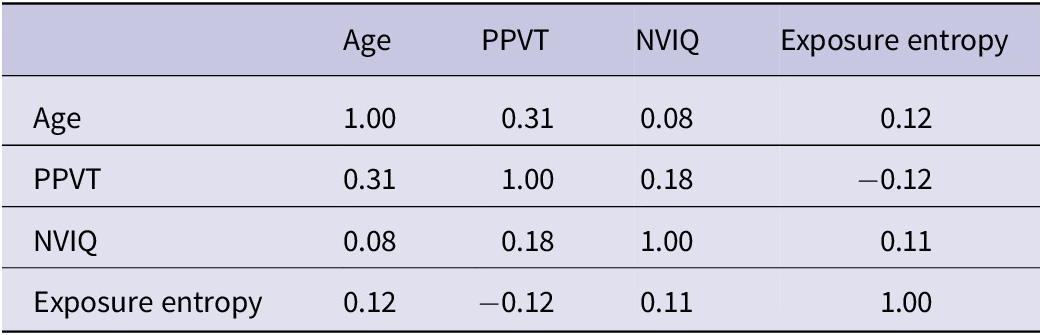
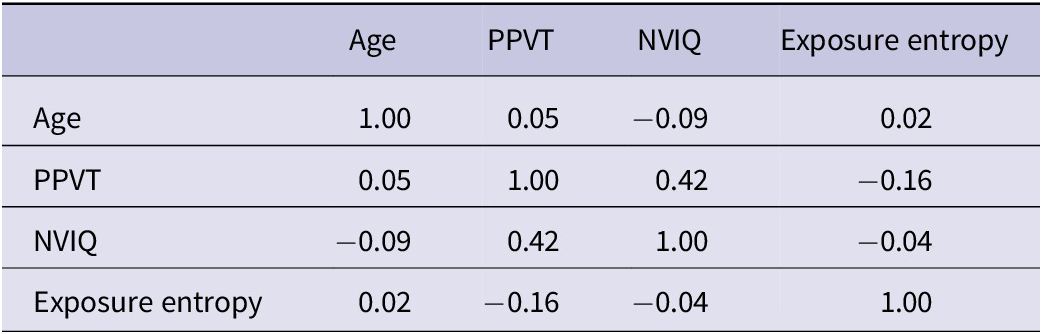
Correlations between the predictors representing participant properties are given in Table A1 for the non-autistic participant group, and in Table A2 for the autistic participant group.
Correlation matrix for the non-autistic participant group

Table A1. Long description
The table consists of four rows and four columns of data representing the correlation coefficients between four variables. The variables are Age, P P V T (Peabody Picture Vocabulary Test), N V I Q (Non-Verbal Intelligence Quotient), and Exposure entropy.
* Row 1 (Age): Correlates with Age at 1.00, P P V T at 0.31, N V I Q at 0.08, and Exposure entropy at 0.12.
* Row 2 (P P V T): Correlates with Age at 0.31, P P V T at 1.00, N V I Q at 0.18, and Exposure entropy at minus 0.12.
* Row 3 (N V I Q): Correlates with Age at 0.08, P P V T at 0.18, N V I Q at 1.00, and Exposure entropy at 0.11.
* Row 4 (Exposure entropy): Correlates with Age at 0.12, P P V T at minus 0.12, N V I Q at 0.11, and Exposure entropy at 1.00.
Correlation matrix for the autistic participant group

Table A2. Long description
The table consists of four columns and four rows of data. The headers for both the columns and rows are Age, P P V T, N V I Q, and Exposure entropy.
* Row 1, Age: correlates with Age at 1.00, P P V T at 0.05, N V I Q at minus 0.09, and Exposure entropy at 0.02.
* Row 2, P P V T: correlates with Age at 0.05, P P V T at 1.00, N V I Q at 0.42, and Exposure entropy at minus 0.16.
* Row 3, N V I Q: correlates with Age at minus 0.09, P P V T at 0.42, N V I Q at 1.00, and Exposure entropy at minus 0.04.
* Row 4, Exposure entropy: correlates with Age at 0.02, P P V T at minus 0.16, N V I Q at minus 0.04, and Exposure entropy at 1.00.
We built model A.1 as the full model warranted by our theoretical considerations, that is, to include the main effects and four-way interactions of CONDITION, GROUP, EXPOSURE ENTROPY and AGE, along with main effects of NVIQ and PPVT as covariates, and a random intercept for each participant. This full model converged, a fixed effects table is provided in Table A3. One asterisk indicates p-values smaller than 0.05, two asterisks indicate p-values smaller than 0.01, three asterisks indicate p-values smaller than 0.001. The explanatory power of the fixed effects alone (marginal R2) was 0.71, the explanatory power of the full model (conditional R2) was 0.79.
To avoid multicollinearity issues, all continuous variables were scaled; covariates showed no collinearity (variance inflation factors were < 2).
Fixed effects table for model A.1

Table A3. Long description
The table specifies the model as Value tilde CONDITION asterisk GROUP asterisk EXPOSURE ENTROPY asterisk AGE plus N V I Q plus P P V T plus (1 vertical bar PARTICIPANT). The columns are Fixed effects, Estimate, Std. Error, df, t-value, and p-value. One asterisk indicates p-values smaller than 0.05, two asterisks indicate p-values smaller than 0.01, three asterisks indicate p-values smaller than 0.001.
* Intercept: -1.725, 0.769, 26.999, -2.245, 0.02561 asterisk.
* Conditions: 1.886, 0.584, 263.000, 3.229, 0.00140 double asterisk.
* Group: -0.086, 0.758, 260.999, -0.114, 0.90936.
* Exposure entropy: 0.304, 0.866, 260.999, 0.350, 0.72631.
* Age: 0.111, 0.007, 260.999, 15.135, less than 2e-16 triple asterisk.
* N V I Q: 0.515, 0.209, 261.000, 2.462, 0.01448 asterisk.
* P P V T: 0.748, 0.146, 261.000, 5.116, 6.05e-07 triple asterisk.
* Condition colon group: 0.341, 0.584, 263.000, 0.584, 0.55995.
* Condition colon exposure entropy: 0.665, 0.667, 263.000, 0.997, 0.31964.
* Group colon exposure entropy: -2.406, 0.866, 260.999, -2.777, 0.00588 double asterisk.
* Condition colon age: 0.030, 0.006, 263.000, 5.329, 2.13e-07 triple asterisk.
* Group colon age: 0.009, 0.007, 260.999, 1.220, 0.22353.
* Exposure entropy colon age: 0.002, 0.008, 260.999, 0.255, 0.79923.
* Condition colon group colon exposure entropy: -0.964, 0.667, 263.000, -1.445, 0.14959.
* Condition colon group colon age: 0.003, 0.006, 263.000, 0.614, 0.53968.
* Condition colon group colon exposure entropy colon age: -0.007, 0.006, 263.000, -1.165, 0.24527.
* Group colon exposure entropy colon age: 0.024, 0.008, 260.999, 2.953, 0.00344 double asterisk.
* Condition colon group colon exposure entropy colon age (repeated): 0.010, 0.006, 263.000, 1.554, 0.12145.
Model A.2 is applied to the autistic and non-autistic group separately, in line with our analysis plan and as a resolution of the three-way interaction of GROUP, EXPOSURE ENTROPY and AGE. The interaction of CONDITION and AGE was included to account for the fact that this interaction was found in model A.1, and would thereby be assumed to influence the dependent measure in both groups, independently of exposure entropy. Fixed effects tables for this model with the autistic and non-autistic participant groups are given in Table A4. One asterisk indicates p-values smaller than 0.05, two asterisks indicate p-values smaller than 0.01, three asterisks indicate p-values smaller than 0.001.
Fixed effects tables for model A.2

Table A4. Long description
Model A dot 2 specifications: The table specifies the model as vValue tilde EXPOSURE ENTROPY asterisk AGE plus CONDITION asterisk AGE plus N V I Q plus P P V T plus (1 vertical bar PARTICIPANT).
Table 1: Fixed effects, non-autistic group. Columns: Estimate, Std. Error, d f, t-value, p-value. One asterisk indicates p-values smaller than 0.05, two asterisks indicate p-values smaller than 0.01, three asterisks indicate p-values smaller than 0.001.
* Intercept: -1.927, 0.783, 170.000, -2.461, 0.014845 asterisk.
* Exposure entropy: -2.104, 0.779, 170.000, -2.700, 0.007630 double asterisk.
* Age: 0.123, 0.008, 170.000, 14.601, less than 2e-16 triple asterisk.
* Condition: 2.286, 0.636, 174.000, 3.594, 0.000423 triple asterisk.
* N V I Q: 0.457, 0.257, 170.000, 1.783, 0.076295.
* P P V T: 0.572, 0.204, 170.000, 2.800, 0.005699 double asterisk.
* Exposure entropy colon age: 0.026, 0.008, 170.000, 3.242, 0.001430 double asterisk.
* Age colon condition: 0.033, 0.007, 174.000, 4.965, 1.63e-06 triple asterisk.
Table 2: Fixed effects, autistic group. Columns: Estimate, Std. Error, d f, t-value, p-value.
* Intercept: -1.495, 1.440, 89.000, -1.038, 0.301920.
* Exposure entropy: 2.736, 1.696, 89.000, 1.614, 0.110118.
* Age: 0.102, 0.013, 89.000, 7.752, 1.4e-11 triple asterisk.
* Condition: 1.424, 0.938, 93.000, 1.518, 0.132518.
* N V I Q: 0.546, 0.364, 89.000, 1.499, 0.137495.
* P P V T: 0.874, 0.225, 89.000, 3.878, 0.000201 triple asterisk.
* Exposure entropy colon age: -0.022, 0.015, 89.000, -1.407, 0.162775.
* Age colon condition: 0.027, 0.009, 93.000, 3.158, 0.002143 double asterisk.
Model B.1 is applied to the autistic participant group only to answer RQ3, that is, assess the role of the strength of social-communicative autistic symptoms on the effects of our predictors of interest. Fixed effects tables for this model are given in Table A5. One asterisk indicates p-values smaller than 0.05, two asterisks indicate p-values smaller than 0.01, three asterisks indicate p-values smaller than 0.001.
Fixed effects tables for model B.1

Table A5. Long description
The table displays fixed effects for Model B dot 1 with the specification: Value tilde exposure Entropy asterisk age asterisk condition asterisk S C Q plus N V I Q plus P P V T plus (1 vertical bar participant). The columns are Fixed effects, Estimate, Std. Error, df, t-value, and p-value. One asterisk indicates p-values smaller than 0.05, two asterisks indicate p-values smaller than 0.01, three asterisks indicate p-values smaller than 0.001.
* Intercept: Estimate -1.599, Std. Error 1.480, df 76.999, t-value -1.080, p-value 0.283293.
* Exposure entropy: Estimate 2.468, Std. Error 1.655, df 76.999, t-value 1.491, p-value 9.69e-11 (significant at 0.001 level).
* Age: Estimate 0.102, Std. Error 0.014, df 76.999, t-value 7.490, p-value 9.69e-11 (significant at 0.001 level).
* Condition: Estimate 2.077, Std. Error 1.005, df 79.000, t-value 2.066, p-value 0.042114 (significant at 0.05 level).
* S C Q: Estimate 2.399, Std. Error 1.538, df 76.999, t-value 1.559, p-value 0.123012.
* N V I Q: Estimate 0.400, Std. Error 0.371, df 76.999, t-value 1.079, p-value 0.284158.
* P P V T: Estimate 0.811, Std. Error 0.231, df 76.999, t-value 3.521, p-value 0.000727 (significant at 0.001 level).
* Exposure entropy: age: Estimate -0.022, Std. Error 0.015, df 76.999, t-value -1.435, p-value 0.155301.
* Exposure entropy: condition: Estimate 1.558, Std. Error 1.144, df 79.000, t-value 1.362, p-value 0.177125.
* Age: condition: Estimate 0.021, Std. Error 0.009, df 79.000, t-value 2.301, p-value 0.024018 (significant at 0.05 level).
* Exposure entropy: S C Q: Estimate -1.121, Std. Error 2.056, df 76.999, t-value -0.546, p-value 0.586981.
* Age: S C Q: Estimate -0.031, Std. Error 0.015, df 76.999, t-value -2.137, p-value 0.035757 (significant at 0.05 level).
* Condition: S C Q: Estimate 2.117, Std. Error 1.059, df 79.000, t-value 1.999, p-value 0.049030 (significant at 0.05 level).
* Exposure entropy: age: condition: Estimate -0.016, Std. Error 0.011, df 79.000, t-value -1.545, p-value 0.126333.
* Exposure entropy: age: S C Q: Estimate 0.018, Std. Error 0.019, df 76.999, t-value 0.978, p-value 0.331201.
* Exposure entropy: condition: S C Q: Estimate 1.239, Std. Error 1.407, df 79.000, t-value 0.880, p-value 0.381475.
* Age: condition: S C Q: Estimate -0.020, Std. Error 0.010, df 79.000, t-value -1.997, p-value 0.049269 (significant at 0.05 level).
* Exposure entropy: age: condition: S C Q: Estimate -0.006, Std. Error 0.013, df 79.000, t-value -0.468, p-value 0.641375.
Model B.2 is a linear regression model, as each participant contributes one data point when separating data for both conditions. We specified the main effects and interaction of AGE and SCQ as fixed effect, and NVIQ and PPVT as covariates. Fixed effects tables for this model are given in Table A6. One asterisk indicates p-values smaller than 0.05, two asterisks indicate p-values smaller than 0.01, three asterisks indicate p-values smaller than 0.001.
Fixed effects tables for model B.2

Table A6. Long description
The table presents Model B.2 with the formula: Value tilde age asterisk S C Q plus N V I Q plus P P V T. The columns are Fixed effects, Estimate, Std. Error, df, t-value, and p-value. One asterisk indicates p-values smaller than 0.05, two asterisks indicate p-values smaller than 0.01, three asterisks indicate p-values smaller than 0.001.
Section 1: Fixed effects, semantic V F
* Intercept: Estimate -0.141, Std. Error 2.174, t-value 0.9484, p-value 0.9484.
* Age: Estimate 0.948, Std. Error 0.020, t-value 6.342, p-value 1.22e-08 (highly significant).
* S C Q: Estimate 3.639, Std. Error 2.265, t-value 1.607, p-value 0.1121.
* N V I Q: Estimate 0.784, Std. Error 0.548, t-value 1.430, p-value 0.1565.
* P P V T: Estimate 0.699, Std. Error 0.332, t-value 2.104, p-value 0.0385 (significant).
* Age: S C Q: Estimate -0.041, Std. Error 0.021, t-value -1.928, p-value 0.0573.
Section 2: Fixed effects, phonemic V F
* Intercept: Estimate -3.7655, Std. Error 1.315, t-value -2.862, p-value 0.005356 (significant).
* Age: Estimate 0.080, Std. Error 0.012, t-value 6.549, p-value 4.93e-09 (highly significant).
* S C Q: Estimate 0.359, Std. Error 1.371, t-value 0.262, p-value 0.793947.
* N V I Q: Estimate 0.266, Std. Error 0.332, t-value 0.801, p-value 0.425309.
* P P V T: Estimate 0.705, Std. Error 0.201, t-value 3.506, p-value 0.000744 (highly significant).
* Age: S C Q: Estimate -0.012, Std. Error 0.013, t-value -0.898, p-value 0.371928.




 Open access

