Stuttering is often considered to be a speech–motor disorder, although it is also clear that factors outside the speech production system influence its development. This has led to proposals that stuttering occurs when a vulnerable speech–motor system fails due to high linguistic and other cognitive processing demands (Bloodstein & Bernstein Ratner, Reference Bloodstein and Bernstein Ratner2008; Howell, Reference Howell2004; Maasen & van Lieshout, Reference Maasen and van Lieshout2010; Smith & Kelly, Reference Smith, Kelly, Curlee and Seigel1997). A large body of literature supports this view that there are several factors that need to be taken into account so that a better understanding of the disorder can be obtained (e.g., Bernstein Ratner, Reference Bernstein Ratner, Curlee and Siegel1997; Bosshardt, Ballmer, & de Nil, Reference Bosshardt, Ballmer and de Nil2002; Howell, Reference Howell2004; Kleinow & Smith, Reference Kleinow and Smith2000; Weber-Fox, Reference Weber-Fox2001). One direction such research has taken has been to examine how language and other forms of cognitive processing, such as memory and attention, impact on stuttering (Anderson & Wagovich, Reference Anderson and Wagovich2010; Anderson, Wagovich, & Hall, Reference Anderson, Wagovich and Hall2006; Bakhtiar, Ali, & Sadegh, Reference Bakhtiar, Ali and Sadegh2007; Hakim & Bernstein Ratner, Reference Hakim and Bernstein Ratner2004; Watkins, Yairi, & Ambrose, Reference Watkins, Yairi and Ambrose1999; Weber-Fox, Wray, & Arnold, Reference Weber-Fox, Wray and Arnold2013). More specifically, the relationship between syntax and stuttering serves as the core of at least one psycholinguistic theoretical perspective of stuttering (Bloodstein & Bernstein Ratner, Reference Bloodstein and Bernstein Ratner2008). The present study followed this perspective by examining accuracy of syntactic comprehension, the influence of working memory and syntactic processing speed in children who stutter (CWS) compared to their matched peers (CWNS), consisting on a novel angle to approach the interface between syntax and stuttering. Before the hypotheses are presented, studies are reviewed that have addressed how stuttering and language ability are linked, and how working memory influences language performance. Then the syntactic structures that were singled out for examination in the current study are described.
STUTTERING AND LANGUAGE
Stuttering typically begins when a child is between 2 and 4 years of age (Yairi, Reference Yairi2004), which is a period of rapid linguistic development, coinciding with of production of the first complex sentences (Logan & LaSalle, Reference Logan and LaSalle1999). A further observation that supports the view that language development and stuttering are linked is that the number of stuttering-like disfluencies increases as children attempt to produce long and grammatically complex utterances (Bernstein Ratner & Sih, Reference Bernstein Ratner and Sih1987; Logan & Conture, Reference Logan and Conture1995; Melnick & Conture, Reference Melnick and Conture2000). Syntax could be one of the language factors that trigger the problem because stuttering does not occur during the developmental stages of babbling when single words are produced and utterances lack syntactic form (Bloodstein, Reference Bloodstein2006). The demands and capacities model of stuttering (Adams, Reference Adams1990; Starkweather & Gottwald, Reference Starkweather and Gottwald1990) could explain why stuttering occurs at the stages of syntactic development by proposing that increases in syntactic demands lead to the capacities of the child being exceeded, resulting in stuttering.
Individuals who stutter have weaker syntactic processing abilities than fluent individuals in experimental behavioral tasks. Grammatical encoding is more demanding on individuals who stutter than on their fluent peers, and this seems to be true regardless of age. On sentence-structure priming tasks, young children who stutter between 3 and 5 years of age (Anderson & Conture, Reference Anderson and Conture2004) and adults who stutter (Tsaimtsiouris & Cairns, Reference Tsiamtsiouris and Cairns2009) showed difficulties in syntactic processing. Stuttering children and adults were slower than their fluent peers to initiate production of sentences in response to a visual stimuli and showed stronger priming effects when a sentence-structure priming was presented. Furthermore, the speech reaction times of adults increased as sentence complexity increased.
Experimental findings with event-related potentials (ERPs) also support the point of a lifelong atypical and weak syntactic processing in individuals who stutter. Adults who stutter show differences relative to controls in functional brain organization, and brain activity that mediate some aspects of language processing, even when untimed standardized tests revealed similar grammatical abilities in both comprehension and production tasks (Cuadrado & Weber-Fox, Reference Cuadrado and Weber-Fox2003; Weber-Fox, Reference Weber-Fox2001; Weber-Fox & Hampton, Reference Weber-Fox and Hampton2008). Weber-Fox et al. (Reference Weber-Fox, Wray and Arnold2013) reported that such differences in brain activation in response to linguistic stimuli occur in individuals who stutter as early as in the preschool years, which points to causal language deficits to stuttering, instead of weaker language processing being a result of stuttering. The ERPs during language processing in young CWS and CWNS who were matched for age, socioeconomic status (SES), IQ, working memory, and language skills showed that the P600 (syntactic processing) ERP component differed between these groups of children. The neural mechanisms involved with syntactic processing persistently remain impaired in children who have not overcome stuttering by the school-age years. Children between 6 and 7 years of age with persistent stuttering presented N400 responses to sentences that contain English syntactic structure but absence of semantic information (jabberwocky sentences), whereas their fluent peers and children who have recovered from stuttering showed the expected P600 ERP potential to those sentences (Usler & Weber-Fox, Reference Usler and Weber-Fox2015). Between the time of stuttering onset at the average age 33 to 34 months (Yairi & Ambrose, Reference Yairi and Ambrose2005) and the age of 6, children can learn to compensate stuttering via word avoidance and poor syntactic processing, which could be a result of stuttering, rather than the cause. However, the fact that CWS present abnormal neural activities to syntactic processing already at the age of 3 (Weber-Fox et al., Reference Weber-Fox, Wray and Arnold2013) seems to point to the contrary.
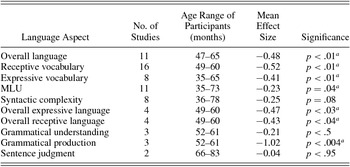
Much remains to be discovered about the way in which language abilities and stuttering are related. Investigations of syntactic features have provided little support for the idea that CWS typically have clinically significant syntactic delays (Howell, Davis, & Au-Yeung, Reference Howell, Davis and Au-Yeung2003; Kadi-Hanifi & Howell, Reference Kadi-Hanifi and Howell1992; Watkins et al., Reference Watkins, Yairi and Ambrose1999). However, this reservation about language involvement in stuttering is offset by data that suggest that speech and language impairment are the most frequent concomitant disorders among children who stutter (Blood, Ridenour, Qualls, & Hammer, Reference Blood, Ridenour, Qualls and Hammer2003; Wolk, Conture, & Edwards, Reference Wolk, Conture and Edwards1990). On a large survey with 2,628 CWS between 5 and 18 years, Blood et al. (Reference Blood, Ridenour, Qualls and Hammer2003) found that only 26.5% of children had no co-occurring language disorders, whereas 46.8% had no co-occurring speech disorders. Other research has shown that CWS are more likely to have language problems than are CWNS (Anderson & Conture, Reference Anderson and Conture2000, Reference Anderson and Conture2004; Hakim & Bernstein Ratner, Reference Hakim and Bernstein Ratner2004; Ntourou, Conture, & Lipsey, Reference Ntourou, Conture and Lipsey2011). A recent meta-analysis (Ntourou et al., Reference Ntourou, Conture and Lipsey2011) explored 22 studies that investigated language abilities of CWS between 2 and 8 years of age, according to 10 different language aspects (overall language, receptive and expressive vocabulary, mean length of utterance, syntactic complexity, overall expressive and receptive language, grammatical understanding, and production and sentence judgment). A summary of findings of the meta-analysis can be found in Table 1. The results indicated that CWS scored significantly lower on norm-referenced tests of overall language performance, receptive and expressive vocabulary, mean length of utterance, overall expressive and receptive language, and grammatical production. However, there was no significant difference on syntactic complexity, grammatical understanding, and sentence judgment between the two groups. The results of the language aspects that involve fewer than eight studies should be interpreted with caution for two reasons. The first is that the limited number of studies hampers the external validity of conclusions. The second is that no homogeneity analysis was conducted to verify the effects of differences in methodology (including sampling differences) on the effect sizes of the meta-analysis. Furthermore, an overall point to the meta-analysis is that it included limited data on children beyond the age of 5 and many complex language aspects are acquired after that age. The literature from outside the stuttering field has shown that tasks that impose processing demands extraneous to language interfere with language processing (Martin & McElree, Reference Martin and McElree2009; Marton, Schwartz, Farkas, & Katsnelson, Reference Marton, Schwartz, Farkas and Katsnelson2006; McElree, Foraker, & Dyer, Reference McElree, Foraker and Dyer2003). Consequently, it would be useful to carry out such studies with CWS. These should investigate whether adding processing demands (e.g., working memory and syntactic processing speed) in tasks where syntactic features are investigated in CWS leads to interactions between language and other cognitive processing.
Summary of findings of the meta-analysis study conducted by Ntourou et al. (Reference Ntourou, Conture and Lipsey2011) according to language aspect analyzed, number of studies, and age range of participants

Note: MLU, Mean length of utterance.
a Statistically significant p values for t tests.
WORKING MEMORY
A rudimentary command of grammar is necessary to generate and comprehend sentences. A sentence is not merely a linear string of words; the words are hierarchically organized into constituent structures that need to be decoded for the sentence to be comprehended (Van Valin, Reference Van Valin2001). The decoding process places demands on memory (as well as language abilities) as individuals have to retain sequential information and hierarchical position of words in memory and use this information during sentence comprehension. Therefore, some of the performance patterns that are observed in children's syntax may reflect immature memory systems rather than, or in addition to, immature grammatical ability (McElree, Reference McElree2000; McElree et al., Reference McElree, Foraker and Dyer2003). Adults who stutter have weak working memory during language-processing tasks, and working memory is more vulnerable to interference as demands increase (e.g., Bosshardt, Reference Bosshardt1995; Byrd, McGill, & Usler, Reference Byrd, McGill and Usler2014; Byrd, Vallely, Anderson, & Sussman, Reference Byrd, Vallely, Anderson and Sussman2012). It is rational to infer that these weaknesses are present (or even more evident) when examined in CWS in a less mature language system. However, the working memory of CWS has been investigated primarily using nonword repetition tests, such as the Children's Test of Nonword Repetition (Gathercole, Willis, Baddeley, & Emslie, Reference Gathercole, Willis, Baddeley and Emslie1994). CWNS outperform CWS on the repetition of two-syllable and three-syllable words (Anderson et al., Reference Anderson, Wagovich and Hall2006; Hakim & Bernstein Ratner, Reference Hakim and Bernstein Ratner2004). Nonword repetition tasks reflect only the temporary retention of verbal material according to Baddeley's (Reference Baddeley and Baddeley1986) model of working memory. Further studies with CWS are needed to determine the role of working memory in language by directly manipulating working memory demands and assessing the impact this has on linguistic processing.
PROCESSING SPEED
An essential claim made in psycholinguistic models of stuttering is that the disorder manifests when there is pressure to produce speech more quickly than language capacities allow (Howell, Reference Howell2004; Reference Howell2009; Kolk & Postma, Reference Kolk, Postma, Curlee and Siege1997). Experimental studies of linguistic processing speed in CWS have shown that differences between CWS and CWNS depend on the task employed. Generally, when researchers employ complex tasks (such as syntactic and lexical priming), slower processing is found in CWS than in CWNS (Anderson & Conture, Reference Anderson and Conture2004; Andrade, Juste, & Fortunato-Tavares, Reference Andrade, Juste and Fortunato-Tavares2013; Pellowski & Conture, Reference Pellowski and Conture2005). In lexical-priming tasks, CWS have slower reaction times and are less accurate than CWNS (Andrade et al., Reference Andrade, Juste and Fortunato-Tavares2013; Pellowski & Conture, Reference Pellowski and Conture2005). However, when the tasks involve naming or categorizing simple pictures, differences in processing speed between CWS and CWNS are not always observed (Anderson & Wagovich, Reference Anderson and Wagovich2010). However, Anderson and Wagovich (Reference Anderson and Wagovich2010) did find that picture-naming speed and nonword repetition score were negatively correlated for CWS (where lower nonword repetition scores were associated with longer speech reaction times). This may suggest a link between nonword repetition and language-processing speed across individuals who stutter.
A linguistic accuracy versus processing speed exchange (e.g., Brébion, Reference Brébiom2001; Foraker & McElree, Reference Foraker and McElree2011; McElree, Reference McElree1993) would be predicted as individuals adjust to the language and cognitive demands of different tasks. That is, CWS could be accurate if they performed a task slowly, but not if the task is performed rapidly. If such exchanges occur in syntactic processing tasks performed by CWS, they would reflect an immature grammatical processing speed, for which the nonspeech motor system compensates to achieve accuracy. Such exchanges also appear to occur in comprehension, as ERP studies have shown slower language processing and different brain timing in individuals who stutter (Cuadrado & Weber-Fox, Reference Cuadrado and Weber-Fox2003; Weber-Fox, Reference Weber-Fox2001; Weber-Fox & Hampton, Reference Weber-Fox and Hampton2008; Weber-Fox et al., Reference Weber-Fox, Wray and Arnold2013).
Considerations about speed–accuracy exchanges may explain some of the many incongruent findings in the stuttering literature. Untimed standardized syntax tests investigate the presence or absence of syntactic deficits and are not an ideal way of examining the dynamics of language processing, given that they usually only employ an overall measure of syntax and provide no time measures. The majority of studies that have investigated syntactic abilities in CWS have not measured their syntactic processing speed at all, let alone how it relates to response accuracy. Furthermore, subclinical differences in language profiles of individuals who stutter (e.g., Anderson & Conture, Reference Anderson and Conture2004; Cuadrado & Weber-Fox, Reference Cuadrado and Weber-Fox2003; Weber-Fox, Reference Weber-Fox2001; Weber-Fox & Hampton, Reference Weber-Fox and Hampton2008) provide support that standardized, untimed measures may be less suitable to capture the difficulties in CWS. In the current study, the comprehension abilities of CWS were examined for two different syntactic constructions: predicate attachment and reflexive assignment. These two constructions were employed under two working memory loads, which varied cognitive demands, so that performance could be measured for different levels on the accuracy and speed dimensions.
SYNTACTIC STRUCTURES UNDER INVESTIGATION
According to Cromer's (Reference Cromer and Wyke1978) hierarchical ordering deficit (HOD) account, and its successors such as the computational grammatical complexity hypothesis (Gallon, Harris, & van der Lely, Reference Gallon, Harris and van der Lely2007; Marinis & van der Lely, Reference Marinis and van der Lely2007; van der Lely, Reference van der Lely2005; van der Lely & Stollwerck, Reference van der Lely and Stollwerck1997), children with language impairment do not build the necessary hierarchical syntactic structure of sentences but, instead, treat sentences as flat (lacking hierarchical levels) structures, which could result in their comprehension errors. Hierarchical syntactic constructions such as those of predicate attachment and reflexive assignment predict that certain forms of error will occur if syntax has not developed typically. For example, in the absence of hierarchical structure, children may incorrectly attach the predicate red of the sentence The box in the cup is red to the cup. Similar errors would occur in assigning the reflexive herself, in the sentence The grandma behind the mom is looking at herself. Comprehension deficits and the influence of working memory on these syntactic structures have been reported for children with specific language impairment (e.g., Fortunato-Tavares et al., Reference Fortunato-Tavares, Andrade, Befi-Lopes, Hestvik, Epstein and Tornyova2012; van der Lely & Stollwerck, Reference van der Lely and Stollwerck1997), autism, and Down syndrome (Fortunato-Tavares et al., Reference Fortunato-Tavares, Andrade, Befi-Lopes, Limongi, Fernandes and Schwartz2015). In the current study, comprehension of sentences containing reflexives was assessed under different working memory loads in CWS and CWNS in a task that required manual responses; accuracy and key-press response times were measured. If language and motor performance are independent processes that each impact on speech performance, accuracy and speed would be inversely related. This would arise in, for instance, spontaneous speech because the more time spent on one form of processing (e.g., language), the less time is available for the other (here, motor output).
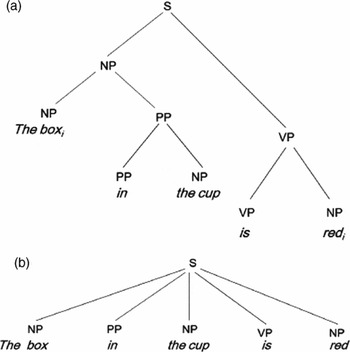
When the sentence The box in the cup is red is heard, a hierarchical representation of the constituent structure (Figure 1a) is constructed. During sentence processing CWS may fail to build the constituent structure. This failure would lead to a flat representation of the sentence (Figure 1b), and the absence of the hierarchical organization would result in comprehension errors (Cromer, Reference Cromer and Wyke1978). Figure 1 shows the same sequence of word units in hierarchical (Figure 1a) and flat (Figure 1b) structures.
(a) Hierarchical structure representation of the sentence with predicate attachment The box in the cup is red. (b) Incorrect (flat) structure representation of the sentence The box in the cup is red.

C-command (constituent command) refers to the relationship between the nodes of grammatical trees and means that the antecedent must be higher in the tree representation than the predicate (Reinhardt, Reference Reinhardt1976), which would arise if a hierarchical representation of a sentence has been constructed. In Figure 1a, the subject (the box) C-commands the predicate (red), leading to the interpretation the box is in the cup, and the box is red. The absence of the hierarchical constituent structure results in ambiguity, leading to two possible interpretations: the correct one, with the predicate being linked to the subject that C-commands it; and the incorrect one, with the predicate being attached to the nearest noun phrase (NP; the cup); not to the furthest NP (the box). If the child employs the strategy of choosing the closest constituent, the incorrect analysis occurs, leading to the incorrect interpretation the box is in the cup, and the cup is red.
Reflexive interpretation also relies on hierarchical assignment of the constituent structure. A reflexive pronoun must agree with the antecedent that C-commands it according to Principle A (“a reflexive anaphor must be bound in its governing category”) of binding theory (Chomsky, Reference Chomsky1993). For example, in the syntactic representation of The grandma behind the mom is looking at herself, the reflexive pronoun can only refer to the grandma, not the mom because the grandma C-commands the reflexive. If children do not have the hierarchical construction, Principle A would not be applied correctly, thus making the mom the antecedent of the reflexive.
Although the two structures have the same syntactic construction, the reflexive assignment relies on Principle A, which is not the case for predicates (related to Principle B: a pronoun is not locally bound). Other factors such as semantics and pragmatics may have different effects on predicate attachment and on antecedent–reflexive relations. It is possible that the attachment of predicates relies on semantic information that extrapolates those of reflexive assignment. The previously reported weakness in vocabulary of CWS in comparison to CWNS (e.g., Ntourou, Reference Ntourou, Conture and Lipsey2011) might influence the performance of CWS. Plausibility effects were controlled in the stimuli used in the following study (in all situations both characters were possible antecedents). However, it is possible that the relation between inanimate objects used on predicate attachment would reveal more pragmatic challenges than the relationship between the human characters used in antecedent–reflexive relations. These differences between the two structures (reliance on Principle A for reflexives, and semantic and pragmatic factors for predicates) would place different demands on processing and possibly affect the relationship between accuracy and speed in different ways.
The question of whether CWS show poorer syntactic skills in structures involving predicates and reflexives was addressed using a methodology previously applied with children with specific language impairment, Down syndrome, and autism (Fortunato-Tavares et al., Reference Fortunato-Tavares, Andrade, Befi-Lopes, Hestvik, Epstein and Tornyova2012, Reference Fortunato-Tavares, Andrade, Befi-Lopes, Limongi, Fernandes and Schwartz2015). In the current study, the first question investigated was whether CWS were able to build a hierarchical relationship and apply the predicate or the reflexive to the correct antecedent. It was predicted that performance accuracy would reveal differences between CWS and CWNS, and potentially between the two structures. The second question concerned how these groups were affected by a directly increased working memory demand on the linguistic stimuli in syntactic constructions containing reflexives. It was predicted that both CWS and CWNS would be affected by the increase in working memory demand but that CWS would be affected to a greater degree. This prediction was based on the findings in some studies that suggested a working memory deficit in CWS (Anderson et al., Reference Anderson, Wagovich and Hall2006; Hakim & Bernstein Ratner, Reference Hakim and Bernstein Ratner2004). The third question was about the speed of processing. By examining comprehension response times, it was possible to investigate the speed of syntactic processing of CWS and their matched peers. Based on the findings of ERP studies suggesting slower brain activation to linguistic processing in individuals who stutter (e.g., Cuadrado & Weber-Fox, Reference Cuadrado and Weber-Fox2003; Weber-Fox et al., Reference Weber-Fox, Wray and Arnold2013), it was anticipated that CWS would exhibit longer comprehension response times to arrive at similar accuracy levels than CWNS. Furthermore, given the interrelationship of syntactic comprehension, processing speed, and working memory, this study aimed to investigate if the interaction among sentence comprehension, processing speed, and working memory operates similarly in CWS and CWNS or is unique in CWS. One concise and novel prediction of the nature of this interaction in CWS is a possible inverse relationship between speed and accuracy, supporting independent influences of language and nonspeech motor reaction time.
MATERIAL AND METHODS
Participants
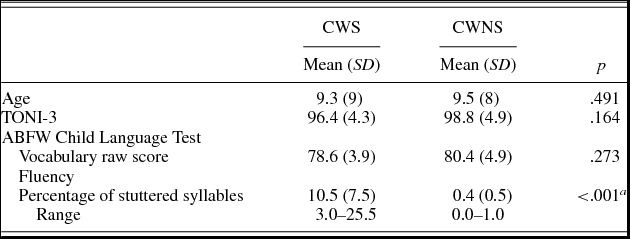
Thirty Brazilian Portuguese-speaking children (20 boys, 10 girls) participated in the two experiments. The children were aged between 7 years 9 months and 10 years 2 months, and there were equal numbers of CWS and CWNS. Each CWS was matched in age within 3 months with a CWNS recruited from public schools in São Paulo. The two groups were also matched for gender and SES. All children came from homes in which Brazilian Portuguese was the only language spoken, and all families were classified as lower middle class on the Brazilian Economic Classification Criterion Questionnaire (Critério de Classificação Econômica Brasil [CCEB]) developed by the Brazilian Association of Research Companies (Associação Brasileira de Empresas de Pesquisa, 2008) These and other details about the groups are summarized in Table 2. The research procedures were approved by the institutional review board of the institution, and parents signed a consent document agreeing to the participation of their children.
Mean (standard deviations) of age, nonverbal IQ, vocabulary performance, and percentage of stuttered syllables of participants

Note: CWS, Children who stutter; CWNS, children who do not stutter; TONI-3, Test of Non-Verbal Intelligence—Third Edition. Ages are in years and months.
a Statistically significant p values for t tests.
Children who stutter
Ten of the CWS were boys and 5 were girls. They were recruited through the Investigation of Fluency Disorders Laboratory at the Department of Physical Therapy, Communication Sciences and Disorders and Occupational Therapy of the School of Medicine, University of São Paulo (Faculdade de Medicina da Universidade de São Paulo), Brazil. These children had no history of neurological impairment and no past history of language impairment other than stuttering based on parent report and examination of their medical history.
A 200-word speech sample was recorded (Riley, Reference Riley1994; Todd et al., Reference Todd, Mirawdeli, Costelloe, Cavenagh, Davis and Howell2014). Each sample was analyzed for frequency of stuttered disfluencies and stuttering severity using the Stuttering Severity Instrument—Third Edition (Riley, Reference Riley1994). CWS exhibited a minimum of three stuttered disfluencies per 100 words in their conversational speech. Stuttered disfluencies took the form of repetitions of syllables and/or sounds, prolongations, blocked words, pauses, and intrusions of sound and/or segments (e.g., filled pauses, grunts). There were five, four, and six CWS classified as mild, moderate, and severe, respectively, by the Stuttering Severity Instrument—Third Edition. The speech samples were analyzed independently by two experienced speech–language pathologists who specialize in stuttering, and a consensus was reached in cases where there were disagreements.
All the CWS were receiving speech–language therapy for stuttering at the time of testing, and had scores on the vocabulary section of the ABFW Child Language Test (Andrade, Befi-Lopes, Fernandes, & Wertzner, Reference Andrade, Befi-Lopes, Fernandes and Wetzner2004) within normal limits. They had normal nonverbal IQ performance (i.e., score of above 85) as measured by the Test of Nonverbal Intelligence—III (Brown, Sherbenou, & Johnson, Reference Brown, Sherbenou and Johnson1997). The demographic information and language and fluency measures of the participants are given in Table 2.
Children who do not stutter
CWNS were recruited from public schools in São Paulo. These children had scores on the four sections (vocabulary, phonology, fluency, and pragmatics) of the ABFW Child Language Test (Andrade et al., Reference Andrade, Befi-Lopes, Fernandes and Wetzner2004) within normal limits, and had normal nonverbal IQ performance as measured by the Test of Nonverbal Intelligence—III (Brown et al., Reference Brown, Sherbenou and Johnson1997). None of the children in this group had any history of neurological nor speech and language impairment. CWNS exhibited two or fewer stuttered disfluencies per 100 words of conversational speech. None of the parents of these children expressed concern about their child's speech fluency.
EXPERIMENT 1: PREDICATE ATTACHMENT
The comprehension of predicate–NP relations (attachment) by CWS and their matched peers was tested using stimuli and procedures previously employed with children with other types of language disorder (Fortunato-Tavares et al., Reference Fortunato-Tavares, Andrade, Befi-Lopes, Hestvik, Epstein and Tornyova2012, Reference Fortunato-Tavares, Andrade, Befi-Lopes, Limongi, Fernandes and Schwartz2015).
Stimuli
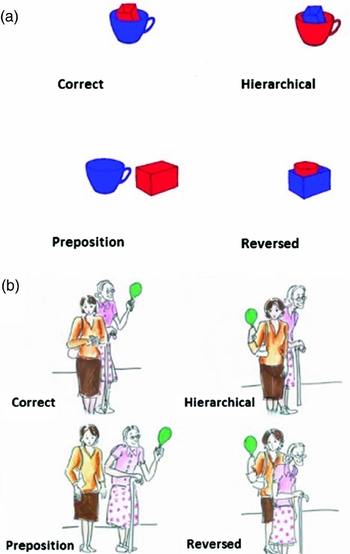
There were 26 trials. Each trial started with a context sentence (Aqui estão a(o) X e a(o) Z; Here is a(an) X and a(an) Z). This was followed by a target sentence (O X na(o)/acima/abaixo/na frente/atrás de Z é Y; The X in/on/under/in front of/behind the Z is Y). A set of four pictures was presented. The four pictures were as follows: correct picture (correct hierarchical relation); hierarchical error picture (incorrect hierarchical relation); preposition change error picture (incorrect prepositional relation); and reverse error picture (incorrect hierarchical relation and incorrect prepositional relation). For example, for the target sentence The box in the cup is red, the correct picture had a red box inside a cup, the hierarchical picture had a box inside a red cup, the prepositional picture had a red box that was not inside a cup, and the reversed picture had a box that was not inside a red cup. The position of the four pictures was randomized by E-Prime software (Psychology Software Tools, Inc., 2012). Figure 2a illustrates the picture stimuli for one of the trials in this experiment.
(a) An example of the picture stimuli from Experiment 1 for the target sentence A caixa dentro da xícara é vermelha (The box in the cup is red). (b) An example of the picture from Experiment 2 for the target sentence A avó atrás da mãe de saia marrom está se olhando (The grandma behind the mom with brown skirt is looking at herself).

Procedure
The experiment was conducted using E-Prime Experimental Control Software (Psychology Software Tools, Inc., 2012). The sentences were recorded digitally by a female native Brazilian Portuguese speaker using PRAAT (Boersma & Weenink, Reference Boersma and Weenink2006). Participants were instructed to pay attention to the sentences and select the picture they found that described the sentence heard. No specific instructions were given regarding expected accuracy or time to respond. A trial started with a context sentence (e.g., Aqui estão a caixa e a xícara; Here is a box and a cup), followed by the target sentence after a 1000-ms interstimulus interval (e.g., A caixa dentro da xícara é vermelha; The box in the cup is red) and the set of four pictures. The child selected the picture that corresponded to the target sentence; there was no time limit. The E-Prime serial response box was used for response collection. The picture selected as the child's response was recorded for use in analysis. See Figure 2a for examples of the pictures. Participants all received five practice trials before the experiment commenced. Although we planned to repeat the practice trials if necessary, all children mastered the task within the five practice trials.
Trials from Experiments 1 and 2 were randomly intermixed individually within a single session to avoid fatigue, order, and familiarization effects. Therefore, the order of trial presentation varied across participants. Experiments 1 and 2 together lasted approximately 40 min, and the session was divided into three blocks with breaks between blocks.
EXPERIMENT 2: REFLEXIVE ASSIGNMENT
This experiment tested the comprehension of reflexives and the effect of different working memory on comprehension in a similar way to Experiment 1. The stimuli and methodology used here have also been employed previously with children with language disorders (Fortunato-Tavares et al., Reference Fortunato-Tavares, Andrade, Befi-Lopes, Hestvik, Epstein and Tornyova2012, Reference Fortunato-Tavares, Andrade, Befi-Lopes, Limongi, Fernandes and Schwartz2015).
Stimuli
There were 52 trials in this experiment (26 for each of two working memory conditions). Each trial consisted of one context sentence, one target sentence, and a set of four pictures as in Experiment 1. Context sentences had the same structure as those in Experiment 1. The target sentences (O X na(o)/acima/abaixo/na frente/atrás de Z [modifier] está Y; The X in/on/under/in front of/behind the Z [modifier] is Y) had two nouns (X and Z) and a verb phrase (Y) with a reflexive pronoun. Working memory load was varied by giving long (high load) or short (low load) versions of target sentences. Long versions contained a modifier phrase between the subject and the reflexive. The modifier phrase is indicated in bold in the following example: A avó na frente da mãe de saia marrom está se olhando; The grandma in front of the mom with brown skirt is looking at herself. Short versions did not contain the modifier phrase but were identical otherwise. The set of four images contained one correct picture (grandma looking at herself behind the mom, and mom is wearing a brown skirt); one hierarchical error (grandma behind the mom, and mom, who is wearing a brown skirt is looking at herself); one preposition change (grandma looking at herself, but not behind the mom, and mom is wearing a brown skirt); and one reverse error, representing incorrect preposition and hierarchical error (grandma is not behind the mom, mom is wearing a brown skirt and looking at herself). See Figure 2b for examples of the pictures.
Data analysis
The Dirichlet-multinomial model (Paulino & Singer, Reference Paulino and Singer2006), a generalization of the beta-binomial model (Molenberghs & Verbeke, Reference Molenberghs and Verbeke2005), was fitted using a maximum likelihood method. The expected response frequencies were compared between and within groups based on Wald statistics. Wilcoxon signed-rank tests and Mann–Whitney tests were used to analyze within- and between-group differences on comprehension response time. Spearman rho (ρs) coefficients were calculated to investigate possible correlations between accuracy, response time, and stuttering severity.
RESULTS
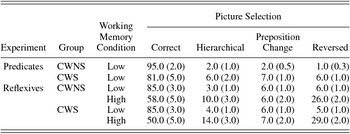
The Dirichlet-multinomial model estimated the probabilities of each response category (correct, hierarchical, preposition change, andreversed) for each participant group and for both experiments (Table 3).
Dirichlet mutinomial model estimated mean (standard error) percentage of picture selection for CWS and CWNS groups in Experiment 1 (predicates) and Experiment 2 (reflexives) by working memory condition

Note: CWNS, Children who do not stutter; CWS, children who stutter. Reversed errors included incorrect preposition and incorrect hierarchical representation.
Predicate attachment accuracy
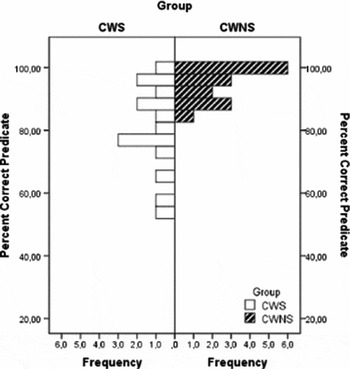
For Experiment 1 (predicate attachment), the Wald statistics revealed an overall effect of group, χ2 (3, N = 30) = 23.14, p < .001, showing that CWNS and CWS differed in their response distributions. Between-group comparisons then examined each response category. CWNS were significantly more accurate than CWS, χ2 (1, N = 30) = 6.88, p = .009. Figure 3 shows the distributions of correct responses for both groups, and it is apparent that CWNS exhibited a more homogeneous distribution than the CWS.
Frequency distribution of percentage correct responses of the two groups (children who stutter and children who do not stutter) in Experiment 1 (predicate attachment).

The two groups also differed regarding the frequency with which they selected the preposition change error, χ2 (1, N = 30) = 13.16, p < .001, and the reversed error, χ2 (1, N = 30) = 25.97, p < .001, with CWS exhibiting more errors than CWNS. There was no between-groups difference for the hierarchical error, χ2 (1, N = 30) = 2.45, p = .118. In the within-group error analysis, no differences were found in the selection of the three error response types: CWS: χ2 (2, N = 15) = 1.39, p = .500; CWNS: χ2 (2, N = 15) = 1.03, p = .598, for either group. This showed that neither group selected one of the incorrect picture types more often than any other. Thus, although CWS made more errors than the CWNS overall, the distribution across the types of error was no different from that of the CWNS.
Reflexive assignment: Low working memory demand accuracy
The Dirichlet multinomial model revealed, via Wald statistics, no overall effect for group, χ2 (3, N = 30) = 1.43, p = .699. This showed that the response distributions of CWNS and CWS were not different. The two groups were combined (as there was no group effect) for the within-group analysis, and a significant effect was found for types of error, χ2 (2, N = 30) = 6.70, p = .035. The combined group differed in the frequencies of the categories of error, with the preposition change and the reversed error (which included wrong preposition an incorrect hierarchical representation) occurring most frequently.
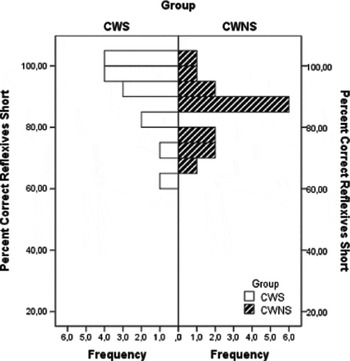
The frequency distribution of percentage correct responses for the low working-memory condition of Experiment 2 is displayed in Figure 4. This shows that the distributions of CWS and CWNS responses were similar (unlike what was found in Experiment 1).
Frequency distribution of percentage correct responses of the two groups (children who stutter and children who do not stutter) on the low working memory condition of Experiment 2 (reflexive assignment).

Reflexive assignment: High working memory demand accuracy
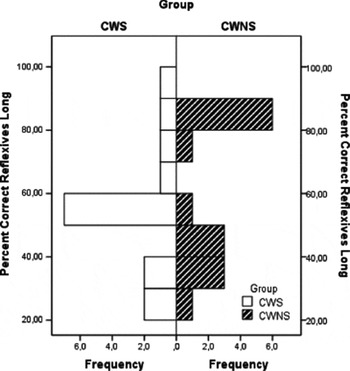
The Wald statistics applied to the statistical model showed no overall effect of group, χ2 (3, N = 30) = 1.78, p = .618. Thus the responses of CWS and CWNS were similar in this condition. Frequency distributions of percentage correct responses for the high working memory condition of Experiment 2 for CWS and CWNS are displayed in Figure 5.
Frequency distribution of percentage correct responses of the two groups (children who stutter and children who do not stutter) on the high working memory condition of Experiment 2 (reflexive assignment).

Similar to the results in the low working memory condition, a significant effect of error was found, χ2 (2, N = 30) = 130.51, p < .001. This indicated that CWNS and CWS combined selected the reversed error picture, representing incorrect preposition and incorrect hierarchical representation, more frequently than the other error pictures.
Working memory effect
The effect of working memory was evaluated by comparing the high and low working memory demand conditions of Experiment 2 (reflexive assignment). The Wald statistics for the Dirichlet model showed that both groups exhibited a decrease in accuracy with an increase in working memory demand: CWNS: χ2 (1, N = 15) = 18.61, p < .001; CWS: χ2 (1, N = 15) = 34.20, p < .001. Although there was an accuracy decrease (calculated as accuracy difference between low- and high-load memory conditions) in both groups, CWS were slightly more affected by increased working memory demand (accuracy decreased by 35%) than CWNS (accuracy decreased by 27%). However, the two proportions were not significantly different by Z test (z = 0.5; p = .317).
Both groups exhibited high rates of erroneous selection for hierarchical: CWS: χ2 (1, N = 15) = 7.34, p = .007; CWNS: χ2 (1, N = 15) = 4.10, p = .043, and reversed (incorrect preposition and hierarchical representation) pictures: CWS: χ2 (1, N = 15) = 148.51, p < .001; CWNS: χ2 (1, N = 15) = 69.55, p < .001, in the high working memory condition. There was no difference in frequency with which the preposition error was selected: CWS: χ2 (1, N = 15) = 0.40, p = .527, CWNS: χ2 (1, N = 15) < 0.001, p = .99.
Processing speed
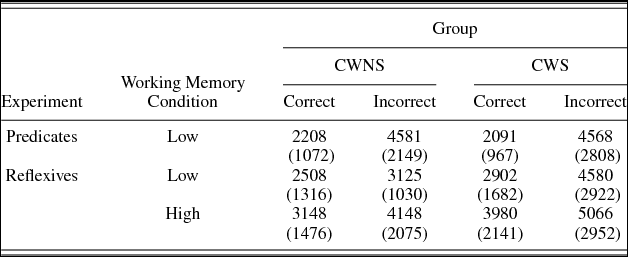
The E-Prime program only allowed responses after the offset of the audio stimuli (target sentence) in order to avoid false starts. The manual reaction time in milliseconds was obtained from the data provided by E-Prime and was the difference in time between when the button on the serial response box was pressed and the offset of the audio stimulus (target sentence). Manual response times that were outliers (7%) were excluded from the analysis. Outliers were response times that were more than 1.5 interquartile range (distance between the first and third quartiles) below the first quartile or above the third quartile. Fifteen and 24 outliers were identified in the data of the CWNS and CWS, respectively. The mean and standard deviation of manual response times for correct and incorrect responses for the two experiments are given in Table 4. In this section, the results of Experiment 1 (predicate attachment) are presented, followed by the results of Experiment 2 (reflexive assignment). It was reported above that the two experiments that examined different syntactic structures differed in accuracy across CWS and CWNS.
Mean (standard deviation) of comprehension response time (ms) for correct and incorrect responses on Experiment 1 (predicates) and in Experiment 2 (reflexives) by working memory condition for CWS and CWNS groups

Note: CWNS, Children who do not stutter; CWS, children who stutter.
In the predicate experiment (Experiment 1), the comprehension response times for correct responses did not differ significantly between CWS and CWNS (U = 35,695, z = –0.970, p = .332, r = –.05). Similarly, no between-group differences were observed on the manual response times for incorrect responses (U = 0.585, z = –0.580, p = .562, r = –.07). It should be noted that both groups exhibited high standard deviation values in response times for correct and incorrect responses. Response times were significantly longer for incorrect than for correct responses in both groups (CWS: z = –6.093, p < .001, r = –.37; CWNS: z = –4.372, p < .001, r = –.24). There was no correlation between response time (in the correct responses) and percentage of stuttered syllables for the CWS (ρs = 0.269, p = .150) and the CWNS (ρs = –0.252, p = .365) groups, suggesting that there was no relationship between stuttering frequency and processing speed of syntactic structures that contained predicates.
In the reflexives experiment (Experiment 2) with the low working memory demand, CWS exhibited significantly longer comprehension response times than CWNS, both in correct (U = 34,317, z = –2.202, p = .028, r = –.11) and incorrect (U = 912.5, z = –2.126, p = .034, r = –.22) manual responses. Both groups exhibited significantly longer response times for incorrect than for correct responses (CWS: z = –6.273, p < .001, r = –.35; CWNS: z = –5.941, p < .001, r = –.33). There was a significant positive correlation between percentage of stuttered syllables and manual response time (on correct responses) of the assignment of reflexives with low working memory demand in CWS (ρs = 0.455, p = .012) but not in CWNS (ρs = –0.094, p = .738). This suggested that stuttering severity might play a role in the speed of processing syntactic structures containing reflexives in CWS, or conversely, that processing of syntactic structures plays a role in stuttering severity. However, when age, vocabulary scores, and/or IQ were controlled for, the significance was not maintained for the group of CWS (all ps > .05).
In the high working memory condition of the reflexives experiment (Experiment 2), CWS again exhibited longer comprehension response times than CWNS both in correct (U = 9,800, z = –3.367, p = .001, r = –.19) and incorrect (U = 8064, z = –2.729, p = .006, r = –.14) responses. This revealed that syntactic processing speed was slower for CWS. Significantly longer manual response times were observed for incorrect than for correct responses in both groups (CWS: z = –4.849, p < .001, r = –.29; CWNS: z = –10.155, p < .001, r = –.59). Similar to the low working-memory condition, a significant positive correlation was found between percentage of stuttered syllables in spontaneous speech and manual response time in CWS (ρs = 0.475, p = .008) but not for CWNS (ρs = –0.315, p = .253). However, when age vocabulary scores, and/or IQ were controlled for, the significance was not maintained (all ps > .05) for the group of CWS.
DISCUSSION
The ability of CWS to establish syntactic relationships between predicates and nouns as well as between reflexives and their antecedents was examined. Performance (accuracy and speed) was compared with an age-, gender-, and SES-matched group of CWNS. This was intended to provide more information about CWS and syntax, in particular by establishing whether linguistic processing accuracy is traded for speed and in the same or different ways for the two constructions and groups.
The first prediction about differences between CWNS and CWS was confirmed for predicate attachment. CWNS were more accurate than CWS only on predicate attachment. The second prediction, that an increased working memory demand would be related to syntactic comprehension, was confirmed. Both CWS and CWNS were affected by an increase in working memory demand. However, the prediction that CWS would be affected to a greater extent than CWNS was not confirmed, as CWS were slightly more affected than their matched CWNS peers, although this was not significant. The third prediction, relating to the exchange of speed for accuracy in CWS, was also confirmed as where CWS performed less accurately than CWNS (predicate attachment), both groups exhibited similar syntactic processing speed, and where CWS exhibited similar accuracy to CWNS (reflexive assignment), CWS were significantly slower in processing these syntactic structures.
Syntactic comprehension accuracy
In Experiment 1, CWS performed more poorly than their CWNS peers, indicating an overall weakness in the comprehension of sentences with nonadjacent predicate–NP relations in this group. The results showed a clear syntactic weakness in the assignment of predicates, a finding that first appears to contradict the view of behavioral studies that CWS, as a group, do not exhibit poorer syntactic skills (Howell et al., Reference Howell, Davis and Au-Yeung2003; Kadi-Hanifi & Howell, Reference Kadi-Hanifi and Howell1992; Watkins et al., Reference Watkins, Yairi and Ambrose1999). However, in previous studies, there may have been a speed–accuracy exchange, with CWS responding slowly in order to maintain accuracy. It should also be noted that some CWS in the current study exhibited near-perfect performance, resulting in high standard deviation values, suggesting that not all CWS have poorer syntax. We examined whether this heterogeneity could be explained by the range of stuttering frequency observed across participants; however, the findings of Experiment 1 revealed no significant correlations between task accuracy and the percent of stuttered syllables. Furthermore, although CWS did exhibit lower accuracy than CWNS, they still performed better than children with specific language impairment, high functioning autism, or Down syndrome in all conditions of previous studies that applied the same paradigm (Fortunato-Tavares et al., Reference Fortunato-Tavares, Andrade, Befi-Lopes, Hestvik, Epstein and Tornyova2012, Reference Fortunato-Tavares, Andrade, Befi-Lopes, Limongi, Fernandes and Schwartz2015). Investigation of further syntactic constructions and studies that directly compare populations would allow a clearer conclusion, but it seems to be true that although CWS do exhibit poorer syntactic processing than CWNS, they still do not show syntactic deficits similar to other populations with language disorders.
Although a syntactic influence was observed on sentence comprehension of CWS in Experiment 1, the selection of the hierarchical error picture was not the most frequent picture to be selected in error. Rather, neither group of children exhibited preference among the three error types (hierarchical, preposition change, or reversed). Cromer's (Reference Cromer and Wyke1978) HOD account maintains that children with language disorders may fail to build the correct syntactic structure during online sentence processing and, instead, represent the hierarchical structure as a sequence of units in a flat structure. The fact that in the present study there was no dominance of the hierarchical error despite an observed poorer comprehension contradicted the claims made by HOD as an explanation for the comprehension deficits in CWS. A previous study also failed to support the HOD in children with specific language impairment (Fortunato-Tavares et al., Reference Fortunato-Tavares, Andrade, Befi-Lopes, Hestvik, Epstein and Tornyova2012). However, the HOD seems to hold true, at least for some syntactic structures, in children with Down syndrome and children with high-functioning autism (Fortunato-Tavares et al., Reference Fortunato-Tavares, Andrade, Befi-Lopes, Limongi, Fernandes and Schwartz2015), suggesting that the lack of structural knowledge may explain some, but not all, comprehension deficits across language disorders.
In Experiment 2, the comprehension of sentences with reflexives and the effect of a greater working memory demand on accuracy and error types were examined. In contrast to Experiment 1, in Experiment 2 CWS exhibited similar accuracy to CWNS, indicating that CWS do not have problems in assigning the correct antecedent to reflexives either under low or high working memory demands. Nonetheless, there was a significant positive correlation between stuttering frequency and manual reaction time for reflexives (but not predicates). Possible explanations could include an arbitrary influence because correlation does not mean causation (although significance was achieved for the two working memory conditions). Furthermore, these correlations lacked significance when age, IQ, and vocabulary scores were entered as control variables on the group of CWS, possibly suggesting that the observed correlations were reflections of other developmental, cognitive, and language skills. This is an intriguing finding that warrants future investigation. Despite the different findings for the two structures, the comprehension weakness in one syntactic structure observed here raises the possibility of weakness in processing additional syntactic structures in CWS.
There are several possible ways that reflexive and predicate processing could lead to accuracy differences. One possible explanation is that semantic and pragmatic factors may have different effects on attachment and on antecedent–reflexive relations. Although both structures have the same syntactic construction, predicates and reflexives differ in that the adjective used in the attachment is an open-class word (i.e., content word, such as nouns, adjectives, adverbs), whereas the reflexive pronoun is a closed-class word (i.e., function word, such as conjunctions, pronouns). It may be that CWS between 7 and 10 years of age (age range of the children included in this study) experience more difficulties with open- than with closed-class words. Evidence that with increasing age, stuttering events decrease in closed-class words and increase in open-class words in many languages supports this (Au-Yeung, Gomez, & Howell, Reference Au-Yeung, Gomez and Howell2003; Dworzynki, Howell, Au-Yeung, & Rommel, Reference Dworzynski, Howell, Au-Yeung and Rommel2004; Howell, Au-Yeung, & Sackin, Reference Howell, Au-Yeung and Sackin1999; Juste, Sassi, & Andrade, Reference Juste, Sassi and Andrade2012). This suggestion could also explain why CWS tend to score lower on standardized measures of receptive vocabulary, which usually use open-class words, than do their normally fluent peers (Anderson & Conture, Reference Anderson and Conture2000; Murray & Reed, Reference Murray and Reed1977; Ntourou et al., Reference Ntourou, Conture and Lipsey2011; Pellowski & Conture, Reference Pellowski and Conture2005). Another possibility is that the two structures that were investigated are acquired at different ages. Previous studies have revealed that 6-year-old children with typical language development have sufficient knowledge of Principle A (i.e., a reflexive must be locally bound, to the antecedent that C-commands it) of binding theory (Chomsky, Reference Chomsky1993) to correctly assign reflexives to their antecedent nouns. However, they still lack the knowledge of Principle B (a pronoun is not locally bound), so they are not able to correctly assign pronouns (Marinis, Reference Marinis, Gavarro and Freitas2008). It might be the case that, as with the attachment of pronouns, the attachment of predicates relies on semantic information that extrapolates those of reflexive assignment. Using this rationale, interpretation of predicate structures would, therefore, be more influenced by lexical abilities. However, it should be noted that although CWS in the current study exhibited poorer vocabulary test scores than CWNS, their performance was still within the normal range.
Working memory
It is clear from the present data that comprehension of syntactic structures with a hierarchically complex structure is not affected by syntax alone. The increase in working memory demands significantly impacted reflexive assignment for both groups (CWS and CWNS). When working memory load increased, there was an increase in the likelihood of syntactic errors and a decrease in the number of lexical (prepositional) errors. Both CWS and CWNS made more syntactic errors (i.e., assignment of incorrect antecedent) in the high than in the low working memory condition. In contrast, preposition errors only involved a location (lexical) error and were selected less frequently in response to the longer sentences. The decrease in lexical error choices along with the increase in syntactic ones in the high-load working memory condition for both groups indicates that working memory has differential effects on distinctive components of language comprehension regardless of the presence of stuttering. The same pattern of changes in response types with an increased working memory load was found for children with specific language impairment (Fortunato-Tavares et al., Reference Fortunato-Tavares, Andrade, Befi-Lopes, Hestvik, Epstein and Tornyova2012), suggesting that the vulnerability of syntax to working memory demands is similar across these two disorders.
Processing speed
Previous studies have reported an overall relationship between stuttering frequency and speech reaction time (Anderson & Wagovich, Reference Anderson and Wagovich2010; Pellowski & Conture, Reference Pellowski and Conture2005). In the present study, an exchange of speed and accuracy was clearly apparent when performance of CWS was compared with CWNS across syntactic constructions. In Experiment 1 where CWS performed poorer than CWNS (predicate attachment), both groups exhibited similar syntactic processing speed. In contrast, in the experiment in which CWS exhibited similar accuracy to CWNS (reflexive assignment), CWS were significantly slower in processing these syntactic structures. Here, in particular, CWS needed more time to comprehend some syntactic structures correctly. These findings highlight the need to consider both linguistic and other processing abilities (such as processing speed), as possible variables associated with childhood stuttering when comparing CWS and CWNS. Even when accuracy did not reveal differences between CWS and CWNS, differences were seen on underlying processes that subserve language comprehension. However, high standard deviation values were found for response times, and although CWS as a group needed more time to process some syntactic structures correctly, this might not be the case for all CWS.
Conclusions
Although there was no clinically significant syntactic deficit, CWS as a group exhibited poorer comprehension of sentences with syntactic structures containing a predicate attachment. However, this was not seen in all children and not with all syntactic structures that were investigated. In addition, CWS presented definite underlying processing deficits even when accuracy was similar to levels seen in CWNS. Working memory effects on language and syntactic processing speed have a clear effect on the comprehension of syntactic structures by CWS and CWNS. Furthermore, exchange of linguistic accuracy for processing speed is clear on sentence processing of CWS relative to CWNS.
ACKNOWLEDGMENTS
This research was supported by CAPES Grant 04/2009 and FAPESP Grant 2012/24837-4 (to T.F.-T.), CNPq Grant 470458/2009-7 (to C.R.F.A.), and NIH NIDCD Grant R01DC011041 (to R.G.S.). We thank all of the children and families for participating. We are also grateful to Arild Hestvik and Hia Data for their role in the design of the initial experiment on which this was based.