Introduction
Subarachnoid hemorrhage (SAH) is characterized by bleeding into the subarachnoid space with the majority of cases caused by the rupture of cerebral aneurysms (van Gijn & Rinkel, Reference van Gijn and Rinkel2001). Many patients recover well, attain good clinical outcome, are functionally independent and free from any physical disabilities, but they often suffer cognitive and emotional deficits that can severely affect their quality of life (Al-Khindi, Macdonald, & Schweizer, Reference Al-Khindi, Macdonald and Schweizer2010; Hackett & Anderson, Reference Hackett and Anderson2000; Østbye, Levy, & Mayo, Reference Østbye, Levy and Mayo1997). One of the most common cognitive domains affected by SAH is memory (Mayer et al., Reference Mayer, Kreiter, Copeland, Bernardini, Bates, Perry and Connolly2002; Ørbo et al., 2008; Powell, Kitchen, Heslin, & Greenwood, Reference Powell, Kitchen, Heslin and Greenwood2004).
There are both subjective and objective reports of memory impairments following SAH after the acute stages of recovery (Larsson et al., Reference Larsson, Rönnberg, Forssell, Nilsson, Lindberg and Ängquist1989, Reference Larsson, Forssell, Rönnberg, Lindberg, Nilsson and Fodstad1994; Ogden, Mee, & Henning, Reference Ogden, Mee and Henning1993; Toomela et al., Reference Toomela, Pulver, Romberg, Orasson, Tikk and Asser2004). One year post-injury, Ogden et al. (Reference Ogden, Mee and Henning1993) found that patients with SAH still presented with deficits in explicit memory encoding and retrieval. Other reports have indicated recall impairment following SAH with this impairment correlating with a variety of aneurysmal factors, most notably aneurysm location and the volume of blood in the subarachnoid space (Egge et al., Reference Egge, Waterloo, Sjøholm, Ingebrigtsen, Forsdahl, Jacobsen and Romner2005; Larsson et al., Reference Larsson, Forssell, Rönnberg, Lindberg, Nilsson and Fodstad1994; Ørbo et al., Reference Ørbo, Waterloo, Egge, Isaksen, Ingebrigtsen and Romner2008). These findings, however, are not universal. For example, Fontanella, Perozzo, Ursone, Garbossa, and Bergui (Reference Fontanella, Perozzo, Ursone, Garbossa and Bergui2003) reported no difference between SAH patients and matched control participants on tests of verbal and spatial memory. One reason for these inconsistent findings may be that studies use a diverse range of standardized neuropsychological tests to assess memory. Previous investigations have used measures such as the California Verbal Learning Test (CVLT; Haug et al., Reference Haug, Sortegerg, Sorteberg, Lindegaard, Lundar and Finset2007), the Rey-Osterrieth Complex Figure–Recall (Diamond, DeLuca, & Kelley, 1997) and subtests of the Wechsler Memory Scale (WMS; Deluca, Reference Deluca1992; Bellebaum et al., Reference Bellebaum, Schäfers, Schoch, Wanke, Stolke, Forsting and Daum2004). While these standard tests are essential tools for diagnoses and for illustrating general cognitive functioning, they rarely allow insight into the precise nature of memory impairment and may overlook more subtle deficits.
The goal of the current investigation was to determine more precisely what aspects of memory are impaired in good recovery SAH patients (i.e., those that are functionally independent and reported as neurologically intact) by using an experimental measure that is more sensitive to memory deficits than standardized neuropsychological tests. In particular, we chose to examine explicit memory processes with and without the demand of executive processes given reports of executive impairments after SAH (see Al-Khindi et al., Reference Al-Khindi, Macdonald and Schweizer2010, for a review). Based on this literature, we hypothesize that patients’ with SAH deficit in explicitly encoding or recalling new material is driven by deficits in the organizational processes (executive functions) associated with a memory task. As such, they should be most impaired on memory tests that tax such functions.
A second aim of this study was to examine broadly if aneurysm location affects memory performance. While there are some indications that the pathology of aneurysmal SAH are from associated diffuse effects (for example, Ogden et al., Reference Ogden, Mee and Henning1993), others have suggested that aneurysm location is a key factor in cognitive functioning. Specifically, aneurysms in the anterior communicating artery (ACoA) affect memory more prominently than aneurysms in other locations (Haug et al., Reference Haug, Sortegerg, Sorteberg, Lindegaard, Lundar and Finset2009). Indeed, such ruptures are often characterized by alterations in cognition and behavior (Deluca & Diamond, Reference Deluca and Diamond1995; Parkin, Yeomans, & Bindschaedler, Reference Parkin, Yeomans and Bindschaedler1994). For example, an early study by Deluca (Reference Deluca1992) compared the performance of patients with ACoA aneurysms to patients with aneurysms in other locations and found that the ACoA group performed significantly worse on a delayed memory test as well as an executive function test (Wisconsin Card Sorting Test), but performed better on tests of immediate recall, attention and visuo-spatial functions. Haug and colleagues (2009) reported that ACoA aneurysm ruptures result in poorer executive and memory function compared to middle cerebral artery aneurysm ruptures. Manning, Pierot, and Dufour (Reference Manning, Pierot and Dufour2005) tested patients with ACoA ruptures and those with non-ACoA ruptures (middle cerebral artery or posterior communicating artery), all treated with coils, on a battery of neuropsychological tests, and found that only 4 of the 24 tests reported any group differences. One test that was more impaired in patients with ACoA aneurysm ruptures was a free recall word list learning task—a task that often requires organization and strategic retrieval (Turner, Cipolotti, Yousry, & Shallice, Reference Turner, Cipolotti, Yousry and Shallice2007). In contrast to these results, Tidswell, Dias, Sagar, Mayes, and Battersby (Reference Tidswell, Dias, Sagar, Mayes and Battersby1995) reported no variation in cognitive performance by aneurysm location when testing patients with SAH, even when testing patients that were treated with minimal surgical intervention (i.e., microvascular clips).
Together, the reviewed literature suggests a more specific deficit for patients with ruptured ACoA aneurysms, which may be the result of specific damage to the orbital prefrontal regions (Deluca & Diamond, Reference Deluca and Diamond1995; Parkin et al., Reference Parkin, Yeomans and Bindschaedler1994) or a disconnection between circuits in the brain that support such additional strategic processes needed for recall or delayed memory tasks (Mavaddat, Kirkpatrick, Rogers, & Sahakian, Reference Mavaddat, Kirkpatrick, Rogers and Sahakian2000). Following such reports, we hypothesize that while SAH will affect memory recall generally, the pattern of impairment will be different for patients with aneurysm ruptures in different locations, particularly those with ruptures in the ACoA and those with ruptures in other locations (herein called non-anterior locations). Patients with ACoA aneurysm ruptures (herein anterior aneurysms) will be more impaired on tests that emphasize the organizational or strategic components of memory, given the link between these processes and frontal lobe functioning (regions affected by ACoA ruptures), than on tests that do not emphasize such components.
To achieve the goals of our study, we used a free recall test based on a paradigm used by Turner and colleagues (2007). Participants were presented with word lists under two conditions, one for which words from the same category were presented together or blocked in an organized manner and another in which words from the same category were presented in a random or unorganized manner. If mnemonic deficits from SAH are specific to the implementation of executive strategic processes, then the organized presentation of the words should aid in recall of materials compared to the unorganized presented word lists. This should be most pronounced for those with ACoA ruptures.
Method
Participants
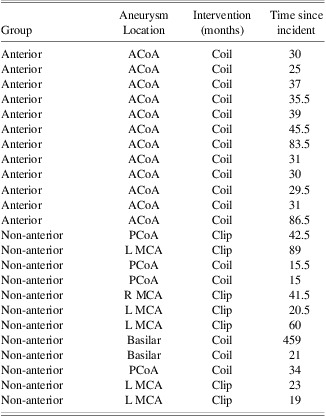
Twenty-four patients with surgically treated SAH (the ruptured aneurysm was treated by neurosurgical clipping or endovascular coiling, Table 1) were recruited from the neurovascular clinic at St. Michael's Hospital. The mean age of the patients was 57.6 years (SE = 1.5; range = 37 to 70 years). Thirteen of the patients were female. All patients had at least ten years of education. Twelve of the patients had ruptures in the anterior communicating artery (ACoA) and 12 had ruptures elsewhere, prominently the middle cerebral artery (MCA; 8) but also the posterior communicating artery (PCoA; 4) and basilar tip (2). The mean time since injury was 55.9 months (SE = 18; range = 15 to 459 months). Patients were grouped as either anterior or non-anterior patients for the purpose of this study. Patients with aneurysms located at or near the ACoA were classified as anterior and aneurysms anywhere posterior to this region were classified as non-anterior. The justification for this grouping is that ACoA ruptures typically inject blood in more anterior regions than MCA, PCoA ruptures and ruptures in the posterior circulation (basilar tip aneurysms). This classification allowed us to look at the effect of blood in anterior versus non-anterior regions of the brain, an important analysis given the importance of anterior/frontal brain regions to particular memory functions.
Characteristics of the 24 SAH patient participants

No patient was clinically amnesic or exhibited gross cognitive disabilities: only five of the 24 participants did not return to work after their aneurysm ruptured. The remaining patients were working part-time, full-time or retired. All patients had a computed tomography (CT) scan or a magnetic resonance imaging (MRI) scan following their admission to the hospital. For each patient participant, the appearance of the hemorrhage was classified according to the modified Fisher Grade based on their admission scan (1 – not evident, 2 – less than 1 mm thick, 3 – more than 1 mm thick, 4 – intraventricular hemorrhage or parenchymal extension; Fisher, Kistler, & Davis, Reference Fisher, Kistler and Davis1980; average = 3.47; SE = 0.2). The severity of the subarachnoid hemorrhage was also graded according to the Hunt and Hess (Reference Hunt and Hess1968) classification (average = 2.5; SE = 0.2).
Twenty-two healthy control participants that were matched for age and education level were recruited from the community via posters and online advertisements (see Table 3 for demographics). Control participants were free from neurological or psychiatric illness.
Participants’ data included in this manuscript was obtained in compliance with the Research Ethics Board at St. Michael's Hospital. Participants received an honorarium for their participation and all participants gave informed consent. Furthermore, all participants were given a short battery of standardized neuropsychological tests (Strauss, Sherman & Spreen, Reference Strauss, Sherman and Spreen2006; Table 3).
Stimuli
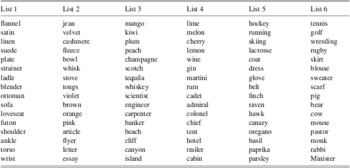
Similar to Turner et al. (Reference Turner, Cipolotti, Yousry and Shallice2007), six 16-word lists were used in this study. Each list contained four words that belonged to one of four categories taken from an updated version of the Battig and Montague (1969) norms (Van Overschelde, Rawson, & Dunlosky, Reference Van Overschelde, Rawson and Dunlosky2004; Table 2). When selecting the words, we excluded the most frequent associates (the first, second, and third) to ensure that one could not rely on prototypical responses and semantic memory. An analysis of variance (ANOVA) revealed no difference between lists (F(1,90) = 1.008; p = .42) in the average normative proportion that the particular word was used in response to its category (Van Overschelde et al., Reference Van Overschelde, Rawson and Dunlosky2004).
Stimuli used for the free recall test

Note. All words were taken from categories from the updated Battig and Montague corpus (Reprinted from the Journal of Memory and Language, 50, Van Overschelde, J.P., Rawson, K.A., & Dunlosky, J., Category norms: An updated and expanded versions of the norms, 289–335, 2004, with permission from Elsevier). Boxed letters denote overlap in categorical words across lists.
Words for the first, third, and fifth list were presented blocked: that is, words from each category were presented together to minimize the need to implement any organizational processes or strategy to encode or retrieve the items. The words in the second, fourth, and sixth list were presented in a random manner so to maximize the need to use organization or strategy to encode or retrieve the items. Deviating slightly from Turner et al. (Reference Turner, Cipolotti, Yousry and Shallice2007), for list two, four, and six, two of the categories used were ones that appeared in the previous list (list one, three, and five, respectively). There was no repetition of words from one list to the other list; rather we used words from the same category to promote intrusions from prior lists and proactive inference (Table 2).
Procedure
For each list, participants were presented with words, one at a time, on the center of the computer screen, for 2 s with a 1-s fixation cross in between each word. Before each list, participants were told to memorize the words on the screen for later recall, but were not told the number of words that they would be given. Directly following the presentation of the last word of the list, a screen came up on the computer that asked participants to count down out loud backward by 3 s from a randomly chosen number that appeared on the screen. They were told to continue to do so until the present screen disappeared. After 30 s of counting backward, the participants were then asked to recall as many words as they could from the previously presented list. They were given as much time as needed. The experimenter recorded the responses. This was repeated for all six lists.
After the task was completed, the experimenter classified each word recalled as either correct, a prior list intrusion (words that were falsely recalled from a prior list: these were not possible for list one) or as a semantic or other intrusions (words that were falsely recalled but did not appear on a previous list; most often these words were categorically related to words appearing on the list). The number of words recalled across all three organized lists and all three unorganized lists was tallied. The number of prior list intrusions and semantic/other intrusions was tallied across all lists for each participant.
Statistical Methods
We first compared the performance on standard neuropsychological tests between the groups (patients with SAH and control participants) using independent t tests.
To examine the results of the experimental memory task, we performed a set of planned between-subject comparisons using ANOVA. Significance was set at p = .05. We compared the number of words recalled across all lists and then for the organized lists and the unorganized lists between patients with SAH and control participants. Patient participants were then divided into those with anterior aneurysms and those with ruptures elsewhere (non-anterior aneurysms) and the number of words recalled in the organized and unorganized list conditions was compared. These analyses were repeated with category recall.
To compare the benefit of list type between patients with different aneurysm locations to control participants, we looked at the individual difference in the number of words recalled for the organized and unorganized lists (done to control for overall differences in words recall).
Similar to Turner et al. (Reference Turner, Cipolotti, Yousry and Shallice2007), we examined the use of organizational strategy when recalling/retrieving words from the lists. To do so, we calculated the number of switches between categories that were made during retrieval. This was done to assess the number of unnecessary switches using the formula from Turner et al. (2007): (# categories switches made - # categories recalled + 1) / (# categories recalled −1). For example, if four categories were recalled, then one only needs to switch three times between categories during recall if using an optimal category clustering strategy. Any additional switches are deemed unnecessary and may represent a more disorganized retrieval strategy.
We also compared the number of intrusions (words that were falsely recalled during list retrieval) between SAH patients and controls, both those from previous lists and those not from a previous list.
Finally, the relation between patient factors, such as a surgical intervention, Hunt and Hess score and Fisher Grade and the words recalled was examined using ANOVA and other factors, such as time since injury, was examined using correlational analyses.
Results
Neuropsychological Tests
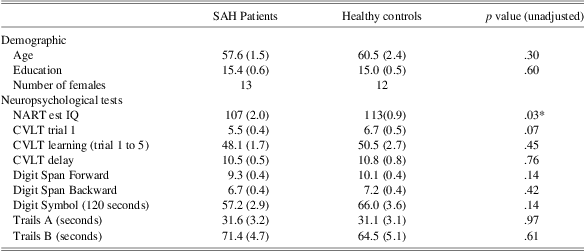
The mean performance of each group (patients with SAH and control participants) on a subset of standardized neuropsychological tests is reported in Table 3.
Demographic characteristics and mean scores (standard errors shown in the parentheses) on neuropsychological tests for SAH patients and healthy control participants.

There was a difference in the estimated premorbid IQ based on the National Adult Reading Test (NART) between healthy controls and patients (F(1,45) = 4.961; p < .05). Given this result, when comparing the patient and the control participant groups for the experimental task, we included estimated IQ scores as a covariate. There were no differences between the groups in the remaining neuropsychological tests (Table 3).
Free Recall Test
Number of recalled words
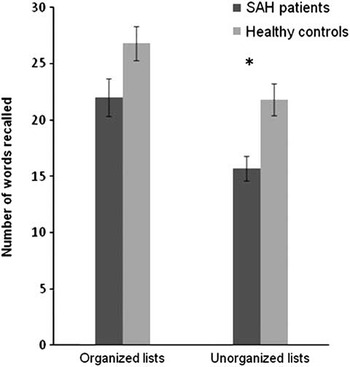
Overall, patients with SAH recalled fewer words compared to control participants (F(2,43) = 4.017; p < .05). Breaking the lists down to those that were organized (categories of words presented in a blocked manner) to those that were unorganized (categories of words presented randomly throughout the list), patients with SAH recalled significantly fewer items for the unorganized lists (F(2,43) = 6.610; p < .005), but did not differ significantly from the control participants in terms of the number of words recalled for the organized lists (F(2,43) = 2.079; p > .10; Figure 1).
The average number of words recalled for the organized and unorganized lists (maximum score = 48 for each condition) for patients with SAH and healthy control participants (standard error bars are shown).

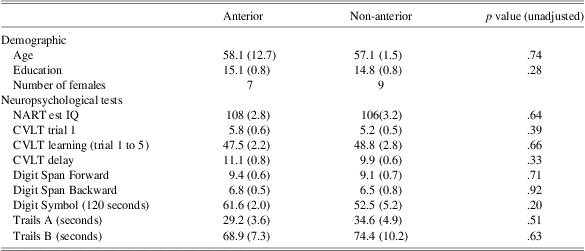
We also examined how aneurysm location affected memory impairment by comparing patients with anterior (ACoA) and those with non-anterior (all others) aneurysms. The patient groups did not differ in terms of sex, age, education level (Table 4), Hunt and Hess Scores (p = .13) nor Fisher grade scores (p = .86), thus any difference we find are likely due to aneurysm location.
Demographic characteristics and mean scores (standard errors shown in the parentheses) on neuropsychological tests for SAH patients with anterior ruptures and those with non-anterior ruptures

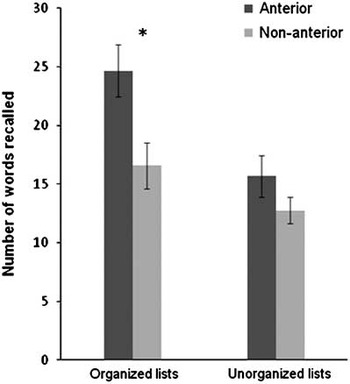
Given that there was no difference in estimated IQ based on the NART between these two patient groups, we did not need to include IQ as a covariate for this analysis. Patients with anterior aneurysms recalled more words for the organized lists compared to those with aneurysms in the non-anterior region (F(1,23) = 7.013; p = .015), but a similar number of words for the unorganized lists (F(1,23) = 1.845; p = .19; Figure 2).
The average number of words recalled for the organized and unorganized lists (maximum score = 48 for each condition) for patients with SAH with aneurysms located in the anterior region of the brain and those with aneurysm located in non-anterior regions of the brain (standard error bars are shown).

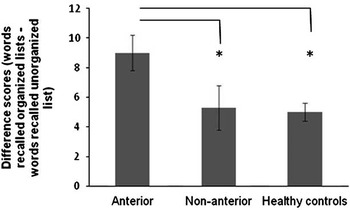
Examining the benefit of list type between patients with different aneurysm locations to control participants, when we compared anterior aneurysm patients and healthy controls, there was a significant difference (F(2,33) = 5.825; p < .005; Figure 3) but this was not the case for the non-anterior aneurysm patients compared to healthy controls (F(2,31) = 0.690; p = .50; Figure 3). This suggests that patients with anterior aneurysms benefited more from the presence of organization in the lists than healthy control participants and non-anterior aneurysm patients. Further supporting this is the finding that non-anterior patients recalled fewer words for both the organized lists (F(2,31) = 5.490; p < .01) as well as the unorganized lists (F(2,31) = 6.184; p = .005) compared to controls, but anterior aneurysm patients only differed from controls for the unorganized lists (unorganized lists: F(2,33) = 3.003; p = .06), organized lists: F(2,33) = 0.432; p = .65).
The average individual difference score (the number of words recalled in the organized list—the number of words recalled in the unorganized lists) for patients with SAH with aneurysms located in the anterior region of the brain, those with aneurysm located in non-anterior regions of the brain and healthy control participants (standard error bars are shown).

Categorical recall
When we examined the number of categories recalled for all patients with SAH and control participants, the same pattern described above emerged. On average, fewer categories were recalled for the SAH patients when they were presented in an unorganized manner (patients mean = 2.6 (SE = 0.1); controls mean = 3.2 (SE = 0.1); F(1,43) = 7.939; p = .007) but a similar number of categories were recalled when presented in an organized, blocked manner (patients mean = 2.5 (SE = 0.2); controls mean = 2.9 (SE = 0.1); F(1,43) = 3.586; p = .07) compared to healthy controls.
Organizational strategy at retrieval
We examined the use of organizational strategy when recalling/retrieving words from the lists by assessing the number of unnecessary switches (see methods). When we calculated the number of unnecessary switches, we found no significant difference between SAH patients and controls made for organized and unorganized lists (patient mean = 2.2, SE = 0.6; control mean = 1.7, SE = 0.3; F(1,45) = 0.670; p = .42).
Intrusions
Patients with SAH erroneously recalled a mean of 2.9 (SE = 0.6) words from a prior list and 2.0 (SE = 0.5) other words across the whole task compared to a mean of 1.3 (SE = 0.3) prior list and 0.9 (SE = 0.2) other word intrusions that were recalled by the control participants (F(2,43) = 3.369; p < .05, controlled for NART estimated IQ scores). For the patients, there were intrusions for both organized and unorganized lists, but there were significantly more present for the unorganized lists (t(23) = 3.153; p = .004), a difference that was not significant for the control participants (t(21) = 0.839; p = .41).
Patient factors: Clip versus coil and neuropsychological measures
Patients treated with clipping or coiling were not significantly different in the number of words recalled (F(1,23) = 0.156; p = .70, F(1,23) = 0.014; p > .90; F(1,23) = 0.093; p = .80 for words recalled in the organized lists, unorganized lists and total recalled, respectively) nor in the number of intrusions made during recall (F(1,23) = 0.057; p = .80). There also was no correlation between the number of words recalled and the time since injury nor was there any significant correlation between free recall scores and Fisher grade or Hunt and Hess scores.
In terms of neuropsychological measures, correlations between the CVLT and the experimental free recall task revealed that in patients, the number of words recalled in the first trial of the CVLT correlated highly with the number of words recalled in the free recall task (r = 0.615; p = 0.002). Learning during the CVLT (sum of trial 1 to 5) or delayed CVLT recall scores did not correlate with free recall (r = 0.255; p > .20; r = 0.147; p > .50, respectively).
Discussion
The current investigation confirms that SAH patients with good clinical recovery and who are functionally independent have long-term deficits in explicit memory. Even though the tested patients with SAH performed similar to a group of age and education matched healthy controls on a series of standard neuropsychological tests, they were impaired at word recall when given a more sensitive, experimental measure of free recall. While these results are in line with previous reports of memory deficits following SAH (Chahal, Barker-Collo, & Feigin, Reference Chahal, Barker-Collo and Feigin2011; Ogden et al., Reference Ogden, Mee and Henning1993; Toomela et al., Reference Toomela, Pulver, Romberg, Orasson, Tikk and Asser2004), our results go further to suggest a specific locus of impairment: Patients with SAH are impaired more when recalling words under conditions that required additional strategic and organizational processes (unorganized lists) and not under conditions for which such additional processes are not required (organized lists). From this, we suggest that SAH predominately affects executive processes associated with explicit memory.
To determine if these impaired executive processes associated with SAH are due to deficits at encoding or retrieval, we looked at organization strategy at retrieval. This was done by looking at the number of switches made between categorical recall—the more unnecessary switches between categories during retrieval is indicative of poorer strategic recall. We did not find a significant difference between SAH patients and control participants in the number of unnecessary switches. Speculating from this, these data suggest that, given that the reported impairments result not from executive deficits at recall, they likely result from less than optimal encoding strategies. That is, impaired strategic or organizational processes during encoding.
Our study also found that patients with SAH reported more intrusions during the free recall test than their matched counterparts. Such findings are in line with recent studies that have found an enhanced susceptibility to some types of false memories following ACoA ruptures (Borsutzky, Fujiwara, Brand, & Markowitsch, Reference Borsutzky, Fujiwara, Brand and Markowitsch2010), but our results extends this executive dysfunction to aneurysmal SAH in general. The increased number of prior word intrusions in patients with SAH is also evidence of proactive interference, an increased susceptibility to prior information (e.g., Shimamura, Reference Shimamura1994). Indeed it could be SAH results in poor proactive interference resolution thought supported by frontal regions that is also the cause of the deficit in recall: a poorer ability to inhibit information may lead to poorer encoding of information. Another possibility is that the increased likelihood of those with SAH to falsely report words during recall, particularly those that are from similar categories, may be the result of more gist based encoding (i.e., encoding words on a broader level).
Neuropsychological Tests
While the result of our study clearly report memory impairment in patients with SAH on an experimental memory task, such impairments were not detected by standard neuropsychological instruments. Patients with SAH did not differ from controls on a series of neuropsychological tests (notably, the California Verbal Learning Task; CVLT) nor was there a relation between performance on these standard tasks and that of the experimental memory measure. While this may be surprising, we take this as evidence that standard tests are likely not sensitive enough to detect subtle memory impairment nor do these tests allow for a more fine-grain examination of affected cognitive processes in populations such as those who have experienced a SAH.
Anterior Versus Non-anterior Aneurysms
Another aim of this investigation was to look at the role of aneurysm location on memory recall. Patients were broadly classified as those with ACoA aneurysm ruptures (anterior) and those with aneurysm ruptures in other locations (non-anterior aneurysms). Using this classification, patients with anterior aneurysm ruptures were impaired only on the free recall task when it stressed organizational and strategic possessing (unorganized lists), but not on the free recall task when it did not require these additional processes (organized lists). Conversely, patients with non-anterior aneurysms were impaired on both lists. These findings are line with reports that ACoA aneurysm ruptures affect executive aspects of memory, such as those needed for recall, but spares other aspects of memory, such as those needed for tests of recognition or organized retrieval (Diamond et al., Reference Diamond, Deluca and Kelley1997; Simard, Rouleau, Brosseau, Laframboise, & Bojanowsky, Reference Simard, Rouleau, Brosseau, Laframboise and Bojanowsky2003).
In terms of neurological function, ACoA aneurysm ruptures often result in direct damage to the orbitofrontal cortex and/or results in disconnection in fronto-temporal circuits (Mavaddat et al., Reference Mavaddat, Kirkpatrick, Rogers and Sahakian2000), which can result in deficits in memory and personality changes (Alexander & Freedman, Reference Alexander and Freedman1984; Wright, Boeve, & Malec, Reference Wright, Boeve and Malec1999). Given that damage from ACoA ruptures is not to the anatomical substrate of mnemonic functioning (the medial temporal lobes) but is that of executive processes, it is expected (and found) that these ruptures will result in more specific impairment on memory tests that require organizational and strategic processing (Bottger, Prosiegel, Steiger, & Yassouridis, Reference Bottger, Prosiegel, Steiger and Yassouridis1998; Diamond et al., Reference Diamond, Deluca and Kelley1997).
Why patients with non-anterior aneurysms (aneurysms that inject blood in more posterior cortical regions than ACoA ruptures) are generally more impaired on this free recall task requires further investigation. One possible reason is that there were more patients treated with surgical clips in the non-anterior patient group, which could have resulted in local brain damage that did not affect those treated with coils (Bellebaum et al., Reference Bellebaum, Schäfers, Schoch, Wanke, Stolke, Forsting and Daum2004). However others have found no effect of surgical intervention on cognitive performance (for example, Frazer, Ahuja, Watkins, & Cipolotti, Reference Frazer, Ahuja, Watkins and Cipolotti2007).
Other possible mechanisms are the focal presence of the subarachnoid blood and related toxic product (Hadjivassiliou et al., Reference Hadjivassiliou, Tooth, Romanowski, Byrne, Battersby, Oxbury and Sagar2001) causing focal damage and/or circulatory arrest from SAH resulting in an environment that damages related watershed areas to the affected vasculature (Grote & Hassler, Reference Grote and Hassler1988). Unlike subarachnoid blood in anterior regions, affecting regions secondary to memory functioning, subarachnoid blood in regions near non-anterior aneurysm ruptures may have an effect on general memory functioning (e.g., Tariq et al., Reference Tariq, Ai, Chen, Sabri, Jeon, Shang and Macdonald2010), perhaps damaging regions of the medial temporal lobes, namely the hippocampus (Bendel et al., Reference Bendel, Koivisto, Hänninen, Kolehmainen, Könönen, Hurskainen and Vanninen2006). Indeed, future investigations are needed to clarify the underlying cause of the presented impairment.
In summary, while the cause of memory deficits is likely diffuse and rests upon the interaction of many factors (Kreiter et al., Reference Kreiter, Copeland, Bernardini, Bates, Peery, Claassen and Mayer2002), we found evidence that one factor that affects the pattern of memory impairment is aneurysm location. Our results suggest a more general deficit in explicit, episodic memory in non-anterior ruptured aneurysm patients and one of strategic encoding in anterior ruptured aneurysm patients (also see Manning et al., Reference Manning, Pierot and Dufour2005).
General Implications
The presented results have implications for how patients who have experienced SAH return to daily living. All patients tested were functionally independent, but may also have a reduced quality of life that could result from memory impairments. Relating the current results to subjective experiences by a SAH patient, one may have more trouble recalling the specifics of a task, especially if information is not presented in an organized manner. Another problem for people after SAH, as illustrated by our findings, could be with competing information and placing events in context, as noted by their increased susceptibility to intruding information. It is often the case that one is presented with interfering information in daily living, such as trying to remember a grocery list while planning when to pick up the dry cleaning, all while listening to a radio program. While speculative, it may be that these memory processes associated with daily living are affected by SAH.
In terms of rehabilitation practices, these results suggest a program that focuses on executive processes and how such processes overlap and interact with memory functioning would be most effective. An example of such a program is Goal Management Training which can help with poor organization use in memory (Levine et al., Reference Levine, Robertson, Clare, Carter, Hong, Wilson and Stuss2000).
Study Limitations
A methodological limitation of the present experiment is the exclusion of more sensitive tests of executive functions and detailed quality of life measures. Future investigations may wish to include such measures to, first, determine if performance on these tests is impaired in patients with SAH and, second, to see if impairment on executive function and assessments of quality of life relates to performance on the experimental measure of memory used in this study. Another limitation of the present study was our small sample size. A goal of future research is to expand on the number of patients with SAH tested so that a more thorough examination of the effect of aneurysm location on memory performance can be done.
Conclusion
While our results are of interest for understanding how neural regions support memory processes, we also believe that our findings have important implications for understanding deficits following SAH and for determining future cognitive rehabilitation programs. From these results, we speculate that rehabilitation programs that emphasize strategic organization of to-be-remembered information and interference resolution may be successful.
Acknowledgments
The information in this manuscript nor this manuscript has not been previously published. The authors would like to thank Andrea Constantinof and Rebecca Metcalfe for help with testing and scoring. This work was supported by funds from the Labatt Family Centre of Excellence and a Personnel Award from the Heart and Stroke Foundation of Canada awarded to T.A.S. No financial or other conflicts of interest affect this manuscript.