Title of show: Caranguejo Overdrive
Producing company: Aquela Cia
Director/playwright: Marco André Nunes/Pedro Kosovski
Music director: Felipe Storino
Installation: Marco André Nunes
Lighting design: Renato Machado
Cast: Carolina Virgüez, Eduardo Speroni, Matheus Macena, Fellipe Marques, Alex Nader
Musicians: Felipe Storino, Mauricio Chiari, Samuel Vieira
Venue, city and date of performance reviewed: SESC Copacabana, Rio de Janeiro, 2015
You can't say that I am the one who speaks; words have little value in the face of strength of appetite, because appetite and words are things that are resolved in the mouth. Words exist for defense so I speak on behalf of an attack and that is what's important here. I speak because I am hungry, for mud mixed with urine, excrement and all types of residues that the high tide brings and in this way days go by where I try to gain weight on the remains of what the city discards.
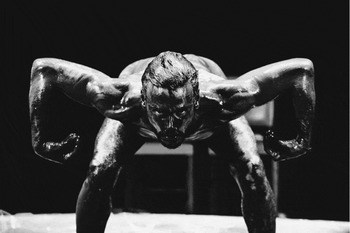
Caranguejo Overdrive. Photographer: Elisa Mendes.

The first words of Caranguejo Overdrive, spoken by ‘a crab who one day had been a man named Cosme’, encapsulate the fundamental principles guiding the work's creation. Based on an unorthodox ingesting of Josué de Castro – the geographer who proved that hunger is not the fruit of any natural disaster, but rather of an unjust social organization – Glauber Rocha, the filmmaker who made hunger not his theme, but the very engine of his aesthetic – and Chico Science, the musician who revived the Baudelairean image of the ‘rag-picker poet’, Oswaldian anthropophagy, and tropicalism – the contemporary figure of the ‘man-crab’ emerges.Footnote 2
In the play his name is Cosme, a crabber born in the São Diogo Mangrove, current-day Cidade Nova (New City), who, when required to go off to a war that is not his, the War with Paraguay (1864–70), witnesses all the horrors of one of the bloodiest episodes in Latin American history and relates them to us. When he returns home, Cosme finds his mangrove silted over and his habitat destroyed. Disoriented and almost mute, he meets a Paraguayan prostitute in Cidade Nova, who ironically agrees to be his guide and gives him an amazing lesson on Brazilian history from the present of the character to that of the spectator. By evoking this episode of an apparently distant past, the text of the performance constructs a sophisticated mechanism for denouncing the gentrification process that the city of Rio de Janeiro is currently experiencing under the pretext of hosting the 2016 Olympic Games.
What this summary of the plot makes plain is, above all, how plot summaries are deceptive. It's as if the performance were saying that in the twentieth century, Brazil was like this, Rio was like this, hunger was like this. It was this way and it still is. It was, it still is, and there is nothing we can do. At most, we can come to the theatre to complain, denounce, be indignant, bang on pots and pans.Footnote 3 And, for a few brief moments, we can feel sorry for the oppressed and angry at the corrupt, so that we can all sleep in peace having paid our pound of flesh.
Nothing is farther from the aim of this newest political theatre. The fact that a history has been one way does not mean that it may not come to be other ways. Yes, Cosme's history is one of the vanquished, of the anonymous, of the voiceless. But, in Caranguejo Overdrive, as opposed to what happened and happens in the official history, this man-crab takes up speech. More than ‘what’ he says, it matters ‘how’ he says what he says.
The direction by Marco André Nunes is of an inventiveness that ought to be celebrated. Besides his emphasis on the overlapping temporal layers and the mixture of narrative forms already present in Pedro Kosovski's text, the direction functions by juxtaposing two performance spaces which together constitute an installation, often requiring the audience to decide which one they want to see. Thus, far beyond the words, the stage relies on the aesthetics of bodies in convulsion, on distinct registers of elocution, on the layers of a sandbox, a map of Brazil, an aquarium full of mud, a white board and a cage of live crabs that are intentionally freed during the performance and brought into the action. The original soundtrack by Felipe Storino and Mauricio Chiari incorporates and makes several references to the electrifying Mangue Beat by Chico Science, cutting across, potentializing and interpreting all of the events.
In this polyphonic disposition of word, music and image, one thing is clear: the complexity of Brazil's history does not allow the comfort of a stable point of view that might be able to encompass everything within a single glance or a single speech. In my view, the new political theatre that acknowledges the impossibility of reductionist diagnostics and of simplistic solutions for today's problems finds a model of unusual succulence in Caranguejo Overdrive.